His own favorite film was Jinnah, in which he played the title role of Pakistan’s ascetic founder. It’s very credible, but it’s not why audiences loved him. Lee redeemed almost anything he was in, but had his work cut out when George Lucas signed him for the Star Wars prequels. By then Lucas was a director without peer when it comes to getting bad performances out of great actors. Once upon a time Ewan McGregor was one of the sexiest actors on the planet. Then George Lucas cast him as Obi-Wan Kenobi, and turned him into a souvenir action-figure with no private parts and a flat monotone voice. As Princess Amidala, Natalie Portman couldn’t be Aniduller. The kid who plays Anakin seems like he should be the shy fellow in the back in some passing boy band but instead his agent stuck him with some lousy movie gig in a language not his own. He and Miss Portman roll in the grass like it’s a contractual obligation. The most fully realized characters are the computer-generated ones, like Yoda, the wrinkly midget with the inverted word order that nevertheless sounds less unnatural than the rest of the inert, stilted dialogue.
But, when it comes to such acting honors as there are in the series, the Empire strikes back! Lee as Count Dooku and Ian McDiarmid as Chancellor Palpatine have the measure of Star Wars: go with the hokum, have some fun doing the standard creepy-snooty Brit bad-guy shtick, and cash the check.
Mark Steyn, “Fangs, Light Sabers and a Supernumary Papilla”, Steyn Online, 2015-06-13.
May 4, 2017
QotD: Christopher Lee in the Star Wars prequels
May 3, 2017
QotD: “Patrick Macnee was a Serious Feminist”
Patrick Macnee
- Refused to model Steed after James Bond because Bond “uses women like battering rams”
- Embraced the concept of a female partner after being cast opposite a male one for a season
- Listened when Honor Blackman began telling him about gender inequality
- Didn’t think that being saved by a woman in any way injured his character’s masculinity
- Consistently gave the women credit for the success of the show
- Recognized that the male producers were chauvinists, and blamed himself for not doing more about it
- Stood up for Linda Thorson when the producers tried to bully her (and was apparently terrifyingly angry about it)
- Was literally the only person on that show that Diana Rigg never said a bad word about
- Consistently talked about being raised by women and viewing women as equal to men
Lauren H. Brooks, “Patrick Macnee was a Serious Feminist”, Kinkiness … and Patrick Mcnee, 2017-04-21.
May 1, 2017
“100% certainty is almost always an indication of a cult rather than any sort of actual truth”
Jay Currie looks at the reaction to a Bret Stephens climate article in the New York Times:
On the science side the greatest threats were the inadequacy of the climate models and the advent of the “hiatus”. The models entirely failed to project any circumstances in which temperature ceased to rise when CO2 continued to rise. However the hiatus created exactly that set of conditions for what is now looking like twenty years. (Right this instant, last year’s El Nino, broke the hiatus. However, rapidly cooling post El Nino temperatures look set to bring the hiatus back into play in the next six months to a year.)
The economic side is even worse. It turns out that renewable energy – windmills and solar – costs a fortune and is profoundly unreliable. Governments which went all in for renewables (see Ontario) found their energy prices hockey sticking and the popularity plummeting without, as it turns out, making even a slight impression on the rise of CO2 concentrations.
The economics of climate change and its “mitigation” are a shambles. And it is beginning to dawn on assorted politicians that they might have been railroaded with science which was not quite ready for prime time.
Which makes it all the more imperative for the Nuccitelli and DeSmog blogs of this world to redouble their attacks on even mildly sceptical positions. Had the alarmists been less certain their edifice could have easily withstood a recalibration of the science and a recalculation of the cost/benefits. But they weren’t. They went all in for a position which claimed to know for certain that CO2 was driving world temperature and that there was no other possible cause for an increase or decrease in that temperature.
The problem with that position is that it was premature and very brittle. As lower sensitivity estimates emerge, as other, non-CO2 driven, temperature controls are discovered, consensus climate science becomes more and more embattled. What had looked like a monopoly on political discourse and media comment begins to fray. The advent of Trump and a merry band of climate change skeptics in the regulatory agencies and in Congress, has pretty much killed any forward motion for the climate alarmists in the US. And the US is where this battle will be won or lost. However, the sheer cost of so called “carbon reduction” schemes in the UK, Germany and the rest of Europe has been staggering and has shown next to no actual benefit so scepticism is rising there too. China has both embarked on an embrace of climate change abatement and the construction of dozens of coal fired electrical generation plants every year.
QotD: How to negotiate badly (unless you’re in a movie)
Does the [Republican congressional] caucus nominate a leader who will be itching for more such fights? This would be bad for America’s already dilapidated political institutions and civil society. It would also, I must point out, be bad for the Republican Party, which still shows lingering signs of infection by the dreaded “Ask for the Stars, You’ll Get the Moon” bargaining strategy. (Ever notice that’s so beloved by Hollywood, and by almost no one who actually has to negotiate deals for a living?)
The idea behind this is that you will eventually settle for something about halfway between your initial demands, and what the other side is asking for. The winning strategy is therefore to ask for enormous concessions, include unrealistic demands as bargaining chips, and convince the other side that you’re just crazy enough to walk away if they won’t make a deal.
As it happens, we have just had a demonstration of this technique — a live drama, no Hollywood effects: Greek Prime Minister Alexis Tsipras tried it with the EU. This strategy worked so well that he ended up with a worse deal than the original offer, plus a banking crisis that is still unspooling. Somehow, this never happens in Hollywood movies.
It’s easy to see why Hollywood loves this strategy: It’s really easy to explain without chewing up screen time, and it’s dramatic. Why don’t real-world negotiators more often do this?
Megan McArdle, “Let’s See What Republicans Learn From Losing Boehner”, Bloomberg View, 2015-09-25.
April 30, 2017
[p-hacking] “is one of the many questionable research practices responsible for the replication crisis in the social sciences”
What happens when someone digs into the statistics of highly influential health studies and discovers oddities? We’re in the process of finding out in the case of “rockstar researcher” Brian Wansink and several of his studies under the statistical microscope:
Things began to go bad late last year when Wansink posted some advice for grad students on his blog. The post, which has subsequently been removed (although a cached copy is available), described a grad student who, on Wansink’s instruction, had delved into a data set to look for interesting results. The data came from a study that had sold people coupons for an all-you-can-eat buffet. One group had paid $4 for the coupon, and the other group had paid $8.
The hypothesis had been that people would eat more if they had paid more, but the study had not found that result. That’s not necessarily a bad thing. In fact, publishing null results like these is important — failure to do so leads to publication bias, which can lead to a skewed public record that shows (for example) three successful tests of a hypothesis but not the 18 failed ones. But instead of publishing the null result, Wansink wanted to get something more out of the data.
“When [the grad student] arrived,” Wansink wrote, “I gave her a data set of a self-funded, failed study which had null results… I said, ‘This cost us a lot of time and our own money to collect. There’s got to be something here we can salvage because it’s a cool (rich & unique) data set.’ I had three ideas for potential Plan B, C, & D directions (since Plan A had failed).”
The responses to Wansink’s blog post from other researchers were incredulous, because this kind of data analysis is considered an incredibly bad idea. As this very famous xkcd strip explains, trawling through data, running lots of statistical tests, and looking only for significant results is bound to turn up some false positives. This practice of “p-hacking” — hunting for significant p-values in statistical analyses — is one of the many questionable research practices responsible for the replication crisis in the social sciences.
H/T to Kate at Small Dead Animals for the link.
QotD: Famous for being famous
Every country that has television, which is all of them, must have celebrities who are famous for almost nothing. The U.K. practically specializes in this. But the “almost” is important. Even the weird layer of U.K. celebrity that subsists on the old country’s old-fashioned panel and reality shows normally tends to demand that a celeb have been a member of Parliament or received a surgically enhanced bosom. If possible, both.
Colby Cosh, “On the ignominious downfall of Jared from Subway”, National Post, 2015-08-20.
April 28, 2017
Words & Numbers: Actually, Life is Pretty Awesome
Published on 26 Apr 2017
This week, James and Antony take a brief departure from talking about the growing national debt, and our absurd tax system to discuss the numerous ways in which more economic and personal freedom has made people wealthier, more equal, and better off all over the world. We’re actually living in pretty amazing times.
Read more:
https://fee.org/articles/actually-life-is-pretty-awesome/
April 27, 2017
Our Channel And The YouTube Adpocalypse I THE GREAT WAR
Published on 26 Apr 2017
Our Patreon: http://patreon.com/thegreatwar
Our Merch Store: https://shop.spreadshirt.net/thegreatwar/A good explanation how YouTube Ads work by CGP Grey: https://www.youtube.com/watch?v=KW0eUrUiyxo
In light of the news surrounding YouTube and their ad policy we got a lot of comments asking how and if all this affects our show and production. We want to make a few things clear and also underline how you can support us.
» HOW CAN I SUPPORT YOUR CHANNEL?
You can support us by sharing our videos with your friends and spreading the word about our work.You can also support us financially on Patreon: https://www.patreon.com/thegreatwarYou can also buy our merchandise in our online shop: http://shop.spreadshirt.de/thegreatwar/
Patreon is a platform for creators like us, that enables us to get monthly financial support from the community in exchange for cool perks.
“Richard Florida has a new book [that] advises cities on what to do about problems that result from advice he gave them in his previous books”
Chris Selley hits this one out of the ballpark:
Gadabout urbanist Richard Florida has a new book: The New Urban Crisis. It advises cities on what to do about problems that result from advice he gave them in his previous books, notably The Rise of the Creative Class. Stuff your downtown core full of creative types and you shall prosper, the University of Toronto professor advised, and many cities listened. Now some face a “crisis of their own success,” he told a Toronto breakfast crowd at the Urban Land Institute’s Electric Cities Symposium: the blue-collar types who make the creative class’s artisanal baked goods and mind their children have been “pushed” ever further into the suburbs. Economic and geographic inequality results, and Rob Ford/Donald Trump/Brexit-style resentment can build.
Florida’s many critics have long warned this was a flaw in his vision. But now Florida says he finds it “terrifying,” so he’s off on another book tour.
If I sound a bit peevish, it’s because I find him rather insufferable. Critics have poked holes in much of his research, but much more of it strikes me as overly complex analysis and measurement of fairly basic, intuitive phenomena that are common to dynamic and not-so-dynamic cities. While the remarkable urban revivals in recent decades in New York and Pittsburgh, and nascent ones in Detroit and Newark, are all very interesting, I’ve never understood what they have to teach us about Canadian cities. Their cores never “hollowed out” in the first place, necessitating wholesale renewal. When I listen to Florida talk, I hear Lyle Lanley trying to sell Springfield a monorail.
In any event, his prescriptions for the GTA are not exactly visionary: more transit, more affordable housing, densification over NIMBYism and more decision-making autonomy for cities. “The key today is shifting power from provinces to cities,” Florida writes in a Canadian-focused paper linked to the new book. That made it all the more galling to watch his post-speech “fireside chat” with Ontario Premier Kathleen Wynne, whose tires he pumped well beyond their recommended PSI.
“You know this. It’s in your blood,” Florida gushed of her urbanist bona fides.
Well, let’s see. Wynne can certainly claim to have committed many billions in taxpayer money to transit projects. But if there were awards for NIMBYism, Wynne would have one for the nine-figure cancellation of two unpopular gas-fired power plants, during an election campaign of which she was co-chair; and perhaps another for her party’s shameless politicking on transit in Scarborough.
April 26, 2017
QotD: The modern vice is “ostentatious class disdain”
Yet Another Example… of our current practice of making important policy decisions based upon little except the learned habit of ostentatious class disdain.
You notice that at this late date, with a major policy campaign against the dreaded Semi. Automatic. Weapon., that most of these guys still haven’t bothered to discover what a semi-automatic is?
That’s a learned habit. They are signalling to other members of their class (or the class they aspire to) that they consider such knowledge base, the sort of thing known by the dirty callous-handed illiterates of the rabble and certainly not by the Lords of Intellect.
I mean, it’s like a recipe for ‘Possum Stew. To even know the thing would reduce you in status. Knowledge about guns is something the lower classes have; the criminal class, the agrarian workers (the peasantry), the lesser Servitor Classes of policemen and armed guards and military betas.
What could possibly explain such ignorance at this point, except a calculated, learned ignorance of the habits of one’s putative lessers?
Ace, “The Unburstable Bubble of Willful Ignorance of the International Self-Purported Elites”, Ace of Spades H.Q., 2013-01-09.
April 25, 2017
Cultural appropriation of “poverty culture” in the Tiny House Movement
Ann Althouse linked to this older article by July Westhale on “Poverty Appropriation”:
How many folks, I wonder, who have engaged in the Tiny House Movement have ever actually lived in a tiny, mobile place? Because what those who can afford homes call “living light,” poor folks call “gratitude for what we’ve got.”
And it’s not just the Tiny House Movement that incites my discontent. From dumpster diving to trailer-themed bars to haute cuisine in the form of poor-household staples, it’s become trendy for those with money to appropriate the poverty lifestyle — and it troubles me for one simple reason. Choice.
The Tiny House Movement began in the ’90s, but has only been rising in popularity since the recession. And to be fair, it’s rooted in a very real problem: more and more people being displaced as a result of soaring housing costs, especially in tech-boom areas like the Bay Area.
[…]
It’s likely, from where I sit, that this back-to-nature and boxed-up simplicity is not being marketed to people like me, who come from simplicity and heightened knowledge of poverty, but to people who have not wanted for creature comforts. For them to try on, glamorize, identify with.
Such appropriation isn’t limited to the Tiny House trend, or even to the idea of simplicity. In major cities, people who come from high-income backgrounds flock to bars and restaurants that both appropriate, and mock, low-income communities. Perhaps the most egregious example is San Francisco’s Butter Bar, a trendy outpost that prides itself on being a true-blue, trailer park-themed bar, serving up the best in “trashy” cuisine and cocktails. With tater tots, microwaved food, and deep-fried Twinkies on the menu, the bar also serves cocktails that contain cheap ingredients, such as Welch’s grape soda. The bar has an actual trailer inside, and serves cans in paper bags, so that bar flies can have a paid-for experience of being what the owners of this bar think of when they think of trailer trash.
Butter Bar in San Francisco (Credit: Facebook)
It’s but one example of an entire hipster movement — can it be called a movement when it’s a subculture rooted not in political consciousness, but in capitalism? — that has brought with it an ethos of poor-culture appropriation and the “re-invention” of things that have largely been tools of survival for poor, disabled, working class, and/or communities of color for decades.

April 24, 2017
Today’s study in “problematic” issues for Teen Vogue
Amy Alkon fisks a recent Teen Vogue piece on soi-disant “cultural appropriation”:
Silly Teen Vogue-ers, Fashion *Is* Appropriation
This bit — from Teen Vogue — is hilariously sad and sadly hilarious:
In our new column Don’t Do It Girl, Jessica Andrews explores the cultural appropriation epidemic at Coachella.
EPIDEMIC! Like AIDS, Zika, or Ebola!
Fashion always has been about appropriation. Appropriating style and appropriating culture. Those lace-up-the-ankle sandals? Ancient Rome!
Yet, do you see Italian kids mewling that you stole their culture? Of course not, because Italians, generally speaking, are exuberant people who really know how to live life.
Meanwhile, back here in America…
The kids growing up now, especially in the United States, are the freest people in human history — both as individuals and through the technology that removes the drudgery that’s been a constant companion for humans throughout the ages.
Naturally, their response to all this unparalleled freedom is to try to control other people’s behavior.
Fashion policing, in this case. Here, from Andrews story on that EPIDEMIC of appreciation:
Even when people feign ignorance, there’s little excuse. In the past, I’ve worn a Pocahontas costume for Halloween. It’s a mistake I regret, and I’ll never do it again knowing how hurtful it is.
Oh, please. I grew up Jewish. If you pretend to be a character from Fiddler on the Roof, should I take to bed and cry for a few days?
With appropriation being such a huge conversation these days…
So much talk…so little reasoning
Like fashion, appropriative hairstyles are now ubiquitous at Coachella. Cornrows or box braids are not a “hot new festival trend”; black women have been wearing them for centuries. When outlets cover the hairstyle as if it started with Kylie Jenner, it’s not appreciation; it’s erasure. Those celebratory headlines are yet another reminder that black hairstyles are only acceptable when they’re removed from actual black people.
Do you need to be high to write for Teen Vogue? It’s a fucking hairstyle. Women wear it because they think it will look good on them. If they’re white with dark hair, they’re probably wrong (nothing like rows of scalpage showing through to make a woman’s head remind us of freshly plowed fields). Women with big honking faces like mine don’t look so hot in them, either.
Unbeknownst to some Coachella attendees, there’s a stigma associated with cornrows and braids when black people wear them.
Unbeknownst to a fucking lot of us, I’d guess.
April 23, 2017
The Real Reason We Never Hear From Monty Python Anymore
Published on 20 Apr 2017
The legendary comedy group Monty Python was once a force of nature, influencing everything that came after them with their surreal, absurdist approach to comedy. So, why don’t we hear from them anymore? When Graham Chapman ceased to be in 1989, fellow Python member Terry Jones described it as “the worst case of party-pooping [he’d] ever seen.” His death came the day before Python’s 20th anniversary, and what followed was a bizarre but fitting eulogy, written to pay tribute to the man who’d written a dead parrot into one of the troupe’s most famous sketches. Chapman becoming an ex-person seemed to put a damper on any kind of authentic reunion, but what about the others? What happened to the late, great Monty Python?
Terry Jones’s illness | 0:44
Michael Palin’s travel shows | 1:54
John Cleese’s purism | 3:01
Terry Gilliam’s moved on | 4:13
Eric Idle’s Broadway ambitions | 5:06
They want to finish on a good note | 6:02Read more here → http://www.grunge.com/53323/never-hear-monty-python-anymore-2/
April 22, 2017
Movie on the Armenian Genocide attracts massive number of Turkish trolls
One of the worst aspects of the First World War was the attempt by Ottoman forces to eliminate the Armenian “threat” by launching an organized campaign of murder and deportation that killed an estimated 1.5 million Armenians. A new movie which is set in this time has been drawing trollish attention from Turkish detractors:
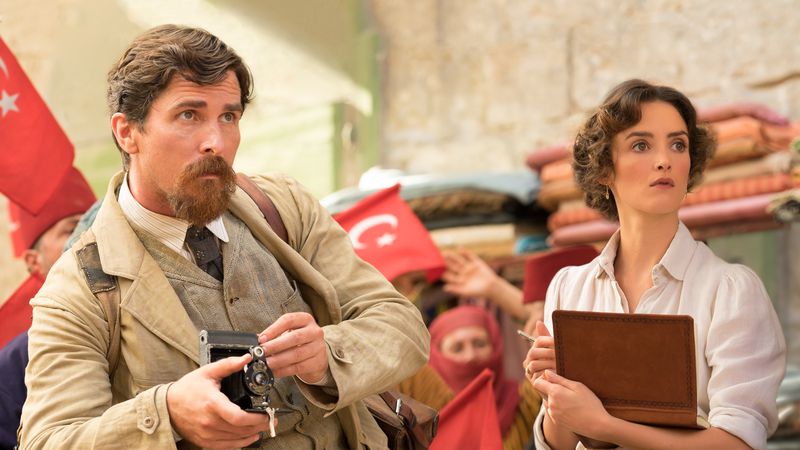
The Promise, the grandest big-screen portrayal ever made about the mass killings of Armenians during World War I, has been rated by more than 111,300 people on IMDb — a remarkable total considering it doesn’t open in theaters until Friday and has thus far been screened only a handful of times publicly.
The passionate reaction is because The Promise, a $100-million movie starring Oscar Isaac and Christian Bale, has provoked those who deny that 1.5 million Armenians were massacred between 1915 and 1923 by the Ottoman Empire or that the deaths of Armenians were the result of a policy of genocide. Thousands, many of them in Turkey, have flocked to IMDb to rate the film poorly, sight unseen. Though many countries and most historians call the mass killings genocide, Turkey has aggressively refused that label.
Yet that wasn’t the most audacious sabotage of The Promise, a passion project of the late billionaire investor and former MGM owner Kirk Kerkorian.
In March, just a few weeks before The Promise was to open, a curiously similar-looking film called The Ottoman Lieutenant appeared. Another sweeping romance set during the same era and with a few stars of its own, including Ben Kingsley and Josh Hartnett, The Ottoman Lieutenant seemed designed to be confused with The Promise. But it was made by Turkish producers and instead broadcast Turkey’s version of the events — that the Armenians were merely collateral damage in World War I. It was the Turkish knockoff version of The Promise, minus the genocide.
“It was like a reverse mirror image of us,” said Terry George, director and co-writer of The Promise. George, the Irish filmmaker, has some experience in navigating the sensitivities around genocide having previously written and directed 2004’s Hotel Rwanda, about the early ’90s Rwandan genocide.
George bought a ticket to see it. “Basically the argument is the Turkish government’s argument, that there was an uprising and it was bad and we had to move these people out of the war zone — which, if applied to the Nazis in Poland would be: ‘Oh, there was an uprising in the Warsaw Ghetto and we need to move these Jews out of the war zone,’” says George. “The film is remarkably similar in terms of structure and look, even.”
The movie itself, however, didn’t win over A.V. Club critic Ignatiy Vishnevetsky:
Among the many virtues of James Gray’s The Lost City Of Z is its sense of proportion, which turns a decades-spanning historical epic into a pas de deux between vision and madness. Unfortunately, most recent historical epics have been more on the order of Terry George’s The Promise: messes of soap and cheese. Here at last is a film that tackles the Armenian genocide by way of a flimsy love triangle and an international cast (it really captures the diversity of the Armenian people), straining so hard to show its good intentions that it doesn’t bother to be directed. What does a movie that can’t even mount a competent horse chase — despite repeated attempts — have to say about the murder of 1.5 million people? At least George can rest easy knowing that his film is less bungled than Bitter Harvest, the February release that turned the Holodomor into the stuff of schmaltz. Up next, presumably, is Nicholas Sparks’ Auschwitz.
Doing his best impression of Omar Sharif, Oscar Isaac stars as Mikael Boghosian, a village apothecary who agrees to marry doe-eyed local girl Maral (Angela Sarafyan) in order to use her dowry to finance his dream of becoming a doctor. (Pity poor Maral, as no two members of the cast seem to agree on how to pronounce her name.) Arriving in Constantinople, the capital of the Ottoman Empire, Mikael moves in with his wealthy uncle and enrolls in medical school, but soon develops a crush on Ana (Charlotte Le Bon), the modern young woman who tutors his uncle’s children. But it’s 1914, and the Ottoman Empire is about to enter World War I as an ally of Germany and Austria-Hungary and within months will begin a strategic elimination of its large Armenian minority. As if to make matters worse, Ana has an American boyfriend, Chris Myers (Christian Bale), the Associated Press’ bureau chief of Armenian genocide exposition.
Still from The Promise, by Open Road Films.