Quotulatiousness

January 29, 2020

Charles Stross on “reality” TV

Filed under: Media — Tags: , , — Nicholas @ 05:00

I don’t watch much TV at all … after catching the Superbowl on Sunday, I may not turn on the TV until the NFL preseason gets underway in the summer, so my impressions of reality TV offerings are gathered second- or third-hand at best. That said, I do recall watching some very early reality TV in the late 80s or early 90s (the one that comes to mind was something like “take a bunch of urban Brits and dump them in a recreated iron age village”). As Charles Stross describes the current crop of shows, I’m very confident that I’ve missed absolutely nothing over the decades:

I watch as little television as I can, and most of it by accident.

Whenever I do catch an eyeful, it usually consists of one of three things: a talking heads news channel, organized sportsball, or a Reality TV show. The first I try to ignore (they’re usually triangulated on the tabloid newspapers with added eye candy, then dumbed down: as information sources this century, TV news channels are useless). The sportsball I leave to my spouse (who is prone to lecturing me interminably about Manchester City). But the latter phenomenon — Reality TV — has all the grisly attention-grabbing potential of a flaming school bus careening out of control into a public execution: I basically have to leave the room in a hurry to avoid having my eyeballs sucked right out of my head by the visual media equivalent of internet clickbait.

What makes Reality TV shows so addictive?

The sector is dominated by a couple of competing recipes. As in so many mature markets, there’s an 80/20 split between a dominant incumbent and an insurgent that isn’t quite successful enough to overturn a monopoly but is too tenacious to die. Think Android/iPhone, or car/pick-up truck (that latter died about a decade ago in the US).

In the case of rTV shows, the 20% insurgent is about people demonstrating competence. Mythbusters was the classic competence-porn show (although it deteriorated into the explosion-of-the-week club after a few seasons): using science!!! and workshop/lab work to evaluate the plausibility of urban legends. Other competence rTV shows include: a team of dudes acquire a car wreck and restore it to good-as-new condition, a former special forces soldier/scout troop leader is dumped on a desert island and demonstrates survival skills, and so on.

But the other 80% of rTV shows are incompetence porn.

Incompetence porn Reality TV, as pioneered by Big Brother, usually aims to get the audience to laugh at or mock the participants in a contest designed to plumb the depths of humiliation. Instead of dropping a fit expedition leader on a desert island, the show dumps a bunch of washed-up B-list celebs in a wilderness of mosquitos and no soft toilet paper. Or perhaps it’s a bunch of Armani-suited sociopaths in a boardroom where they’re expected to pitch business start-up proposals at a washed-up B-list business celeb like Alan Sugar (or, in the American version of The Apprentice, a certain mobbed-up New York property speculator with shady Russian banking connections). Back-stabbing is a given in the celebrity/sociopath driven variant of rTV, as incompetent contestants are shoved out of the show at every episode until only the most obliviously egocentric remains.

(Note that the survivor selection criterion isn’t “competence”, be it at wilderness survival or boardroom brown-nosing: it’s entertainment value. Because these shows, despite the name, aren’t about reality, they’re showbiz.)

But these aren’t the worst.

Patton | Based on a True Story

Filed under: History, Media, Military, USA, WW2 — Tags: , , , , , , — Nicholas @ 04:00

The Cynical Historian
Published 30 Aug 2018

It’s finally time to review Patton! I have a lot to say about it, as you can tell by the time stamp. Way back when I started the Based on a True Story series, the second episode was a bit about what I considered to be the best ones — and this movie was at the top. I love this film, but for more reasons than most of you could know — so this is going to be a deep dive into the film and its subject matter. It’s ambiguous, narrowed in subject, and just a perfect examination of the man. As the New Yorker said during the movie’s release, “[Patton] appears to be deliberately planned as a Rorschach test.”
————————————————————
references:
Brian Sobel and George S. Patton IV, The Fighting Pattons (Westport: Praeger Publishing, 1997). https://amzn.to/2u2WI57

MacMillan Compendium, America at War (New York: Macmillan Library Reference, 1994), 726-727. https://amzn.to/2m6o4mx

John Keegan and Andrew Wheatcroft, Who’s Who in Military History: from 1453 to the Present Day, (London: Routledge, 1996), 231-232. https://amzn.to/2KWv53M

Paul Fussell, “Patton”, in Past Imperfect: History According to the Movies, ed. Mark Carnes (New York: Henry Holt and Company, 1996). https://amzn.to/2J5iGc7

Jonathan Vankin and John Whalen, Based on a True Story: Fact and Fantasy in 100 Favorite Movies, (Chicago: A Cappella Books, 2005), 269-272. https://amzn.to/2m2sSZQ

Frank Sanello, Reel v. Real: How Hollywood Turns Fact into Fiction (Lanham: Taylor Trade Publishing, 2003), 177-181. https://amzn.to/2N072BB

http://www.historynet.com/patton-film…

https://dailyhistory.org/How_accurate…

http://jbell2ja.umwblogs.org/history-…

https://www.theguardian.com/film/2008…

https://www.moviemistakes.com/film960

Special thanks to my mom, dad, and uncle for making sure this was accurate and providing media for the end bit, especially my father (Mark Hall-Patton), who proofread the script as well.
————————————————————
Support the channel through Patreon:
https://www.patreon.com/CynicalHistorian
or pick up some merchandise at SpreadShirt:
https://shop.spreadshirt.com/cynicalh…

LET’S CONNECT:
https://discord.gg/Ukthk4U
https://twitter.com/Cynical_History
————————————————————
Wiki:
Patton is a 1970 American epic biographical DeLuxe Color war film about U.S. General George S. Patton during World War II. It stars George C. Scott, Karl Malden, Michael Bates and Karl Michael Vogler. It was directed by Franklin J. Schaffner from a script by Francis Ford Coppola and Edmund H. North, who based their screenplay on the biography Patton: Ordeal and Triumph by Ladislas Farago and Omar Bradley’s memoir A Soldier’s Story. The film was shot in 65 mm Dimension 150 by cinematographer Fred J. Koenekamp and has a music score by Jerry Goldsmith.

Patton won seven Academy Awards, including Best Picture, Best Director and Best Original Screenplay. Scott won Best Actor for his portrayal of General Patton, but declined to accept the award. The opening monologue, delivered by George C. Scott as General Patton with an enormous American flag behind him, remains an iconic and often quoted image in film. The film was successful, and in 2003, Patton was selected for preservation in the United States National Film Registry by the Library of Congress as being “culturally, historically or aesthetically significant”. The Academy Film Archive preserved Patton in 2003.
————————————————————
#History #Patton #Review #Accuracy #GeneralPatton

“CanCon” rules for internet streaming services will be “inevitable”

Filed under: Business, Cancon, Government, Media — Tags: , , , , , — Nicholas @ 03:00

Yes, the federal government is serious about extending the moronic “Canadian content” regime to internet streaming companies (like Netflix). Canadians are too blind to be allowed to select all of their own viewing without the paternal hand of government jiggling those choices in a politically desired direction, as Michael Geist explains:

Later this week, a government appointed panel tasked with reviewing Canada’s broadcast and telecommunications laws is likely to recommend new regulations for internet streaming companies such as Netflix, Disney, and Amazon that will include mandated contributions to support Canadian film and television production. In fact, even if the panel stops short of that approach, Canadian Heritage Minister Steven Guilbeault and Canadian Radio-television and Telecommunications Commission chair Ian Scott have both signalled their support for new rules with Mr. Guilbeault recently promising legislation by year-end and Mr. Scott calling it inevitable.

My Globe and Mail op-ed notes that the new internet regulations are popular among cultural lobby groups, but their need rests on a shaky policy foundation as many concerns with the fast-evolving sector have proved unfounded.

[…]

Third, the not-so-secret reality of the Canadian system is that foreign location and service production and Canadian content are frequently indistinguishable. Qualifying as Canadian requires having a Canadian producer along with meeting a strict point system that rewards granting roles such as the director, screenwriter, lead actors, and music composer to Canadians.

Yet this is a poor proxy for “telling our stories”. The rules mean foreign companies can never produce Canadian content leading to the absurd outcome that revivals of Canadian programs such as Trailer Park Boys and Degrassi will not meet the qualification requirements if Netflix is the sole funder and producer. Moreover, programs such as The Handmaid’s Tale may be based on a Margaret Atwood novel, but using one of Canada’s best known novelists as the source doesn’t count in the Canadian points system.

So what is Canadian? A quick scan of Canadian Audio-Visual Certification Office data turns up Blood and Fury: America’s Civil War, The Kennedys, Murder in Paradise, Natural Born Outlaws, Who Killed Ghandi?, and dozens of other programs that are Canadian in regulation-only. Further, there are also “co-productions”, in which treaty agreements deem predominantly foreign productions such as The Borgias or Vikings as Canadian.

January 27, 2020

QotD: The radicalization of the Republican Party

Filed under: Media, Politics, Quotations, USA — Tags: , , , , , — Nicholas @ 01:00

When the Democrats ran the House of Representatives for almost all of six decades, before 1995, they did not treat the Republican minority particularly well. So I can understand Newt Gingrich’s desire for revenge when he took over as Speaker of the House in 1995. But many of the changes he made polarized the Congress, made bipartisan cooperation more difficult, and took us into a new era of outrage and conflict in Washington. One change stands out to me, speaking as a social psychologist: he changed the legislative calendar so that all business was done Tuesday through Thursday, and he encouraged his incoming freshmen not to move to the District. He did not want them to develop personal friendships with Democrats. He did not want their spouses to serve on the same charitable boards. But personal relationships among legislators and their families in Washington had long been a massive centripetal force. Gingrich deliberately weakened it.

And this all happened along with the rise of Fox News. Many political scientists have noted that Fox News and the right-wing media ecosystem had an effect on the Republican Party that is unlike anything that happened on the left. It rewards more extreme statements, more grandstanding, more outrage. Many people will point out that the media leans left overall, and that the Democrats did some polarizing things, too. Fair enough. But it is clear that Gingrich set out to create a more partisan, zero-sum Congress, and he succeeded. This more combative culture then filtered up to the Senate, and out to the rest of the Republican Party.

Jonathan Haidt, “The Age of Outrage: What the current political climate is doing to our country and our universities”, City Journal, 2017-12-17.

January 24, 2020

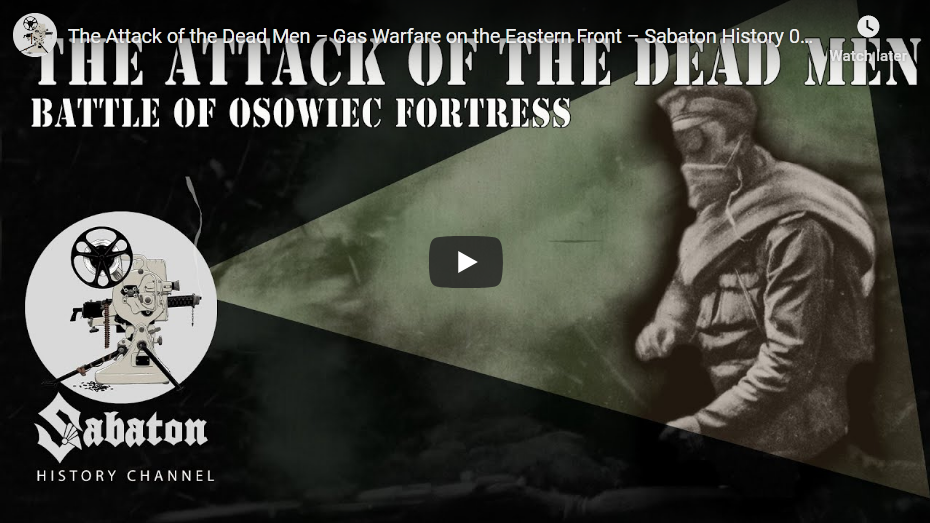
“The Attack of the Dead Men” – Gas Warfare on the Eastern Front – Sabaton History 051 [Official]

Filed under: Germany, History, Media, Military, Russia, WW1 — Tags: , , , — Nicholas @ 04:00

Sabaton History
Published 23 Jan 2020

This episode is about the “Attack of the Dead Men”. During the third battle for Osowiec Fortress in July 1915 during the Great War, German artillery was bombarding the defending Russian soldiers with a new deadly weapon: Poison Gas. The fatal mixture of chlorine and bromine descended like a green fog over the Russian trenches. Without adequate gas-masks to protect themselves, the defenders were believed to all have died in agony. However, as the German infantry advanced, they did not only march right into a Russian counterattack but also encountered the dead, seemingly rising from their graves.

Support Sabaton History on Patreon: https://www.patreon.com/sabatonhistory

Listen to The Great War (where “The Attack of the Dead Men” is featured):
CD: http://nblast.de/SabatonTheGreatWar
Spotify: https://sabat.one/TheGreatWarSpotify
Apple Music: https://sabat.one/TheGreatWarAppleMusic
iTunes: https://sabat.one/TheGreatWarItunes
Amazon: https://sabat.one/TheGreatWarAmazon
Google Play: https://sabat.one/TheGreatWarGooglePlay

Check out the trailer for Sabaton’s new album The Great War right here: https://www.youtube.com/watch?v=HCZP1…

Listen to Sabaton on Spotify: http://smarturl.it/SabatonSpotify
Official Sabaton Merchandise Shop: http://bit.ly/SabatonOfficialShop

Hosted by: Indy Neidell
Written by: Markus Linke and Indy Neidell
Directed by: Astrid Deinhard and Wieke Kapteijns
Produced by: Pär Sundström, Astrid Deinhard and Spartacus Olsson
Creative Producer: Joram Appel
Executive Producers: Pär Sundström, Joakim Broden, Tomas Sunmo, Indy Neidell, Astrid Deinhard, and Spartacus Olsson
Post-Production Director: Wieke Kapteijns
Edited by: Iryna Dulka
Sound Editing by: Marek Kaminski
Maps by: Eastory – https://www.youtube.com/c/eastory

Archive by: Reuters/Screenocean https://www.screenocean.com
Music by Sabaton.

Sources:
– IWM: Q 78100, Q 86635
– The New York Public Library
– Narodowe Archiwum Cyfrowe

An OnLion Entertainment GmbH and Raging Beaver Publishing AB co-Production.

© Raging Beaver Publishing AB, 2019 – all rights reserved.

“Sorry, Boomers. Just because you’ve been told your entire lives that you’re killing the planet, that doesn’t mean it’s true”

Filed under: History, Media, Politics — Tags: , , — Nicholas @ 03:00

Talk about a golden oldie! Does anyone else remember the portentious “Doomsday Clock”? It was devised shortly after WW2 as a handy visual and rhetorical prop for various unilateral disarmament, Soviet agitprop, and general anti-Western civilization groups to use. It’s apparently still being used to pretend we’re facing yet another potentially world-ending crisis:

Remember the Doomsday Clock? It’s a symbolic clock created by a group of scientists in the 1940s, supposedly indicating how close the human race is getting to Armageddon. Originally the clock was set to seven minutes to midnight, and when the clock strikes 12, we’re all dead. That’s the idea, anyway. This corny propaganda tool reached its pop-culture zenith in the ’80s, when everybody from Midnight Oil and Iron Maiden and Sting to DC Comics’ Watchmen were predicting catastrophe by referencing the Doomsday Clock. People love to be scared about the end of the world, and a lot of artists made a lot of money by exploiting that. Nobody ever lost a buck fearmongering.

But you’re reading this right now, which means we’re all still here. Doomsday hasn’t come. So of course, that must mean … it’s just that much closer!

[…]

And this means as much as it’s meant for the past 70-odd years: nothing. Real clocks are instruments of science; the Doomsday Clock is an instrument of the arbitrary whims of some scientists. It might as well be the Doomsday Dartboard. Do you really think we’re any closer to planetary doom than we were during the Cuban Missile Crisis, or the Chernobyl disaster, or the premiere of MTV’s The Real World? You’ve got all those brainiacs gathered in one place, and not one of them has read “The Boy Who Cried Wolf.”

We scoff at Jim Jones and Marshall Applewhite and other doomsday cult leaders, but at least they had the courage of their convictions. If these scientists really believe we’re all doomed, why are they sticking around? If Al Gore actually believes all hope is lost, why is he still living in huge mansions and jetting off to Davos? As the great Glenn Reynolds says: “I’ll believe it’s a crisis when the people who say it’s a crisis start acting like it’s a crisis.”

QotD: Writing as a career

Filed under: Media, Quotations — Tags: , , , — Nicholas @ 01:00

Leftist writers raised in affluent circumstances — as I think even they would admit, in honest moments — suffer from heroic self-image as an occupational disease. And perhaps this is equally true of the conservatives as well. But when you come from the actual working class — when your father is someone who actually helps assemble buildings, as opposed to designing them — you can never, as a professional intellectual, shake the suspicion that you are going to get caught and sent back to [earn] a proper living. I think it’s part of why relatively minor career crises have such a shattering effect on my nerves; as a columnist I’ve turned out to be much more of a cowardly beggar for editorial reassurance than I ever thought I’d be. It’s because I see my career subconsciously, and always will, as the product of some inchoate power’s inexplicable carelessness.

Colby Cosh “Who let him in?”, ColbyCosh.com, 2005-01-19.

January 22, 2020

Australian tourism, RIP

Filed under: Australia, Environment, Media — Tags: , , , , , , — Nicholas @ 05:00

As we’ve all been inundated with the shocking images of almost the entire inhabited area of the Australian mainland burning, like this one, for example, claimed on social media to be a “satellite image”:

… it’s not surprising that anecdotal evidence of the decline in bookings from foreign tourists implies that there will be few visitors to the burned-out wasteland that used to be a thriving first-world nation. This, on top of the widely reported “death” of the Great Barrier Reef, means the few dozen dazed survivors will be reduced to cannibalism shortly. Or, as Arthur Chrenkoff suggests, we’ve been sold another bill of goods and things are not quite as desolate and post-apocalyptic as all that:

Just like many other people I know, I have been inundated by messages from family and friends overseas, inquiring about my safety, having been terrified by the media reports of what seemed like an environmental armageddon engulfing the entire country. I had to explain time after time that while the fires have been savage and extensive, they have largely burned through relatively sparsely populated areas (if it all, considering the vast extent of our national parks). No significant town has been threatened and destruction and loss of life, while tragic, have been pretty small in proportion to the area affected.

Yet, watching the hysterical and over-sensationalised coverage overseas has convinced many that the very existence of the nation is at stake. And the social media, if anything, has been even worse, with a number of completely misleading maps and photos exaggerating the extent of the affected areas by two-figure factors. As I pointed out, indeed the area the size of the state of Kentucky has been burned out, but unlike most other places on Earth, certainly in the developed world, Australia fits in nearly eighty Kentuckys, most of them pretty empty of human presence and activity.

Media sensationalises at the best of times in a never-ending quest for more eyeballs (“if it bleeds it leads”, or, in this case, “if it’s on fire, we’re on fire”) but the intersection of a large scale natural disaster with the “climate crisis” activism has generated a truly terrifying inferno of human passions where news becomes propaganda and the narrative trumps the objectivity. A significant proportion of the population — and the majority in the media — want to see the fires as Gaia’s wrath, with the disaster turning into green porn to terrify, titillate and agitate. Tourism has now become one of the casualties of this rhetorical excess, a collateral damage to the pursuit of a political agenda. This crisis is very much man-made and the economic pain unnecessarily inflicted on a whole industry because you wanted to make as terrible a point as possible will hang around your necks like a charred albatross, dear green activists on the streets and those masquerading as journalists.

The Green Wattle Creek bushfire moves towards the Southern Highlands township of Yanderra as police evacuate residents from Yanderra Road, 21 December, 2019.
Photo by Helitak430 via Wikimedia Commons

January 19, 2020

“Night Witches” – Female Soviet Pilots – Sabaton History 050 [Official]

Filed under: History, Media, Military, Russia, WW2 — Tags: , , , , , , — Nicholas @ 06:00

Sabaton History
Published 18 Jan 2020

This episode is about the Soviet 588th bomber regiment. They were all-female and got the nickname “Night Witches” from the sound their planes made after they killed their engines for maximum effect. This sound made German think of the broomsticks of witches, and they called them “Nachthexen“.

Support Sabaton History on Patreon: https://www.patreon.com/sabatonhistory

Listen to Heroes (where “Night Witches” is featured):
CD: http://bit.ly/HeroesStore
Spotify: http://bit.ly/HeroesSpotify
Apple Music: http://bit.ly/HeroesAppleMusic
iTunes: http://bit.ly/HeroesiTunes
Amazon: http://bit.ly/HeroesAmz
Google Play: http://bit.ly/HeroesGoogleP

Watch the official lyric video of “Night Witches” here: https://www.youtube.com/watch?v=C7NSU…

Listen to Sabaton on Spotify: http://smarturl.it/SabatonSpotify
Official Sabaton Merchandise Shop: http://bit.ly/SabatonOfficialShop

Hosted by: Indy Neidell
Written by: Markus Linke and Indy Neidell
Directed by: Astrid Deinhard and Wieke Kapteijns
Produced by: Pär Sundström, Astrid Deinhard and Spartacus Olsson
Creative Producer: Joram Appel
Executive Producers: Pär Sundström, Joakim Broden, Tomas Sunmo, Indy Neidell, Astrid Deinhard, and Spartacus Olsson
Post-Production Director: Wieke Kapteijns
Edited by: Iryna Dulka
Sound Editing by: Marek Kaminski
Maps by: Eastory – https://www.youtube.com/c/eastory

Eastory YouTube Channel: https://www.youtube.com/channel/UCEly…
Archive by: Reuters/Screenocean https://www.screenocean.com
Music by Sabaton.

Colorizations:
– Olga Shirnina a.k.a. Klimbim – https://klimbim2014.wordpress.com/

Sources:
– Tver United State Museum
– Photo of the instructor Semeon Lykin and a group of pilots posing in front of a Polikarpov Po-2 courtesy of Franco Folini on Flickr
– Po-2 “Sudstroitel”; 588th night light bomber aviation regiment – all courtesy of Segey G on Flickr
– SA-kuva 39220
– Sniper scope icon by DTDesign from the Noun Project

An OnLion Entertainment GmbH and Raging Beaver Publishing AB co-Production.

© Raging Beaver Publishing AB, 2019 – all rights reserved.

Travelling SNCF in the age of the smartphone app

Filed under: Business, France, Humour, Media, Railways, Technology — Tags: , , , , — Nicholas @ 05:00

At The Register, Alistair Dabbs reveals some unfortunate truths about the French railway service (the Société nationale des chemins de fer français or SNCF) and its mobile app:

An SNCF Train à Grande Vitesse (TGV) Duplex DASYE (moteur asynchrone, nouvelle generation de duplex) train at Figueres-Vilafant station, 1May 2011.
Photo by eldelinux via Wikimedia Commons.

Actually, the hotel app is rubbish. The booking system is slow, the property information incomplete and some of the buttons don’t do anything at all. From time to time, the app flashes up a notification inviting you to install the app … er, that you’re already running. Much better to book using a proper computer. Still, flashing the screen around got me the Presidential Disability Suite. Franklin D rocked a wheelchair, remember, and I’m a fan.

This, however, pales into insignificance with the tedious and frankly silly collection of smartphone apps I had to juggle to manage my train journey to get here. Yes, it’s my own fault for trying to navigate my way across France on public transport in the midst of a general strike but surely that’s precisely the kind of thing digital communications ought to be able to help you with, don’t you agree?

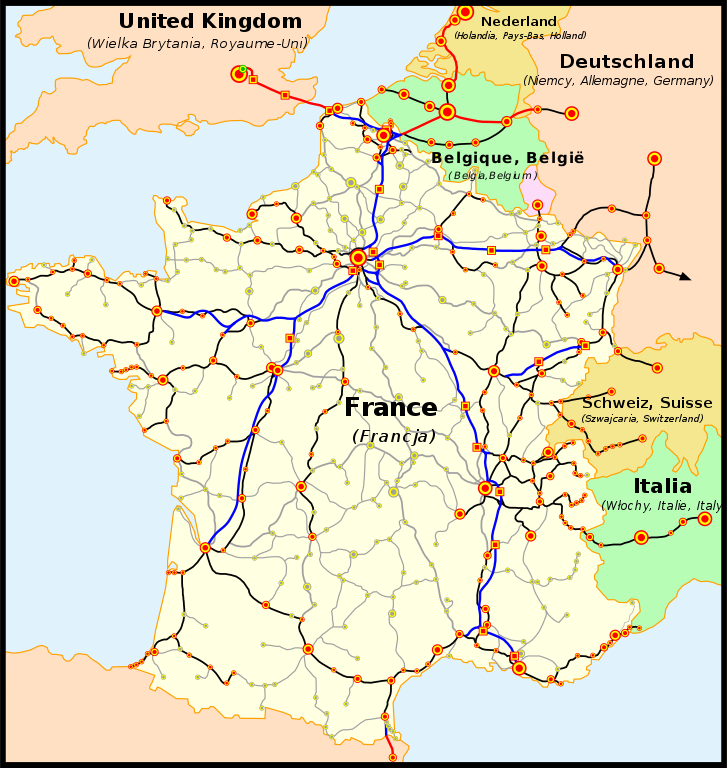
Map of the French railways on which the TGV (LGV: blue; normal tracks: black) and Intercités (grey) SNCF trains run. Only lines going to and from Paris are shown here.
Wikimedia Commons.

The French train company, SNCF, has been doing its best by notifying travellers with bookings every day at 17:00 which of the following day’s trains would be running and which would be cancelled. I’m a lifelong union member myself and I fully support the workers’ rights to … oh buggeration, my TGV’s been rerouted to set off from a city 300km away. Fucking union arsewipes – sack ’em all bastard wankers.

Oh well, I thought, I’ll just have to work out another way. Fire up the SNCF booking app!

A banner at the top informs me that I should seek information about which train services are running by checking its Twitter feed. So I launch the Twitter app. SNCF on Twitter says I should check via the idiotic INOUI brand for TGV bookings. So I launch the INOUI app. This tells me I should check with SNCF or, if I want more information, click on a highlighted link. I click on it: it links to a one-sentence message that tells me there is a strike on and that train services may be affected.

Two hours of thumb-numbing smartphone tomfoolery later, I have worked out my own alternative route via multiple connecting services. This was made more challenging by the SNCF and INOUI apps providing contradictory information about the same journey. Best of all is they can’t agree on where my TGV will actually go. Will it reach its terminus as usual or will it apparently go inexplicably missing from the tracks in the countryside outside Lille? According to SNCF and INOUI, it will do both. It’s Schrodinger’s train.

Just as I go to bed, the Eurostar app sends me a notification reminding me to get to my local station on time tomorrow to catch the TGV that’s been cancelled.

As you can see, my much prolonged, zig-zag route up the country and into Blighty worked, no thanks to these ridiculous apps. It wasn’t all bad: I got to see more French farmland than I expected and experienced first-hand the extraordinarily rich cultural variety of train station beggars that France has to offer the modern rail traveller.

January 17, 2020

The crying need for “regime change” … in Canadian newsrooms

Filed under: Cancon, Media, Middle East, Politics — Tags: , , , , — Nicholas @ 03:00

Chris Selley discusses the amazingly tone-deaf “corrections” issued by CBC and CTV over their malicious misquoting of former Prime Minister Stephen Harper’s comments on the Iranian government:

Harper did not advocate military intervention in Iran, or indeed any particular intervention whatsoever. Despite describing Iran (accurately) as an “anti-Semitic state” premised on “religious fanaticism and regional imperialism” that is standing resolutely in the way of cooperation between other Middle Eastern nations, Harper didn’t even advocate “a complete change of government.”

Prime Minister Stephen Harper speaking at the Annual Meeting of the World Economic Forum in Davos, Switzerland, January 26, 2012.
World Economic Forum photo via Wikimedia Commons.

“I do believe we need to see a change in Iran if we are going to see peace in the Middle East,” he said.

“Without a change in the nature of the government of Tehran,” he said, “the Middle East will continue to be in turmoil.”

He said he hoped the furious protests in Iran might nudge the country toward “a better trajectory.”

These are perfectly anodyne statements. Who doesn’t want the Iranian regime to alter its behaviour?

Clarification or correction? I would say this calls for something more like “colossal embarrassment necessitating deep introspection.”

The root problem, I think, is that so much of Canadian politics is purely for show. We are a sparsely populated, not very powerful nation where the differences between the two major federal parties are remarkably small — and thus so are the stakes. It requires special measures to keep people interested, as much for the media as for politicians.

[…]

That’s how the big outlets like CBC and CTV make the sausage of the day, and it’s understandable. They do great investigative work, but the beast needs feeding not just every day, but all day every day. During the campaign I would watch colleagues set up for live hits in various parking lots and back yards and sometimes even on the campaign bus, and imagine them speaking the truth: “I’m here in Delta, B.C. and there’s f–k-all to report. Back to you, Kent.” But the viewers must never know. They need drama, as weak as it might be. I can easily imagine how that principle transformed “a changed regime” into “regime change.”

The real problem with this reporting regime is when it’s applied to things that actually do matter. There are serious potential consequences to telling the world that Stephen Harper thinks, in essence, that we should declare war on Iran with an eye to bouncing the ayatollahs. Harper’s successor and his government are in the midst of an extremely delicate and frankly improbable operation to find out precisely what happened the morning of Jan. 8 in the skies above Tehran and seek justice for the victims and their families. Those families don’t deserve fake news about a warmongering former PM, and I’m sure our diplomats would prefer members of the unchanged Iranian regime didn’t come across it either.

This isn’t a Canadian federal election. It’s real life, and needs to be covered as such.

January 16, 2020

“… he returned to settle in a 250-year-old farmhouse in Wiltshire which he named ‘Scrutopia'”

Filed under: Britain, History, Media, Politics — Tags: , , , — Nicholas @ 03:00

In Quillette, Barbara Kay remembers Sir Roger Scruton:

Scruton’s breadth of knowledge was astonishing. None of his enemies could dispute that. He wrote whole books with complete authority on religion, architecture, opera, the environment, Islam, philosophy. But running through them all was a guilt-free love for, and fidelity to his — our — cultural inheritance. He loved his own home, England, and he would not repudiate it for its disfiguring historical warts, which seemed to preoccupy almost everyone else. It was Scruton who gave us the word “oikophobia” — hatred of one’s home — which is the hallmark of progressivism. He was out of sync with the hey-hey-ho-ho-western-civ-has-got-to-go zeitgeist. It didn’t help that he was the son of a lowly schoolmaster and had gone to the Royal Grammar School High Wycombe, a selective public high school.

Sir Roger Scruton
Photo by Pete Helme via Wikimedia Commons.

Feeling isolated, like Andrew Sullivan and Christopher Hitchens before him, Scruton drifted “across the pond” to breathe the friendlier air of the last western redoubt where conservative thought finds a welcoming hearth. From 1992 to 1995, he taught a philosophy course at Boston University, and he spent a second stint in America from 2004 to 2009. But the pull of his beloved England proved too great, and he returned to settle in a 250-year-old farmhouse in Wiltshire which he named “Scrutopia.”

[…]

Among those who expressed their gratitude to Scruton in his final year were the governments of Poland and Hungary, who garlanded him with honors for the role he’d played in overthrowing the Communist regimes that had blighted their countries before the fall of the Berlin Wall. This recognition followed his receipt of the Czech Medal of Merit (First Class), presented to him by Vaclav Havel in 1998. At great risk to himself, Scruton had smuggled banned books across the Iron Curtain and helped dissidents organize an underground university, even arranging for degrees to be awarded by the Cambridge theology department. Among his other achievements, he was on the right side of history.

I cherish the memory of a brief conversation I had with Scruton after his Ottawa talk, in which he had expanded on the idea of decency, a concept of great interest and importance for me, especially in retrospect, for Scruton was himself a supremely decent man, although that did not save him from the postmodern jackals. I remember he said decency was easy to regulate in small towns, because you can’t be happy in a small town without a willingness to conform to standards. But these standards aren’t written down. There is no need. Everyone knows what they are. You know you’ve transgressed them when you receive disapproving glances or are cold-shouldered.

Compelled conformity — not legislated, God forbid, but enforced by social pressure — looks stifling to progressives, but in its own way it can be a great comfort, knowing the rules of what is and isn’t decent, and, through them, belonging. We all want to belong, but healthy belonging is sensitive to scale. We’re not made for globalization. We’re made for homes and homelands. If people don’t have homes to keep them rooted, feeling they belong in a good way, they will find fake homes that are tethered to ideas and theories, and then they often belong in a bad way. These are Scrutonesque musings.

Conformity and its effects, good and bad, absorbed Scruton. He once described the entire trajectory of his life as a constant movement toward “that impossible thing: an original path to conformity.” Like so many other of his gnomic utterances, it forces one to stop and think, really think, about what it means. And you know it means something worth thinking about because Roger Scruton never thought or spoke or wrote bullshit. He left that to his critics.

January 15, 2020

History Buffs: Amadeus

Filed under: Europe, History, Media — Tags: , , , , — Nicholas @ 04:00

History Buffs
Published 3 Dec 2015

In this episode we look at the original Rock n Roll bad boy, Wolfgang Amadeus Mozart! And who says this show isn’t classy and sophisticated 🙂

● Follow us on Twitter: https://twitter.com/HistoryBuffs_

________________________________________­_________________________________

Amadeus is a 1984 American period drama film directed by Miloš Forman, written by Peter Shaffer, and adapted from Shaffer’s stage play Amadeus (1979). The story is set in Vienna, Austria, during the latter half of the 18th century.

The film was nominated for 53 awards and received 40, including eight Academy Awards (including Best Picture), four BAFTA Awards, four Golden Globes, and a Directors Guild of America (DGA) award. In 1998, the American Film Institute ranked Amadeus 53rd on its 100 Years… 100 Movies list.

The story begins in 1823 as the elderly Antonio Salieri (F. Murray Abraham) attempts suicide by slitting his throat while loudly begging forgiveness for having killed Wolfgang Amadeus Mozart (Tom Hulce) in 1791. Placed in a lunatic asylum for the act, Salieri is visited by Father Vogler (Richard Frank), a young priest who seeks to hear his confession. Salieri is sullen and uninterested but eventually warms to the priest and launches into a long “confession” about his relationship with Mozart.

“Subdivisions”

Filed under: Cancon, History, Media — Tags: , , — Nicholas @ 03:00

Colby Cosh on the way Rush responded to the “New Wave” on their 1982 album Signals:

Every Rush fan is presenting his own list of essential tracks this week: unexpectedly I found myself returning over and over again to “Subdivisions,” the opener from Signals (1982). No Rush song ever had a more portentous dividing effect: there are still fans who haven’t forgiven. Moving Pictures had come out in February of 1981, and its sales set up the band for life and beyond. But it was a consciously backward-looking record — the cover is a big clue — and a culmination of Rush’s original identity. Moving Pictures is an affectionate farewell to 11-minute track lengths and science-fiction song lyrics (mostly).

After just a few months came the first 51 seconds of “Subdivisions” — Rush’s own astonishing riposte to the New Wave. A lone synthesizer pulses (in 7/8) for a few seconds and then Neil comes in: no further description is possible or necessary. The passage would make a career calling card for any drummer, but what was novel was the upside-down structure of the song, with Alex Lifeson’s guitar showing up late and then carrying the rhythm (beautifully, if you take the trouble to pick him out) while the drums truly lead the way. This is rare, outside of a drum-solo setting, for any rock drummer not named Moon or Bonham.

It was as if Rush, until then a very loud group fuelled by metaphors of battle, had made a conscious decision to cool down and give the spotlight to its ultimate weapon. Very well, the start of Signals announced, this is the age of the synthesizer and we’re going along with it — but let’s see you S.O.B.s synthesize Neil Peart.

Not coincidentally, Peart’s lyrics for “Subdivisions” also took an artistic step: they shake free of the SF/fantasy tropes and the 1930s poetic conceits he had mostly hidden behind until then. Heard in 2020, the song drags the mind of the listener helplessly back to the moment when “Subdivisions” was on the radio, yet seems to have been written for us to hear now. “Some will sell their dreams for small desires,” Peart warned in a mood of cranky prophecy, “or lose the race to rats …”.

Rush in concert, Milan 2004.
Photo by Enrico Frangi, via Wikimedia Commons

January 12, 2020

Neil Peart, RIP

Filed under: Cancon, Liberty, Media — Tags: , , , , , — Nicholas @ 03:00

I was very saddened to see the news, but it explains why the band retired:

Rush in concert, Milan 2004.
Photo by Enrico Frangi, via Wikimedia Commons

Neil Peart, the virtuoso drummer and lyricist for Rush, died Tuesday, January 7th, in Santa Monica, California, at age 67, according to Elliot Mintz, a family spokesperson. The cause was brain cancer, which Peart had been quietly battling for three-and-a-half years. A representative for the band confirmed the news to Rolling Stone.

Peart was one of rock’s greatest drummers, with a flamboyant yet precise style that paid homage to his hero, the Who’s Keith Moon, while expanding the technical and imaginative possibilities of his instrument. He joined singer-bassist Geddy Lee and guitarist Alex Lifeson in Rush in 1974, and his musicianship and literate, philosophical lyrics — which initially drew on Ayn Rand and science fiction, and later became more personal and emotive — helped make the trio one of the classic-rock era’s essential bands. His drum fills on songs like “Tom Sawyer” were pop hooks in their own right, each one an indelible mini-composition; his lengthy drum solos, carefully constructed and packed with drama, were highlights of every Rush concert.

In a statement released Friday afternoon, Lee and Lifeson called Peart their “friend, soul brother and bandmate over 45 years,” and said he had been “incredibly brave” in his battle with glioblastoma, an aggressive form of brain cancer. “We ask that friends, fans, and media alike understandably respect the family’s need for privacy and peace at this extremely painful and difficult time,” Lee and Lifeson wrote. “Those wishing to express their condolences can choose a cancer research group or charity of their choice and make a donation in Neil Peart’s name. Rest in peace, brother.”

A rigorous autodidact, Peart was also the author of numerous books, beginning with 1996’s The Masked Rider: Cycling in West Africa, which chronicled a 1988 bicycle tour in Cameroon — in that memoir, he recalled an impromptu hand-drum performance that drew an entire village to watch.

Peart never stopped believing in the possibilities of rock (“a gift beyond price,” he called it in Rush’s 1980 track “The Spirit of Radio”) and despised what he saw as over-commercialization of the music industry and dumbed-down artists he saw as “panderers.” “It’s about being your own hero,” he told Rolling Stone in 2015. “I set out to never betray the values that 16-year-old had, to never sell out, to never bow to the man. A compromise is what I can never accept.”

Update: At AIER Peter C. Earle pays tribute to Peart’s life and work.

The announcement of the death of Rush drummer Neil Peart came as a tremendous shock. Having only retired about four years ago, so many fans of Rush (myself included) had convinced ourselves that this was a temporary hiatus, and that in a year or two – eventually, at any rate – there would be an announcement of a new album, a short tour, or some other project. Surely musicians of their virtuosity and passion couldn’t stay away from the studio or stage for long. But now we know we were wrong, and we know why.

It was revealed that Neil had been battling a brain tumor for over three years. Characteristically, he, his family, and friends (among the closest of whom, Rush vocalist/bass player Geddy Lee and guitarist Alex Lifeson) upheld his desire for privacy. I haven’t done the math as to whether Neil’s illness was likely a causative factor in the decision to retire, or whether it seems to have come along not long after the decision to retire.

[…]

In his role as the lyricist of Rush, Peart took on such topics as pernicious nationalism (“Territories”), mass hysteria (“Witch Hunt”), the division between constructive and destructive belief (“Faithless”), the fall of Communism (“Heresy”), conflict and power (“The Trees”), the horrors of totalitarian rule (“2112,” “Red Sector A”) and many allusions to individual liberty (“Tom Sawyer,” “Anthem,” “The Analog Kid,” “Finding My Way,” “Caravan”). He did so via lyrics which artfully and passionately evinced those sentiments; sentiments which early on suggested Objectivist perspectives, but over time developed into what he called “Bleeding Heart” libertarianism:

    I call myself a bleeding heart libertarian. Because I do believe in the principles of Libertarianism as an ideal – because I’m an idealist. Paul Theroux’s definition of a cynic is a disappointed idealist. So as you go through past your twenties, your idealism is going to be disappointed many many times. And so, I’ve brought my view and also – I’ve just realized this – Libertarianism as I understood it was very good and pure and we’re all going to be successful and generous to the less fortunate and it was, to me, not dark or cynical. But then I soon saw, of course, the way that it gets twisted by the flaws of humanity. And that’s when I evolve now into … a bleeding heart Libertarian. That’ll do.

Neil, through his lyrics, managed to do what so many lyricists and writers – even, perhaps especially, so many libertarian intellectuals – fail to do: make liberty neither an alien fixture, a flat slogan, or a utopian slog. It is a way of thinking and living, and one which not only doesn’t ignore, but embraces the flaws and frailty of humanity, tempering realism with hope and optimism.

« Newer PostsOlder Posts »

Powered by WordPress