Sabaton History
Published 13 Feb 2020The Battle of Britain had saved the United Kingdom from imminent invasion by the German Wehrmacht, however the war was far from over. To destroy Britain’s economic capabilities to wage war, the German Kriegsmarine had to win the tonnage war in the North Atlantic. The German submarines — the U-Boote, were sent out to hunt. As the British Royal Navy returned to the convoy system to protect its merchant fleet, the Germans as well began organizing their submarines in groups to attack in unison. These hunter-killer teams, the Wolfpacks, would soon haunt the depths of the North Atlantic.
Support Sabaton History on Patreon: https://www.patreon.com/sabatonhistory
Listen to “Wolfpack” on the album Primo Victoria:
CD: http://bit.ly/PrimoVictoriaStore
Spotify: http://bit.ly/PrimoVictoriaSpotify
Apple Music: http://bit.ly/PrimoVictoriaAppleMusic
iTunes: http://bit.ly/PrimoVictoriaiTunes
Amazon: http://bit.ly/PrimoVictoriaAmzn
Google Play: http://bit.ly/PrimoVictoriaGooglePlayCheck out the trailer for Sabaton’s new album The Great War right here: https://www.youtube.com/watch?v=HCZP1…
Listen to Sabaton on Spotify: http://smarturl.it/SabatonSpotify
Official Sabaton Merchandise Shop: http://bit.ly/SabatonOfficialShopHosted by: Indy Neidell
Written by: Markus Linke and Indy Neidell
Directed by: Astrid Deinhard and Wieke Kapteijns
Produced by: Pär Sundström, Astrid Deinhard and Spartacus Olsson
Creative Producer: Joram Appel
Executive Producers: Pär Sundström, Joakim Broden, Tomas Sunmo, Indy Neidell, Astrid Deinhard, and Spartacus Olsson
Post-Production Director: Wieke Kapteijns
Edited by: Iryna Dulka
Sound Editing by: Marek Kaminski
Maps by: Eastory – https://www.youtube.com/c/eastoryArchive by: Reuters/Screenocean https://www.screenocean.com
Music by Sabaton.Colorizations:
– Olga Shirnina, a.k.a. Klimbim – https://klimbim2014.wordpress.com/Sources:
– IWM: HU 16546, A 30292
– Bundesarchiv
– Otis Historical Archives, National Museum of Health and Medicine
– Narodowe Archiwum Cyfrowe
– Canadian ship being attacked, photo courtesy of the Government of Canada, https://www.canada.ca/en/navy/service…An OnLion Entertainment GmbH and Raging Beaver Publishing AB co-Production.
© Raging Beaver Publishing AB, 2019 – all rights reserved.
February 14, 2020
“Wolfpack” – German U-boat Tactics – Sabaton History 054 [Official]
February 12, 2020
Rebecca Black, nine years after the release of “Friday”
CNN‘s Scottie Andrew talked to Rebecca Black about her experiences and the reactions to her debut video:
Partyin’, partyin’, YEAH! “Friday,” the accidental anthem of 2011 and an ode to the best day of the week, is officially nine years old.
It became something of a national joke when it debuted. But to a then-13-year-old Rebecca Black, the single’s star, the jokes made at her expense were immensely damaging.
Black, now 22 but still a pop singer, is remarkably well-adjusted for someone whose life was upended by a music video. She marked the 9th anniversary of the song that started it all with a note to her younger self — and advice for her followers to love themselves a little better.
[…]
Black was only in middle school when she filmed the infamous video. She paid a company called Ark Music Factory to write her a song and film a music video for it, starring her and her friends.
It’s not an artistic achievement, but it’s fitting for the young star at its center. In it, Black sways and sings her way through a Friday — she wakes up, she eats cereal, she can’t decide which seat in a convertible to take. Typical teen stuff.
The negative comments rolled in almost immediately, and nearly all of them lambasted Black.
At the time, I linked to a couple of deconstructions of the video that amused me. One was from The Awl:
She offers the camera a hostage’s smile, forced, false. Her smoky eyes suggest chaos witnessed: tear gas, rock missiles and gasoline flames. They paint her as a refugee of a teen culture whose capacity for real subversion was bludgeoned away somewhere between the atrocities of Kent State and those of the 1968 Democratic Convention, the start of a creeping zombification that would see youthful dissent packaged and sold alongside Pez and Doritos.
“Look and listen deeply,” she challenges. An onanistic recursion, at once Siren and Cassandra, she heralds a new chapter in the Homeric tradition. With a slight grin, she calls out to us: “I sing of the death of the individual, the dire plight of free will and the awful barricades daily built inside the minds of all who endure what lately passes for American life. And here I shall tell you of what I have done in order to feel alive again.”
***Ms. Black first appears as her own computer-generated outline: wobbly, marginal, a dislocated erasure. The days of the week flip by accompanied by dull obligations — “essay due” — and tired clichés — “Just another manic Monday …” Her non-being threatens to be consumed by this virtual litany of nothing at all until, at long last — Friday.
[…]
Yet here the discerning viewer notes that something is wrong. Because it is a simple matter of fact that in this car all the good seats have already been taken. For Rebecca Black (her name here would seem to evoke Rosa Parks, a mirroring that will only gain in significance) there is no actual choice, only the illusion of choice.
The viewer knows that she’ll take the only seat that’s offered to her, a position so very undesirable as to be known by a derisive — the “Bitch” seat.
She might well have been better off on the school bus, among the have-nots. But Rebecca Black’s world is so advanced in the craft of evisceration that this was never a consideration. John Hughes died while out jogging, these are the progeny of his great materialist teen-villain, James Spader, a name that would come to be synonymous with desperate sex and high-speed collision. And as she gets in the car Ms. Black’s joy is as patently empty as her liberation.
“Partying, Partying,” she sings, in hollow mantra.
“Yeah!” an unseen mass replies, a Pavlovian affirmation.
The other was from Jeffrey Tucker in the Christian Science Monitor:
Far more significant is the underlying celebration of liberation that the day Friday represents. The kids featured in the video are of junior-high age, a time when adulthood is beginning to dawn and, with it, the realization of the captive state that the public school represents.
From the time that children are first institutionalized in these tax-funded cement structures, they are told the rules. Show up, obey the rules, accept the grades you are given, and never even think of escaping until you hear the bell. If you do escape, even peacefully of your own choice, you will be declared “truant,” which is the intentional and unauthorized absence from compulsory school.
This prison-like environment runs from Monday through Friday, from 8 a.m. to late afternoon, for at least ten years of every child’s life. It’s been called the “twelve-year sentence” for good reason. At some point, every kid in public school gains consciousness of the strange reality. You can acquiesce as the civic order demands, or you can protest and be declared a bum and a loser by society.
“Friday” beautifully illustrates the sheer banality of a life spent in this prison-like system, and the prospect of liberation that the weekend means. Partying, in this case, is just another word for freedom from state authority.
The largest segment of the video then deals with what this window of liberty, the weekend, means in the life of someone otherwise ensnared in a thicket of statism. Keep in mind here that the celebration of Friday in this context means more than it would for a worker in a factory, for example: for the worker is free to come and go, to apply for a job or quit, to negotiate terms of a contract, or whatever. All of this is denied to the kid in public school.

QotD: Experienced political operators after an unexpected paradigm shift
I think this is causing some confusion, blindness and otherwise inexplicably stupid behavior in people who never seemed stupid before. This is what I call The Years the Masks Fell off.
Look, take a just-now thing: the DNC says that all precincts in Iowa WERE counted. The app recorded every vote, they say. They just need to tally them.
Turns out that’s probably not precisely true.
As a friend noticed, that’s not precisely a lie, that’s just “making sh*t up.”
We’re seeing that a lot from the other side of the aisle suddenly. Unbelievably stupid behavior like the sham wow impeachment.
They keep telling us “Who you gonna believe, me or your lying eyes?” and being shocked and appalled when we choose our lying eyes.
[…]
And then they’re shocked, nay astonished, when these tactics don’t work. While we who are standing outside this look at them and go “Who would think that would work? Some two year old?”
I mean half of the bizarre behavior of our government and its agencies falls under that heading too. “Who could think that would work/wouldn’t be found out/made any sense?”
But the thing you have to understand is that you’re not dealing with stupid people. Not by half. You’re dealing with people who were very competent and comfortable in — for lack of a better term — the previous paradigm of politics, or publishing or whatever.
The more comfortable they were; the easier it was for them, the harder it is to accept that it’s gone and it’s not coming back
For instance, the dems could trust the media would cover for them absolutely and completely, and that their pettiness, idiocy or outright corruption would never be revealed.
They got used to it, they got comfortable. They got to believing it was their natural right. It was just the way things were. They were the good people. Their hearts were pure. No one would ever look into their behavior outside the limelight.
If some psychological tests are correct, they grew to believe they were entitled to corruption and unethical behavior for all the “good” they did, such as Clinton thinking he was entitled to all the women he wanted for “fighting for women’s rights” (Which for men like him always mean abortion, but never mind.)
They can’t adapt. They can’t believe things have changed.
Sarah Hoyt, “How Things Have Always Been”, Libertarian Enterprise, 2020-02-09.
February 11, 2020
“… loveable Nickelodeon show Paw Patrol is an insidious tool of capitalism”
I’ve only heard of the show because my grand-niece is a huge fan, so I can’t say anything one way or another about these heresy allegations:
Six adorable, daring puppies and their whiz kid leader, ten-year-old Ryder, rescue people in the community of Adventure Bay. You would have to be a fool to not love Paw Patrol. And that’s where the Canadian state broadcaster CBC comes in!
A new article by Rebecca Zandbergen explores the groundbreaking new theory by Canadian university professor Liam Kennedy that loveable Nickelodeon show Paw Patrol is an insidious tool of capitalism. Kennedy, from King’s University College, has penned a vital new piece of research called “Whenever there’s trouble. Just yelp for help”: Crime, Conservation and Corporatization in Paw Patrol” in the peer-reviewed journal Crime Media Culture. His child isn’t allowed to watch the show, but Kennedy spent countless hours watching it in his office.
In the show, Ryder is the ring-leader of the pups, each of whom has a job to do as part of their team. There’s Chase, the police dog, Marshall, the fire chief dog who can never quite get control of his hose, Rubble, the builder, Skye, who flies a plane for some reason and is the girl pup, Everest, the extreme outdoor adventuring pup, Rocky, the rescue dog, and Zuma, the pup who drives a boat.
Together, they are the Paw Patrol, and they even have a headquarters, because all kids love a home base. Inexplicably, the grown-ups in town depend on Ryder and the pups to help them when they’re in a jam. Probably because it’s a show for kids, so it’s kid-centric. Kids like that.
Kennedy posits that “Paw Patrol, as a private corporation, is used to help provide basic social services in the Adventure Bay community. That’s problematic in that the Paw Patrol creators are sending this message that we can’t depend on the state to provide these services.”
Kennedy was angry that elected officials are not portrayed as heroes: “Mayor Humdinger and Mayor Goodway — kind of the representatives of the state or the government — are portrayed negatively,” Kennedy argued.
Kennedy also pointed out that, at the age of ten, Ryder should be in school, not saving the world. CBC did not bother to ask Kennedy how he feels about real-life school-skipper and saviour Greta Thunberg. We guess some do-gooders are more equal than others.
Animal “rights”
In the latest Libertarian Enterprise, L. Neil Smith republished a short essay he wrote for the March 1996 edition which is still fully relevant today:

An olive ridley sea turtle, a species of the sea turtle superfamily.
NASA image via Wikimedia Commons.
Last Friday I watched an episode of X-Files in which innocent zoo animals were being abducted — apparently by benign, superior UFOsies (the ones who mutilate cattle and stick needles in women’s bellies) — to save them from a despicable mankind responsible for the erasure of thousands of species every year.
Or every week, I forget which.
I was reminded of a debate I’d found myself involved in about sea turtles; I’d suggested that laws prohibiting international trade in certain animal products be repealed so the turtles might be privately farmed and thereby kept from extinction. After all, who ever heard of chickens being an endangered species? From the hysteria I provoked — by breathing the sacred phrase “animal rights” and the vile epithet “profit” in one sentence — you’d have thought I’d demanded that the Virgin be depicted henceforth in mesh stockings and a merry widow like Frank N. Furter in The Rocky Horror Picture Show.
That debate convinced me of two things. First: I wasn’t dealing with politics, here, or even philosophy, but with a religion, one that would irrationally sacrifice its highest value — the survival of a species — if the only way to assure it was to let the moneylenders back into the temple. Its adherents abominate free enterprise more than they adore sea turtles.
Second (on evidence indirect but undeniable): those who cynically constructed this religion have no interest in the true believers at its gullible grassroots, but see it simply as a new way to pursue the same old sinister objective. A friend of mine used to refer to “watermelons” — green on the outside, red on the inside — who use environmental advocacy to abuse individualism and capitalism. Even the impenetrable Rush Limbaugh understands that animal rights and related issues are just another way socialism pursues its obsolete, discredited agenda.
In my experience, those who profess to believe in animal rights usually don’t believe in human rights. That’s the point, after all.
February 10, 2020
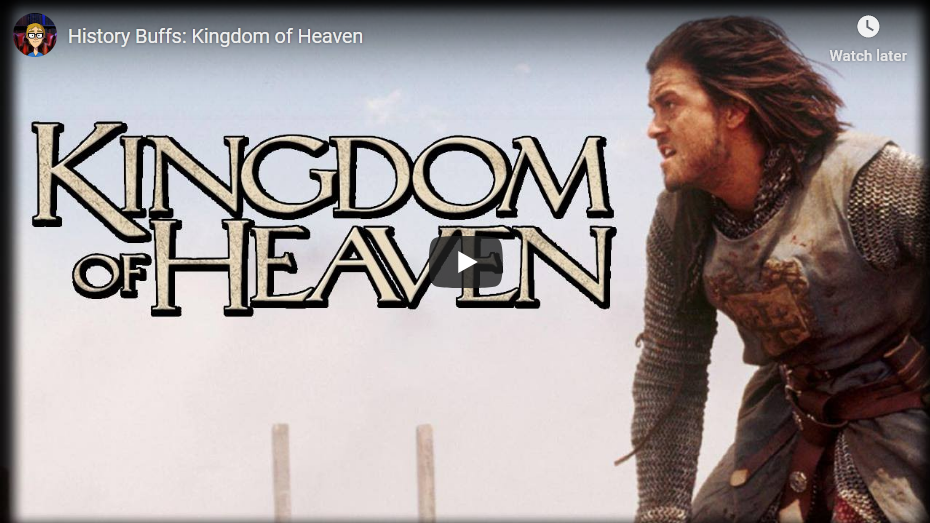
History Buffs: Kingdom of Heaven
History Buffs
Published 15 Aug 2015Apparently, Orlando Bloom was suffering from a nasty cold when shooting a big chunk of this movie. I think it shows … Anyway, it’s time for a brand new episode of History Buffs! Enjoy guys and thank you so much for all your support!
February 8, 2020
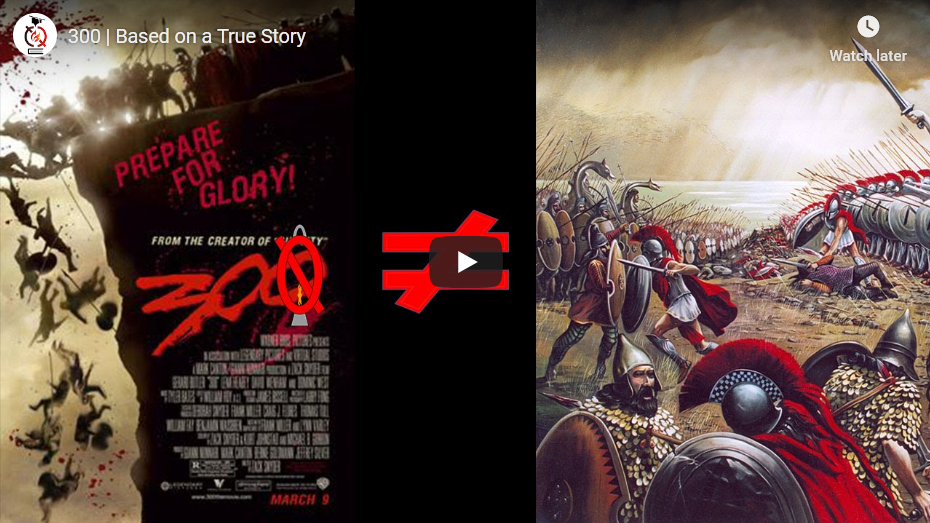
300 | Based on a True Story
The Cynical Historian
Published 29 Jul 2015Here is another episode of “Based on a True Story”. This time it is 300 and how it is based on the battle of Thermopylae. It is a great film with a great many historically innacurate plot points.
————————————————————
references:
http://www.todayifoundout.com/index.p…http://www.historyvshollywood.com/ree…
https://en.wikipedia.org/wiki/300_(fi…
————————————————————LET’S CONNECT: https://twitter.com/Cynical_History
————————————————————
Wiki:
300 is a 2006 American epic fantasy war film based on the 1998 comic series of the same name by Frank Miller and Lynn Varley. Both are fictionalized retellings of the Battle of Thermopylae within the Persian Wars. The film was directed by Zack Snyder, while Miller served as executive producer and consultant. It was filmed mostly with a super-imposition chroma key technique, to help replicate the imagery of the original comic book.The plot revolves around King Leonidas (Gerard Butler), who leads 300 Spartans into battle against the Persian “god-King” Xerxes (Rodrigo Santoro) and his invading army of more than 300,000 soldiers. As the battle rages, Queen Gorgo (Lena Headey) attempts to rally support in Sparta for her husband. The story is framed by a voice-over narrative by the Spartan soldier Dilios (David Wenham). Through this narrative technique, various fantastical creatures are introduced, placing 300 within the genre of historical fantasy. The events are revealed to be a story told by Delios, the only one of the 300 Spartans to survive the battle.
300 was released in both conventional and IMAX theaters in the United States on March 9, 2007, and on DVD, Blu-ray Disc, and HD DVD on July 31, 2007. The film received mixed reviews, receiving acclaim for its original visuals and style, but criticism for favoring visuals over characterization and its depiction of the ancient Persians in Iran, a characterization which some had deemed racist; however, the film was a box office success, grossing over $450 million, with the film’s opening being the 24th largest in box office history at the time. A sequel, entitled Rise of an Empire, which is based on Miller’s unpublished graphic novel prequel Xerxes, was released on March 7, 2014.
————————————————————
Hashtags: #history #300 #Thermopylae #review #BasedOnATrueStory #Sparta #ThisIsSparta
ESR on the Wuhan coronavirus
He’s backing away from his — to me unfathomable — earlier belief in the accuracy of official Chinese government statistics:
My willingness to believe the official line didn’t stem from any credulity about what the Chinese government would do if it believed the truth wouldn’t serve. As Communists they are lying evil scum pretty much by definition, and denial would have been politically attractive for as long as they thought they could nip the pandemic in the bud. I thought their incentives had flipped and they would now be honest as a way of assisting their own countermeasures and seeking international help.
My first clue that I was wrong about that came from a friend who is plugged into the diaspora Chinese community. According to him, there is terrifying video being sent from Chinese clans to the overseas branches they planted in the West to prepare a soft landing in case they have to bail out of China. Video of streets littered with corpses. And of living victims exhibiting symptoms like St. Vitus’s Dance (aka Sydenham’s chorea), which means the virus is attacking central nervous systems.
My second clue was the Tencent leak. […] the takeaway is that there is now reason to believe that as of Feb 1st the actual coronavirus toll looked like this: confirmed cases 154023, suspected cases 79808, cured 269, deaths 24589.
Compare that with the Johns Hopkins tracker numbers for today, a week later: Confirmed cases 31207, cured 1733, deaths 638. Allowing for the Tencent leak being roughly one doubling period earlier, the official statistics have been lowballing the confirmed case number by a factor of about 8 and the deaths by a factor of about 80. And then inflating cures by a factor of about 12.
Even given what I’d heard about the video, I might have remained skeptical about the leak numbers if someone (don’t remember who or where) hadn’t pointed out that the ratio between reported cases and deaths has been suspiciously constant in the official Chinese statistics. In uncooked statistics one would expect more noise in that ratio, if only because of reporting problems.
So my present judgment, subject to change on further evidence, is that the Tencent-leak numbers are the PRC’s actual statistics. And that has a lot of grim implications.
February 7, 2020
“Winged Hussars” – Polish Cavalry – Sabaton History 053 [Official]
Sabaton History
Published 6 Feb 2020The Winged Hussars have arrived!
By the 17th century it seemed like the golden age of the Winged Hussars had come to an end. Heavily armored, clad in steel and leopard skins, they had once charged over the battlefields with their wings proudly flying in the wind. But as the city of Vienna came under siege by the Ottoman Empire, the Polish Winged Hussars once more set out to meet their foes on the battlefield. Prepare for a thunderous charge that would go down in history.
Support Sabaton History on Patreon: https://www.patreon.com/sabatonhistory
Listen to “Winged Hussars” on the Last Stand Album:
CD: http://bit.ly/TheLastStandStore
Spotify: http://bit.ly/TheLastStandSpotify
Apple Music: http://bit.ly/TheLastStandItunes
iTunes: http://bit.ly/TheLastStandItunes
Amazon: http://bit.ly/TheLastStandAmz
Google Play: http://bit.ly/TheLastStandGooglePlayWatch the official lyric video of “Winged Hussars” here:
https://www.youtube.com/watch?v=rcYhY…Check out the trailer for Sabaton’s new album The Great War right here: https://www.youtube.com/watch?v=HCZP1…
Listen to Sabaton on Spotify: http://smarturl.it/SabatonSpotify
Official Sabaton Merchandise Shop: http://bit.ly/SabatonOfficialShopHosted by: Indy Neidell
Written by: Markus Linke and Indy Neidell
Directed by: Astrid Deinhard and Wieke Kapteijns
Produced by: Pär Sundström, Astrid Deinhard and Spartacus Olsson
Creative Producer: Joram Appel
Executive Producers: Pär Sundström, Joakim Broden, Tomas Sunmo, Indy Neidell, Astrid Deinhard, and Spartacus Olsson
Post-Production Director: Wieke Kapteijns
Edited by: Iryna Dulka
Sound Editing by: Marek Kaminski
Maps by: Eastory – https://www.youtube.com/c/eastoryArchive by: Reuters/Screenocean https://www.screenocean.com
Music by Sabaton.An OnLion Entertainment GmbH and Raging Beaver Publishing AB co-Production.
© Raging Beaver Publishing AB, 2019 – all rights reserved.
February 5, 2020
“On this issue, Canada’s two solitudes could hardly be more starkly apparent”
Chris Selley on the vastly different reaction from Quebec media to the Trudeau government’s notion to turn the country’s news organizations into a modern version of Joseph Goebbels’ propaganda apparatus, pumping out approved-by-the-Liberals story lines:
On Sunday, when CTV’s Evan Solomon pushed Heritage Minister Steven Guilbeault on the issue of issuing journalism licences to foreign media outlets, Guilbeault eventually just shrugged: “I’m not sure I see what the big deal is.”
The minister tried to walk it back on Monday, but the fact is many of his fellow Quebecers will also struggle to discern a big deal. There is simply much more tolerance of this sort of cultural gatekeeping among francophone Quebecers than in the Rest of Canada, and the tolerance extends well into the realm of journalism.
“In reading the (report’s) 260 pages and 97 recommendations, one word comes to mind” Sunday’s editorial in La Presse gushed: “Finally!”
Opposition to government regulation of journalism is firmly entrenched not just in anglophone Canada, but across the anglosphere. When the 2011 Leveson Inquiry proposed the British government create a powerful new press regulator, nearly every major outlet rejected the idea. Fraser Nelson, editor of The Spectator, famously vowed the magazine “will not attend its meetings, pay its fines nor heed its menaces.”
The same year, Laval University professor Dominique Payette’s report into Quebec’s struggling news media recommended the government legislate a “professional journalist” designation. The province’s largest journalists’ trade organization and the Quebec Press Council happily sat down with the government to bash out a power-sharing agreement on deciding who’s a proper journalist and who isn’t.
The English-language Montreal Gazette was dead-set against the idea, but Le Devoir called it a “logical outcome.” (The power-sharing discussions eventually fell apart, and the idea died a merciful death.)
QotD: The decline of Jazz
The opening note of Jazz, Ken Burns’ […] series for PBS, comes from trumpeter Wynton Marsalis, who’s not playing but lecturing. “Jazz music objectifies America,” he tells us, then offers a lesson about what jazz really is. The form’s great power emerges from musicians who “negotiate their agendas with each other.” According to Marsalis (he’s Lincon Center’s artistic director for jazz), that negotiation, that handing off and passing around of inspiration — that jam — is jazz’s transcendence.
Most jazz musicians would agree. As the cliché goes, it’s one thing to do a show for your paying customers, playing what they expect and have paid to hear, but after the squares go home, you can stop blowing shit and make another kind of music altogether. Yet many musicians would also agree that, more often than not, it’s a lot more satisfying to play that personal kind of music than it is to sit and listen to it. Jazz musicians involved with each other in intimate creativity may well be negotiating their way to improvisational sublimity, but they’ve often left the audience out of the musical deal. This is a central but rarely acknowledged tension in Burns’ documentary treatment.
Charles Paul Freund, “Epic Jazz”, Reason, 2001-01-03.
February 4, 2020
CRTC regulating the internet – “Nobody elsewhere is proposing anything like it, and for good reason: because it’s insane”
Ted Campbell suggests that the Canadian government most recent brainfart is a “Tea Party moment” for Canadians:
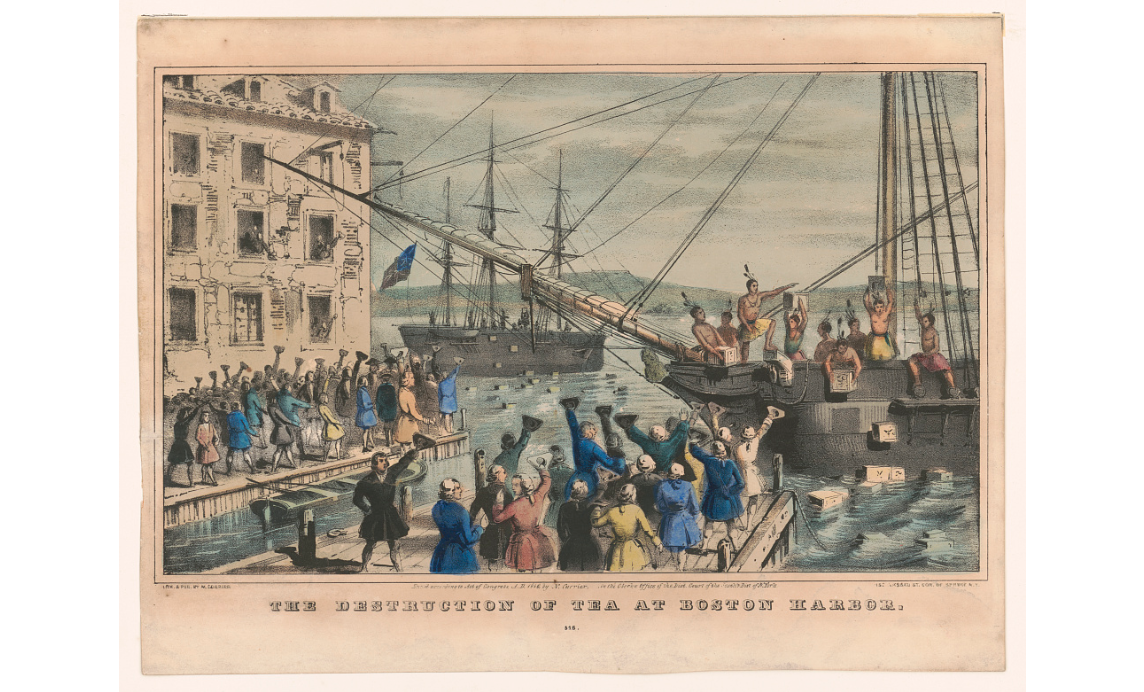
One commentator on social media dubbed this […] the moment when Heritage Minister Steven Guilbeault said that the Trudeau regime plans to license news websites as a “Boston Tea Pary moment.”
N. Currier. Destruction of tea at Boston Harbor, 1846. [New York: N. Currier]
Retrieved from the Library of Congress – https://www.loc.gov/item/91795889/She was referring to the protest, in December of 1773, when angry American colonists (many dressed as Native Americans to try and hide their true identities) dumped several hundred chests of tea, imported by the East India Company, into Boston harbour to protest the taxes, on almost everything, that had been imposed, by Westminster to pay for the Seven Years War. Westminster felt it was only fair to tax the colonists equally, along with the people of the British Isles, because much of the war, called the French-Indian War, now, by Americans, was fought to protect them and their vital commercial interests. The American colonists disagreed, many on the principle that they should not be taxed without being represented in parliament. We know where it all ended.
It’s a good question. Most commentators seem to agree with me that the Trudeau regime has seriously overreached in supporting the Broadcasting and Telecommunications Legislative Review Panel’s recommendations that, somehow, the distribution of “news” should be regulated by the government. That is a far, far greater intrusion into the liberty of free Canadian citizens than a tax on staples was to Americans in 1773.
Andrew Coyne, writing in the Globe and Mail, opines that “The whole thing is just breathtaking – a regulatory power grab without precedent, either in Canada or the democratic world. Nobody elsewhere is proposing anything like it, and for good reason: because it’s insane. This kind of bureaucratic micromanagement, with its obsession with ‘cultural sovereignty’ and ‘telling ourselves our own stories,’ would have been hopelessly outdated in 1990. In 2020, it’s just embarrassing.” He’s right to use the word “insane,” ~ the proposal is quite possibly unconstitutional, just for a start, it is, certainly based on a deeply mistaken idea of what the internet actually is ~ and he’s equally right to say that every Canadian who doesn’t, actively, protest against this must be embarrassed because each is, for no good reason at all that I can see, supporting a proposal that makes Canada less, far less, of a liberal democracy and more like Ethiopia and Senegal (both with scores below 6.0, the threshold for a Flawed Democracy in the well regarded Economist Intelligence Unit’s latest democracy index) where he will visit this week … perhaps to learn from the leaders of authoritarian regimes what his next steps should be to embarrass Canada further.
Michael Geist on the jaw-dropping performance of Trudeau’s Canadian Heritage Minister last weekend:
In June 2017, the Standing Committee on Canadian Heritage committee recommended implementing tax on Internet services in a report on media. Within minutes, Prime Minister Justin Trudeau was asked about the proposal at a press conference in Montreal. Trudeau’s answer – which literally came as committee chair Hedy Fry was holding a press conference on the report – was unequivocal: No. The government was not going to raise costs of Internet services with an ISP tax. The committee recommendation was minutes old and the government wasted absolutely no time in killing the proposal.
Last week, the Broadcasting and Telecommunications Legislative Review Panel proposed a far broader regulatory vision for the Internet. Indeed, it is difficult to give the full breadth of this plan its due. I will be posting this week on some of the most harmful aspects of the plan, including regulating media organizations around the world with penalties in the hundreds of thousands of dollars for failing to obtain licences, regulating streaming companies despite their massive investment in Canada, regulating everything from app stores to operating systems, creating liability for harmful content that violates Canada’s commitments in the USMCA, undermining net neutrality, and increasing the costs of Internet-based services for Canadian consumers.
Over the weekend, Canadian Heritage Minister Steven Guilbeault was asked about the proposal. In particular, he was asked about the proposal to licence foreign news sites (the example used was Breitbart but it could just as easily have been the New York Times, BBC, CNN, Fox or MSNBC). The answer should have been easy: no.
Instead of “no”, Minister Guilbeault’s response was that it was “no big deal.”
On Monday morning, the minister appears to have reconsidered being quite so blatant in indulging his inner authoritarian control freak:
Guilbeault walked back the comments on Monday, stating that the government had “no intention to impose licensing requirements on news organizations,” nor will the government “regulate news content.”
“… Our focus will be and always has been that Canadians have diversity to high-quality news sources,” said Guilbeault to reporters in Ottawa.
This announcement comes after deep criticism of a previous announcement by the Liberal government, where they said they would force news organizations to apply for a licence.
Guilbeault’s announcement faced intense scrutiny from across the political spectrum with some commentators suggesting that it would be a dangerous attack on the freedom of the press.
January 31, 2020
“Wehrmacht” – The German Army 1935-1945 – Sabaton History 052 [Official]
Sabaton History
Published 30 Jan 2020From 1935 onwards, the German Wehrmacht was expanding rapidly. Millions of men joined the army, the Luftwaffe and the Kriegsmarine to fulfill Adolf Hitler’s visions for the 3rd Reich.
Highly motorized Panzergrenadiers, elite parachute- and resilient mountain-infantry troops were trained and and led with the utmost combat-efficiency in mind, supported by state of the art Panzers and aircraft. If it came to war, they would break the enemy and break them fast, achieving fast victories in a series of devastating hits. However, succumbing to the ideological influence of National-Socialism, the Wehrmacht found itself soon to be both culprit and accomplice to a self-reinforcing cycle of violence and atrocities.
Support Sabaton History on Patreon: https://www.patreon.com/sabatonhistory
Listen to “Wehrmacht” here:
CD: http://bit.ly/CoatOfArmsStore
Spotify: http://bit.ly/CoatOfArmsSpotify
Apple Music: http://bit.ly/CoatOfArmsAppleMusic
iTunes: http://bit.ly/CoatOfArmsiTunes
Amazon: http://bit.ly/CoatOfArmsAmzn
Google Play: http://bit.ly/CoatOfArmsGooglePlayCheck out the trailer for Sabaton’s new album The Great War right here: https://www.youtube.com/watch?v=HCZP1…
Listen to Sabaton on Spotify: http://smarturl.it/SabatonSpotify
Official Sabaton Merchandise Shop: http://bit.ly/SabatonOfficialShopHosted by: Indy Neidell
Written by: Markus Linke and Indy Neidell
Directed by: Astrid Deinhard and Wieke Kapteijns
Produced by: Pär Sundström, Astrid Deinhard and Spartacus Olsson
Creative Producer: Joram Appel
Executive Producers: Pär Sundström, Joakim Broden, Tomas Sunmo, Indy Neidell, Astrid Deinhard, and Spartacus Olsson
Post-Production Director: Wieke Kapteijns
Edited by: Iryna Dulka
Sound Editing by: Marek Kaminski
Maps by: Eastory – https://www.youtube.com/c/eastoryArchive by: Reuters/Screenocean https://www.screenocean.com
Music by Sabaton.Sources:
– Bundesarchiv
– IWM: H 21907- Bundesarchiv
– IWM: H 21907An OnLion Entertainment GmbH and Raging Beaver Publishing AB co-Production.
© Raging Beaver Publishing AB, 2019 – all rights reserved.
QotD: The heyday of blogging
This was a birthday party, not a blogger meeting. You could tell it wasn’t a blogger meeting because NO ONE WAS SPEAKING ELVISH OR KLINGON, and several of the people there weren’t virgins.
Steve H., “Cracking on Crackers”, Hog On Ice, 2005-01-21.