
Do they really hate ordinary people that much?
Yes, they do. For liberals, the distinction between the “dumb masses” and their enlightened selves renders life meaningful. Disdain for ordinary folks is not just an ancillary trait of liberalism. It is fundamental to the its nature.
At its heart, liberalism is a gnostic religion, and the essence of that religion is the believer’s faith that he possesses the means of changing the world for the better. The belief that the world must be changed requires there to be a mass of individuals whose lives are in need of change. Following this logic, it is the liberal, not those deplorables in need of change, who knows what must be changed. For liberals, there must be a mass of people in need of this knowledge for life to make sense.
Above all, liberalism is a hubristic faith. Its followers share the fatal flaw of pride in their own intellectual capacity. This is why liberalism appeals so strongly to those in the knowledge trades: teachers, journalists, writers, psychologists, and social workers. The sense of “knowing more than others” is its strongest attraction – particularly to the young, who otherwise know so little. Liberalism confers, or seems to confer, almost immediate power and authority to those who embrace it.
The left’s obsession with superior knowledge runs through its entire history. As Woodrow Wilson remarked, the “instrument” of political science “is insight. A nice understanding of subtle, unformulated conditions.” Lyndon B. Johnson thought “a president’s hardest task” is “to know what is right.” And the most hubristic of all is Obama’s “We are the ones we’ve been waiting for.” Yes, we are wonderfully bright, and we’ve been waiting eons for ourselves to appear.
Jeffrey Folks, “Leftists versus the People”, American Thinker, 2018-02-24.
January 12, 2020
January 11, 2020
What does a former royal do?
At UnHerd, Douglas Murray discusses membership in the (extended) royal family as a “predicament”:

The royal family at Buckingham Palace for the Trooping of the Colour 2010, 30 June, 2015.
Photo by Robert Payne via Wikimedia Commons.
There is a line in Alan Bennett’s play The Madness of George III which is so good that the makers of The Crown lifted it — without attribution — in their most recent season. The heir to the throne, waiting for Parliament to declare him regent, says that to be Prince of Wales is not a position: “It is a predicament.”
Whether or not that is the case for the current Prince of Wales, it is certainly true for the Sussexes, who have just announced that they are going to step back from public duties in order to become “financially independent”.
Even the most devout republican will recognise that there is something worse than the now-defunct Civil List; something undisguisably worse than members of the Royal Family receiving public subsidy. It is the predicament of Royal privilege.
Such is the cruelty of public life, that people born into a position of undeniable privilege are rewarded — or revenged — by being placed into an impossible situation. If a prince or princess is carrying out public duties, but also having the occasional moment of private enjoyment, they will be lambasted by the press for freeloading and gallivanting on the public’s dime. If they decide to relieve the strains on the public coffers by accepting the largesse of some wealthy individuals, then the same press will attack said royal for freeloading on someone else’s dime, and being caught up with sleazy or shallow celebrity characters.
There is a way out, of course, one demonstrated by Her Majesty the Queen throughout her public life, which has been to doggedly and dutifully carry out an unceasing round of obligations for so many years that in her tenth decade of service, no reasonable person could begrudge her the occasional day off.
But the head of the family is at an advantage. That role is well defined. It is the other royals — especially the “minor royals” — who find themselves in the worst situation. True, there are people — almost everybody else on earth if it comes to that — who are in a materially worse position. But in terms of being born into a difficult role, being born a non-monarch in the royal family must count as among the most impossible to carry out.
In the 1990s, when the Civil List was whittled down, we were given an inkling of how the Sussex situation might play out. Members of the Royal Family, such as the Michaels of Kent, were suddenly expected to strike out on their own; forced to sell their home while the press enjoyed ogling at their embarrassment. When the Michaels had an attic sale, they were attacked for cheapening themselves and the Royal Family by auctioning their possessions. They then attempted to make money through various forms of consultancy and authorship, but every way they turned they were accused of using their position to “cash in”. What else were they to do, though? What other commodity — other than royalty — did they have?
January 10, 2020
Brendan O’Neill on “Megxit”
He calls the Duchess a “woke Wallis Simpson”:
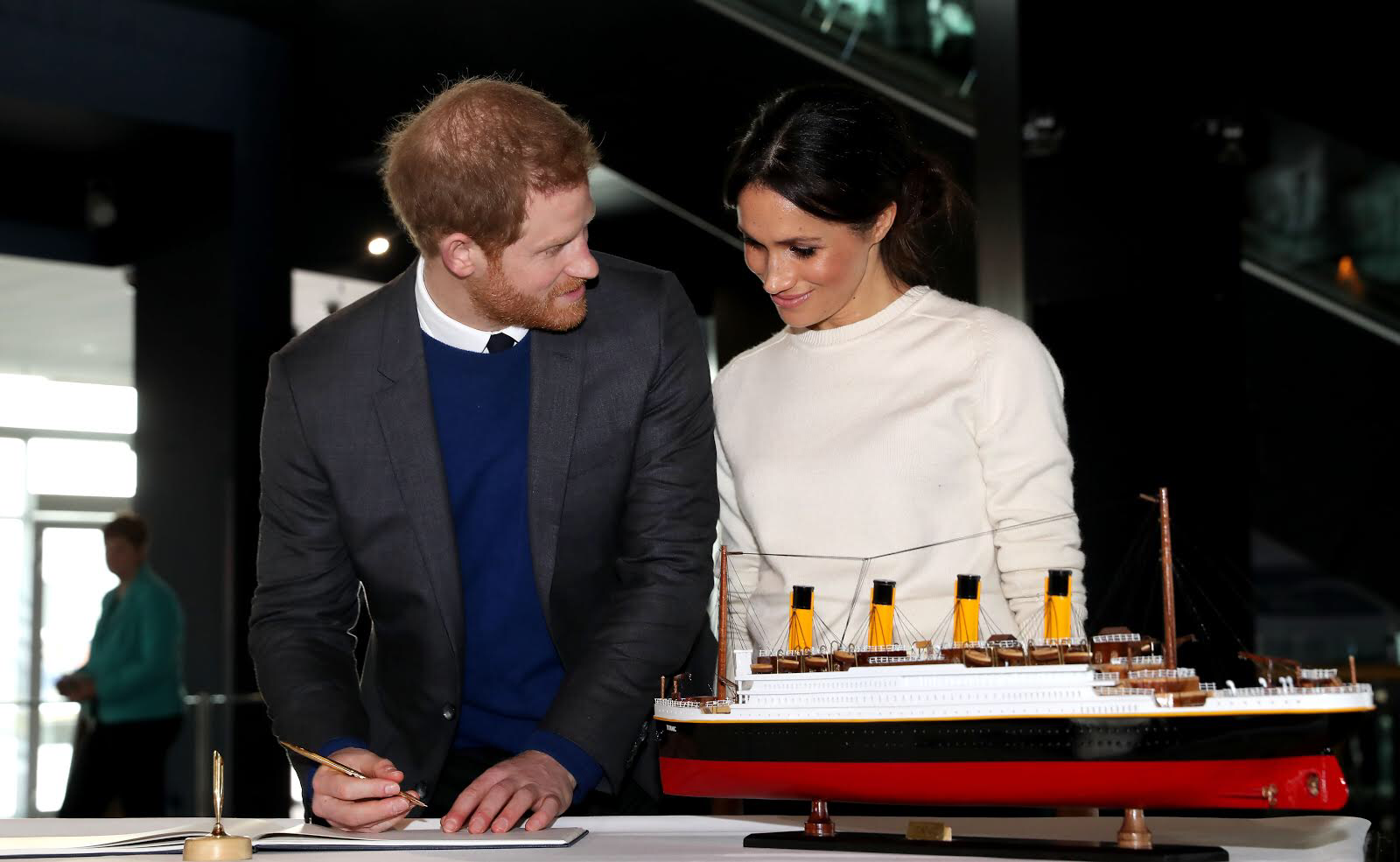
Prince Harry and Meghan Markle visit Titanic Belfast in March 2018.
Photo from the Northern Ireland Office via Wikimedia Commons.
So Harry and Meghan are stepping back. They’re resigning from The Firm. They’re ducking out of the Sovereign Grant and royal duties and going it alone. They’re going to split their time between the UK and North America – think of all the CO2! – and become more “independent”.
Why? Come on, we all know why. Forget the tripe about them fleeing the racism of the UK tabloids and the nonsense about the first DOC (duchess of colour) not being made to feel welcome in the stiff, white House of Windsor. No, H&M, the most right-on royals in history, are breaking off so that they can foist even more woke bollocks on the plebs without having to worry about receiving a tutting phone-call from Her Maj’s press secretary reminding them that they’re royalty and not virtue-signalling Hollywood celebs.
Megxit, as this royal bombshell is wittily being called, is a striking sign of the times. What Harry and Meghan are doing is virtually unprecedented in the history of the royals. They are jacking in their jobs (I say jobs) as senior royals and pursuing a more “financially independent” path that will allow them to earn, travel and – this is important – jabber on about their pet concerns and causes as much as they like.
Even leaving aside the fact that they won’t actually be financially independent – they’ll still get wads of cash from the Duchy of Cornwall and will still stay in that Frogmore Cottage us British taxpayers just splashed 2.4million quid on – still their move is a startling and concerning one.
What it fundamentally reveals is the incompatibility of the modern culture of narcissism with the values of duty, loyalty and self-negation traditionally associated with royal life. To someone like Meghan, who sprang from celebville, who sees herself as the embodiment of right-on goodness, and who loves nothing more than advertising her eco-virtue and performing her PC credentials, life in the British monarchy was never going to be a good fit.
Yes, the woke agenda Meghan expresses so well shares much in common with the old-world elitism of the monarchical system. Both obsess over inherited characteristics (the woke bang on about race and gender, the monarchy is all about bloodline). Both have a penchant for looking down their noses at the little people. And both have an instinctive loathing for modernity, from Charles’ longstanding conservationism to H&M’s humanity-bashing eco-hysteria.
“Light in the Black” – United Nations Peacekeeping – Sabaton History 049 [Official]
Sabaton History
Published 9 Jan 2020The United Nations were created to avoid any future human suffering and all-out conflict. Numerous peacekeeping missions had the goal to deescalate and protect the innocent. However, the success and usefulness of the UN is still quite ambiguous. The Sabaton song “Light in the Black” is about the UN peacekeeping missions and we tell you about the history.
Support Sabaton History on Patreon: https://www.patreon.com/sabatonhistory
Listen to Attero Dominatus (where “Light in the Black” is featured):
CD: http://bit.ly/AtteroDominatusStore
Spotify: http://bit.ly/AtteroDominatusSpotify
Apple Music: http://bit.ly/AtteroDominatusAppleMusic
iTunes: http://bit.ly/AtteroDominatusiTunes
Amazon: http://bit.ly/AtteroDominatusAmzn
Google Play: http://bit.ly/AtteroDominatusGooglePlayListen to Sabaton on Spotify: http://smarturl.it/SabatonSpotify
Official Sabaton Merchandise Shop: http://bit.ly/SabatonOfficialShopHosted by: Indy Neidell
Written by: Markus Linke and Indy Neidell
Directed by: Astrid Deinhard and Wieke Kapteijns
Produced by: Pär Sundström, Astrid Deinhard and Spartacus Olsson
Creative Producer: Joram Appel
Executive Producers: Pär Sundström, Joakim Broden, Tomas Sunmo, Indy Neidell, Astrid Deinhard, and Spartacus Olsson
Production Intern: Rune Væver Hartvig
Post-Production Director: Wieke Kapteijns
Edited by: Iryna Dulka
Sound Editing by: Marek Kaminski and Karolina Dolega
Maps by: Eastory – https://www.youtube.com/c/eastoryArchive by: Reuters/Screenocean https://www.screenocean.com
Music by Sabaton.Sources:
RijksmuseumAn OnLion Entertainment GmbH and Raging Beaver Publishing AB co-Production.
© Raging Beaver Publishing AB, 2019 – all rights reserved.

Pierre Poilievre’s bid for federal Conservative leader
Chris Selley on the varying reactions to the notion of Pierre Poilievre as Andrew Scheer’s replacement:
Glee is spreading among Liberal partisans at the thought of Pierre Poilievre succeeding Andrew Scheer as Conservative leader. The theory is he is so pugnacious, so obnoxious, so poisonously, sneeringly partisan as to be literally unelectable.
Conservative MP Pierre Poilievre at a Manning Centre event, 1 March 2014.
Manning Centre photo via Wikimedia Commons.It is true that the man longtime Conservative cabinet minister John Baird nicknamed “Skippy,” in tribute to his enthusiastic Question Period performances, does not suffer from an excess of gravitas — though Poilievre’s reported support for his leadership bid from Baird and Jenni Byrne, a former senior adviser to Stephen Harper, lend him some within party ranks. His candidacy hasn’t made any measurable dent thus far in public opinion polls. And the opposition war rooms would certainly have fun unpacking his baggage.
Never mind Poilievre questioning the value-for-money proposition of compensating residential school victims (for which he apologized), or his use of the term “tar baby” in the House of Commons (for which he did not, and nor should he have, because it was a perfectly apt and inoffensive analogy in the context he used it), or the dreaded Green Light from the Campaign Life Coalition. Having been Harper’s parliamentary secretary, Liberals will blame him for every supposed atrocity of the Harper era.
All that said, the notion that people widely viewed as pugnacious, obnoxious and partisan-to-a-fault can’t win in Canadian politics is belied by reality. A quick glance around the federation brings Jason Kenney, Doug Ford and Justin Trudeau immediately to mind.
That’s not to say they won because of those character traits: Kenney’s and Ford’s leadership opponents would likely have fared just as well. Trudeau hoodwinked many with his Sunny Ways fraud, but he might well have won as the classic born-to-rule Liberal he turned out to be. If his government continues venting credibility at the rate it established late in its first mandate, the next Conservative leader could well become prime minister no matter who he is.

After recounting the dismal tale of Sheer’s “leadership”, Selley recounts a favourite story about Boris Johnson which contrasts strongly with the Milk Dud’s occupancy of the job.
Again, that degree of swagger and eloquence is far too much to ask of Canadian politicians. But it shouldn’t be too much to ask a party leader to have enough confidence in his party, his members, his movement and his ideas to arouse him to at least some degree of annoyance when they’re unfairly deprecated. If Conservative members aren’t excited by the prospect of a Poilievre leadership, they shouldn’t be half as mortified as Liberals think they should be.
QotD: Deciding what is “newsworthy”
The idiosyncracies of historical remembrance of battle do not hinge alone on the presence of a Socrates or Teddy Roosevelt in the ranks. Sometimes there are wild cards of culture and politics as well. In this case and at this time, the fact that Israelis fit the stereotype of affluent and proud Westerners abroad while the Palestinians were constructed as impoverished and oppressed colonial subjects brought to the equation the sympathies of influential Americans and Europeans in the media, universities, and government — the prominent and sometimes worrisome elites who determined to send their reporters, scholars, and diplomats to Jenin rather than to Islamabad or Grozny.
Victor Davis Hanson, Ripples of Battle, 2004.
January 9, 2020
QotD: National music
James Lileks, Screedblog, 2005-07-08.
January 7, 2020
Isaac Asimov at 100 … ish
It’s probably the centenary year for the late Isaac Asimov, but the date is only approximately correct:
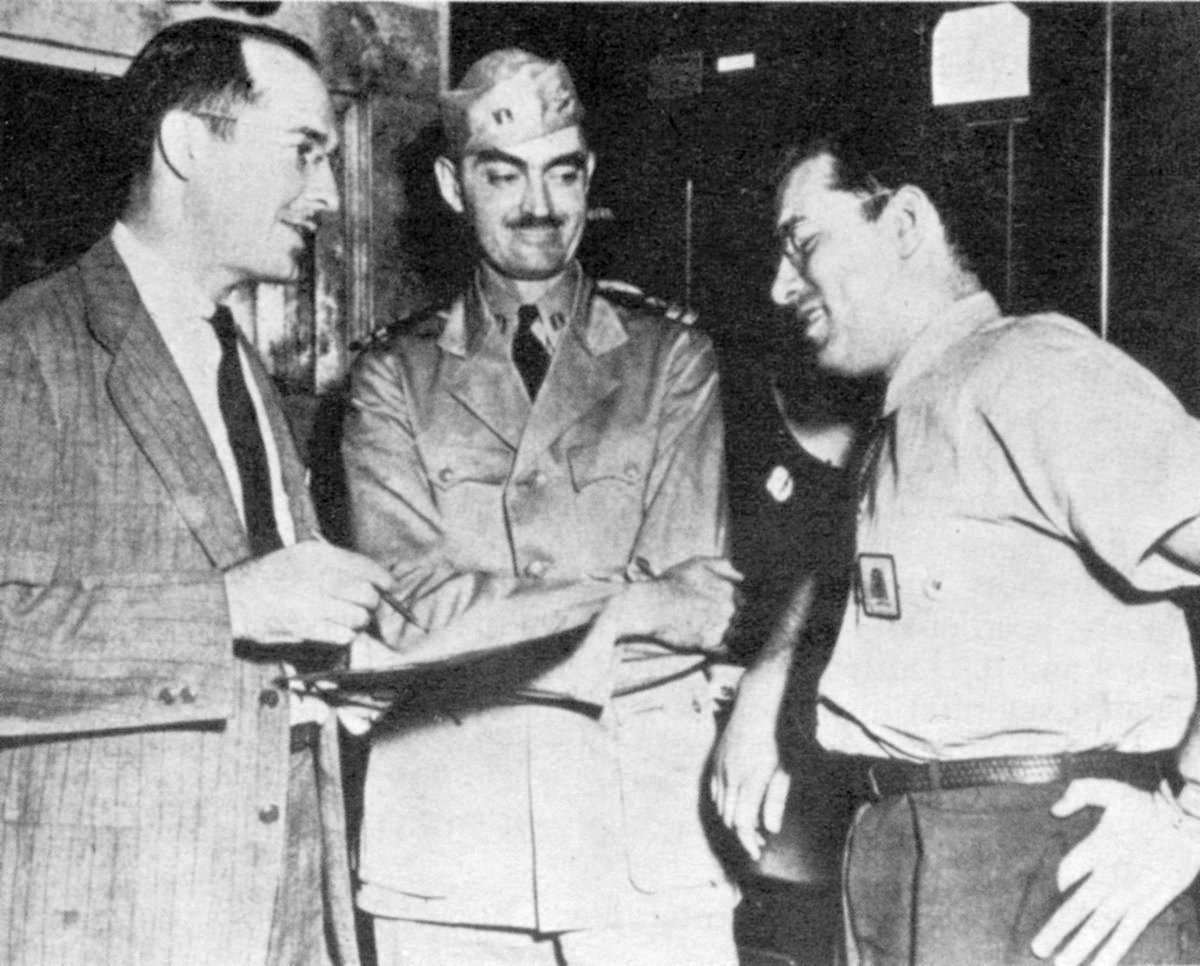
Robert Heinlein, L. Sprague de Camp and Isaac Asimov at the Philadelphia Navy Yard in 1944.
US government photo via Wikimedia Commons.
In actual fact the centenary is a bit of a fudge because Asimov never knew his actual birthday and picked January 2 as a likely date, and one that allowed for an extra holiday after the Christmas festivities. He was born around the turn of the year in 1920, three years after the Russian revolution, in the Soviet town of Petrovichi, although he emigrated to the US at the age of three.
Like many Russian Jews the family moved to Brooklyn in New York, and Asimov’s father ended up running a confectionery store and newsagent. Asimov taught himself to read at the age of five and taught his sister too, and consumed the pulp science fiction magazine stocked in his father’s shop.
At the age of 15 he applied to Columbia but was rejected, ostensibly on age grounds but, as he wrote in his autobiography I, Asimov, he recounted that the university had filled its quota of Jews for the year. After multiple rejections he eventually earned his Master of Arts degree in chemistry in 1941 and earned a Doctor of Philosophy degree in chemistry in 1948, serving as a civilian in the US Army in the Second World War.
An academic career beckoned and in 1949 he joined the Boston University School of Medicine as a biochemistry teacher. But by then he had already been getting science fiction short stories published for nearly ten years. In 1950 he wrote his first book and largely abandoned his teaching career, finding writing more lucrative and enjoyable.
[…]
Some thought Asimov had peaked as a science fiction writer by the mid 1960s, as he spent the next few years writing a lot of popular science books, non-fiction and school textbooks. He was even asked by Paul McCartney to write a science fiction musical for his then-band Wings, although the idea was eventually dropped.
But in the 1970s he came back into the SF fold with a series of books and short stories, winning two Hugo and two Nebula awards in the decade. He was also involved in some television and film work, having acted as a consultant on Star Trek in the 1960s.
In 1981 he was approached by a publisher to return to the Foundation series and add more to the canon. Foundation’s Edge was published the next year year, to wide acclaim. This was followed by Foundation and Earth in 1986, Prelude to Foundation in 1988, and finally Forward the Foundation, which was published in 1993, one year after Asimov’s death.
January 6, 2020
The Nazis, The British Accent, and BBC News
Today I Found Out
Published 29 Apr 2016In this video:
The British Broadcasting Corporation (BBC) is an institution known and respected the world over for its relative impartiality and objectivity compared to many other news sources, with numerous surveys showing that the BBC is one of the most trusted sources of news in both the UK and the US. But we’re not here to talk about that. We’re here to talk about dinner jackets, Received Pronunciation, the Nazis, and what all of this has to do with the BBC News.
Want the text version?: http://www.todayifoundout.com/index.p…
Sources:
http://www.bl.uk/learning/langlit/sou…
https://books.google.co.uk/books?id=B…
http://www.bbc.co.uk/voices/yourvoice…
https://books.google.co.uk/books?id=Q…
http://news.bbc.co.uk/aboutbbcnews/sp…
https://books.google.co.uk/books?id=c…
http://www.theguardian.com/uk/2008/ap…
https://en.wikipedia.org/wiki/John_Re…

Gerontophobia – “the most acceptable, widespread prejudice in society today”
In Spiked, Ella Whelan discusses one form of prejudice that is not only common, it’s practically proselytizing for new members:
Have you found yourself grimacing at Zimmer frames on the bus? Do you revel in checking the latest census data to see the average age of the nation? Do you retweet sarky comments about “youthquakes” shaking out the old fuddy-duddies? If so, you might be suffering from gerontophobia – the fear and loathing of old people – which is the most acceptable, widespread prejudice in society today.
Ageism is the one “ism” that is given a free pass. Hating on granny is all the rage. Recently, former US president Barack Obama made headlines by talking about “old people … not getting out of the way”.
The 58-year-old is not the only older politician to turn against his age group. Since the Brexit vote, 76-year-old Vince Cable has been railing against older Leave voters. On a panel with me at the How the Light Gets In festival last year, he drew laughs from a Hampstead crowd for mocking Brexit as a “Zimmer-frame revolution”. The author Ian McEwan also denounced his fellow septuagenarians when he delightedly predicted that by 2019, “1.5 million oldsters, mostly Brexiters, freshly in their graves” could swing public opinion towards remaining in the EU.
The phrase “OK Boomer” went viral last year after a young person posted a clip of herself reacting to a “baby boomer” complaining about “snowflakes” and overgrown teenagers. This derisory response of “OK Boomer”, used to shut down the so-called Baby Boomer generation, was also used by Netflix in one of its social-media posts. It was even used earnestly in the New Zealand parliament by Green politician Chlöe Swarbrick in response to an older colleague.
The instant popularity of the phrase signalled how normalised generational divides have become. There have always been tensions between younger and older generations, but never before has there been so much celebration of youngsters deriding their parents. Rather than rebelling against the old and changing the world, the OK Boomer phenomenon shows how little young people want to interact with older generations, instead preferring petulant put-downs.
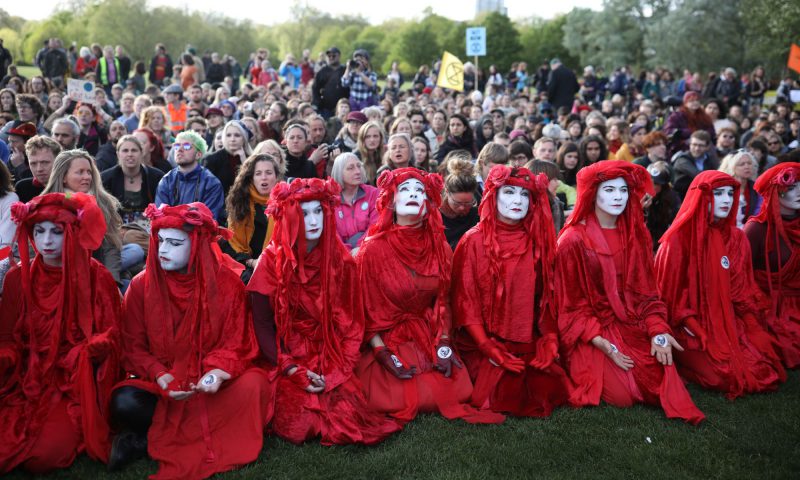
Perhaps the most pronounced and sinister ageism came from the wave of interest in Extinction Rebellion (XR), Greta Thunberg and the climate-emergency panic. From Thunberg being named Time person of the year after blaming older generations for stealing “my dreams and my childhood” to XR Youth proclaiming that “adults need to be accountable to the young people”, climate activism isn’t very oldie friendly. Instead of asking questions about what political changes might be made to help the planet, and, more importantly, the people living on it, environmentalism has veered towards a cultish celebration of youth. Fawning adults have handed over all moral authority to schoolchildren.

Greta Thunberg at the EU Parliament, 16 April, 2019.
European Parliament photo via Wikimedia Commons.
January 5, 2020
Based On vs Inspired By
History Buffs
Published 20 Oct 2017SUPPORT HISTORY BUFFS ON PATREON
https://www.patreon.com/HistoryBuffs
January 4, 2020
Australia, the firebug country
Arthur Chrenkoff rounds up the surprisingly numerous reports of arson over the last few months in Australia:

The Green Wattle Creek bushfire moves towards the Southern Highlands township of Yanderra as police evacuate residents from Yanderra Road, 21 December, 2019.
Photo by Helitak430 via Wikimedia Commons
According to my calculations and estimates, the number of individuals around Australia whose arson has contributed to the current bushfire crisis has now passed 200.
This figure is not presented as a counter-argument to those who blame the fires on climate change. Most people (I hope) understand that trees tend not to spontaneously combust, no matter what the air temperature is; when we talk about bushfires starting naturally, we are talking about lightning strikes igniting tinder. The climate change argument posits that the more extreme weather conditions – higher temperatures, drought, etc. – make fires, however started, much more destructive and much more difficult to control and extinguish. These are debates to be had between climatologists, forestry experts and fire fighters. What is painfully clear, however, that Australia has a firebug crisis. It will no doubt be up to future royal commissions and inquiries to calculate exactly what proportion of the current loss and destruction can be attributed to human action, but I suspect it will be a significant one. Man might be making climate change, but man is most definitely making fires start.
Below, a sample of news reports from around the country for the past several months.
[…]
There are no conspiracies here. Though arson has been tried and called for before as a tool of terror, the Australian fires seem to result from the actions of unconnected individuals who are either disturbed or reckless. This is nothing new; as ecological criminologist Paul Read wrote back in November:
A 2015 satellite analysis of 113,000 fires from 1997-2009 confirmed what we had known for some time — 40 per cent of fires are deliberately lit, another 47 per cent accidental. This generally matches previous data published a decade earlier that about half of all fires were suspected or deliberate arson, and 37 per cent accidental. Combined, they reach the same conclusion: 87 per cent are man-made …
If I had to guess, I’d say about 10,000 arsonists lurk from the top of Queensland to the southern-most tip of Victoria, but not all are active and some light fires during winter. The most dangerous light fires on the hottest days, generally closer to communities and during other blazes, suggesting more malicious motives. Only a tiny minority will gaze with wonder at the destruction they have wrought, deeply fascinated and empowered. Others get caught up with the excitement of chaos and behave like impulsive idiots.
As for children, they are not always malicious. Children and youths follow the age-crime curve where delinquency peaks in their late teens. Fire is just one of many misbehaviours. The great majority grow out of it. Four overlapping subgroups include: accidental fire-play getting out of control; victims of child abuse — including sexual abuse — and neglect; children with autism and developmental disorders; and conduct disorder from a younger age, which can be genuinely dangerous.
The more fires, proportionally the more arsonists. And the recent mega-fires are really bringing out all the fire bugs out of the woodwork (or into the woodwork to be more accurate). It is disturbing, but sadly not surprising or unexpected. As some have suggested already, the current crisis, with its large sample of arsonists, provides a good opportunity for more research into the psychology, motivation and behaviour of fire-starters. This might help in the future, but clearly arsonists will always be with us. The task is to make their work more difficult, for example through better management of our forests to make them less combustible. But as much as bushfires are an environmental and land management problem, as we search for solution we can’t forget that they are also a criminal one.
January 3, 2020
“Union” – Battle of Monte Cassino – Sabaton History 048 [Official]
Sabaton History
Published 2 Jan 2020In early 1944, as the Allies are nearing Rome, Albert Kesselring orders a defensive line the likes of which rivals some of history’s greatest fortifications. Here, with the old hilltop abbey Monte Cassino looking down on the two front, the Axis and the Allies duel it out in a bloody and tiring fight for control of central Italy…
Support Sabaton History on Patreon: https://www.patreon.com/sabatonhistory
Listen to The Art Of War (where Union is featured):
CD: http://bit.ly/TheArtOfWarStore
Spotify: http://bit.ly/TheArtOfWarSpotify
Apple Music: http://bit.ly/TheArtOfWarAppleMusic
iTunes: http://bit.ly/TheArtOfWariTunes
Amazon: http://bit.ly/TheArtOfWarAmz
Google Play: http://bit.ly/TheArtOfWarGooglePlayListen to Sabaton on Spotify: http://smarturl.it/SabatonSpotify
Official Sabaton Merchandise Shop: http://bit.ly/SabatonOfficialShopHosted by: Indy Neidell
Written by: Markus Linke and Indy Neidell
Directed by: Astrid Deinhard and Wieke Kapteijns
Produced by: Pär Sundström, Astrid Deinhard and Spartacus Olsson
Creative Producer: Joram Appel
Executive Producers: Pär Sundström, Joakim Broden, Tomas Sunmo, Indy Neidell, Astrid Deinhard, and Spartacus Olsson
Production Intern: Rune Væver Hartvig
Post-Production Director: Wieke Kapteijns
Edited by: Iryna Dulka
Sound Editing by: Marek Kaminski
Maps by: Eastory – https://www.youtube.com/c/eastoryArchive by: Reuters/Screenocean https://www.screenocean.com
Music by Sabaton.Sources:
– Narodowe Archiwum Cyfrowe
– National Portrait Gallery
– Bundesarchiv
– National Army Museum
– IWM E446, E 3020E, MH 1557, NA 12895, NA 15139, MH 6352, MH 11250, NA15141, C4363, HU 16546, NA 9807, NA 13274
– Soldiers of 100th Infantry Battalion during the Battle of Monte Cassino courtessy of Bco100bn from Wikimedia Commons
– Gebirgsjäger in position in Saltdal in 1940, Courtessy of Rudi Margreiter through Arkiv i Nordland
– Fondo Antiguo de la Biblioteca de la Universidad de SevillaAn OnLion Entertainment GmbH and Raging Beaver Publishing AB co-Production.
© Raging Beaver Publishing AB, 2019 – all rights reserved.

Magical thinking in names
Theodore Dalrymple relates the rather odd story of a young girl’s media-publicized objection to a math problem in school and then considers the girl’s given name in the larger context:
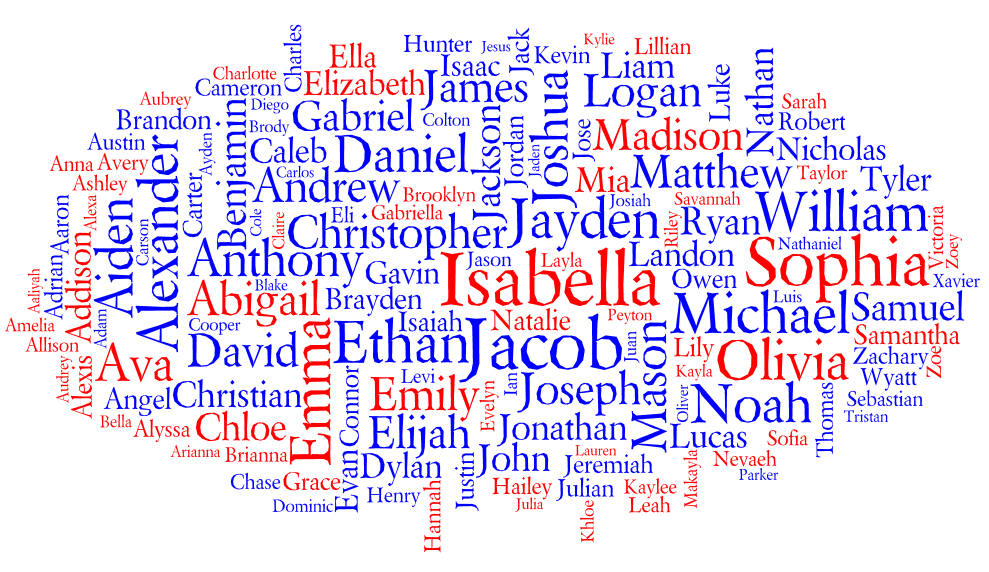
Popular first names in the United States, 2010.
Image from Behind the Name.
My attention was also caught by the first name of the politically-correct child: Rhythm. This is not a traditional name, though not actually ugly; but her parents have evidently accepted the increasing convention of giving a child an unconventional, and sometimes previously unheard of, name. This is a worldwide, or at least occident-wide, phenomenon. In Brazil, for example, parents in any year give their children one of 150,000 names, most of them completely new, made up like fake news, and in France, 55,000 children are born every year who are given names that are shared by three or fewer children born the same year. This latter is all the more startling because, until 1993, there was an old Napoleonic law (admittedly not rigidly enforced) that constrained parents to choose among 2000 names, mainly those of either saints or classical heroes.
What does the phenomenon of giving children previously unheard-of names signify — assuming that it signifies something? I think it is symptomatic of an egoistic individualism without true individuality, of self-expression without anything to express, which is perhaps one of the consequences of celebrity culture.
I performed an internet search on the words Rhythm as a given name. I soon found the website of a group called the Kabalarians, who believe that the name given to a child determines, or at least contributes greatly, to its path through life, especially in conjunction with the date of birth:
When language is used to attach a name to someone this creates the basis of mind, from which all thoughts and experiences flow. By representing the conscious forces combined in your name as a mathematical formula, one’s specific mental characteristics, strengths and weaknesses can be measured.
It invited readers to inquire about the psychological characteristics and problems of people with various given names. I invented a child called Rhythm of the same age, more or less, as Rhythm Pacheco. This was the result:
The name of Rhythm causes this child to be extremely idealistic and sensitive. She will find it difficult to overcome self-consciousness and to express her deeper thoughts and feelings in a free, natural way. She is too easily hurt and offended, and will often depreciate her own abilities. Because of her lack of confidence and her sensitivity, she will go to great lengths to avoid an issue. True affection, understanding, and love mean a great deal to her, as she is a romantic and emotional youngster. Often she will resort to a dream world when her feelings are hurt. She could be very easily influenced by others, for she will find it difficult to maintain her individuality. This problem could become more predominant during the teenage years. Although there is much that is refined and beautiful about her, the lack of emotional control could bring much unhappiness, repression, misunderstanding and loneliness later in life. Tension could also create fluid and respiratory problems. Because of the sensitivity created by this name, she will find it difficult to cope with the challenges of life.
There is, in fact, a semi-serious theory of nominative determinism, according to which a name may influence a person’s choice of career: two of the most prominent British neurologists of the first half of the twentieth century, for example, were Henry Head and Russell Brain. A recent Lord Chief Justice of England was called Igor Judge. And surely it must work in a negative direction too: no poet could be called Albert Postlethwaite. However rational one believes oneself, one might also experience a frisson of fear on consulting a doctor called Slaughter — as was called the doctor and popular novelist Frank G. Slaughter.
When I first went to Africa, I encountered patients whose first names were Clever, Sixpence or Mussolini. The first of these names was presumably an instance of magical thinking, while the second two were chosen merely because the naming parents liked the sound of them. Years later, during the civil war in Liberia, I met a constitutional lawyer called Hitler Coleman, who presumably desired to live his name down by concerning himself with the rule of law.
January 2, 2020
QotD: Anime
Friend A: “Anime by itself isn’t supposed to be cringy. There’s lots of good anime out there.”
Friend B: “Intentional or not, that’s the effect on me.”
Friend A: “Well, what anime have you watched?”
Friend B: “Let’s see… Pantyflash Crisis, Fanservice High School, and Animal-Eared Preteens, I believe.”
I laughed so hard I nearly lost continence.
Tamara Keel, “Overheard Online…”, View From The Porch, 2019-10-16.


