Quotulatiousness

September 20, 2020

The CBC’s latest bit of “mission creep”

Filed under: Business, Cancon, Media — Tags: , , , — Nicholas @ 05:00

At The Line, Jen Gerson wonders what the hell the CBC thinks it’s doing with this move:

Let us take a moment to leverage a little credibility under the CBC’s ass.

What the fuck is the CBC playing at, here? The corporation receives a cool $1 billion in public funding per year and it’s using taxpayer funds to, yet again, horn into the revenue streams of private communications outlets. No one — literally not a single Canadian taxpayer who isn’t already employed by the CBC — wants to throw money at a public broadcaster so that it can: “Help Canada’s strongest brands shape and share inspiring stories across our platforms and across the country.” Vomit.

No one asked for a taxpayer-funded advertising firm, you goddamn loons.

This is yet another classic example of one of the most dysfunctional habits of the MotherCorp: mission creep. A massive and rudderless operation unfettered from the practical limitations of profit-seeking has proven itself unable to restrain its own boneheaded impulses.

We, at The Line, can hear the pitiable defences already: “Oh, but they’re already underfunded. Of course they need to, uh, use their incredible taxpayer-funded competitive advantage to eat into the dwindling revenue streams of failing private media outlets just to survive!”

No. No. No they do not.

When faced with a dysfunctional hydra-headed cultural behemoth that is demonstrably incapable of keeping its mandate in its pants, the first impulse should not be to shovel ever-more taxpayer funds into the ever-widening maw. The CBC could respond to *cough* “inadequate funding” by narrowing its scope and focus to the things that make it most necessary to the Canadian public that it serves — radio, news, documentary, serving regions and topics that the private sector cannot adequately penetrate. Instead it goes off and does weird shit like this, and CBC Comedy, and CBC Music.

CBC. Guys.

You cannot be everything to everyone. You shouldn’t be everything to everyone. Canadians are not well served by a monopolistic government-funded one-stop #content communications shop. Figure out what you do best and stick to it. Focus on supplementing — rather than crushing — private-sector journalism. Maybe even consider ways to support private-sector start ups and independents, especially in local markets. “Revenue generation” is not the place where a public broadcaster should demonstrate self-defeating, industry-following innovation.

Andrew Sullivan on the politically deranging effects of social media addiction

Filed under: Media, Politics, Technology, USA — Tags: , , , , , — Nicholas @ 03:00

In his latest Weekly Dish installment, Andrew Sullivan decries the extreme polarization of the US electorate and points an accusing finger at social media for making things much worse:

An Electoral College victory for Trump, if he loses the popular vote again, would, in this new elite consensus, prove beyond doubt the centuries’ long grip of “white supremacy”. Some are already calling such a victory illegitimate, even though it would be completely constitutional, under the rules everyone has agreed to. The sickening street violence that the far left has downplayed, and permitted to run riot in major cities could be a mere taste of what is to come — along with ever-stronger white nationalist gangs instigating or responding in kind. (Trump’s toleration of this dangerous right-extremism in the past four years is as unforgivable as the left’s excuses for murderous violence.) But the upshot is the same: we will be lucky if the country doesn’t erupt in large-scale civil violence by the end of all this.

And the reason this dystopian scenario is so credible is not just the fault of these political actors. It’s ours too — thanks to the impact of social media. I think we’ve under-estimated just how deep the psychological damage has been in the Trump era — rewiring the minds of everyone, including your faithful correspondent, in ways that make democratic discourse harder and harder and harder to model. The new Netflix documentary, The Social Dilemma, is, for that reason, a true must-watch. It doesn’t say anything shockingly new, but it persuasively weaves together a whole bunch of points to reveal just how deeply and thoroughly fucked we are. Seriously, take a look.

The doc effectively shows how the information system necessary for democratic deliberation has, in effect, been jerry-rigged in the last decade to prevent any reasoning at all. It’s all about the feels, and the irrationality, and the moment, which is why Trump is so perfectly attuned to his time. And what’s smart about the documentary is that it shows no evil genius behind this unspooling, no sinister plot deliberately to destroy our system of government. One of the more basic motives in American life — making money — is all you now need, the documentary shows, to detonate American democracy at its foundation.

For Facebook and Google and Instagram and Twitter, the business goal quickly became maximizing and monetizing human attention via addictive dopamine hits. Attention, they meticulously found, is correlated with emotional intensity, outrage, shock and provocation. Give artificial intelligence this simple knowledge about what distracts and compels humans, let the algorithms do their work, and the profits snowball. The cumulative effect — and it’s always in the same incendiary direction — is mass detachment from reality, and immersion in tribal fever.

With each passing second online, news stories, graphic videos, incendiary quotes, and outrages demonstrate their stunning utility to advertisers as attention seizers, are endlessly tweaked and finessed by AI to be even more effective, and thereby prime our brains for more of the same. They literally restructure our minds. They pickle us in propaganda. They use sophisticated psychological models to trap, beguile, outrage, and prompt us to seek more of the same.

[…]

And online is increasingly where people live. My average screen time this past week was close to ten hours a day. Yes, a lot of that is work-related. But the idea that I have any real conscious life outside this virtual portal is delusional. And if you live in such a madhouse all the time, you will become mad. You don’t go down a rabbit-hole; your mind increasingly is the rabbit hole — rewired that way by algorithmic practice. And you cannot get out, unless you fight the algorithms to a draw, or manage to exert superhuman discipline and end social media use altogether.

But the thing about algorithms and artificial intelligence is that they don’t rest, they have no human flaws, they exploit every weakness we have, and have already taken over. This is not a future dystopia in which some kind of AI robot takes power and kills us all. It is a dystopia already here — burrowed into our minds, literally disabling the basic mental tools required for democracy to work at all.

If you watch video after video of excessive police force against suspects, for example, and your viewing habits are then reinforced by algorithms so you see no countervailing examples, your view about the prevalence of such excessive force will change, regardless of objective reality. A new study shows how this happens. Watching the videos, even more than reading text about them, raises the percentage of white liberals who believe the cops frequently or always use excessive force by around 20 percentage points. The actual data are irrelevant. The BLM movement this summer was less a racial reckoning, as we’re constantly lectured, than a moment of web-induced mass hysteria.

September 19, 2020

Andrew Heaton attempts to talk to people about politics

Filed under: Humour, Media, Politics, USA — Tags: , , — Nicholas @ 05:00

In his latest missive from deeply singed California, Andrew Heaton expresses some concerns about the American body politic in the late stages of utter emotional breakdown (that is, the last couple of months of the election):

I’m going to go out on a limb here and say that the political climate is going to “heat up.” Although the heat comes from a different fault line than you might think. The real division in America isn’t between conservatives and progressives. It’s between people who read stuff, and people who TYPE IN ALL CAPS ON TWITTER.

I’m pretty firmly in the “read stuff” camp. Which makes me poorly situated for our current period, as I am a quarter Vulcan on my father’s side, and it’s overwhelmingly in vogue to be emotionally incontinent. Emotionally incontinent people don’t care for us pseudo-Vulcans. Perhaps you can relate?

This is a normal conversation for me:

    Friend: Trump is an evil fascist meat goblin!

    Me: Yeah, I can’t stand that guy. I’m not a big Biden fan, but I definitely prefer him over Trump.

    Friend: But Trump is a racist lunatic!

    Me: Sure. I certainly don’t think he has an ideological core or respect for constitutional rule of law. I have serious misgivings about his leadership. Also he’s horrible on trade.

    Friend: HE’S LOCKING CHILDREN IN CAGES! THE WORLD IS ON FIRE!!! DON’T YOU SEE THAT TRUMP IS THE DEATH OF THIS AND ALL WORLDS!?!?

If you read the above conversation carefully, you might notice that I’m not actually disagreeing with my hysterical friend. In fact we’re broadly in agreement, at least on the 2020 election outcome. So why are they flipping out, like the electoral version of Kermit the Frog flailing his arms in a Muppets sketch?

Here’s why: in political conversations the People Who Read Stuff are interested in exchanging ideas and policies. The ALL CAPS ON TWITTER crowd wants to exchange feelings.

If your hysterical conservative friend is laying eggs about Antifa ushering in the Night of the Long Knives, or your progressive friend is freaking out about Trump ushering in The Night of the Long Knives, what you say or think is immaterial — they are looking for you to match their emotional state. If you don’t, it means you’re probably making a buck selling knives.

This is a problem in my social life. I have learned that my feelings are fickle and easy to manipulate, and so distrust them. I take pride in my Vulcan heritage. When confronted with a big, scary problem, I believe the best response is to get calm and thoughtful. In Vulcan culture we call this “acting like an adult.”

Unfortunately equanimity is not popular on this planet. It’s trendy to experience feelings so hard that neurochemicals seep out of your pores, the way alcoholics sweat vodka.

You can subscribe to the newsletter here.

QotD: Dictatorship of the Cancel Culture proletariat

Filed under: Cancon, Media, Politics, Quotations, Sports, USA — Tags: , , , , — Nicholas @ 01:00

This sort of thing is, to put it mildly, not good. There are at least three major problems with cancel culture. First, almost anyone could be cancelled, on the basis of the (claimed) standards prevalent on the modern “social justice” left. Secondly, cancellation tends in practice to be a non-random process targeted at political and ideological opponents, rather than a genuine attempt at a new moral standard. Finally, and most importantly, the declaration by wokesters that many conversations are now simply off-limits prevents the communication of important information that would make it possible for citizens better to judge the arguments of movements like Black Lives Matter.

While not the most important, the first of these points is the most relevant on a day-to-day basis. Without endorsing these behaviours, the plain fact is that the huge majority of people have probably at some point told an ethnic or regional joke, sent a pornographic or un-PC snap, had sex while intoxicated, used a slur tied to sexual orientation / race / gender online or in the lockerroom, worn a St Paddy’s Day or Cinco de Mayo outfit they would really prefer a mulligan on, or committed other Cardinal Sins against Wokeness. As a result of this, many young people are intently aware that Twitter and Facebook wars involving the unearthing of old content generally end with egg on the face of everyone involved. Caucasian NBA point guard Donte DeVincenzo was humiliated in late 2018 by the revelation that – at age 14 – he had described his hoops handle as “ballin’ on these nig*as like I’m Derrick Rose”. He ended up deleting his entire social-media presence. The point of monitoring this sort of thing, for the many people and organisations that do so, is not punishing the tiny minority of real racists and abusers out there so much as keeping normal citizens too terrified by the potential unearthing of past indiscretions to comment lustily on the issues of the day.

The fact that virtually anyone could in fact “legitimately” be cancelled leads into extreme partisan hypocrisy. While anyone who attended church as a lad might correctly suspect that the hard right is capable of similar behaviour, cancellers today are overwhelmingly concentrated on the “social justice” left – and they are, at least occasionally, reluctant to eat their own. This often results in remarkable and hilarious double standards. In February 2018, for example, liberal Virginia governor Ralph Northam – nicknamed “Coonman” – escaped any serious censure after he was revealed to have apparently appeared in a mid-1980s high-school yearbook photo wearing shoe-polish blackface.

To be fully fair to Northam, the same photo included a student dressed in full white robes as a Ku Klux Klansman, and CNN has noted that Northam has never actually said “whether he was wearing the Ku Klux Klan outfit or [the] blackface”. Oh, fair enough. At any rate, he serves as governor of Virginia today. Not to be outdone by any of his neighbors to the south, Canadian prime minister Justin Trudeau was revealed that same year to have worn black- and brown-face several times, and as late as 2001, once apparently painting his entire body to appear in costume as Aladdin at an Arabian Nights revue! He, too, remains solidly entrenched in office today.

Wilfred Reilly, “They can’t cancel all of us”, Spiked, 2020-06-17.

September 18, 2020

“The Last Battle” – The Strangest Fight of WWII – Sabaton History 085 [Official]

Filed under: Germany, History, Media, Military, USA, WW2 — Tags: , , , , — Nicholas @ 04:00

Sabaton History
Published 17 Sep 2020

On the 5th of May 1945, the Second World War in Europe is literally in its final days. As the German lines and Nazi state collapse into free fall, some Nazi hardliners remain fighting until the very moment surrender is announced. At Castle Itter, the lines are blurred as US and German soldiers fight side by side in a medieval castle, home to some of the highest profile prisoners of the war.

Support Sabaton History on Patreon: https://www.patreon.com/sabatonhistory

Listen to “The Last Battle” on the album The Last Stand:
https://music.sabaton.net/TheLastStand

Watch the Official Lyric Video of “The Last Battle” here:
https://www.youtube.com/watch?v=BwfJs…

Listen to Sabaton on Spotify: http://smarturl.it/SabatonSpotify
Official Sabaton Merchandise Shop: http://bit.ly/SabatonOfficialShop

Hosted by: Indy Neidell
Written by: Markus Linke and Indy Neidell
Directed by: Astrid Deinhard and Wieke Kapteijns
Produced by: Pär Sundström, Astrid Deinhard and Spartacus Olsson
Creative Producer: Maria Kyhle
Executive Producers: Pär Sundström, Joakim Brodén, Tomas Sunmo, Indy Neidell, Astrid Deinhard, and Spartacus Olsson
Community Manager: Maria Kyhle
Post-Production Director: Wieke Kapteijns
Editor: Iryna Dulka
Sound Editor: Marek Kaminski
Maps by: Eastory – https://www.youtube.com/c/eastory
Archive: Reuters/Screenocean – https://www.screenocean.com
Sources:
– Photos of the Itter Castle: Sammlung Risch-Lau, Vorarlberger Landesbibliothek
All music by: Sabaton

An OnLion Entertainment GmbH and Raging Beaver Publishing AB co-Production.

© Raging Beaver Publishing AB, 2019 – all rights reserved.

September 16, 2020

The Canadian echo chamber on American political issues

Filed under: Cancon, Media, Politics, USA, Weapons — Tags: , , , , , — Nicholas @ 05:00

Ben Woodfinden’s latest for The Dominion looks at the weird effects political passions in the United States have on political stances in Canada:

Restricted and prohibited weapons seized by Toronto police in a 2012 operation. None of the people from whom these weapons were taken was legally allowed to possess them.
Screen capture from a CTV News report.

Participatory media increasingly defines and shapes our discourse. It submerges us in a broader reality but only does so by filtering it into a digital reality that offers a distorted reflection rather than picture of the real world. This has been going on for at least a decade now, but the pandemic has accelerated this transformation of our discourse and politics. By locking us in our homes the pandemic forces us to view the world through a digital lens even more than we already did, and in a world where we’re all viewing everything through our screens that digital reality becomes closer and closer to our primary reality.

One of the specific, and most pernicious effects of this, as I lamented in The Critic is that it turns us all into online Americans participating in their politics through the digital medium, rendering us virtual participants and not just foreign observers. I won’t repeat myself too much, I’d recommend just reading the piece [link], but the online realm is American, and what digital politics does is make politics everywhere more American. We participate in it as a game and a form of entertainment. This bleeds back into our own politics.

Americanized Discourse

Gun politics is one particular political issue where Americanized discourse is most pronounced. It captures perfectly how Americanization plays out. Every time there is some sort of tragic shooting or discussion of gun violence in Canada the debates play out in depressingly predictable ways. Progressives and Liberals paint a picture in which Canada suffers from the kind of rampant gun violence and mass proliferation of firearms as in America. This is the framing used to justify often highly symbolic or ineffective new gun laws and restrictions that, while often not all that effective, make the Liberals and progressives seem like the party for gun control in the face of this rampant violence. But only if you pretend we live in America.

And it’s not just the Liberals and progressives who play this game. Listen to some of the more vocal advocates of “gun rights” in Canada and you’d think we have a second amendment in the Charter. One side wants to make it seem like Canadians are walking around with and easily able to acquire assault weapons, the other side wishes it were so! The reality of course lies somewhere in between. Gun possession is heavily regulated, but lawful citizens can still buy firearms if they want to, and there is no explicit right in the Charter that prevents the government from regulating and restricting firearms. Talking about gun “rights” in Canada is itself quite a foreign and imported concept. At the same time we don’t have an epidemic of gun violence, and while we have experienced some horrific mass shootings, like the recent Nova Scotia tragedy, gun violence in Canada pales in comparison to the United States.

But because both sides are essentially happy to help paint a phantasmic picture of gun violence and/or gun regulations in Canada, we end up with a surreal politics around guns. Sensible debates around guns are made harder by this because debates take place on top of a framing and narrative that draws explicitly on American political culture more than it does Canada’s. Both sides want to take on American roles and are happy to contribute to this framing.

Gun politics is just one example, and there are so many others. Our discourse is so often built around framings that make it seem as if the issues and political cleavages here are indistinguishable from American ones, but it only happens because we import American framing and narratives into our own discourse and then build are arguments around these phantasms. We, like many other countries around the world, are in the middle of a moment of racial reckoning, or whatever you want to call it, because of something that happened in Minneapolis, not in Canada.

Racism is a real thing in Canada, no honest person should deny this, because there is racism in absolutely every country and society. But in the wake of George Floyd’s killing we ended up having a conversation about racism that reflected the particular ways racism works in America.

September 15, 2020

When you mix up cause and effect

In the Continental Telegraph, Esteban remembers a Reagan bon mot that is still observably true today:

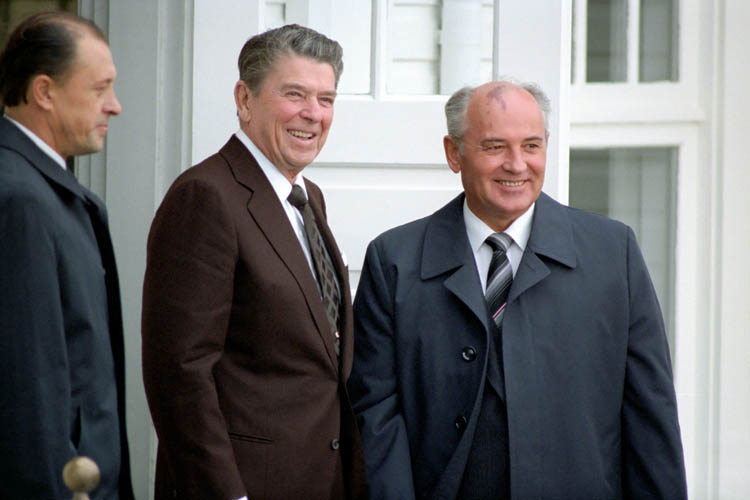
US President Ronald Reagan and Soviet General Secretary Mikhail Gorbachev at the Hofdi House in Reykjavik, Iceland during the Reyjavik Summit in 1986.
Official US government photograph via Wikimedia Commons.

Ronald Reagan once observed that “the trouble with our liberal friends isn’t that they are ignorant, it’s that so much they know isn’t so”. I am repeatedly surprised by Leftists’ ability not to just get something wrong, but to get it spectacularly, 180 degrees wrong.

First, a couple of examples from the archives – some years ago there was an article in the NY Times (or WaPo perhaps) quite distressed that even though crime rates in the U.S. were at historically low levels the percentage of the population in prison was quite high. “Why are we putting so many people in prison when the crime rate is low?” they wondered, seriously. Hmm, how about this – when we put more bad people in prison the crime rate goes down? Keep in mind that the crime rate is what’s happening now, the prison population is who we caught and locked up over the past several years.

Then we had an article in a West Coast newspaper wondering why the homeless population in San Francisco had grown dramatically in recent years despite all the wonderful things the city had done to help them – weekly stipends, free shopping carts, etc. Note that none of this assistance to the homeless enabled them to become independent or required them to better themselves, they were all handouts. How is it that offering lots of goodies to homeless people attracts more of them here?

My point in bringing up these old stories is that it seems impossible that someone could fail to see they had cause and effect reversed. How could someone intelligent enough to write a column get these stories so backwards. The only answer I can see is that their worldview, at least in these areas, flows in only one direction and the underlying premise can never be questioned – putting people in prison is bad, there can be no possible upside, giving homeless people stuff is good, there can be no downside. So, when things get worse it’s a mystery, we can’t reconsider our starting point.

September 11, 2020

Canadian government heading toward “the worst of all worlds on Internet regulation”

Filed under: Business, Cancon, Government, Media — Tags: , , , , — Nicholas @ 05:00

Michael Geist on the bull-headed determination of the Canadian federal government — and specifically Heritage Minister Steven Guilbeault — to “solve” a problem by introducing savagely anti-consumer internet regulations:

Canadian Heritage Minister Steven Guilbeault, 3 February 2020.
Screencapure from CPAC video.

The harm that will come from these policy choices is difficult to overstate. By focusing the tax burden on sales taxes rather than technology company revenues, consumer costs will go up and the company profits will be left untouched. The CRTC powers will lead to years of hearings and follow-on litigation, yielding few tangible benefits for creators. The mandated Cancon contributions will spark trade wars and make Canada a less attractive market for new services leading to fewer choices and less competition, while the link licensing requirement will result in blocked sharing of news articles on social media sites that hurts both Canadians and media organizations. All the while, the issues that really matter – privacy, anti-competitive behaviour, online hate, misinformation, a fair share of tech corporate profits – are left largely untouched.

How did the government end up with the worst of all worlds on Internet regulation?

The starting point was the 2015 election in which it committed to no new Netflix taxes (prompted by a Conservative pledge on the issue) and subsequent consultations on everything from copyright to digital cultural policy. The result was then-Heritage Minister Melanie Joly struggling to honour the no-tax commitment, while satisfying increasingly vocal demands from some stakeholders for one. Those calls increased after the results of her cultural policy consultation were released, which largely focused on a rejection of new Internet taxes and support for net neutrality.

In the aftermath of the Cambridge Analytica scandal, worries about Russian election interference, and Christchurch massacre broadcast live online, the policy winds shifted and the government was clearly looking to become more active on the Internet regulation file. That led to Election Act provisions that were generally viewed as successful. It also paved the way for a 2019 election platform that was far aggressive on social media and the Internet, with commitments to address everything from privacy to hate speech online.

[…]

If the government were to address the real concerns, there would be long-overdue privacy reforms, a more aggressive approach on competition issues, measures to address online hate and misinformation, and pursuit of a global agreement on fair taxation of technology company revenues. If it wants to support increased film production from indigenous groups or help the news sector, it can make those policy choices and use general tax revenues without creating a massive regulatory infrastructure.

Instead, it is turning to the harmful policies noted above that raise consumer costs (digital sales taxes), regulate online Cancon with mandated spending requirements (even though the industry has record production led by Netflix), dispense with any pretense of maintaining net neutrality, lead to blocked sharing of news articles (mandated licence for social media sites merely for linking to news content), and result in services avoiding the Canadian market (market interference in payments from services such as Spotify). Much of this will be overseen by the newly empowered CRTC, leading to lengthy hearings that primarily benefit lawyers. After having badly mishandled Canadian digital policy, the government now seems content to take a pass on the important issues and leave the controversial non-issues to the regulator and the courts.

“Carolus Rex” – Charles XII of Sweden – Sabaton History 084 [Official]

Filed under: Europe, History, Media, Military, Russia — Tags: , , , , , — Nicholas @ 04:00

Sabaton History
Published 10 Sep 2020

In 1697, just 15 years old, Charles XII ascended to the Swedish throne. By the grace of God, he was anointed King — Carolus Rex. Charles would not ask for obedience, nor would he make any concessions to his rule. His authority was divine and his judgment law. Determined to rule the Swedish Empire with absolute power, Charles set out to restore the might and glory of the kingdom.

Support Sabaton History on Patreon: https://www.patreon.com/sabatonhistory

Listen to “Carolus Rex” on the album Carolus Rex:
Carolus Rex (English Version) – https://music.sabaton.net/CarolusRexEN
Carolus Rex (Swedish Version) – https://music.sabaton.net/CarolusRexSE

Watch the Official Live Video of Carolus Rex here:
https://www.youtube.com/watch?v=WhA9B…

Listen to Sabaton on Spotify: http://smarturl.it/SabatonSpotify
Official Sabaton Merchandise Shop: http://bit.ly/SabatonOfficialShop

Hosted by: Indy Neidell
Written by: Markus Linke and Indy Neidell
Directed by: Astrid Deinhard and Wieke Kapteijns
Produced by: Pär Sundström, Astrid Deinhard and Spartacus Olsson
Creative Producer: Maria Kyhle
Executive Producers: Pär Sundström, Joakim Brodén, Tomas Sunmo, Indy Neidell, Astrid Deinhard, and Spartacus Olsson
Community Manager: Maria Kyhle
Post-Production Director: Wieke Kapteijns
Editor: Karolina Dołęga
Sound Editor: Marek Kaminski
Maps by: Eastory – https://www.youtube.com/c/eastory
Archive: Reuters/Screenocean – https://www.screenocean.com
Sources:
Osipov Georgiy and Nokka Tarajan from Wikimedia
Nationalmuseum
All music by: Sabaton

An OnLion Entertainment GmbH and Raging Beaver Publishing AB co-Production.

© Raging Beaver Publishing AB, 2019 – all rights reserved.

QotD: “Karen” and other stereotypes

Filed under: Humour, Media, Quotations, USA — Tags: , , — Nicholas @ 01:00

When I first saw the name “Karen,” used in the plural, apparently for a whole class of women, I did not look it up. Context told me that I wouldn’t have to; that a Karen was simply the updated term for what I formerly knew as a Becky. There are related, more focused terms, such as “Trixie” for a Karen from upscale white Chicago, and so forth. It is one of many reasons to celebrate the black urban lexical culture from which it emerged. The image of a passive-aggressive blonde, with a pony tail, disputing her order at Starbucks, comes quickly to mind. She will be married to a “Chad” whom she met in law school.

I love stereotypes. They help us understand what the Greeks called syndromes, carrying them beyond the narrow world of medical jargon. “Karen” began as the stereotype for the woman who “wants to see the manager,” but was soon extended through a gallery of related traits. One thinks affectionately through a shortlist of the Karens one has known. For the Christian, it can impact one’s prayer life. (I found myself once praying for a certain Karen Surname, then spontaneously extending it to “Karens everywhere,” with a memorial for the Beckies. I noticed as I searched my memory that many of these Karens were biologically male.)

And today I wonder, as I have often done, at the genius of colloquial language, and the unerring way with which it uncovers fresh stereotypes, that enhance our perception of reality, in a way like painting and the other fine arts. (In a lost portrait, Leonardo depicted a Karen of the Renaissance.)

David Warren, “Karens & their kind”, Essays in Idleness, 2020-06-10.

September 9, 2020

Today’s intelligentsia: helpless captives of their uber-woke disciples

Filed under: Education, Media, Politics, USA — Tags: , , , , — Nicholas @ 05:00

Theodore Dalrymple on the temptations of power:

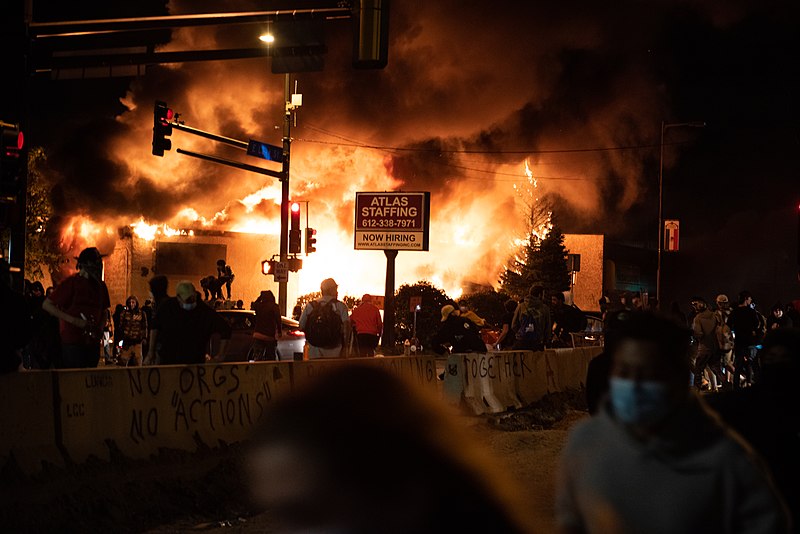
A building burning in Minneapolis following the death of George Floyd.
Photo by Hungryogrephotos via Wikipedia.

One must not exaggerate, of course. We do not yet live under a Soviet-type tyranny in which every university thesis, on no matter how arcane a subject, was obliged by hook or by crook to quote Lenin. It is still possible, though not at all easy, to live as a scholar in our societies outside the university system. But it does not require the tyranny of the complete police state to obtain a high degree of intellectual conformity, as we can now observe at our leisure. Young university academics of my acquaintance in several countries tell me that they are now afraid to speak their mind, not because they would fear for their lives, but fear for their promotion. This is not the same, or as terrible, as fearing for their lives, but it is nonetheless very far from the Millian ideal of freedom of thought and speech.

There is much worse. It is not merely that they must keep their mouth shut and not say what they think, bad enough as this must be for those who have chosen the life of the mind; it is that they must positively subscribe to things that they believe to be bad or false. And this is a mark of totalitarianism. They must subscribe to doctrines they believe absurd, for example by describing in job applications their future efforts to promote diversity, so-called. By making the expression of untruth the condition of employment, probity is destroyed in advance. Those who lack it are easier to control.

Increasingly, social movements do not allow any neutrality with regard to the causes that they promote. Non-adherence is no different from enmity and derogation is evil: if you are not part of the solution you are part of the problem. In vain might you argue that your interest is elsewhere, in the taxonomy of grasshoppers, for example, or in the biochemistry of acorns, or in the bibliography of Alexander Pope: there is one subject that trumps all others in importance, and on it only one opinion is permissible. You must pass a test of loyalty.

The latest of these movements is, of course, Black Lives Matter, and its success in cowing so large a part of the intelligentsia is in a way admirable, a model of political organization for the future, though one much to be feared. By claiming that silence is violence, it has made hand-wringing (to avoid its anathema) the mark, and almost the whole, of virtue. It has successfully reversed Martin Luther King’s goal, such that the colour of a man’s skin is once again more important than the content of his character, and it has made respectable that most Stalino-Maoist of notions, that people should be promoted and rewarded according to their social (in this case, racial) origins. And anyone who disagrees is an Enemy of the People, the word People being here used in a severely technical sense, to mean the arbiters of the allocation of rewards.

How have you enjoyed your six-month visit to Neil deGrasse Tyson’s “Rationalia” (rule by experts)?

Filed under: Bureaucracy, Government, Health, Media, Science, USA — Tags: , , , — Nicholas @ 03:00

Tabitha Alloway clearly isn’t a fan of technocratic “experts” running our lives — and who can blame her?

Cropped photo of Neil deGrasse Tyson on stage with Richard Dawkins at Howard University in Washington D.C. on 28 September 2010.
Photo by Bruce F. Press via Wikimedia Commons.

Expert advice has ping-ponged on COVID-19 like a bead in a pinball machine. Even the medical literature itself has been rife with contradictions and retractions. Lawmakers have tripped over themselves trying to outdo one another in creating the most laws and regulations during the lockdowns in response to the nebulous (and ever-changing) “science” of the coronavirus.

Meanwhile, suicides, domestic violence, hunger and starvation, and economic difficulty have been on the rise. The Nobel Prize-winning Michael Levitt has said, “There is no doubt in my mind that when we come to look back on this, the damage done by lockdown will exceed any saving of lives by a huge factor.” Stacey Lennox, writing for PJ Media said, “COVID-19 may go down as history’s most devastating example of expert arrogance and media malfeasance.”

[…]

A few years ago Neil deGrasse Tyson made waves with his “Rationalia” government proposal: Create a world in which all policies are based on “weight of evidence.” Let science rule us.

This utopian proposal was quickly criticized by a number of voices. Popular Science charged that such a misguided idea would lead to “vast human suffering,” and pointed out some obvious problems:

    “Scientists study what they want, and they study what they can get paid to study, so the work of science is not free from the pressures of money, nor interaction with the business world … In a hypothetical world where a single person (let’s call him ‘Neil’) decided policy based on precisely measuring the weight of evidence, how that person selected evidence would matter a great deal, and would likely come down to values.”

But of course.

The idea that science could be wholly objectively applied, free from the biases, personal values, and limited understanding of the expert legislating (or proposing) it is a childish fantasy. While Tyson dreams of an unerring scientific principle formulated as a rule for society, his Rationalia proposal makes no room for human error, passion, and prejudice. Our application of science is necessarily limited by our ever-changing understanding of it. And while science can tell us what happens when X meets Y, it cannot tell us if it is moral and good for X to meet Y.

We have more than a little evidence from history that science (or what was accepted at the time as science) has most certainly caused “vast human suffering” when wielded by unscrupulous men and fascist dictators. From the murder of Aboriginal Australians to the forced sterilizations in America, eugenics, genocide, and racism have sprung from (or found their apology in) social Darwinism. As Robert F. Graboyes noted in U.S. News & World Report, “Nazi Deputy Fuhrer Rudolf Hess stated — probably sincerely — that ‘National Socialism is nothing but applied biology.'”

Bumbling do-gooders and their victims are not immune to unintended consequences either, as we have so lately observed.

QotD: Drama critics

Filed under: Humour, Media, Quotations — Tags: , — Nicholas @ 01:00

Drama critics are like eunuchs in a harem: they see the tricks done every night, they know how it’s done, but they can’t do it themselves.

Brendan Behan, quoted in “Notes by Sage of Nonsense”, Globe and Mail 1961-03-18.

September 8, 2020

2020 is a cracking year

Filed under: Books, Liberty, Media, Politics, USA — Tags: , , , , , — Nicholas @ 03:00

And by “cracking” I don’t mean the old Victorian expression for “very good”. Sarah Hoyt explains the cracks at the Libertarian Enterprise:

“Covid 19 Masks” by baldeaglebluff is licensed under CC BY-SA 2.0

It’s 2020 and we’re all cracking.

And no, by that I don’t mean that we’re cracking like crazy on our writing. Most of us are having trouble writing. A lot of us are having trouble reading. Though I’ve finally got out of the Pride and Prejudice fanfic jag.

I’ve seen people suddenly lose it and start crying over dirty dishes. Or the fact we ran out of peanut butter.

Okay, that was me. Yesterday. But I’ve been watching signs of just that much fragility in everyone I know.

Part of it is the lockdown. Man — and verily, woman — is a social animal. Not only is it not good for Man — do I need to say “and woman again?” — to be alone, it’s not good for us, when going out to be confronted with “truncated” human faces.

It is instinctive in humans to see human faces in everything. Don’t believe me? Look at a random pattern long enough, and you’ll find faces. Truncated human faces, the mouth gone, are deeply unsettling to the back of our brain. It is wrong, mutilated.

Suicides are through the roof. Mental health issues abound. The young are suffering particularly badly, because on top of all they believe they’re going to die. (The rest of us are already dead from the ice age, acid rain, fossil fuel depletion, alar, global warming, ozone depletion … I’m sure I’m forgetting some things. After so much death, one becomes resilient. Those of us forty and over won’t die. Even if they kill us.)

But the other part of it is that in a contentious political year there’s nowhere to escape.

Remember when you used to have friends that believed exactly the opposite of what you did, and you both knew it, but you were still friends? You couldn’t talk politics, but you could talk knitting, embroidery, kids, gardening, furniture refinishing, science fiction? You could sit down and have a cup of coffee with someone whose political views you considered despicable and not mention politics? Not even once?

But that was before the invasion of those for whom everything is political. Oh, cancel culture already existed. Before social media, I was terrified of saying the wrong word and revealing my real thoughts, and getting blacklisted by publishing houses.

But there were spaces you could draw a breath. Places where you didn’t have to talk and/or think about politics.

September 5, 2020

Kareem Shaheen on the shame of mask-shaming

In The Line, Kareem Shaheen — who is a mask-wearer and was one before they were made mandatory — explains why shaming anti-maskers is a terrible way to encourage compliance, but a great way to virtue-signal:

“Covid 19 Masks” by baldeaglebluff is licensed under CC BY-SA 2.0

The mask shaming mirrors the way social media has warped our culture. The Twitter and ‘gram “in crowd” flaunt its mask use to demonstrate an ostensibly superior grasp of morals and science — and to bully those who don’t follow its cues. Those who perceive themselves to be on the outside of this circle can’t help but cringe at the manipulation and grandstanding behind these seemingly well-intentioned gestures.

Mask resistance, then, becomes a virtue signal of its own.

And, of course, Twitter itself has been a cesspool of counter-productive shame. Back in July, the hashtag #NoMasks trended, which gave the illusion of a groundswell of opposition against mandatory masking laws. But an analysis by First Draft, a nonprofit based in the United Kingdom, examined 8,000 Twitter accounts that used the hashtag. It found that the majority of people who tweeted #NoMasks were actually pro-mask. Their condemnation of the supposed anti-mask contingent actually boosted #NoMasks, bringing more people in contact with related conspiracy theories and arguments against wearing masks.

The moralizing is all the more galling because our own governments were forced to do an embarrassing about-face on their efficacy.

In the early weeks of the pandemic, health agencies in Canada and the United States recommended against wearing masks because there was insufficient evidence that they could prevent the spread of the virus, remember? They said that masks would provide a sense of false security, and suggested that we were all too dumb to know how to wear them properly.

This despite widespread use of masks in Asia, and while there was a growing consensus in hard-hit parts of Europe that they were effective and necessary.

With so much confused messaging, it’s no mystery that so many people are now skeptical about wearing masks. Sure, some of the most ardent mask-haters are also Q-Anon-spouting, anti-vaxxer crystal-healing masks-are-fascism conspiracy theorist kooks. But not all them fit that description.

And the problem with all of this is that if you’re actually trying to convince people to wear masks — as opposed to merely demonstrating your own superior morality via the veil — shame is one of the least effective methods of persuasion.

« Newer PostsOlder Posts »

Powered by WordPress