
TimeGhost History
Published on 15 May 2018In 1920 the Bolshevik Russian Red army has more or less routed the Russian counter-revolutionary White armies. Their attention now turns to the West. Lenin wants to take the communist revolution to Germany, France and the United Kingdom. To get there he has to go through Poland though, and he hasn’t counted with Józef Piłsudski, the leader of the Polish Republic.
Most of the amazing colorised pictures in this episode are from Olga Shirnina, who has made a name as one of the best colouring artists there is, especially (but not only) covering Russian historical characters, Check out her website for some amaaaazing eye candy https://klimbim2014.wordpress.com Olga, thanks for letting us use the pictures!
Click here for the rest of the Between 2 Wars series: http://goo.gl/enXJWf
Join the TimeGhost Army at https://timeghost.tv
or on Patreon: https://www.patreon.com/TimeGhostHistoryHosted by: Indy Neidell
Written by Spartacus Olsson and Indy Neidell
Directed by: Spartacus Olsson
Produced by: Astrid Deinhard
Photo Colouring by: Olga Shirnina
Executive Producers: Bodo Rittenauer, Astrid Deinhard, Indy Neidell, Spartacus OlssonA TimeGhost chronological documentary produced by OnLion Entertainment GmbH
May 16, 2018
Miracle on the Vistula – Polish Soviet War I BETWEEN 2 WARS I 1920 Part 1 of 4
Crusader Tank | Animated History
The Armchair Historian
Published on 25 Jun 2016
May 15, 2018
Evolution of French Infantry During World War 1 I THE GREAT WAR Special
The Great War
Published on 14 May 2018The French soldier in 1914 was already very different from the one in 1918 if you looked at his uniform or equipment. Also the combat tactics evolved considerably in four years of war. The Battle of Verdun, the Nivelle Offensive or the Battle of La Malmaison were important steps during that evolution in which the Poilu became a modern French soldier.
French protests over new British submarine in three, two, one…
Gareth Corfield helpfully sums up the reasons for the French to take offence after the Royal Navy chose to name the next Astute-class nuclear submarine HMS Agincourt:
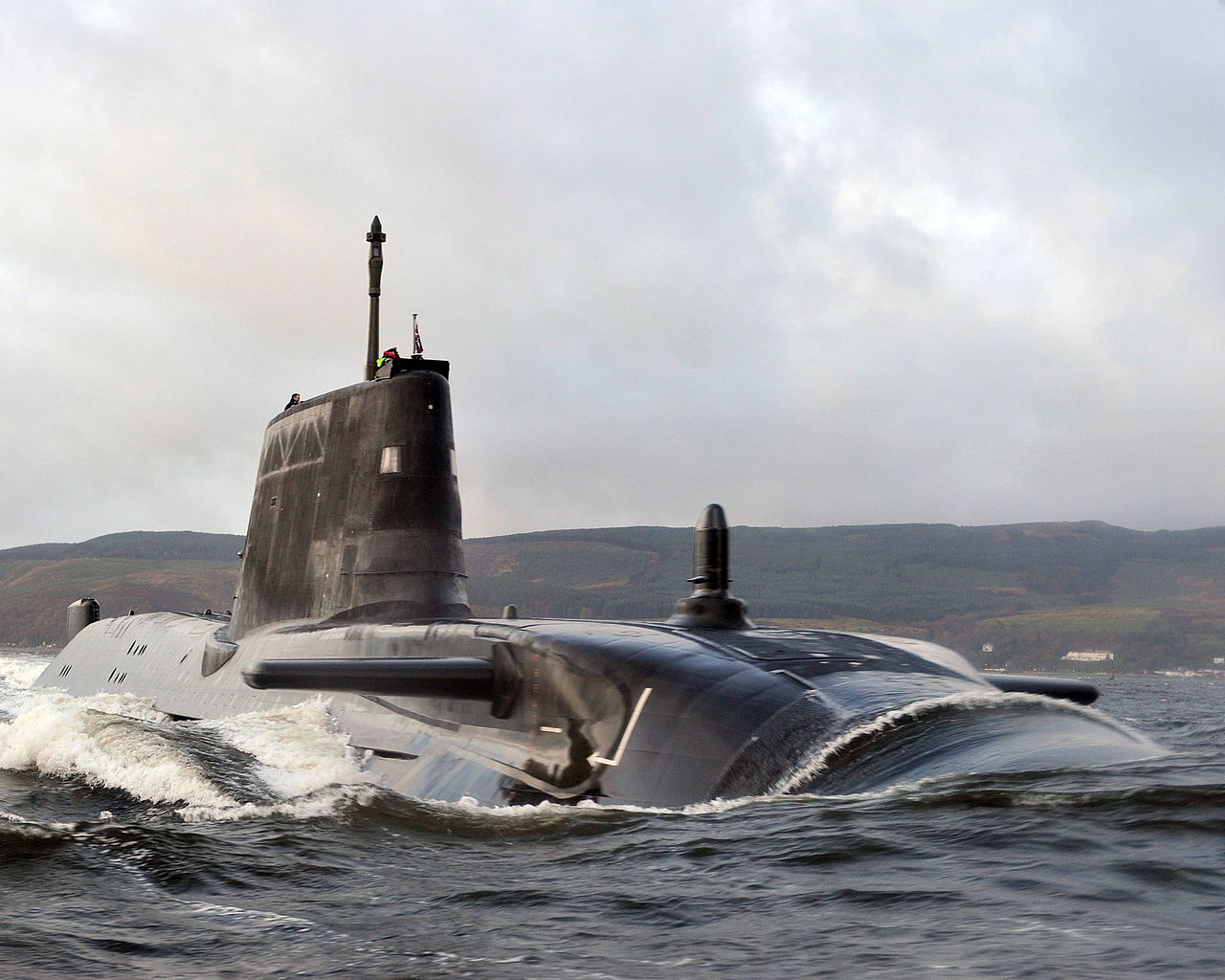
HMS Astute (S119), lead ship of her class, sails up the Clyde estuary into her home port of Faslane, Scotland.
MOD photo, via Wikimedia Commons.
The Royal Navy, always keeping up with the times, has named its newest attack submarine HMS Agincourt, after the 1415 battle where an English army beat French troops led by its nobility.
Agincourt the boat is the seventh and final Astute-class attack sub. The nuclear-powered vessels are used primarily to defend British interests from underwater, including seeing off marauding Russian vessels near British waters and also for sneaky-beaky missions of their own into foreign waters.
The £1.5bn submarine is under construction at BAE Systems’ yard in Barrow-in-Furness, Cumbria. Defence equipment minister Guto Bebb joyously declared: “Today’s announcement includes a £60m contract for Rolls-Royce, supporting over 700 jobs here in Derby as the factory continues to make the reactors that will power our state-of-the-art Dreadnought subs into the 2060s.”
And just to rile up any sensitive French souls, he also gives a thumbnail history of the battle the ship will be named for:
The name Agincourt is mildly controversial, inasmuch as it brings to mind the famous victory of King Henry V over France at a time where the English army, which was blundering around the Pas-de-Calais countryside, was largely thought to be on its last legs and cut off from its chances to retreat back home. In the words of the king’s (fictional, thanks to Shakespeare) eve-of-battle speech, it was “we few, we happy few, we band of brothers” up against the very best France had to offer.
Through “yew bow and cloth yard shaft”, as the chroniclers of the day put it, the English and Welsh longbowmen shot a torrent of arrows into the heavily armoured French knights. The arrows’ steel points penetrated the plate armour of the French nobles and the lightly equipped English then set about the bogged-in Frenchmen, whose weighty suits of armour were totally unsuited to the heavy mud of the battlefield.
In today’s world, where the UK and France are close allies and England has given way to the United Kingdom, naming the submarine Agincourt may be seen by some as a bit of an unintentional snub, bringing to mind Henry V’s slaughter of French prisoners of war and the failed negotiations that preceded the battle over Henry’s disputed claim to the title of King of France.
QotD: The making of Gandhi
As it happens, the government of India openly admits to having provided one-third of the financing of Gandhi out of state funds, straight out of the national treasury — and after close study of the finished product I would not be a bit surprised to hear that it was 100 percent. If Pandit Nehru is portrayed flatteringly in the film, one must remember that Nehru himself took part in the initial story conferences (he originally wanted Gandhi to be played by Alec Guinness) and that his daughter Indira Gandhi is, after all, Prime Minister of India (though no relation to Mohandas Gandhi). The screenplay was checked and rechecked by Indian officials at every stage, often by the Prime Minister herself, with close consultations on plot and even casting. If the movie contains a particularly poisonous portrait of Mohammed Ali Jinnah, the founder of Pakistan, the Indian reply, I suppose, would be that if the Pakistanis want an attractive portrayal of Jinnah let them pay for their own movie. A friend of mine, highly sophisticated in political matters but innocent about film-making, declared that Gandhi should be preceded by the legend: The following film is a paid political advertisement by the government of India.
Gandhi, then, is a large, pious, historical morality tale centered on a saintly, sanitized Mahatma Gandhi cleansed of anything too embarrassingly Hindu (the word “caste” is not mentioned from one end of the film to the other) and, indeed, of most of the rest of Gandhi’s life, much of which would drastically diminish his saintliness in Western eyes. There is little to indicate that the India of today has followed Gandhi’s precepts in almost nothing. There is little, in fact, to indicate that India is even India. The spectator realizes the scene is the Indian subcontinent because there are thousands of extras dressed in dhotis and saris. The characters go about talking in these quaint Peter Sellers accents. We have occasional shots of India’s holy poverty, holy hovels, some landscapes, many of them photographed quite beautifully, for those who like travelogues. We have a character called Lord Mountbatten (India’s last Viceroy); a composite American journalist (assembled from Vincent Sheehan, William L. Shirer, Louis Fischer, and straight fiction); a character called simply “Viceroy” (presumably another composite); an assemblage of Gandhi’s Indian followers under the name of one of them (Patel); and of course Nehru.
I sorely missed the fabulous Annie Besant, that English clergyman’s wife, turned atheist, turned Theo-sophist, turned Indian nationalist, who actually became president of the Indian National Congress and had a terrific falling out with Gandhi, becoming his fierce opponent. And if the producers felt they had to work in a cameo role for an American star to add to the film’s appeal in the United States, it is positively embarrassing that they should have brought in the photographer Margaret Bourke-White, a person of no importance whatever in Gandhi’s life and a role Candice Bergen plays with a repellant unctuousness. If the film-makers had been interested in drama and not hagiography, it is hard to see how they could have resisted the awesome confrontation between Gandhi and, yes, Margaret Sanger. For the two did meet. Now there was a meeting of East and West, and may the better person win! (She did. Margaret Sanger argued her views on birth control with such vigor that Gandhi had a nervous breakdown.)
I cannot honestly say I had any reasonable expectation that the film would show scenes of Gandhi’s pretty teenage girl followers fighting “hysterically” (the word was used) for the honor of sleeping naked with the Mahatma and cuddling the nude septuagenarian in their arms. (Gandhi was “testing” his vow of chastity in order to gain moral strength for his mighty struggle with Jinnah.) When told there was a man named Freud who said that, despite his declared intention, Gandhi might actually be enjoying the caresses of the naked girls, Gandhi continued, unperturbed. Nor, frankly, did I expect to see Gandhi giving daily enemas to all the young girls in his ashrams (his daily greeting was, “Have you had a good bowel movement this morning, sisters?”), nor see the girls giving him his daily enema. Although Gandhi seems to have written less about home rule for India than he did about enemas, and excrement, and latrine cleaning (“The bathroom is a temple. It should be so clean and inviting that anyone would enjoy eating there”), I confess such scenes might pose problems for a Western director.
Richard Grenier, “The Gandhi Nobody Knows”, Commentary, 1983-03-01.
May 14, 2018
The Empire of Mali – The Final Bloody Act – Extra History – #5
Extra Credits
Published on 12 May 2018The Mali Empire comes to an end after the rise of rival powers and weakened by colonial influences, but not without leaving a legacy as a place of wealth and splendor.
The Austro-Prussian War
Epic History
Published on 28 Dec 2015The Austro-Prussian War or Seven Weeks’ War (also known as the Unification War, Prussian–German War, German Civil War, or Fraternal War and in Germany as German War) was a war fought in 1866 between the German Confederation under the leadership of the Austrian Empire and its German allies on one side and the Kingdom of Prussia with its German allies and Italy on the other, that resulted in Prussian dominance over the German states.
May 13, 2018
Marie Curie in WW1 – Who Killed The Red Baron? I OUT OF THE TRENCHES
The Great War
Published on 12 May 2018Chair of Wisdom Time!
QotD: The lost works of Epicurus
[Most of the original writings of Epicurus have been lost.] There are the elaborate refutations of Epicureanism by Cicero and Plutarch. These inevitably outline and sometimes even quote what they are attacking. There are hundreds of other references to Epicurus in the surviving literature of the ancient world. Some of these are useful sources of information. Some are our only sources of information on certain points of the philosophy.
During the past few centuries, scholars have been trying to read the charred papyrus rolls from a library in Herculaneum buried by the eruption of Vesuvius in 79 AD. Some of these contain works by Philodemus of Gadara, an Epicurean philosopher of the 1st century BC. Much of this library remains unexcavated, and most of the rolls recovered have not really been examined. There are hopes that a complete work by Epicurus will one day be found here.
Above all else, though, is the De Rerum Natura of Lucretius. He was a Roman poet who died around the year 70 BC. His epic, in which he claims to restate the physical doctrines of Epicurus, was unfinished at the time of his death, and it is believed that Cicero himself edited the six completed books and published the text roughly as it has come down to us. This is one of the greatest poems ever written, and perhaps the strangest of all the great poems. It is also the longest explanation in a friendly source of the physical theories of Epicurus.
Therefore, if anyone tries to say in any detail what Epicurus believed, he will not be arguing from strong authority. If we compare the writings of any extant philosopher with the summaries and commentaries, we can see selective readings and exaggerations and plain misunderstandings. How much of what Karl Marx really said can be reliably known from the Marxist and anti-Marxist scholars of the 20th century? Even David Hume, who wrote very clearly in a very clear language, seems to have been consistently misunderstood by his 19th century critics. For Epicurus, we may have reliable information about the main points of his ethics and his physics. We have almost no discussions of his epistemology or his philosophy of mind. Anyone who tries writing on these is largely guessing.
All this being said, enough has survived to make a general account of the philosophy possible. Epicurus appears to have been a consistent thinker. Though it may only ever be a guess — unless the archaeologists in Herculaneum find the literary equivalent of Tutankhamen’s tomb — we can with some confidence proceed from what Epicurus did say to what he might have said. Certainly, we can give a general account of the philosophy.
Sean Gabb, “Epicurus: Father of the Enlightenment”, speaking to the 6/20 Club in London, 2007-09-06.
May 11, 2018
The Ostende Raid – Peace of Bucharest I THE GREAT WAR Week 198
The Great War
Published on 10 May 2018Even though the first raid on Ostende and the Raid on Zeebrugge were not entirely successful, the Royal Navy is still determined to block access to the German submarine ports in Belgium. And this week they attack Ostende again. Meanwhile, the Germans are planning their next offensives for late May 1918 even though ten percent of the Western Front army has become a casualty in the offensives this year alone.
May 10, 2018
Enter ADOLF HITLER stage left I BETWEEN 2 WARS I 1919 Part 4 of 4
TimeGhost History
Published on 8 May 2018The fledgling democracy in Germany struggles to survive as the German Revolution escalates into a downright civil war. In one of the German States Bavaria, Adolf Hitler appears on the stage within the context of the Bavarian Soviet Revolution.
Click here for the rest of the Between 2 Wars series: http://goo.gl/enXJWf
Join the TimeGhost Army at https://timeghost.tv
or on Patreon: https://www.patreon.com/TimeGhostHistoryHosted by: Indy Neidell
Written by Spartacus Olsson and Indy Neidell
Directed by: Spartacus Olsson
Produced by: Astrid Deinhard
Executive Producers: Bodo Rittenauer, Astrid Deinhard, Indy Neidell, Spartacus OlssonA TimeGhost chronological documentary produced by OnLion Entertainment GmbH
CORRECTION: Article 48 of the Weimar Constitution gave the PRESIDENT of the German Reich the power to suspend civil rights and take armed action, nothing else… our apologies. In this episode we meet Adolf Hitler for the first time. Now some might be surprised about how we portray Hitler and his political views in 1919 and this needs some commentary. Before you go off in any specific direction about Hitler and Naziism, you should therefore read our commentary here https://community.timeghost.tv/t/enter-adolf-hitler-from-the-left-between-2-wars-1919-part-4-of-4/262/3:
Commentary regarding our portrayal of Hitler:
Those of you who follow our work since a longer time will know that we are loath to tell a skewed or biased version of the events we portray. Our aim with how we tell Hitler’s story is neither to exonerate him, nor to vilify him; the facts speak for themselves and we are convinced that we neither need to add, nor subtract emphasis to the story of Hitler and the Nazis.
In many other works covering Hitler you will see a tendency to hang the events of this epoch on the leaders that rose to power in the period. While it is unquestionable that the impact of those leaders was far reaching and instrumental in how the events evolved, it should not be forgotten that these men (and a few women) were not created in a bubble. As postulated in the main historiographical theory dealing with the impact of leadership, Zeitgeist Theory (from where we take or brand name btw.) it is easily seen at that it was not the characters that created the times, but the times that created the characters who then steered the events as they evolved.
This is an uncomfortable position to take, because it leads to the next conclusion: Germany, Japan and Italy did also not exist inside bubbles. This in turn leads us to have to look at the entire picture of the world to understand the events that followed. Inevitably this will not lead to a black and white picture of good guys vs. bad guys. Instead we face a complex situation where many cogwheels interact to bring about the situation that eventually leads to war.
To be clear: once again we are not seeking to exonerate, or vilify anyone. What with the extensive crimes against humanity perpetrated by the Axis powers before and during the war, there is always the risk of comparing apples and oranges when you dive into this area. To avoid that conundrum, the war crimes perpetrated by the Allies are often brushed aside, or simply justified as an unfortunate part of war. Again to be clear: while the firebombing of Dresden, Hamburg, Tokyo, Osaka and many other cities does constitute war crimes, it does not exonerate the murder of tens of millions of people by the Nazis. Furthermore the sheer difference in numbers and method speak for themselves (if you must look at a comparison of who was worse than the other).
Our interest will always be to tell the story as accurately as we can and let the story itself provide judgement. At no point will we waiver from telling a part of the story just because it makes one side or the other look better or worse. Also, we will not get involved in the moral arguments surrounding this, such as that certain acts were justified because they led to victory, or were the lesser evil. It is not our job to make that kind of moral judgement – that is up to the philosophers of the world and we’re mere tellers of history.
Regarding Hitler’s political views in 1919:
The fact that Hitler had liberal sympathies in 1919, should not be misunderstood as a foundation for an argument that Naziism was a left wing ideology. While Hitler and Drexler did incorporate social welfare concepts and anti-capitalist ideas into their agenda, the national socialist doctrine is clearly a derivative of conservatism, not progressivism.
Contrary to communism that focuses on class and internationalism, Naziism focuses on race and nationalism. Naziism espouses traditional social conservative views regarding gender roles, division of labour, social values, and foreign relations. Communism claims to be egalitarian while Naziism espouses an elitist world view. Communism seeks to create a completely new economic system based on overthrowing traditional trade and profit ideas, Naziism espouses economic protectionism and state regulated capitalism. In one aspect the two ideologies do share a common denominator, namely in the repression of the financial transfer economy (money lending, property speculation and so on). This last bit has often been misrepresented as proof that Naziism is a left-wing ideology, but that would be a fallacious conclusion as this is not at the centre of the ideology, but rather an artifact of the somewhat contradictory antisemitic ideas of Naziism.
Last but not least the main unique feature of Naziism that differentiates it from Fascism is the outspoken antisemitism at the heart of the ideology. Absurdly Hitler came to equate Jews with robber capitalists AND communism. As strange as that is, it’s a way of thinking that was not only prevalent with Hitler, but also with other political thinkers like Charles Maurras, a Frenchman who formulated an early form of Naziism already in the late 1880s and 1890s (yes we will cover him). The basis of this is their belief in a world conspiracy led by the Jews that was aimed at the overthrow of what they perceived as ‘their race.’ Based on that, robber capitalism and Bolshevik Communism were seen as instruments in this imaginary war of the races. The idea was also promoted within the context of the Russian Revolution, where for instance the fabricated Protocols of The Elders of Zion, aimed to show that the ‘Jewish conspiracy’ was a driving force behind the revolution.
May 9, 2018
Comics and Hard-Boiled – Pulp! Noir – Extra Sci Fi
Extra Credits
Published on 8 May 2018Many sci fi writers, especially in the United States, had backgrounds in reading and writing detective stories. They introduced to the sci-fi genre the action hero — no longer just scientific or philosophical protagonists.
QotD: The “you can’t get good help” period after WW1
Look, I, like you, heard about how terrible the aftermath of WWI was, and how broke people were right after, and how they were moving to cities and living in tenements. It wasn’t until I was reading a book about the between the war period in England that I realized they were telling me TWO stories which couldn’t both have happened. In the part about the common folk, they were telling me how much poorer they were than before the war. In the part about the great families, they were telling me how the huge rise of the middle class and the building of suburbs had hurt them, and how the newly rich common folk no longer wanted to be servants.
That was one of those “wait a minute.” Sure I was taught both things in school, but you know you write down the bullet point for the test, and that’s it. Now I was going “Who the heck wrote these narratives and why doesn’t anyone question them?”
The truth, btw, from going to primary sources is closer to the second. And the people who wrote the narrative were the unseated noblemen, who did not like all these nouveau riche but who wanted to justify their disgust by showing how it hurt the poor. (It did increase the underclass somewhat, not because of economic conditions, but because a lot of men don’t integrate well after war, and well, WWI was something special by way of trauma.)
There are tons of these when you start poking. For instance the idea that the industrial revolution was unremittingly bad for the poor/people. Looking at China and India and such places right now, all I can do is roll my eyes.
Yeah, sure, the conditions of the early industrial revolution were appalling. And yet people crowded to the cities to take these jobs. What the historians never ask themselves is “How much worse was what they were escaping from?” We know that in India and China and other recently industrialized countries.
Sure the countryside has relatively clean air and more open space, but there are still real famines, and the work was unremitting and brutal and yes, little children worked too (says the daughter of middle class in a rural community whose first “job” was weeding the onion patch at five. And I was a pampered moppet. Kids my age from farming families had what we’d call full time jobs. Factory jobs at least had a stopping time.)
The idea that the industrial revolution was awful comes from upper class historians who could see the little kids twisted by working in the mills but who never consorted closely enough with the rural poor to see the misery behind raising baah lambs and the pretty pretty flowers.
Yeah. So the past isn’t written in stone. And it’s not a conspiracy. Not precisely a conspiracy. Yeah, sure, the Marxists influenced a lot of modern history with their ideas, but that is not necessarily conspiring. They view the world a certain way and it influences how they view the past too.
Sarah Hoyt, “How Do You Know?”, According to Hoyt, 2016-08-24.
May 8, 2018
The Western Front Awakens – Peace In The East I THE GREAT WAR Summary Part 13
The Great War
Published on 7 May 2018The spring of 1918 brought huge shifts to the fronts of World War 1. The Eastern Front went quiet after the Treaty of Brest-Litovsk and the Western Front returned to a war of movement with the German Spring Offensive 1918.
Charge of the Light Brigade | Animated History
The Armchair Historian
Published on 28 Dec 2017The Charge of the Light Brigade, Animated History


