
In response to something I’d written about labor unions, a critic started badgering me about child labor.
What a terrible feature of capitalism, he said.
No, it was a terrible feature of all of world history, I replied.
Thank goodness for people who passed laws against it, he said.
No, I said, thank goodness for capitalism, which created enough wealth that families didn’t have to send their kids to work anymore just to avoid starvation.
Then I was asked: do I really believe my kids would be better off in a factory (than in school, presumably)?
As if the choice we’re talking about is between factory work and school! The actual choice faced by these families is between factory work and starvation.
The British charity Oxfam found that in Bangladesh, where the government caved in to Western demands to suppress child labor, the children — you’ll never guess — didn’t wind up in school! How about that.
Where did they wind up? In prostitution, or dead.
Nice going, geniuses.
Yes, there were laws passed against child labor, but those came when child labor was already practically a thing of the past.
No law is going to keep families from avoiding starvation — and even the left-wing International Labor Organization admits that this is the real reason for child labor. Only capital accumulation makes it possible to end child labor humanely.
My opponent probably isn’t a bad guy. He’s just absorbed the conventional wisdom on pretty much everything.
It’s very easy to blame “capitalism” for child labor. Where is the average person going to hear any other explanation?
Tom Woods, “SJWs Really Mean Well, But Accidentally Starve Some Children”, The Tom Woods Show, 2016-09-13.
May 26, 2018
QotD: Child labour
May 25, 2018
Bombs Away – German Thirst For Caucasian Oil I THE GREAT WAR Week 200
The Great War
Published on 24 May 2018In the 200th week of the war, the total nature of modern warfare is truly showing its face. The warring nations escalate their bombing campaigns and the German troops in the Caucasus are so thirsty for Caucasian oil, that they are considering to double cross their own allies.
May 24, 2018
Medieval tank – The 13th Century Knight I IT’S HISTORY
IT’S HISTORY
Published on 23 May 2018This time we will take you back to middle ages. It’s 13th century – what did medieval armor look like?
Tank Chats #30 M3 Grant | The Tank Museum
The Tank Museum
Published on 27 Jan 2017The thirtieth in a series of short films about some of the vehicles in our collection presented by The Tank Museum’s historian David Fletcher MBE.
Tanks of this type were first used in Western Desert in 1942. The M3’s were mechanically reliable, but soon superseded by Sherman.
May 22, 2018
The Fightinest Marine – Dan Daly I WHO DID WHAT IN WW1?
The Great War
Published on 21 May 2018Dan Daly was one of only two Marines to be awarded Medals of Honor in two separate conflicts. The first, for his actions in 1901 during the China relief. His second, for his actions during the U.S. invasion and occupation of Haiti in 1915. But he wasn’t done yet and after the U.S. entry into WW1 in April 1917, he was close to receiving his third one on the battlefield of Belleau Wood in France.
Feature History – Opium Wars
Feature History
Published on 19 Oct 2016Welcome to Feature History, featuring the Opium Wars, western imperialism, and this fancy new intro and vignette.
The super sexy stuff like animation, voice, and script are all by the super sexy me.
The music is Anamalie and Clash Defiant, both by Kevin MacLeod
Twitter: https://twitter.com/Feature_History
QotD: Capitalism is the most feminist economic system ever
We really do need to be pointing out that the Good Old Days are now. Both technological advance and productivity growth have been driven by that combination of capitalism and markets. Capitalism, in its lust for profits, leading to the invention. Markets and the ability to copy what works being what creates the general uplift in standards by the spreading and wide use of those inventions.
The net effect of this has been, well, it’s been to make women’s lives vastly better. Starting with the point that many women actually have lives as a result. Childbirth has moved from being the leading cause of female death* to a mild risk which kills very few – each one a tragedy which is why we’re so happy that we have reduced that risk. We’ve automated all the heavy lifting in society meaning that women can indeed, with their generally lighter musculature, compete in near all areas of work. We’ve done more automation of household drudgery than we have of anything else too, freeing the distaff side from that chain upon their ambitions.
We’ve even freed all from the child bearing consequences of bonking – much to the great pleasure of man and woman alike.
Women today are the most privileged, richest, group of women who have ever stumbled across the surface of this planet. And in comparison to the men in their society they’re the most equal too. All of which leads to an interesting question. Just why are they whining so much?
*Possibly an exaggeration but not much of one. Certainly not about the mid 19th century before Semmelweiss.
Tim Worstall, “Capitalism Is The Most Feminist Economic System Ever”, Continental Telegraph, 2018-04-30.
May 21, 2018
The Empire of Mali – Lies – Extra History – #6
Extra Credits
Published on 19 May 2018History, and the past, can be two different concepts. Is Mansa Musa REALLY that wealthy? Did his son really die of “sleeping sickness”? It’s time for Lies, featuring Robert Rath, Jac Kjellberg, and James Portnow!
“Civil War Uniforms of Blue & Grey – The Evolution” Volume 2
LionHeart FilmWorks
Published on 29 Apr 2018http://www.lionheart-filmworks.com
Volume 2 of 4… A display of some of the more unique and important uniforms to represent the evolution of the American Civil War “Blue and Grey” from just before the spark of the war in 1861 to Union victory and occupation in 1865.
This project is meant to honor men from both the north and the south — now together forever in eternity — who served their countries, their states and their comrades while wearing these uniforms, weapons, and accouterments — during some of the most brutal battles Americans have ever faced. Shot in 4K and featuring nine of the best Living Historians in the country.
As accurately as we possibly could, and one uniform at a time.… telling the story of the 2.75 Million soldiers who once wore these sacks coats, shell jackets and kepis with pride — each soldier earning a debt we should all be duty-bound to continue to honor.
Directed/Produced: Kevin R. Hershberger
Cinematography: Hugh Burruss
Costumers & Featuring: Tyler Grecco, Nathan Hoffman, Connor Timony, Brennan Wheatley, Guy Gane, Eric Smallwood… as well as Mark Aaron, Tr’waan Coles & Justin Young.
Grip / Electric: Brian Lyles
Costumes & Props: Historical Wardrobe – Richmond, VA
May 20, 2018
Black Army of Ukraine – Togoland in WW1I OUT OF THE TRENCHES
The Great War
Published on 19 May 2018Chair of Wisdom Time!
“I grew up in one of the most progressive societies in the history of humanity”
At Quillette, Konstantin Kisin discusses the differences between the utopian ideal and reality:
I grew up in one of the most progressive societies in the history of humanity. The gap between the rich and poor was tiny compared to the current gulf between the ‘haves’ and the ‘have-nots’ we find across much of the West. Access to education was universal and students were paid to study and offered free accommodation. Healthcare was available to all and free at the point of use. Racial tensions were non-existent, with hundreds of different ethnic groups living side by side in harmony under the mantra of ‘Friendship of the Peoples.’ Women’s equality was at the very heart of Government policy. According to the prevailing ideology “all forms of inequality were to be erased through the abolition of class structures and the shaping of an egalitarian society based on the fair distribution of resources among the people.”
You are probably wondering whether the idyllic nation from which I hail is Sweden or Iceland. It was the Soviet Union. In modern Britain the top 10 percent earn 24 times as much as the bottom 10 percent but in the Soviet Union the wealthy and powerful barely made 4 times as much as those at the bottom. The illiteracy rate in late Soviet times was just 0.3 percent compared to 14 percent of the US adult population who cannot read today. University students were paid an allowance to study and those from working class backgrounds were often given preferential treatment to facilitate better access to higher education. Free accommodation was available for students studying outside their home town.
The Soviet Union was a huge country populated by hundreds of ethnic and religious groups that had been slaughtering each other for centuries. In this shining example of a successful multicultural state, Armenians, Azerbaijanis, Ukrainians, Russians, Tatars, Moldovans, Belarussians, Uzbeks, Chechens, Georgians, Kazakhs, Tajiks, Turkmens, Lithuanians, Estonians, Latvians, and dozens of others all lived side-by-side as friends and neighbours.
The USSR actively promoted women’s equality in order to get more women into the workforce, with some of Vladimir Lenin’s first steps after the 1917 Revolution including simplifying divorce and legalising abortion with the stated goal of “freeing women from the bondage of children and family.” Maternity leave was generous and the state provided ample childcare centres, one of which I myself attended.
Unfortunately, despite these facts and the lofty ideals from which they were derived, the reality of life in the Soviet Union was rather different.
May 19, 2018
The Macedonian phalanx – structure and organization
Syntagma
Published on 19 Feb 2018A description of the Macedonian phalanx structure during the Alexander and Diadochi age, based on later written Asclepiodotos and Aelian infantry manuals.
QotD: Operation “keeping up appearances”
It’s hard to blame the Army, and even if it wasn’t not all of even most of the blame can be laid at the Army’s doorstep.
Government, both Conservative and Liberal kept repeating Pierre Trudeau’s lie that “we’re here and we’re doing our full, fair and agreed upon share.” Kudos to Prime Minister Mulroney who, when faced with irrefutable and embarrassingly public evidence that we simply could not deploy and sustain two small brigades in war, cancelled the North Norway brigade commitment and pulled the Germany-based brigade back to Canada.
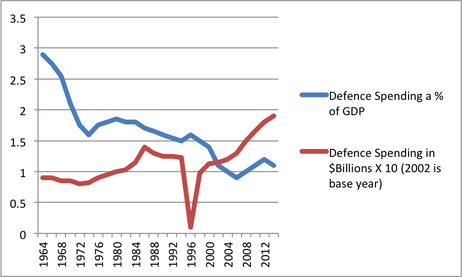
This graph, which is only rough, being drawn from three different sources and “rounded” for ease of plotting, shows, essentially, what happened between 1964 (Prime Minister Pearson) and 2014 Prime Minister Harper). As you can see defence spending as a percentage of Gross Domestic Product ~ a fair measure of our national, political commitment to our defence of Canada and of our allies and neighbours, has declined steadily even though, generally, with one “blip” in the Chrétien era, when he was trying to wrestle with the deficit, the actual dollars spent on defence have grown in number. What it really shows is that our GDP grew a lot in the past 50 years ~ it’s now almost $2.5 Trillion (that’s $2,500,000,000,000.00) ~ but our political willingness (or appreciation of the necessity) to spend 2% of GDP, as we did in about 1970s and as we have, sort of, agreed (in NATO) do aspire to do again, has not kept pace with our increasing prosperity. In fact, while the dollars spend on defence have doubled, in 50 years, the % of GDP spent of defence has fallen to ⅓ of its 1964 level. But ministers’ desires to “talk good fight” remain at historically high levels and even as resources shrink admirals and generals are told to “keep up appearances”. That, keeping up appearances, was what the admirals and generals wanted to do … no one really wanted to go into various international military fora and say “as our resources decline we’re going to have to do less,” instead they went out and said “we’re learning new ways to do more with less,” which is, of course, utter nonsense. Meanwhile more and more quite senior officers came back from tours of duty in the USA and brought with them some very American ideas about organization and management. Now American organizational models might work very well for armies with 1,000,000+ soldiers, or even for those with 495,000, like South Korea’s perhaps, even for those with 100,000+ like the French army, but they are not always or even often suitable for an army with 20,000± regulars and 25,000± reservists. The new organizations might make us look bigger, on paper, but they hide the fact the army has been hollowed out since 1970.
The Army of 1964, the one that consumed its fair share of the 3% of GDP that Canada spent on defence had four brigades, the largest had about 6,500 soldiers in it, the smaller ones had about 5,000 each. That was more men and women in combat units than we have in the entire, top heavy, Canadian Army today in total. But we still have three of the four brigades, we have nine instead of 13 battalions of infantry and three instead of four regiments of artillery … but how? Simple: it’s the Potemkin village, again, battalions that should have 950 soldiers have 500 … if their lucky. In fact there are no combat ready infantry battalions. Any battalion being readied for operations must be reinforced from other infantry battalions … we have nine battalion commanders and nine regimental sergeants major and so on but we only have enough soldiers in rifle platoons to staff five battalions … maybe only four if the battalions are properly equipped with mortars and heavy assault weapons. Why? Because no one, not ministers, not senior civil servants and not the generals want to “cut his coat according to his cloth.”
Ted Campbell, “A Canadian Potemkin Village”, Ted Campbell’s Point of View, 2016-09-15.
May 18, 2018
Deploy scare quotes as required when considering the “cultural” “impact” of the suburbs
Rick McGinnis has a thoughtful piece on the creation and evolution of the modern western suburb, in the context of the ongoing Ontario election:
Maybe it’s some remnant of our tribal past, but it’s hard for us to leave behind some impulse to fear and vilify whoever lives one village over, beyond the river or in the next valley. We might think we’re sophisticated, cosmopolitan people, but this nascent tribalism is never far from the surface, and I saw it re-emerge with a roar during recent municipal elections here in Toronto.
Back when the late Rob Ford won his surprise mayoral victory in 2010 – certainly a surprise for his opponents, who couldn’t imagine how decisively he’d win – the electoral post-mortems painted his triumph as the revenge of the suburbs that once comprised a group of independent townships over the downtown, Toronto’s older urban core.
It was a battle between the suburbs and the city, won this time by the suburbs, who rallied behind various standards – summed up in the media as a love of cars, ethnic and cultural homogeneity and lower property taxes. As with any history written by the losers – the media, for the most part, who identified as urbanite, not suburbanite – it relied on conveniently ignoring facts that didn’t fit, and the deployment of sweeping generalizations, many of them out of date – if they were ever true at all – by decades.
[…]
Up here in Ontario, the imminent provincial election means that the suburbs versus city scenario will be revived, to either apportion blame should Progressive Conservative leader Doug Ford become premier, or get unpacked if he loses and the boogeyman of a monolithic voting bloc needs to be triumphantly debunked.
There remains the small matter that Ford Nation events – held inevitably in the suburbs since the heyday of Doug’s brother Rob – are visibly far more diverse than, say, the average Liberal fundraiser, and Ford opponents have been chewing on that tough gristle for nearly a decade.
Obviously, the suburbs can’t be both a politically, economically and culturally monolithic place, and a diverse, complex collection of communities mysteriously moved to unite during election cycles to oppose the prerogatives of certain political parties and the urbanites who love them. There’s a very complex story about the suburbs dying to be told, but we’re still invested in stereotypes that are decades out-of-date for the purposes of situational political utility. It’s an object lesson that politics, more than anything else, is the enemy of truth.
Diversity has joined “marriage,” “rights,” “privilege” and “family” on that list of words that we’ve come to use without sharing a common meaning, especially when we talk about places like the suburbs, what have come to mean something very different in our imaginations than they exist in reality. For the people living there – whose lived experience has nothing to do with convenient fictions – the suburbs are really just a place where a mortgage might be affordable, where you can have a front and a back yard, and where you don’t share walls with your neighbours.
Rebellion I THE GREAT WAR Week 199
The Great War
Published on 17 May 2018The summer of 1918 saw many ethnic and political groups within the warring empires to openly rebel. The Austro-Hungarian Army saw open mutiny every week, the Irish rebelled against the British, the situation in the newly annexed Eastern European territories that were now part of the German Empire was a powder keg. And in France civilians were sentenced to death for treason.


