
Ministry of Defence
Published on 25 May 201610,000 men. 250 ships. 12 hours. Two sides. The Battle of Jutland – 100 years ago.
May 31, 2018
The Battle of Jutland Explained
Comments Off on The Battle of Jutland Explained
Megan McArdle’s tweetstorm explaining the Reagan coalition to under-35s
I’d embed all of these, except it would take a week for the page to render, so here’s the start of the thread, and the rest will just be copy-pasta’d text:
This week's column is on the series finale of The Americans, and what the series finale of Soviet Communism did to American politics, particularly on the right.
— Megan McArdle (@asymmetricinfo) May 30, 2018
Fear not, my little chickadees, there will be no spoilers. Except that, as Woddy Allen once remarked of “War and Peace”, “It involves Russia.”
Oh, heck, obviously this tweetstorm is going to be typo-tastic. I think we’re just gonna have to roll with it, folks.
Actually, most of this Tweetstorm is going to be about one small point that I raised in the column, but didn’t have space to explore.
Which is the extent to which those on the left who are under 45, and particularly those who are under 35, fundamentally misunderstand the Reagan coalition, because they don’t remember communism.
There’s a phenomenon in cognitive science called “hindsight bias”. People wildly overestimate their ability to predict events when they know what the outcome was.
Indeed, if you ask them to predict an event, then tell them the outcome, and then ask them what they predicted, some of them will misremember having correctly predicted the outcome.
They will also think they could have predicted an outcome that was designed to be random. Don’t think that you are not one of these people. All of us are, at least to some extent, plagued by hindsight bias. It takes conscious effort to overcome, and you never will, fully.
So once you know that Soviet Communism was doomed to the ash heap of history, because it is an infinitely inferior way of satisfying your society’s basic material needs, you become nearly incapable of imagining what it was like to live in the shadow of the Berlin Wall.
Unless you actually did.
Nonetheless, let me try to explain what it was like to our younger viewers. When I grew up, the Soviet Bloc was just one massive red blob on the map. One that the Soviets had repeatedly demonstrated an interest in expanding.
Whatever you think of American foreign policy post-1945, Soviet foreign policy was like that too, except with nastier. Our client regimes were terrible. Their client regimes were terrible. But we didn’t shoot people to keep them from leaving, or run a totalitarian police state.
It obviously, in hindsight, was not plausible to think that they were going to take over the whole world. They didn’t have the resources. But alas, we did not get the benefit of hindsight when it was happening. Almost until the Wall came down, people were predicting convergence.
There was a large, expansionist power. They were basically singlehandedly keeping Cuba afloat, subsidizing actual, honest-to-God communist groups that wanted to bring the rugged splendors of life without consumer goods to America, and oh, had a history of invading their neighbors
And then there were the nukes. So true, funny story–they were phasing out nuclear drills when I was in grammar school, because someone in the NYC Department of Ed had realized there’s not much point in drilling to become radioactive vapor. Pretty much just happens naturally.
But I had an older teacher who insisted on telling us to get under our desks if the Bomb hit. Also, inexplicably, to tuck our pants into our socks to protect us from fallout.
“I’m afraid your daughter is dead, Mrs. McArdle. But just look at those pristine ankles!”
Were Red Dawn and Top Gun over the top and a little silly? Yes. But folks in the 1980s (at least those of the appropriate age for viewing such things) didn’t watch them *ironically*. They believed the Soviets wanted to bury us. Because they had said stuff like “We will bury you”
We grew up actually afraid that the Soviet Union was going to turn our country into a sheet of radioactive glass. In hindsight, seems obviously overblown, but again: *we didn’t have hindsight*.
Also, even in the 1980s, there was a delusional portion of the left that actually thought life was better for ordinary people in the Soviet Union. That portion had, thankfully, gotten smaller after Hungary. But there was a larger portion that thought maybe it wasn’t really worse.
To be clear, I’m not talking about “Democrats”. I’m talking about hard leftists who I grew up with on the Upper West Side. They existed, and were kind of noisy.
And then there was a larger still part of the left that wasn’t Marxist, but thought that the things they were concerned about, like gender inequality and racism, didn’t exist under communism, or were better.
(NARRATOR: they existed. They weren’t better)
They thought these things because it’s hard to get good information about a police state. People saw America’s oppressions being reported on the front pages of American newspapers, and concluded that they must be worse than places we had no information on.
The existence of various sorts of at least vaguely communist-sympathetic folks inside the country, and an eerie background expectation that at any moment, a large, Imperialist communist power outside our borders might vaporize you, made this a very, very politically salient issue
If you are trying to interpret the Reagan Right without understanding the large emotional impact that this had on voters, you are getting it badly wrong.
As an aside, as I also mentioned in this column, this is *ALSO* true of people who aren’t old enough to remember urban crime in the 1980s.
I was mugged for the first time at the age of 8. In the girl’s bathroom of my grammar school. Which was supposedly the safest on the UWS.
A kid in my high school class was hospitalized after a gang of boys his own age beat and mugged him. At 10 in the morning. Off of Park Avenue.
It’s easy to have a complex, nuanced, high-level response to crime when you’re reading about crime statistics. When you are actually personally, viscerally afraid of being hurt or killed every time you walk out of your front door, your reaction tends not to be so measured.
Was there a racialized aspect to politicians talking about crime? Absolutely. That was not, however, the only thing driving it. When politicians ranted about crime, what they were often really actually talking about was … crime. Which was genuinely scary for everyone.
Which is why, as the excellent “Locking Up Our Own” documents, so many “tough on crime” laws that did huge and disproportionate damage to young black men were originated or supported by the black community. They were most at risk from law enforcement, but also from crime.
We can argue over how important “the Southern Strategy” was to the GOP’s rise. But you can’t argue that race was the whole story. Or even the overwhelming majority of the story. There was a lot going on.
But some of those problems faded, largely of their own accord. And the generation that doesn’t remember them first-hand tends to discount those problems that faded, leaving only the problem which is still with us, to which they overattribute Reagan’s success.
The left frequently suggests that conservatives are insufficiently imaginative when discussing the problems of the poor, leaving out huge areas of complexity and nuance. They’re right. I see young lefties making the same error about the problems of their parents & grandparents.
It’s one part hindsight bias (“*I’d* have known this wasn’t that big a threat”) and one part the simple difficulty of imagining how something feels if you haven’t lived it.
Comments Off on Megan McArdle’s tweetstorm explaining the Reagan coalition to under-35s
No5 MkI Enfield “Jungle Carbine”
Forgotten Weapons
Published on 18 Jan 2015http://www.forgottenweapons.com
The No.5 MkI Enfield, commonly called the “jungle carbine” is nearly the shortest-lived rifle in British military service. Introduced in 1944, they were declared obsolete in 1947 as the result of insoluble accuracy problems. The guns were originally developed from regular No4 Enfield rifles with the goal of producing a shorter and lighter variant for paratroops. This was done by shortening the barrel, adding a flash hider, and making lightening cuts in several places on the barrel and receiver (which were the cause of the problems that doomed the gun).
Not all No.5 rifles produced developed problems, and they were certainly handier than the regular Enfield rifles. They are noted for kicking harder, of course, and this is not really helped by the narrow rubber buttpad they came with (most of which are nice and hard today).
Theme music by Dylan Benson – http://dbproductioncompany.webs.com
Comments Off on No5 MkI Enfield “Jungle Carbine”
May 30, 2018
Decisive Weapons S02E04 – U-Boat Killer: The Anti-Submarine Warship
erana19
Published on 25 Jan 20161996-1997 BBC documentary series. Series 2, Episode 4.
Comments Off on Decisive Weapons S02E04 – U-Boat Killer: The Anti-Submarine Warship
A point about cloaks
Lindybeige
Published on 28 Nov 2012I shot this ages ago, but there were massive delays because the special effects for the weather were a nightmare and just refused to work. Anyway, recently I found the time to wrestle with the software again, and I never managed to get them to work properly, but at least I managed to find a long tedious convoluted work-around using two different editing packages.
Another thing I can say about the cloak I’m wearing in this, is that it turned out that the pattern on it was a very effective camouflage – acting a lot like modern military disruptive patterned materials. I have heard that the various tartans had colours in them to match the seasons, and were used for that purpose.
www.LloydianAspects.co.uk
Comments Off on A point about cloaks
May 29, 2018
The History of Non-Euclidian Geometry – Sacred Geometry – Extra History – #1
Extra Credits
Published on 26 May 2018Before we get into non-Euclidian geometry, we have to know: what even is geometry? What’s up with the Pythagorean math cult? Who was Euclid, for that matter? And what the heck is the 5th Postulate?
Comments Off on The History of Non-Euclidian Geometry – Sacred Geometry – Extra History – #1
ESR’s thumbnail sketch on the origins of the Indo-European language families
When you mash historical linguistics hard enough into paleogenetics, interesting things fall out:
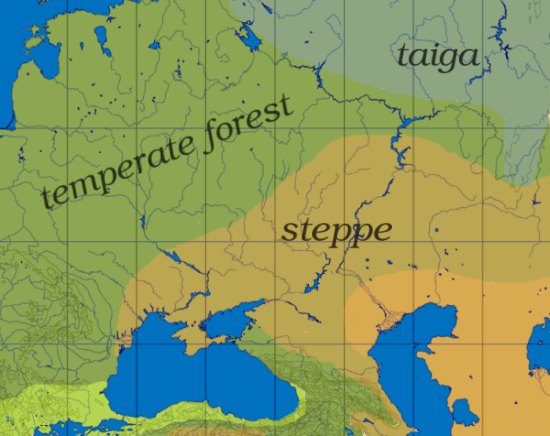
The steppe extends roughly from the Dniepr to the Ural or 30° to 55° east longitude, and from the Black Sea and the Caucasus in the south to the temperate forest and taiga in the north, or 45° to 55° north latitude.
Via Wikipedia
What we can now say pretty much for sure: Proto-Indo-European was first spoken on the Pontic Steppes around 4000 BCE. That’s the grasslands north of the Black Sea and west of the Urals; today, it’s the Ukraine and parts of European Russia. The original PIE speakers (which we can now confidently identify with what archaeologists call the Yamnaya culture) were the first humans to domesticate horses.
And – well, basically, they were the first and most successful horse barbarians. They invaded Europe via the Danube Valley and contributed about half the genetic ancestry of modern Europeans – a bit more in the north, where they almost wiped out the indigenes; a bit less in the south where they mixed more with a population of farmers who had previously migrated in on foot from somewhere in Anatolia.
The broad outline isn’t a new idea. 400 years ago the very first speculations about a possible IE root language fingered the Scythians, Pontic-Steppe descendants in historical times of the original PIE speakers – with a similar horse-barbarian lifestyle. It was actually a remarkably good guess, considering. The first version of the “modern” steppe-origin hypothesis – warlike bronze-age PIE speakers domesticate the horse and overrun Europe at sword- and spear-point – goes back to 1926.
But since then various flavors of nationalist and nutty racial theorist have tried to relocate the PIE urheimat all over the map – usually in the nut’s home country. The Nazis wanted to believe it was somewhere in their Greater Germany, of course. There’s still a crew of fringe scientists trying to pin it to northern India, but the paleogenetic evidence craps all over that theory (as Cochran explains rather gleefully – he does enjoy calling bullshit on bullshit).
Then there have been the non-nutty proposals. There was a scientist named Colin Renfrew who for many years (quite respectably) pushed the theory that IE speakers walked into Europe from Anatolia along with farming technology, instead of riding in off the steppes brandishing weapons like some tribe in a Robert E. Howard novel.
Alas, Renfrew was wrong. It now looks like there was such a migration, but those people spoke a non-IE language (most likely something archaically Semitic) and got overrun by the PIE speakers riding in a few thousand years later. Cochran calls these people “EEF” (Eastern European Farmers) and they’re most of the non-IE half of modern European ancestry. Basque is the only living language that survives from EEF times; Otzi the Iceman was EEF, and you can still find people with genes a lot like his in the remotest hills of Sardinia.
Even David Anthony, good as he is about much else, seems rather embarrassed and denialist about the fire-and-sword stuff. Late in his book he spins a lot of hopeful guff about IE speakers expanding up the Danube peacefully by recruiting the locals into their culture.
Um, nope. The genetic evidence is merciless (though, to be fair, Anthony can’t have known this). There’s a particular pattern of Y-chromosome and mitochondrial DNA variation that you only get in descendant population C when it’s a mix produced because aggressor population A killed most or all of population B’s men and took their women. Modern Europeans (C) have that pattern, the maternal line stuff (B) is EEF, and the paternal-line stuff (A) is straight outta steppe-land; the Yamnaya invaders were not gentle.
How un-gentle were they? Well…this paragraph is me filling in from some sources that aren’t Anthony or Cochran, now. While Europeans still have EEF genes, almost nothing of EEF culture survived in later Europe beyond the plants they domesticated, the names of some rivers, and (possibly) a murky substratum in some European mythologies.
The PIE speakers themselves seem to have formed, genetically, when an earlier population called the Ancient Northern Eurasians did a fire-and-sword number (on foot, that time) on a group of early farmers from the Fertile Crescent. Cochrane sometimes calls the ANEs “Hyperboreans” or “Cimmerians”, which is pretty funny if you’ve read your Howard.
Comments Off on ESR’s thumbnail sketch on the origins of the Indo-European language families
Allied Defense During Spring Offensives 1918 I THE GREAT WAR Special
The Great War
Published on 28 May 2018MHV about Stormtrooper tactics: https://www.youtube.com/watch?v=BNqmA-if-4g
The French and British defenses during the German Spring Offensive 1918 were put to a real test when the Germans attacked. The carefully built defenses had to be abandoned and new lessons had to be learned.
Comments Off on Allied Defense During Spring Offensives 1918 I THE GREAT WAR Special
QotD: Gandhi on the Holocaust
I am aware that for many not privileged to have visited the former British Raj, the names Gujarat, Rajasthan, and Deccan are simply words. But other names, such as Germany, Poland, Czechoslovakia, somehow have a harder profile. The term “Jew,” also, has a reasonably hard profile, and I feel all Jews sitting emotionally at the movie Gandhi should be apprised of the advice that the Mahatma offered their coreligionists when faced with the Nazi peril: they should commit collective suicide. If only the Jews of Germany had the good sense to offer their throats willingly to the Nazi butchers’ knives and throw themselves into the sea from cliffs they would arouse world public opinion, Gandhi was convinced, and their moral triumph would be remembered for “ages to come.” If they would only pray for Hitler (as their throats were cut, presumably), they would leave a “rich heritage to mankind.” Although Gandhi had known Jews from his earliest days in South Africa — where his three staunchest white supporters were Jews, every one — he disapproved of how rarely they loved their enemies. And he never repented of his recommendation of collective suicide. Even after the war, when the full extent of the Holocaust was revealed, Gandhi told Louis Fischer, one of his biographers, that the Jews died anyway, didn’t they? They might as well have died significantly.
Richard Grenier, “The Gandhi Nobody Knows”, Commentary, 1983-03-01.
Comments Off on QotD: Gandhi on the Holocaust
May 28, 2018
Naval Operations In The Dardanelles Campaign 1915 I THE GREAT WAR On The Road
The Great War
Published on 25 May 2018In our first episode filmed on the former Gallipoli battlefields, Indy and our guide Can Balcioglu explore the naval campaign that preceded the landings at Gallipoli in early 1915.
Comments Off on Naval Operations In The Dardanelles Campaign 1915 I THE GREAT WAR On The Road
Leopard tanks in Afghanistan – “When the legend becomes fact, print the legend”
There’s a story that’s been told for more than a decade and — given the Canadian government’s legendary unwillingness to spend money on the military — widely believed. David Pugliese does his best to debunk it here:

Canadian Leopard 1A3 (Leopard C1) at the Bovington Tank Museum.
Photo by Chris Parfeniuk, via Flickr.
As stories go it’s a pretty good one.
The Canadian Army was up against a tough enemy – the Taliban – in Afghanistan. Commanders called for Leopard tanks to join the battle but those armored vehicles had been mothballed and made into monuments.
So the ever resourceful Canadian Army crews jumped in the Leopard tanks mounted on concrete pads outside bases as monuments and drove them off those platforms, making sure they were shipped to their comrades in Afghanistan.
This myth has been around since 2007 and has once again resurfaced in a new book by retired Maj.-Gen. David Fraser about Operation Medusa.
Fraser also repeated the story in a recent CBC interview with Anna-Maria Tremonti, noting that he knew of at least one Leopard tank pulled off its concrete pad and brought back to serviceability and then shipped to Afghanistan.
In the 2008 book Kandahar Tour by Lee Windsor, David Charters and Brent Wilson the story gets even better. The tanks were driven off the concrete pads and then sent to Afghanistan, according to those authors.
A similar claim is made at the museum devoted to telling the story of the “Essex Regiment (Tank).” On its website the museum claims multiple numbers of Canadian Leopard tanks were taken from monuments (“A mad scramble to retrieve tanks from monuments and prepare them for war,” it claims).
Again, a great story.
But the Canadian Army says it never happened.
The Army points out that Leopard tanks, positioned on the concrete pads as monuments, had already been demilitarized so no one was driving them anywhere.
So what did happen?
Comments Off on Leopard tanks in Afghanistan – “When the legend becomes fact, print the legend”
Middle East: Palmyra Today – Afterword – Extra History
Extra Credits
Published on 31 Oct 2015Learn about Odenathus, King of Palmyra: http://bit.ly/1GDsDvz
____________Palmyra is an embodiment of our shared past, but right now it’s under the control of ISIS. They have destroyed the antiquities that remind us of our shared past. We would like to take a moment to honor Dr. Khaled al-Assad, the museum director who gave his life rather than reveal the locations of more Palmyrene relics for ISIS to destroy.
Comments Off on Middle East: Palmyra Today – Afterword – Extra History
May 27, 2018
Middle East: Odenathus – Ghosts of the Desert – Extra History
Extra Credits
Published on 31 Oct 2015Watch the afterword about Palmyra Today: http://bit.ly/1kiAKTN
Support us on Patreon: http://bit.ly/EHPatreon
____________In 260 CE, the Roman Empire was falling apart on all sides. Emperor Valerian gathered the legions to push back on the worst incursions from the Sassanid Empire in the east. They not only lost – they were massacred, and the emperor was taken captive. This left the empire in disarray. Into this desperate moment stepped Odenathus from the city-state of Palmyra. Palmyra was a vassal state that owed fealty to Rome and had been decorated with many honors and recognition in the past. If Rome fell, the Sassanid Empire would certainly look to conquer and annex Palmyra, so Odenathus rode to the rescue. He gathered all the soldiers he could find and took the Sassanid army by surprise on their way back from the battle with Valerian. He destroyed them. From there, he rode north to protect the emperor’s son, and the next heir to Rome, then south again where he pushed the Sassanids all the way back to their capitol twice. Despite his success and undeniable military power, he never took power for himself or declared himself an emperor. Rome showered him with appreciation and titles. Sadly, he was murdered by his nephew in 267 CE, but his loyalty had bought the Roman Empire enough time to recover and survive for another 200 years.
Comments Off on Middle East: Odenathus – Ghosts of the Desert – Extra History
QotD: Epicurus on the ethics of pleasure
Epicurus begins with the question asked by Socrates at the end of the fifth century — what is the good life? His answer is that the good lies not in virtue or justice or wisdom — though these are not to be ignored — but in happiness.
“Pleasure” he writes, “is our first and kindred good. It is the starting point of every choice and every aversion, and to it we come back, inasmuch as we make feeling the rule by which to judge of every good thing.”
Now we have more than enough of Epicurus to know that he is not arguing for what are called the self-indulgent pleasures — of eating and drinking and sex and the like. Aristippus of Cyrene (c435-366 BC), we are told, had already argued for these. He also claimed that happiness was the highest good, but went on to claim that happiness lay in the pursuit of pleasure regardless of convention or the feelings of others or of the future.
This interpretation was attached to Epicurus in his own lifetime, and the attachment has been maintained down to the present — so that the words “Epicure” and “Epicurean” have the meaning of self-indulgent luxury.
What Epicurus plainly means by happiness is the absence of pain. We are driven to act by a feeling of discontent. We seek food because we are hungry. We seek warmth because we are cold. We seek medicine because we are sick. Once we have acted correctly and removed the cause of discontent, we are happy.
Turning to his own words, he says:
When we say… that pleasure is the end and aim, we do not mean the pleasures of the prodigal or the pleasures of sensuality, as we are understood to do by some through ignorance, prejudice or wilful misrepresentation. By pleasure we mean the absence of pain in the body and of trouble in the soul. It is not by an unbroken succession of drinking bouts and of revelry, not by sexual lust, nor the enjoyment of fish and other delicacies of a luxurious table, which produce a pleasant life; it is sober reasoning, searching out the grounds of every choice and avoidance, and banishing those beliefs through which the greatest tumults take possession of the soul. Of this the beginning and the greatest good is wisdom. Therefore wisdom is a more precious thing that even philosophy; from it springs all the other virtues, for it teaches that we cannot live pleasantly without living wisely, honourably and justly; nor live wisely, honourably and justly without living pleasantly.
In this scheme, therefore, happiness is to be defined as peace of mind, or ataraxia. This pursuit of happiness does involve bodily pleasure, but such pleasure is a means to the greater end of ataraxia. “No pleasure” he says, “is a bad thing in itself, but the things which produce certain pleasures entail disturbances many times greater than the pleasures themselves.”
His ethics of pleasure can be summarised as:
The pleasure which produces no pain is to be embraced. The pain which produces no pleasure is to be avoided. The pleasure is to be avoided which prevents a greater pleasure, or produces a greater pain. The pain is to be endured which averts a greater pain, or secures a greater pleasure.
And so the happy man for Epicurus is one who lives simply within his means, who seeks only those pleasures which contribute to his long term peace of mind.
And while hedonism is ultimately a doctrine of selfishness, what Epicurus had in mind was not a life spent in the pursuit of solitary happiness. He says: “Of the means which wisdom acquires to ensure happiness throughout the whole of life, by far the most important is friendship.”
It may be that we seek friendship for selfish reasons. But friendship is to be persistently sought and maintained throughout life. Epicurus himself had an immense capacity for friendship.
Sean Gabb, “Epicurus: Father of the Enlightenment”, speaking to the 6/20 Club in London, 2007-09-06.
Comments Off on QotD: Epicurus on the ethics of pleasure
May 26, 2018
QotD: Child labour
In response to something I’d written about labor unions, a critic started badgering me about child labor.
What a terrible feature of capitalism, he said.
No, it was a terrible feature of all of world history, I replied.
Thank goodness for people who passed laws against it, he said.
No, I said, thank goodness for capitalism, which created enough wealth that families didn’t have to send their kids to work anymore just to avoid starvation.
Then I was asked: do I really believe my kids would be better off in a factory (than in school, presumably)?
As if the choice we’re talking about is between factory work and school! The actual choice faced by these families is between factory work and starvation.
The British charity Oxfam found that in Bangladesh, where the government caved in to Western demands to suppress child labor, the children — you’ll never guess — didn’t wind up in school! How about that.
Where did they wind up? In prostitution, or dead.
Nice going, geniuses.
Yes, there were laws passed against child labor, but those came when child labor was already practically a thing of the past.
No law is going to keep families from avoiding starvation — and even the left-wing International Labor Organization admits that this is the real reason for child labor. Only capital accumulation makes it possible to end child labor humanely.
My opponent probably isn’t a bad guy. He’s just absorbed the conventional wisdom on pretty much everything.
It’s very easy to blame “capitalism” for child labor. Where is the average person going to hear any other explanation?
Tom Woods, “SJWs Really Mean Well, But Accidentally Starve Some Children”, The Tom Woods Show, 2016-09-13.
Comments Off on QotD: Child labour


