
Extra Credits
Published on 20 Jun 2017Although the French government surrendered to the German invasion, French people rose up and formed resistance groups to take their country back. Charles de Gaulle and his Free French took advantage of these independent movements to help organize actions that would greatly aid the Allied landings at Normandy.
June 8, 2018
D Day – III: La Résistance – Extra History
Comments Off on D Day – III: La Résistance – Extra History
June 7, 2018
Trade war with Canada justified because the White House was torched in the War of 1812
Maybe it was intended as a joke, but what else was Trump supposed to say when Trudeau actually asked what actual security threat Canada poses to the United States?

During a phone call with Canadian Prime Minister Justin Trudeau last weekend, President Donald Trump reportedly justified his decision to impose tariffs on Canadian steel and aluminum by invoking … the burning of the White House by British troops during the War of 1812.
At least, that’s what CNN is reporting this afternoon. Here’s how they put it, citing information from “sources familiar with the call: “Trudeau pressed Trump on how he could justify the tariffs as a ‘national security’ issue. In response, Trump quipped to Trudeau, ‘Didn’t you guys burn down the White House?'”
That is, presumably, a reference to the War of 1812, during which British troops invaded Washington, D.C., and set fire to the White House. Despite the war’s name, the burning of the White House actually occurred in 1814. And it wasn’t carried out by Canadians because, well, Canada did not become an independent nation until 1867 — or 53 years after the White House burned.
But, sure, whatever. The War of 1812 makes Canada a national security threat in the year 2018, despite our having been allies for the last century, sharing the world’s longest unpatrolled border, and exchanging more than $620 billion in goods last year. The rationales for war with Canada in Canadian Bacon and South Park: Bigger, Longer & Uncut are more grounded in reality.
Comments Off on Trade war with Canada justified because the White House was torched in the War of 1812
D-Day – II: The Secret War – Extra History
Extra Credits
Published on 13 Jun 2017The Germans expected the Allies to invade France to re-open the Western Front, but they did not know when or where the invasion would start – thanks largely to the operations of MI5, British intelligence services, who staged an elaborate deception called Operation Bodyguard designed to make the Germans think they would be invading Pas de Calais instead of their real target: Normandy.
Comments Off on D-Day – II: The Secret War – Extra History
June 6, 2018
D-Day: Canada at Juno Beach
Yesterday Today
Published on 3 Jun 2017D-Day: Canada at Juno Beach
6 June 1944
Of the nearly 150,000 Allied troops who landed or parachuted onto the Normandy coast, 14,000 were Canadians. They assaulted a beachfront code-named “Juno”.
The Royal Canadian Navy contributed 110 ships & 10,000 sailors in support of the landings while the RCAF had helped prepare the invasion by bombing targets inland. On D-Day & during the ensuing campaign, 15 RCAF fighter & fighter-bomber squadrons helped control the skies over Normandy and attacked enemy targets. On D-Day, Canadians suffered 1074 casualties, including 359 killed.
Comments Off on D-Day: Canada at Juno Beach
D-Day – I: The Great Crusade – Extra History
Extra Credits
Published on 6 Jun 2017D-Day: June 6, 1944, the day when Allied forces stormed the beaches of Normandy to retake France from the Germans. They hoped to take the Germans by surprise, and their decision to brave rough weather to make their landings certainly accomplished that, but despite these small advantages, the American forces at Utah and Omaha Beach had to overcome monumental challenges to establish a successful beachhead.
Comments Off on D-Day – I: The Great Crusade – Extra History
QotD: When the “Right Stuff” becomes “old school”
Consider the popular conception of firefighters: brave, selfless, strong enough to haul an incapacitated person from a burning building.
A few years ago, at a conference, I learned that many women were failing to qualify as firefighters, because they were coming up short on the strength test. What was so interesting, though, was that in practice, it turns out that one of the most important skills a firefighter needs is not so much the strength to drag an unconscious person from a building, but, far more commonly, the ability to coax someone who’s in danger and is terrified to come with them. Apparently, many women turn out to be far more persuasive than men – highlighting the importance of selection based on real-world skills, rather than legacy stereotypes.
Space flight offers another striking example of this phenomenon. In the context of a recent Tech Tonics podcast interview with Dorit Donoviel, director of the Biomedical Innovations Laboratory at the Center for Space Medicine at Baylor College of Medicine, I had told Dr. Donoviel about my lifelong interest in astronomy and space, about launching Estes rockets and my love of the National Air and Space Museum and above all, about my affection for the heroism captured in the movie The Right Stuff, an all-time favorite.
In response, she laughed, and told me how “old school” that thinking was. When the space program started out, she explained, there was an exceptional degree of risk involved, and astronauts tended to be selected from the ranks of fighter pilots – because, in her words, they had “the skill sets and the cojones.” But today, she said, things are different – in large measure because the “space program is a lot safer than it used to be.”
Consequently, Donoviel explained, “Today what we’re looking for is less of the sort of alpha-male pilots, and more of the sort of scientists and engineers, geologists and earth scientists, folks who can work together in a cohesive manner in a team.”
Moreover, she added, the astronaut of the future needs to be able to endure long periods of boredom and the prolonged lack of stimulation – in many ways, the opposite of high-adrenaline “seat-of-the-pants flying” that in some ways characterized the early astronaut missions.
In space travel, as in firefighting, our notion of what constitutes the right skill set has evolved appreciably.
David Shaywitz, “Evolving Notions Of The Right Stuff — In Spaceflight And In Medicine”, Forbes, 2016-09-20.
Comments Off on QotD: When the “Right Stuff” becomes “old school”
June 5, 2018
The Landings At ANZAC Cove And Suvla Bay 1915 I THE GREAT WAR On The Road
The Great War
Published on 4 Jun 2018With thanks to Mr. Ali Serim for making this episode possible.
Indy and our guide Can Balcioglu explore the northern landings sites of Gallipoli where the Australian and New Zealand Army Corps (ANZAC) landed in 1915.
Comments Off on The Landings At ANZAC Cove And Suvla Bay 1915 I THE GREAT WAR On The Road
June 4, 2018
The economic damage of tariffs
Tim Worstall fisks a recent Pat Buchanan brain fart article on the glories of erecting tariff walls against foreign trade:
Pat Buchanan has been going on for decades about how wondrous tariffs are and if only they were brought back then things would be just peachy. Sadly, this all seems to be based on his not understanding trade, tariffs, nor apparently even history. That’s not a good set of recommendations for a policy about trade and tariffs, one that has been tried many a time in history.
Now, it is entirely true that if we returned to a more Hamiltonian policy era then we’d all be richer. But that wouldn’t be because we had tariffs which paid for government rather than an income or corporate tax. It’s because government would be confiscating a very much smaller portion of what we all produce to pay for itself. If the Feds took 3% of everything we do instead of the current 18% or so then sure, we’d all be richer. But that’s true however that tax is raised.
[…]
His argument is that, protected from foreign competition, American business was able to develop and grow into being world beaters. No, I don’t think this is true – I insist that behind tariff barriers companies stagnate. Indeed it’s standard economics that the medium to long term effects of trade are that the competition from foreigners is what makes the domestic companies stronger and more productive. But put that argument to one side. Assume that Buchanan is correct.
For his conclusion to be correct then it must have been true that the total costs of trade were rising in that time period. Total costs being tariffs plus transport. Only if the total costs were rising was protection rising. The tariffs are only part of the story. And as it happens total protection was falling over this time period. The falls in the costs of transport – for the US externally primarily the steam ship – were greater than the rises in the tariffs. Thus the US was becoming more open to trade at this time when industry was booming and growing to world class levels.
That’s not an argument in favour of trade protection now, is it?
The U.S. relied on tariffs to convert from an agricultural economy in 1800 to the mightiest manufacturing power on earth by 1900.
Well, it’s also true that what the US was inside those tariff barriers was the largest free trade area in the world. I’m the guy insisting that free trade makes places grow, Pat the opposite. And the place with more free trade among more people than anywhere else grows fastest? That’s a point in my favour, no, not Pat’s? Remember, the US Constitution expressly forbids the individual states from having tariffs between them…..that regulation is left to the Feds who have never imposed them.
How have EU nations run up endless trade surpluses with America? By imposing a value-added tax, or VAT, on imports from the U.S., while rebating the VAT on exports to the USA. Works just like a tariff.
No, a VAT does not work like a tariff. In no manner at all does it do so in fact. As every economist keeps trying to point out. Within the EU all goods and services, no matter where they’re made, pay the exact same rate of VAT. Well, OK, ladies unmentionables pay a lower rate than motor cars, that’s true, but all unmentionables pay the same rate, all cars. There is no difference made between domestic and foreign production. It’s entirely unlike a tariff therefore, the crucial component of which is that distinction made between home and foreign production.
Stuff made in the EU and sold in the US pays no VAT. Stuff made in the US and sold in the US pays no VAT. Again, we’ve no distinction by source or origin, this is entirely and completely unlike a tariff.
Comments Off on The economic damage of tariffs
The History of Non-Euclidian Geometry – The Great Quest – Extra History – #2
Extra Credits
Published on 2 Jun 2018For hundreds of years, Euclid’s geometry disappeared with the fall of the Roman Empire. But in Constantinople, Islamic mathematicians, including Al-Khwarizmi (who gave us the word “algebra”) worked long and hard on proving the Fifth Postulate.
Comments Off on The History of Non-Euclidian Geometry – The Great Quest – Extra History – #2
QotD: Pushing the Confederacy down the memory hole
Lately, I have been mightily irritated by the politically-correct campaign to permanently banish the old Confederate flag, and all music associated with the Southern cause, or any symbol that it once existed, before it was comprehensively defeated a century-and-a-half ago. Memorials of Robert E. Lee are being treated as memorials of Adolf Q. Hitler.
It strikes me that even under the old lamentable cotton-plantation slave system of the South, people mixed and got to smell one another — rich and poor, black and white, genteel and grotesque. That, the most forgotten slogan of the Dixie Land was her war cry: “Down with the Eagle, and up with the Cross!” That, it is the Cross of Saint Andrew astride the old Confederate flag that is most galling to the hyper-secular, liberal mind. That, the greatest triumph of the Union propaganda was to tar all those flag-bearers in the way our contemporary media demean all dissenters from the current party line as “racists,” “sexists,” “phobes,” and nothing more. That, the principal crime of the South was to stand by the wording of the U.S. Constitution, and from the beginning, to get in the way of a grand national scheme for social engineering, which triumphed with Lincoln (though hardly a liberal by the standards of today). That, in the Southern view, the eagle swooped down on them, with claws.
Something similar is now happening in the division of “Red States” and “Blue”: in an America from which the Christian conception of the “common man” is being systematically expunged. All who resist the categories to which they have been assigned are instinctively rebelling; “victim” and “oppressor” alike. This is what “common men” will do, when tarred and pressed, often without fully understanding why they rebel. They remember, however obliquely, whose sons and daughters they are. That, no matter how low in social station, they are Christ’s, and not the segregated chattels of some malicious and incompetent — and intentionally divisive — Washington Nanny.
The recovery of USA, and more largely, the recovery of Christendom, turns on the recovery of this conception of the “common man” — as Man, not as member of a client group. This has nought to do with “equality,” for it is none of a government’s business to help one group get even with another. Rather it is to serve man as man. This is a matter that goes deeper even than slavery, as Saint Paul explained. It is an unarguable, even mystical point. Where that conception survives, of the common in man, Christendom persists, and can potentially flourish.
David Warren, “The common man”, Essays in Idleness, 2016-08-29.
June 3, 2018
Conrad von Hötzendorf – A Military Genius? I OUT OF THE TRENCHES
The Great War
Published on 2 Jun 2018Chair of Wisdom Time!
Comments Off on Conrad von Hötzendorf – A Military Genius? I OUT OF THE TRENCHES
June 2, 2018
A Safer Berth – HMS Victory
NMRNPortsmouth
Published on Aug 21, 2017An 18-month programme to re-support the world’s most famous warship HMS Victory sagging under her own weight is now underway.
Comments Off on A Safer Berth – HMS Victory
June 1, 2018
50 Miles To Paris – Third Battle Of The Aisne I THE GREAT WAR Week 201
The Great War
Published on 31 May 2018The German spring offensive has lost some traction over the past few weeks but the Allies are still under pressure. With Operations Blücher and York, the Germans are getting within 50 miles of Paris again, just as they did in 1914.
Comments Off on 50 Miles To Paris – Third Battle Of The Aisne I THE GREAT WAR Week 201
Spiked armour
Lindybeige
Published on 11 Nov 2012In summary: no.
www.LloydianAspects.co.uk
Comments Off on Spiked armour
May 31, 2018
Admiral David Beatty: “There seems to be something wrong with our bloody ships today”
One of the outcomes of the Battle of Jutland was that naval opinion finally crystalized over the notion of battle cruisers: the loss of three British battle cruisers during the battle (and near-loss of a fourth) proved to most that the design was flawed and that this class of ships should never have sailed into battle against real battleships. A recent post at Naval Gazing begs to differ on this judgement:
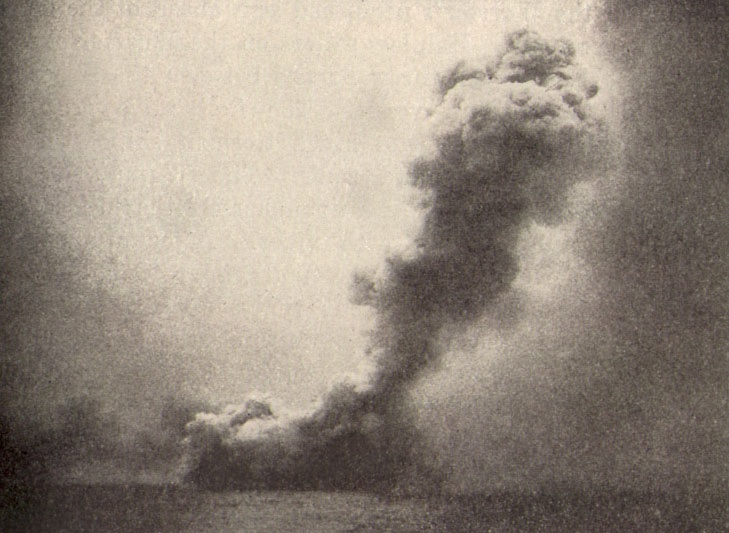
Explosion that sank HMS Queen Mary at the Battle of Jutland, 31 May 1916
Image via Wikimedia Commons.
David Beatty’s famous remark about the destruction of two of his ships by catastrophic magazine explosions during the Battle of Jutland sums up the traditional attitude towards one of the battle’s most famous aspects. Of the 3,326 men aboard the battlecruisers Indefatigable, Queen Mary, and Invincible, only 17 survived. It’s long been believed that the ships themselves were to blame, as they were built with only relatively light armor. Shells supposedly penetrated to the magazines and set them off. Recent research has revealed that this was not the case, and the ships were lost primarily due to defects in operation, not design.
The basic problem with the conventional theory is that no German shell penetrated deep enough into the surviving ships to have been able to set off a magazine if it had hit one. The magazines take up a minority of a battlecruiser’s deck, so if such hits were common, then at least a few of the surviving ships should have seen shells reach their machinery. Instead, German shells were found to detonate with 16-24′ of their first impact with the structure. At the 20° angle the shells were falling at at the time, this puts them no more than 8 feet below the upper deck upon detonation. The only case where shell fragments reached magazine was a hit on Barham at 1758 when fragments from a 12″ shell penetrated the deck over the 6″ magazine. Despite leaving a 12″x15″ hole in the 1″ deck, the fragments had no effect on the powder stored under it.
So is there a different potential cause, one that happened to a surviving ship? A survey of the damage to Beatty’s battlecrusiers reveals a promising candidate. A hit on a turret, such as the one suffered by HMS Lion, could cause a flash to propagate down into the magazine, which would then deflagrate in precisely the manner seen during the battle. A careful examination of Lion‘s damage shows that she came very close to suffering the same fate.
Turret explosions are hardly unknown aboard warships, either as a result of accident or enemy action, and a great deal of care goes into making sure that they don’t set off the magazines. Powder is stored in metal cans or tanks, and flashproof doors and other interlocks are used to make sure that fire does not reach the magazines. Unfortunately, the British had systematically undermined these protections in the search for rate of fire and ammunition capacity, and their magazine practices during the battle can only be described as suicidal.
After the Battle of Dogger Bank, Beatty decided that the reason he was unable to destroy the German battlecruisers was insufficient rate of fire. Not only would opening fire early and firing quickly lead to early hits, but it would also distract the German gunners. However, the British were not particularly confident in their long-range fire control, and began to stuff extra cordite into the handling rooms and other spaces that had been designed to provide flash protection. This was made much worse by a other changes intended to increase rate of fire. Normally, the cordite cases were kept sealed until just before the charges are sent to the gun, but the crews chose to open many of the cases early, take some cordite out of the cases before battle to make it easy to access, and even stored extra charges completely unprotected. In a final effort to make the turrets as dangerous as possible, the majority of the anti-flash safety doors were removed.
The only ship which strongly resisted this trend was Lion, and the efforts of her Gunner, Alexander Grant, deserve most of the credit. When Grant came aboard, he found the situation described above, and quickly reintroduced the traditional magazine safety regulations with the support of Lion‘s captain, Ernle Chatfield. He managed to train the magazine crews to the point where they could provide cordite to the guns faster than the guns could fire it, while observing full safety procedures.
Comments Off on Admiral David Beatty: “There seems to be something wrong with our bloody ships today”


