
Megan T
Published on 26 Apr 2015
June 15, 2018
JM’s Toy Stories – Legoland Vault
Comments Off on JM’s Toy Stories – Legoland Vault
QotD: Churchill on Montgomery
There was a brief firestorm in Britain when a photograph appeared in the press of Montgomery and Gen. Wilhelm Ritter von Thoma, the commander of the Afrika Korps and the highest-ranking German captured at Alamein. After his capture Thoma was brought to the Eighth Army command post, where Montgomery accorded him the respect of one honorable professional soldier to another. The two dined that night, and the photograph of the two generals led Brendan Bracken to send Churchill a memo criticizing Montgomery’s naïveté and noting that it created a bad impression with the public. Churchill merely commented: “I sympathize with Gen. von Thoma. Defeated, humiliated, in captivity, and,” after pausing for effect, “dinner with General Montgomery.”
Carlo d’Este, Warlord: A life of Winston Churchill at war, 1874-1945, 2008.
Comments Off on QotD: Churchill on Montgomery
June 13, 2018
June 12, 2018
The Goeben & The Breslau – Two German Ships Under Ottoman Flag I THE GREAT WAR On The Road
The Great War
Published on 11 Jun 2018How SMS Goeben and SMS Breslau, two German warships in 1914 sailed under Ottoman flag and helped Enver Pasha to get the Ottoman Empire into World War 1.
Comments Off on The Goeben & The Breslau – Two German Ships Under Ottoman Flag I THE GREAT WAR On The Road
June 11, 2018
The History of Non-Euclidian Geometry – Squaring the Circle – Extra History – #3
Extra Credits
Published on 9 Jun 2018Euclidean geometry eventually found its way back into Europe, inspiring René Descartes to create the Cartesian coordinate system for maps, and Isaac Newton to invent calculus. Both these tools helped humanity understand the world better.
Comments Off on The History of Non-Euclidian Geometry – Squaring the Circle – Extra History – #3
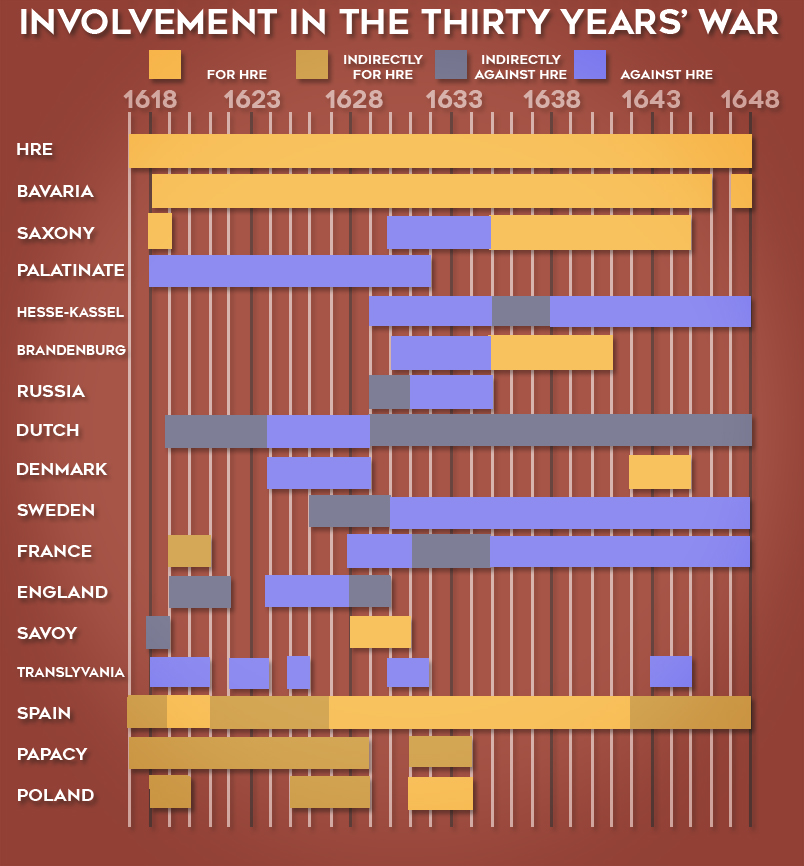
Feature History – Thirty Years’ War
Feature History
Published on 12 Nov 2016Hello and welcome to Feature History, featuring religious conflict, tragic war, and a really nifty collaboration with Jabzy.
3 Minute History – German Peasant’s War
https://www.youtube.com/watch?v=zeQVAUmyLksInvolvement Chart
Comments Off on Feature History – Thirty Years’ War
QotD: Gandhi as filmic hagiography
Gandhi, therefore, the film, this paid political advertisement for the government of India, is organized around three axes: (1) Anti-racism — all men are equal regardless of race, color, creed, etc.; (2) anti-colonialism, which in present terms translates as support for the Third World, including, most eminently, India; (3) nonviolence, presented as an absolutist pacifism. There are other, secondary precepts and subheadings. Gandhi is portrayed as the quintessence of tolerance (“I am a Hindu and a Muslim and a Christian and a Jew”), of basic friendliness to Britain (“The British have been with us for a long time and when they leave we want them to leave as friends”), of devotion to his wife and family. His vow of chastity is represented as something selfless and holy, rather like the celibacy of the Catholic clergy. But, above all, Gandhi’s life and teachings are presented as having great import for us today. We must learn from Gandhi.
I propose to demonstrate that the film grotesquely distorts both Gandhi’s life and character to the point that it is nothing more than a pious fraud, and a fraud of the most egregious kind. Hackneyed Indian falsehoods such as that “the British keep trying to break India up” (as if Britain didn’t give India a unity it had never enjoyed in history), or that the British created Indian poverty (a poverty which had not only existed since time immemorial but had been considered holy), almost pass unnoticed in the tide of adulation for our fictional saint. Gandhi, admittedly, being a devout Hindu, was far more self-contradictory than most public men. Sanskrit scholars tell me that flat self-contradiction is even considered an element of “Sanskrit rhetoric.” Perhaps it is thought to show profundity.
Richard Grenier, “The Gandhi Nobody Knows”, Commentary, 1983-03-01.
Comments Off on QotD: Gandhi as filmic hagiography
June 10, 2018
The Landings At Cape Helles 1915 I THE GREAT WAR On The Road
The Great War
Published on 9 Jun 2018Thank you to Mr Ali Serim for making this trip possible.
Indy and our guide Can Balcioglu explore the southern tip of Gallipoli where the British Army landed in April 1915.
Comments Off on The Landings At Cape Helles 1915 I THE GREAT WAR On The Road
D-Day – Lies – Extra History
Extra Credits
Published on 1 Aug 2017D-Day is too vast and important a topic to be completely covered by four short videos, but we hope our series offered some new insights into the massive effort that went into the Normandy beach landings. James Portnow and Richard Cutland, Wargaming’s Head of Military Relations, take some time to chat about some more important D-Day stories.
Comments Off on D-Day – Lies – Extra History
June 9, 2018
Thermopylae – The Hellenic Alliance – Extra History – #1
Extra Credits
Published on 7 Jun 2018A small handful of Grecian city-states have come together to stand off against the invading Persians at Thermopylae. At this fateful mountain pass, Greece will discover its identity as a nation.
The Battle of Thermopylae is one of the most significant events in the ancient world — and also one of the least understood.
Brought to you by Total War: Arena! Use the code HOPLITE for extra goodies:
https://totalwararena.net/join/4064_EN1…
Comments Off on Thermopylae – The Hellenic Alliance – Extra History – #1
D-Day – IV: The Atlantic Wall – Extra History
Extra Credits
Published on 29 Jun 2017The Germans had established a secure barrier against the Allied invasion of France – or so they believed, until the D-Day landings in Normandy caught them by surprise and the Atlantic Wall quickly fell apart.
Comments Off on D-Day – IV: The Atlantic Wall – Extra History
QotD: Thomas Jefferson on Epicurus and Plato
As you say of yourself, I too am an Epicurean. I consider the genuine (not the imputed) doctrines of Epicurus as containing everything rational in moral philosophy which Greece and Rome have left us… Their great crime [the Stoics] was in their calumnies of Epicurus and misrepresentations of his doctrines; in which we lament to see the candid character of Cicero engaging as an accomplice. Diffuse, vapid, rhetorical, but enchanting. His prototype Plato, eloquent as himself, dealing out mysticisms incomprehensible to the human mind, has been deified by certain sects usurping the name of Christians; because, in his foggy conceptions, they found a basis of impenetrable darkness whereon to rear fabrications as delirious, of their own invention.
Thomas Jefferson, Letter to William Short, 1819-10-31.
Comments Off on QotD: Thomas Jefferson on Epicurus and Plato
June 8, 2018
The Battle of Belleau Wood Begins I THE GREAT WAR Week 202
The Great War
Published on 7 Jun 2018The German Army is still threatening Paris and the situation for the Allies looks dire. Reluctantly, General Pershing agrees to put some of the American troops into action at Belleau Wood and Château-Thierry.
Comments Off on The Battle of Belleau Wood Begins I THE GREAT WAR Week 202
The spiritual and aesthetic brutality of Brutalist architecture
In City Journal, Catesby Leigh looks at (and shudders at) some of the best-known examples of Brutalist architecture in the UK:
World War II left Britain in urgent need of rebuilding. The Blitz destroyed 200,000 homes and left another quarter-million uninhabitable. In the severely overcrowded urban slums, often blighted by industrial pollution, families lived without indoor plumbing, and they shared outdoor privies with neighbors. Others found shelter in temporary prefabricated homes produced by the aviation industry. In 1946, the government legislated the creation of new towns that, along with extensions of existing ones, would eventually be home to more than 2 million Britons. Aside from the new towns, a multitude of urban renewal and greenfield-development schemes emerged during the economically vigorous 1950s and 1960s. Housing “estates” erected by city and other local councils, mainly for lower-income residents, sprang up at a vertiginous rate, along with new office buildings, civic centers, shopping centers, parking garages, schools, hospitals, factories, and university buildings. Some 1.5 million prewar homes were demolished in the three decades following the war. Old urban centers were transformed: “Post-war Birmingham rebuilt itself in austere raw concrete, like Kuwait and Hanover and Manila,” Christopher Beanland enthuses in Concrete Concept: Brutalist Buildings Around the World. But by the late 1960s, it was obvious that most Englishmen weren’t keen on the idea of Birmingham looking like Kuwait and Hanover and Manila.
[…]
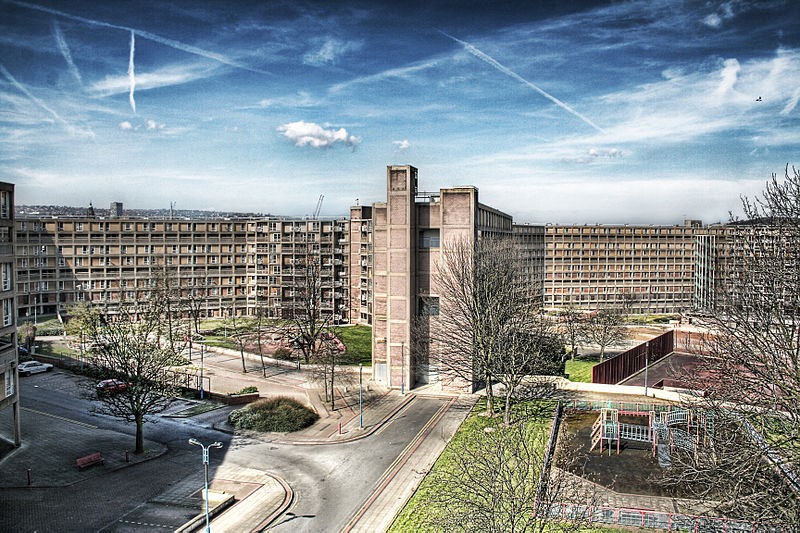
Park Hill, half-abandoned council housing estate, Sheffield, England
Photo via Wikimedia CommonsMany of the buildings that Harwood’s book covers make you wonder whether it is really about architecture at all. Consider Park Hill (1961), a huge council-housing estate containing nearly 1,000 duplexes and single-level flats that partially replaced a demolished slum overlooking downtown Sheffield — a crime-ridden precinct that, for all its problems, had housed a resilient community. Laid out as four long, interconnected slabs inflected so as to form an utterly antiurban, vermiculated footprint, Park Hill owed an enormous debt to the Unité d’habitation. At every third story, it featured elevated open-air “streets” or “decks” — the Corbusian fetish of the day — that ran indoors and out, connecting the slabs. As at the Unité, the imagery was nakedly industrial, with the apartments stashed in a “bottle-rack” grid of concrete that soon assumed a depressingly drab tincture and also proved prone to spalling. A ruthless rationalism likewise asserted itself in the level height maintained throughout the complex, which ranged from four to 13 stories, despite the irregular, sloping site. Park Hill was less a work of architecture than a huge, strange contraption inflicted on the urban skyline. Visual amenity, such as it was, came in the form of soft-hued brick within the concrete grid.
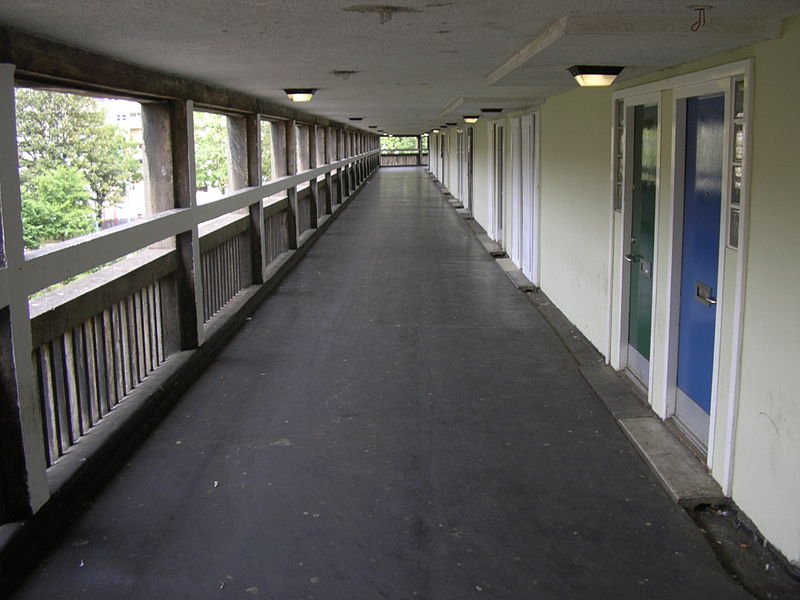
A typical deck in the Park Hill Flats, Sheffield.
Photo via Wikimedia Commons.As with many postwar housing projects, Park Hill offered practical amenities that residents had never before enjoyed: indoor plumbing, hot water, mechanical heating, even a sophisticated garbage-disposal system. Harwood mentions that, Britain’s many council-housing catastrophes notwithstanding, Park Hill “stood firm.” This is not true. By 1979, less than 20 years after its completion, Park Hill was an urban basket case — riddled with graffiti, terrorized by hooligans, afflicted with irruptions of black mold and the terrible stench resulting from waste-disposal blockages. Deserted decks and stairways provided criminals with multiple escape routes.
[…]
Local journalist Peter Tuffrey’s Sheffield Flats, Park Hill and Hyde Park: Hope, Eyesore, Heritage — whose title might seem to play ironically off Harwood’s but for the fact that the book appeared two years earlier — allows us to study a map and old photographs of the slum that Park Hill and Hyde Park supplanted. What we see are blocks, courts, and alleys teeming with row houses and low-rise tenements — streetscapes displaying a human scale, much solid construction, and considerable dereliction, all to be swept away by the desolation of the Corbusian superblocks.
Harwood doesn’t trouble herself with the Hulme Crescents (1972), another assemblage of concrete slabs on the vermiculated, “streets-in-the-sky” plan that rose from the blank slate of a demolished Manchester working-class district where 90,000 people once lived — “the human engine-room of the Industrial Revolution,” as Lynsey Hanley calls it in her largely autobiographical and often engrossing Estates: An Intimate History. The Crescents, designed to house more than 13,000, were conceived in emulation of Bath, the gorgeous Georgian city. Things didn’t work out that way.
“Almost immediately, the estate’s infrastructure began to suffer from the same problems that beset Park Hill and Broadwater Farm [a troubled north London estate]: leaky roof membranes, infestations of vermin and insects, uncontrollable damp, deserted walkways, and an endemic feeling of isolation,” Hanley notes. “The flats were so expensive to warm that many tenants never turned the central heating on, and communal areas were so difficult to maintain that the [city] council could not cope. When a small child died after falling off the top-floor ‘access deck’ of one of the Crescents in 1974, families decamped to the outskirts, belatedly following the rest of old Hulme.” The Crescents’ descent into chaos did make it possible for an anarchic punk scene to flourish in an upper-level hangout known as The Kitchen. The party ended with the estate’s demolition during the 1990s.
[…]
Still, the folly of concentrating lower-income populations in tall buildings eludes her, just as it eluded the Tory government that, in 1956, introduced hugely generous subsidies for the construction of high-rises, relative to row houses and semidetached houses. Not only are tall buildings much more expensive to build and maintain than houses; they were not even essential to achieving the residential densities that postwar planners sought. Tall buildings are highly artificial and complex structures housing temperamental machines, like elevators, that require a heightened degree of maintenance, often by highly paid technicians rather than handymen with toolboxes and stepladders, as Hanley observes. Tall buildings also require an elevated degree of social discipline, as well as security features like intercom systems, closed-circuit TV, and doormen or concierges. The tower blocks and high-rise slabs at the Barbican Estate, the carefully developed, elaborately landscaped, intensely picturesque Brutalist “bankers’ commune” in the City of London, have been very successful. The appropriate synecdoche for the Barbican’s low-end counterparts, however, might well be a broken-down elevator littered with trash, defaced by graffiti, and reeking of urine.
Comments Off on The spiritual and aesthetic brutality of Brutalist architecture
D Day – III: La Résistance – Extra History
Extra Credits
Published on 20 Jun 2017Although the French government surrendered to the German invasion, French people rose up and formed resistance groups to take their country back. Charles de Gaulle and his Free French took advantage of these independent movements to help organize actions that would greatly aid the Allied landings at Normandy.
Comments Off on D Day – III: La Résistance – Extra History


