
World War Two
Published on 24 Nov 2018The European Allies seek a countermeasure to the mysterious German mines, in China the Japanese advance, and in Poland it is the beginning of the Warsaw Ghetto.
WW2 day by day, every day is now live on our Instagram account @World_war_two_realtime https://www.instagram.com/world_war_t…
Join us on Patreon: https://www.patreon.com/TimeGhostHistory
Or join The TimeGhost Army directly at: https://timeghost.tvWritten and Hosted by: Indy Neidell
Produced and Directed by: Spartacus Olsson and Astrid Deinhard
Executive Producers: Bodo Rittenauer, Astrid Deinhard, Indy Neidell, Spartacus Olsson
Research by: Indy Neidell
Edited by: Wieke Kapteijns and Spartacus Olsson
Community Manager: Joram AppelColoring by Spartacus Olsson and Norman Stewart
Norman’s pictures https://oldtimesincolor.blogspot.com/Archive by Screenocean/Reuters https://www.screenocean.com
A TimeGhost chronological documentary produced by OnLion Entertainment GmbH
November 26, 2018
Will the Kriegsmarine Rule the Waves? – WW2 – 013 24 November 1939
England: South Sea Bubble – Too Big to Fail – Extra History – #2
Extra Credits
Published on 14 Mar 2015Support us on Patreon! http://bit.ly/EHPatreon
____________Frustrated at every turn by the Whig-controlled Bank of England, Harley and Blunt decide to start their own institution: a trading company that will exchange government debt for stock shares. This new South Sea Company will have a monopoly on trade in the rich new lands of South America, but all the ports there are controlled by Spain, with whom Britain is at war. So Blunt pushes the country into a premature and unfavorable peace with Spain, enlisting famous authors to write his propaganda and convincing Queen Anne herself to tip the balance of Parliament in his favor. After the queen dies and the government changes hands, Blunt kicks Harley and his Tory leaders out of the company. He manages to bring King George I himself on board as a ceremonial leader, linking the success of the South Sea Company with the reputation of the monarchy. But while his maneuvering inflates the value of his company’s stock, it’s never produced anything close to the amount of money he’s convinced people to invest in it.
November 25, 2018
Lenin’s death and Stalin’s rise to Power I BETWEEN 2 WARS I 1924 Part 1 of 2
TimeGhost History
Published on 24 Nov 2018As Lenin’s health starts to fail, the struggle to become his successor picks up speed with Stalin maneuvering closer and closer to power. The outcome of this struggle will define a century of world events.
First off: sorry for some sound issues this was recorded before we built our studio. Again we jump ahead a bit to cover events in the 1920s that have a huge impact on the current events in our WW2 In Real Time series. Our TimeGhost Army member Kamil Szadkowski made this episode possible with his research and balanced views on the events of 1924. Also many, many thanks to Olga Shirnina for providing us with the excellent colorized images for this episode. Check out Olga’s amazing volume of work here: https://klimbim2014.wordpress.com.
Join us on Patreon: https://www.patreon.com/TimeGhostHistory
Hosted by: Indy Neidell
Written and directed by: Spartacus Olsson
Research Contributed by: Kamil Szadkowski
Produced by: Astrid Deinhard
Executive Producers: Bodo Rittenauer, Astrid Deinhard, Indy Neidell, Spartacus Olsson
Community Manager: Joram AppelArchive by Screenocean/Reuter https://www.screenocean.com
A TimeGhost chronological documentary produced by OnLion Entertainment GmbH
Miracle on the Vistula – Polish Soviet War I BETWEEN 2 WARS I 1920 Part 1 of 4
https://www.youtube.com/watch?v=Equ7u…Russia Before the 1917 Revolution I THE GREAT WAR Special
https://www.youtube.com/watch?v=t1b3f…The Russian February Revolution 1917 I THE GREAT WAR Week 137
https://www.youtube.com/watch?v=5SyO5…The Russian October Revolution 1917 I THE GREAT WAR Week 172
https://www.youtube.com/watch?v=2uoLo…The Last Tsar of Russia – Nicholas II I WHO DID WHAT IN WW1?
https://www.youtube.com/watch?v=2OnTL…Lenin & Trotsky – Their Rise To Power I WHO DID WHAT IN WW1?
https://www.youtube.com/watch?v=CPoJ6…
England: South Sea Bubble – The Sharp Mind of John Blunt – Extra History – #1
Extra Credits
Published on 28 Feb 2015Support us on Patreon! http://bit.ly/EHPatreon
____________When Robert Harley steps in as England’s new Chancellor of the Exchequer, he discovers that not only is the government deeply in debt, but no one knows quite how much debt it owes. Because vicious political infighting between the Tory and Whig politic parties made it difficult to pass new tax laws, Harley turned to a private financier named John Blunt to help find enough money for England to keep up with its expenses for the year. Using Harley’s government resources, Blunt instigated a series of get-rich schemes that drove artificial demand for unsustainable land and lottery investments with tremendous short term gains. Before the year was done, Blunt had successfully covered the shortfall for the government that year – albeit at the cost of driving England’s already outrageous debt even higher.
November 24, 2018
QotD: The Anglo-Saxon invasion
The withdrawal of the Roman legions to take part in Gibbon’s Decline and Fall of the Roman Empire (due to a clamour among the Romans for pompous amusements such as bread and circumstances) left Britain defenceless and subjected Europe to that long succession of Waves of which History is chiefly composed. While the Roman Empire was overrun by waves not only of Ostrogoths, Vizigoths, and even Goths, but also of Vandals (who destroyed works of art) and Huns (who destroyed everything and everybody, including Goths, Ostrogoths, Vizigoths, and even Vandals), Britain was attacked by waves of Picts (and, of course, Scots) who had recently learnt how to climb the wall, and of Angles, Saxons, and Jutes who, landing at Thanet, soon overran the country with fire (and, of course, the sword).
Important Note
The Scots (originally Irish, but by now Scotch) were at this time inhabiting Ireland, having driven the Irish (Picts) out of Scotland; while the Picts (originally Scots) were now Irish (living in brackets) and vice versa. It is essential to keep these distinctions clearly in mind (and verce visa).
The brutal Saxon invaders drove the Britons westward into Wales and compelled them to become Welsh; it is now considered doubtful whether this was a Good Thing. Memorable among the Saxon warriors were Hengist and his wife (? or horse), Horsa. Hengist made himself King in the South. Thus Hengist was the first English King and his wife (or horse), Horsa, the first English Queen (or horse). The country was now almost entirely inhabited by Saxons and was therefore renamed England, and thus (naturally) soon became C. of E. This was a Good Thing, because previously the Saxons had worshipped some dreadful gods of their own called Monday, Tuesday, Wednesday, Thursday, Friday, and Saturday.
W.C. Sellar & R.J. Yeatman, 1066 And All That, 1930.
November 23, 2018
Defense of Poland – The Battle of the Border – Extra History – #1
Extra Credits
Published on 22 Nov 2018This series is brought to you by World of Tanks PC. Check out the game at https://redir.wargaming.net/z3ehuthn/… and use the code ORLIK for extra goodies.
Poland is threatened in 1939 not just by the Nazis, but by its own precarious geography between Germany and Soviet Russia. Edward Rydz-Śmigły spreads the Polish cavalry and tanks as thin as he has to around the border…
Join us on Patreon! http://bit.ly/EHPatreon
November 22, 2018
Perseus – Medusa – Extra Mythology – #2
Extra Credits
Published on 19 Nov 2018Join the Patreon community! http://bit.ly/EMPatreon
Perseus is not intimidated by the grey women and their eyeball, or by Hermes’s complicated directions, or by Medusa, or by a winged horse sprouting out of Medusa’s blood, or by Andromeda’s boyfriend, or by his own dad.
November 21, 2018
Allied War Economy During World War 1 I THE GREAT WAR Special
The Great War
Published on 19 Nov 2018Check Out Supremacy 1914: https://www.supremacy1914.com/index.p…
Financing and supplying the First World War was a huge economic undertaking that influenced the British, French, American and Italian economies profoundly and shaped the global balance of power.
November 20, 2018
Gordon Lightfoot’s “Wreck of the Edmund Fitzgerald“
Mark Steyn devotes a column to the work of Canadian singer/songwriter Gordon Lightfoot, particularly his very well-known ballad on the loss of the Edmund Fitzgerald on Lake Superior in 1975:
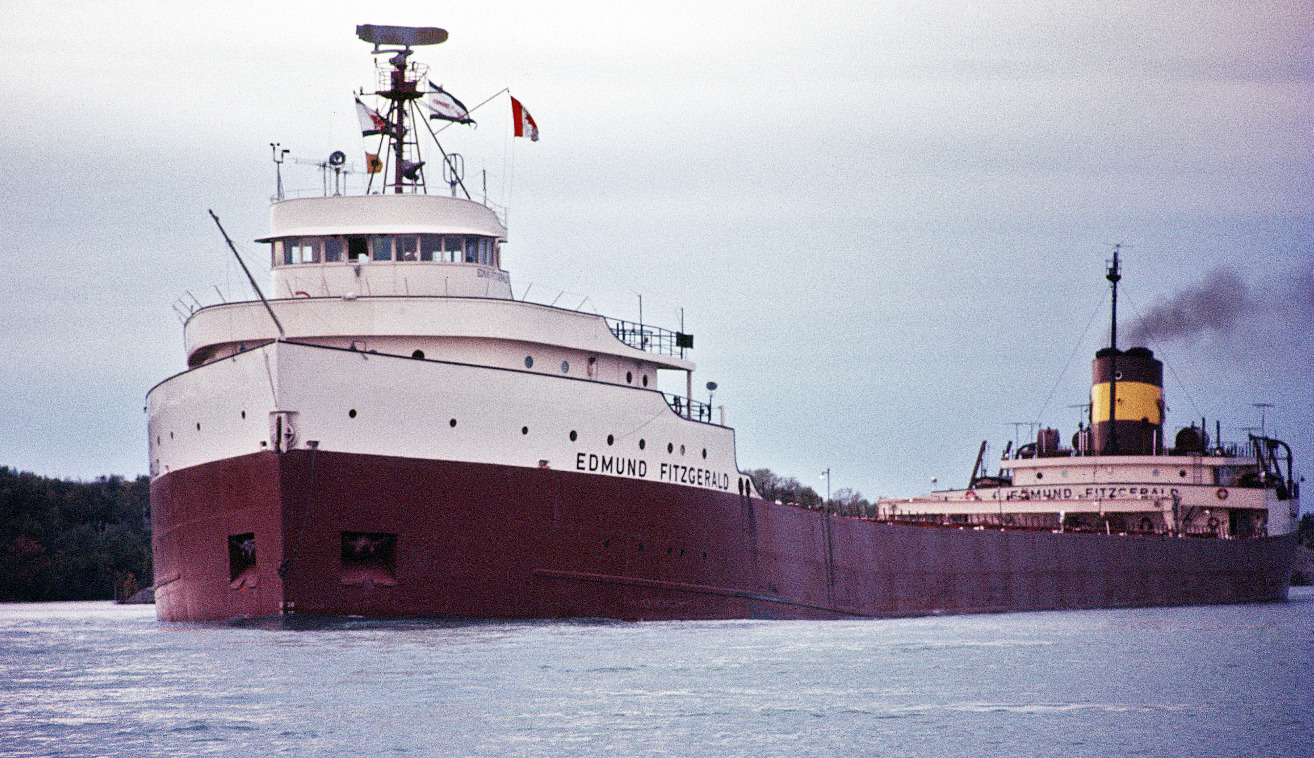
Edmund Fitzgerald, 1971
Detail of a photo from Wikimedia Commons
When it comes to trains and boats and planes, Gordon Lightfoot has hymned all three, but it’s the middle mode of transportation that produced the song he’s proudest of:
The ship was the pride Of the American side
Coming back from some mill in Wisconsin
As the big freighters go
It was bigger than most
With a crew and good captain well seasoned…In November 1975 Lightfoot chanced to be reading Newsweek‘s account of the sinking of a Great Lakes freighter in Canadian waters. He’s a slow and painstaking writer, which is one reason he’s given up songwriting – because it takes too much time away from his grandkids. But that day forty-three years ago the story literally struck a chord, and he found himself scribbling away, very quickly:
The legend lives on From the Chippewa on down
Of the big lake they called Gitche Gumee
The lake, it is said Never gives up her dead
When the skies of November turn gloomy…“Gitche gumee” is Ojibwe for “great sea” – ie, Lake Superior – as you’ll know if you’ve read your Longfellow, which I’m not sure anyone does these days. Evidently Hiawatha was on the curriculum back east across Lake Huron in young Gordy’s Orillia schoolhouse. The Gitche Gumee reference may be why, when I first heard “The Wreck of the Edmund Fitzgerald“, I assumed its subject had sunk long before the song was written. In fact, it sank on November 10th 1975 – just a few days before Lightfoot wrote the number. When she’d launched in 1958, the Edmund Fitzgerald was the largest ship on the Great Lakes, and, when she passed through the Soo Locks between Lakes Superior and Huron, her size always drew a crowd and her captain was always happy to entertain them with a running commentary over the loudspeakers about her history and many voyages. For seventeen years she ferried taconite ore from Minnesota to the iron works of Detroit, Toledo and the other Great Lakes ports …until one November evening of severe winds and 35-feet waves:
The wind in the wires
Made a tattle-tale sound
And a wave broke over the railin’
And every man knew
As the captain did too
‘Twas the witch of November come stealin’…And about seventeen miles from Whitefish Bay the Edmund Fitzgerald sank, with the loss of all 29 lives. It remains the largest ship ever wrecked on the Great Lakes, launched in 1958 to take advantage of the new St Lawrence Seaway (to be opened by the Queen and President Eisenhower on an inaugural voyage by the Royal Yacht Britannia the following year) and specifically constructed to be only a foot less than the maximum length permitted. Edmund Fitzgerald was the then chairman of Northwestern Mutual Life Insurance of Milwaukee, and, as far as I’m aware, the only insurance company executive to be immortalized in a song title. Fifteen thousand people showed up for the ship’s launch at River Rouge, Michigan. It took Mrs Fitzgerald three attempts to shatter the champers against the bow, and then there was a further half-hour’s delay as the shipyard workers tried to loosen the keel blocks. After which the ship flopped into the water, crashed against a pier, and sent up a huge wave to douse the crowd. One spectator promptly had a heart attack and died.
And then came seventeen happy years. Even in the twenty-first century, there is something especially awful and sobering about death at sea: it is in a certain sense a reminder of the fragility of security and modernity. Whenever I’m in, for example, St Pierre et Miquelon, the last remaining territory of French North America, I stop by the monument aux marins disparus, sculpted in 1964 and to which many names have been added in the years since – because a ship put out, and somewhere on the horizon the great primal forces rose up from the depths and snapped it in two like a matchstick.
QotD: Why do we drink?
Alcoholic beverages, like agriculture, were invented independently many different times, likely on every continent save Antarctica. Over the millennia nearly every plant with some sugar or starch has been pressed into service for fermentation: agave and apples, birch tree sap and bananas, cocoa and cassavas, corn and cacti, molle berries, rice, sweet potatoes, peach palms, pineapples, pumpkins, persimmons, and wild grapes. As if to prove that the desire for alcohol knows no bounds, the nomads of Central Asia make up for the lack of fruit and grain on their steppes by fermenting horse milk. The result, koumiss, is a tangy drink with the alcohol content of a weak beer.
Alcohol may afford psychic pleasures and spiritual insight, but that’s not enough to explain its universality in the ancient world. People drank the stuff for the same reason primates ate fermented fruit: because it was good for them. Yeasts produce ethanol as a form of chemical warfare — it’s toxic to other microbes that compete with them for sugar inside a fruit. That antimicrobial effect benefits the drinker. It explains why beer, wine, and other fermented beverages were, at least until the rise of modern sanitation, often healthier to drink than water.
What’s more, in fermenting sugar, yeasts make more than ethanol. They produce all kinds of nutrients, including such B vitamins as folic acid, niacin, thiamine, and riboflavin. Those nutrients would have been more present in ancient brews than in our modern filtered and pasteurized varieties. In the ancient Near East at least, beer was a sort of enriched liquid bread, providing calories, hydration, and essential vitamins.
[…]
Indirectly, we may have the nutritional benefits of beer to thank for the invention of writing, and some of the world’s earliest cities — for the dawn of history, in other words. Adelheid Otto, an archaeologist at Ludwig-Maximilians University in Munich who co-directs excavations at Tall Bazi, thinks the nutrients that fermenting added to early grain made Mesopotamian civilization viable, providing basic vitamins missing from what was otherwise a depressingly bad diet. “They had bread and barley porridge, plus maybe some meat at feasts. Nutrition was very bad,” she says. “But as soon as you have beer, you have everything you need to develop really well. I’m convinced this is why the first high culture arose in the Near East.”
Andrew Curry, “Our 9,000-Year Love Affair With Booze”, National Geographic, 2017-02.
November 19, 2018
Viking Expansion – The Lands of the Rus – Extra History – #4
Extra Credits
Published on 17 Nov 2018The Rus Vikings headed further inland into eastern Europe, raiding Constantinople (unsuccessfully) at first, and then eventually falling into negotiations with the Byzantines and changing their own culture over time. One of their most famous descending rulers was Olga of Kiev, who was also the grandmother of Vladimir.
Join us on Patreon! http://bit.ly/EHPatreon
QotD: How nationalism distorts opinion and judgement
For those who feel deeply about contemporary politics, certain topics have become so infected by considerations of prestige that a genuinely rational approach to them is almost impossible. Out of the hundreds of examples that one might choose, take this question: Which of the three great allies, the U.S.S.R., Britain and the USA, has contributed most to the defeat of Germany? In theory, it should be possible to give a reasoned and perhaps even a conclusive answer to this question. In practice, however, the necessary calculations cannot be made, because anyone likely to bother his head about such a question would inevitably see it in terms of competitive prestige. He would therefore start by deciding in favour of Russia, Britain or America as the case might be, and only after this would begin searching for arguments that seemed to support his case. And there are whole strings of kindred questions to which you can only get an honest answer from someone who is indifferent to the whole subject involved, and whose opinion on it is probably worthless in any case. Hence, partly, the remarkable failure in our time of political and military prediction. It is curious to reflect that out of all the ‘experts’ of all the schools, there was not a single one who was able to foresee so likely an event as the Russo-German Pact of 1939. And when news of the Pact broke, the most wildly divergent explanations were of it were given, and predictions were made which were falsified almost immediately, being based in nearly every case not on a study of probabilities but on a desire to make the U.S.S.R. seem good or bad, strong or weak. Political or military commentators, like astrologers, can survive almost any mistake, because their more devoted followers do not look to them for an appraisal of the facts but for the stimulation of nationalistic loyalties. And aesthetic judgements, especially literary judgements, are often corrupted in the same way as political ones. It would be difficult for an Indian Nationalist to enjoy reading Kipling or for a Conservative to see merit in Mayakovsky, and there is always a temptation to claim that any book whose tendency one disagrees with must be a bad book from a literary point of view. People of strongly nationalistic outlook often perform this sleight of hand without being conscious of dishonesty.
George Orwell, “Notes on Nationalism”, Polemic, 1945-05.
November 18, 2018
New research shows 536AD to have been the true annus horribilis
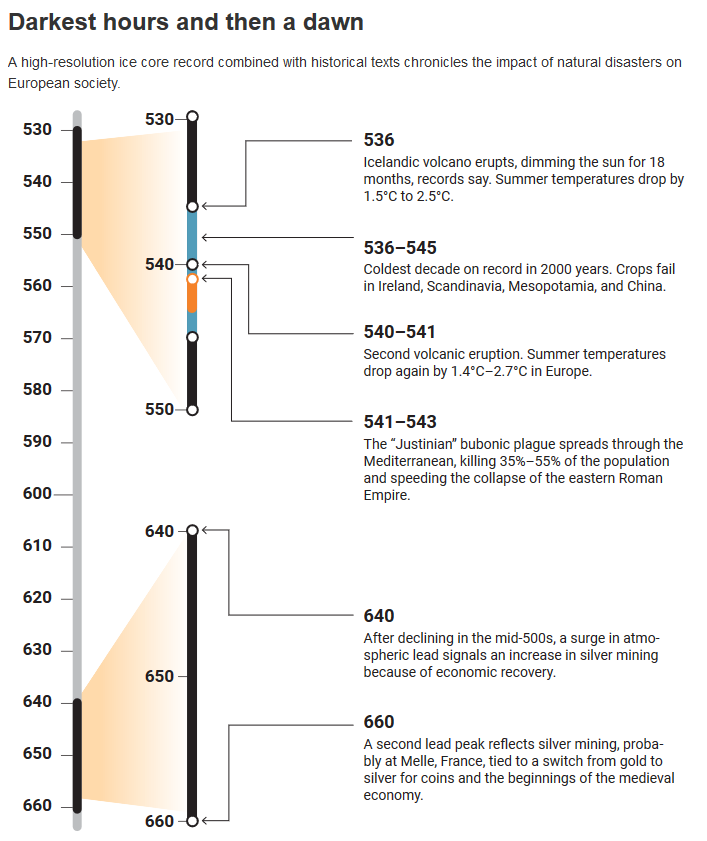
There have been bad years in human history. There have been worse days in human history. But according to a recent study summarized in Science magazine, the worst year in recorded history was 536AD:
Ask medieval historian Michael McCormick what year was the worst to be alive, and he’s got an answer: “536.” Not 1349, when the Black Death wiped out half of Europe. Not 1918, when the flu killed 50 million to 100 million people, mostly young adults. But 536. In Europe, “It was the beginning of one of the worst periods to be alive, if not the worst year,” says McCormick, a historian and archaeologist who chairs the Harvard University Initiative for the Science of the Human Past.
A mysterious fog plunged Europe, the Middle East, and parts of Asia into darkness, day and night — for 18 months. “For the sun gave forth its light without brightness, like the moon, during the whole year,” wrote Byzantine historian Procopius. Temperatures in the summer of 536 fell 1.5°C to 2.5°C, initiating the coldest decade in the past 2300 years. Snow fell that summer in China; crops failed; people starved. The Irish chronicles record “a failure of bread from the years 536–539.” Then, in 541, bubonic plague struck the Roman port of Pelusium, in Egypt. What came to be called the Plague of Justinian spread rapidly, wiping out one-third to one-half of the population of the eastern Roman Empire and hastening its collapse, McCormick says.
Historians have long known that the middle of the sixth century was a dark hour in what used to be called the Dark Ages, but the source of the mysterious clouds has long been a puzzle. Now, an ultraprecise analysis of ice from a Swiss glacier by a team led by McCormick and glaciologist Paul Mayewski at the Climate Change Institute of The University of Maine (UM) in Orono has fingered a culprit. At a workshop at Harvard this week, the team reported that a cataclysmic volcanic eruption in Iceland spewed ash across the Northern Hemisphere early in 536. Two other massive eruptions followed, in 540 and 547. The repeated blows, followed by plague, plunged Europe into economic stagnation that lasted until 640, when another signal in the ice — a spike in airborne lead — marks a resurgence of silver mining, as the team reports in Antiquity this week.
H/T to Blazing Cat Fur for the link.
The Mysterious Threat to the Royal Navy – WW2 – 012 17 November 1939
World War Two
Published on 17 Nov 2018While the Finns and the Soviets seem to be moving ever closer to war, the Royal Navy is losing ships at a frightening rate to an explosive threat not yet understood.
WW2 day by day, every day is now live on our Instagram account @World_war_two_realtime https://www.instagram.com/world_war_t…
Between 2 Wars: https://www.youtube.com/playlist?list…
Join us on Patreon: https://www.patreon.com/TimeGhostHistory
Or join The TimeGhost Army directly at: https://timeghost.tvWritten and Hosted by: Indy Neidell
Produced and Directed by: Spartacus Olsson and Astrid Deinhard
Executive Producers: Bodo Rittenauer, Astrid Deinhard, Indy Neidell, Spartacus Olsson
Research by: Indy Neidell
Edited by: Wieke Kapteijns and Spartacus Olsson
Community Manager: Joram AppelColoring by Spartacus Olsson
Archive by Screenocean/Reuters https://www.screenocean.com
A TimeGhost chronological documentary produced by OnLion Entertainment GmbH
The Toronto Circus Riot of 1855
The History Guy: History Deserves to Be Remembered
Published on 26 Oct 2018In 1855 Toronto, a fireman and a clown walked into a brothel. What followed would change the course of one of the world’s great cities.
The episode is intended for educational purposes. All events are portrayed in historical context. No graphic depictions of violence are included.
The History Guy uses media that are in the public domain. As photographs of actual events are sometimes not available, photographs of similar objects and events are used for illustration.
Patreon: https://www.patreon.com/TheHistoryGuy
The History Guy: History Deserves to Be Remembered is the place to find short snippets of forgotten history from five to fifteen minutes long. If you like history too, this is the channel for you.


