
Forgotten Weapons
Published on 25 Oct 2018https://www.forgottenweapons.com/the-…
http://www.patreon.com/ForgottenWeapons
In the aftermath of World War One, the Treaty of Versailles strictly limited the number of machine guns that the German military could keep in inventory. The main type that the Germans chose to keep was the MG08/15 (although a substantial number of MG08 guns were kept as well). Through the 1920s and 1930s, these Maxim guns were improved and updated in a variety of ways until finally replaced by the MG34 starting in 1936. Many of these updated 08/15s would be deployed in reserve areas during World War Two, but relatively few survive today. Today we are looking at one such gun, and noting the changes made to it compared to the 08/15 of World War One. Specifically:
* Anti-aircraft sights and mounting brackets
* Oiler bottle in the stock
* Bipod attachment at the muzzle
* New water drain and fill plugs
* Modified drum hanger bracket
* Feed block for both cloth Maxim belts and metal MG34 belts
* Leather pistol grip cover
* Top cover locking latchContact:
Forgotten Weapons
PO Box 87647
Tucson, AZ 85754If you enjoy Forgotten Weapons, check out its sister channel, InRangeTV! http://www.youtube.com/InRangeTVShow
November 17, 2018
The MG 08/15 Updated Between the Wars
QotD: Positive and negative nationalism
…nationalist feeling can be purely negative. There are, for example, Trotskyists who have become simply enemies of the U.S.S.R. without developing a corresponding loyalty to any other unit. When one grasps the implications of this, the nature of what I mean by nationalism becomes a good deal clearer. A nationalist is one who thinks solely, or mainly, in terms of competitive prestige. He may be a positive or a negative nationalist — that is, he may use his mental energy either in boosting or in denigrating — but at any rate his thoughts always turn on victories, defeats, triumphs and humiliations. He sees history, especially contemporary history, as the endless rise and decline of great power units, and every event that happens seems to him a demonstration that his own side is on the upgrade and some hated rival is on the downgrade. But finally, it is important not to confuse nationalism with mere worship of success. The nationalist does not go on the principle of simply ganging up with the strongest side. On the contrary, having picked his side, he persuades himself that it is the strongest, and is able to stick to his belief even when the facts are overwhelmingly against him. Nationalism is power-hunger tempered by self-deception. Every nationalist is capable of the most flagrant dishonesty, but he is also — since he is conscious of serving something bigger than himself — unshakeably certain of being in the right.
George Orwell, “Notes on Nationalism”, Polemic, 1945-05.
November 16, 2018
The Victors & The Vanquished I THE GREAT WAR Epilogue
The Great War
Published on 15 Nov 2018G.J. Meyer: A World Undone
Martin Gilbert: The First World War
Peter Hart: The Great War
David Zabecki: The German Spring Offensives
Alexander Watson: Ring of Steel
Robin Neillands: Western Front Generals
The Origin of Quantum Mechanics (feat. Neil Turok)
minutephysics
Published on Oct 14, 2012Check out the Massey Lectures with Neil Turok: http://www.cbc.ca/radio/ideas/the-201…
Perimeter Institute for Theoretical Physics: http://pitp.caMinute Physics provides an energetic and entertaining view of old and new problems in physics — all in a minute!
Music by Nathaniel Schroeder: http://www.soundcloud.com/drschroeder
Thanks to Nima Doroud and Bruno LeFloch for contributions and to Perimeter Institute for support.
http://www.perimeterinstitute.caProduced in association with the 2012 Massey Lecture Series http://dft.ba/-massey Created by Henry Reich
H/T to Aeon:
The physics revolution that started with the flicker of a lightbulb
The discovery of quantum mechanics at the start of the 20th century shook the very foundations of physics, forcing scientists and philosophers to reexamine everything from particles upward. But as this short animation from MinutePhysics explains, the quantum revolution was jumpstarted by a rather unremarkable question. As the German government asked the theoretical physicist Max Planck: how can lightbulbs be made more efficient? To help solve the problem, Planck tried to account for the changing colour of light based on temperature, which he eventually realised couldn’t be explained by classical Newtonian physics. Working backwards from his data in ‘an act of despair’, Planck found that light wasn’t emitted continuously, but rather in discrete packets that he referred to as ‘quanta’. And the rest is the illusory arrow of time that we call history.
November 15, 2018
The Romance of the Rails
Randal O’Toole’s new book on North American railways goes straight to my “wish list”. He’s also a long-time fan of railways, but has been forced to admit that attempts to bring back the golden age of rail are wasted effort because railways — especially US and Canadian lines — are built to carry bulk freight efficiently and economically but attempts to also carry large numbers of passengers quickly cannot be successful without building entirely separate (high-speed) lines. This is from the introduction to The Romance of the Rails [PDF]:

Amtrak’s
Eastbound Empire Builder crossing Two Medicine Trestle at East Glacier MT on 20 July 2011.
Photo by Steve Wilson via Wikimedia Commons.
Early in my career, I joined the National Association of Railroad Passengers (NARP) and supported more funding for Amtrak. Later, I realized Amtrak was poorly managed and supported Amtrak reform. More recently, along with NARP founder Anthony Haswell — who is sometimes called the Father of Amtrak — I became completely disillusioned with the idea of government-run trains and have argued for abolishing the heavily subsidized federal passenger rail corporation.
My attitudes toward urban transit have also undergone a transition. In 1972, as an undergraduate student, I wrote a paper for the Oregon Student Public Interest Research Group (OSPIRG) advocating low-cost transit improvements in Portland aimed at attracting people out of their automobiles and reducing air pollution. When the director of OSPIRG later became general manager of TriMet, Portland’s transit agency, he implemented some of those improvements, and transit ridership surged. To be honest, I didn’t propose rail transit reform in 1972 simply because I didn’t think there was much chance of that happening. However, I later became more skeptical of rail transit when Portland built an expensive light-rail line, followed by more lines that were even more expensive.
That skepticism has led some people to call me “anti-transit” and “anti-passenger train.” But I’m not. If someone could design a rail system that attracted riders and efficiently moved them from place to place, I’d be the first to endorse it. As this book will show, however, this is no more likely to happen than the freight railroads converting back to steam power. The next technology replacement will not be people trading in their cars for high-speed trains and light rail. Rather, it will be people trading in their human-driven cars for increasingly autonomous cars that drive themselves.
The short answer to the question of why passenger trains and streetcars have been replaced by planes, cars, and buses is that rails are more expensive and less flexible than the alternatives. To understand why, the first 10 chapters of this book will delve deep into the history of rail to show how passenger rail transportation once worked, who it worked for, and what has changed so that it no longer works today. This history demonstrates why statements such as, “High-speed trains have faster downtown-to-downtown times than flying” or “Light rail provides an alternative to congested roads going to work” are not relevant. Chapter 11 discusses the question of why passenger rail seems to work in Europe and Asia but not in North America.
Chapters 12 through 17 will each focus on a different kind of passenger rail, from streetcars to high-speed rail. Finally, Chapter 18 will demonstrate why we love trains, but also why we can’t expect them to do for us what they did in the 19th century.
Passenger rail was once an important part of our history, but today it represents a drag on our economy. I still love passenger trains, but I don’t think other people should have to subsidize my hobby.
Colt Model 639: MACVSOG’s Vietnam Carbine
Forgotten Weapons
Published on 24 Oct 2018http://www.forgottenweapons.com/colt-…
http://www.patreon.com/ForgottenWeapons
The Colt Model 639 was the export version of the Colt Model 629, which was type classified by the US military as the XM177E2 and issued to MACVSOG special operations units in 1967 and 1968. Improved from the Model 609 carbine, the 629/639 has an 11.5 inch barrel and an interesting small muzzle device (“moderator”) which served to change the signature of its firing to sound much more like an AK-type rifle than an M16. The device does that job well – at least until it had been fired extensively, which slowly fills up the (non-disassemblable) unit with carbon and powder residue, substantially reducing its effectiveness. It has a full-fence lower, standard carbine buffer and spring, and a two position aluminum collapsing stock. It is the iconic weapon of US special forces in Vietnam.
Only about 100 of the Model 639 were made in the early 1970s, and many of those were sent back to Colt in 1975 under a recall. At that time, the ATF decided to classify the muzzle device as a silencer, prompting Colt to recall the guns and remove and destroy the devices. Some owners, however, kept their carbines and instead registered the muzzle devices, allowing them legally remain on the guns.
Contact:
Forgotten Weapons
PO Box 87647
Tucson, AZ 85754If you enjoy Forgotten Weapons, check out its sister channel, InRangeTV! http://www.youtube.com/InRangeTVShow
November 14, 2018
Scrub Plane – a Historical Perspective – | Paul Sellers
Paul Sellers
Published on 7 Aug 2014In times past, before Stanley Rule and Level cast their first all-metal scrub plane, well used and worn-down wooden smoothing planes were kept as roughing planes for scrubbing off rough surfaces in preparation for more refined work. Longer planes such as jack planes and jointer planes followed to further level and straighten the work before the smoothing plane smoothed out the final surfaces.
The roughing plane had many names including Hunter plane, Scud or Scudding plane; Scurf or Scurfing plane; Cow plane and I am sure others I haven’t heard of and was the forerunner to the original Stanley scrub plane we know today. The wooden roughing plane worked well for centuries but with Stanley’s new fangled all-metal planes came the necessity of metal scrub planes too. In this video I explain a little of the important history behind the development of the scrub plane and the transition from wooden planes to the all metal versions.To find out more about Paul Sellers and the projects he is involved with visit http://paulsellers.com
November 13, 2018
A Kristallnacht album
9 November, 1938. The Germans called it Kristallnacht, the “Night of Broken Glass”, Reichspogromnacht or simply Pogromnacht. Elisheva Avital tells the story of a photo album from that terrible event that came into her grandfather’s possession at some point during World War 2:
THE GREAT WAR IS NOT OVER
The Great War
Published on 12 Nov 2018The Patreon Page: https://www.patreon.com/thegreatwar
The following information — basically the same as what Flo discusses in the video above — was sent out to Patreon supporters:
July 14, 2014 was our first day with The Great War project. 4 1/2 years later, and we managed to not miss a single Thursday to bring you the latest weekly update from 100 years ago. We could not have done this without your support on Patreon. We are not exaggerating when we say that our show would have been cancelled several times if we had to rely on YouTube revenue alone. For that we, and the rest of the production team want to say: “Thank you!”
Now, in the last few weeks we were rather quiet here on Patreon but also on Social Media in general. The main reason for that was that we, the team who researched big parts of this project, who edited, animated and published all the episodes and we who responded to your questions and criticisms over the years needed to figure out what we want to do after 11/11/18.
We quickly realised that we want to continue working in the field of historical film production and with that in mind we will start our own company in early 1919, pardon 2019. So far, we were employees of Mediakraft, the company that initially financed this channel and kept it afloat before you all started supporting us on Patreon. But now we want to stand on our feet.
And the great news is, that The Great War will stay with us and with you in the future. We reached an agreement with Mediakraft that we can continue working on the channel and publish more content. For this content, we still need your support and we hope that you trust our capabilities based on the past 4 1/2 years.
From a historical perspective, 11/11/1918 may have marked the end of hostilities in the First World War but it certainly didn’t usher in an era of world peace – quite the contrary. New wars, more revolutions, difficult peace negotiations and the attempts to create a new world order all were pivotal moments in our world history and we want to continue to tell these stories on The Great War channel.
But, there is always a but, that doesn’t mean that we won’t change things up behind the scenes and on the channel. The first, and for you probably most important point, is that Indy has moved on to new projects (and we wish him all the best for that) which means we will be looking to find a new host. This won’t be easy and I know you will be nervous, but we are sure that we can find someone that can fill these shoes over time.
Moreover, we will probably move away from the weekly episode format that was also accompanied by two extra weekly uploads for the past years. This incredible high output meant that we couldn’t always focus on topics as much as they deserved and we know from the numbers on YouTube that it was an overwhelming amount of content for a lot of our fans, too. Instead we will probably move to less uploads but longer episodes with more detail, more polish, better animations and just overall try to take it to the next level.
To wrap this long post up, I want to kindly ask you to trust in our abilities, to be open for this new direction and most importantly to continue to support us here on Patreon as now independent creators. Over the next few weeks, I will send out more updates on this evolution of The Great War. Right now we want to publish the first new episode in early January. In the meantime, you can enjoy the epilogue episodes with Indy that we will put up in the future.
And if you have any questions or ideas, feel free to put them in the comments of this post, we will try to answer them to the best of my ability.
Flo & Toni
Producers of The Great War
The Maginot Line: Actually a Good Idea
Historigraph
Published on 13 Oct 2018If you enjoyed this video and want to see more made, consider supporting my efforts on Patreon: https://www.patreon.com/historigraph
My old video on the invasion of France in 1940, which is useful for background info to this video: https://www.youtube.com/watch?v=-4-l0…
Check out my Norway 1940 series: https://www.youtube.com/playlist?list…
► Twitter: https://twitter.com/historigraph
Sources:
James Holland, The War in the West – A New History Vol. 1: Germany Ascendant 1939-1941 (kindle edition)
Lloyd Clark, Blitzkrieg: Myth, Reality and Hitler’s Lightning War – France, 1940.
Alistair Horne, To Lose a Battle: France 1940.
Charles River Editors, The Maginot Line: The History of the Fortifications that failed to protect France from Nazi Germany during World War II.
QotD: Julius Caesar’s invasion of Britain
The first date in English History is 55 B.C., in which year Julius Caesar (the memorable Roman Emperor) landed, like all other successful invaders of these islands, at Thanet. This was in the Olden Days, when the Romans were top nation on account of their classical education, etc.
Julius Caesar advanced very energetically, throwing his cavalry several thousands of paces over the River Flumen; but the Ancient Britons, though all well over military age, painted themselves true blue, or woad, and fought as heroically under their dashing queen, Woadicea, as they did later in thin red lines under their good queen, Victoria.
Julius Caesar was therefore compelled to invade Britain again the following year (54 B.C., not 56, owing to the peculiar Roman method of counting), and having defeated the Ancient Britons by unfair means, such as battering-rams, tortoises, hippocausts, centipedes, axes, and bundles, set the memorable Latin sentence, “Veni, Vidi, Vici“, which the Romans, who were all very well educated, construed correctly.
The Britons, however, who of course still used the old pronunciation, understanding him to have called them “Weeny, Weedy, and Weaky”, lost heart and gave up the struggle, thinking that he had already divided them All into Three Parts.
W.C. Sellar & R.J. Yeatman, 1066 And All That, 1930.
November 12, 2018
Woodrow Wilson
In City Journal, Lance Morrow looks back at the successes and failures of President Wilson:
It’s been a century since President Woodrow Wilson arrived in Europe, weeks after the Armistice ending World War I. A crowd of 2 million cheered him in Paris. The papers called him the “God of Peace,” the “Savior of Humanity,” a “Moses from America.” He bowed, he tipped his silk top hat — the newsreel images come flickering to us from an earlier world. He sat down with Georges Clemenceau and David Lloyd George and the others to hash out the fiasco of the Versailles Treaty. He returned home to the fatal wrangle over the League of Nations with Henry Cabot Lodge in the Senate. Then came the cross-country tour to sell the treaty to the American people, his collapse on the train near Wichita, and, back in Washington, the terrible stroke and the long twilight — a sequence that led, further down the road, to Warren G. Harding and, in the fullness of time, to Adolf Hitler and World War II.
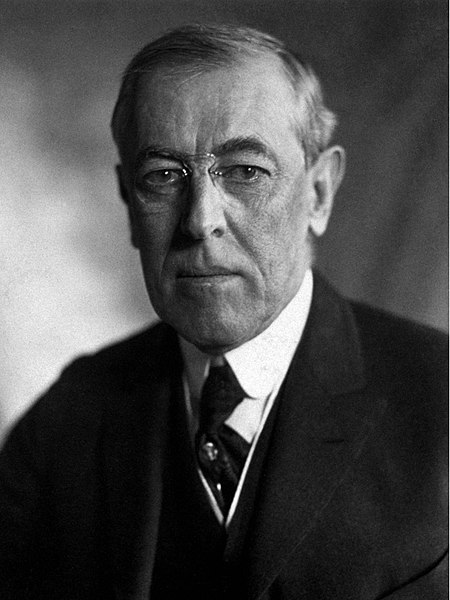
Woodrow Wilson, 1919
Photo via Wikimedia Commons.The Woodrow Wilson story is an American classic — a set piece, like the rise and fall of Joseph McCarthy, or the fable of John F. Kennedy. Of Wilson, the historian Barbara Tuchman wrote: “Since Americans are not, by and large, a people associated with tragedy, it is strange and unexpected that the most tragic figure in modern history — judged by the greatness of expectations and the measure of the falling off — should have been an American.”
People speak of “settled science.” One might also speak of “settled myth.” (The Kennedys are one of those.) But Wilson’s myth remains vexed and unsettled. He persists, in American memory, as a sort of botched paragon — a man who remains almost irritatingly alive and imperfect and somehow touching. The respect that he deserves is complicated — and so is the contempt. The same has been said of American idealism itself.
As with America, there are two basic versions of Wilson: the sacred and the profane. Was his greatness real or fake? He ranks in polls in the top quarter of American presidents, but with a dissenting asterisk. Was he the superbly effective Progressive president (who introduced the Federal Reserve and the graduated income tax and much else) and the prophet of twentieth-century internationalism? (Wait: Are we to thank Wilson for Vietnam? Iraq? Afghanistan?) Or was he the last fling of nineteenth-century moralism and hypocrisy — a Southern-born racist or near-racist, and a brute on the subject of civil liberties? (He tossed Eugene V. Debs in jail merely for disagreeing with him on the war, leaving it to Warren G. Harding to pardon Debs.) Some said that his mind was a Sunday school; others, that it was the pool of Narcissus. Yet he managed to be a great man all the same. It’s too bad that he did not leave the presidency, one way or another, in 1919, after the damage from his stroke became evident. Amazingly, even in the summer of 1920, the broken man had delusions of running for a third term. He felt embittered and betrayed when the Democratic nomination went to Governor James Cox of Ohio. Woodrow Wilson’s ego died harder than Rasputin.
An indispensable aspect of Wilson’s genius—and a key, perhaps, to his failure — was his lambent but vaguely narcissistic prose style, sweet in its clarities but sometimes too supple and manipulative. Unlike most presidents, he wrote his own speeches. He governed a good deal by means of language, and he used words to impose his will or to conjure up an ideal world that might be mistaken, from a distance, for the Kingdom of God. He was also a theatrical man, an actor, an excellent mimic: a performer. Was he Prospero? Or was he, in the end, Christ crucified? People spoke routinely of his messiah complex. At one point during the Paris Peace Conference, he seemed to suggest that he was actually an improvement on the messiah. Lloyd George listened in amazement as Wilson observed that organized religion had yet to devise practical solutions to the problems of the world. Christ had articulated the ideal, Wilson said, but he had offered no instructions on how to attain it. “That is the reason why I am proposing a practical scheme to carry out his aims.” Self-righteousness is tiresome in the end. Many concluded that Wilson should be remembered, without appeals to either religion or literature, as the stiff-necked, hypochondriacal son of a Presbyterian minister, led astray by his own moral vanity — either that, or as the uxorious hero of ladies’ teas. He loved the companionship of doting women but not necessarily that of strong men.
H.L. Mencken wrote of Wilson, shortly after the President’s death, in a review of The Story of a Style by Dr. William Bayard Hale:
Two or three years ago, at the height of his illustriousness, it was spoken of in whispers, as if there were something almost supernatural about its merits. I read articles, in those days, comparing it to the style of the Biblical prophets, and arguing that it vastly exceeded the manner of any living literatus. Looking backward, it is not difficult to see how that doctrine arose. Its chief sponsors, first and last, were not men who actually knew anything about the writing of English, but simply editorial writers on party newspapers, i.e., men who related themselves to literary artists in much the same way that Dr. Billy Sunday relates himself to the late Paul of Tarsus. What intrigued such gentlemen in the compositions of Dr. Wilson was the plain fact that he was their superior in their own special field — that he accomplished with a great deal more skill than they did themselves the great task of reducing all the difficulties of the hour to a few sonorous and unintelligible phrases, often with theological overtones – that he knew better than they did how to arrest and enchant the boobery with words that were simply words, and nothing else. The vulgar like and respect that sort of balderdash. A discourse packed with valid ideas, accurately expressed, is quite incomprehensible to them. What they want is the sough of vague and comforting words – words cast into phrases made familiar to them by the whooping of their customary political and ecclesiastical rabble-rousers, and by the highfalutin style of the newspapers that they read. Woodrow knew how to conjure up such words. He knew how to make them glow, and weep. He wasted no time upon the heads of his dupes, but aimed directly at their ears, diaphragms and hearts.
But reading his speeches in cold blood offers a curious experience. It is difficult to believe that even idiots ever succumbed to such transparent contradictions, to such gaudy processions of mere counter-words, to so vast and obvious a nonsensicality. Hale produces sentence after sentence that has no apparent meaning at all — stuff quite as bad as the worst bosh of the Hon. Gamaliel Harding. When Wilson got upon his legs in those days he seems to have gone into a sort of trance, with all the peculiar illusions and delusions that belong to a frenzied pedagogue. He heard words giving three cheers; he saw them race across a blackboard like Socialists pursued by the Polizei; he felt them rush up and kiss him. The result was the grand series of moral, political, sociological and theological maxims which now lodges imperishably in the cultural heritage of the American people, along with Lincoln’s “government for the people, by the people,” etc., Perry’s “We have met the enemy, and they are ours,” and Vanderbilt’s “The public be damned.” The important thing is not that a popular orator should have uttered such grand and glittering phrases, but that they should have been gravely received, for many weary months, by a whole race of men, some of them intelligent. Here is a matter that deserves the sober inquiry of competent psychologists. The boobs took fire first, but after a while even college presidents — who certainly ought to be cynical men, if ladies of joy are cynical women — were sending up sparks, and for a long while anyone who laughed was in danger of the calaboose. Hale does not go into the question; he confines himself to the concrete procession of words. His book represents tedious and vexatious labor; it is, despite some obvious defects, very well managed; it opens the way for future works of the same sort. Imagine Harding on the Hale operating table!
Viking Expansion – Ireland – Extra History – #3
Extra Credits
Published on 10 Nov 2018When Thorgest arrived on the coasts of Ireland with over a hundred long ships, he was ready to raid — and to establish cities like Dublin and many others that shaped the religion and culture of Ireland, much to the population’s excitement.
Join us on Patreon! http://bit.ly/EHPatreon
Reason magazine at 50
It’s the fiftieth anniversary of the publication of Reason, the top libertarian magazine in the United States, if not the world — I’ve been a subscriber for something like thirty years now. To mark the occasion, Matt Welch recounts the story of the magazine’s founder, Lanny Friedlander.
The New Republic was launched in 1914 by three of the most famous intellectuals of the Progressive era: Walter Lippmann, Herbert Croly, and Walter Weyl. National Review was introduced in 1955 by an oil tycoon’s son named William F. Buckley, already notorious for provocative books criticizing Yale and defending Joseph McCarthy. The Weekly Standard was founded with Rupert Murdoch’s money 40 years later by former Dan Quayle speechwriter William Kristol, whose legendary magazine-editor father Irving was considered the godfather of neoconservatism. Prestigious journals of opinion often emanate from prestige.
Not so Reason. The magazine you are reading was the brainchild of a 20-year-old Boston University student nobody had ever heard of named Lanny Friedlander, who stapled together and mailed out the first mimeographed issues from a hopelessly disorganized room at his mother’s brick house in Brighton, Massachusetts. You will search in vain for any editor’s note in the history of The Nation or Mother Jones with a lead like this opening line from Friedlander in January 1970: “I drive a delivery van for a living.”
From these inauspicious beginnings, Reason has grown to a magazine with a circulation of over 40,000, averaging more than 4 million visits online per month and producing videos that were watched 48 million times on YouTube and Facebook in the last year — in addition to a practical-minded public policy shop that helps reform public pensions, privatize government services, and build better highways. Almost all of that achievement took place after Friedlander exited the scene. In 1970, after two thrilling but erratic years, Reason‘s founder sold the publication’s thin assets and thicker liabilities for less than $3,500 to the industrious California-based trio of systems engineer Robert W. Poole Jr., libertarian lawyer Manuel S. Klausner, and neo-Objectivist philosopher Tibor Machan. (Their significant others, who also joined the partnership at the time, were eventually bought out.) In 1978, they launched the foundation that publishes the magazine to this day.
By the time both Reason and the modern libertarian movement began to flourish, one of the key architects of both had fallen off the grid, never to return. Yet Friedlander’s distinct vision is still visible, in the form of the magazine’s lowercase, sans-serif logo, its willingness to gather in various strains of libertarianism for examination and debate, and a certain natural sympathy for outsiders, eccentrics, dreamers. “He was bold, amazingly gifted, socially uncertain,” recalls Mark Frazier, then a high school student who helped with paste-up and other tasks on some of those early editions before moving on to a long career in the free cities movement. “He followed a compass that set many different things in motion.”
Who exactly was this sui generis spark, how was he able to rise above the 1960s and ’70s din of short-lived libertarian-world newsletters, and why did he flame out so fast? These elusive questions have haunted a succession of Reason captains. Upon Friedlander’s death in 2011, Nick Gillespie, editor in chief of the magazine from 2000 through 2007, wrote that in the absence of any information, he had “started thinking of Lanny as libertarianism’s answer to Syd Barrett, the mad genius founder of Pink Floyd who got something great started and then couldn’t or wouldn’t live in the world he did so much to create.” Even people who knew Friedlander in the flesh are hazy on details, tending to project onto his sparse canvas the arc of their own life journeys.
A closer examination on the occasion of this 50th anniversary begins to fill out the picture of Reason‘s starkly minimalist origin story. Lanny Friedlander was an Objectivist who believed in big-tent libertarianism, a student protester who reviled other student protesters, and an anti-war/anti-draft activist who volunteered for the Navy. He was professionally charismatic and personally introverted, an exacting truth seeker and unreliable narrator, a systemic thinker and disheveled coordinator. (“The printed format of this issue,” he wrote when announcing the magazine’s first offset-press edition in September 1969, “does not represent a guarantee that the next issue will also be printed.”) He will likely be remembered most for his striking sense of art direction — Wired co-creator Louis Rossetto, who first encountered Reason as an undergrad at Columbia University, said in 2011 that the publication “was my gateway to good design” — yet when describing himself, Friedlander preferred the term “writer/intellectual.”
German U-Boat Line-Thrower Rifle Conversions
Forgotten Weapons
Published on 21 Oct 2018https://www.forgottenweapons.com/germ…
http://www.patreon.com/ForgottenWeapons
These two Gewehr 98 rifles were converted by the Mauser factory to be used as naval line-throwing rifles. The exact nature of the line and lead projectiles is not clear, but they are clearly original military conversions and came form the Geoffrey Sturgess collection. Entirely new stocks were made for these guns, with a substantially increased length of pull to mitigate the harsh recoil of line throwing. The magazines were blocked with wooden plugs, allowing only one short (blank) round to be held, but allowing that round to be depressed enough to close the rifle’s bolt over it and keep the chamber empty. The barrels were replaced with launch tubes, on 10 inches long with a 2 inch bore and the other 10.5 inches long with a 1.75 inch bore.
Contact:
Forgotten Weapons
PO Box 87647
Tucson, AZ 85754If you enjoy Forgotten Weapons, check out its sister channel, InRangeTV! http://www.youtube.com/InRangeTVShow


