
The Great War
Premiered 4 hours agoOn November 11 1918, the German delegation and the Allies reach an agreement for an armistice. At the 11th hour the guns go silent and the First World War is over, well at least the guns go silent but is it a peace already? Germany is struggling with revolution and civil war at home, the break up of the Austro-Hungarian Empire causes a lot of chaos. And in Romania, the men are taking up arms again.
November 11, 2018
Armistice – But Peace? I THE GREAT WAR Week 225
Comments Off on Armistice – But Peace? I THE GREAT WAR Week 225
Hitler Almost Killed – WW2 – 011 10 November 1939
World War Two
Published on 10 Nov 2018As Hitler drives for a fast invasion he faces covert and open resistance, even an assignation attempt. In the background British and German agents and double agents play a game of betrayal and counter-betrayal.
WW2 day by day, every day is now live on our Instagram account @World_war_two_realtime https://www.instagram.com/world_war_t…
Join us on Patreon: https://www.patreon.com/TimeGhostHistory
Or join The TimeGhost Army directly at: https://timeghost.tvWritten and Hosted by: Indy Neidell
Produced and Directed by: Spartacus Olsson and Astrid Deinhard
Executive Producers: Bodo Rittenauer, Astrid Deinhard, Indy Neidell, Spartacus Olsson
Research by: Indy Neidell
Edited by: Ben Ollerenshaw and Spartacus OlssonColoring by Spartacus Olsson and Sarvesh
Archive by Screenocean/Reuters https://www.screenocean.com
A TimeGhost chronological documentary produced by OnLion Entertainment GmbH
Comments Off on Hitler Almost Killed – WW2 – 011 10 November 1939
Mark Knopfler – “Remembrance Day”
Bob Oldfield
Published on 3 Nov 2011A Remembrance Day slideshow using Mark Knopfler’s wonderful “Remembrance Day” song from the album Get Lucky (2009). The early part of the song conveys many British images, but I have added some very Canadian images also which fit with many of the lyrics. The theme and message is universal… ‘we will remember them’.
Comments Off on Mark Knopfler – “Remembrance Day”
In memoriam
A simple recognition of some of our family members who served in the First and Second World Wars:
The Great War
 Private William Penman, Scots Guards, died 16 May, 1915 at Le Touret, age 25
(Elizabeth’s great uncle)- Private Archibald Turner Mulholland, Argyll & Sutherland Highlanders, mortally wounded 25 September, 1915 at Loos, age 27
(Elizabeth’s great uncle) - Private David Buller, Highland Light Infantry, died 21 October, 1915 at Loos, age 35
(Elizabeth’s great grandfather) - Private Harold Edgar Brand, East Yorkshire Regiment. died 4 June, 1917 at Tournai.
(My first cousin, three times removed) - Private Walter Porteous, Durham Light Infantry, died 4 October, 1917 at Passchendaele, age 18
(my great uncle) - Corporal John Mulholland, Argyll & Sutherland Highlanders, wounded 2 September, 1914 (shortly before the First Battle of the Aisne), wounded again 29 June, 1918, lived through the war.
(Elizabeth’s great uncle)
The Second World War
- Flying Officer Richard Porteous, RAF, survived the defeat in Malaya and lived through the war
(my great uncle) - Able Seaman John Penman, RN, served in the Defensively Equipped Merchant fleet on the Murmansk Run (and other convoy routes), lived through the war
(Elizabeth’s father) - Private Archie Black (commissioned after the war and retired as a Major), Gordon Highlanders, captured at Singapore (aged 15) and survived a Japanese POW camp
(Elizabeth’s uncle) - Elizabeth Buller, “Lumberjill” in the Women’s Land Army in Scotland through the war.
(Elizabeth’s mother) - Trooper Leslie Taplan Russon, 3rd Royal Tank Regiment, died at Tobruk, 19 December, 1942 (aged 23).
A recently discovered relative. Leslie was my father’s first cousin, once removed (and therefore my first cousin, twice removed).
For the curious, the Commonwealth War Graves Commission the Royal British Legion, and the Library and Archives Canada WW1 and WW2 records site provide search engines you can use to look up your family name. The RBL’s Every One Remembered site shows you everyone who died in the Great War in British or Empire service (Canadians, Australians, New Zealanders, South Africans and other Imperial countries). The CWGC site also includes those who died in the Second World War.
In Flanders fields the poppies blow
Between the crosses row on row,
That mark our place; and in the sky
The larks, still bravely singing, fly
Scarce heard amid the guns below.We are the Dead. Short days ago
We lived, felt dawn, saw sunset glow,
Loved and were loved, and now we lie
In Flanders fields.Take up our quarrel with the foe:
To you from failing hands we throw
The torch; be yours to hold it high.
If ye break faith with us who die
We shall not sleep, though poppies grow
In Flanders fields.Lieutenant Colonel John McCrae, MD Canadian Army Medical Corps (1872-1918)
Comments Off on In memoriam
How Peter Jackson ‘Brought To Life’ WW1 Footage In His New Film | RATED
Forces TV
Published on 10 Oct 2018Lord Of the Rings director Peter Jackson has seen footage of a mine explosion that his own grandfather was only a hundred yards away from on the Western Front at the time. He saw the footage while making his new film They Shall Not Grow Old.
Comments Off on How Peter Jackson ‘Brought To Life’ WW1 Footage In His New Film | RATED
QotD: “Chateau” generals and the modern Canadian Army
… the great British strategist, one of the “fathers” of modern armoured-mechanized-mobile warfare, Major General JFC “Boney” Fuller, wrote in the mid 1930s called Generalship: Its Diseases and Their Cure: A Study of the Personal Factor in Command. In it Fuller was harshly critical of what he saw as an old, fat (quite literally) and out of touch military command structure that was intent on fighting the last war, or even the one before that, and was unable to innovate or accept change. Too many generals, he suggested, were physically and mentally unfit for the stresses of modern war, they could not “rough it” with soldiers and actually needed to be in nice warm chateaux behind the lines while soldiers and colonels fought in the mud. This is related to something that the brilliant British soldier-scholar Field Marshal Lord Wavell said in his comments on “generalship:” commanders need to be “robust … able to withstand the shocks of war.” Fuller, especially, went to great lengths, and back two thousand plus years in history, to say that wars and military leadership require physical and mental vigour and that young people, often very young people can master both war and leadership. I suspect that both Fuller and Wavell would look at our modern Canadian Army, especially at our seasoned, experienced and relatively old sergeant section and tank commanders and so, “No, no, no! You’re wasting all that good training and experience at too low a level. Section commanders need only half that much training; those sergeants should be doing more and more important things.”
I believe that we, the Canadian public, need and deserve a more efficient and cost effective Army, and one way to make it so is to lower the ranks of junior leaders: tank and rifle section and tank troop and rifle platoon commanders. It should be harder but quicker for young soldiers to achieve the ranks of lance corporal, corporal and master corporal and command a tank or a rifle section ~ but the corporals and master corporals should be paid more. Junior officers should spend longer in the ranks of second lieutenant and lieutenant, and be paid more, while they are given the opportunities to master the basics of their profession. If you have first rate platoon commanders you’ll get good generals without too much trouble … if you don’t have a plentiful supply of really good tank troop and rifle platoon commanders then good generals will only appear now and again, by happy accident.
Ted Campbell, “The foundation (2)”, Ted Campbell’s Point of View, 2017-02-21.
Comments Off on QotD: “Chateau” generals and the modern Canadian Army
November 10, 2018
Hitler’s Beer Hall Disaster I BETWEEN 2 WARS I 1923 Part 1 of 2
TimeGhost History
Published on 10 Nov 2018When Germany spirals into hyperinflation and the French occupy the Ruhr, Adolf Hitler and Erich Ludendorff make a grab for power.
Join us on Patreon: https://www.patreon.com/TimeGhostHistory
Hosted by: Indy Neidell
Written and directed by: Spartacus Olsson
Writing and Research Contributed by: Rune V. Hartvig
Produced by: Astrid Deinhard
Executive Producers: Bodo Rittenauer, Astrid Deinhard, Indy Neidell, Spartacus OlssonArchive by Screenocean/Reuter https://www.screenocean.com
A TimeGhost chronological documentary produced by OnLion Entertainment GmbH
And from the comments:
We jump ahead briefly to 1923 as this week is the anniversary of the Hitlerputsch and the Georg Elser Bomb in 1939. We will return to part 4 of 1920 in shortly. Many thanks to Rune V. Hartvig for contributing to the writing of this episode.
READ BEFORE YOU COMMENT: This episode was recorded before we had our studio, therefore our the sound is not great. Also READ OUR RULES:
RULES OF CONDUCT
STAY CIVIL AND POLITE we will delete any comments with personal insults, or attacks.
AVOID PARTISAN POLITICS AS FAR AS YOU CAN we reserve the right to cut off vitriolic debates.
HATE SPEECH IN ANY DIRECTION will lead to a ban.
RACISM, XENOPHOBIA, OR SLAMMING OF MINORITIES will lead to an immediate ban.
PARTISAN REVISIONISM, ESPECIALLY HOLOCAUST AND HOLODOMOR DENIAL will lead to an immediate ban.Thanks for reading, and now…. let’s make history!
Comments Off on Hitler’s Beer Hall Disaster I BETWEEN 2 WARS I 1923 Part 1 of 2
Emperor Karl’s last attempt for peace, 1917
Part of a post at Essays in Idleness from last month by David Warren:
As we approach the centenary of the Great Armistice, I see the plastic poppies circulating from the little boxes in the liquor stores. My thoughts turn to war qua war. Though sometimes necessary, it is not a good thing (“bad for children and animals” as the peaceniks say); and given the ambiance of our high-tech weaponry, little heroism is left to raise the tone. Contemporary battles are not confined to the soldiers, as once they could be. The devastation of cities and towns, the routine destruction of infrastructure, the civilian suffering that follows from that, must match or quite exceed ancient incidents of rapine.
While I’ve never thought war should be avoided at all costs, I recognize that the cost is very high. Opportunities for peace should not be overlooked, even while the carnage is in progress.
When, for instance, the newly-enthroned Emperor Karl of Austria-Hungary — “fanatic” Catholic Christian — discreetly proposed a separate peace to the allies in the spring of 1917, his agents were rebuffed, outed, and mocked. The Americans were coming to tilt our fortunes, the Germans were distracted overrunning the Russians, and while the Western Front was in catastrophic stasis, our nationalist politicians could now hope to utterly crush the foe. They would demand unconditional surrender.
The incident haunts my historical imagination. This was a serious opportunity to restore something close to the status quo ante, while resolving casus belli (very much plural) from Belgium and Alsace to Serbia and Constantinople on the principle of sweet reason. Drowned in the gunfire was this Blessed Karl’s expressly Christian plea. In an instant the decision was made, in the West, to persist till millions more were slain, and the conditions were assembled for international violence and totalitarianism through the next seventy years.
The gentlemen I call “the three stooges of the apocalypse” — Wilson, Lloyd George, Clemenceau — were all modern politicians, whose nationalist ideals were now buttressed by the vast democratic constituencies of countries at war, goaded on by the screaming headlines of a paper mass media. They wanted a New Europe, a New World Order, in which antiquated empires and all the sleepy old aristocratic polities would be smashed and replaced — with modern, ethically homogenous, democratic States. The consequences were unforeseeable to them, wrapped in their flags and the rhetoric of liberté, égalité, fraternité.
It was a war to end all wars! … Both the malice and the naivety were astounding.
Comments Off on Emperor Karl’s last attempt for peace, 1917
War Graves: Honouring the Fallen of the First World War | The Tank Museum
The Tank Museum
Published on 2 Nov 2018On a visit to the Cambrai Memorial to the Missing at Louverval, Curator David Willey took the opportunity to explore the Allied First World War graves. In this video he explains how they were set up by the Commonwealth War Graves Commission during WW1 and why they look the way they do.
SUBSCRIBE to The Tank Museum YouTube channel: ► http://www.youtube.com/channel/UChl-X…
Support the work of The Tank Museum on Patreon: ► https://www.patreon.com/tankmuseumVisit The Tank Museum SHOP: ►https://tankmuseumshop.org/
Press the little bell above to enable NOTIFICATIONS so you don’t miss the latest Tank Museum videos.
Twitter: ► https://twitter.com/TankMuseum
Tiger Tank Blog: ► http://blog.tiger-tank.com/
Tank 100 First World War Centenary Blog: ► http://tank100.com/ #tankmuseum #tanks
Comments Off on War Graves: Honouring the Fallen of the First World War | The Tank Museum
November 9, 2018
Revolution in Germany – Armistice in Austria I THE GREAT WAR Week 224
The Great War
Published on 8 Nov 2018Unrest within the German Empire is spreading, resentment against the war, the hunger and the elites is turning into revolutionary action and with a mutiny in Kiel the wheels begin to turn quickly. Austria signs an armistice, the Macedonian Front collapses, Romania might enter the war again and the new German political leaders send a delegation through the lines in France. Their goal: An Armistice.
Comments Off on Revolution in Germany – Armistice in Austria I THE GREAT WAR Week 224
Tank Chats #37 Daimler Armoured Car | The Tank Museum
The Tank Museum
Published on 12 May 2017Historian David Fletcher MBE, in the 37th Tank Chat discussing the Daimler Armoured Car.
The Daimler Armoured Car proved to be a versatile and successful vehicle, serving with the British Army in all theatres of war from 1941 and remaining in service for some years after the Second World War.
Support the work of The Tank Museum on Patreon: ► https://www.patreon.com/tankmuseum
Or donate http://tankmuseum.org/support-us/donate
Comments Off on Tank Chats #37 Daimler Armoured Car | The Tank Museum
November 8, 2018
Perseus – Plans of Bismarckian Proportion – Extra Mythology – #1
Extra Credits
Published on 5 Nov 2018Join the Patreon community! http://bit.ly/EMPatreon
Perseus was the undesirable grandchild of the king Acrisius, who wanted him dead — but accidentally just left him alive to float to a new beach. THEN he became the undesirable ADOPTED grandchild of the island’s despot, Polydectes, who sent him on a quest to obtain the head of a gorgon…
Comments Off on Perseus – Plans of Bismarckian Proportion – Extra Mythology – #1
80 years on from Kristallnacht
Jerrold Sobel reminds us that 80 years ago today, the Nazis got their desired pretext to launch a domestic terror campaign against the Jews:
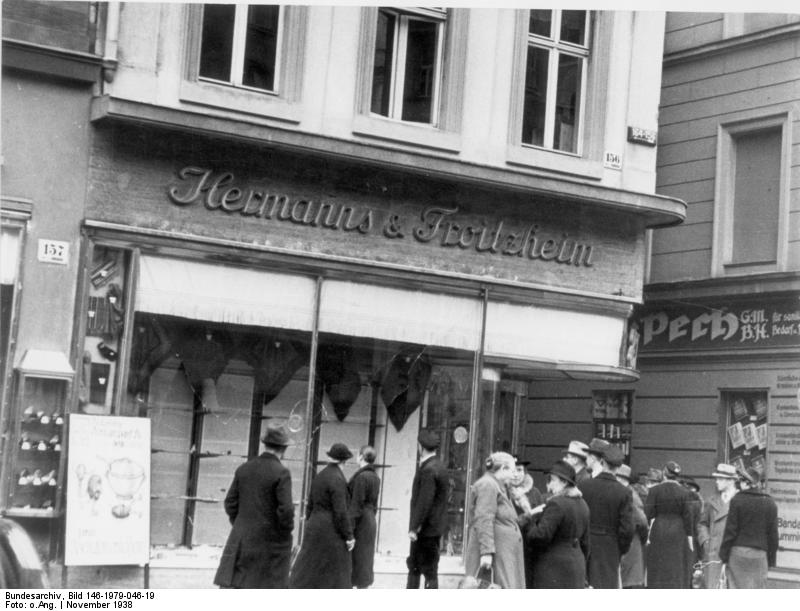
Destroyed shopfront of a Jewish business in Magdeburg, November 9, 1938.
Photo Bundesarchiv Bild 146-1979-046-19, via Wikimedia Commons.
Hitler came into power in 1933 with a plan to expand Germany’s rule and to completely annihilate world Jewry. During this time between his ascension and 1938, progressively strident anti-Semitic laws known as the Nuremberg Laws were enacted in which governmental policies regulated every aspect of Jewish life.
As conditions increasingly worsened for Jews, a Polish Jewish student, Herschel Grynszpan, whose family was being deported after a lifetime living in Germany, acted out against the Nazis and assassinated a German diplomat, Ernst vom Rath, on November 7, 1938. Hitler could not have been happier: it was the pretext he had been seeking to up the ante of anti-Semitism from “law-based” to mob violence.
By November 9, rioting was already in full swing in all quarters of the Reich, which by this time included Austria. Minister of propaganda Josef Goebbels encouraged Hitler to allow further punishment of the Jews through more “spontaneous demonstrations” of violence. According to Goebbels’s diary, Hitler responded: “[D]emonstrations should be allowed to continue. The police should not be withdrawn. For once the Jews should get the feel of popular anger.”
And did they ever. On the nights of November 9 and 10, 1938, unspeakable assaults upon Jewish women and men took place in Germany and Austria. When the majority of the mayhem finally ended on November 11, 30,000 Jewish men had been arrested and taken to concentration camps. Although figures vary, at least 100 fatalities were initially reported, the number growing into the hundreds due to subsequent mistreatment of those arrested.
Over 1,400 synagogues were burnt to the ground, and more than 7,500 businesses were likewise looted and torched. Jewish hospitals, homes, and schools fared no better. Those two nights of havoc would ignominiously become known as Kristallnacht: the night of the broken glass.
Soon, the world came to know the depredations wrought upon the Jewish people those nights. It was just the beginning, a precursor to the greatest ethnic mass murder of a people in the history of the world: the Holocaust.
Comments Off on 80 years on from Kristallnacht
The Franco-Prussian War
Epic History
Published on 29 Dec 2015The Franco-Prussian War or Franco-German War, often referred to in France as the War of 1870 (19 July 1870 – 10 May 1871), was a conflict between the Second French Empire and the German states of the North German Confederation led by the Kingdom of Prussia. The conflict was caused by Prussian ambitions to extend German unification. Prussian chancellor Otto von Bismarck planned to provoke a French attack in order to draw the southern German states — Baden, Württemberg, Bavaria and Hesse-Darmstadt — into an alliance with the North German Confederation dominated by Prussia.
Comments Off on The Franco-Prussian War
November 7, 2018
Romagne 14-18 Museum Tour
Forgotten Weapons
Published on 4 Nov 2018http://www.patreon.com/ForgottenWeapons
Jean-Paul de Vries runs a very interesting private World War One museum in the village of Romagne-sous-Montfaucon in the Meuse region of northeastern France. It is the exact opposite of typical modern museums, as it has a massive number of artifacts on display with almost no printed explanation. It is also unusual in displaying almost exclusively recovered artifacts of the war, the majority of them have been left on the fields or buried for decades. You will not find new specimens here; you will find remnants of war and weather.
That may sound dreary to some, but to me it is a very interesting way to approach the war and its history. You know that every item in this museum was actually used on the field of battle, and that can provide some interesting insights. For example, the American .30-06 Chauchat automatic rifles here indicate, contrary to most printed sources, that those guns were actually used in combat actions by American soldiers and not just for training. Tired of museums that have great open rooms with a single item on a glass case in the center? Then this is one place you will really appreciate!
The museum is an entirely private operation, and includes a small restaurant for sandwiches and such, and a shop offering books, reproduction items, and original artifacts for sale. If it located near the huge American Meuse-Argonne Cemetery, and I would highly recommend it to anyone traveling in the area with an interest in the Great War.
You can see the museum’s web site here:
https://romagne14-18.com/index.php/en/
Contact:
Forgotten Weapons
PO Box 87647
Tucson, AZ 85754
Comments Off on Romagne 14-18 Museum Tour


