
Overly Sarcastic Productions
Published on 7 Aug 2017There’s a fascinating history from just northwest of American history that is too often ignored. But that’s a damn shame, because it’s a damn cool history, and I’m going to talk about it dammit!
No, I didn’t accidentally misspell the title of this video when I sleepily uploaded this after I woke up. That’s absurd.
EXTRA CREDITS: HIAWATHA: https://youtu.be/79RApCgwZFw
This video was produced with assistance from the Boston University Undergraduate Research Opportunities Program.
PATREON: http://www.patreon.com/OSP
February 12, 2019
History Summarized: Iroquois Native Americans
Comments Off on History Summarized: Iroquois Native Americans
February 11, 2019
Tuberculosis – A Ten-Thousand Year Battle – Extra History – #2
Extra Credits
Published on 7 Feb 2019Tuberculosis couldn’t be cured and eliminated by just one person like Dr. Robert Koch, but thanks to the collective efforts of the medical community since Koch’s time — including public health initiatives and the introduction of randomized clinical trials — TB is steadily being wiped out.
Join us on Patreon! http://bit.ly/EHPatreon
Comments Off on Tuberculosis – A Ten-Thousand Year Battle – Extra History – #2
QotD: Gandhi’s conflicted views of war and pacifism
… the real center and raison d’être of Gandhi is ahimsa, nonviolence, which principle when incorporated into vast campaigns of noncooperation with British rule the Mahatma called by an odd name he made up himself, satyagraha, which means something like “truth-striving.” During the key part of his life, Gandhi devoted a great deal of time explaining the moral and philosophical meanings of both ahimsa and satyagraha. But much as the film sanitizes Gandhi to the point where one would mistake him for a Christian saint, and sanitizes India to the point where one would take it for Shangri-la, it quite sweeps away Gandhi’s ethical and religious ponderings, his complexities, his qualifications, and certainly his vacillations, which simplifying process leaves us with our old European friend: pacifism. It is true that Gandhi was much impressed by the Sermon on the Mount, his favorite passage in the Bible, which he read over and over again. But for all the Sermon’s inspirational value, and its service as an ideal in relations among individual human beings, no Christian state which survived has ever based its policies on the Sermon on the Mount since Constantine declared Christianity the official religion of the Roman empire. And no modern Western state which survives can ever base its policies on pacifism. And no Hindu state will ever base its policies on ahimsa. Gandhi himself — although the film dishonestly conceals this from us — many times conceded that in dire circumstances “war may have to be resorted to as a necessary evil.”
It is something of an anomaly that Gandhi, held in popular myth to be a pure pacifist (a myth which governments of India have always been at great pains to sustain in the belief that it will reflect credit on India itself, and to which the present movie adheres slavishly), was until fifty not ill-disposed to war at all. As I have already noted, in three wars, no sooner had the bugles sounded than Gandhi not only gave his support, but was clamoring for arms. To form new regiments! To fight! To destroy the enemies of the empire. Regular Indian army units fought in both the Boer War and World War I, but this was not enough for Gandhi. He wanted to raise new troops, even, in the case of the Boer and Kaffir Wars, from the tiny Indian colony in South Africa. British military authorities thought it not really worth the trouble to train such a small body of Indians as soldiers, and were even resistant to training them as an auxiliary medical corps (“stretcher bearers”), but finally yielded to Gandhi’s relentless importuning. As first instructed, the Indian Volunteer Corps was not supposed actually to go into combat, but Gandhi, adamant, led his Indian volunteers into the thick of battle. When the British commanding officer was mortally wounded during an engagement in the Kaffir War, Gandhi — though his corps’ deputy commander — carried the officer’s stretcher himself from the battlefield and for miles over the sun-baked veldt. The British empire’s War Medal did not have its name for nothing, and it was generally earned.
Richard Grenier, “The Gandhi Nobody Knows”, Commentary, 1983-03-01.
Comments Off on QotD: Gandhi’s conflicted views of war and pacifism
February 10, 2019
Stalemate in China, Bombs over Finland – WW2 – 024 – February 9 1940
World War Two
Published on 9 Feb 2019While the Winter War rages on in Finland, Japan is confronted with a dilemma. Keep fighting the Chinese and face huge problems feeding the populace in Japan and their newly conquered territories or withdraw and face your own populace to whom you’ve promised a glorious victory.
Follow WW2 day by day on Instagram @World_war_two_realtime https://www.instagram.com/world_war_t…
Join us on Patreon: https://www.patreon.com/TimeGhostHistory
Or join The TimeGhost Army directly at: https://timeghost.tvBetween 2 Wars: https://www.youtube.com/playlist?list…
Written and Hosted by: Indy Neidell
Produced and Directed by: Spartacus Olsson and Astrid Deinhard
Executive Producers: Bodo Rittenauer, Astrid Deinhard, Indy Neidell, Spartacus Olsson
Creative Producer: Joram Appel
Research by: Indy Neidell
Edited by: Iryna Dulka
Map animations: EastoryColorizations by Norman Stewart.
Thumbnail Colorization by Olga Shirnina aka Klimbim.Photos of the Winter War are mostly from the Finnish Wartime Photograph Archive (SA-Kuva).
Eastory’s channel: https://www.youtube.com/channel/UCEly…
Archive by Screenocean/Reuters https://www.screenocean.comA TimeGhost chronological documentary produced by OnLion Entertainment GmbH.
From the comments:
World War Two
2 days ago (edited)
New week, new video. A special one, since this one covers my birthday. Well, it would have if i were 54 years older… Anyhow, the Japanese are in trouble this week. At the same time, the Finnish are not as much in trouble as the Soviets would like them to be, but the pressure of the Soviet attacks is building up. Meanwhile, the Allied forces present a plan to actually intervene in the Winter War, in favour of Finland. A – for the Allies not at all unconvenient, side-effect would be an extra bonus. Talking about a convenient side-effect: If you support us on Patreon, we will be able to create ever more content. Right now, we’re working on the first biographies and more specials. We love to be able to bring those to you weekly, but we’re not there yet. Check out or Patreon page on https://www.patreon.com/TimeGhostHistory.Cheers,
Joram
Comments Off on Stalemate in China, Bombs over Finland – WW2 – 024 – February 9 1940
A debate on the impact of Brutalism on British cities
In Prospect magazine, James Stevens Curl and Barnabas Calder disagree on how Brutalist architecture has influenced destroyed urban areas in so many British cities. This is Curl’s opening salvo:
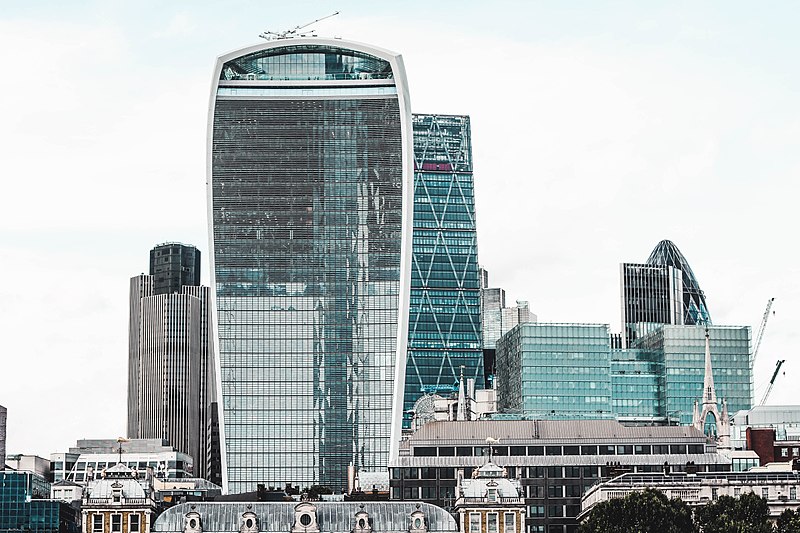
20 Fenchurch Street in London has been nicknamed the “Walkie-Talkie” due to its distinctive design.
Image by Toa Heftiba via Wikimedia Commons.
Visitors to these islands who have eyes to see will observe that there is hardly a town or city that has not had its streets — and skyline — wrecked by insensitive, crude, post-1945 additions which ignore established geometries, urban grain, scale, materials, and emphases.
Such structures were designed by persons indoctrinated in schools of architecture in ways that made them incapable of creating designs that did not cause immense damage and offend the eye, the sensibilities, and the spirit. Harmony with what already exists has never been a consideration for them, as it was not for their teacher: following the lead of “Le Corbusier” (as Swiss-French architect Charles-Édouard Jeanneret called himself), they have, on the contrary, done everything possible to create buildings incompatible with anything that came before. It seems that the ability to destroy a townscape or a skyline was the only way they have been able to make their marks. Can anyone point to a town in Britain that has been improved aesthetically by modern buildings?
Look at the more recent damage done to the City of London, with such crass interventions as the so-called “Walkie-Talkie” (which, through its reflectivity, has caused damage on the street below), or the repellent stuff inflicted on several cities by the infamous John Poulson and some of his bent cronies (from the 1950s until they were jailed in 1974). Quod erat demonstrandum.
How has this catastrophe been allowed to happen? A series of totalitarian doctrinaires reduced the infinitely adaptable languages of real architecture to an impoverished vocabulary of monosyllabic grunts. Those individuals rejected the past so that everyone had to start from scratch, reinventing the wheel and confining their design clichés to a few banalities. Today, form follows finance, when modern architecture is dominated by so-called “stars,” and becomes more bizarre, egotistical, unsettling, and expensive, ignoring contexts and proving stratospherically remote from the aspirations and needs of ordinary humanity. Their alienating works, inducing unease, are, without exception, inherently dehumanising and visually repulsive.
Comments Off on A debate on the impact of Brutalism on British cities
Semiauto M2 Hyde Reproduction: The Interim US WW2 Subgun
Forgotten Weapons
Published on 9 Jan 2019http://www.patreon.com/ForgottenWeapons
Cool Forgotten Weapons merch! http://shop.bbtv.com/collections/forg…
George Hyde designed the gun that would eventually be adopted as the M2 submachine gun in the late 1930s, and it was first tested at Aberdeen Proving Grounds in October of 1939. At that time, the gun had many good traits (weight, handlings, etc) but suffered from parts breakage and unreliability. Hyde went back to work on the gun at the Inland Division of GM, and came back with a much improved version in April of 1942.
The Inland-Hyde SMG was chambered for .45 ACP ammunition and used standard Thompson magazines, and was poised to become the US Army’s new submachine gun, replacing the overly expensive Thompson. The Hyde passed a 6080 round endurance test with flying colors, and exhibited much better effectiveness in fully automatic than the Thompson. At the end of the April tests, it was formally accepted to replace the Thompson and given the designation M2.
A contract was given to the Marlin company (Inland being busy with other projects) to manufacture 164,450 of the guns, with delivery to begin in December 1942. However, Marlin had problems tooling up to produce the new gun, in particular with dies for several parts to be made using powdered metal sintering. Actual delivery of the first guns did not happen until May of 1943. In the meantime, Hyde and Inland had continued working on cheaper and simpler designs, and created the stamped sheet metal M3 “Grease Gun”. By the time the M2 was actually ready for delivery, the M3 had been tested and accepted by the Army as a better replacement than the M2. By mid-June, the M2 was declared obsolete and Marlin’s contract cancelled.
In total only about 500 M2 submachine guns were made, with (I believe) 6 surviving today. The example in this video is a semiautomatic-only reproduction made from scratch by a viewer of the channel, who graciously offered to loan it to me for this filming. Thanks, K!
Contact:
Forgotten Weapons
PO Box 87647
Tucson, AZ 85754
Comments Off on Semiauto M2 Hyde Reproduction: The Interim US WW2 Subgun
February 9, 2019
40:1 – The Battle of Wizna – Sabaton History 001
Sabaton History
Published on 7 Feb 2019Sabaton wrote a song about the Battle of Wizna, called 40:1. When the Germans invaded Poland in 1939, they met determined and fierce resistance. Multiple battles show the steadiness of the Polish defenders, in contrast to the common narrative about the Polish defence. One of these Battles is the Battle of Wizna, where a Polish defensive force managed to hold off a much larger German army for several days.
Watch the official music video for 40:1 in full here: https://www.youtube.com/watch?v=epeQw…
Support Sabaton History on Patreon: https://www.patreon.com/sabatonhistory
Hosted by: Indy Neidell
Written by: Markus Linke and Indy Neidell
Directed by: Astrid Deinhard and Wieke Kapteijns
Produced by: Pär Sundström, Astrid Deinhard and Spartacus Olsson
Creative Producer: Joram Appel
Executive Producers: Pär Sundström, Joakim Broden, Tomas Sunmo, Indy Neidell, Astrid Deinhard, and Spartacus Olsson
Maps by: Eastory
Edited by: Iryna Dulka
Sound Editing by: Marek KaminskiEastory YouTube Channel: https://www.youtube.com/channel/UCEly…
Archive by: Reuters/Screenocean https://www.screenocean.comMusic by Sabaton
An OnLion Entertainment GmbH and Raging Beaver Publishing AB co-Production
© Raging Beaver Publishing AB, 2019 – all rights reserved.
Comments Off on 40:1 – The Battle of Wizna – Sabaton History 001
HMS Dreadnought – Guide 001
Drachinifel
Published on 12 Dec 2018HMS Dreadnought, the first dreadnought battleship and game changer for the British Royal Navy, is today’s subject.
Want to support the channel? – https://www.patreon.com/Drachinifel
Want to talk about ships? https://discord.gg/TYu88mt
Comments Off on HMS Dreadnought – Guide 001
February 8, 2019
Smashing China to Pieces, the Background | Between 2 Wars | 1925 Part 1 of 2
TimeGhost History
Published on 7 Feb 2019The 19th century throws all kinds of terror and misfortune on China, which not long before was the most powerful nation in the world. While many other Western, Asian and even American nations seek to gain influence in China through politics, wars and trade, China itself tries to hold on to its glory days.
Join us on Patreon: https://www.patreon.com/TimeGhostHistory
Hosted by: Indy Neidell
Directed by: Spartacus Olsson
Written by: Spartacus Olsson
Produced by: Astrid Deinhard
Executive Producers: Bodo Rittenauer, Astrid Deinhard, Indy Neidell, Spartacus Olsson
Creative Producer: Joram Appel
Edited by: Wieke Kapteijns
Research by: Spartacus OlssonThumbnail depicts Ataturk colorised by Olga Shirnina aka Klimbim.
Colorized Pictures by Olga Shirnina and Norman Stewart
Olga’s pictures: https://klimbim2014.wordpress.com
Norman’s pictures https://oldtimesincolor.blogspot.com/Video Archive by Screenocean/Reuters http://www.screenocean.com
A TimeGhost chronological documentary produced by OnLion Entertainment GmbH
From the comments:
TimeGhost History
1 day ago (edited)Hey all!
After we decided to do Between Two Wars episodes on China in the 20’s, we quickly discovered that the historical context is necessary if you want to understand modern China. Therefore, we present to you a pre-war introduction of China. The end of the mighty empires is an exciting part of history that is often overlooked. That’s no longer the case.
Cheers,
Joram
Comments Off on Smashing China to Pieces, the Background | Between 2 Wars | 1925 Part 1 of 2
History Summarized: The Portuguese Empire
Overly Sarcastic Productions
Published on 9 Nov 2018Play World of Warships for free: http://bit.ly/2zyT191. New players will receive 1 MILLION free credits, the historical premium ship HMS Campbeltown and more by using my code PLAYWARSHIPS2018
What happens when you spend a few decades casually getting really good at seafaring, only to find that there’s suddenly a whole new world that’s only accessible to societies with exceptional sailing prowess? — You get fabulously rich, that’s what. Watch along and learn all about the surprising success of Portugal!
PATREON: http://www.patreon.com/OSP
From the comments:
BenficaHaze 1904
1 month ago
Portugal didn’t follow Spain. Portugal started the discoveries 60-70 years before SpainPietro SF
1 month ago
The video already starts badly by suggesting Portugal only entered the Discoveries as a response to the Spaniards, when in reality the Portuguese pioneered the Age of Discovery, starting it half a century before Columbus’ Voyage.Daniel Ghan
1 month ago
Nice video, but 2 significant errors:
1) Columbus didn’t motivate Portugal’s exploration as the video implies; rather, it was the other way around. The Portuguese began searching for a way to India around Africa after the fall of Constantinople in 1453. Columbus, who was Italian, asked the Portuguese king to finance his expedition but was refused, and only then went to Spain.
2) Magellan (Magalhães) was Portuguese but his expedition was sponsored by Spain and he had a Spanish crew. So the expedition would not have returned to Lisbon.Metriximor
1 month ago
Alright, Portuguese here, just wanna say overall you did a great job but I wanna clear a few misconceptions.Portugal didn’t just spring up into action because of Columbus, in fact, he even asked the Portuguese Crown for funding before he asked the Spanish Crown. Portuguese discoveries began in 1418 with Madeira, 1427 we found Açores, then in 1434 Gil Eanes goes around Cape Bojador, 1472 we found Newfoundland, but most importantly, in 1487 Bartolomeu Dias goes around the Cape of Storms, and looking out at the huge possibilities of his accomplishment he declares it to be the Cape of Good Hope.
This was all before Columbus even thought of sailing the Atlantic(1488) or contacting the Spanish(1489), so saying Portugal just began exploring because of him is downplaying it a lot.
Otherwise, fantastic work, love your channel and content keep it up 😀
PORTUGAL CARALHO
Comments Off on History Summarized: The Portuguese Empire
February 7, 2019
Dunkirk (2017) | Based on a True Story
The Cynical Historian
Published on 25 Jan 2018Dunkirk is a 2017 war film written, directed, and produced by Christopher Nolan that depicts the Dunkirk evacuation of World War II. Its ensemble cast includes Fionn Whitehead, Tom Glynn-Carney, Jack Lowden, Harry Styles, Aneurin Barnard, James D’Arcy, Barry Keoghan, Kenneth Branagh, Cillian Murphy, Mark Rylance, and Tom Hardy. The film is a British, American, French, and Dutch co-production, and was distributed by Warner Bros.
————————————————————
Wiki:
Dunkirk portrays the evacuation from three perspectives: land, sea, and air. It has little dialogue, as Nolan sought instead to create suspense from cinematography and music. Filming began in May 2016 in Dunkirk and ended that September in Los Angeles, when post-production began. Cinematographer Hoyte van Hoytema shot the film on IMAX 65 mm and 65 mm large-format film stock. Dunkirk has extensive practical effects, and employed thousands of extras as well as historic boats from the evacuation, and period aeroplanes.
————————————————————
Hashtags: #History #Dunkirk #WWII #Review #BasedOnATrueStory #PhoneyWar
Comments Off on Dunkirk (2017) | Based on a True Story
February 5, 2019
Mythology Matters – Extra Mythology – #1
Extra Credits
Published on 4 Feb 2019Join the Patreon community! http://bit.ly/EMPatreon
We’ll periodically, in-between series, do a Mythology Matters video, where we talk about some of the writing and research choices we made and topics we didn’t really get to cover in the full illustrated episodes. Let’s talk about plot holes and discrepancies in the myths we’ve covered so far, and the parallels we see between myths from completely different cultures!
Comments Off on Mythology Matters – Extra Mythology – #1
Tiger vs. Comet – Germany 1945
Mark Felton Productions
Published on 18 Dec 2018The Comet was Britain’s newest tank in 1945, and led the charge into Northern Germany. In this episode, find out what happened when Royal Tank Regiment Comets encountered a lone German Tiger in the forest.
Help support Marks’ channel – see below for more details;
https://www.patreon.com/markfeltonpro…
https://www.paypal.me/markfeltonprodu…Film: YouTube Creative Commons
Comments Off on Tiger vs. Comet – Germany 1945
QotD: Democracy and diversity
Whether ethnic diversity is compatible with democratic republican government is open to question, though it is considered impolite, or worse, to raise that question. Democracy requires a demos. Truly free, democratic, and stable multiethnic societies are rare, as the Europeans are learning again. There’s Switzerland, sure, but a core principle of the Swiss solution is separation: the country’s four ethnicities are mostly concentrated in their own cantons. Switzerland is a highly decentralized confederacy, where most political issues get decided at the canton level, which minimizes ethnic and regional tensions. The federal government in Bern is practically invisible; most Swiss can’t name their country’s president. This is not a model easily replicated.
The history of the United States does not convincingly prove that ethnic diversity is part and parcel with democracy. Ask a random man in the street of any blue-state city what the purpose of America is, and he’s likely to tell you that it’s immigration—though the word appears nowhere in the founding documents. The U.S. was, from its beginnings, multiethnic, multiracial, multi-religious, and multilingual. But until recently, this background condition was not seen as the font of our national strength. Rather, for most of our history, it was a problem to be overcome through nation-building and assimilation, which America excelled at. By the early 1960s, United States had come close to creating its own unique national ethnicity, albeit one that starkly excluded African-Americans. But even this exception seemed to be moving rapidly toward resolution before the country gave up on nation-building in the late 1960s. One can make a strong case that the early Civil Rights movement was a product of the mid-century high-water mark of American nationalism. Listen to Martin Luther King’s “I Have a Dream” speech; it’s striking how classically nationalist it is, from its evocation of the country’s geographical features to the reaffirmation of its basic creed of freedom, equality, and individual rights, to its Old Testament rhetoric rooted in John Winthrop’s Puritanism.
E.M. Oblomov, “The Case for National Realism: Diversity is the hallmark of empires, not democracies”, City Journal, 2019-01-02.
Comments Off on QotD: Democracy and diversity
February 4, 2019
Jane Austen – Sarcasm and Subversion – Extra History
Extra Credits
Published on 2 Feb 2019Jane Austen wrote in the name of making critical social commentary of the privileges she and others held while the rest of Europe was in political turmoil. Her novels like Pride and Prejudice, Mansfield Park, and Emma made waves in their time for how they criticized
VictorianRegency-era society.
Join us on Patreon! http://bit.ly/EHPatreon
From the comments:
Extra Credits
2 days ago
Jane Austen saw the hypocrisy of an entire class of the most powerful empire on Earth taking tea and planning balls while the world burned. And from a young age she took up arms against that hypocrisy with the only weapon she had: her pen.(Comment from Belinda) I don’t know if anyone else has had this experience with Jane Austen’s works, but in the educational culture I grew up in, the historical context of Austen’s writing was almost never emphasized. Pride & Prejudice in particular is frequently reduced to being the original formula for romantic comedies (to say nothing of its own spin-off movies of the same name). I remember in high school class it seemed really weird to me that we would be talking about this 19th century novel as a progressive feminist work because it’s already a given in the 21st century world that marrying for love is extremely commonplace. I’m really proud of our writers Jac and Rob, and our artist Ali, for bringing to life the “extra History” of Jane Austen that gets glossed over by popular culture. <3
Comments Off on Jane Austen – Sarcasm and Subversion – Extra History


