
Observance of Prohibition in the breech was also common amongst junior officers. While commanding tank battalions and living next door to one another in renovated barracks at Camp Meade, Maryland, Dwight Eisenhower and George Patton avidly partook in the new American pastime of making their own bootleg alcohol. Eisenhower distilled gin in an unused bathtub, while Patton brewed beer, storing it in a shed outside his kitchen. One summer evening there was a sudden noise outside the Pattons’ barracks that sounded like a machine gun, followed by a series of soft booms. As their cook began screaming, Patton instinctively dove for cover. When they realized it was merely the beer bottles exploding from the heat, he rose, sheepishly explaining how much it had sounded like hostile fire. His wife Beatrice “laughed and laughed and called him ‘her hero’ and he got very red.” Omar Bradley commanded an infantry battalion in the 27th Infantry Regiment in the 1920s and took advantage of the Hawaii Division’s leisurely pace of duty to play golf several times a week. At the end of one round, the 33-year-old teetotaler drank his first glass of whiskey, which he liked enough to make “a habit of having a bourbon and water or two (but never more) before dinner” for the rest of his life.
Benjamin Runkle, “‘What a Magnificent Body of Men Never to Take Another Drink’: The U.S. Army and Prohibition”, Real Clear Defense, 2019-01-16.
February 18, 2019
QotD: Patton and Prohibition
February 17, 2019
Finland’s Desperate Fight – WW2 – 025 – February 16 1940
World War Two
Published on 16 Feb 2019After more than a week of preliminary bombardments and attacks, the Red Army finally attacks the Finnish defensive positions on the Karelian Isthmus en masse. They throw thousands of troops at the Finns at the entire width of their lines, even exceeding them. The Finns defend the best as they can, but their winning streak seems to come to an end.
Join us on Patreon: https://www.patreon.com/TimeGhostHistory
Or join The TimeGhost Army directly at: https://timeghost.tvFollow WW2 day by day on Instagram @World_war_two_realtime https://www.instagram.com/world_war_t…
Between 2 Wars: https://www.youtube.com/playlist?list…
Source list: http://bit.ly/WW2sourcesWritten and Hosted by: Indy Neidell
Produced and Directed by: Spartacus Olsson and Astrid Deinhard
Executive Producers: Bodo Rittenauer, Astrid Deinhard, Indy Neidell, Spartacus Olsson
Creative Producer: Joram Appel
Research by: Indy Neidell
Edited by: Iryna Dulka
Map animations: EastoryColorizations by Norman Stewart.
Thumbnail Colorization by Julius Jääskeläinen: https://www.flickr.com/photos/juliusjaa/Photos of the Winter War are mostly from the Finnish Wartime Photograph Archive (SA-Kuva).
Eastory’s channel: https://www.youtube.com/channel/UCEly…
Archive by Screenocean/Reuters https://www.screenocean.comA TimeGhost chronological documentary produced by OnLion Entertainment GmbH.
From the comments:
World War Two
2 days agoMajor developments in the Winter War this week! The thumbnail (colorized by JuliusJaa – https://www.flickr.com/photos/juliusjaa/) depicts Aarne Juutilainen or the “The Terror of Morocco”. This particular photo was taken earlier in December 1939 during the battle of Kollaa, where he acquired a hero status. He owed his name to his service in the French Foreign Legion in Morocco, where he served from 1930 to 1935. By 1940, he commanded his own ‘Moroccan company’, a unit made out of decorated soldiers known for their superior skills.
We sincerely hope that you enjoy the videos we put out for you all! As Indy notes at the end of the video, especially important for today’s episode (there are 14 maps in this) is Eastory, who researches and animates our maps for us. Check out his channel as well! It’s really good -> https://www.youtube.com/channel/UCElybFZ60Hk1NSjgCf7I2sg
Please do consider supporting us on Patreon. That allows us to keep working with awesome people like Eastory and will help us create even more content for you all to enjoy.
Cheers,
Joram
When Trump gets serious with Canada about defence spending
Ted Campbell notes that, despite all the nay-saying, President Trump appears to be getting results with US allies on defence issues. That being the case, he’s wondering when Prime Minister Trudeau will get the message:
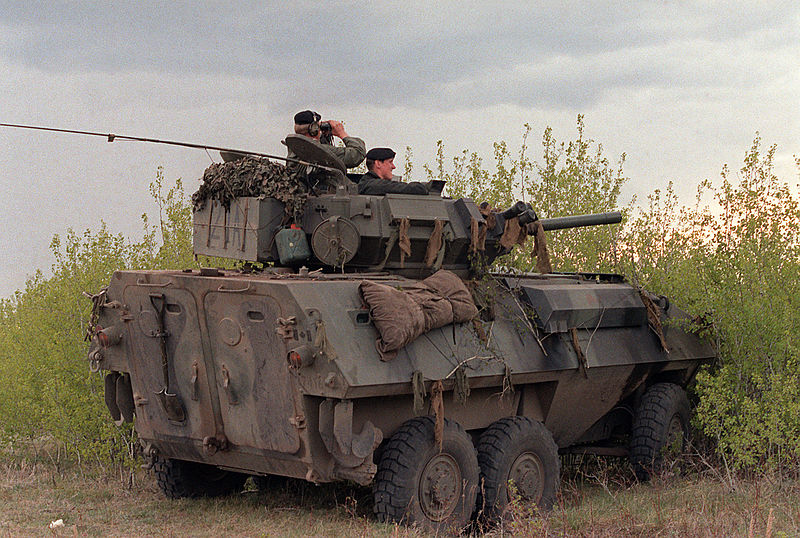
A right rear view of a Canadian army Cougar wheeled fire support vehicle being used as an observation post by soldiers standing watch during the combined U.S./Canadian NATO Exercise Rendezvous ’83. Location: Camp Wainright, AB
I was commenting on this before president Trump was elected; and shortly after his 2016 election victory I said that
“Prime Minister Trudeau and most European presidents and prime ministers will have to face a newly elected US president who wants them to pay for a bigger and bigger slice of their own defence. Real leaders would do well to recognize that the Americans have a valid point … some, probably many of them, including Prime Minister Justin Trudeau, may try to pretend that it doesn’t matter; they will be wrong.”
I was impressed, then, with how deeply many, many Americans felt about Donald Trump’s campaign message which said that allies were “freeloading,” and taking unfair advantage of America’s innate generosity … I was very, very conscious of the fact that, when I was a young man, a junior officer in Canada’s tough, superbly disciplined, well trained, trained, nuclear armed “vest pocket army” (as more than one allied general called us) brigade group in Germany, Canada used to pay its full and fair share … but we stopped, in the late summer of 1969, when Pierre Trudeau tried to totally withdraw from NATO and, indeed, from the world.
I wonder when President Trump will send someone like Timothy Betts, the Deputy Assistant Secretary and Senior Advisor for Security negotiations and Armaments in the US State Department, to Ottawa to demand that Canada should pay up after a half century of “freeloading” on the US taxpayers’ goodwill. That will come as a nasty shock to Team Trudeau and, indeed, to a majority of Canadians who have gotten used to the notion that the Americans will defend us out of the kindness of their hearts. I’m not sure that Canada is next in line, but I suspect we’re on his short list.
Project Lightening Episode 02: 100 Yard Test
C&Rsenal
Published on 14 Feb 2019Project Lightening is the first collaborative project between C&Rsenal and Forgotten Weapons. It features SEVEN World War One light machine guns put head to head to see which is the best!
We’re releasing two episode a week but you can get them all at once over at C&Rsenal AND support both shows at the same time!
Tank Chats #42 Elefant | The Tank Museum
The Tank Museum
Published on 18 Aug 2017Originally known as the Ferdinand, then later renamed Elefant, 90 of this heavily armed and armoured vehicle were built, seeing service in the Soviet Union, Italy and Germany.
Although deployed as a tank destroyer, the Elefant had its origins in Ferdinand Porsche’s attempt to build what became the Tiger tank.
This particular Elefant is part of The Tiger Collection at The Tank Museum, Bovington, on loan from the US Army Ordnance Training and Heritage Center, VA.
Support the work of The Tank Museum on Patreon: ► https://www.patreon.com/tankmuseum
Or donate http://tankmuseum.org/support-us/donateTwitter: ► https://twitter.com/TankMuseum
Tiger Tank Blog: ► http://blog.tiger-tank.com/
Tank 100 First World War Centenary Blog: ► http://tank100.com/ #tankmuseum #tanks #tigertank tiger tanks tank chat
February 16, 2019
Project Lightening Episode 01: Introduction
Forgotten Weapons
Published on 14 Feb 2019Don’t wait like a chump! Get the whole 8-part series right now at:
https://candrsenal.com/product/lighte…
I am excited to introduce Project Lightening! This is a collaborative series with Othais and Mae of C&Rsenal in which we test all seven light machine guns and automatic rifles of World War One and put them through a series of tests and evaluations. Each week we will be posting one video on Forgotten Weapons and one on C&Rsenal. Today we have the introduction here, and the 100 yard accuracy testing over on C&Rsenal (https://youtu.be/-hSZbo8Hvn4).
http://www.patreon.com/ForgottenWeapons
Contact:
Forgotten Weapons
PO Box 87647
Tucson, AZ 85754
February 15, 2019
“Blood of Bannockburn” – Sabaton History 002
Sabaton History
Published on 14 Feb 2019Sabaton’s song “Blood of Bannockburn” is about the First War of Scottish Independence and one of its key figures, Robert the Bruce. He fought the English King Edward who invaded Scotland when Bruce’s revolutionary force forced all Scottish nobles to join his cause or lose their lands. Edward moved on Bruce’s army while they were besieging Stirling Castle, but his plans to overwhelm the Scottish was opposed by Bruce.
Support Sabaton History on Patreon: https://www.patreon.com/sabatonhistory
Watch the official lyric video for Blood of Bannockburn here: https://www.youtube.com/watch?v=Xp-Rk…
Hosted by: Indy Neidell
Written by: Markus Linke and Indy Neidell
Directed by: Astrid Deinhard and Wieke Kapteijns
Produced by: Pär Sundström, Astrid Deinhard and Spartacus Olsson
Creative Producer: Joram Appel
Executive Producers: Pär Sundström, Joakim Broden, Tomas Sunmo, Indy Neidell, Astrid Deinhard, and Spartacus Olsson
Maps by: Eastory
Edited by: Wieke Kapteijns
Sound Editing by: Marek KaminskiEastory YouTube Channel: https://www.youtube.com/channel/UCEly…
Archive by: Reuters/Screenocean https://www.screenocean.com
Music by Sabaton‘Photo young Sabaton’ ©Dalarnas museum, foto: Susanne Nyhlén – The National Portrait Gallery https://www.npg.org.uk
An OnLion Entertainment GmbH and Raging Beaver Publishing AB co-Production.
© Raging Beaver Publishing AB, 2019 – all rights reserved.
From the comments:
Sabaton History
1 day ago (edited)Hey!! We’re leaving the modern times (which instantly that answers a frequently asked question about if we’re just sticking to WW2) and will enter the Medieval Era. The 3d animated maps are made and researched by Eastory (check his channel here: https://www.youtube.com/channel/UCElybFZ60Hk1NSjgCf7I2sg). As the battle took place long ago, there is little documentation about it and there are several possible reconstructions of the events of the battle available. We had to prefer one version and proponents of others may criticise it. The most risky decision was to add the effects of land rise and make the Forth river larger as a result. This is absent from most of reconstructions, but Eastory studied some old maps and according to them the sea level in 15th and 16th centuries was far higher in the region.
Enjoy and STAY AWESOME! 🤘🤘
Introducing the Baroque Theorbo
Orchestra of the Age of Enlightenment
Published on Jan 11, 2019“People complain a lot about the space that I take up”.
Lutenist Elizabeth Kenny explains how and why the theorbo was developed in the 17th century, what it was used for, and what it’s like to carry it around on the train.
Website: http://oae.co.uk
Twitter: https://twitter.com/theoae
February 14, 2019
Macedonian Wars | 3 Minute History
Jabzy
Published on 28 Mar 2015Roman-Macedonian Wars
I will gradually continue to make episodes on Rome somewhat chronologically.
February 13, 2019
Native American Myth – Nlaka’pamux: The Adventures of Coyote – Extra Mythology
Extra Credits
Published on 11 Feb 2019Join the Patreon community! http://bit.ly/EMPatreon
Coyote is not just a wild animal in North America, but also a heroic, trickster protagonist whose mythological adventures reflect lessons learned from the natural world. Let’s examine the Nlaka’pamux tribe’s interpretation of Coyote.
The origins of the word “loot”
William Dalrymple wrote about the Honourable East India Company for the Guardian a few years back, including the way the word “loot” entered common English usage:
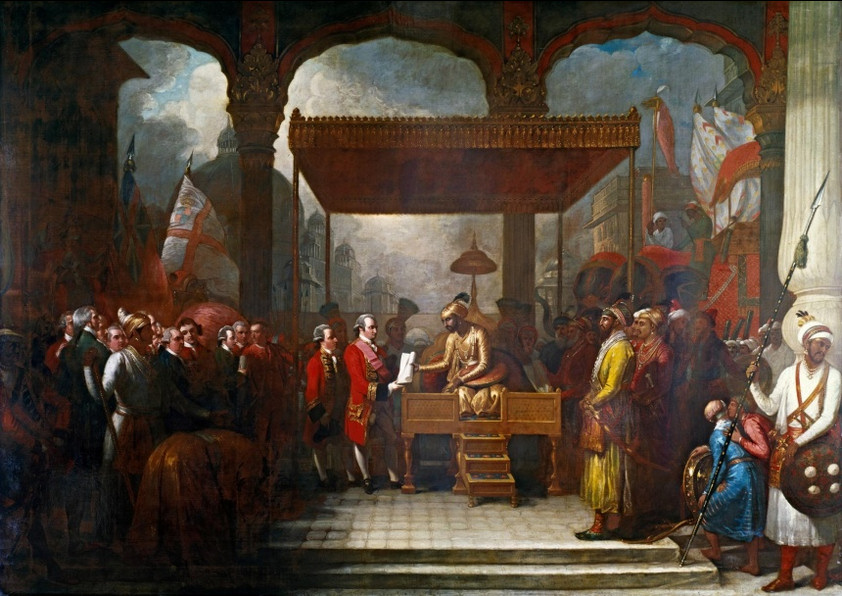
The Mughal emperor Shah Alam hands a scroll to Robert Clive, the governor of Bengal, which transferred tax collecting rights in Bengal, Bihar and Orissa to the East India Company, August 1765.
Oil painting by Benjamin West (1738-1820) via Wikimedia Commons.
One of the very first Indian words to enter the English language was the Hindustani slang for plunder: “loot”. According to the Oxford English Dictionary, this word was rarely heard outside the plains of north India until the late 18th century, when it suddenly became a common term across Britain. To understand how and why it took root and flourished in so distant a landscape, one need only visit Powis Castle.
The last hereditary Welsh prince, Owain Gruffydd ap Gwenwynwyn, built Powis castle as a craggy fort in the 13th century; the estate was his reward for abandoning Wales to the rule of the English monarchy. But its most spectacular treasures date from a much later period of English conquest and appropriation: Powis is simply awash with loot from India, room after room of imperial plunder, extracted by the East India Company in the 18th century.
There are more Mughal artefacts stacked in this private house in the Welsh countryside than are on display at any one place in India – even the National Museum in Delhi. The riches include hookahs of burnished gold inlaid with empurpled ebony; superbly inscribed spinels and jewelled daggers; gleaming rubies the colour of pigeon’s blood and scatterings of lizard-green emeralds. There are talwars set with yellow topaz, ornaments of jade and ivory; silken hangings, statues of Hindu gods and coats of elephant armour.
Such is the dazzle of these treasures that, as a visitor last summer, I nearly missed the huge framed canvas that explains how they came to be here. The picture hangs in the shadows at the top of a dark, oak-panelled staircase. It is not a masterpiece, but it does repay close study. An effete Indian prince, wearing cloth of gold, sits high on his throne under a silken canopy. On his left stand scimitar and spear carrying officers from his own army; to his right, a group of powdered and periwigged Georgian gentlemen. The prince is eagerly thrusting a scroll into the hands of a statesmanlike, slightly overweight Englishman in a red frock coat.
The painting shows a scene from August 1765, when the young Mughal emperor Shah Alam, exiled from Delhi and defeated by East India Company troops, was forced into what we would now call an act of involuntary privatisation. The scroll is an order to dismiss his own Mughal revenue officials in Bengal, Bihar and Orissa, and replace them with a set of English traders appointed by Robert Clive – the new governor of Bengal – and the directors of the EIC, who the document describes as “the high and mighty, the noblest of exalted nobles, the chief of illustrious warriors, our faithful servants and sincere well-wishers, worthy of our royal favours, the English Company”. The collecting of Mughal taxes was henceforth subcontracted to a powerful multinational corporation – whose revenue-collecting operations were protected by its own private army.
It was at this moment that the East India Company (EIC) ceased to be a conventional corporation, trading and silks and spices, and became something much more unusual. Within a few years, 250 company clerks backed by the military force of 20,000 locally recruited Indian soldiers had become the effective rulers of Bengal. An international corporation was transforming itself into an aggressive colonial power.
Using its rapidly growing security force – its army had grown to 260,000 men by 1803 – it swiftly subdued and seized an entire subcontinent. Astonishingly, this took less than half a century. The first serious territorial conquests began in Bengal in 1756; 47 years later, the company’s reach extended as far north as the Mughal capital of Delhi, and almost all of India south of that city was by then effectively ruled from a boardroom in the City of London. “What honour is left to us?” asked a Mughal official named Narayan Singh, shortly after 1765, “when we have to take orders from a handful of traders who have not yet learned to wash their bottoms?”
Project Lightening: The World’s Best Collab
Forgotten Weapons
Published on 13 Jan 2019You have asked for it for years, so we made it happen. The two hardest-working gun channels on the ‘net have joined forces in the best collaboration in all history. Coming February 14th (because we love you all so much)…Project Lightening!
https://www.patreon.com/ForgottenWeapons
https://www.patreon.com/CandRsenal
Cool Forgotten Weapons merch! http://shop.bbtv.com/collections/forg…
Contact:
Forgotten Weapons
PO Box 87647
Tucson, AZ 85754
QotD: The goose-step
One rapid but fairly sure guide to the social atmosphere of a country is the parade-step of its army. A military parade is really a kind of ritual dance, something like a ballet, expressing a certain philosophy of life. The goose-step, for instance, is one of the most horrible sights in the world, far more terrifying than a dive-bomber. It is simply an affirmation of naked power; contained in it, quite consciously and intentionally, is the vision of a boot crashing down on a face. Its ugliness is part of its essence, for what it is saying is “Yes, I am ugly, and you daren’t laugh at me”, like the bully who makes faces at his victim. Why is the goose-step not used in England? There are, heaven knows, plenty of army officers who would be only too glad to introduce some such thing. It is not used because the people in the street would laugh. Beyond a certain point, military display is only possible in countries where the common people dare not laugh at the army. The Italians adopted the goose-step at about the time when Italy passed definitely under German control, and, as one would expect, they do it less well than the Germans. The Vichy government, if it survives, is bound to introduce a stiffer parade-ground discipline into what is left of the French army. In the British army the drill is rigid and complicated, full of memories of the eighteenth century, but without definite swagger; the march is merely a formalized walk. It belongs to a society which is ruled by the sword, no doubt, but a sword which must never be taken out of the scabbard.
George Orwell, “The Lion And The Unicorn: Socialism and the English Genius”, 1941-02-19.
February 12, 2019
Sun Yat-sen – Lies – Extra History
Extra Credits
Published on 9 Feb 2019Writer Rob Rath talks about all the cool stories and facts we didn’t get to cover in the Sun Yat-sen series.
Join us on Patreon! http://bit.ly/EHPatreonRecommended reading – The Unfinished Revolution: Sun Yat-Sen and the Struggle for Modern China
3:42 – flag time!
7:59 – what are the Triads anyway?
16:13 – one man’s legacy can be very malleable…
19:05 – movies depicting the Chinese Revolution
20:16 – the Walpole Connection TM
21: 35 – what’s next on Extra History?


