
It is a truth universally acknowledged that, en masse if not individually, E2 has a slight nagging tendency towards anti-French sentiment. For the Brits it’s sort of traditional/historic, dating back to the Hundred Years War and all that (in which the English gloriously won, as they will be sure to note, at Crecy and Agincourt; strangely, at the end of it all, the French owned all of France, including the bits that the English had owned previously) and quite a lot of subsequent ones, mainly fought in Belgium, while for the Americans it seems to be something to do with the fact that they needed French help to run a revolution properly, along with the proximity of uppity Quebeckers and the fact that the French are marginally less prepared than the rest of the world to roll over and be McDisneyfied™; not being one I can’t say definitively. But I digress.
When it comes to military history, this particular bias mostly comes out in references to three weeks in May 1940, and specifically one piece of particularly crap judgement by General Gamelin and one bypassed fortress line. The fact that that the allied participants — France, Britain, the Netherlands and Belgium — have spent most of the time since blaming each other and trying to work out who sold out whom has been allowed to mask the fact that this particular campaign was successful beyond all reasonable expectations for the Germans, and that when the French actually had troops in the right places, they were perfectly capable of fighting the advancing Panzers to a standstill at a tactical or operational level. Visitors to Paris may wish to note that the big — rather bigger than you think until you actually see it in the flesh — structure at one end of the Champs Elysées is called the Arc de Triomphe, and not the Arc de Defaite; it bears an admittedly tedious and tasteless, but indubitably long, list of battles at which the French did rather well. The fact that your school history lessons may have taught you rather more about Paul Revere or Clive of India than about Charles Martel is not relevant in the greater scheme of things.
Albert Herring, “Why neither the French nor the Italians are the worst military nation”, Everything2, 2002-01-07.
August 16, 2019
QotD: It’s not really accurate to call the French “cheese-eating surrender monkeys”
August 15, 2019
Slavery in the American colonies
Tim Worstall outlines the history of slavery in the area under British rule that eventually became the United States:
This is so well known, what did in fact happen, that even Wikipedia has it unencumbered by wokeness.
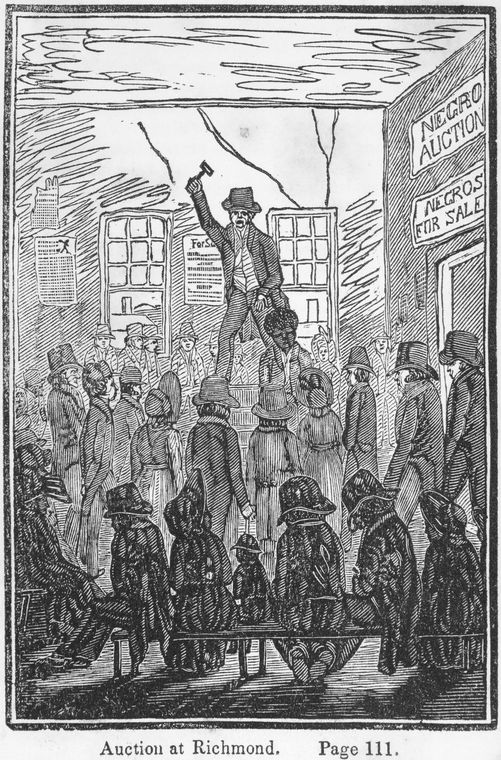
Auction at Richmond. (1834)
“Five hundred thousand strokes for freedom; a series of anti-slavery tracts, of which half a million are now first issued by the friends of the Negro.” by Armistead, Wilson, 1819?-1868 and “Picture of slavery in the United States of America” by Bourne, George, 1780-1845
New York Public Library via Wikimedia Commons.
The first 19 or so Africans to reach the English colonies arrived in Jamestown, Virginia, in 1619, brought by English privateers who had seized them from a captured Portuguese slave ship. Slaves were usually baptized in Africa before embarking. As English custom then considered baptized Christians exempt from slavery, colonists treated these Africans as indentured servants, and they joined about 1,000 English indentured servants already in the colony. The Africans were freed after a prescribed period and given the use of land and supplies by their former masters. The historian Ira Berlin noted that what he called the “charter generation” in the colonies was sometimes made up of mixed-race men (Atlantic Creoles) who were indentured servants, and whose ancestry was African and Iberian. They were descendants of African women and Portuguese or Spanish men who worked in African ports as traders or facilitators in the slave trade. For example, Anthony Johnson arrived in Virginia in 1621 from Angola as an indentured servant; he became free and a property owner, eventually buying and owning slaves himself. The transformation of the social status of Africans, from indentured servitude to slaves in a racial caste which they could not leave or escape, happened gradually.
There were no laws regarding slavery early in Virginia’s history. But, in 1640, a Virginia court sentenced John Punch, an African, to slavery after he attempted to flee his service. The two whites with whom he fled were sentenced only to an additional year of their indenture, and three years’ service to the colony. This marked the first legal sanctioning of slavery in the English colonies and was one of the first legal distinctions made between Europeans and Africans.
That’s the 1640 start, if you prefer that. When the distinction was made between black and white runaways from that indenture.
Worth noting that there was nothing unusual about indenture. Very similar indeed to the idea and practice of apprenticeship at the time. In effect, a time limited ownership of the labor – not the person – in return for certain benefits such as transport, sustenance, training and so on. This was actually the manner in which anyone at all entered the skilled working class. Sure, it all sounds a bit feudal but then that’s because it was rather the overhang of that feudal system. And it really did apply to people irrespective of skin colour or racial – even national – background.
England hadn’t had chattel slavery since the Anglo Saxons – Scotland and certain miners being evidence that all of Britain wasn’t so lucky – and it was rather more the Moors, Ottomans, Arabs, various places below the Olive Line, who still had full on slavery.
This then full changed in the colonies. And Anthony Johnson, that arrival from Angola in 1621, who makes the history here:
When Anthony Johnson was released from servitude, he was legally recognized as a “free Negro.” He became a successful farmer. In 1651 he owned 250 acres (100 ha), and the services of five indentured servants (four white and one black). In 1653, John Casor, a black indentured servant whose contract Johnson appeared to have bought in the early 1640s, approached Captain Goldsmith, claiming his indenture had expired seven years earlier and that he was being held illegally by Johnson. A neighbor, Robert Parker, intervened and persuaded Johnson to free Casor.
Parker offered Casor work, and he signed a term of indenture to the planter. Johnson sued Parker in the Northampton Court in 1654 for the return of Casor. The court initially found in favor of Parker, but Johnson appealed. In 1655, the court reversed its ruling. Finding that Anthony Johnson still “owned” John Casor, the court ordered that he be returned with the court dues paid by Robert Parker.
This was the first instance of a judicial determination in the Thirteen Colonies holding that a person who had committed no crime could be held in servitude for life. Though Casor was the first person declared a slave in a civil case, there were both black and white indentured servants sentenced to lifetime servitude before him.
That first instance of that full on chattel slavery in the colonies that became the US was firstly in 1655 – we even know the date, March 8 – and it was of a black owning a black. Oh, and free blacks owning slaves themselves was something that never did entirely disappear from American life, not until slavery itself did in the 1860s.
This all is more than mere pendantry too. Because slavery was not simply the invention of white Europeans to oppress black Africans. A few places in NW Europe – see England above – didn’t have slavery for several hundred years before the Atlantic trade. The rest of the world carried on, quite gaily, having it. To the point that the very word “Slav” is cognate with slave. The Mamluks who ruled Egypt were a caste of mercenaries composed of slaves. The Ottoman Sultan took as his tribute from the Balkans and elsewhere male children who were then sent to Egypt to enlist. Their own children could not join that ruling caste and army. It was a non-hereditary ruling army of slaves, weird as it may seem. Africa itself was awash with slavery and the Arab slave trade up into North Africa and the Mediterranean was a trade in something already happening.
August 14, 2019
Summer Stupidity: Hercules 2014 (Media Review!)
Overly Sarcastic Productions
Published on 13 Aug 2019“I’ve seen The Rock act before and he’s really fun and charismatic! Surely this movie starring him will be a Good Time!” I thought, foolishly.
PATREON: https://www.Patreon.com/OSP
MERCH LINKS: https://www.redbubble.com/people/OSPY…
OUR WEBSITE: https://www.OverlySarcasticProductions.com
Find us on Twitter https://www.Twitter.com/OSPYouTube
Find us on Reddit https://www.Reddit.com/r/OSP/

1950s Willys Jeep Promotional Film – The Jeep Family Of 4 Wheel Drive Vehicles
PeriscopeFilm II
Published on 3 Sep 2015Willys, the “World’s Largest Manufacturer of Utility Vehicles,” presents the Jeep Family of 4-Wheel Drive Vehicles and Special Equipment, a circa 1954 black-and-white film promoting Jeeps produced for civilian use. Following the success of Jeeps during World War II, the film opens with an explanation of how the vehicles soon their way to civilian use. Some of the vehicles seen in this film are used by construction companies, farmers, firefighters, and even at airports to tow aircraft and move cargo trailers and plow snow. At mark 02:49 the film introduces other types of Jeep equipment, such as a generator that turns the vehicle “into a mobile source of electric power to operate saws, communication equipment, motion picture equipment, flood and spotlights. And indeed any electrical equipment that must be moved around over bad terrain or in bad weather.” Scenes also capture telephone company repair crews, oil field crews, plus local and state road crews and construction companies. A Jeep is shown at a cemetery at mark 04:03 moving sand, shrubs, and burial equipment around the grounds in addition to lifting memorial markers. The viewer learns about variable engine speeds beginning at mark 05:55 with an up-close look at an engine and a discussion of its power, as well as various ways that power can be tapped for various operations. As it continues the film touts the Jeep rotary cutter (mark 07:45) as high brush is cut down, a hammer mill (mark 08:15), and a trencher (mark 08:30). There are forklift attachments, front and rear winches, as a front winch is shown pulling a dead tree from the ground (mark 10:10). The sales pitch rolls on at mark 11:42 showing some Jeep steel tops including the half-cab, master, and standard top — “each one designed for a special purpose but all three designed to stand up in rough hard service year after year.” Mark 12:00 begins an explanation of the vehicle’s 4-wheel drive capabilities, meaning that the vehicle “can go anywhere to do its job” including remote camping and hunting spots, while by mark 13:48 there’s a look at a Willys sedan delivery vehicle as grocery store employees are shown loading items into the back, and the Willys pick-up trick at mark 14:52. Other models are shown hauling grain and livestock, as well as an ambulance (mark 17:00).
Jeep is a brand of American automobiles that is a division of FCA US LLC (formerly Chrysler Group, LLC), a wholly owned subsidiary of Fiat Chrysler Automobiles. The original Jeep was the prototype Bantam BRC. Willys MB Jeeps went into production in 1941 specifically for the military, arguably making them the oldest four-wheel drive mass-production vehicles now known as SUVs. The Jeep became the primary light 4-wheel-drive vehicle of the United States Army and the Allies during World War II, as well as the postwar period. The term became common worldwide in the wake of the war. The first civilian models were produced in 1945. It inspired a number of other light utility vehicles, such as the Land Rover. Many Jeep variants serving similar military and civilian roles have since been designed in other nations. Willys-Overland and Ford, under the direction of Charles E. Sorensen (Vice-President of Ford during World War II), produced about 640,000 Jeeps towards the war effort, which accounted for approximately 18% of all the wheeled military vehicles built in the U.S. during the war.
From 1945 onwards, Willys took its four-wheel drive vehicle to the public with its CJ (Civilian Jeep) versions, making these the first mass-produced 4×4 civilian vehicles. In 1948, the U.S. Federal Trade Commission agreed with American Bantam that the idea of creating the Jeep was originated and developed by American Bantam in collaboration with some U.S. Army officers. The commission forbade Willys from claiming, directly or by implication, that it had created or designed the Jeep, and allowed it only to claim that it contributed to the development of the vehicle. However, American Bantam went bankrupt by 1950, and Willys was granted the “Jeep” trademark in 1950.
This film is part of the Periscope Film LLC archive, one of the largest historic military, transportation, and aviation stock footage collections in the USA. Entirely film backed, this material is available for licensing in 24p HD and 2k. For more information visit http://www.PeriscopeFilm.com

QotD: Proto-progressive thought
Thomas Babington Macaulay, “Southey’s Colloquies on Society”, 1830.
August 13, 2019
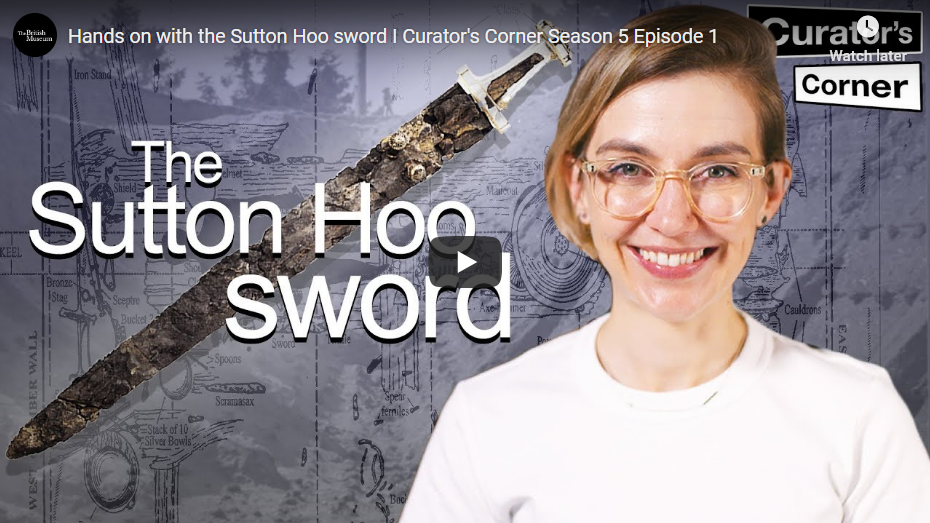
Hands on with the Sutton Hoo sword I Curator’s Corner Season 5 Episode 1
The British Museum
Published on 5 Aug 2019Sue Brunning and her trusty foam sword (newly dubbed Flexcalibur by commentator Pipe2DevNull) are back for another sword story. This time Sue takes us up close and personal with one of the most famous swords ever discovered.
Sue has also written a blog about Sutton Hoo available here: https://bit.ly/2yQkfYV (there are lots of other great articles there too!)
#CuratorsCorner #SwordswithSue #SuttonHooSue
August 12, 2019
Hogs in History – Creator and Destroyer – Extra History
Extra Credits
Published on 10 Aug 2019Download the World of Tanks game for free https://tanks.ly/2yj0usN and use the invite code
EXTRATANKS1to claim your $15 starter pack.In 1494, among the colonization forces from Spain, eight pigs arrived in Cuba. With multiple uses in culinary and craft trades, as well as their general top-tier hardiness, pigs would naturally propagate themselves throughout the Caribbean, and then to Central, South, and North America — but they were also incredibly destructive.
Visit TierZoo to learn about how OP pigs are: https://www.youtube.com/watch?v=6xbQ2…
Join us on Patreon! http://bit.ly/EHPatreon
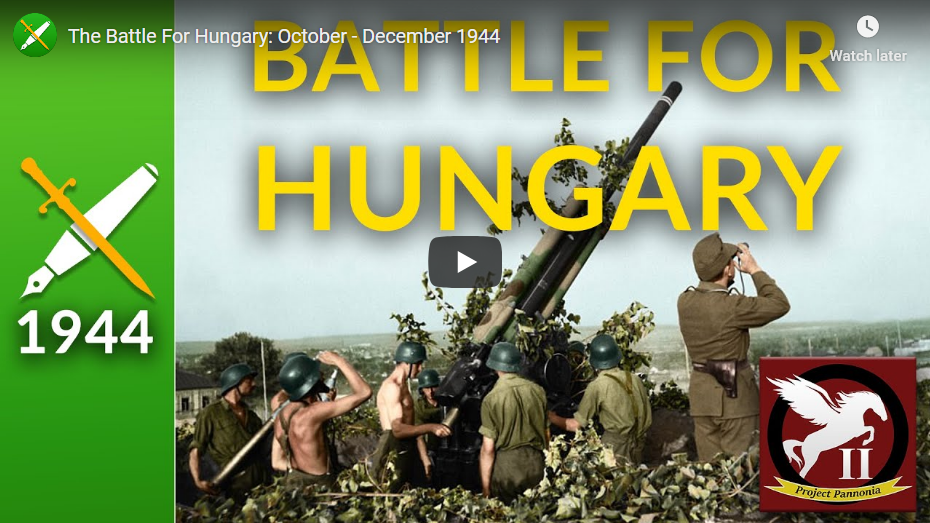
The Battle For Hungary: October – December 1944
Historigraph
Published on 10 Aug 2019Join me in War Thunder! Use my link for a FREE premium aircraft, tank or ship and a three day account boost as a BONUS: https://gjn.link/Historigraph/190810 Also available for free on PlayStation®4 and Xbox One.
If you enjoyed this video and want to see more made, consider supporting my efforts on Patreon: https://www.patreon.com/historigraph
To chat history, join my discord: https://discord.gg/vAFTK2D
I’m indebted to some viewers for helping me out with pronounciation of Hungarian words:
https://www.youtube.com/watch?v=FApWW…
https://www.youtube.com/watch?v=nCG_w…If you are Hungarian, please be charitable as I will still not have the word sounds 100% correct, as I am not a native speaker. I’m not about to put on a bad hungarian accent!
#WarThunder #BattleForHungary #HistorigraphSources:
The Siege of Budapest and the battles that led to it have had precious little written about them (in English!), so the bulk of this video (and the next) comes from one book:
Krisztián Ungváry, Battle for Budapest: 100 Days in World War 2
This is by far the most detailed account of the battle that I could find.
QotD: The “lost technological developments” of the Great Library
Hero does seem to have been another exception to the rule when it comes to philosophers tinkering with gadgets and it’s possible (though far from certain) that he worked in the Mouseion. But the practical applications of his study of pneumatics and dynamics were more toys and curiosities than any great leaps forward in technology. He famously made an aeolipile, though he didn’t actually invent it, given that it had already been described by the Roman engineer and architect Vitruvius, but this can only be called a “steam engine” in the loosest sense of the term. Hero’s little device was not capable of doing anything more than spinning in place and Roman technology lacked the high tensile metallurgy, the mathematics or the precision tooling that would be required to make a true steam engine. The other technological wonder that is often invoked here is the Antikythera mechanism. Exactly how this intricate mechanical orrery based on a geocentric model is supposed to indicate some nascent Industrial or Scientific Revolution is never made clear, but not only did it have no connection to the Great Library, it was a kind of instrument known since the third century BC. If it is evidence that the Greco-Roman world was on the brink of a technological revolution and was only stymied by the rise of Christianity, one has to wonder what kept them from achieving this wondrous thing for the 600 years between its invention and the conversion of Constantine.
The New Atheist mythic conception of the “Great Library of Alexandria” bears very little resemblance to any historical actuality. It was a shrine with scholars attached to it, not a secular university. Its scholars were far more concerned with poetry, textual analysis, grammar, lexicography and rhetoric than anything we would see as “science”. The proto-science they did do was mainly of a highly abstract and often metaphysical nature rather than anything like modern science. And it was also generally divorced from technical innovation and what little practical application it was given did not much at all to advance technology. The idea that if the Great Library had not been burned down by wicked Christians we’d all be living in gleaming space cities on Europa or Callisto is, therefore, a silly fantasy. And not least because the Great Library … wasn’t burned down by wicked Christians.
Tim O’Neill, “The Great Myths 5: The Destruction Of The Great Library Of Alexandria”, History for Atheists, 2017-07-02.
August 11, 2019
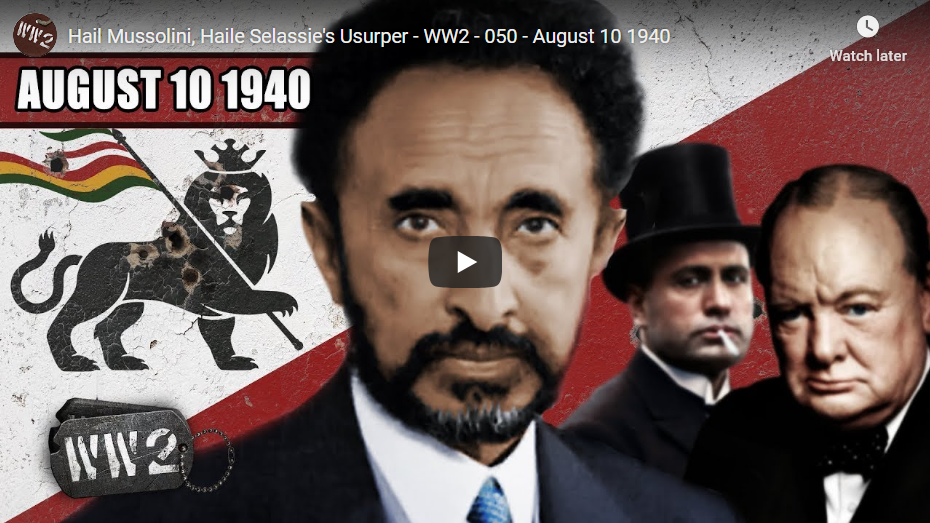
Hail Mussolini, Haile Selassie’s Usurper – WW2 – 050 – August 10 1940
World War Two
Published on 10 Aug 2019This week, the war spreads to Africa, when the Italians invade the British Colony of British Somaliland. While this might seem trivial, it might have tremendous consequences on the remainder of the war.
Join us on Patreon: https://www.patreon.com/TimeGhostHistory
Or join The TimeGhost Army directly at: https://timeghost.tvFollow WW2 day by day on Instagram @World_war_two_realtime https://www.instagram.com/world_war_t…
Join our Discord Server: https://discord.gg/D6D2aYN.
Between 2 Wars: https://www.youtube.com/playlist?list…
Source list: http://bit.ly/WW2sourcesWritten and Hosted by: Indy Neidell
Produced and Directed by: Spartacus Olsson and Astrid Deinhard
Executive Producers: Bodo Rittenauer, Astrid Deinhard, Indy Neidell, Spartacus Olsson
Creative Producer: Joram Appel
Post-Production Director: Wieke Kapteijns
Research by: Indy Neidell
Edited by: Iryna Dulka
Map animations: EastoryColorisations by Norman Stewart and Julius Jääskeläinen https://www.facebook.com/JJcolorization/
Eastory’s channel: https://www.youtube.com/channel/UCEly…
Archive by Screenocean/Reuters https://www.screenocean.com.Sources:
Freepngimg.com
IWM: CH 3484
Sound effect: littlerobotsoundfactoryA TimeGhost chronological documentary produced by OnLion Entertainment GmbH.
From the comments:
World War Two
2 days ago
Last week, we saw how one of our flagship episodes was taken down by YouTube. It turned out that this was a mistake by a YouTube worker who erroneously identified our content as hate speech. While we contacted YouTube immediately to protest, they themselves noticed the mistake before we reached the right people. They have since apologized to us and reinstated the episode. You can watch it here: https://youtu.be/DLN8NHXiMy0. We welcome YouTube’s diligence in fighting against extremist hateful content, especially in light of the current tragic events in the US, and we have accepted their apology. However, this does not change the fact that we still face demonetization of many of our videos, connected to lower recommendation of these videos. This is a problematic situation that we deplore – we continue to believe that the best way to fight ignorance and hatred is by education and that is at the heart of what we do here, unfortunately YouTube’s monetization policies continue to stand in the way of that mission.When the episode went down we saw a surge of support from many of you and we are humbly grateful for our dedicated community. The effort you all have made to share our content and support us on Patreon and timeghost.tv is what makes this show possible, and it’s an honor to have you all here. It is your support, both financially and in spirit that keeps us getting up in the morning to face yet another day of the war. Thank You!
Cheers,
The TimeGhost team
QotD: Deconstructing “Minoan Crete”
Perhaps the most prominent high priestess of the Great Goddess was Lithuanian archaeologist Marija Gimbutas (1921-1994). During the 1950s and 60s Gimbutas developed her so-called “Kurgan Thesis;” basically the idea that the archaeological marker of the arrival in Europe of Indo-European-speakers was to be found in the Bronze Age Kurgan mound burials of the Pontic Steppe, a vast region incorporating most of present-day Ukraine, southern Russia and northern Kazakhstan. Controversially, Gimbutas further claimed that these nomadic Indo-Europeans brought with them a warrior-culture dominated by male sky-gods, which supplanted earlier matriarchal and goddess-worshipping cultures. In this, she echoed ideas already expressed at great length by Robert Graves in his 1948 book The White Goddess. Over the next three decades Gimbutas developed her ideas further in a series of books, articles and lectures delivered at campuses throughout America and Europe, where she was immensely influential amongst the burgeoning women’s movement. Three major works, The Goddesses and Gods of Old Europe (1974), The Language of the Goddess (1989), and The Civilization of the Goddess (1991), presented an overview of her conclusions regarding what she saw as Europe’s primeval matriarchy.
The importance of Gimbutas in the development of the matriarchal myth, and also by extension in the development of modern radical feminism, cannot be overstated. Her archaeological experience and expertise, together with her wide knowledge of linguistics and anthropology, seemed to give academic credibility to the romantic and poetic ramblings of Arthur Evans and Robert Graves. Yet in retrospect it is hard to imagine why anyone with even a modicum of common sense could have been taken in.
There were warning signals everywhere. Right from the beginning, for example, many historians were critical of Evans’ interpretation of Minoan Crete, and a devastating blow was delivered in 1974 when German author Hans Georg Wunderlich published his Wohin der Stier Europa trug? (Where did the Bull carry Europa? published in English in 1975 as The Secret of Crete). Here Wunderlich, a trained geologist, examined the structure of the “palace” of Knossos in Crete in detail and came to the conclusion that the building could never have been a palace for the living. It was, instead, a charnel house, a massive necropolis which doubled as an arena for human sacrifice. For the happy-go-lucky “bull vaulting game”, said Wunderlich, was nothing of the sort: it was a ferocious form of human sacrifice which involved young men and women being gored and trampled to death by a sacred bull. This, said Wunderlich, was the origin of the legend of the Minotaur. Since Wunderlich’s time human sacrifice has been confirmed as an integral part of Cretan religious practice, whilst the supposed “pacifism” which Evans and others had imagined, was exposed as nonsensical.
Emmet Scott, “The Myth of the Primeval Matriarchy”, The Gates of Vienna, 2016-07-13.
August 10, 2019
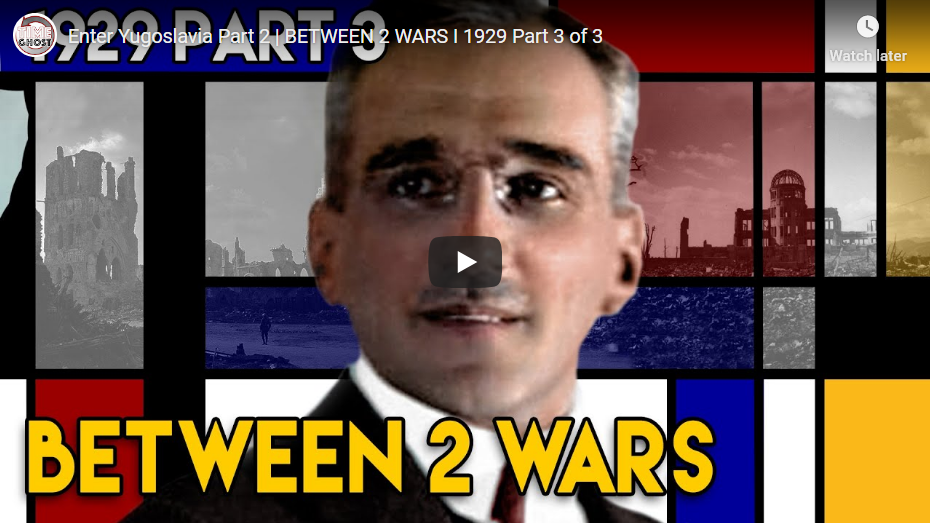
Enter Yugoslavia Part 2 | BETWEEN 2 WARS I 1929 Part 3 of 3
TimeGhost History
Published on 9 Aug 2019As 1929 approaches, the Kingdom of Serbs, Croats and Slovenes spirals closer and closer to collapse. When the parliament descends into murderous chaos, it is up to King Alexander to decide what to do…
Join us on Patreon: https://www.patreon.com/TimeGhostHistory
Hosted by: Indy Neidell
Written by: Francis van Berkel and Spartacus Olsson
Directed by: Spartacus Olsson and Astrid Deinhard
Executive Producers: Bodo Rittenauer, Astrid Deinhard, Indy Neidell, Spartacus Olsson
Creative Producer: Joram Appel
Post-Production Director: Wieke Kapteijns
Research by: Francis van Berkel
Edited by: Daniel Weiss
Sound design: Make KaminskiArchive by: Reuters/Screenocean http://www.screenocean.com
A TimeGhost chronological documentary produced by OnLion Entertainment GmbH.
From the comments:
TimeGhost History
1 hour ago
We don’t delete or ban any opinions which disagree with other opinions. We delete comments that contain historical fallacies and political propaganda by antidemocratic organisations, irrespective of political leaning. This means that we do not tolerate any lies or propaganda that forward the agenda of, for instance, Nazis, Fascists, Stalinists, Leninists, other ultra-Marxists or Anarchists. That is within our responsibility according to the laws in our territory which forbids the dissemination of false flag information, propaganda, and symbols connected to organizations that have been found to be unconstitutional and an immediate danger to a democratic, free society by the German courts, in accordance with §86 and §86a of the German Penal Code. The law specifically mentions NDSDAP in §86 and the KPD in §86a (NSDAP is the Nazi Party and KPD the Communist party). Moreover we do not tolerate hate speech, racism, xenophobia, and the denial of proven crimes against humanity. This is in perfect agreement with the opinion forwarded by The US Supreme Court on society’s responsibility to fight against that kind of speech and it is in agreement with numerous EU and EU member state laws against same said speech.
Trump as the American Commodus
In the New York Review of Books, Tom Holland explains that America isn’t Rome, even if the current President does rather remind him of the Emperor Commodus:
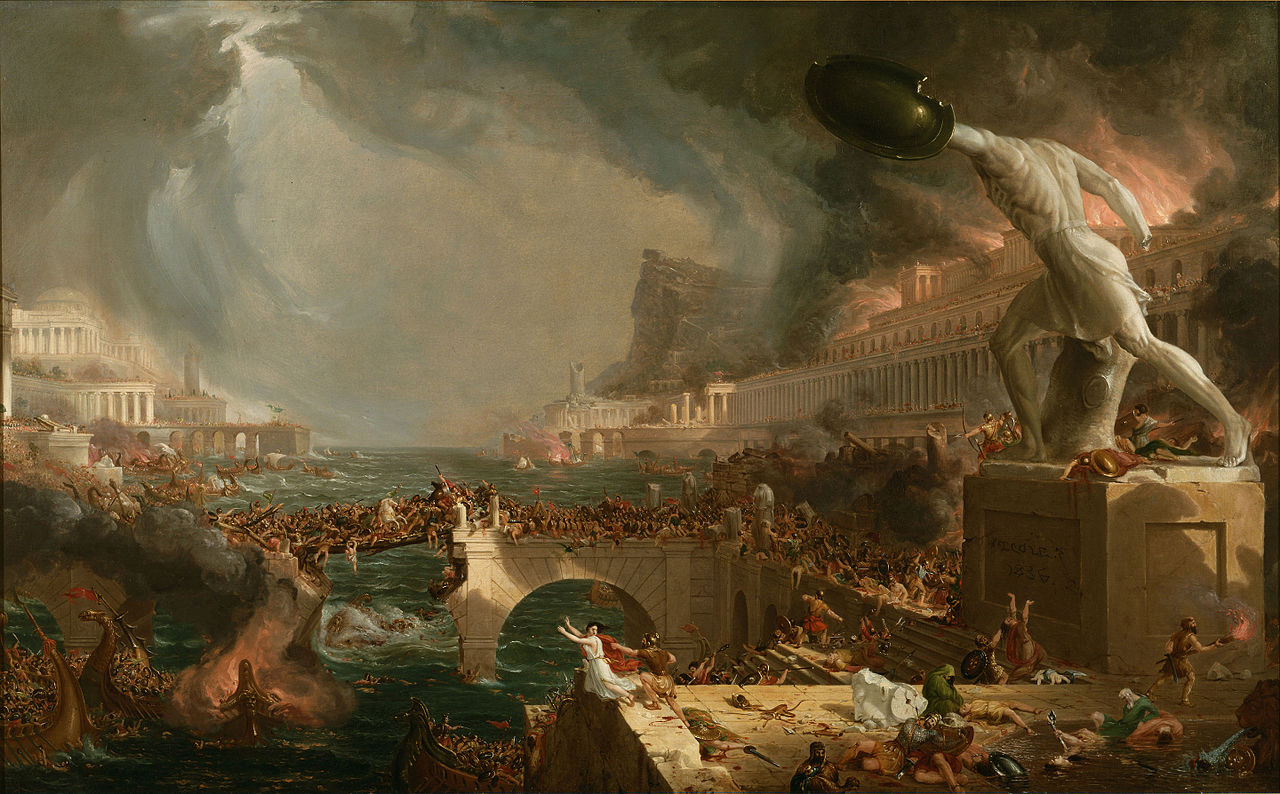
The Course of Empire – Destruction by Thomas Cole, 1836.
From the New York Historical Society collection via Wikimedia Commons.
When Edward Gibbon embarked on his great history of the decline and fall of the Roman Empire, he began his narrative with the accession of Commodus. Marcus Aurelius, the father of the new emperor, was a man who, in the noblest traditions of the Roman people, had combined the attributes of a warrior, a statesman, and a philosopher; Commodus was none of these.
“The influence of a polite age, and the labour of an attentive education,” Gibbon wrote sternly, “had never been able to infuse into his rude and brutish mind, the least tincture of learning; and he was the first of the Roman emperors totally devoid of taste for the pleasures of the understanding.” Instead, Commodus delighted in trampling on the standards by which the Roman political class had traditionally comported themselves. Most shockingly of all — as everyone who has seen Gladiator will remember — he appeared in the arena. His reward for this spectacular breach of etiquette was the cheers of the plebs and the pursed-lipped horror of the senatorial elite. To fight before the gaze of the stinking masses was regarded by all decent upholders of Roman morality as the most scandalous thing that a citizen could possibly do — but Commodus reveled in it. So it was, as Gibbon put it, that he “attained the summit of vice and infamy.”
Today, when conservatives contemplate a leader who, far from being merely an enthusiast for World Wrestling Entertainment, has long been an active and flamboyant participant in it, they may experience a similar shudder. Donald Trump, the only president of the United States ever to have been inducted into the WWE Hall of Fame, boasted that he had won “the highest ratings, the highest pay-per-view in the history of wrestling of any kind.” The Battle of the Billionaires — a proxy wrestling match fought in 2007 between Trump and Vince McMahon, the owner of WWE — had culminated in a victorious Trump strapping McMahon to a barber’s chair and shaving him bald. A decade later, Trump made clear just how much of an influence the theatrical violence of WWE had had on his approach to politics when he tweeted a video of himself body-slamming and repeatedly punching McMahon.
It was in a similar spirit, perhaps, that Commodus might have posed after decapitating an ostrich. Trump, smacking home his point, made sure before he tweeted the video to specify who his real target was. Clumsily superimposed over McMahon’s face was the CNN logo. “FraudNewsCNN” ran the hashtag. “The speed with which we’re recapitulating the decline and fall of Rome is impressive,” the conservative intellectual and former editor of the Weekly Standard Bill Kristol tweeted in response. “What took Rome centuries we’re achieving in months.”
The conviction that Trump is single-handedly tipping the United States into a crisis worthy of the Roman Empire at its most decadent has been a staple of jeremiads ever since his election, but fretting whether it is the fate of the United States in the twenty-first century to ape Rome by subsiding into terminal decay did not begin with his presidency. A year before Trump’s election, the distinguished Harvard political scientist Joseph Nye was already glancing nervously over his shoulder at the vanished empire of the Caesars: “Rome rotted from within when people lost confidence in their culture and institutions, elites battled for control, corruption increased and the economy failed to grow adequately.” Doom-laden prophecies such as these, of decline and fall, are the somber counterpoint to the optimism of the American Dream.
H/T to Niall Ferguson for this and the preceding Roman-related link.
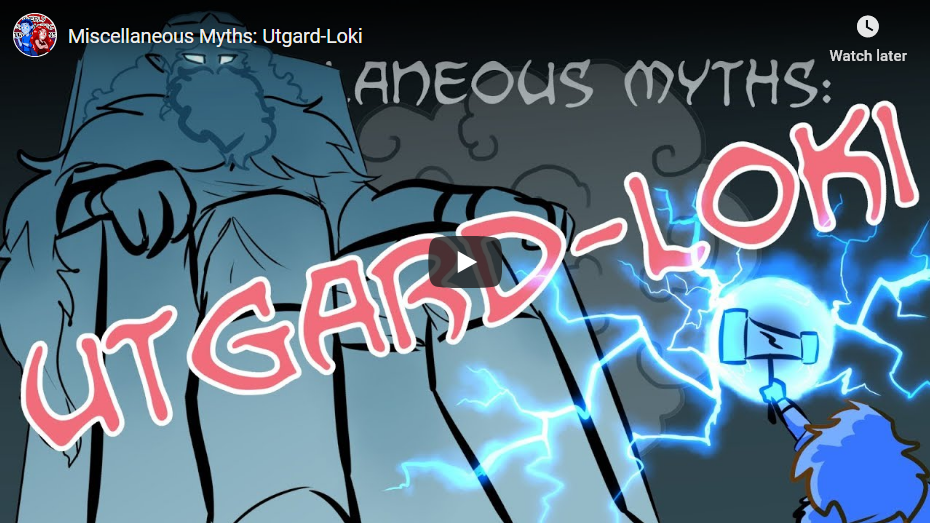
Miscellaneous Myths: Utgard-Loki
Overly Sarcastic Productions
Published on 9 Aug 2019BRAND NEW MYTH-RELEVANT MERCH: https://www.redbubble.com/people/ospy…
In today’s Norse Mythology news: A goat has a very bad day, Loki loses an eating competition and Thor fails to wrestle an old lady, more at 11.
PATREON: https://www.Patreon.com/OSP
OUR WEBSITE: https://www.OverlySarcasticProductions.com
Find us on Twitter https://www.Twitter.com/OSPYouTube
Find us on Reddit https://www.Reddit.com/r/OSP/
Sulla’s dictatorships
In New York magazine, Andrew Sullivan portrays the current state of the American Republic in light of the late history of the Roman Republic:
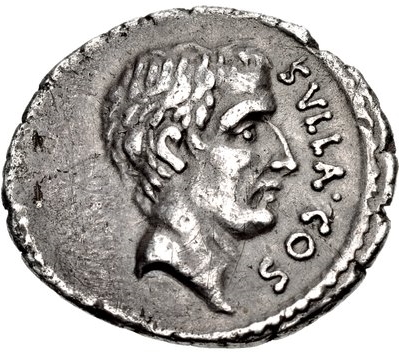
This 54 B.C. coin bears the portrait of the dictator Sulla. The moneyer was Q. Pompeius Rufus, the grandson of Sulla and his home would likely have had portraits of their famous ancestor. Thus, although posthumously struck, the portrait on these coins is probably an accurate representation.
Photo by CNG via Wikimedia Commons.
… zoom out a little more and one obvious and arguably apposite parallel exists: the Roman Republic, whose fate the Founding Fathers were extremely conscious of when they designed the U.S. Constitution. That tremendously successful republic began, like ours, by throwing off monarchy, and went on to last for the better part of 500 years. It practiced slavery as an integral and fast-growing part of its economy. It became embroiled in bitter and bloody civil wars, even as its territory kept expanding and its population took off. It won its own hot-and-cold war with its original nemesis, Carthage, bringing it into unexpected dominance over the entire Mediterranean as well as the whole Italian peninsula and Spain.
And the unprecedented wealth it acquired by essentially looting or taxing every city and territory it won and occupied soon created not just the first superpower but a superwealthy micro-elite — a one percent of its day — that used its money to control the political process and, over time, more to advance its own interests than the public good. As the republic grew and grew in size and population and wealth, these elites generated intense and increasing resentment and hatred from the lower orders, and two deeply hostile factions eventually emerged, largely on class lines, to be exploited by canny and charismatic opportunists. Well, you get the point.
After the overthrow of the monarchy, the new Republic went from strength to strength, struggling against and generally beating and absorbing other city states in the Italian peninsula, eventually rising to face the challenge of Carthage, the dominant power in the western Mediterranean. The eventual Roman victory over Carthage left Rome the superpower of its age, able to dominate and control even the remaining “great” powers of the eastern Mediterranean world. One of the costs of military dominance was an over-reliance on its citizen armies, which eventually changed the entire economy of the Republic, switching from largely small-holding farmers (who were subject to legionary service) to larger slave-worked farms that displaced the families of free citizens from their lands. The result was a constant inflow of impoverished rural citizens to the urban centres, especially Rome itself.
The newly enlarged urban poor found champions to push for reforms to aid them in their plight, the first of whom was Tiberius Gracchus (Extra Credits did a short video series on the Brothers Gracchi: Part I, Part II, Part III, Part IV, Part V, and an extra commentary video). The defeat and death of the Gracchi brothers by agents of the Patrician order led, as you might expect, to yet more polarization and further violent political struggle. This process was hastened by the conflict between Marius and his former protégé Sulla:
As the turn of the first century BCE approached and wars proliferated, with Roman control expanding west and east and south across the Mediterranean, the elites became ever wealthier and the cycle deepened. Precedents fell: A brilliant military leader, Marius, emerged from outside the elite as consul, and his war victories and populist appeal were potent enough for him to hold an unprecedented seven consulships in a row, earning him the title “the third founder of Rome.” Like the Gracchi, his personal brand grew even as republican norms of self-effacement and public service attenuated. In a telling portent of the celebrity politics ahead, for the first time, a Roman coin carried the portrait of a living politician and commander-in-chief: Marius and his son in a chariot.
A dashing military protégé (and rival) of Marius, Sulla, was the next logical step in weakening the system — a popular and highly successful commander whose personal hold on his soldiers appeared unbreakable. Tasked with bringing the lucrative East back under Rome’s control, he did so with gusto, prompting a somewhat nervous Senate to withdraw his command and give it to his aging (and jealous) mentor Marius. But Sulla, appalled by the snub, simply refused to follow his civilian orders, gathered his men, and called on them to march back to Rome to reverse the decision. His officers, shocked by the insubordination, deserted him. His troops didn’t, soon storming Rome, restoring Sulla’s highly profitable command, and forcing his enemies into exile. Sulla then presided over new elections of friendly consuls and went back into the field. But his absence from Rome — he needed to keep fighting to reward his men to keep them loyal — enabled a comeback of his enemies, including Marius, who retook the city in his absence and revoked Sulla’s revocations of command. Roman politics had suddenly become a deadly game of tit for tat.
When Sulla entered Rome a second time, he rounded up 6,000 of his enemies, slaughtered them en masse within earshot of the Senate itself, launched a reign of terror, and assumed the old emergency office of dictator, but with one critical difference: He removed the six-month expiration date — turning himself into an absolute ruler with no time limit. Stocking and massively expanding the Senate with his allies, he neutered the tribunes and reempowered the consuls. He was trying to use dictatorial power to reestablish the old order. And after three years, he retired, leaving what he thought was a republic restored.
Within a decade, though, the underlying patterns deepened, and nearly all of Sulla’s reforms collapsed. What lasted instead was his model of indefinite dictatorship, with the power to make or repeal any law. He had established a precedent that would soon swallow Rome whole.


