Quotulatiousness

December 10, 2019

In praise of Warren Gamaliel Harding

Filed under: History, Politics, USA — Tags: , , , , — Nicholas @ 03:00

At Essays in Idleness, David Warren says nice things about an American president who rarely gets any love from historians:
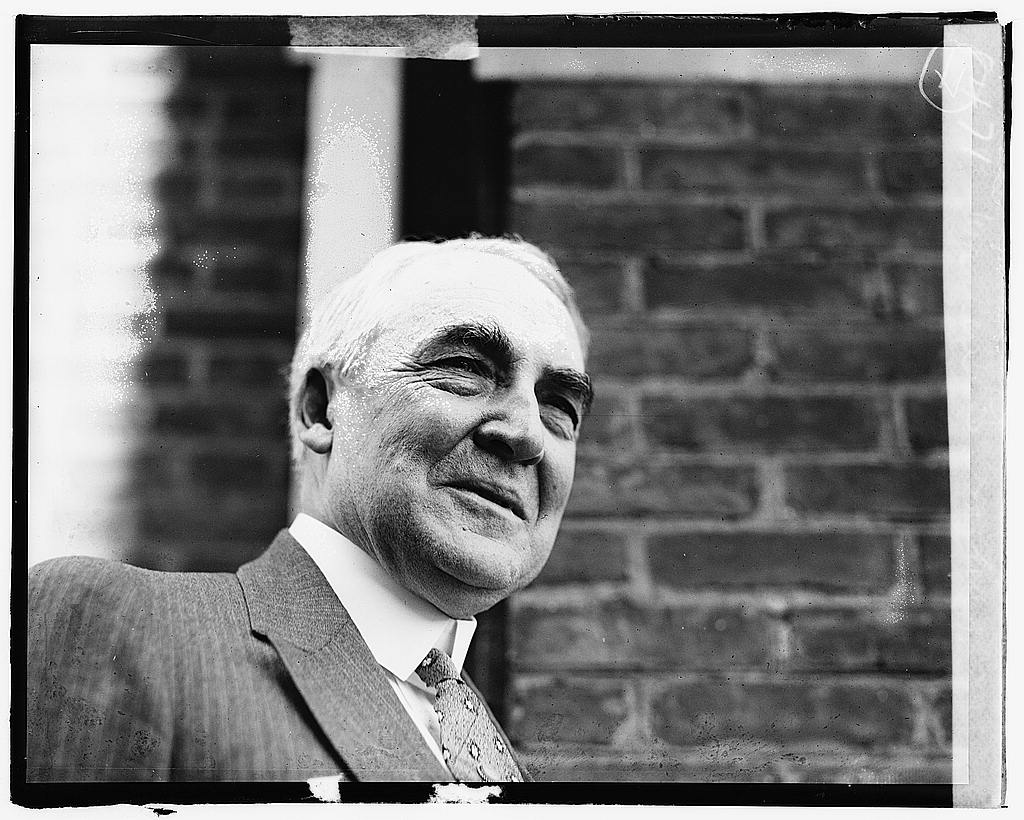
Warren G. Harding, 14 June 1920.
Library of Congress control number 2016828156

Like most politicians, W. G. Harding was only semi-literate, yet well above the average. The Ivy League types are still querying his use of “normalcy,” which the Natted States president used during his election campaign of 1920. Harding himself ranks low in the polls of “Great American Presidents,” though he was quite popular until his death. That mistake, committed after a heart attack in San Francisco, anno 1923, was the first of several. It was discovered that his administration had been rather corrupt, and himself guilty of an adultery. One might say he was “impeached,” posthumously. Today, they impeach Republican presidents for breathing.

Warren Gamaliel Harding is naturally among my favourite presidents. This has something to do with his “return to normalcy.” For the better part of a decade, his countrymen had suffered under the ministrations of progressive Democrats, such as the unspeakable Woodrow Wilson, and from such foreign entanglements as the First World War. The federal budget was being blown to heck, and society was on the verge of the Jazz Age.

Harding, who stayed home in Marion, Ohio, for most of his presidential campaign — rather than “pressing the flesh” and risking the influenza — won by a landslide, promising: “Not heroics, but healing; … not revolution, but restoration; not agitation, but adjustment; not surgery, but serenity; not the dramatic, but the dispassionate; not experiment, but equipoise; not submergence in internationality, but sustainment in triumphant nationality.”

Oh yes and, “not nostrums, but normalcy.”

The quote, which I have filched from the Wicked Paedia, is semi-literate throughout. Harding was a man who had an unhealthy relationship with a dictionary, and to his other sins, we must add an addiction to semi-colons. Still, “The Peeple” could guess what he meant. He wanted America to move backwards. He thought the whole country should forget about recent lunatic adventures, and return to her wonted calm.

Al Stewart wrote a song called “Warren Harding” (lyrics here):

Before the Lewis Gun was the McClean Automatic Rifle

Filed under: History, Military, USA, Weapons — Tags: , , , , , — Nicholas @ 02:00

Forgotten Weapons
Published 18 Oct 2019

This is Lot 1158 in the upcoming October Morphy Extraordinary auction.

Samuel McClean was a medical doctor from Iowa who began tinkering with firearms designs in 1889, and formed the McClean Arms Company in 1896. He was an intelligent and talented designer, but never quite managed to get a gun good enough for military acceptance. His work included bolt actions rifles, self-loading shoulder rifles, machine guns, and self-loading cannons. By 1910 his company had gone bankrupt twice, and he was forced out by his investors. Isaac Newton Lewis was brought in, and turned McClean’s initial concepts into the ultimately-successful Lewis Machine gun.

However, McClean made one least attempt to produce his own gun after World War One. This is the McClean Automatic Rifle, and it was tested by the US Navy in 1919 – and rejected. This pattern uses an operating system similar to McClean’s early work, and thus also quite similar to the Lewis gun. Instead of two large locking lugs, however, it has several dozen small lugs in two rows on each side of the bolt. The gas piston is also huge by modern standards; over an inch in diameter. The gun is unfortunately missing its magazine Still, it is the only example of the type known to exist, and probably the only one ever manufactured.

http://www.patreon.com/ForgottenWeapons

Cool Forgotten Weapons merch! http://shop.bbtv.com/collections/forg…

Contact:
Forgotten Weapons
6281 N. Oracle #36270
Tucson, AZ 85704

QotD: British breakfast – “Not a snack but a serious meal”

Filed under: Britain, Food, History, Quotations, WW2 — Tags: , , , , — Nicholas @ 01:00

First of all, then, breakfast. Ideally for nearly all British people, and in practice for most of them even now, this is not a snack but a serious meal. The hour at which people have their breakfast is of course governed by the time at which they go to work, but if they were free to choose, most people would like to have breakfast at nine o’clock. In principle the meal consists of three courses, one of which is a meat course. Traditionally it starts with porridge, which is made of coarse oatmeal, sodden and then boiled into a spongy mess: it is eaten always hot, with cold milk (better still, cream) poured over it, and sugar. Breakfast cereals, which are ready-cooked preparations of wheat or rice, taken cold with milk and sugar, are often eaten instead of porridge. After this comes either fish, usually salt fish, or meat in some form, or eggs in some form. The best and most characteristically British form of salt fish is the kipper, which is a herring split open and cured in wood-smoke until it is deep brown colour. Kippers are either grilled or fried. The usual breakfast meat dishes are either fried bacon, with or without fried eggs, grilled kidneys, fried pork sausages, or cold ham. British people favour a lean, mild type of bacon or ham, cured with sugar and nitre rather than with salt. At normal time it is not unusual to eat grilled beef steaks or mutton chops at breakfast, and there are still old-fashioned people who like to start the day with cold roast beef. In some parts of the country, for instance in East Anglia, it is usual to eat cheese at breakfast.

After the meat course comes bread, or more often toast, with butter and orange marmalade. It must be orange marmalade, though honey is a possible substitute. Other kinds of jam are seldom eaten at breakfast, and marmalade does not often appear at other times of [the] day. For the great bulk of British people, the invariable breakfast drink is tea. Coffee in Britain is almost always nasty, either in restaurants or in private houses; the majority of people, though they drink it fairly freely, are uninterested in it and do not know good coffee from bad. Of tea, on the other hand, they are extremely critical, and everyone has his favourite brand and his pet theory as to how it should be made. Tea is always drunk with milk, and it is usual to brew it very strong, about one spoonful of dry tea leaves being allowed for each cup. Most people prefer Indian to Chinese tea, and they like to put sugar in it. Here, however, one comes upon a class distinction, or more exactly a cultural distinction. Virtually all British working-people put sugar in their tea, and indeed will not drink tea without it. Unsweetened tea is an upper-class or middle-class habit, and even in those classes it tends to be associated with a Europeanised palate. If one made a list of the people in Britain who prefer wine to beer, one would probably find that it included most of the people who prefer tea without sugar.

After this solid breakfast – and even now, in a time of rationing, it is usual to eat a fairly large bulk of food, chiefly bread, at breakfast – it is natural that the midday meal should be somewhat lighter than it is in many other countries.

George Orwell, “British Cookery”, 1946. (Originally commissioned by the British Council, but refused by them and later published in abbreviated form.)

December 9, 2019

All the Guns on an M4 Sherman Tank (with Nicholas Moran, the Chieftain)

Filed under: History, Military, USA, Weapons, WW2 — Tags: , , , , , — Nicholas @ 06:00

Forgotten Weapons
Published 7 Dec 2019

Try out World of Tanks with a special bonus tank using this link!

https://tanks.ly/ForgottenWeapons

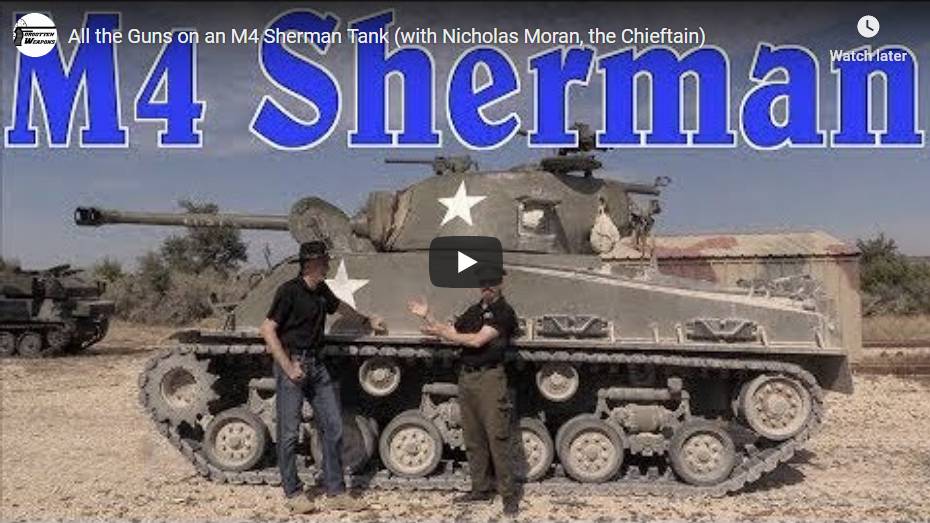
Today Nicholas Moran (the Chieftain) and I are at DriveTanks.com courtesy of Wargaming.net, to show you around a World War Two Sherman tank and all its various armaments. We will discuss and shoot the bow machine gun, coaxial machine gun, commander’s hatch machine gun, antiaircraft .50 cal M2 machine gun, 76mm high velocity main gun, and the crew’s small arms, an M3 Grease Gun and a 1911 pistol.

If you enjoy this video, check out World of Tanks – and maybe they will send Nicholas and I back again to do the same thing for a different tank!

http://www.patreon.com/ForgottenWeapons

Cool Forgotten Weapons merch! http://shop.bbtv.com/collections/forg…

Contact:
Forgotten Weapons
6281 N. Oracle #36270
Tucson, AZ 85704

Policing London – The Fall of Jonathan Wild – Extra History – #2

Filed under: Britain, History, Law — Tags: , , , — Nicholas @ 04:00

Extra Credits
Published 7 Dec 2019

Jonathan Wild had the whole crime system figured out. A man of justice by day, and leader of a criminal empire by night. But that is when Jack Sheppard came into his life. Jack Sheppard was a talented thief but an even more talented escape artist. And one of the last criminals in London who refused to bend the knee to Jonathan Wild. This was unacceptable. Jonathan Wild became obsessed. But obsessions can be dangerous. Every prison escape causes Sheppard’s popularity amongst the people, sick and tired of corruption, to grow. And the consequences may be deadly.

Join us on Patreon! http://bit.ly/EHPatreon

December 8, 2019

The Road to Moscow – German Invasion Plans – WW2 – 067 – December 7, 1940

Filed under: Europe, Germany, Greece, History, Italy, Military, Russia, WW2 — Tags: , , , , , — Nicholas @ 06:00

World War Two
Published 7 Dec 2019

Wilhelm Canaris once again disturbs Hitlers plans to drag Spain into the war, as the Germans finalize their plan for the Invasion of the Soviet Union which is scheduled for the summer of 1941. Meanwhile, the Greek counter-offensive into Albania loses steam and the Pope objects to the German T-4 euthanasia program.

Join us on Patreon: https://www.patreon.com/TimeGhostHistory
Or join The TimeGhost Army directly at: https://timeghost.tv

Follow WW2 day by day on Instagram @World_war_two_realtime https://www.instagram.com/world_war_t…
Join our Discord Server: https://discord.gg/D6D2aYN.
Source list: http://bit.ly/WW2sources

Written and Hosted by: Indy Neidell
Produced and Directed by: Spartacus Olsson and Astrid Deinhard
Executive Producers: Bodo Rittenauer, Astrid Deinhard, Indy Neidell, Spartacus Olsson
Creative Producer: Joram Appel
Post-Production Director: Wieke Kapteijns
Research by: Indy Neidell
Edited by: Mikołaj Cackowski
Map animations: Eastory (https://www.youtube.com/c/eastory)

Colorizations by:
– Cassowary Colorizations
– Julius Jääskeläinen – https://www.facebook.com/JJcolorization/

Sources:
Narodowe Archiwum Cyfrowe
USHMM, photograph number 60468
IWM (HU 76031)

Archive by Screenocean/Reuters https://www.screenocean.com.

A TimeGhost chronological documentary produced by OnLion Entertainment GmbH.

From the comments:

World War Two
2 days ago (edited)
YouTube has age-restricted our Blitz Spirit WW2 video and had REMOVED our Between Two Wars episode on the Holodomor (1932-02). We received a warning, which means that next time this happens we will be banned from publishing content for one week. They state that our “content was removed due to a violation of our Community Guidelines,” on account of publishing “violent of graphic content”, explaining that “Violent or gory content intended to shock or disgust viewers, or content encouraging others to commit violent acts, is not allowed on YouTube.”

EDIT: After pushing our appeal, YouTube has reinstated the episode and it’s back up. The Blitz video is still age-restricted.

Needless to say, we were shocked and disgusted by this action and legitimisation. Though it’s back up [here], this still shows how much our independence depends on our Patreon supporters. Without them, we would have been long gone. So please consider supporting our effort and help us spread vital knowledge about our world’s history, albeit hard to swallow or confronting. Don’t let YouTube decide what will be a part of our public memory! You can support us on https://patreon.com/timeghosthistory or https://timeghost.tv.
Cheers,
Joram

History Summarized: Florence

Overly Sarcastic Productions
Published 6 Dec 2019

Get 3 months of Audible for just $6.95 a month. That’s more than half off the regular price. Visit http://www.audible.com/overlysarcastic or text overlysarcastic to 500 500.

Can’t start a Renaissance without building a few *Domes* — You’ve seen the memes, now learn the history behind the magnificent city of Florence!

It may sound like sacrilege, but many years ago, Florence was the first Italian city that little Blue had a cartoonishly-overblown obsession for — move over, Venice. In fact, Florentine history is basically THE reason I ever started caring about History in the first place. So I hope that you find this exquisite chapter in world history as enjoyable as I do.

SOURCES & Further Reading:
Death in Florence — Paul Strathern https://www.audible.com/pd/Death-in-F…
Florence: The Biography of A City — Christopher Hibbert
Be Like The Fox: Machiavelli In His World — Erica Benner

Our content is intended for teenage audiences and up.

DISCORD: https://discord.gg/sS5K4R3

PATREON: https://www.Patreon.com/OSP

MERCH LINKS: https://www.redbubble.com/people/OSPY…

OUR WEBSITE: https://www.OverlySarcasticProductions.com
Find us on Twitter https://www.Twitter.com/OSPYouTube
Find us on Reddit https://www.Reddit.com/r/OSP/

Sturmgeschütz (StuG) – German Assault Artillery – History & Organization #StugLife

Filed under: Germany, History, Military, Weapons, WW2 — Tags: , — Nicholas @ 02:00

Military History Visualized
Published 15 Jul 2016

» HOW YOU CAN SUPPORT MILITARY HISTORY VISUALIZED «
(A) You can support my channel on Patreon: https://www.patreon.com/mhv

(B) You can also buy “Spoils of War” (merchandise) in the online shop: https://www.redbubble.com/people/mhvi…

(C) If you want to buy books that I use or recommend, here is the link to the Amazon Store: http://astore.amazon.com/ytmh-20 which has the same price for you and gives a small commission to me, thus it is a win/win.

Short video about the famous German “StuGs” (Sturmgeschütze) Assault guns. The initial concept, organization and development from infantry support to mainly the tank destroyer role.

Script & Further Information: http://militaryhistoryvisualized.com/…

—Sources—
Wettsein, Adrian: “Sturmartillerie Geschichte einer Waffengattung”
http://portal-militaergeschichte.de/s…

Spielgerger, Walter: Sturmgeschutz & Its Variants
Amazon.com (affiliate link): http://amzn.to/29FLo3S

Spielberger, Walter: Sturmgeschütze. Entwicklung und Fertigung der sPak
Amazon.de (affiliate link): http://amzn.to/29FTHeF

Fleischer, Wolfgang: Die deutschen Sturmgeschütze 1935-1945.
Amazon.de (affiliate link): http://amzn.to/2a0ctCa

Buchner, Alex: The German Infantry Handbook 1939-1945
amazon.com (affiliate): http://amzn.to/1l4ABU0

Buchner, Alex: Das Handbuch der deutschen Infanterie 1939-1945; Gliederung – Uniformen, Bewaffnung – Ausrüstung, Einsätze
amazon.de (affiliate): http://www.amazon.de/gp/product/38955…

-Disclaimer-
Amazon Associates Program: “Bernhard Kast is a participant in the Amazon Services LLC Associates Program, an affiliate advertising program designed to provide a means for sites to earn advertising fees by advertising and linking to amazon.com.”
Amazon Partner (amazon.de): “Bernhard Kast ist Teilnehmer des Partnerprogramms von Amazon Europe S.à r.l. und Partner des Werbeprogramms, das zur Bereitstellung eines Mediums für Websites konzipiert wurde, mittels dessen durch die Platzierung von Werbeanzeigen und Links zu Amazon.de Werbekostenerstattung verdient werden kann.

—Credits & Special Thanks—
The Counter-Design is heavily inspired by Black ICE Mod for the game Hearts of Iron 3 by Paradox Interactive
https://forum.paradoxplaza.com/forum/…

—Song—-
Ethan Meixsell – “Demilitarized Zone” (the Irony :D)

December 7, 2019

History of Space Travel – One Small Step – Extra History – #5

Filed under: History, Russia, Space, Technology, USA — Tags: , , , , , , — Nicholas @ 06:00

Extra Credits
Published 5 Dec 2019

Start your Warframe journey now and prepare to face your personal nemesis, the Kuva Lich — an enemy that only grows stronger with every defeat. Take down this deadly foe, then get ready to take flight in Empyrean! Coming soon! http://bit.ly/EHWarframe

The United States was losing the space race. A number of unfortunate missteps and mistakes had hindered their progress. But the United States had also structured its space program entirely differently from the USSR. Instead of being helmed by the military, the National Aeronautics & Space Administration was created by Eisenhower with an emphasis on exploration and research. And in the end, the later but more advanced satellites will collect the data required a dream firmly placed in the American consciousness by JFK. A dream to place a man on the moon.

From the comments:

Extra Credits
19 hours ago
The plaque still gives me goosebumps in the best way possible. Hopefully one day we can live up to its promise of peace. Be good to one another. ❤️

And thanks to Rebecca Ford (the voice of Lotus) for voicing space mom at the end of each of these episodes. They’ve been a blast to make and we hope that you all have enjoyed this trip to the stars.

Pearl Harbor – The Japanese Attack

Filed under: History, Japan, Military, Pacific, USA, WW2 — Tags: , , , — Nicholas @ 04:00

Military History Visualized
Published 29 Nov 2016

» HOW YOU CAN SUPPORT MILITARY HISTORY VISUALIZED «
(A) You can support my channel on Patreon: https://www.patreon.com/mhv

(B) Alternatively, you can also buy “Spoils of War” (merchandise) in my online shop: https://www.redbubble.com/people/mhvi…

(C) If you want to buy books that I use or recommend, here is the link to the Amazon Store: http://astore.amazon.com/ytmh-20 which has the same price for you and gives a small commission to me, thus it is a win/win.

» SOURCES & LINKS «

Kuehn, John T.: “The war in the Pacific, 1941-1945”; in: Cambridge History of the Second World War, Volume 1
Amazon.com (affiliate): http://amzn.to/2g82o9a

Dull, Paul S.: The Battle History of the Imperial Japanese Navy.
Amazon.com (affiliate): http://amzn.to/2gPBxhJ

Germany & The Second World War – Volume VI
Amazon.com (affiliate): http://amzn.to/2g85hqt

Das Deutsche Reich und der Zweite Weltkrieg, Band 6.
Amazon.de (affiliate) http://amzn.to/2gc49Ra

Zimm, Alan D. The Pearl Harbor Myth
http://www.historynet.com/pearl-harbor

Zimm, Alan D. Attack on Pearl Harbor: Strategy, Combat, Myths, Deceptions.
Amazon.com (affiliate): http://amzn.to/2gc0LWk

» ADDITIONAL LINKS «
Maps
http://pacificwarbirds.com/pearl-harb…

https://spotlights.fold3.com/2011/12/…

Verifying the Submarine loss
https://www.history.navy.mil/research…

http://www.combinedfleet.com/I-70.htm

Bonus Link (not used): Original Damage Reports
https://archive.org/download/WorldWar…

» CREDITS & SPECIAL THX «
Song: Ethan Meixsell – “Demilitarized Zone”

» DISCLAIMER «
Amazon Associates Program: “Bernhard Kast is a participant in the Amazon Services LLC Associates Program, an affiliate advertising program designed to provide a means for sites to earn advertising fees by advertising and linking to amazon.com.”

Bernhard Kast ist Teilnehmer des Partnerprogramms von Amazon Europe S.à.r.l. und Partner des Werbeprogramms, das zur Bereitstellung eines Mediums für Websites konzipiert wurde, mittels dessen durch die Platzierung von Werbeanzeigen und Links zu amazon.de Werbekostenerstattung verdient werden können.

Bryan Donkin, 19th century inventor, amateur public relations whiz and independent lobbyist

Filed under: Britain, Government, History, Technology — Tags: , , , , , — Nicholas @ 03:00

In the latest installment of Anton Howes’ Age of Invention newsletter, he recounts the story of Bryan Donkin and his efforts to save innovators from excessive government interference:

One of the major arguments of the book I’m writing is that inventors’ talent for public relations and lobbying was one of the main reasons that Britain — rather unexpectedly — was the place that experienced an unprecedented acceleration of innovation.

The greatest of these lobbyist-inventors has to be Bryan Donkin, a nineteenth-century mechanical engineer. As an inventor, Donkin improved threshing machines, dredging machinery, and a variety of other tools. He invented the steel pen, dabbled in chemistry, as well as phrenology, and was one of the key people responsible for mechanising the production of paper. He became best known for improving and commercialising tin cans for food. Mechanised paper-making and canned food, having both been invented in France, were perfected in Britain by Donkin. He was the archetypal tinkerer.

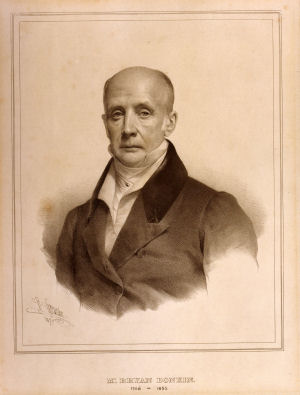
Bryan Donkin (1768-1855).
Photographer unknown via Wikimedia Commons.

But it’s as a lobbyist that I think Donkin was truly exceptional. His experience has important lessons for all would-be supporters of invention today.

In April 1817, Donkin read in his newspaper that there had been a disaster in Norwich: the boiler aboard the steamboat Telegraph had exploded. Of the boat’s twenty-two passengers, eight had died immediately in the blast, and another six had eventually succumbed to their wounds. It was a shocking tragedy. And for Donkin, doubly so: in addition to the human death toll, the explosion threatened to kill off one of the era’s newest and most exciting inventions.

Although some of the first trials of steamboats had taken place in the 1780s, it wasn’t until the turn of the century that they began to be practical. By 1817, the first commercially successful steamboat service in Britain, Henry Bell’s Comet, had been chugging its way up the River Clyde between Glasgow and Greenock for only five years. And Londoners like Donkin had only just seen their first steamboat, Margery, when she puffed her way into the Thames in 1815 (the following year, after becoming the first steamboat to cross the Channel, she reinvented herself in Paris as Elise). Thus, by the time of Telegraph‘s explosion, the passenger steamboat had only just been born. There was a very real risk that it would be banned.

Fortunately, however, the steamboat had Donkin in its corner. His immediate reaction upon reading about the explosion was to gather some of his engineer friends — Timothy Bramah and John Collinge — and set off for Norwich to view the explosion site for themselves. As the first expert engineers on the scene, they then took control of the narrative about the explosion. Donkin and his friends went straight to Norwich’s MP to ask him to set up a parliamentary select committee to look into the disaster. And while they waited for the politicians to be assembled for the committee, they held a series of public meetings about the disaster at the Crown & Anchor Tavern — a favourite haunt of London’s engineers. There, they had a chance to rally the rest of the profession and get their story straight about what must have caused the explosion.

Biggest Revolver Yet? A 10-Gauge Colt 1855…

Filed under: History, USA, Weapons — Tags: , , — Nicholas @ 02:00

Forgotten Weapons
Published 17 Oct 2019

http://www.patreon.com/ForgottenWeapons

Cool Forgotten Weapons merch! http://shop.bbtv.com/collections/forg…

This ludicrously huge handgun is actually a 10-gauge Colt 1855 Revolving Shotgun with a cut-down barrel and a newly made grip frame. The backstop and trigger guard of the shotgun were handily reshaped into a grip frame, and the finished product actually looks nicely proportional — until you try to actually pick it up, of course. The grip is filled with brass inlay, about a third of which are missing (possibly from the recoil of actually firing?). Despite the rather poor finish condition, the gun cycles smoothly, and appears to be fully functional. Just the thing for someone who wants to make the Colt Walker look puny!

Contact:
Forgotten Weapons
6281 N. Oracle #36270
Tucson, AZ 85704

December 6, 2019

The End of Polish Democracy – Pilsudski and the Sanacja Regime | BETWEEN 2 WARS | 1935 Part 2 of 4

Filed under: Europe, Germany, History — Tags: , , , , , — Nicholas @ 06:00

TimeGhost History
Published 5 Dec 2019

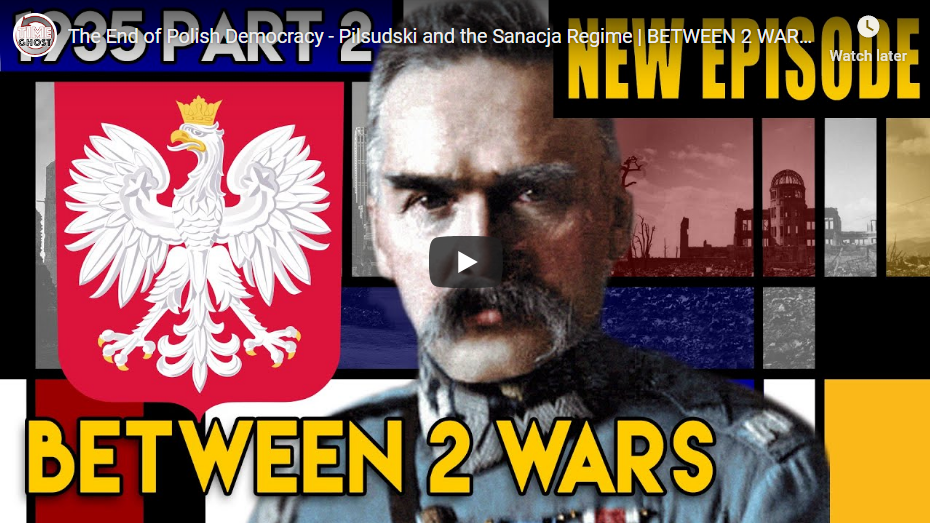
The Second Polish Republic emerged victorious from the Polish-Soviet War in 1921. But the shine of independence is quickly rubbing off as the new state finds itself burdened with sever economic, political, and social problems. There is one man who sees it as his destiny to save his ailing nation. That man is Józef Piłsudski. But will his undemocratic Sanacja regime be able to solve Poland’s problems?

Join us on Patreon: https://www.patreon.com/TimeGhostHistory

Hosted by: Indy Neidell
Written by: Francis van Berkel
Directed by: Spartacus Olsson and Astrid Deinhard
Executive Producers: Bodo Rittenauer, Astrid Deinhard, Indy Neidell, Spartacus Olsson
Creative Producer: Joram Appel
Post-Production Director: Wieke Kapteijns
Research by: Francis van Berkel
Edited by: Daniel Weiss
Sound design: Marek Kaminski

Colorization:
– Julius Jääskeläinen – https://www.facebook.com/JJcolorization/

Sources:

A TimeGhost chronological documentary produced by OnLion Entertainment GmbH.

From the comments:

TimeGhost History
2 hours ago (edited)
YouTube has age-restricted our Blitz Spirit WW2 video and has REMOVED our Between Two Wars episode on the Holodomor (1932-02). We received a warning, which means that next time this happens we will be banned from publishing content for one week. They state that our “content was removed due to a violation of our Community Guidelines,” on account of publishing “violent of graphic content”, explaining that “Violent or gory content intended to shock or disgust viewers, or content encouraging others to commit violent acts, is not allowed on YouTube.”

Needless to say, we are shocked and disgusted by this action and legitimisation and are currently exploring our options. Meanwhile, this shows how much our independence depends on our Patreon supporters. Without them, we would have been long gone. So please consider supporting our effort and help us spread vital knowledge about our world’s history, albeit hard to swallow or confronting. Don’t let YouTube decide what will be a part of our public memory! You can support us on https://patreon.com/timeghosthistory or https://timeghost.tv.
Cheers,
Joram

Mikhail Gorbachev and the “third generation”

Filed under: Government, History, Russia — Tags: , , , , , — Nicholas @ 05:00

At Rotten Chestnuts, Severian explains why Mikhail Gorbachev’s perestroika was doomed to fail:

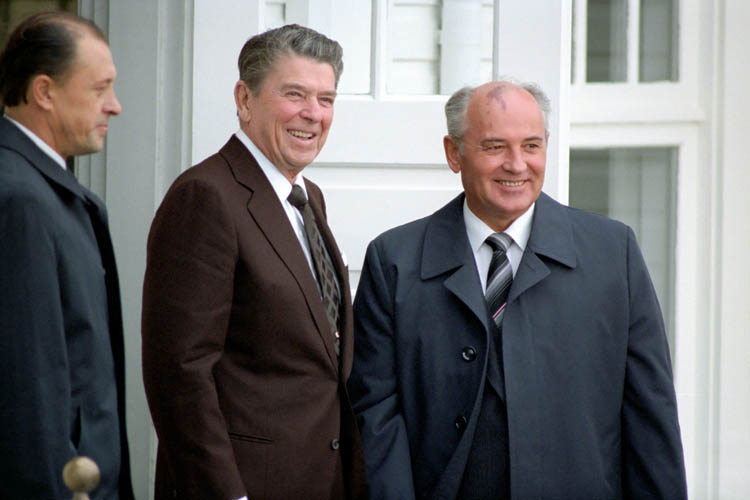
US President Ronald Reagan and Soviet General Secretary Mikhail Gorbachev at the Hofdi House in Reykjavik, Iceland during the Reyjavik Summit in 1986.
Official US government photograph via Wikimedia Commons.

Perestroika‘s what happens when you turn the reins over to the third generation — the generation that didn’t come up hard, and thus wasn’t forced to deal with objective reality. For all his faults, and for all the debate over whether Stalin was “really” a Communist (hint: he was), the Boss knew what it takes to hold onto power in a one-party state. He learned his craft in the hardest school — maneuvering against Lenin and Trotsky, two of the coldest, most ruthless sons-of-bitches ever to draw breath. His successor, Nikita Khrushchev, survived both the Great Purge and the Great Patriotic War for the Motherland — an achievement, as you can imagine, that pretty much no one else of consequence could boast.

Mikhail Gorbachev, by contrast, was born in 1931. His childhood was affected by the war — as was every Russian child’s — but his grandfather was a kolkhoznik from way back; Mikhail was wired in to the Party from birth. Stalin died in 1953. Gorbachev was 22 — in an earlier generation he could’ve been a serious player at that age, but the postwar generation didn’t start rising until their 30s, or more usually their 40s. He was still at university when the Boss kicked the bucket; he didn’t start his official political career until 1955, and wasn’t recognized as a bona-fide comer until the late 1960s.

What this meant was that Gorbachev grew up in the kinder, gentler Soviet Union — the one where Khrushchev released a whole bunch of folks from the Gulag and denounced cults of personality. This is not to say that Gorbachev wasn’t a sincere Communist; he was. In fact, that was his problem — he was too sincere. The earlier generations faced the stark choice between hewing to orthodox Marxism, or hanging on to power. They chose the latter, of course, and that’s why Trotsky had to go — he kept on claiming to be the only true Marxist of the bunch (which he was, of course, but that’s a story for another day). Gorbachev, though, got to see Communism “working,” and from this he deduced — not unreasonably for someone who didn’t come up hard — that Communism’s manifest failures were due to not following Marx and Lenin more exactly. Marx and Lenin talked a great game about “openness” (glasnost), “democracy,” and all that “improving the lot of the People” jazz.

So he did all that, the fool, not realizing that Communism “worked,” such as it did, only through repression. Take your foot off The People’s neck enough to let them breathe, by all means — that was Comrade Khrushchev’s great insight — but if you ease off any further, they’ll try to wriggle out … and eventually kill you, their tormentor. Having never seen The People at close range — as everyone in the previous generations had — he couldn’t understand this, and so crashed the system.

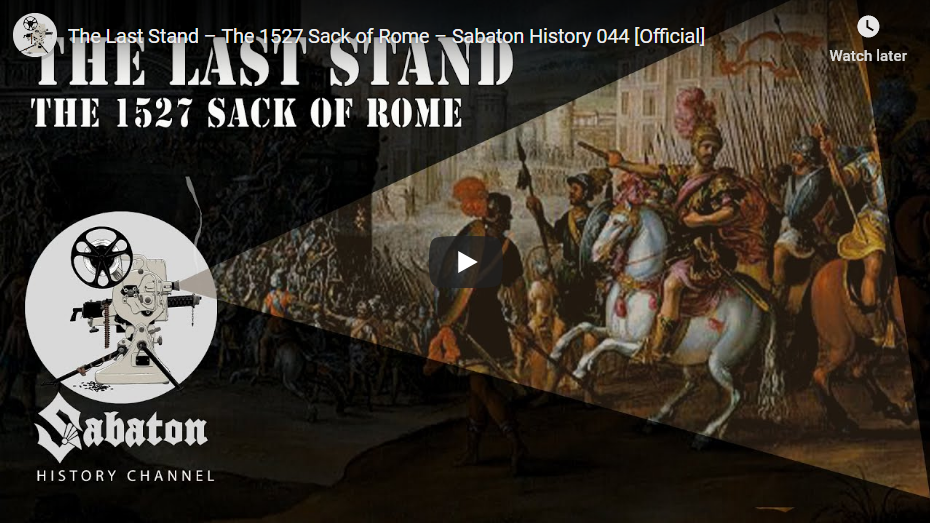
“The Last Stand” – The 1527 Sack of Rome – Sabaton History 044 [Official]

Filed under: Europe, History, Media, Military, Religion — Tags: , , , , , , — Nicholas @ 04:00

Sabaton History
Published 5 Dec 2019

In 1527, a large Holy Roman army consisting of Germans, Spaniards and Italians march on Rome frustrated over unpaid wages and lacking supplies. Pope Clement VII seeks shelter as Rome is pillaged and burned while his brave Swiss Guard makes a heroic last stand.

Support Sabaton History on Patreon: https://www.patreon.com/sabatonhistory

Listen to The Last Stand (where “The Last Stand” is featured):
CD: http://bit.ly/TheLastStandStore
Spotify: http://bit.ly/TheLastStandSpotify
Apple Music: http://bit.ly/TheLastStandItunes
iTunes: http://bit.ly/TheLastStandItunes
Amazon: http://bit.ly/TheLastStandAmz
Google Play: http://bit.ly/TheLastStandGooglePlay

Watch the official lyric video of “The Last Stand” here: https://www.youtube.com/watch?v=BwfJs…

Listen to Sabaton on Spotify: http://smarturl.it/SabatonSpotify
Official Sabaton Merchandise Shop: http://bit.ly/SabatonOfficialShop

Hosted by: Indy Neidell
Written by: Markus Linke and Indy Neidell
Directed by: Astrid Deinhard and Wieke Kapteijns
Produced by: Pär Sundström, Astrid Deinhard and Spartacus Olsson
Creative Producer: Joram Appel
Executive Producers: Pär Sundström, Joakim Broden, Tomas Sunmo, Indy Neidell, Astrid Deinhard, and Spartacus Olsson
Post-Production Director: Wieke Kapteijns
Production Intern: Rune Vaever Hartvig
Edited by: Iryna Dulka
Sound Editing by: Marek Kaminski
Maps by: Eastory – https://www.youtube.com/c/eastory

Archive by: Reuters/Screenocean https://www.screenocean.com
Music by Sabaton.

Sources:
– Rijksmuseum
– Fondo Antiguo de la Biblioteca de la Universidad de Sevilla
– A massacre in a church during the Sack of Rome: a priest is about to be stabbed and another priest is lying dead on the floor before the altar. Wood engraving by R. Venturi after himself. Credit: Wellcome Collection. CC BY
– Guy de Chauliac bandaging the leg of Pope Clement VII at Avi. Oil painting by Ernest Board. Credit: Wellcome Collection. CC BY
– Photo of Sistine Chapel ceiling by Qypchak
– Photo of Arco delle Campane by Przemek Pietrak

An OnLion Entertainment GmbH and Raging Beaver Publishing AB co-Production.

© Raging Beaver Publishing AB, 2019 – all rights reserved.

« Newer PostsOlder Posts »

Powered by WordPress