The “mercantile system” is […] what we today commonly call “protectionism” or “economic nationalism.” By duping the general public into believing that the artificially promoted and protected profits and wages reaped by a handful of highly visible and politically powerful firms and workers are the same as — or are evidence of — a high standard of living for ordinary people nationwide, mercantilists convince members of the general public to accept government-imposed restrictions on their freedom to trade with foreigners. More succinctly, protectionists pull off the rather amazing feat of convincing ordinary people that their standard of living rises when government artificially increases the scarcity of the goods and services that they wish to consume.
Don Boudreaux, “Quotation of the Day…”, Café Hayek, 2017-12-17.
March 6, 2020
QotD: Mercantilism
March 5, 2020
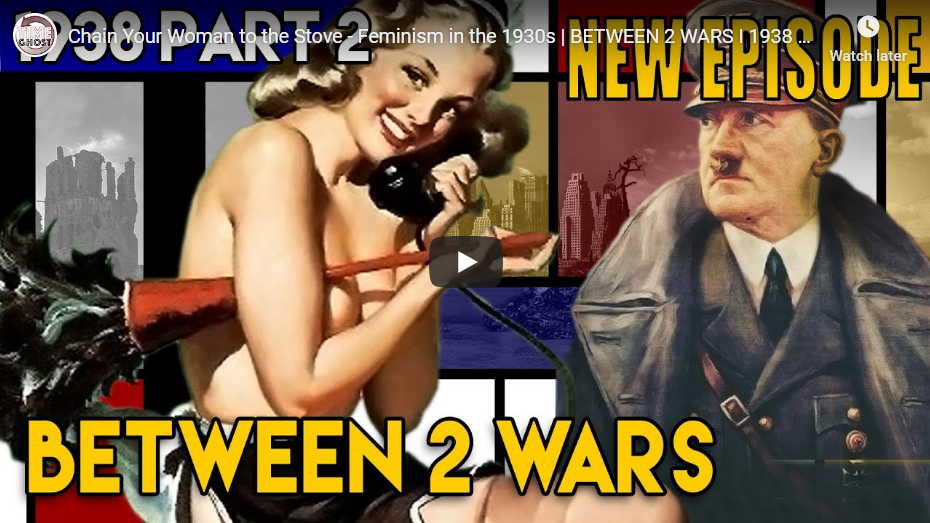
Chain Your Woman to the Stove – Feminism in the 1930s | BETWEEN 2 WARS I 1938 Part 2 of 4
TimeGhost History
Published 4 Mar 2020Under the yoke of economic depression and more and more authoritarian rulers, Western women face renewed misogyny, patriarchy, and decreasing independence. But not all women think this is such a bad thing.
Join us on Patreon: https://www.patreon.com/TimeGhostHistory
Hosted by: Indy Neidell
Written by: Spartacus Olsson
Directed by: Spartacus Olsson and Astrid Deinhard
Executive Producers: Bodo Rittenauer, Astrid Deinhard, Indy Neidell, Spartacus Olsson
Creative Producer: Joram Appel
Post-Production Director: Wieke Kapteijns
Research by: Spartacus Olsson
Edited by: Daniel Weiss
Sound design: Marek KamińskiSources:
Bundesarchiv_Bild:
101III-Alber-174-14A, 102-04517A, 102-17313, 102-17818,
111-098-069, 137-055879, 146-1973-010-31, 146-1975-069-35,
146-1976-112-03A, 146-2006-205, 146-2008-0271,
183-2000-0110-500, 183-2005-0502-502, 183-2005-0530-500,
183-E10868, 183-E20457, 183-H28245, 183-J02040,
183-S08630, 183-S68014, 183-S68021, 183-S68029,
noun_pipe By Icon Lauk,
noun_company By wardehpillai,
noun_Farmer By Francisca Muñoz Colina.Colorizations by:
– Daniel Weiss
– Norman StewartSoundtracks from Epidemic Sound:
– “Sophisticated Gentlemen” – Golden Age Radio
– “The Inspector 4” – Johannes Bornlöf
– “Magnificent March 3” – Johannes Bornlöf
– “Last Point of Safe Return” – Fabien Tell
– “Step On It 5” – Magnus Ringblom
– “First Responders” – Skrya
– “Step Lightly” – Farrell Wooten
– “Try and Catch Us Now” – David Celeste
– “Not Safe Yet” – Gunnar Johnsen
– “The Dominion” – Bonnie Grace
– “The Charleston 3” – Håkan ErikssonA TimeGhost chronological documentary produced by OnLion Entertainment GmbH.
From the comments:
TimeGhost History
2 days ago (edited)
So, we take a little break from the geopolitical developments in 1938 to look at the situation of women in the Western World in 1938. We’ve received a lot of requests on the WW2 channel to cover the situation on the home fronts. While we do mention it in the weekly episodes, and War Against Humanity covers the horrid parts of it, WWII was so much more. It literally changed the world’s culture in just six years. To do that subject justice we have asked Anna to join us as host for a new monthly WW2 series: On the Homefront.A few years back Anna was a regular feature on German YouTube on her own channel and some of the bigger YouTube entertainment channels. She left YouTube to finish her studies, and because she was searching for more depth than YT entertainment content was offering her. As Astrid’s and my daughter, and having grown up with Indy around all the time, she has a passion for human history form childhood, especially cultural history.
She also has a personal relationship to this time through her grandparents, Herbert and Renate, Astrid’s parents who served in Germany during the war, on the front and at home. Herbert, a career administrator and later NCO in the Wehrmacht engineer corps, went on after the war to work for the British as translator, and then as a public servant supporting the creation of the Bundeswehr, the German defense forces, and eventually Germany’s contribution as NATO member.
Renate’s father, a bank director, died under mysterious circumstance in 1936 after repeatedly refusing to pay out money belonging to Jewish families to the Nazis. Her mother and sisters soldiered on under the Nazis as best they could, When the war broke out they first suffered under the Allied bombing, losing their home three times. When the bombing became a daily occurrence, Renate was drafted to the German flak and only barely survived the war.
Several years after the war Herbert and Renate met and started a family together. They both passed away only a few years ago, late enough so that Anna had a chance to spend countless hours over 23 years listening to their war stories, and what they took away from it: hope for a better world, and the knowledge that what happened in Germany between 1933 and 1945, must never happen again. Please join us to welcome Anna, our daughter to TimeGhost.
Spartacus
Fallen flag — The Clinchfield Railroad
This month’s fallen flag article in Classic Trains magazine recounts the story of the Carolina, Clinchfield & Ohio, later known as the Clinchfield Railroad:
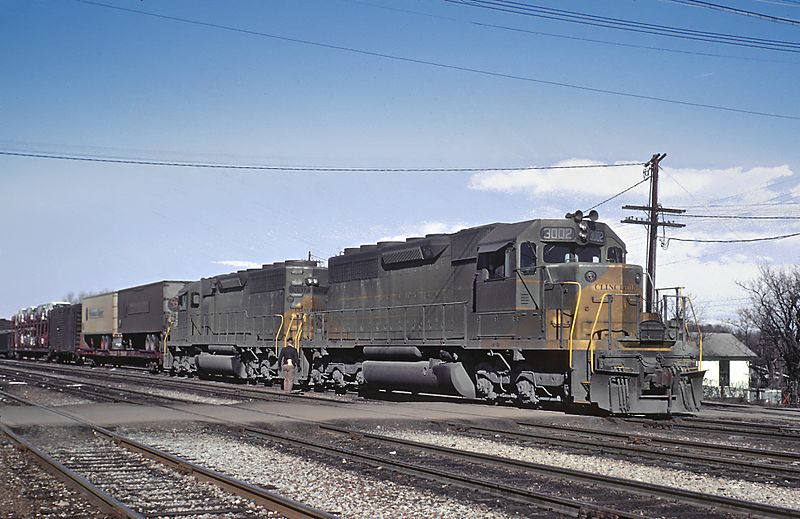
Clinchfield Railroad SD40 locomotive number 3002 at Spartanburg, SC in February 1968.
Roger Puta photo via Wikimedia Commons.
The Clinchfield was different. It was conceived by men who had the vision and resources to do things right. It was built to the highest engineering standards of the early 20th century. It never went through a financial failure or reorganization. Indeed, the Carolina, Clinchfield & Ohio Railway was the antithesis of traditional railroad evolution.
In 1902, a wealthy regional businessman, George L. Carter, began stitching together an integrated industrial enterprise to develop vast coal deposits in the Clinch (River) Fields of southwest Virginia and to deliver the coal across the southern Appalachian mountains to markets in the Carolinas and to ships calling at Wilmington, Charleston, Savannah, and Jacksonville. Carter, from whom Howard Hughes could have learned a thing to two about secrecy, operated using the South & Western Railway banner. The name said everything … and nothing. The S&W was chartered from any point on the Atlantic Ocean to any point on the Great Lakes. Carter agents seized by legal means and/or physical occupation key terrain features through the mountains in competition with the Chesapeake & Ohio and the Southern Railway.
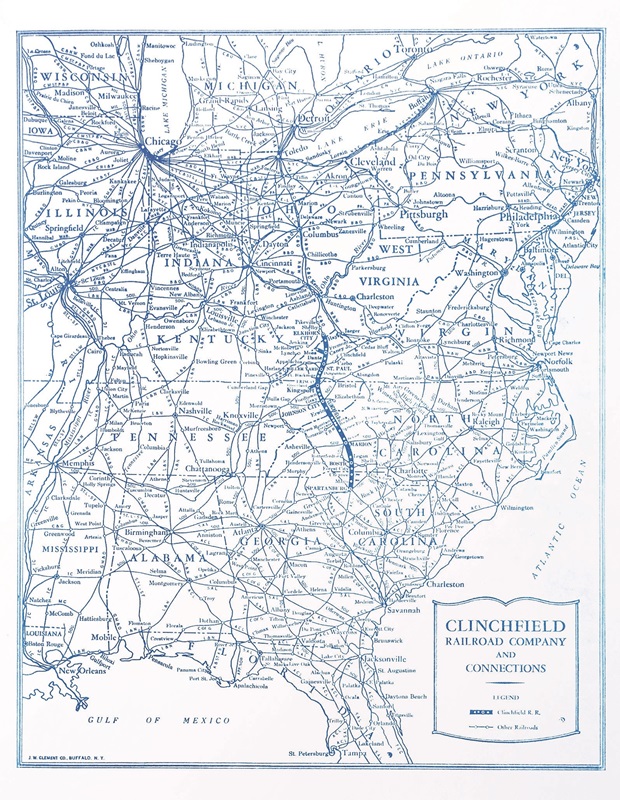
Clinchfield Railroad map. The Clinchfield’s 277-mile, 5-state line stretched from Elkhorn City, Kentucky, to Spartanburg, South Carolina.
Map via Classic Trains.Within that generous charter was the idea of building a railroad to haul coal south and merchandise in both directions between the Midwest and the Southeast. The plans also incorporated development of several on-line cities to consume coal and make products from regional resources to diversify and grow the freight business. Finally, a steamship line was organized to move coal beyond the ports to customers in the Caribbean.
By 1905, Carter realized he needed far more capital than he could personally provide. Reluctantly, he managed to convince Blair & Co., a big Wall Street investment house, to finance the project. M. J. Caples, an engineer with mining and railroad experience, laid out and then built a magnificent low-grade, high-capacity railroad. Tunnels, steel viaducts, generous fills, and rocky cuts appeared as needed. More than 4 percent (almost 10 miles) of the line was underground in 55 tunnels. With construction of the 277-mile railroad well advanced, its name was changed to Carolina, Clinchfield & Ohio Railway in 1908.
Coal began flowing across the 242 miles from Dante, Va., to Spartanburg, South Carolina, in 1909 while the owners and engineers debated how to cross the Cumberland mountains into the Ohio River valley. Between 1912 and 1915, a 35-mile extension including what was then the 10th-longest tunnel in the U.S. created a through route connecting Chesapeake & Ohio at Elkhorn City, Kentucky, with the three major southeastern carriers (Seaboard at Bostic, North Carolina; Atlantic Coast Line and Southern at Spartanburg). In constant-value dollars, the five-state CC&O was the most expensive railroad ever built in the U.S.
First Crusade | 3 Minute History
Jabzy
Published 20 Mar 2015I will try and cover the other Crusades soon
March 4, 2020
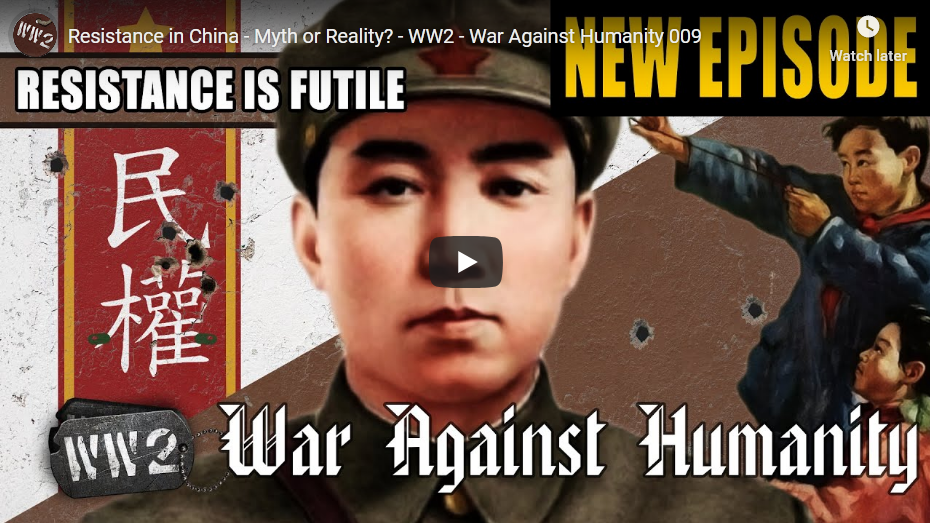
Resistance in China – Myth or Reality? – WW2 – War Against Humanity 009
World War Two
Published 3 Mar 2020The war in China already started in 1931 when Japan invaded Manchuria. Early resistance was small and was met by heavy Japanese retaliations. But throughout the 30’s, the movement started to grow.
Join us on Patreon: https://www.patreon.com/TimeGhostHistory
Or join The TimeGhost Army directly at: https://timeghost.tvFollow WW2 day by day on Instagram @World_war_two_realtime https://www.instagram.com/world_war_t…
Join our Discord Server: https://discord.gg/D6D2aYN.
Between 2 Wars: https://www.youtube.com/playlist?list…
Source list: http://bit.ly/WW2sourcesHosted by: Spartacus Olsson
Written by: Francis van Berkel
Produced and Directed by: Spartacus Olsson and Astrid Deinhard
Executive Producers: Bodo Rittenauer, Astrid Deinhard, Indy Neidell, Spartacus Olsson
Creative Producer: Joram Appel
Post-Production Director: Wieke Kapteijns
Research by: Francis van Berkel
Edited by: Mikołaj Cackowski
Map animations: Eastory (https://www.youtube.com/c/eastory)Colorizations by:
Norman Stewart – https://oldtimesincolor.blogspot.com/Sources:
Library of Congress
Narodowe Archiwum Cyfrowe
Chinese anti-Japanese posters, courtesy of pictoright
SHANGHAI, CHINA-1921Soundtracks from the Epidemic Sound:
Johan Hynynen – “Dark Beginning”
Yi Nantiro – “Watchmen”
Yi Nantiro – “A Single Grain of Rice”
Reynard Seidel – “Deflection”
Fabien Tell – “Last Point of Safe Return”
Andreas Jamsheree – “Guilty Shadows 4”
Rannar Sillard – “Split Decision”Archive by Screenocean/Reuters https://www.screenocean.com.
A TimeGhost chronological documentary produced by OnLion Entertainment GmbH.
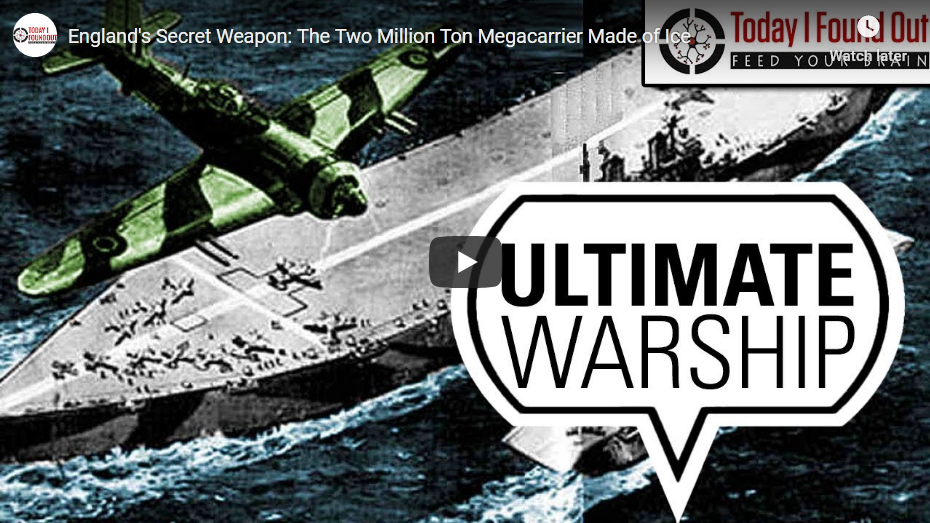
England’s Secret Weapon: The Two Million Ton Megacarrier Made of Ice
Today I Found Out
Published 16 Feb 2018If you happen to like our videos and have a few bucks to spare to support our efforts, check out our Patreon page where we’ve got a variety of perks for our Patrons, including Simon’s voice on your GPS and the ever requested Simon Whistler whistling package: https://www.patreon.com/TodayIFoundOut
This video is sponsored by World of Warships
In this video:
Britain was taking a beating from the German ships and submarines and were looking for something to build a ship out of that couldn’t be destroyed by torpedoes, or at least could take a major pounding without incurring a fatal amount of damage. With steel and aluminum in short supply, Allied scientists and engineers were encouraged to come up with alternative materials and weapons.
Want the text version?: http://www.todayifoundout.com/index.p…
March 3, 2020
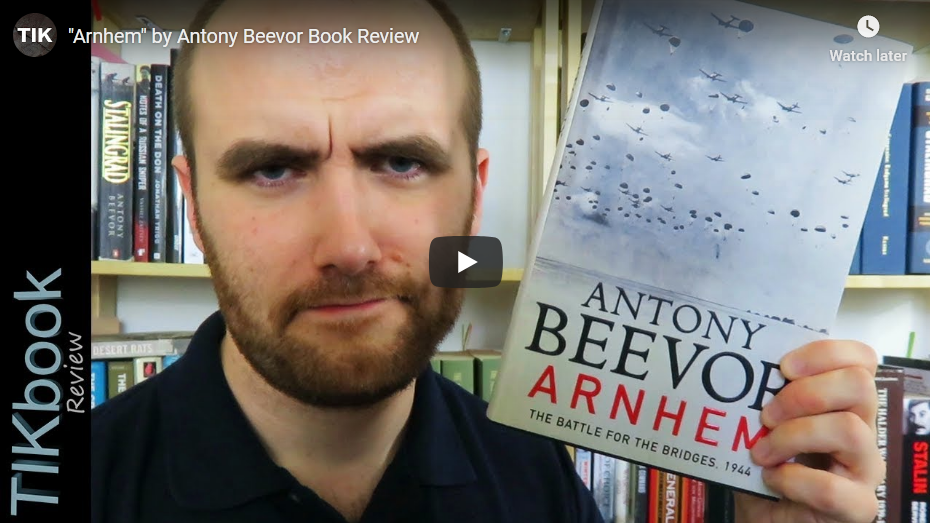
Arnhem by Antony Beevor Book Review
TIK
Published 18 Jun 2018Antony Beevor’s book Arnhem is good — but it contains a flawed argument. So flawed, that there’s a ton of counter evidence that shows it doesn’t work. Here, I will explain the events of the Nijmegen battle, what Beevor’s incorrect statement is, why he has to say it like he did, and how he could have done things differently.
Check out the pinned comment below for more information, notes, links, and sources.
Don’t forget to subscribe if you like history or gaming! And hit the little bell icon to be notified when videos like this are uploaded.
Please consider supporting me on Patreon and help make more videos like this possible https://www.patreon.com/TIKhistory
From the comments:
TIK
1 year agoSelected Bibliography/Sources
Brereton, L. The Brereton Diaries: The War in the Air in the Pacific, Middle East and Europe, 3 October 1941-8 May 1945. Kindle, 2014.
Frost, J. A Drop Too Many. Kindle, 2009.
Hastings, M. Armageddon. Pan Books, 2004.
Robert J. Kershaw, It Never Snows in September. Ian Allan Publishing, 2007.
Mead, R. General Boy: The Life of Lieutenant General Sir Frederick Browning. Kindle, 2010.
Middlebrook, M. Arnhem 1944: The Airborne Battle, 17-29 September. 2009.
Neillands, R. The Battle for the Rhine 1944. Kindle, 2014.
Poulussen, R.G. Lost at Nijmegen. Kindle, 2011.
Ryan, C. A Bridge Too Far. Kindle, 1974
Urquhart, R. Arnhem. Kindle, 1958.
Sosabowski, S. Freely I Served. Kindle, 1982.Links
My “REAL Operation Market Garden” documentary https://youtu.be/vTUC79o4Kmc
“The BAD BOY of Operation Market Garden” A video on General ‘Boy’ Browning https://youtu.be/Dvv8GQIRYVU
The “Who to Blame? John Frost on Operation Market Garden’s Failure” video https://youtu.be/7C_HoMVhKAI
My discussion of Market Garden’s True Purpose using Monty vs Eisenhower’s Memoirs https://youtu.be/f79KgQVL3MM
A video on Kampfgruppen where I talk about some of the Market Garden Kampfgruppen https://youtu.be/zKWczZkQ130
My Book review of It Never Snows in September https://youtu.be/-RRdWCyHpG8
My A Bridge Too Far Book Review video https://youtu.be/D6vDlbsOkQEAdd me on Twitter @TIKhistory
Thanks for watching, bye for now!
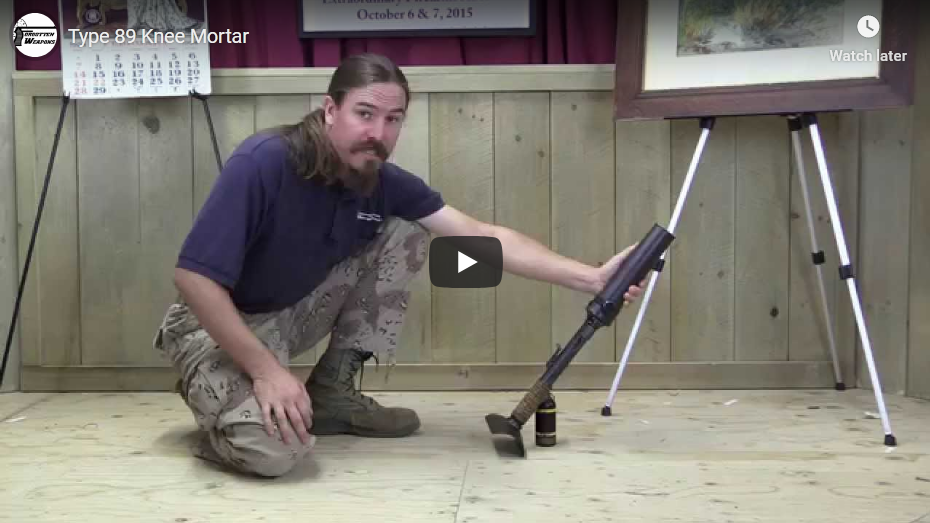
Type 89 Knee Mortar
Forgotten Weapons
Published 23 Sep 2015http://www.patreon.com/ForgottenWeapons
Hammer price: $2,500
The Type 89 grenade discharger, commonly known as the “knee mortar” was a Japanese light infantry weapon introduced in 1929 which blurs the lines between grenade launcher and mortar. Like a mortar, it fires propelled explosive bombs in a high-angle indirect fire role, but it has a rifled barrel and uses a range adjustment mechanism very different from most mortars.
The knee mortar proved to be a very capable and effective weapon in WWII against US forces. It was accurate, effective, and perhaps most importantly, light and very fast to put into action. The closest comparable US weapon was the 60mm light mortar, which had a more effective projectile but was significantly slower to use.
Of course, the “knee mortar” nickname was based on the theoretical belief that one was supposed to rest the curved baseplate of the weapon on a leg while firing, which would actually have resulted in a broken leg. The baseplate was curved to allow it to dig into soft soil and be used against objects like logs and roots.
March 2, 2020
The Trouble With Tumbleweed
CGP Grey
Published 1 Mar 2020Director’s commentary: https://www.youtube.com/watch?v=rbHQO…
## Crowdfunders:
Bob Kunz, Steven Snow, John Buchan, Nevin Spoljaric, Donal Botkin, Phil Gardner, Chris Chapin, Richard Jenkins, Martin, Steven Grimm, سليمان العقل, Colin Millions, Michael Mrozek, Saki Comandao, Jason Lewandowski, Andrea Di Biagio, David F Watson, rictic, Ben Schwab, Marco Arment, Elliot Lepley, Shantanu Raj, emptymachine, Bobby, Chris Amaris, George Lin, Mikko, Derek Bonner, Derek Jackson, Orbit_Junkie, Ron Bowes, Tómas Árni Jónasson, Henry Ng, Jordan Earls, Joshua Jamison, Nick Fish, Nick Gibson, Robert Webb, Jeffrey Podis, Thunda Plum, Awoo, David Tyler, Fuesu, iulus, Kevin Costello, Michael Reilly, Tyler Bryant, Kermit Norlund, chrysilis, David Palomares, Erik Parasiuk, ken mcfarlane, Leon, Tristan Watts-Willis, Veronica Peshterianu, Bear, Emi, Esteban Santana Santana, Freddi Hørlyck, John Rogers, Maarten van der Blij, Peter Lomax, Rhys Parry, ShiroiYami, Dag Viggo Lokøen, John Lee, Maxime Zielony, Elizabeth Keathley, Frederick The Great, Luxe Gifts, Rebecca Wortham, Bryan McLemore
Music by Music by: http://www.davidreesmusic.com
Wikipedia says:
A tumbleweed is a structural part of the above-ground anatomy of a number of species of plants, a diaspore that, once it is mature and dry, detaches from its root or stem, and rolls due to the force of the wind. In most such species, the tumbleweed is in effect the entire plant apart from the root system, but in other plants, a hollow fruit or an inflorescence might serve the function. Tumbleweed species occur most commonly in steppe and arid ecosystems, where frequent wind and the open environment permit rolling without prohibitive obstruction.
Apart from its primary vascular system and roots, the tissues of the tumbleweed structure are dead; their death is functional because it is necessary for the structure to degrade gradually and fall apart so that its seeds or spores can escape during the tumbling, or germinate after the tumbleweed has come to rest in a wet location. In the latter case, many species of tumbleweed open mechanically, releasing their seeds as they swell when they absorb water.
The tumbleweed diaspore disperses seeds, but the tumbleweed strategy is not limited to the seed plants; some species of spore-bearing cryptogams — such as Selaginella — form tumbleweeds, and some fungi that resemble puffballs dry out, break free of their attachments and are similarly tumbled by the wind, dispersing spores as they go.
[…]
In the family Amaranthaceae (i.e. broadly defined to include Chenopodiaceae), several annual species of the genus Kali are tumbleweeds. They are thought to be native to Eurasia, but when their seeds entered North America in shipments of agricultural seeds, they became naturalized in large areas. In the cinema genre of Westerns, they have long been symbols of frontier areas. Kali tragus is the so-called “Russian thistle”. It is an annual plant that breaks off at the stem base when it dies, and forms a tumbleweed, dispersing its seeds as the wind rolls it along. It is said to have arrived in the United States in shipments of flax seeds to South Dakota, perhaps about 1870. It now is a noxious weed throughout North America, dominating disturbed habitats such as roadsides, cultivated fields, eroded slopes, and arid regions with sparse vegetation. Though it is a troublesome weed, Kali tragus also provides useful livestock forage on arid rangelands.
History-Makers: Anna Komnena
Overly Sarcastic Productions
Published 28 Feb 2020She’s a Princess! She’s a Poet! She’s a Historian! She’s Anna Komnena — the COOLEST writer in the Byzantine Empire! On this episode of History-Makers, jump into the reign of Alexios Komnenos from the perspective of his daughter Anna, and learn about the emperor who saved the Byzantines from certain doom, as well as the traits that make Anna’s Alexiad a masterpiece.
This video was edited by Sophia Ricciardi, AKA “Indigo”.
Our content is intended for teenage audiences and up.Sources & Further Reading: The Alexiad — obviously, what are you waiting for? (Also Norwich’s Byzantium)
PATREON: https://www.Patreon.com/OSP
DISCORD: https://discord.gg/h3AqJPe
MERCH LINKS: https://www.redbubble.com/people/OSPY…
OUR WEBSITE: https://www.OverlySarcasticProductions.com
Find us on Twitter https://www.Twitter.com/OSPYouTube
Find us on Reddit https://www.Reddit.com/r/OSP/
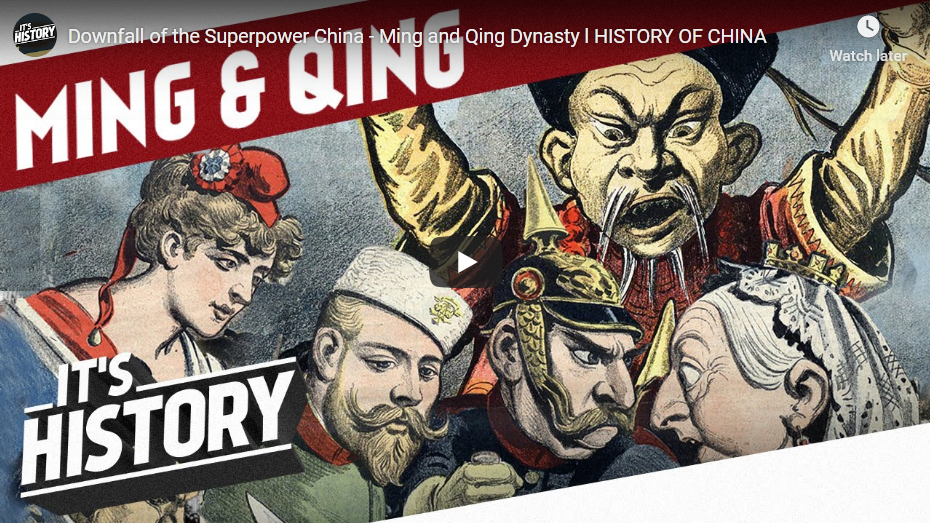
Downfall of the Superpower China – Ming and Qing Dynasty l HISTORY OF CHINA
IT’S HISTORY
Published 17 Aug 2015With the dynasties of the Ming and the Qing came social security and flourishing international trade. The White Lotus Movement advocated progressive thinking in the time of the conservative Ming dynasty. In 1616 the Qing dynasty came to power. Also known as the Manchu dynasty, the Qing refused to open their borders to limitless trade which led to frustrated European merchants. This caused hostility and mistrust of the “barbaric Chinese”. Shortly thereafter China’s economy lost its race against European Colonialism and would lose military influence after gunpowder reached Europe. All about the fall of the former Chinese superpower in this episode on IT’S HISTORY!
» SOURCES
Videos: British Pathé (https://www.youtube.com/user/britishp…)
Pictures: mainly Picture Alliance
Content:
Twitchett, Denis and Loewe, Michael. The Cambridge History of China. Cambridge University Press.
Wilkinson, Endymion, Chinese History: A New Manual. Harvard University, Asia Center
Loewe, Michael; Shaughnessy, Edward L. The Cambridge History of Ancient China. Cambridge University Press
John M. Roberts A Short History of the World. Oxford University Press
Xu, Pingfang The Formation of Chinese Civilization: An Archaeological Perspective. Yale University Press.
Fairbank, J. K.; Goldman, M. China: A New History. Harvard University Press. ”» ABOUT US
IT’S HISTORY is a ride through history – Join us discovering the world’s most important eras in IN TIME, BIOGRAPHIES of the GREATEST MINDS and the most important INVENTIONS.» HOW CAN I SUPPORT YOUR CHANNEL?
You can support us by sharing our videos with your friends and spreading the word about our work.» CAN I EMBED YOUR VIDEOS ON MY WEBSITE?
Of course, you can embed our videos on your website. We are happy if you show our channel to your friends, fellow students, classmates, professors, teachers or neighbors. Or just share our videos on Facebook, Twitter, Reddit etc. Subscribe to our channel and like our videos with a thumbs up.» CAN I SHOW YOUR VIDEOS IN CLASS?
Of course! Tell your teachers or professors about our channel and our videos. We’re happy if we can contribute with our videos.» CREDITS
Presented by: Guy Kiddey
Script by: Guy Kiddey
Directed by: Daniel Czepelczauer
Director of Photography: Markus Kretzschmar
Music: Markus Kretzschmar
Sound Design: Bojan Novic
Editing: Markus KretzschmarA Mediakraft Networks original channel
Based on a concept by Florian Wittig and Daniel Czepelczauer
Executive Producers: Astrid Deinhard-Olsson, Spartacus Olsson
Head of Production: Michael Wendt
Producer: Daniel Czepelczauer
Social Media Manager: Laura Pagan and Florian WittigContains material licensed from British Pathé
All rights reserved – © Mediakraft Networks GmbH, 2015
QotD: The legend of Rommel and the Afrika Korps
It’s an attractive image all around, and it is unfortunate that practically all of it is false. The desert was hardly a haven of beauty or romance. It was a pain, and fighting in it was a nightmare for both sides. Far from letting the respective tank fleets roam free, the desert chained them irresistibly to their supply lines, and a single failed supply convoy or a lost column of trucks could stop an entire offensive dead in its tracks. Contrary to the alleged mobility of desert warfare, both sides would spend far more time in static defensive positions, often quite elaborate, then they would launching tank charges.
That leaves us with Rommel. Here, too, we should challenge the mythology. He was hardly apolitical. His entire career had been based on Hitler’s favor, and we might reasonably describe his attitude toward the Führer as worshipful. He was Hitler’s fair-haired boy, a young officer repeatedly promoted over more senior candidates. He was a media creation. Nazi propaganda painted him not only as a garden-variety hero, but as a model National Socialist and Aryan, a man who could overcome stronger enemies through the sheer force of his will. He was not merely a passive bystander to the hype; he was an active accomplice. He loved nothing better than having a camera crew along with him on campaign, and he would regularly order scenes to be reshot if his posture was insufficiently heroic or the lighting had not shown him to best advantage. As is often the case, his relationship to the media was both self-serving and self-destructive. During the years of victory, the German propaganda machine used him as an example to the nation. When things went sour, he became a diversion from the increasingly bad news on other fronts. Finally, when he was no longer useful for any purpose at all, the regime dropped him altogether and eventually killed him.
Robert Citino, “Drive to Nowhere: The Myth of the Afrika Korps, 1941-43″, The National WWII Museum, 2012. (Originally published in MHQ, Summer 2012).
March 1, 2020
The Nazis Building Bridges, Not Walls – WW2 – 079 – February 28, 1941
World War Two
Published 29 Feb 2020Parts of the British forces in North-Africa are being send to Greece to strengthen the Allied position there. While the remaining British plan for the near future, others make huge advances in East-Africa and Hitler plans his attack on Greece through Bulgaria.
Join us on Patreon: https://www.patreon.com/TimeGhostHistory
Or join The TimeGhost Army directly at: https://timeghost.tvFollow WW2 day by day on Instagram @World_war_two_realtime https://www.instagram.com/world_war_t…
Join our Discord Server: https://discord.gg/D6D2aYN.
Between 2 Wars: https://www.youtube.com/playlist?list…
Source list: http://bit.ly/WW2sourcesWritten and Hosted by: Indy Neidell
Produced and Directed by: Spartacus Olsson and Astrid Deinhard
Executive Producers: Bodo Rittenauer, Astrid Deinhard, Indy Neidell, Spartacus Olsson
Creative Producer: Joram Appel
Post-Production Director: Wieke Kapteijns
Research by: Indy Neidell
Edited by: Mikołaj Cackowski
Map animations: Eastory (https://www.youtube.com/c/eastory)
Additional animation: Ryan WeatherbyColorizations by:
– Julius Jääskeläinen – https://www.facebook.com/JJcolorization/
– Norman Stewart – https://oldtimesincolor.blogspot.com/Sources:
IWM: E 2386, E 2372, E 2368, E 2388, E 450, E 1579, FL 10025
National Portrait Gallery
Letter by Mochammad Kafi from the Noun Project
Mil.ru
BASA (3K-15- 84-2, 3K-7-436-41)
Narodowe Archiwum Cyfrowe
Museum of Science and Technology BelgradeArchive by Screenocean/Reuters https://www.screenocean.com.
A TimeGhost chronological documentary produced by OnLion Entertainment GmbH.
The Black Death of the 14th Century
Ed West looks at what we know of the spread of the worst plague to hit western Europe in the 1300s:
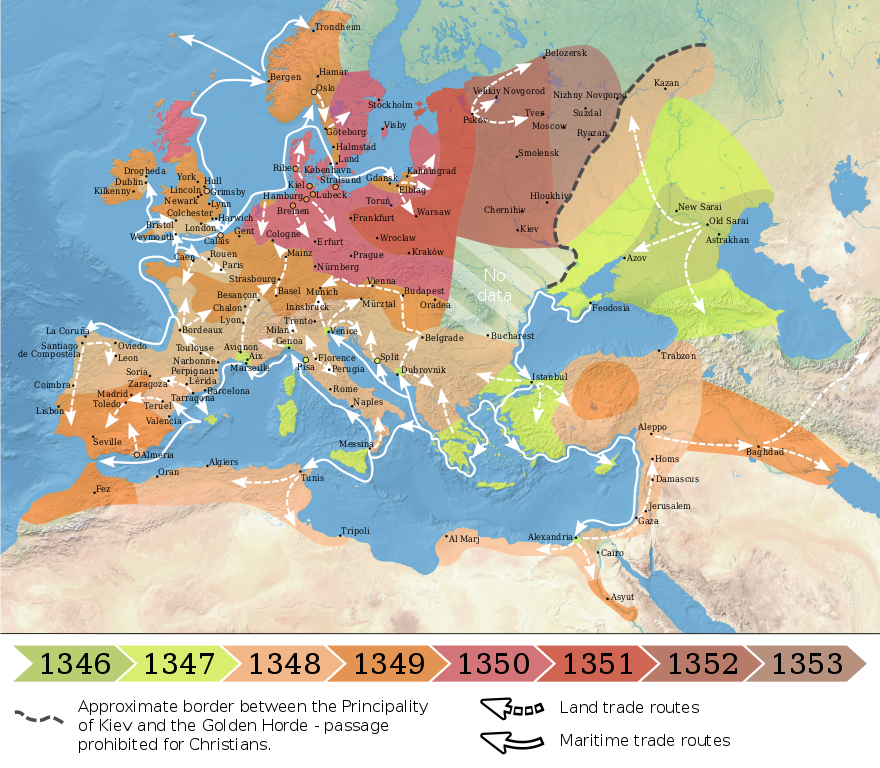
Map showing the spread of the Black Death in Europe between 1346 and 1353.
Map by Flappiefh via Wikimedia Commons.
There had never been a terror like it, and the “Great Mortality” as it was known — and much later, the “Black Death” — has seared itself in the European imagination. It changed the culture and tested the institutions of the time, and as we anxiously await the arrival of another — thankfully far less deadly — contagion from Italy its legacy and impact are worth remembering.
Epidemics have been around as long as civilization. Plaga — from the Greek for “strike” or “hit” — devastated classical Athens in the 5th century BC, when the historian Thucydides nursed sufferers; the Antonine Plague — probably smallpox or measles — killed as many as five million Romans at the empire’s peak. Far more deadly was the Plague of Justinian in the sixth century, which had a toll of 25 million and emptied whole regions of the eastern (Byzantine) Empire. Only in the 21st century did researchers confirm that this was the same illness that would appear eight centuries later — the Bubonic Plague.
Empires were particularly affected by these horrific epidemics, because empires are a form of globalisation — bringing different people into contact with each other and, more dangerously, into contact with other mammals, who act as disease vectors.
Another danger is climate change, which might turn a mild virus into a deadly one, or cause disease-carrying animals to migrate. This is what happened during the 14th century when the northern hemisphere became considerably cooler, soon after the Mongols had created the largest contiguous empire in history.
Genghis Khan’s people have generally received a historical bad press — people are more likely to recall the pyramid of skulls and the Tigris flowing black and red — yet their rule had opened up trade routes, allowing goods and people to cross Asia. Whether brought at the point of a sword or a trade deal, globalisation always brings the new: new cultures, new ideas, new languages and new pathogens.
Yersinia pestis had been living on gerbils and other rodents in central Asia, but unstable climate conditions in 1330s caused the disease to jump onto the rat flea. It was killing people by 1339, and in the mid-1340s Christians first heard of a disease raging in the Islamic world, which some at least took as divine punishment for the crusades.
After two centuries of Holy War this was understandable, yet hatred was not universal and during these conflicts Italian merchants had continually done business with Muslims, much to the Church’s fury. Now this trade, once the source of prosperity and peace, proved deadly: plague reached Europe via the Genovese colony of Caffa on the Black Sea (now Feodosiya, in the Ukraine). In October 1347, four ships escaping the diseased city had turned up in Sicily, condemning Italy to its fate.
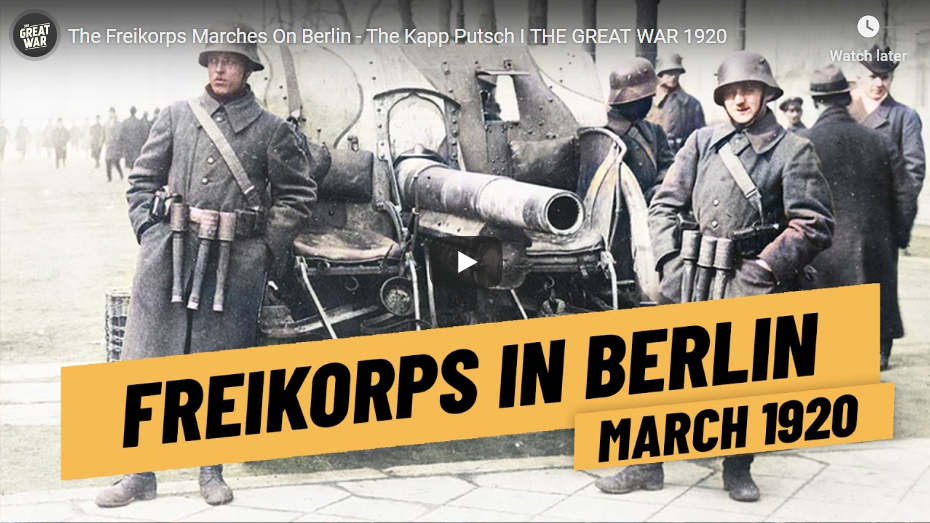
The Freikorps Marches On Berlin – The Kapp Putsch I THE GREAT WAR 1920
The Great War
Published 28 Feb 2020Sign up for Curiosity Stream and Nebula: https://curiositystream.com/thegreatwar
Dissatisfied with the new German Republic and the terms of the Treaty of Versailles, parts of the new Reichswehr and the paramilitary Freikorps decide to take matters into their own hands. The Marinebrigade Ehrhardt marches on Berlin to topple the government: It’s the Kapp Putsch.
» SUPPORT THE CHANNEL
Patreon: https://www.patreon.com/thegreatwar
Merchandise: https://shop.spreadshirt.de/thegreatwar/» SOURCES
Grevelhörster, Ludwig: Kleine Geschichte der Weimarer Republik. 1918-1933. Ein
problemgeschichtlicher Überblick, 2000.
Haffner, Sebastian: Die Deutsche Revolution 1918/1919. 2010.
Heiden, Konrad: Adolf Hitler: Das Zeitalter der Verantwortungslosigkeit. Ein Mann gegen
Europa, 2016.
Kotowski, Georg (Hrsg.): Historisches Lesebuch. 1914-1933, 1968.
Möller, Horst: Die Weimarer Republik. Demokratie in der Krise, 2018.
Pöppinghege, Rainer: Republik im Bürgerkrieg. Kapp-Putsch und Gegenbewegung an Ruhr
und Lippe 1919/1920, 2019.
Stackelberg, Roderick & Winkle, Sally (Ed.), The Nazi Germany Sourcebook: An Anthology of Texts, (Florence : Taylor and Francis, 2003)
Ulrich, Volker: Adolf Hitler. Band 1: Die Jahre des Aufstiegs 1889-1939. 2013.
Sturm, Reinhard (2011). “Weimarer Republik, Informationen zur politischen Bildung”. Bonn: Bundeszentrale für politische Bildung.» SOCIAL MEDIA
Instagram: https://instagram.com/the_great_war
Twitter: https://twitter.com/WW1_Series
Reddit: https://reddit.com/r/TheGreatWarChannel»CREDITS
Presented by: Jesse Alexander
Written by: Mark Newton
Director: Toni Steller & Florian Wittig
Director of Photography: Toni Steller
Sound: Toni Steller
Editing: Toni Steller
Mixing, Mastering & Sound Design: http://above-zero.com
Maps: Daniel Kogosov (https://www.patreon.com/Zalezsky)
Research by: Markus Linke
Fact checking: Florian WittigChannel Design: Alexander Clark
Original Logo: David van StepholdA Mediakraft Networks Original Channel
Contains licensed material by getty images
All rights reserved – Real Time History GmbH 2020