Quotulatiousness

August 29, 2020

Extermination Now! – War Against Humanity 016 – August 1941, Part 01

World War Two
Published 28 Aug 2020

Not all plans for Operation Barbarossa are as successful as hoped. In August 1941, Adolf Hitler and Heinrich Himmler push forward their plans to wage war on all Jews, unleashing the Einzatsgruppen and the SS Cavalry Brigade of Hermann Fegelein on the Jewish people of Eastern Europe.

Join us on Patreon: https://www.patreon.com/TimeGhostHistory
Or join The TimeGhost Army directly at: https://timeghost.tv

Follow WW2 day by day on Instagram @World_war_two_realtime https://www.instagram.com/world_war_two_realtime
Between 2 Wars: https://www.youtube.com/playlist?list…
Source list: http://bit.ly/WW2sources

Hosted by: Spartacus Olsson
Written by: Spartacus Olsson and Joram Appel
Director: Astrid Deinhard
Producers: Astrid Deinhard and Spartacus Olsson
Executive Producers: Astrid Deinhard, Indy Neidell, Spartacus Olsson, Bodo Rittenauer
Creative Producer: Joram Appel
Post-Production Director: Wieke Kapteijns
Research by: Joram Appel
Edited by: Miki Cackowski
Sound design: Marek Kamiński
Map animations: Eastory (https://www.youtube.com/c/eastory)

Colorizations by:
Julius Jääskeläinen – https://www.facebook.com/JJcolorization/
Jaris Almazani (Artistic Man) – https://instagram.com/artistic.man?ig…
Spartacus Olsson
Norman Stewart – https://oldtimesincolor.blogspot.com/
Mikolaj Uchman
Cassowary Colorizations – https://www.flickr.com/photos/cassowa…
Klimbim – https://www.flickr.com/photos/2215569…
Tzo15 – https://commons.wikimedia.org/wiki/Fi…

Sources:
Yad Vashem 4788/72, 5648/39, 139BO1, 2725/8, 5138/98, 4220/2, 48AO4, 4272/10, 75EO4, 2725/7, 2798/2, 4147/65, 48AO5, 3745/143, 3955/365, 1907/4, 3745/140, 3521/134
USHMM
Narodowe Archiwum Cyfrowe
Bundesarchiv
From the Noun Project: people by ProSymbols, Skull by Muhamad Ulum, Woman and boy by Studio Het Mes

Soundtracks from the Epidemic Sound:
Reynard Seidel – “Deflection”
Johan Hynynen – “Dark Beginning”
Skrya – “First Responders”
Farrell Wooten – “Blun Object”
Fabien Tell – “Last Point of Safe Return”
Gunnar Johnsen – “Not Safe Yet”
Philip Ayers – “Under the Dome”
Cobby Costa – “From the Past”

Archive by Screenocean/Reuters https://www.screenocean.com.

A TimeGhost chronological documentary produced by OnLion Entertainment GmbH.

Durs Egg Ferguson – The Rifle That Didn’t Shoot George Washington

Forgotten Weapons
Published 27 Oct 2018

http://www.patreon.com/ForgottenWeapons

Cool Forgotten Weapons merch! http://shop.bbtv.com/collections/forg…

Captain Patrick Ferguson was a British officer who designed and patented a breechloading rifle in 1776, which would actually see service in the American Revolution at the Battle of Brandywine. Ferguson presented two rifles to the British military for consideration, one of them being this specific gun. In a shooting demonstration on a windy, rainy day he convinced the Board of Ordnance of the viability of his rifle, and a field trials was set in motion. One hundred Ferguson rifles were made for the Crown, and Ferguson was detached from his regiment to be given command of a company of specially trained elite riflemen. His men were drilled in accurate shooting as well as use of the bayonet, they were organized in small groups to make use of cover and concealment, and they were fitted with green uniforms to blend into the terrain. This unit deployed to the American colonies in 1777, and saw action in the Battle of Brandywine.

Unfortunately for Ferguson and his ideas, the unit didn’t make any particularly notable impact on the battle, although not by any fault of their own. Worse, Ferguson was wounded, and because the unit was so heavily dependent on him it was disbanded while he recuperated. He did see service again at the Battle of King’s Mountain, where he was killed in action. This particular Ferguson rifle was made by the noted London gunsmith Durs Egg, and is one of the two guns presented to the Board of Ordnance that began the whole series of events.

Contact:
Forgotten Weapons
PO Box 87647
Tucson, AZ 85754

If you enjoy Forgotten Weapons, check out its sister channel, InRangeTV! http://www.youtube.com/InRangeTVShow

August 28, 2020

George Stephenson: The Father of the Railways

Filed under: Britain, History, Railways — Tags: , , , , — Nicholas @ 06:00

Biographics
Published 6 Feb 2020

Check out Squarespace: http://squarespace.com/biographics for 10% off on your first purchase.

This video is #sponsored by Squarespace.

TopTenz Properties
Our companion website for more: http://biographics.org

Credits:
Host – Simon Whistler
Author – Radu Alexander
Producer – Jennifer Da Silva
Executive Producer – Shell Harris

Business inquiries to biographics.email@gmail.com

“Killing Ground” – The Battle of Fraustadt – Sabaton History 082 [Official]

Filed under: Europe, Germany, History, Media, Military, Russia — Tags: , , , — Nicholas @ 04:00

Sabaton History
Published 27 Aug 2020

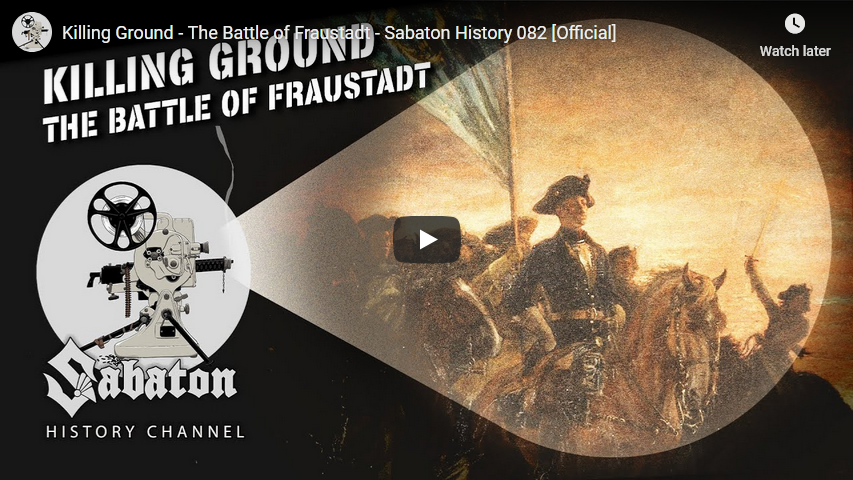
Poland, February 1706. Near the small town of Fraustadt the taste of battle fills the air. General Rehnskiöld of the Swedish Empire readies his 10,000 soldiers. Their enemy? The numerically superior Saxon army of General Schulenburg, numbering 20,000.
At stake? The fate of thrones and empires.

Support Sabaton History on Patreon: https://www.patreon.com/sabatonhistory

Listen to “Killing Ground” on the album Carolus Rex:
Carolus Rex (English Version) – https://music.sabaton.net/CarolusRexEN
Carolus Rex (Swedish Version) – https://music.sabaton.net/CarolusRexSE

Listen to Sabaton on Spotify: http://smarturl.it/SabatonSpotify
Official Sabaton Merchandise Shop: http://bit.ly/SabatonOfficialShop

Hosted by: Indy Neidell
Written by: Markus Linke and Indy Neidell
Directed by: Astrid Deinhard and Wieke Kapteijns
Produced by: Pär Sundström, Astrid Deinhard and Spartacus Olsson
Creative Producer: Maria Kyhle
Executive Producers: Pär Sundström, Joakim Brodén, Tomas Sunmo, Indy Neidell, Astrid Deinhard, and Spartacus Olsson
Community Manager: Maria Kyhle
Post-Production Director: Wieke Kapteijns
Editor: Iryna Dulka
Sound Editor: Marek Kaminski
Maps by: Eastory – https://www.youtube.com/c/eastory
Archive: Reuters/Screenocean – https://www.screenocean.com

All music by: Sabaton

An OnLion Entertainment GmbH and Raging Beaver Publishing AB co-Production.

© Raging Beaver Publishing AB, 2019 – all rights reserved.

From the comments:

Sabaton History
2 days ago
Not for the first time, and certainly not for the last, an important battle is fought on Polish territory. This time, however, neither of the armies involved belong to Poland. Looking at the troop numbers counts, the outcome would seem settled before it even began. Yet, if we have learned anything from other battles on Polish soil, unpredictability is a word that can be applied time and time again.

With the help of Indy and the TimeGhost team you can learn more about future battles on Polish territory in these two episodes from our own channel and the “World War Two In Real Time” series:

“40:1” – The Battle of Wizna – Sabaton History 001 [Official]
https://www.youtube.com/watch?v=Qpb8gTSMUbo

The Polish-German War – WW2 – 001 – September 1, 1939 [IMPROVED]
https://www.youtube.com/watch?v=2b7GY4BSUmU

Britain’s National Trust decides to go in a radically different direction

Filed under: Architecture, Britain, History — Tags: , , , — Nicholas @ 03:00

If you’ve ever visited the UK, you’ll almost certainly have seen some National Trust historic properties in your travels. Despite the name, it’s not a government-affiliated organization, so the Trust has its mission set by its own leadership … and the current leadership are apparently turning their back on the tradional role of the Trust “due to the pandemic”:

From its establishment in 1895 by Octavia Hill, Sir Robert Hunter and Hardwick Rawnsley “to promote the permanent preservation for the benefit of the Nation of lands and tenements (including buildings) of beauty or historic interest”, it has become the pre-eminent haunt of the tasteful middle classes, and is as much part of national life as that other much-lauded institution, the NHS. I have fond memories from my own childhood, and beyond, of walking round grand houses and of playing in their lavish and beautifully appointed grounds. Even their names produce a kind of Proustian rush in me – Felbrigg, Blickling, Stourhead, Dyrham Park, Kingston Lacy. In an uncertain and constantly changing world, the National Trust seemed to be almost a secular church, a rather well-appointed and comfortable Rock of Ages in its own right.

Yet we live in a time when a grubby little pandemic has turned all certainties upside down, and so even the National Trust has had to rethink its plans for the future. Unfortunately, its method of so doing seems to be both destructive and ill-considered. Some might call it woke, if it weren’t for the fact that its actions do not seem to be dictated by panicked social change, but instead by the reported £200 million loss that the coronavirus outbreak has occasioned. Despite having an endowment of over a billion pounds, and still retaining the annual memberships of over five million people, elements within the organisation that long for disruption seem now to have grasped the initiative, with potentially disastrous consequences for both the Trust and the country at large.

An internal briefing document that was leaked to the Times by a no doubt furious insider represents a chilling account of a cull of both heritage and expertise. It describes the status quo as “an outdated mansion experience”, and one that exists only to serve “a loyal but dwindling audience.” It plans to deal with this old-fashioned situation by firing dozens of its curators, placing large amounts of art and antiquities in storage, and by closing most of the properties to the public, instead letting them be hired by corporate entities and the well-heeled for private events, or “new sources of experience-based income”. As the document put it, the Trust wishes to “flex our mansion offer to create more active, fun and useful experiences.” Flex. Mansion Offer. We are, it seems, at the end of days.

I briefly considered, before writing this article, attempting to hold a séance to try and obtain James Lees-Milne’s views from beyond the grave, but eventually decided against interrupting his eternal rest to inform him of the disappointing and frightening news. Yet this situation does not need the phantoms of long-dead architectural historians to fan the flames. There are plenty of living people who are equally, and vocally, appalled, ranging from those who cancelled their memberships to the Trust when the institutional ties were no longer available in their gift shops to the curators, historians and architectural consultants who stand to lose both income and professional standing if these ill-considered and short-sighted reforms are brought about.

The art historian and broadcaster Bendor Grosvenor has been especially exercised by the revelation of the Trust’s plans. He has described their restructuring ideas in The Art Newspaper as “one of the most damaging assaults on art historical expertise ever seen in the UK.” Grosvenor has since been assiduously passing scathing commentary on the various public statements, of varying degrees of disingenuity, made by various high-up executives at the National Trust, none of which have denied that historic properties will be “repurposed”, that the specialist curator posts will be “closed” and the expert curators fired, nor, perhaps most chillingly of all, that the Trust will be seeking to “dial down” its status as a “major national cultural institution”.

About thirty years ago, when we could afford to travel more often, we had a family membership in the National Trust even though we’d only get to visit National Trust properties for two-to-three weeks in a given year. I’m very disappointed to hear about this planned change to the organization, but the chances of me visiting the UK anytime in the next few years are quite low, so I may not have to worry about it personally.

August 27, 2020

Israel Faces U.S. Sanctions – The Second Arab-Israeli War Begins | The Suez Crisis | Part 1

Filed under: Africa, Britain, France, History, Middle East, Military, USA — Tags: , , , , , — Nicholas @ 04:00

TimeGhost History
Published 26 Aug 2020

Israel launches its invasion of Egypt, much to the surprise of America who reacts furiously to the act of aggression. It quickly becomes apparent to America that Israel is not acting alone when Britain and France deliver an ultimatum to Egypt. However, could Anglo-French war plans hit the buffers if the expected American backing does not materialize?

Join us on Patreon: https://www.patreon.com/TimeGhostHistory

Hosted by: Indy Neidell
Written by: Francis van Berkel and Joram Appel
Director: Astrid Deinhard
Producers: Astrid Deinhard and Spartacus Olsson
Executive Producers: Astrid Deinhard, Indy Neidell, Spartacus Olsson, Bodo Rittenauer
Creative Producer: Joram Appel
Post-Production Director: Wieke Kapteijns
Research by: Francis van Berkel and Joram Appel
Image Research: Shaun Harrison & Daniel Weiss
Edited by: Daniel Weiss
Sound design: Marek Kamiński
Maps: Ryan Weatherby

Colorizations:
– Mikolaj Uchman
– Daniel Weiss
– Carlos Ortega Pereira (BlauColorizations) – https://www.instagram.com/blaucoloriz…
– Norman Stewart – https://oldtimesincolor.blogspot.com/

Sources:
National Archives NARA
Library of Congress Geography and Maps Department
Photo From the IAF website, https://www.iaf.org.il

From the Noun Project:
– telegraph – Luke Anthony Firth, GB
– soldier – Wonmo Kang

Soundtracks from Epidemic Sound:
– “Devil’s Disgrace” – Deskant
– “Searching Through Sand” – Deskant
– “As the Rivers Collapse” – Deskant
– “Crying Winds” – Deskant
– “Where Kings Walk” – Jon Sumner
– “Dreamless Nights” – The New Fools
– “Call of Muezzin” – Sight of Wonders
– “Dunes of Despair” – Deskant

Archive by Screenocean/Reuters https://www.screenocean.com.

A TimeGhost chronological documentary produced by OnLion Entertainment GmbH.

From the comments:

TimeGhost History
2 days ago
Some of the military history buffs out there no doubt know about B.H. Liddell Hart and his contribution to interwar strategic theory. Well, he reportedly referred to the Israeli invasion here, code-named Operation Kadesh, as one of the finest applications of the strategy of the indirect approach he developed. This is reason enough to watch this episode, but the opening of hostilities in Sinai is interesting for reasons beyond purely theoretical concerns.

From the get-go, military plans are inherently tied to political maneuvering. From the secrecy and deception of the IDF’s movements to the delaying of the Anglo-French bombing campaign; politics determine the course of this war. However, it’s easy in limited conflicts like this that are almost academic in their application, to forget that it’s destroying the lives of ordinary people. Not only the soldiers fighting, but also the civilians whose homes and lives are under threat.

Average Egyptian and Palestinians suffered disproportionately in this short campaign. You’ll learn in a later episode about at least one massacre in a Palestinian town, and there was a blatant disregard for civilian life on all sides. You probably all have different opinions on which side deserves to win here and who is at fault. But let’s not forget the real people who suffered as a result of international politics.

Margaret Murray’s highly influential The Witch-Cult in Western Europe

Filed under: Books, Britain, History, Religion — Tags: , , , , , , — Nicholas @ 03:00

In First Things, Francis Young discusses the impact Murray’s work had when it was published in the 1920s:

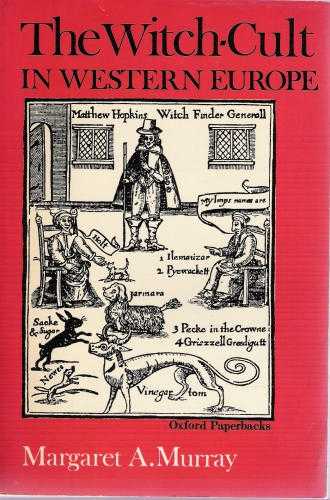
Just under a century ago, in 1921, one of the strangest books ever to be published by Oxford University Press appeared in print: The Witch-Cult in Western Europe by Margaret Alice Murray. By today’s academic standards — in fact, even by the standards of the 1920s — Murray’s book was filled with transparent flaws in methodology and research. Furthermore, the book’s author (a leading Egyptologist) was not qualified to write it. The few scholars then working on the history of European witchcraft dismissed Murray’s contribution. Yet in spite of this, The Witch-Cult in Western Europe became an instant hit and captured the imaginations of readers. Within three decades, the book had not only profoundly influenced cultural understandings of witchcraft, but also directly led to the rise of neopaganism and the foundation of a new religion, Wicca, that today has millions of adherents throughout the world.

Margaret Alice Murray (1863–1963) was born and brought up in British India — an upbringing that, as with so many Anglo-Indians of the nineteenth century, may have opened her mind to interests beyond Victorian culture. Determined to pursue a career of her own at a time when opportunities for women were limited, Murray tried out both nursing and social work before entering the progressive University College London in 1894, where she studied Egyptology under W. Flinders Petrie. Murray rapidly rose through the academic ranks, and by 1914, she was effectively running the Egyptology department. Her impressive achievements in advancing knowledge of ancient Egypt and higher education for women have, however, been largely overshadowed by her decision to take a detour into writing about European witchcraft.

In The Witch-Cult in Western Europe, Murray seized on some unusual testimonies in 16th-century Scottish witch trials to elaborate a radical theory: She claimed that what medieval and early modern people called witchcraft was, in fact, the last traces of a pagan fertility cult that originated in the Neolithic period. The witch trials of the 15th–17th centuries represented Christianity’s last attempt to stamp out this cult, which was practiced in secret covens (groups of thirteen people) who worshipped a horned god (who was mistaken for the devil). Knowledge of this cult was passed through families or, occasionally, to new initiates, but kept secret from the outside world.

Murray’s use of a single set of problematic sources from one country (Scotland) to argue that a previously unnoticed religion had existed since prehistory failed to meet basic historiographical and anthropological standards of research. She was given to making huge conceptual leaps on the basis of contentious interpretations of meager evidence. Using a small range of hostile trial records designed to discredit women accused of witchcraft (along with testimonies extracted under torture), Murray reconstructed what she believed were real religious practices lurking behind the demonological construct of the Witches’ Sabbath. In so doing, she brought together traditions of interpretation honed by the anthropologist Sir James Frazer (1854–1941), the author of The Golden Bough, and the French historian Jules Michelet (1798-1874). Murray followed Michelet in arguing that those accused of witchcraft were not the innocent victims of trumped-up charges, but were in fact adherents of a subversive cult; and she followed Frazer in her belief that prehistoric religious beliefs, associated with fertility, had survived into recent times.

August 26, 2020

“Your Strict Thesis is not Correct!” – WW2 – Reading Comments

Filed under: Europe, Germany, History, Military, Russia, Weapons, WW2 — Tags: , , , , , — Nicholas @ 04:00

World War Two
Published 25 Aug 2020

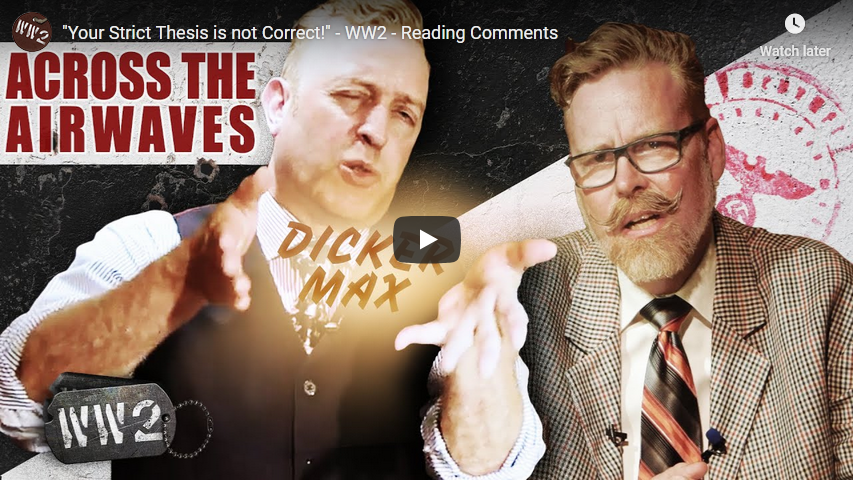
Indy and Sparty are back again for “Across the Airwaves”, where we look at interesting and unique comments from our videos and forums. In this episode, we will look at foreign volunteers in the SS, and the Polish experience in World War Two.

Join us on Patreon: https://www.patreon.com/TimeGhostHistory
Or join The TimeGhost Army directly at: https://timeghost.tv

Follow WW2 day by day on Instagram @World_war_two_realtime https://www.instagram.com/world_war_two_realtime
Between 2 Wars: https://www.youtube.com/playlist?list…
Source list: http://bit.ly/WW2sources

Hosted by: Indy Neidell & Spartacus Olsson
Director: Astrid Deinhard
Producers: Astrid Deinhard and Spartacus Olsson
Executive Producers: Astrid Deinhard, Indy Neidell, Spartacus Olsson, Bodo Rittenauer
Creative Producer: Joram Appel
Post-Production Director: Wieke Kapteijns
Research by: Francis van Berkel
Edited by: Karolina Dołęga
Sound design: Marek Kamiński
Maps: Eastory (https://www.youtube.com/c/eastory) & Karolina Dołęga

Colorizations by:
Jaris Almazani (Artistic Man), https://instagram.com/artistic.man?ig…

Visual Sources:
Imperial War Museums: KID1265, STT 4459, 009752., D26726, D26731
Bundesarchive
Auschwitz Memorial and Museum
Icons from The Noun Project by: Icon Lauk, iconixar, Evgeni Moryakov, Panzano, Adrien Coquet, Eucalyp, Eris Natansa, Gan Khoon Lay, sumirna, priyanka & Danishicon

Music:
“The Inspector 4” – Johannes Bornlöf
“Remembrance” – Fabien Tell
“Superior” – Silver Maple
“Rush of Blood” – Reynard Seidel
“London” – Howard Harper-Barnes
“Never Forget” – Fabien Tell
“Guilty Shadows 4” – Andreas Jamsheree

Archive by Screenocean/Reuters https://www.screenocean.com.

A TimeGhost chronological documentary produced by OnLion Entertainment GmbH.

Sir Anthony Blunt, the “Fourth Man”

Filed under: Britain, History, Military, Russia, WW2 — Tags: , , , , , — Nicholas @ 03:00

In The Critic, David Herman reviews a new book on the unmasking of Soviet spy … and close associate of the Royal family, Sir Anthony Blunt by Prime Minister Margaret Thatcher in 1979:

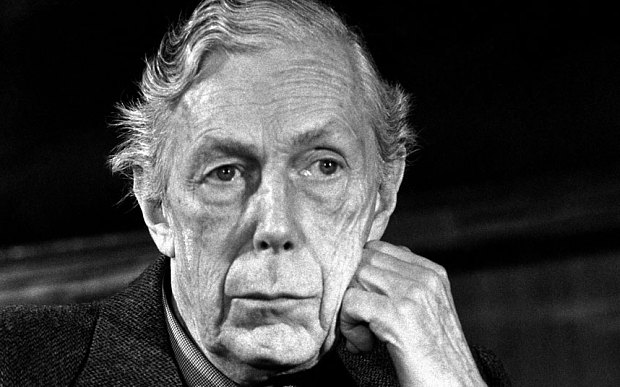
Anthony Blunt (1907-1983), was the “Fourth Man” in the Cambridge spy ring that supplied the Soviets with secret documents from within Britain’s WW2 intelligence services.

In November 1979, the newly elected Prime Minister, Margaret Thatcher, named Professor Sir Anthony Blunt, one of the most distinguished art historians in post-war Britain, as the “Fourth Man”, one of the traitors known as the “Cambridge Spies”, a group of spies working for the Soviet Union from the 1930s to at least the early 1950s. Mrs. Thatcher did not pull her punches. She regarded Blunt’s behaviour as “contemptible and repugnant”, and she was appalled by the evidence of treason and treachery at the heart of the British establishment.

What set Blunt apart from the others – Guy Burgess, Donald Maclean and Kim Philby – was his distinguished academic career. Blunt was professor of art history at the University of London, director of the Courtauld Institute of Art and Surveyor of the Queen’s Pictures. He was related to the Queen Mother. His students included such famous figures as Anita Brookner, Sir Nicholas Serota, Sir Neil Macgregor and Sir Alan Bowness. He also passed 1,771 documents to his Soviet spymasters during the war while working for MI5. For some of this time, the Soviet Union was a foreign enemy, allied to Nazi Germany.

The mix of homosexuality, 1930s Cambridge and treason, the scholar and the spy, made a compelling story and Blunt has been the subject of a famous essay in The New Yorker by George Steiner (“The Cleric of Treason”, 8 December, 1980), plays by Dennis Potter (Blade on the Feather, 1980), Alan Bennett (A Question of Attribution, 1988) and a novel by John Banville (The Untouchable, 1997). More recently, he has turned up in the third season of The Crown (2019), played by Samuel West. Had Alex Jennings not already played the Duke of Windsor in earlier series of The Crown, he would have been perfect casting.

After Mrs. Thatcher’s revelations in the House of Commons, Blunt was immediately stripped of his knighthood and he was subsequently forced to resign his Honorary Fellowship at Trinity College, Cambridge. The University of London, however, did not take away his Emeritus Professorship and the French government did not strip him of his Legion of Honour. There could be no criminal proceedings against Blunt because in 1964 he had only admitted his guilt in exchange for guaranteed immunity for any subsequent prosecution for the rest of his life.

The question then arose how should the British Academy respond? Blunt had been a Fellow for almost twenty years. He had served as a Vice-President and was talked of as a possible future President.

Almost immediately lines were drawn and leading figures like the historians John H. Plumb and A.J.P. Taylor threatened to resign from the Academy. It was a spectacular bunfight and the press had a wonderful time.

London-Made Lorenzonis Repeating Flintlocks

Filed under: Britain, History, Weapons — Tags: , , , — Nicholas @ 02:00

Forgotten Weapons
Published 26 Aug 2016

Sold for $28,750 (for the pair).

A 7-shot repeating handgun before cartridges had been invented? Yep, long before. These two pistols are London-made examples of the Lorenzoni system, in which a gun was made with internal magazines of powder and projectiles and a rotating central loading spindle like a modern reloading powder throw. By rotating a lever on the left side of pistol 180 degrees and back, a shooter could load a ball into the chamber, load powder behind it, recock the action, prime the pan, and close the frizzen all in one automated sequence.

This system originated with a German gunsmith named Kalthoff in the mid 1600s, but it was an Italian by the name of Lorenzoni who made it more practical and began building pistols of the type. Lorenzoni is the name that has been generally applied to the system as a result. These two were made by a gunsmith named Glass in London in the mid 1700s — in those days of hand-made firearms, ideas and systems like this would slowly spread and be adopted by craftsmen who were capable of producing them and thought they could find an interested market for them.

The Lorenzoni system offered unmatched repeating firepower for its time, but was hampered by its complexity. Only a very skilled gunsmith could build a reliable and safe pistol of the type, and this made them very expensive.

http://www.patreon.com/ForgottenWeapons

August 25, 2020

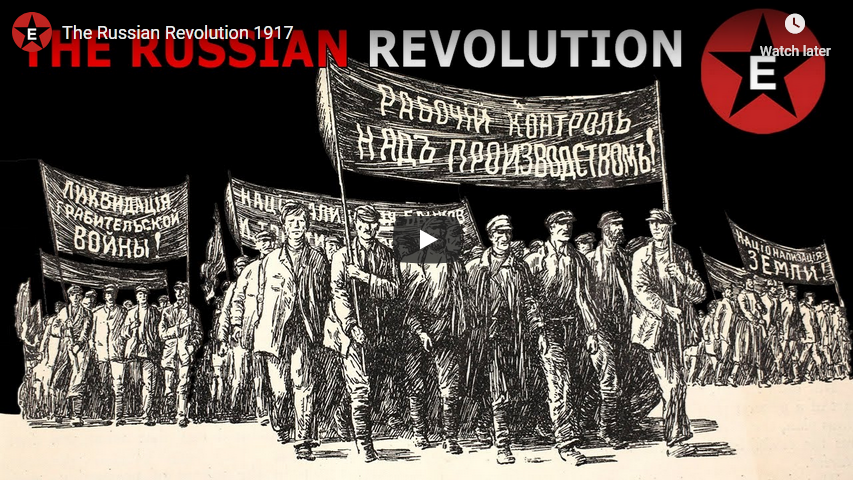
The Russian Revolution 1917

Filed under: Government, History, Military, Russia, WW1 — Tags: , , , , , , — Nicholas @ 06:00

Epic History TV
Published 4 Aug 2016

Everything you need to know about the Russian Revolution in a 13 min video. Produced in partnership with Bridgeman Images http://www.bridgemanimages.com/en-GB/

We explain all the major events of Russia’s TWO revolutions of 1917 – the February Revolution that ended Tsarist rule in Russia, and the October Revolution, that brought the Bolsheviks to power. We explain the causes of Tsar Nicholas II’s growing unpopularity – the role of the mysterious Siberian mystic Rasputin, Russia’s disastrous involvement in World War One, and the events on the streets of Petrograd that led to the Tsar’s abdication. That summer Russia lurched from crisis to crisis, with a Provisional Government that faced riots (the July Days), military revolt (the Kornilov Affair), economic chaos, and constantly dwindling support. Socialist Prime Minister Alexander Kerensky, once hailed as Russia’s great hope, was unable to restore order, or, in October, prevent the Bolsheviks from launching a coup, organised by Leon Trotsky and led by Vladimir Lenin, that overthrow the Provisional Government and brought the Bolsheviks to power. A brutal civil war followed, leading to the death of more than 10 million Russians – amongst them Tsar Nicholas II and his family, executed by Bolsheviks at Yekaterinburg in July 1918. From the wreckage emerged the Soviet Union, formed in 1922, and destined to be one of the 20th century’s two superpowers.

Please help me make more history videos by supporting me at Patreon: https://www.patreon.com/epichistorytv

#EpicHistoryTV #HistoryofRussia #RussianRevolution

Recommended books on the Russian Revolution (as an Amazon Associate I earn from qualifying purchases):
S. A. Smith, The Russian Revolution: A Very Short Introduction http://geni.us/RzOAk2U
Orlando Figes, A People’s Tragedy: The Russian Revolution http://geni.us/UIxyirj
Robert Service, The Last of the Tsars: Nicholas II and the Russian Revolution http://geni.us/A89T
Neil Faulkner, A People’s History of the Russian Revolution http://geni.us/bME0unl

The Bronze Age Changes with Archeological Evidence

Filed under: Architecture, History, Middle East, Science, Technology — Tags: , , , , — Nicholas @ 04:00

The Cynical Historian
Published 22 Feb 2019

Check out the full collaboration playlist here: https://www.youtube.com/playlist?list…

Up until the 19th century, the Bronze Age was merely a time of legends, where the Bible and Iliad told fantastic tales of brutality and triumph. But archeology changed that, and that’s what I want to talk about today, how the Bronze Age was rescued from legend.
————————————————————
references:
Stephen L. Dyson, “Archaeology and Ancient History,” in A Companion to Ancient History, edited by Andrew Erskine (Malden, Mass.: Blackwell Publishers, 2002), 59-66. https://amzn.to/2PCf04X

Marie-Henriette Gates, “Archeology and the Ancient Near East: Methods and Limits,” in A Companion to the Ancient Near East, edited by Daniel C. Snell (Malden, Mass.: Blackwell Publishers, 2005), 65-79. https://amzn.to/2BrsBqO

Alan B. Lloyd, “Chronology,” in A Companion to Ancient Egypt, vol. 1, edited by Alan B. Lloyd (Malden, Mass.: Blackwell Publishers, 2010), xxxii-xliii. https://amzn.to/2LqGZnM

John Marincola, “Historiography,” in A Companion to Ancient History, edited by Andrew Erskine (Malden, Mass.: Blackwell Publishers, 2002), 13-22. https://amzn.to/2PCf04X

John Van Seters, “Historiography in Ancient Israel,” in A Companion to Western Historical Thought, edited by Lloyd Kramer and Sarah Maza (Malden, Mass.: Blackwell Publishers, 2002), 15-34. https://amzn.to/2PAC5Vz

Tim Whitmarsh, “Ancient History through Ancient Literature,” in A Companion to Ancient History, edited by Andrew Erskine (Malden, Mass.: Blackwell Publishers, 2002), 77-86. https://amzn.to/2PCf04X
————————————————————
Support the channel through PATREON:
https://www.patreon.com/CynicalHistorian
or pick up some merchandise at SpreadShirt:
https://shop.spreadshirt.com/cynicalh…

LET’S CONNECT:
Discord: https://discord.gg/Ukthk4U
Twitter: https://twitter.com/Cynical_History
————————————————————
Wiki: The Bronze Age is a historical period characterized by the use of bronze, and in some areas proto-writing, and other early features of urban civilization. The Bronze Age is the second principal period of the three-age Stone-Bronze-Iron system, as proposed in modern times by Christian Jürgensen Thomsen, for classifying and studying ancient societies.

An ancient civilization is defined to be in the Bronze Age either by producing bronze by smelting its own copper and alloying with tin, arsenic, or other metals, or by trading for bronze from production areas elsewhere. Bronze itself is harder and more durable than other metals available at the time, allowing Bronze Age civilizations to gain a technological advantage.

Copper-tin ores are rare, as reflected in the fact that there were no tin bronzes in Western Asia before trading in bronze began in the third millennium BC. Worldwide, the Bronze Age generally followed the Neolithic period, with the Chalcolithic serving as a transition. Although the Iron Age generally followed the Bronze Age, in some areas (such as Sub-Saharan Africa), the Iron Age intruded directly on the Neolithic.

Bronze Age cultures differed in their development of the first writing. According to archaeological evidence, cultures in Mesopotamia (cuneiform script) and Egypt (hieroglyphs) developed the earliest viable writing systems
————————————————————
Hashtags: #history #TheBronzeAge #archeology #BronzeBonanza

How we used to “dine out” (and someday might be able to again)

Filed under: Books, Britain, Business, Europe, Food, France, History — Tags: , , , , , — Nicholas @ 03:00

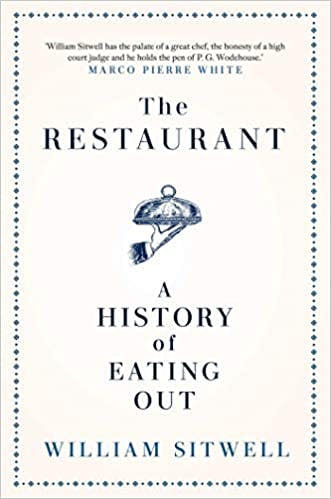
In The Critic, Alexander Larman reviews The Restaurant: A history of eating out by William Sitwell:

The recent enforced lockdown closure was a potential death blow to the entire [restaurant] industry. Which makes William Sitwell’s luxurious book both a celebration and an unintentional requiem for what may be a bygone time.

His central thesis is clear: the history of dining out is also a social history of evolving cultures and tastes. This means that the subjects he writes about range from ancient Pompeii to the growth of the sushi conveyor belt restaurant, encompassing everything from medieval taverns and the French Revolution to the rise of Anglo-Indian cuisine.

It is a broad and impressive spectrum, but perhaps Sitwell has, like some of the less fortunate people he describes, bitten off more than he can chew. His opening chapter about Pompeii is rich in surprising detail (graffiti uncovered outside one tavern when it was excavated ranged from the poetic — “Lovers are like bees in that they lead a honeyed life” — to the crude — “I screwed the barmaid”) and an insightful evocation of the dining culture in Ancient Rome.

He is then, unfortunately, faced with the insurmountable difficulty that the restaurant, as we know it today, did not exist until the late eighteenth century, meaning that his definition of “eating out” has to do some extremely heavy lifting.

There is as much padding in the early chapters as there is around some of his subjects’ waistlines. Much of what he writes is very interesting and often amusing, such as the way in which coffee, first drunk in London around the time of the Restoration, became associated both with health-giving properties and reportedly making men impotent, withered “cock-sparrows”. Yet there are also lengthy sections that have little or nothing to do with restaurants, such as a potted history of the Industrial Revolution.

Nevertheless, when Sitwell finally gets into his stride and begins to write about eateries proper, his authority and enthusiasm are palpable. He describes the dawn of fine dining in Paris in the nineteenth century evocatively. London lagged behind, although gentlemen’s clubs such as the Athenaeum and Reform offered some delights for the wealthy thanks to chefs (French, naturally) such as Alexis Soyer who implemented what one biographer called “the most famous and influential working kitchen in Europe” in 1841, complete with gas-fired stoves, butcher’s rooms and a fireplace devoted to the roasting of game and poultry.

QotD: Collective punishment

We used to take calls for collective punishment much more seriously. In the 1949 Geneva Convention it was determined that: “No protected person may be punished for an offense he or she has not personally committed.” Collective punishment was seen as a tactic designed to intimidate and subdue an entire population. The drafters of the Geneva Convention clearly had in mind the atrocities committed in WWI and WWII where entire villages and communities suffered mass retribution for the resistance activities of a few. In their commentary on the outlawing of collective punishment the International Red Cross stated: “A great step forward has been taken. Responsibility is personal and it will no longer be possible to inflict penalties on persons who have themselves not committed the acts complained of.”

In times of peace, collective punishment may come in the form of social media dust-ups over sombrero hats or Chinese dresses. Gradual softening on the taboo of collective punishment does not bode well for the health of liberal democracies. Which is also why it is important for us all to remember that social-justice activists who complain about cultural appropriation only represent themselves, and not the minority groups to which they belong.

Claire Lehmann, “The Evils of Cultural Appropriation”, Tablet, 2018-06-11.

August 24, 2020

Why the British Army was so effective in 1914 – Learning lessons from the Boer War

Filed under: Africa, Britain, Germany, History, Military, Weapons, WW1 — Tags: , , , , , — Nicholas @ 06:00

History West Midlands
Published 10 Oct 2014

When Britain despatched an Expeditionary Force (the BEF) to the Continent in August 1914, the German Kaiser issued an order of the day to his generals to “walk over General French’s contemptible little army”.

But despite being heavily outnumbered, this small force, including many men from the West Midlands, played a vital role in stopping the seemingly overwhelming German advance across Belgium and into France.

Small in size compared with the much larger armies of France and Germany, the BEF was highly effective. This was in stark contrast to the disasters that the British Army had experienced a few years earlier at the start of the Second Boer War (1899-1902) in South Africa.

« Newer Posts — Older Posts »

Powered by WordPress