IT’S HISTORY
Published 13 May 2015It was the defining moment of the British naval history and let the groundwork for their naval superiority over the next century. Horatio Nelson’s brilliant battle tactics let to a decisive victory over Napoleon’s French Navy. Find out all about the famous Battle of Trafalgar with Indy on IT’S HISTORY.
» The Complete Piracy-PLAYLIST: http://bit.ly/PiratePlaylist
» ALL EPISODES of Battlefields: http://bit.ly/BattlefieldsOfHistory
» JOIN OUR COMMUNITY FOR MORE HISTORY KNOWLEDGE!
Follow us on Twitter: http://twitter.com/thehistoryshow
Your photos on Instagram: https://instagram.com/itshistorychannel» SOURCES
Videos: British Pathé (https://www.youtube.com/user/britishp…)
Pictures: mainly Picture Alliance» ABOUT US
IT’S HISTORY is a ride through history – Join us discovering the world’s most important eras in IN TIME, BIOGRAPHIES of the GREATEST MINDS and the most important INVENTIONS.» HOW CAN I SUPPORT YOUR CHANNEL?
You can support us by sharing our videos with your friends and spreading the word about our work.» CAN I EMBED YOUR VIDEOS ON MY WEBSITE?
Of course, you can embed our videos on your website. We are happy if you show our channel to your friends, fellow students, classmates, professors, teachers or neighbors. Or just share our videos on Facebook, Twitter, Reddit etc. Subscribe to our channel and like our videos with a thumbs up.» CAN I SHOW YOUR VIDEOS IN CLASS?
Of course! Tell your teachers or professors about our channel and our videos. We’re happy if we can contribute with our videos.» CREDITS
Presented by: Indy Neidell
Based on the script by: Daniel Hungerford
Directed By: Daniel Czepelczauer
Director of Photography: Markus Kretzschmar
Music: Markus Kretzschmar and Daniel Czepelczauer
Sound Design: Bojan Novic
Editing: Markus KretzschmarA Mediakraft Networks original channel
Based on a concept by Florian Wittig and Daniel Czepelczauer
Executive Producers: Astrid Deinhard-Olsson, Spartacus Olsson
Head of Production: Michael Wendt
Producer: Daniel Czepelczauer
Social Media Producer: Hendrik Sontheim
Social Media Manager: Florian Wittig and Laura PaganContains material licensed from British Pathé
All rights reserved – © Mediakraft Networks GmbH, 2015
May 9, 2020
The Battle of Trafalgar – Admiral Nelson’s Moment
May 8, 2020
Sending the Jews to Madagascar? – War Against Humanity 011 – May 1941
World War Two
Published 7 May 2020The War Against Humanity is accelerating and accelerating. Across the world, people live under oppression. In Nazi Europe, solutions to the so-called “Jewish Question” has taken on new, fantastical, proportions.
Join us on Patreon: https://www.patreon.com/TimeGhostHistory
Or join The TimeGhost Army directly at: https://timeghost.tvFollow WW2 day by day on Instagram @World_war_two_realtime https://www.instagram.com/world_war_t…
Between 2 Wars: https://www.youtube.com/playlist?list…
Source list: http://bit.ly/WW2sourcesHosted by: Spartacus Olsson
Written by: Francis van Berkel, Spartacus Olsson
Director: Astrid Deinhard
Producers: Astrid Deinhard and Spartacus Olsson
Executive Producers: Astrid Deinhard, Indy Neidell, Spartacus Olsson, Bodo Rittenauer
Creative Producer: Joram Appel
Post-Production Director: Wieke Kapteijns
Research by: Francis van Berkel
Edited by: Mikołaj Cackowski
Sound design: Marek Kamiński
Map animations: Eastory (https://www.youtube.com/c/eastory)Colorizations by:
Olga Shirnina https://klimbim2014.wordpress.com
Dememorabilia – https://www.instagram.com/dememorabilia/
Norman Stewart – https://oldtimesincolor.blogspot.com/Sources:
IWM HU 106212
USHMM
Bundesarchiv
Narodowe Archiwum Cyfrowe
Glaser family photo, courtesy Willie Glaser
from the Noun Project: Letter by Mochammad Kafi, people by ProSymbols, Deteriorated building by Tokka Elkholy, workshop by Gan Khoon Lay from the Noun Project
Page 1 of La Loi Portant Status Des Juifs with Pétain’s annotations, courtesy Mémorial de la ShoahSoundtracks from the Epidemic Sound:
Reynard Seidel – “Deflection”
Farell Wooten – “Blunt Object”
Philip Ayers – “Trapped in a Maze”
Wendel Scherer – “Growing Doubt”
Gavin Luke – “Drifting Emotions 3”
Johannes Bornlof – “The Inspector 4”
Andreas Jamsheree – “Guilty Shadows 4”
Peter Sandberg – “Document This 1”
Jo Wandrini – “Dawn Of Civilization”
Gunnar Johnsen – “Not Safe Yet”
Philip Ayers – “Under the Dome”Archive by Screenocean/Reuters https://www.screenocean.com.
A TimeGhost chronological documentary produced by OnLion Entertainment GmbH.
Soldier of Three Armies Pt. 3 – Vietnam War – Sabaton History 066 [Official]
Sabaton History
Published 7 May 2020Crossed the water a new start, war still beating in his heart, a new legend has been born.
Arrested by the Finnish secret police and tried for treason, war-hero and living legend Lauri Törni realized that his home country held no more future for him any longer. Törni made a run for it. Towards a new country, a new life and a new name. And a new war.
Support Sabaton History on Patreon: https://www.patreon.com/sabatonhistory
Listen to “Soldier of Three Armies” on the album Heroes:
CD: http://bit.ly/HeroesStore
Spotify: http://bit.ly/HeroesSpotify
Apple Music: http://bit.ly/HeroesAppleMusic
iTunes: http://bit.ly/HeroesiTunes
Amazon: http://bit.ly/HeroesAmz
Google Play: http://bit.ly/HeroesGooglePCheck out the trailer for Sabaton’s new album The Great War right here: https://www.youtube.com/watch?v=HCZP1…
Listen to Sabaton on Spotify: http://smarturl.it/SabatonSpotify
Official Sabaton Merchandise Shop: http://bit.ly/SabatonOfficialShopHosted by: Indy Neidell
Written by: Markus Linke and Indy Neidell
Directed by: Astrid Deinhard and Wieke Kapteijns
Produced by: Pär Sundström, Astrid Deinhard and Spartacus Olsson
Creative Producer: Joram Appel
Executive Producers: Pär Sundström, Joakim Broden, Tomas Sunmo, Indy Neidell, Astrid Deinhard, and Spartacus Olsson
Post-Production Director: Wieke Kapteijns
Edited by: Iryna Dulka
Sound Editing by: Marek Kaminski
Maps by: Eastory – https://www.youtube.com/c/eastoryArchive by: Reuters/Screenocean https://www.screenocean.com
Music by Sabaton.Sources:
– Helsinki City Museum
– KANSALLISARKISTO
– Lauri Törni in 1951 from Forum Marinum, CC BY-ND 4.0
– Cricket sound by damonmensch from freesound.org
– Photo of Lauri and Marja courtesy of Hillevi KopsAn OnLion Entertainment GmbH and Raging Beaver Publishing AB co-Production.
© Raging Beaver Publishing AB, 2019 – all rights reserved.
Fallen flag — the Atchison, Topeka & Santa Fe Railway
This month’s fallen flag article for Classic Trains is the story of the Atchison, Topeka & Santa Fe Railway by George Drury:

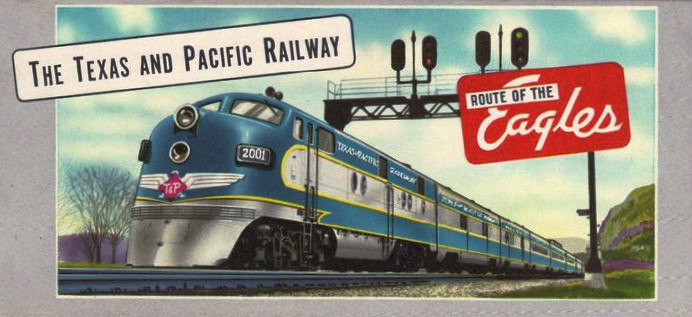
Pages from a circa 1937 booklet about the Santa Fe trains The Chief and the Super Chief. The railroad was showcasing the streamlined changes made to its main Chicago to California trains. Super Chief had given up its boxcab locomotives for EMC E1 units. Chief was no longer pulled by the “Blue Goose” steam locomotive, but by EMD diesel locomotives.
Wikimedia Commons.
The Atchison & Topeka Railroad was chartered in 1859 to join the towns of its title and continue southwest toward Santa Fe, New Mexico.
“Santa Fe” was added to the corporate name in 1863. Construction started in 1869; by the end of 1872 the railroad extended to the Kansas-Colorado border, opening much of Kansas to settlement and carrying wheat and cattle east to markets. The railroad temporarily set aside its goal of Santa Fe — once the trading capital of the Spanish colony in that area — and continued building west, reaching Pueblo, Colorado, in 1876, just in time for the silver rush at Leadville, Colorado.
In 1878, the railroad resumed construction toward Santa Fe, building southwest from La Junta to Trinidad, Colorado, then south over Raton Pass. It chose that route instead of an easier route south across the plains from Dodge City because of Native American attacks and a lack of water on the southerly route and coal deposits near Trinidad, Colorado, and Raton, New Mexico.
The Denver & Rio Grande was also aiming at Raton Pass, but Santa Fe crews arose early one morning in 1878 and were hard at work with picks and shovels when the Rio Grande crews showed up after breakfast. At the same time the two railroads skirmished over occupancy of the Royal Gorge of the Arkansas River west of Canon City, Colorado; the Rio Grande won that battle.
The Santa Fe reached Albuquerque, New Mexico, in 1880 (because of geography the city of Santa Fe found itself at the end of a short branch from Lamy, New Mexico) and connected with the Southern Pacific at Deming, New Mexico, in 1881. The Santa Fe then built southwest from Benson, Arizona, to Nogales, on the Mexican border. There it connected with the Sonora Railway, which Santa Fe interests had constructed north from the Mexican port of Guaymas.

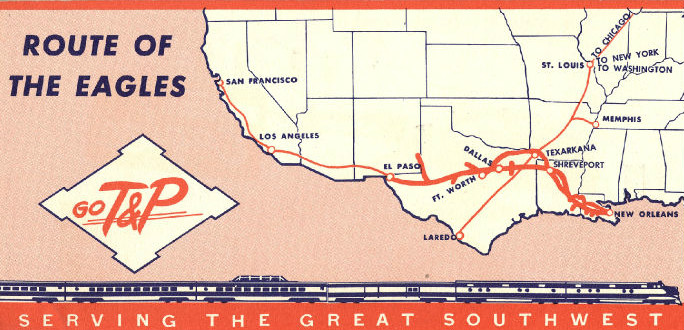
Comparison map showing the Santa Fe Trail and the ATSF Railway, 1922.
Map from By the Way – A condensed guide of points of interest along the Santa Fe lines to California, Rand McNally and Company via Wikimedia Commons.
In 1960 the Santa Fe bought the Toledo, Peoria & Western Railroad, then sold a half interest to the Pennsylvania Railroad. The TP&W cut straight east across Illinois from near Fort Madison, Iowa, to a connection with the Pennsy at Effner, Indiana, forming a bypass around Chicago for traffic moving between the two lines. The TP&W route didn’t mesh with the traffic pattern Conrail developed after 1976, so Santa Fe bought back the other half, merged the TP&W in 1983, then sold it back into independence in 1989.
During the 1960s the Santa Fe explored merger with the Frisco and the Missouri Pacific with no success. By 1980 Santa Fe, which had been the top railroad in route mileage in the 1950s, was surrounded by larger railroads. It was well managed and profitable, and it had the best route between the Midwest and Southern California, but its neighbors were larger, and friendly connections had been taken over by rival railroads. Southern Pacific was in the same situation. In 1980 Santa Fe and SP proposed merger. Approval seemed certain, but in 1986 the Interstate Commerce Commission denied permission because the merger would create a railroad monopoly in New Mexico, Arizona, and California.
The Santa Fe, suddenly the smallest of the Super Seven freight railroads, began spinning off branches and secondary lines and became primarily a conduit for containers and trailers moving between the Midwest and Southern California. In June 1994 Santa Fe and Burlington Northern announced their intention to merge — BN would buy Santa Fe. The deal was consummated in 1995, forming the Burlington Northern Santa Fe, known today as BNSF Railway.
The denied merger between the Southern Pacific and the Santa Fe included an eye-catching proposed “Kodachrome” paint scheme for locomotives, as described in the Wikipedia article:
The holding company controlled all the rail and non-rail assets of the former Santa Fe Industries and Southern Pacific Company, and it was intended that the two railroads would be merged. They were confident enough that this would be approved that they began repainting locomotives into a new unified paint scheme, including the letters SP or SF and an adjacent empty space for the other two (as SPSF, the reverse order of the holding company).
The locomotive livery featured the Santa Fe’s Yellowbonnet with a red stripe on the locomotive’s nose; the remainder of the locomotive body was painted in Southern Pacific’s scarlet red (from their Bloody Nose scheme) with a black roof and black extending down to the lower part of the locomotive’s radiator grills. The numberboards were red with white numbers. In large block letters within the red portion of the sides was either “SP” (for Southern Pacific-owned locomotives) or “SF” (for Santa Fe-owned locomotives). The lettering was positioned on the locomotive sides so that the other half of the lettering could be added after the merger became official. Two ATSF EMD SD45-2s (ATSF #7219 and #7221) were painted with the full SPSF lettering to show what the unified paint scheme would look like after the merger was complete. One Santa Fe caboose was also painted with “SPSF” in a similar situation.
This paint scheme, combining yellow, red and black, has come to be called the Kodachrome paint scheme due to the colors’ resemblance to those on the boxes that Kodak used to package its Kodachrome slide film (which was heavily used by railfans of the time). After the ICC’s denial, railroad industry writers, employees of both railroads and railfans alike joked that SPSF really stood for “Shouldn’t Paint So Fast”.
Weapons as Political Protest: P.A. Luty’s Submachine Gun
Forgotten Weapons
Published 2 Aug 2017Armament Research Services (ARES) is a specialist technical intelligence consultancy, offering expertise and analysis to a range of government and non-government entities in the arms and munitions field. For detailed photos of the guns in this video, don’t miss the ARES companion blog post:
http://armamentresearch.com/pa-luty-9…
Phillip A. Luty was a Briton who took a hard philosophical line against gun control legislation in the UK in the 1990s. In response to more restrictive gun control laws, he set out to prove that all such laws were ultimately futile by showing that one could manufacture a functional firearm from hardware store goods, without using any purpose-made firearms parts.
Luty succeeded in this task, designing a 9mm submachine gun made completely from scratch with a minimum of tools. In 1998, he published the plans for his gun as the book Expedient Homemade Firearms. Luty was not particularly discreet about his activities (actually, he was quite outspoken…) and was eventually caught by the police while out to test fire one of his guns, and arrested. He was convicted, and spent several years in prison. He continued to pursue a gun rights agenda after being released, and was facing legal trouble again when he passed away from cancer in 2011.
Several of Luty’s submachine guns are still held in the collection of the Royal Armouries’ National Firearms Centre, including the one that led to his original conviction. Many thanks to the NFC for allowing me to bring that weapon to you!
http://www.patreon.com/ForgottenWeapons
Cool Forgotten Weapons merch! http://shop.bbtv.com/collections/forg…
If you enjoy Forgotten Weapons, check out its sister channel, InRangeTV! http://www.youtube.com/InRangeTVShow
QotD: Measuring beauty
Helen of Troy was renowned as a very beautiful woman, said to have possessed “the face that launched a thousand ships” (i.e. to invade Troy and rescue her). Her name has thus become a unit of measure of beauty. For example, a millihelen has been defined as “the amount of beauty needed to launch a single ship”, whereas a negative helen is “the amount of negative beauty (i.e. ugliness) that can beach a thousand ships”.
Peter Grant, “How do you measure up?”, Mad Genius Club, 2018-01-28.
May 7, 2020
1947: From Dutch Boy to Murderer – 1st “Police Actions” | The Indonesian War of Independence Part 3
TimeGhost History
Published 6 May 2020The Dutch are desperate to regain control over their colony as the Lingadjatti Treaty failed to deliver. They launch a brutal military offensive which they mask as “police actions” in an attempt to satisfy the international community.
Join us on Patreon: https://www.patreon.com/TimeGhostHistory
Hosted by: Indy Neidell
Written by: Joram Appel
Director: Astrid Deinhard
Producers: Astrid Deinhard and Spartacus Olsson
Executive Producers: Astrid Deinhard, Indy Neidell, Spartacus Olsson, Bodo Rittenauer
Creative Producer: Joram Appel
Post-Production Director: Wieke Kapteijns
Research by: Joram Appel and Isabel Wilson
Edited by: Karolina Dołęga
Sound design: Marek KamińskiColorizations:
Carlos Ortega Pereira (BlauColorizations) – https://www.instagram.com/blaucoloriz…
Dememorabilia – https://www.instagram.com/dememorabilia/
Jaris Almazani (Artistic Man) – https://instagram.com/artistic.man?ig…
KlimbimResearch Sources: https://bit.ly/IndoSources
Visual Sources:
Nationaal Archief
Tropenmuseum, part of the National Museum of World Cultures
Archive by Screenocean/Reuters https://www.screenocean.com.Music:
“Last Point of Safe Return” – Fabien Tell
“Guilty Shadows 4” – Andreas Jamsheree
“Epic Adventure Theme 4” – Håkan Eriksson
“Symphony of the Cold-Blooded” – Christian Andersen
“Disciples of Sun Tzu” – Christian Andersen
“March Of The Brave 10” – Rannar Sillard – Test
“Remembrance” – Fabien Tell
“Moving to Disturbia” – Experia
“Deflection” – Reynard Seidel
“Heroes On Horses” – Gunnar Johnsén
“Not Safe Yet” – Gunnar Johnsen
“Ominous” – Philip Ayers
“Last Point of Safe Return” – Fabien Tell
“Epic Adventure Theme 4” – Håkan Eriksson
“Walk With Legends” – Bonnie Grace
“Epic Adventure Theme 4” – Håkan ErikssonA TimeGhost chronological documentary produced by OnLion Entertainment GmbH.
“When it’s over we can shave the heads of a few easy victims and vilify a few who enjoyed it too much. But I collaborated too.”
The mandatory shutdown of most of the world’s economy is inducing some introspection:

Prime Minister Boris Johnson at his first Cabinet meeting in Downing Street, 25 July 2019.
Official photograph via Wikimedia Commons.
I looked again at the decisions of the Johnson government. Should they have followed my instincts? No lockdown. Shield the elderly and the vulnerable, like my elder daughters immuno-deficient boyfriend, but let all normal life continue. Let the virus rip. Let the football league play out its conclusion and more to the point let out beloved Dundee Stars Elite Ice Hockey Club break our hearts and miss the playoffs. Such a government would probably have fallen within days, battered by the broadcast media, backbench rebellion and a nation that preferred to be kept safe from the unknown that they feared. Had they survived the month, then the elderly who by choice refused to be shielded would have pitched up in their thousands at A&E, to be faced with experienced nurses like my wife who triaged them on the doorstep and sent many of them home to die, to preserve the ICU beds for those who could be saved. Instead of admitting them so that they could die with every bit as much certainty. Had he survived the first month, Johnson would have fallen regardless and nation would be traumatised by the memory of grandparents sent home to die
Had I been in his shoes, I too would have sued for peace. My nation demanded it of me. I would have convinced myself it was the right thing and when the chest pain and cough arrived, I would have felt relief that I had made the correct call. I would have looked at the Malice of Piers Morgan and convinced myself that I was still moderate. I would have dismissed the feeble objections of lunatic libertarians.
When it’s over we can shave the heads of a few easy victims and vilify a few who enjoyed it too much. But I collaborated too.
QotD: Chestnuts
Now that the consensus of media dieticians is shifting from carbohydrates to fats, I should like to put in a contrary word for chestnuts. They are very starchy indeed, contain little fat, and just a trace of protein. They are delicious roasted or boiled, and can be eaten au naturel once elegantly stripped of their casings. (Whereas, raw potatoes or yams are no fun at all.) They contain vitamins that other foods omit, better apportioned through a delicious nut than by chewing on manganese or copper. Moreover, they are real nuts, not fake ones like almonds and cashews, or peas passing themselves off as “groundnuts”. Those are all fats and useless calories. Chestnuts will make you fat, thus cutting out the middleman.
Which is why they have been fed to pigs, these last few hundred years; that, and the appalling propaganda mounted against chestnuts by our culinary elites. The European poor once ate them in quantity, as their filler; made bread from chestnut flour. Italians, harder to intimidate by fashion than most others, still adore their subtle flavours.
These thoughts were occasioned by a sealed bag of peeled chestnuts, casually purchased the other day as a snack while walking. They were candied in a rather disagreeable way. But worse, I unfortunately failed to read the label attentively, or would have noticed that the contents were “organic”. No intelligent consumer will buy anything on which this warning is prominently displayed. Quite apart from the doubling or tripling of the price, the product itself may be missing some important ingredient.
Children raised on “organic” food become weak and sickly. Those raised “vegan” as well are likely to die. If you find a child perishing in this way, be merciful and fill him with meat and chestnuts.
David Warren, “Chestnuts”, Essays in Idleness, 2018-01-29.
May 6, 2020
Georgy Zhukov – Hero of the Soviet Union! – WW2 Biography Special
World War Two
Published 5 May 2020Georgy Zhukov’s rise to one day become the Hero of the Soviet Union did not happen overnight. Instead, the son of a poor tradesman has slowly worked himself up the ranks of the Red Army using his grit, determination, and iron will.
Join us on Patreon: https://www.patreon.com/TimeGhostHistory
Or join The TimeGhost Army directly at: https://timeghost.tvFollow WW2 day by day on Instagram @World_war_two_realtime https://www.instagram.com/world_war_t…
Between 2 Wars: https://www.youtube.com/playlist?list…
Source list: http://bit.ly/WW2sourcesHosted by: Indy Neidell
Written by: Francis van Berkel
Director: Astrid Deinhard
Producers: Astrid Deinhard and Spartacus Olsson
Executive Producers: Astrid Deinhard, Indy Neidell, Spartacus Olsson, Bodo Rittenauer
Creative Producer: Joram Appel
Post-Production Director: Wieke Kapteijns
Research by: Francis van Berkel
Edited by: Mikołaj Cackowski
Sound design: Marek Kamiński
Map animations: Eastory (https://www.youtube.com/c/eastory)Colorizations by:
Carlos Ortega Pereira, BlauColorizations, https://www.instagram.com/blaucoloriz…
Jaris Almazani (Artistic Man), https://instagram.com/artistic.man?ig…
Olga Shirnina, https://klimbim2014.wordpress.com
Sources:
Mil.ru
Cross of Saint-George Issue for subaltern officers 1917, courtesy Robert Prummel
from the Noun Project: company soldiers by Andrei Yushchenko, ak 47 by TMDSoundtrack from the Epidemic Sound:
Reynard Seidel – “Deflection”
Johannes Bornlof – “The Inspector 4”
Johannes Bornlof – “Deviation In Time”
Rannar Sillard – “March Of The Brave 4”
Johannes Bornlof – “Death And Glory 2”
Phoenix Tail – “At the Front”Archive by Screenocean/Reuters https://www.screenocean.com.
A TimeGhost chronological documentary produced by OnLion Entertainment GmbH.
Quintus Tullius Cicero, Praetor 62 B.C.E.
Thersites the Historian
Published 25 Jul 2018Quintus Tullius Cicero is best known as the younger brother of Marcus Tullius Cicero who wrote a pamphlet on running for the Consulship, but he was also one of Caesar’s legates in Gaul and a braver than average Roman.
Patreon link: https://www.patreon.com/thersites
PayPal link: paypal.me/thersites
Twitter link: https://twitter.com/ThersitesAthens
Minds.com link: https://www.minds.com/ThersitestheHis…
Steemit/dtube link: https://steemit.com/@thersites/feed
Backup Channel: https://www.youtube.com/channel/UCUrD…
QotD: The French philosophes and the “lower orders”
Apart from the different philosophical status they assigned to reason and virtue, the one issue where the contrast between the British and French Enlightenments was sharpest was in their attitudes to the lower orders. This is a distinction that has reverberated through politics ever since. The radical heirs of the Jacobin tradition have always insisted that it is they who speak for the wretched of the earth. In eighteenth-century France, they claimed to speak for the people and the general will. In the nineteenth century, they said they represented the working classes against their capitalist exploiters. In our own time, they have claimed to be on the side of blacks, women, gays, indigenes, refugees, and anyone else they define as the victims of discrimination and oppression. Himmelfarb’s study demonstrates what a façade these claims actually are.
The French philosophes thought the social classes were divided by the chasm not only of poverty but, more crucially, of superstition and ignorance. They despised the lower orders because they were in thrall to Christianity. The editor of the Encyclopédie, Denis Diderot, declared that the common people had no role in the Age of Reason: “The general mass of men are not so made that they can either promote or understand this forward march of the human spirit.” Indeed, “the common people are incredibly stupid,” he said, and were little more than animals: “too idiotic — bestial — too miserable, and too busy” to enlighten themselves. Voltaire agreed. The lower orders lacked the intellect required to reason and so must be left to wallow in superstition. They could be controlled and pacified only by the sanctions and strictures of religion which, Voltaire proclaimed, “must be destroyed among respectable people and left to the canaille large and small, for whom it was made.”
Keith Windschuttle, “Gertrude Himmelfarb and the Enlightenment”, New Criterion, 2020-02.
May 5, 2020
Killer Tanks – The Cromwell
gusty9053
Published 12 Jul 2014
Confusingly, the tank shown in the thumbnail isn’t a Cromwell, and many later tanks are shown in footage that is supposed to be from the Dunkirk evacuation during the Battle of France in 1940 (including wrecked Churchill tanks on the beach at Dieppe in August 1942). The video covers the genesis of the tank in WW1 and the British interwar neglect of tanks, but almost completely ignores light tanks and infantry tanks to concentrate on “cruiser” tank development. Wikipedia has a useful summary of the Cromwell family of tanks:
The Cromwell tank, officially Tank, Cruiser, Mk VIII, Cromwell (A27M), was one of the series of cruiser tanks fielded by Britain in the Second World War. Named after the English Civil War leader Oliver Cromwell, the Cromwell was the first tank put into service by the British to combine high speed from a powerful and reliable engine (the Rolls-Royce Meteor), and reasonable armour. The intended dual-purpose high velocity gun could not be fitted in the turret and the medium velocity dual purpose gun fitted proved inadequate. An improved version with a high velocity gun became the Comet tank.
The name “Cromwell” was initially applied to three vehicles during development. Early Cromwell development led to the creation of the A24 Cavalier. Later Cromwell development led to the creation of the competing Tank, Cruiser, Mk VIII, Centaur (A27L) design. The Centaur tank was closely related to the Cromwell, both vehicles being externally similar. The Cromwell and Centaur tanks differed in the engine used; the Centaur had the 410 hp Liberty engine, the Cromwell had the significantly more powerful 600 hp Meteor.
The Cromwell first saw action in the Battle of Normandy in June 1944. The tank equipped the armoured reconnaissance regiments of the Royal Armoured Corps, in the 7th Armoured Division, 11th Armoured Division and the Guards Armoured Division. While the armoured regiments of the latter two divisions were equipped with M4 Shermans, the armoured regiments of the 7th Armoured Division were equipped with Cromwells. The Centaurs were not used in combat except for those fitted with a 95 mm howitzer, which were used in support of the Royal Marines during the amphibious invasion of Normandy.
[…]
Post war
After the war, the Cromwell remained in British service, and saw service in the Korean War with the 8th King’s Royal Irish Hussars.
Cromwell Tanks were used by Czechoslovakia and Israel.
Fifty-two Centaur I tanks were donated in early 1946 to the Greek Army, during the opening stages of the Greek Civil War but they were kept in storage due to the lack of trained personnel. In 1947, the first Greek officers returned from training courses in the United Kingdom and training of tank crews began. In April 1948, the Centaurs were organised in three Centaur tank companies initially numbered II, IX and XI, but a year later were renumbered 381, 382, 383 and temporarily attached to Reconnaissance Regiments 391, 392, and 393. The Centaurs saw limited service in the war because battles were fought mainly on mountainous areas, but proved useful in supporting infantry units and in defence of inhabited areas. After the end of the war, in October 1949, the three Centaur companies were organised into the 391 Tank Regiment. The Centaurs were replaced by US built M47s and in 1962 were sold and scrapped. One Centaur is preserved in the Greek Army Tank Museum.
The British army, Austria and Jordan used the upgraded Charioteer version of the Cromwell post-war. Jordanian vehicles saw action in conflicts in the Middle-East.
Early Lever-Action Rifles: Volcanic, Henry, Winchester
Forgotten Weapons
Published 6 Feb 2016Hammer prices:
Volcanic – $19,550
1860 Henry – $15,960
1866 Winchester – $8,625We’ve all seen lever action rifles galore in movies about the old west, and most of us have handled and shot a bunch of them as well. But do you know where they came from?
Today we will take a look at the first American lever-action rifle put into successful (more or less) production, the Volcanic. We will then continue to examine the 1860 Henry and the 1866 Winchester to get a foundational understanding of the development of these guns, and the interesting group of people involved with them.
May 4, 2020
The No 4, Mk I* Lee-Enfield: Introduction
britishmuzzleloaders
Published 21 Aug 2018If you would like to support the Channel you can do so through our Patreon Page.
https://www.patreon.com/britishmuzzle…Errata –
The labelling of the “wrongly stamped” Mk III sight should be better described as “confusingly stamped” … the designation refers to the leaf …It should be clarified that the rifle has at some point spent time in India with resultant modifications and maintenance…
Also, as of the 1937 Manual, the safety catch should be applied with the forefinger of the right hand.
For your Martini and Snider needs email Martyn at xringservices@yahoo.com
And for further reading on all British Victorian (and earlier) arms stop by the British Militaria Forum and say hello. http://britishmilitariaforums.yuku.com