Cultural appropriation is good. When ideas from different cultures are imperfectly absorbed, new ideas ensue. Exchange promotes change. I detest empires, but, in deference to truth, praise them as culturally creative arenas in which new ways of life, thought, art, language, worship, work, government and food take shape, as people swap and circulate biota, behaviour and brilliance.
Some of the resulting dishes are deplorable. I could live happily in a world without chop suey, chilli con carne, or coronation chicken. I’m not going to try a recipe described in Eater magazine as “huevos Kathmandu that paired green chutney and spiced chickpeas with fried eggs”.
Tex-mex cuisine is Montezuma’s most effective revenge. Rijstafel conquered the Netherlands more thoroughly than the Dutch ever subjected the East, and now rivals the drearier Hutspot as Holland’s national dish. Yet Dutch food still lags behind grandes cuisines.
Vindaloo is the epitome of culinary appropriation: a Bengali dish with ingredients from the Americas — potatoes and chillies — and a corruption of a Portuguese name: vinho d’alho, or garlic wine. It has become so British that “Vindaloo nah-nah” was the chorus of a chant popular among English football fans at a World Cup tournament (perhaps they confused it with Waterloo). I still dislike it.
Usually, however, culturally exchanged foods produce admirable dishes. Chocolate, tomato and avocado are among the few English words derived from Nahuatl. The Aztecs never used the items they designate in pain au chocolat, or tricolore, or avocado toast. But the responsible cultural appropriators deserve praise, not blame.
Satay would be unthinkable if Malays hadn’t incorporated peanuts that Portuguese pinched from Brazil. The basics of cajun cuisine reached Louisiana with “Acadian” migrants from French Canada — but cultural appropriation made it what it is today. Black chefs in the same region would be at a loss without African-born yams.
Curries would be historical curiosities if Indians hadn’t appropriated chillies from Mexico. Is Sichuanese cuisine imaginable without American peppers or sweet potatoes. Tempura would be unavailable if Japanese chefs hadn’t annexed and improved Portuguese techniques of frying. Culinary historians bicker over whether Jewish or Italian immigrants developed fish and chips. But almost everyone agrees that the British could never have done it on their own.
Felipe Fernández-Armesto, “Bad taste of PC foodies”, The Critic, 2020-09-19.
January 8, 2021
QotD: Culinary appropriation
January 7, 2021
Arsenal AF2011: A Double Barreled 1911 Monster Pistol
Forgotten Weapons
Published 4 Sep 2017The Arsenal 2011 began as a manufacturing proof of concept, to showcase the technical ability of the company making it (their prior experience was largely in exquisite miniature firearms). It was introduced to the public at SHOT Show a few years ago, and garnered more purchases than had been anticipated.
The gun itself is basically two 1911 frames and slides mated together into a single gun. It has two barrels, two magazines, and two hammers attached to make a single unit. The triggers are also connected together, and pulling either one will cause both barrels to fire simultaneously.
While this sort of firearm is fun to consider (and fantastic for use by movie villains), it is rather difficult to imagine a practical use for it. Most oversized handguns are made for hunting and target competition, but the two-shots-per-trigger-pull nature of the 2011 make it rather unsuited to these uses. It is impossible to shoot a truly small group, as the bullets will always be about an inch apart and they cannot be regulated by the shooter to group together. Not that this stops people from wanting this sort of over-the-top handgun, of course.
http://www.patreon.com/ForgottenWeapons
Cool Forgotten Weapons merch! http://shop.bbtv.com/collections/forg…
If you enjoy Forgotten Weapons, check out its sister channel, InRangeTV! http://www.youtube.com/InRangeTVShow

January 6, 2021
QotD: George Bernard Shaw’s views on eugenics
The Irishman’s opinions are, however, coming back to mangle and even smash his reputation. A group of students at RADA have called for Shaw’s name to be removed from the drama school’s theatre as part of an anti-racism action plan. This matters, because Shaw provided for the school in his will, and last year the royalties from his work contributed more than £78,000 to RADA. Yet the accusation that the renowned theatre college “celebrates historical figures who embraced racist ideologies” does have a certain merit. Problem is, as has been debated myriad times: do, can, and should we separate an artist’s work from their period, character and ideas? If the ghosts of anachronism and historical assumptions are never to be exorcised, there are an awful lot of people who will fail and fall to the wide-awake litmus test.
Shaw did indeed write, that, “The only fundamental and possible socialism is the socialisation of the selective breeding of man” and, chillingly, “A part of eugenic politics would finally land us in an extensive use of the lethal chamber. A great many people would have to be put out of existence simply because it wastes other people’s time to look after them.” He lectured for the Eugenic Education Society, praised Stalin (naturally) the early Mussolini, and even Hitler as late as 1935. He abandoned most of all this in his old age but never made any formal apology.
He was also an incisive critic of imperialism, mercilessly exposed establishment hypocrisy, opposed war and oppression throughout his career, and cared passionately about actors and writers – the very people at RADA trying to expunge his name from their place of learning. And here’s another challenge and even embarrassment for those who would remove the social engineers from the litany of the great and the good: many of their harshest opponents were not others on the left but, in Edwardian Britain and in the 20s and 30s, conservative Roman Catholic writers led by G.K. Chesterton and Hilaire Belloc.
Michael Coren, “Eugenics and the intellectual left”, The Critic, 2020-09-16.
January 5, 2021
Lockdowns are inducing a kind of cultural autism (but especially among our self-imagined “betters”)
Last month, Douglas Murray looked at how the various shades and degrees of lockdown in most western nations have disrupted normal socialization patterns and created odd and unusual social feedback to various stimuli:

A building burning in Minneapolis following the death of George Floyd.
Photo by Hungryogrephotos via Wikipedia.
This year has seen a series of extraordinary events. First and foremost are the unprecedented lockdowns, which have removed from almost all our societies not just our ability to congregate, but also almost all of our social antennae. It is not just actors, comedians or public speakers who have lost that mechanism: we all have to some extent.
“Will this statement/opinion/joke go down well or badly?” is a fine judgement call. In public and relative private we all try things out and experiment all of the time. Take away all audiences beyond your immediate household and we must all subject ourselves to some other way of testing which way the wind is blowing. The only such device left is the online world, which — as should be obvious to all by now — has its own problems.
And so, during the middle of the oddest mass psychological experiment in history, came the death of George Floyd in May and the rapid escalation of the Black Lives Matter movement. A movement that attempted to push, inveigle and eventually intimidate itself into almost every walk of life inside America and beyond.
In Britain, institutions as far away from the scene of the crime as the British Library and Cambridge University seemed to think that the death of an unarmed black man at the hands of a Minnesota police officer (currently awaiting trial on a charge of murder) demanded some kind of response, lest they be accused of being insufficiently devout.
In ordinary times, people might have been able to get a sense of where other people stood on such a matter. Did users of the British Library really feel any culpability for events in Minnesota? Were things so bad in the state of race relations in America and across the western world (only the western world, naturally) that a stance was required — indeed demanded — of everyone? For a time, it seemed so. Almost every major British institution, including all its universities, issued statements about the death of a man in police custody on another continent, in a jurisdiction over which we have precisely zero control, and similar levels of influence.
“Taking the knee” became one of the emblems of obedience, or subservience, to the cause. Soon, even questioning the reverence of that hallowed, brand new tradition was cause to be pummelled online. And when all gatherings of more than six were banned by law, what other world mattered?
Tank Chats #89 | Universal Carrier | The Tank Museum
The Tank Museum
Published 22 Nov 2019David Fletcher takes a look at the Second World War Universal Carrier, a light tracked armoured vehicle and the most produced armoured fighting vehicle of WW2.
Support the work of The Tank Museum on Patreon: ► https://www.patreon.com/tankmuseum
Visit The Tank Museum SHOP: ►tankmuseumshop.org
Twitter: ► https://twitter.com/TankMuseum
Instagram: ► https://www.instagram.com/tankmuseum/
Tiger Tank Blog: ► http://blog.tiger-tank.com/
Tank 100 First World War Centenary Blog: ► http://tank100.com/
#tankmuseum #tanks

January 3, 2021
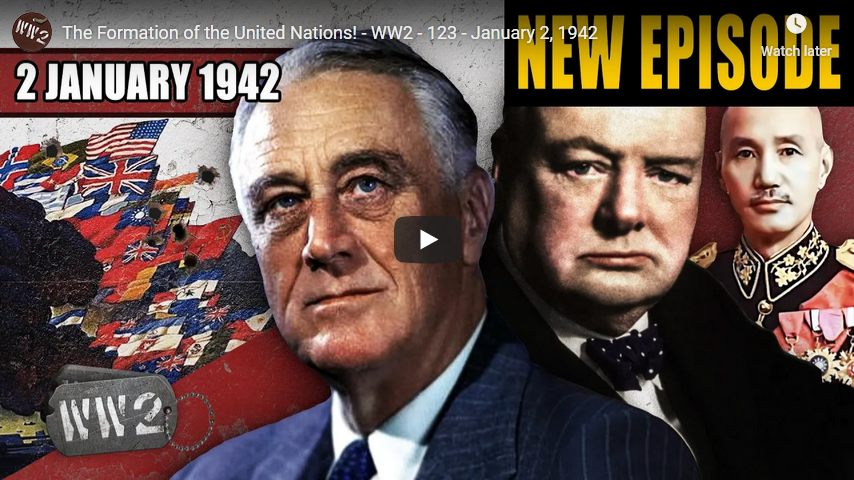
The Formation of the United Nations! – WW2 – 123 – January 2, 1942
World War Two
Published 2 Jan 2021At the ongoing Arcadia Conference, 26 nations sign the Declaration of the United Nations. Otherwise it is very much a week of motion and changes in motion: in the USSR the Soviets are on the move in the center and the Crimea, the Japanese are slowing their movement in China, the Americans are finishing their movement in the Philippines, and the Axis are moving backward in North Africa. The Luftwaffe also decides that Malta must be eliminated as a base for the Allies.
Join us on Patreon: https://www.patreon.com/TimeGhostHistory
Or join The TimeGhost Army directly at: https://timeghost.tvFollow WW2 day by day on Instagram @ww2_day_by_day – https://www.instagram.com/ww2_day_by_day
Between 2 Wars: https://www.youtube.com/playlist?list…
Source list: http://bit.ly/WW2sourcesWritten and Hosted by: Indy Neidell
Director: Astrid Deinhard
Producers: Astrid Deinhard and Spartacus Olsson
Executive Producers: Astrid Deinhard, Indy Neidell, Spartacus Olsson, Bodo Rittenauer
Creative Producer: Maria Kyhle
Post-Production Director: Wieke Kapteijns
Research by: Indy Neidell
Edited by: Iryna Dulka
Sound design: Marek Kamiński
Map animations: Eastory (https://www.youtube.com/c/eastory)Colorizations by:
– Julius Jääskeläinen – https://www.facebook.com/JJcolorization/
– Mikolaj UchmanSources:
– Election1960 from Wikimedia
– Battleship by Anand Prahlad from the Noun Project
– Supermarine Spitfire by Joel Wisneski from the Noun Project
– Afrrs from Wikimedia
– National Portrait Gallery
– BundesarchivArchive by Screenocean/Reuters https://www.screenocean.com.
A TimeGhost chronological documentary produced by OnLion Entertainment GmbH.
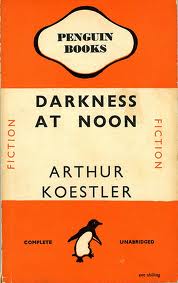
Arthur Koestler’s Darkness at Noon ranks with Orwell’s Nineteen Eighty-Four
James E. Hartley on why Koestler’s 1941 novel should be seen as a prescient guide to modern-day “wokeness”:
The puzzling thing about wokeness is not that it is fashionable among a small subset of the Campus Left. One should never be surprised by what is fashionable among college faculty and students. The curious question is how these ideas broke out of the academic asylum and met acquiescence among a large group of people who should have known better.
The answer is found in a book which should have never fallen off the radar: Arthur Koestler’s Darkness at Noon. First published in 1941, it was — along with 1984 — one of the great books about totalitarianism written in the 1940s. Widely praised when it was published, the book was enormously influential in fostering the consensus view of post-war anti-communism. In 1998, Modern Library published a list of the 100 best English novels of the 20th century; Darkness at Noon was ranked eighth, five places above 1984.
The plot of the novel itself is fairly simple. The story begins with the imprisonment of Nicholas Rubashov, one of the heroes of the communist revolution in a country which is clearly the Soviet Union. Decades after the revolution, Number 1 (read: Stalin) has assumed power. Rubashov is imprisoned on the absurdly false charges of plotting to kill Number 1. The entire novel takes place in prison, as Rubashov is interrogated and eventually comes to voluntarily confess at a public trial to crimes he did not commit. He is then shot.
The novel explores the philosophical puzzle of why Rubashov would join with what has obviously become a murderous cult run by a totalitarian who is solely interested in amassing enough power to stamp his will upon the whole country. Rubashov, a devoted communist to the end, abandons his principles and bit by bit comes to accede to demands of the new generation who are seeking scapegoats and ritualistic confessions of guilt.
What is the nature of the new generation? One of the Party officials interrogating Rubashov explains:
There are only two conceptions of human ethics, and they are at opposite poles. One of them is Christian and humane, declares the individual to be sacrosanct, and asserts that the rules of arithmetic are not to be applied to human units. The other starts from the basic principle that a collective aim justifies all means, and not only allows, but demands, that the individual should in every way be subordinated and sacrificed to the community — which may dispose of it as an experimentation rabbit or a sacrificial lamb.
The individual does not matter. The group matters. What is good for the group is by definition good, regardless of whether it is good for the individual. As the interrogators make abundantly clear, no individual has the right to stand in the way of the group. The Party represents the group, and thus no individual has the right to oppose the Party.
QotD: Literary stasis in the Byzantine empire
Sean Gabb, “The Mediaeval Roman Empire: An Unlikely Emergence and Survival”, SeanGabb.co.uk, 2018-09-14.
January 2, 2021
Lee Metford and Lee Enfield Carbines for the Cavalry
Forgotten Weapons
Published 28 Sep 2020http://www.patreon.com/ForgottenWeapons
https://www.floatplane.com/channel/Fo…
Cool Forgotten Weapons merch! http://shop.bbtv.com/collections/forg…
When the Lee magazine rifle was adopted for British military service, it was initially produced as a long rifle for the infantry. To accommodate the cavalry on horseback, a much more compact carbine version was produced. These were initially Lee Metford pattern, but changed to Lee Enfield pattern rifling when the long rifles made the same shift. The carbines were the origin of the cocking-piece-mounted safety, as the Lee Metford rifles in service at the time had no manual safety at all. The cavalry service wanted one, and the safety they came up with was added to later patterns of infantry rifle.
The Lee carbines are designed to be sleek and handy, to easily fit into a cavalry scabbard. The bolt handles are swooped forward slightly and flattened against the receiver. The front sight wings are rounded and the magazine was reduced to 6 rounds, barely extending beyond the receiver. Early examples were fitted with a D-ring on the left side of the receiver socket for use with a single point sling, but this was removed quickly and it is very rare to find carbines with intact sling rings today.
Contact:
Forgotten Weapons
6281 N. Oracle #36270
Tucson, AZ 85740

January 1, 2021
“Wolfpack” Pt. 2 – The Torpedoing – Sabaton History 100 [Official]
Sabaton History
Published 31 Dec 2020The Allies had cracked the secret codes, deprived the German Kriegsmarine of their best U-Boat aces, and sunk more submarines than the Germans could replace. Yet the Wolfpacks returned. From the depth of the sea they continued their hunt, even far away from the busy routes of the Atlantic. On their way south, along the coast of Africa, Wolfpack “Eisbär” would engage in a fateful encounter. An encounter that would demonstrate how the old rules of conduct, honor and mercy had become a thing of the past.
Support Sabaton History on Patreon: https://www.patreon.com/sabatonhistory
Listen to “Wolfpack” on the album Primo Victoria: https://music.sabaton.net/PrimoVictoria
Listen to Sabaton on Spotify: http://smarturl.it/SabatonSpotify
Official Sabaton Merchandise Shop: http://bit.ly/SabatonOfficialShopHosted by: Indy Neidell
Written by: Markus Linke and Indy Neidell
Directed by: Astrid Deinhard and Wieke Kapteijns
Produced by: Pär Sundström, Astrid Deinhard and Spartacus Olsson
Creative Producer: Maria Kyhle
Executive Producers: Pär Sundström, Joakim Brodén, Tomas Sunmo, Indy Neidell, Astrid Deinhard, and Spartacus Olsson
Community Manager: Maria Kyhle
Post-Production Director: Wieke Kapteijns
Editor: Iryna Dulka
Sound Editor: Marek Kaminski
Maps by: Eastory — https://www.youtube.com/c/eastory
Archive: Reuters/Screenocean — https://www.screenocean.comSources:
– Design vector of baseball elements created by macrovector official – www.freepik.comAll music by: Sabaton
An OnLion Entertainment GmbH and Raging Beaver Publishing AB co-Production.
© Raging Beaver Publishing AB, 2019 – all rights reserved.

The paradox of innovation – the more you have, the less impact each individual innovation has
In the latest Age of Invention newsletter, Anton Howes considers the oddity that as the British economy expanded during the early Industrial Revolution, each new discovery had less and less direct impact on the economy as a whole:

What this means is that when there were even some slight improvements in agriculture alone, the effects on living standards could be dramatic. But absent such improvements, a rich culture of innovation affecting everything from clothes to watches to books, wine, glassware, metals, and pottery would have been almost entirely masked from the figures. Importantly, the same applies not only to the composition of average notional consumption baskets, but to the contributions of different sectors to the economy as a whole. While the total amount of food has increased dramatically for the past few hundred years, for example, agriculture’s share of the economy steadily fell (from over 40% of the English economy in 1600, and an even greater share of total employment, to less than 1% today, with a similar trend repeated worldwide). So the relative importance of your typical agricultural innovation for overall growth rates has fallen dramatically. Perhaps it’s no wonder that twentieth-century agricultural pioneers like Norman Borlaug still don’t really get their due.
The same goes, more recently, for manufacturing. The reason the textbooks always name Kay, Hargreaves, Crompton, Cartwright and Arkwright, is because they made improvements to what was already one of the most important sectors of the economy: textiles. In the eighteenth century, textiles as a whole accounted for a whopping 16-17% of the British economy. So any growth in the value of wool, linen, and increasingly cotton goods, had an appreciable impact on overall economic growth. Today, by contrast, you’d be hard pressed to find many sectors that account for even 5% of the country’s economy (except construction, and possibly financial services, depending on how broadly you define them). And while Britain may have long lost its role as the workshop of the world, textile production in China today still only accounts for about 7% of the country’s economy. To put it another way, the modern Arkwrights and Cartwrights and Cromptons of China, to have any comparable effect on national statistics, would have to make productivity improvements to their industry that are at least three times as impressive.
And impressive they are, though you won’t have heard of them. Arkwright and Crompton multiplied the number of threads that a single machine could spin, from one to dozens. Today, thread is spun by the thousands, at speeds they could have scarcely comprehended, and with entire factories hardly needing a single pair of human hands. Automatic sensors monitor the yarn’s tension and detect any defects while it is being spun, with robots even whizzing along to repair any snaps, able to find a loose end and piece the yarn together again — a task that once required the nimble fingers of small children. From an eighteenth-century perspective, our textile machines routinely now do magic, and are getting ever more fantastical every day. Imagine showing Arkwright the use of lasers in fading and cutting jeans.
But by replacing human labour, innovation has become ever more hidden. Many people don’t realise that British manufacturing is actually larger and more valuable than ever. It’s just that it employs fewer people than ever, so hardly anybody gets to witness its great strides forwards (to witness a flavour of manufacturing’s modern marvels, I recommend checking out MachinePix).
And more importantly, the overall effect of each innovation has also been steadily diluted — itself the result of growth. Innovation has, in a sense, been the victim of its own success. By creating ever more products, sprouting new industries, and diversifying them into myriad specialisms, we have shrunk the impact that any single improvement can have. When cotton was king, a handful of inventors might hope to affect the entire national textile industry in some way. Nowadays, there’s not a chance. Doubling the productivity of cotton spinning is all well and good, but what about nylon, polyester, rayon, and the host of other fibres we have since invented? And which kind of spinning machine would you improve? An old-fashioned ring-spinner, a newer rotor spinner, or perhaps even one of the brand new air-jet types?
If you make an improvement, it’s not going to be to the industry as a whole — it’ll be specific. And actually improvements have always been specific; it’s just that the industries have since multiplied and narrowed. Inventors once made drops into a puddle, but the puddle then expanded into an ocean. It doesn’t make the drops any less innovative. This paradox of progress affects all innovation, such that it is no wonder that the number of researchers has been increasing while national-level productivity growth has appeared fairly stagnant. Even general-purpose technologies, like the recent dramatic improvements to telecommunications, computing, and software, have had a muted effect, being applied more slowly than we’d have liked. I expect that all future general-purpose technologies will fare even worse, for it takes still further effort and innovation to apply a technology to a given industry, and those industries will continue to multiply. All future general-purpose technologies, that is, except improvements to energy.
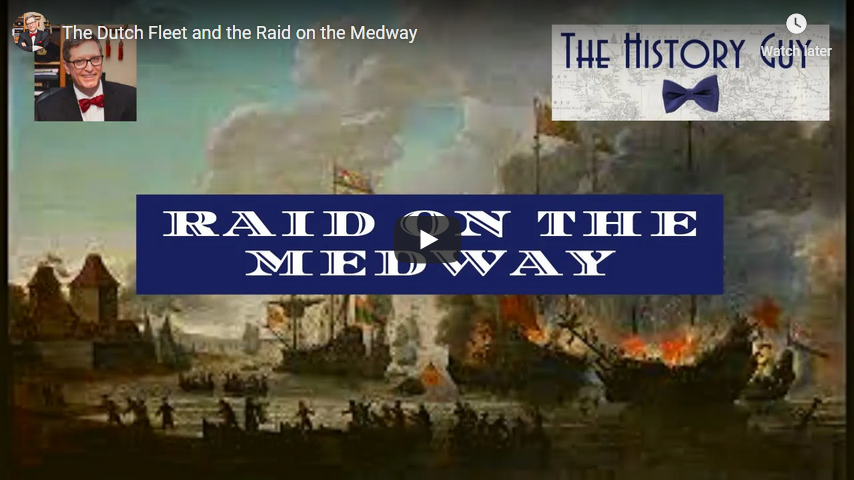
The Dutch Fleet and the Raid on the Medway
The History Guy: History Deserves to Be Remembered
Published 3 Nov 2018Two of the world’s greatest sea powers compete for control of the world’s shipping lanes. At the height of the Age of Sail, the Dutch fleet makes one of the most daring naval raids in history. The History Guy remembers the raid on the Medway.
This is original content based on research by The History Guy. Images in the Public Domain are carefully selected and provide illustration. As photographs of actual events are sometimes not available, photographs of similar objects and events are used for illustration.
The episode relates events that occurred during a period of conflict. All information is provided within historical context and is intended for educational purposes. Those who do not learn from history are doomed to repeat it.
Patreon: https://www.patreon.com/TheHistoryGuy
The History Guy: History Deserves to Be Remembered is the place to find short snippets of forgotten history from five to fifteen minutes long. If you like history too, this is the channel for you.
Awesome The History Guy merchandise is available at:
teespring.com/stores/the-history-guy#worldhistory #militaryhistory #thehistoryguy
December 31, 2020
QotD: The “noble savage” belief system
***When the ancestors of North America’s Indigenous peoples entered the New World some 16,000 years ago via Siberia, they hunted many of the mammals, reptiles, and birds, from the Arctic down to Tierra del Fuego. Mammoths, mastodons, and enormous ground-dwelling sloths, as well as giant bears, giant tortoises, and enormous teratorn birds with 16-foot wingspans — animals that had never had a chance to evolve in the presence of humans — were among the many species that disappeared from the Americas. Some medium-sized animals — such as horse, peccary, and antelope species — were also wiped out. But others survived: Bison and deer species, tree sloths, tapirs, jaguars, bear species, alligators, and big birds such as rheas and condors are, at least for the time being, still with us. The existence of these survivors, along with the relatively unspoiled forests, grasslands, and rivers seen by the first Europeans to enter the Americas, served to support the illusion that America’s first peoples had been maintaining what popular environmentalist David Suzuki calls a “sacred balance” with the natural world. Throughout history, however, humans killed animals that were tasty, numerous, and huntable. For kin-groups, staying alive meant making life-and-death cost-benefit calculations about where to send your berry-pickers and hunters. “Sacredness” had nothing to do with it.
This is not to say that the Indigenous peoples who migrated from Asia to the Americas were especially bloodthirsty (though Europeans typically reported that their hunting and fishing skills were excellent). In every known case where humans entered continents formerly uninhabited by our species, the bigger animals tended to disappear, since they provided the most sustenance per kill. The first humans to enter Australia some 70,000 years ago wiped out giant kangaroo species, rhino-sized marsupial herbivores, jaguar-sized marsupial carnivores, big flightless birds, and many other megafauna. The same thing would happen in Europe: After sapiens completed its occupation of that sub-continent some 30,000 years ago, the mammoths, woolly rhinos, giant deer, and lions they recorded in their cave paintings and carvings also disappeared.
Baz Edmeades, “The Myth of Harmonious Indigenous Conservationism”, Quillette, 2020-09-06.
December 30, 2020
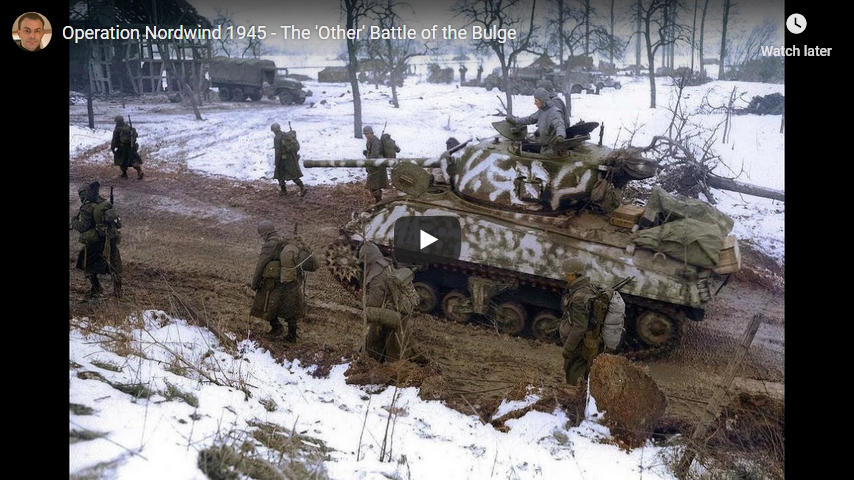
Operation Nordwind 1945 – The ‘Other’ Battle of the Bulge
Mark Felton Productions
Published 29 Dec 2020The stories of the last big German offensives on the Western Front in WWII — Operations Nordwind and Sonnenwende in Alsace, France, January 1945.
Dr. Mark Felton is a well-known British historian, the author of 22 non-fiction books, including bestsellers Zero Night and Castle of the Eagles, both currently being developed into movies in Hollywood. In addition to writing, Mark also appears regularly in television documentaries around the world, including on The History Channel, Netflix, National Geographic, Quest, American Heroes Channel and RMC Decouverte. His books have formed the background to several TV and radio documentaries. More information about Mark can be found at: https://en.wikipedia.org/wiki/Mark_Fe…
Help support my channel:
https://www.paypal.me/markfeltonprodu…
https://www.patreon.com/markfeltonpro…Disclaimer: All opinions and comments expressed in the ‘Comments’ section do not reflect the opinions of Mark Felton Productions. All opinions and comments should contribute to the dialogue. Mark Felton Productions does not condone written attacks, insults, racism, sexism, extremism, violence or otherwise questionable comments or material in the ‘Comments’ section, and reserves the right to delete any comment violating this rule or to block any poster from the channel.
December 29, 2020
The Economics of Wine (Orley Ashenfelter, Princeton)
Marginal Revolution University
Published 30 Sep 2020What does an economist know about wine? Given that many wines need years to mature, how can one predict which ones will be great or not?
Princeton’s Orley Ashenfelter explains how he used economic principles and regression analysis to predict wine quality (and score great deals!). His research helped spawn an entire field dedicated to the economics of wine.
This video is based on the following paper:
Predicting the Quality and Prices of Bordeaux Wines By Orley Ashenfelter
https://www.researchgate.net/publicat…More of Orley Ashenfelter’s work: https://irs.princeton.edu/people/orle…
Orley Ashenfelter’s vineyard: https://cedarrosevineyards.com/
Want to see more Economists in the Wild? Check out our series: https://mru.io/economists-wild-67905