
World War Two
Published 22 Jul 2023This week, Adolf Hitler is blown up and Hideki Tojo steps down. In the Pacific, the Americans land on Guam and prepare for hard fighting. In France, the Americans take Saint-Lô and British and German armored forces clash around Caen. In the East, the Red Army enters Latvia, tears a gap in Army Group North, and reaches the gates of Lvov.
(more…)
July 23, 2023
Sayonara Tojo – WW2 – Week 256 – July 22, 1944
Comments Off on Sayonara Tojo – WW2 – Week 256 – July 22, 1944
Tom Whipple’s history of radar development during WW2
In The Critic, Robert Hutton reviews The Battle of the Beams by historian Tom Whipple, who retells the story of the technological struggle between Britain and Germany during the Second World War to find ways to guide RAF or Luftwaffe pilots to their targets:
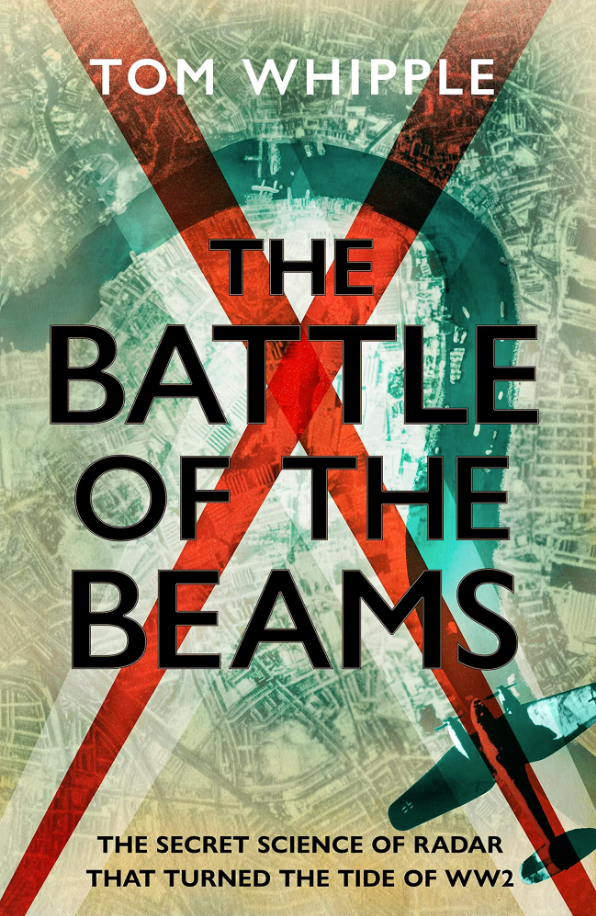
In an age when my phone can tell me exactly where I am and how to get where I’m going, it’s hard sometimes to imagine a time when navigation was one of any traveller’s great challenges. At the outbreak of the Second World War, the advice to Royal Air Force pilots trying to find their way was, more or less, to look out of the window and see whether anything on the ground looked familiar. The Luftwaffe, though, had a rather more sophisticated means of finding their targets.
As Britain braced herself for the bomber onslaught of 1940, there was comfort in knowing that radar would give Hurricanes and Spitfires advance warning of where the attack was coming. As soon as the sun went down, so did the fighters: at night, relying on their eyeballs, they simply couldn’t find the enemy.
That wasn’t so bad, as long as the German pilots had the same problem, but one young British scientist began to suspect that the Luftwaffe had developed a technology that allowed them to find their way even in the dark, guided by radio beams. In June 1940 he found himself explaining to Winston Churchill that German bombers could accurately reach any spot over England that they wanted, even in darkness.
Reg “RV” Jones was the original boffin: a gifted physicist who was recruited to the Air Ministry at the start of the war to help make sense of intelligence reports that offered clues about enemy technology. It was a role to which he was perfectly suited: a man who liked puzzles, with the ability to absorb lots of information and see links, as well as the arrogance to insist on his conclusions, even when his superiors didn’t like them.
The story of the radio battle has been told before, not least by Jones himself. His 1978 memoir Most Secret War was a bestseller and remains in print. It is 700 pages long, though, and it assumes a lot of knowledge about the way 1940s radios worked that readers probably had 50 years ago. Since few people under 50 have much clue why a radio would need a valve or what you might do with a slide rule, there is definitely room for a fresh telling.
Comments Off on Tom Whipple’s history of radar development during WW2
July 22, 2023
In European politics, “far right” doesn’t mean what Americans think it means
In The European Conservative, Rod Dreher tries to put the various “far right” European political parties into context for North American readers:

If you are an American who depends on the U.S. and other English-language media for news about continental European politics — and most Americans obviously do — then you might well be afraid that a wave of fascism is poised to sweep Europe.
The European Conservative, obviously, is a great source of news and information about Europe for our American readers — and I hope with this column to help American conservatives better understand what’s going on with the European Right — because there are very few venues for them to do so.
American and British news agencies are reporting that the “far-right” party VOX is likely to do well in this weekend’s Spanish elections. The “far-right” Alternative für Deutschland (AfD) is surging in German opinion polls. It seems like just yesterday that the “far-right” party of Giorgia Meloni topped Italian elections. “Far-right” parties are key to governing coalitions in Finland and Sweden.
And, of course, the BBC website informs its readers to mind “the ultra-conservative, authoritarian-leaning governments in Poland and in Hungary”. Far-rightists to the fingertips, the lot, right?
Well, no. Not even close. American conservatives should understand that by U.S. standards, the “far-right” parties are basically center-right contemporary Republicans. The declining establishment conservative parties of the European continent are more or less Clinton-style Democrats. There do exist genuinely far-right parties in Europe, but they aren’t anywhere near government.
(Though in this spring’s Hungarian elections, the actually far-right party Jobbik, which considers Viktor Orban to be a squish, went into coalition with the left-wing parties. This caused the coalition prime ministerial candidate to boast moronically that his side was truly diverse, because it spanned the ideological spectrum from communist to fascist.)
When U.S. journalists describe these nationalist and populist parties as “far-right”, they intend to call up images of burly fascists marching down cobblestone streets in hobnail boots, shouting abuse at Jews and minorities. I can’t decide if they do this deliberately to mislead American readers into thinking Europe is two tics away from a gran mal Nazi seizure, or if the reporters themselves are so absorbed in the ideology of their class that they honestly cannot discern gradations of right-wing politics.
H/T to Blazing Cat Fur for the link.
Comments Off on In European politics, “far right” doesn’t mean what Americans think it means
July 21, 2023
The Führer Adolf Hitler is Dead!?
World War Two
Published 20 Jul 2023Stauffenberg, Olbricht and the plotters launch Operation Valkyrie. The army moves in to seize power, troops surround the government quarter in Berlin, and Joseph Goebbels is arrested. But things start going wrong pretty much immediately and far away in East Prussia the Nazi fightback begins.
(more…)
Comments Off on The Führer Adolf Hitler is Dead!?
July 19, 2023
Diplomats Fight the Nazis in Budapest – War Against Humanity 104
World War Two
Published 18 Jul 2023Hungary’s Jews are facing a Holocaust machine in overdrive. The deportation trains are arriving in such volume that even the extermination factory of Auschwitz can barely keep up with the pace. The entire country swiftly becomes Judenfrei and the Jews of Budapest sit helplessly as Adolf Eichmann and his Hungarian collaborators tighten the noose around them. Admiral Miklós Horthy is one of the few who can save them, but so far he has done nothing. Will that change?
(more…)
Comments Off on Diplomats Fight the Nazis in Budapest – War Against Humanity 104
July 16, 2023
Mass Suicide on Saipan – WW2 – Week 255 – July 15, 1944
World War Two
Published 15 Jul 2023Japanese troops and civilians commit mass suicide rather than surrender to the Americans in the Marianas; in Normandy, Caen has finally fallen to the Allies though the fight for St. Lo is not over; the Soviet offensives in the north take Vilnius and the fighting continues up in Finland, but the big eastern front news is the mighty new Soviet offensive in Western Ukraine. (more…)
Comments Off on Mass Suicide on Saipan – WW2 – Week 255 – July 15, 1944
July 14, 2023
How Hitler Approved His Own Assassination – WW2 Documentary Special
World War Two
Published 13 Jul 2023So far, the German resistance haven’t had much luck with their attempts to kill the Führer, Adolf Hitler. But now, the German war hero Claus von Stauffenberg, together with Friedrich Olbricht and Henning von Tresckow, drives the resistance forward. It’s time to kill Hitler. It’s time for Operation Valkyrie.
(more…)
Comments Off on How Hitler Approved His Own Assassination – WW2 Documentary Special
MG-3: Germany Modernizes the Classic MG-42
Forgotten Weapons
Published 7 Apr 2023When the Bundeswehr was formed, it chose to simply continue using the MG42 as its standard GPMG. This was initially done by converting older MG42s to 7.62x51mm NATO as the MG1 (adopted in 1958), but progressed to production of a brand new version of the gun by Rheinmetall (adopted in 1968). The MG3 included improvements to the belt feed system, added integral antiaircraft sights, and allowed a rate of fire between 700 and 1300 rpm depending on the choice in bolt, buffer and booster. It was the standard German MG until finally being replaced by the MG5 in 2012 — and it is/was in use by nearly 4 dozen other countries as well. Today we are going to compare this transferrable, C&R MG3 to an original MG42 to see the improvements that were made.
(more…)
Comments Off on MG-3: Germany Modernizes the Classic MG-42
July 12, 2023
Nazi drone war begins – War Against Humanity 103
World War Two
Published 11 Jul 2023Bombing enemy civilians does nothing to advance a nation’s war effort. But now, Adolf Hitler believes that the V-1 flying bomb, the first of the Vengeance Weapons, will bring London to its knees and unite the German population behind the war effort as never before. The missiles are ready for launch and thousands more civilians will die to satisfy the Führer’s
delusions.
(more…)
Comments Off on Nazi drone war begins – War Against Humanity 103
July 9, 2023
The Destruction of Army Group Center – Week 254 – July 8, 1944
World War Two
Published 8 Jul 2023Operation Bagration continues, smashing the armies of German Army Group Center and taking ever more territory including the prize of Minsk; on Saipan the Americans have taken most of the island when the Japanese resort to a huge suicidal banzai charge to try and turn the tide; and in Normandy new attacks begin try to finally take Caen and St. Lo.
(more…)
Comments Off on The Destruction of Army Group Center – Week 254 – July 8, 1944
July 8, 2023
The Perfect D-Day That History Forgot
Real Time History
Published 7 Jul 2023The summer of 1944 saw the Allies land in France not once but twice. Two months after Operation Overlord, the Allies also landed in Southern France during Operation Dragoon. It was “the perfect landing” and opened up the important ports of Marseille and Toulon for Allied logistics.
(more…)
Comments Off on The Perfect D-Day That History Forgot
July 7, 2023
Nazis destroy last Jewish sanctuary – War Against Humanity 102
World War Two
Published 6 Jul 2023Until now Miklos Horthy’s Kingdom of Hungary has been a rare sanctuary where most Jews have lived in relative safety. That changes with the German occupation. Now Adolf Eichmann. the Nazis, and their Hungarian allies bring the Holocaust to Hungary.
(more…)
Comments Off on Nazis destroy last Jewish sanctuary – War Against Humanity 102
QotD: Nazi Germany’s plans for Eastern Europe versus their actual implementation of those plans
… it’s easy to see what the evidence is (or would be): The well-documented awfulness of life under Stalin. There’s also plenty of evidence that the Wehrmacht certainly thought they’d be greeted as liberators, and while it’s hard to put too much weight on the anecdotes of individual soldiers and civilians (most recorded long after the fact), there seems to be a fair amount of evidence they actually were greeted as liberators …
… at least in some places, and at least initially. There’s a second inference here: “the exigencies of war led Germany to behave tactfully”. Here’s where our initial ground rules of evidence become extremely important. Those anecdotal reports of civilian / military interaction, above: What weight do we assign those? And why?
If I’m arguing for the “greeted as liberators” theory, I can use all those recollections of cordial civilian / military interaction. But I need to be consistent: If I say “You can trust those, even though they’re personal memories written down long after the fact, because XYZ”; then I can’t turn around and dismiss contrary evidence of the same type: “All those reports of brutality are just personal memories written down long after the fact.” That’s one of the ways you catch a propagandist: they constantly conflate the two.
Fortunately, in this case we’re dealing with two totally ideologized societies. Even better, one of those totally ideologized societies was German, with their well-documented love of paperwork. All armies generate scads of paperwork, and an ideologized army’s paperwork is full of ideology. So: How does the Army of Occupation’s paperwork tell the tale? That should give us some clues as to their future plans — obviously the occupiers would need to be part of it — and some insight as to the day-to-day.
As it turns out, the second part of your inference — “the exigencies of war led Germany to behave tactfully” — is false. We’ve got the paperwork on it, starting with the infamous “Commissar Order” and working down. Ideology trumps exigency. It seems clear from Wehrmacht paperwork that so long as military efficiency was maintained, you could do pretty much whatever you wanted out there.
[Interestingly, in a bit of meta-irony, the Wikipedia “thumbnail” — the little box you get on the side of the search results page — says of the Commissar Order: “Nazi conspiracy-enforcing unit of the Nazi military.” [Sic], of course — they really want you to know these guys were Nazis. Also, what’s a “conspiracy-enforcing unit”? One imagines a Q-tard goon squad, beating up people whose faith in the God-Emperor is wavering. Finally, it wasn’t a “conspiracy” — they were right out in the open with it. We’ve got lots of copies of the Commissar Order, because it was read out to the troops before the invasion. ALL the troops].1
That segues into the “Organizational Darwinism” thing. The paperwork shows us that “the Nazis” really did have grandiose plans for settling a whole bunch of Germans in the depopulated East. They even got a pilot program underway, as I recall — a whole bunch of ethnic Germans from Bohemia or someplace getting stuck in a transit camp in eastern Poland, or even Ukraine. But notice I put “the Nazis” in quotation marks. The guys with the grandiose plans were RuSHA, the Main Race and Settlement Office. And not even all of them: It was the fourth department, “Settlement”, inside RuSHA. And RuSHA was inside the SS, which was inside — but also outside, over, under, around, and through — the rest of the Nazis’ plate-of-spaghetti org chart.
And it’s actually way more complicated than that, because of course it is — these are the Nazis we’re talking about. I’m not going to dive into the details (not least because it all makes my head hurt), but if you were an ethnic German who wanted to get resettled in Ukraine for some reason — and this is all mostly theoretical, I hasten to add, very few actually moved so far as I know — you’d have to deal with a bewildering array of bizarrely-acronymed organizations. RuSHA, VOMI, the Generalgovernment (Occupied Poland), the SS (in general; over and above RuSHA), the army, the whole bewildering array of groups represented in Generalplan Ost, which was a “plan” in much the same way the “Holy Roman Empire” was holy, Roman, and an empire. Various Party goons would want to get their beaks wet, as would the Gestapo (hell yes they want to know if people are moving around the Reich, especially towards the front on military railroads), and so on.
As weird as this sounds, all this elaborate mishmash of ass-pulled “organization” was by largely by design. For one thing, it diffuses responsibility for really nasty shit — when it comes to certain events on the Eastern Front, even scrupulously neutral historians are often reduced to Ilhan Omar’s level: some people did some things. Who gave what order? Who was he reporting to? And in what capacity? Insufficient data.
Severian, “Organizational Darwinism”, Founding Questions, 2023-01-30.
1. Side note: Ideology really increases military efficiency, up to a point. Recalling that I’m not even an armchair general, it seems like the American military is really missing a trick there. Imagine what the Americans could’ve done in Vietnam if their regular forces had been better indoctrinated, instead of punting military-civilian relations off to CORDS. Properly indoctrinated, I mean, with an ideology that kinda sorta makes sense and is internally consistent and at least somewhat intersects with the real world. “Spreading democracy” would work ok, if they actually ideologized the ranks (instead of having the PR guys just parrot it to the cameras). The AINO military is of course fully indoctrinated, but see above: we’re talking combat efficiency here, not butt stuff.
Comments Off on QotD: Nazi Germany’s plans for Eastern Europe versus their actual implementation of those plans
July 6, 2023
Ursula von der Leyen touted as NATO Secretary General Jens Stoltenberg’s successor
In Spiked, Fraser Myers is amazed at Ursula von der Leyen’s ability to rise above her own failures time after time:
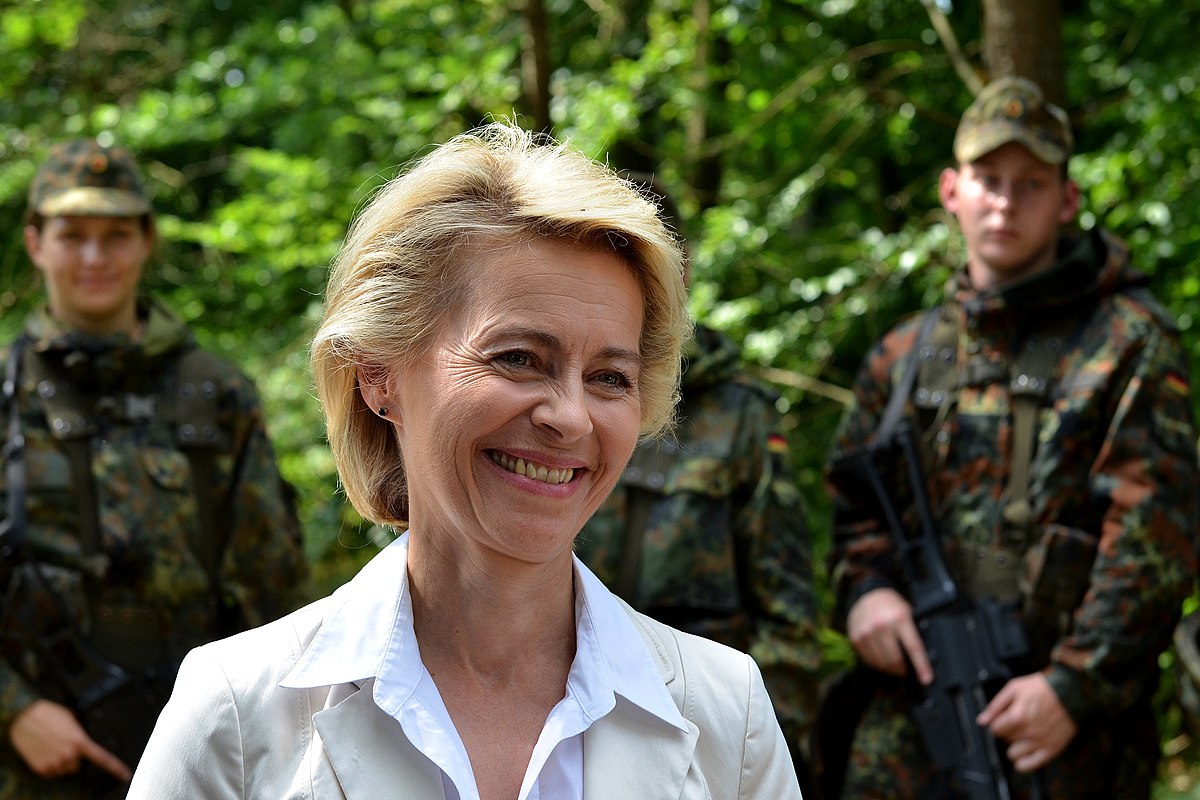
Ursula von der Leyen with German soldiers during a visit to the Field Marshal Rommel Barracks, Augustdorf, 17 July 2014.
Photo by Dirk Vorderstraße via Wikimedia Commons.
The political career of Ursula von der Leyen, president of the European Commission, has been defined by bungling and incompetence. She is deeply unpopular with voters, distrusted by colleagues and has regularly been mired in scandals. And yet, somehow, she manages to keep rising up the ranks of international politics.
Now von der Leyen has been tipped for another plum job on the global stage. According to reports in the Telegraph this week, US president Joe Biden is pushing for her to be named as secretary-general of NATO. He thinks she is best placed to replace Jens Stoltenberg when he steps down in 2024.
This ought to set off alarm bells. Whatever one thinks of NATO, there could hardly be a worse candidate to lead it than von der Leyen – especially right now, while war wages in Ukraine and NATO faces one of its most serious challenges in its 73-year existence.
Just look at her time leading the EU. She was parachuted into the role in 2019, unelected, over the heads of European citizens. She was a singularly unimpressive candidate. In fact, some argue that this was why she was selected. “When EU leaders picked von der Leyen … they deliberately eschewed candidates with greater experience, charisma or cunning”, according to a Bloomberg report. The European Council apparently wanted a Commission leader that it could easily push around. In the end, despite being the only candidate, she managed to persuade just nine MEPs to back her in the job.
MEPs were right to be sceptical. Her incompetence became all too clear when she faced her first major challenge as president – the Covid pandemic in 2020 and 2021. While von der Leyen boasted of taking “personal charge” of the EU’s vaccination programme, the rollout was infamously slow, lagging behind the rest of the world. At the time, fellow commissioners, civil servants and other officials were openly venting their distress with her leadership.
Comments Off on Ursula von der Leyen touted as NATO Secretary General Jens Stoltenberg’s successor
The Devilish History of Deviled Eggs
Tasting History with Max Miller
Published 4 Apr 2023
(more…)
Comments Off on The Devilish History of Deviled Eggs


