
World War Two
Published 1 Jul 2023Several weeks after the invasion of Normandy began, the Allies finally take a port city there, though the actual harbor has been destroyed. On Saipan the Americans have the advantage, in Finland, the Soviets do, but the big news is the Soviet destruction of huge chunks of German Army Group Center, demolishing entire Army Corps, and surrounding tens of thousands of the enemy.
(more…)
July 2, 2023
Allies Liberate Cherbourg – WW2 – Week 253 – July 1, 1944
Comments Off on Allies Liberate Cherbourg – WW2 – Week 253 – July 1, 1944
Tank Chats #170 | Sd. Kfz. 251 | The Tank Museum
The Tank Museum
Published 31 Mar 2023Curator David Willey is back with another Tank Chat. This time, he will be discussing the Sonderkraftfahrzeug 251, which is more commonly referred to as the Sd.Kfz. 251.
(more…)
Comments Off on Tank Chats #170 | Sd. Kfz. 251 | The Tank Museum
June 29, 2023
The End of Nazi Intelligence in 1944 – WW2 Documentary Special
World War Two
Published 27 Jun 2023After years of undermining the Nazi regime and aiding the resistance, Abwehr Chief Wilhelm Canaris finally loses his battle with Heinrich Himmler and the SS. The Abwehr Trojan Horse is no more, and German intelligence is at death’s door at the most crucial moment.
(more…)
Comments Off on The End of Nazi Intelligence in 1944 – WW2 Documentary Special
June 28, 2023
The Treaty of Versailles: 100 Years Later
Gresham College
Published 4 Jun 2019The Treaty of Versailles was signed in June 1919. Did the treaty lead to the outbreak of World War II? Was the attempt to creat a new world order a failure?
A lecture by Margaret MacMillan, University of Toronto
04 June 2019 6pm (UK time)
https://www.gresham.ac.uk/lectures-an…A century has passed since the Treaty of Versailles was signed on 28 June 1919. After WWI the treaty imposed peace terms which have remained the subject of controversy ever since. It also attempted to set up a new international order to ensure that there would never again be such a destructive war as that of 1914-18. Professor MacMillan, a specialist in British imperial history and the international history of the 19th and 20th centuries, will consider if the treaty led to the outbreak of the Second World War and whether the attempt to create a new world order was a failure.
(more…)
Comments Off on The Treaty of Versailles: 100 Years Later
June 25, 2023
The Greatest Pincer Movement in Military History – WW2 – Week 252 – June 24, 1944
World War Two
Published 24 Jun 2023The Red Army surges forward in Operation Bagration, a mighty new offensive to destroy German Army Group Centre. Fighting continues in Normandy, Italy, and Finland. The United States Navy tears the heart out of the Imperial Japanese Navy in the Philippine Sea even as the Imperial Japanese Army has success in China. The British and Indian armies lift the siege of Kohima.
(more…)
Comments Off on The Greatest Pincer Movement in Military History – WW2 – Week 252 – June 24, 1944
June 23, 2023
From Operation Barbarossa in 1941 to the disinformation and cover-up over the origins of the Wuhan Coronavirus
Chris Bray outlines the utterly amazing situation between the Soviet Union and Nazi Germany on the eve of Hitler launching Operation Barbarossa — where Stalin refused to believe that Hitler would attack Russia despite overwhelming evidence from many sources — to the parallel situation over Covid:
Several sources quite specifically reported to the Soviet government that the Germans would invade around dawn on June 22. Their reports can be found in the Soviet archives in a “folder of dubious and misleading reports”. Then, shortly before dawn on June 22, Germany invaded the Soviet Union. Military leaders on the border called in reports of the invasion, and the people they talked to in Moscow declined to believe them. Soviet border troops held their fire, seeing Germans while being ordered to understand that no true invasion could possibly be underway. Stalin knew better, and contradicting Josef Stalin was known to be a fatal mistake. Achieving an entirely avoidable surprise, the Germans destroyed much of the Soviet air force on the ground, parked wingtip-to-wingtip for the convenience of the invader’s bombers.
[…]
An invasion that could have been met with brutal severity from the first moment instead achieved considerable initial success against a supine nation because the Soviet leader, and the chain of subordinates beneath him who were forced to adopt his conception of facts and truth, assumed that things they didn’t wish to believe constituted disinformation. Millions of lives were wasted for that illusion. A society that categorizes inconvenient truths in this way is committing a form of suicide, hiding from hard facts that demand acknowledgment.
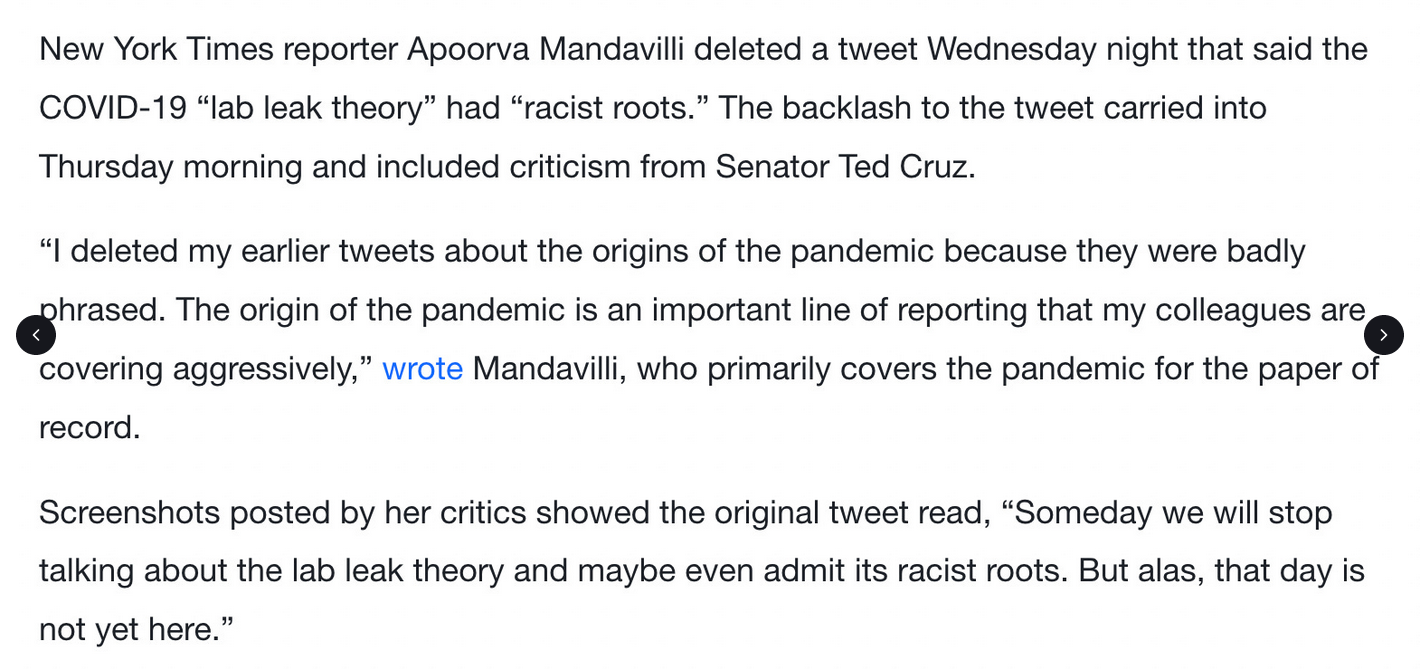
Now: In 2021, the lab leak theory was a disgusting lie with “racist roots”.
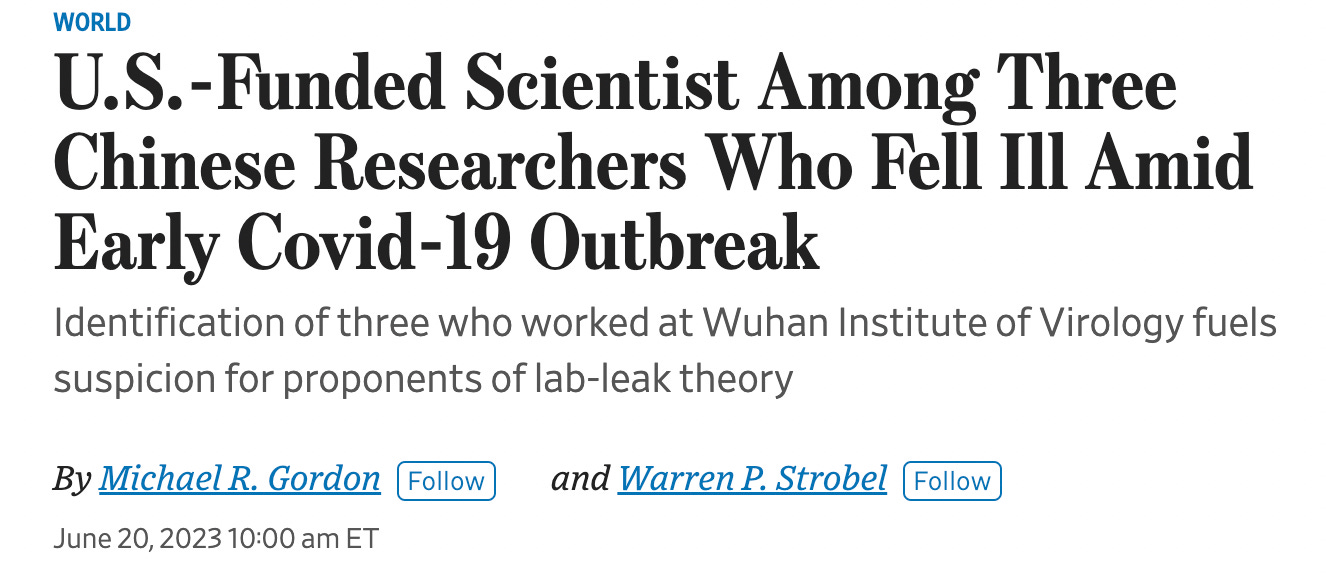
In June of 2023, the, uh, first people who got sick with Covid turn out to have been, uh, scientists at the lab in Wuhan. BUT THEY PROBABLY HAD SOME BAT SOUP AT THE WET MARKET, IS WHY, or something.
Stupid conspiracy theorists, you people are such MORONS, do you actually bel— okay, that one’s true too.
We’ve somehow developed an industry of professional information barriers, dimwitted parasitical human garbage whose sole function in life is to prevent understanding by pasting “disinformation” stickers on things that you’re not supposed to know.
Comments Off on From Operation Barbarossa in 1941 to the disinformation and cover-up over the origins of the Wuhan Coronavirus
FG-42: Perhaps the Most Impressive WW2 Shoulder Rifle
Forgotten Weapons
Published 8 Mar 2023The first production version of the FG42 used a fantastically complex milled receiver and a distinctive sharply swept-back pistol grip. A contract to make 5,000 of them was awarded to Krieghoff in late spring of 1943, but by the fall its replacement was already well into development. The milled receiver used a lot of high-nickel steel which was becoming difficult for Germany to acquire, and it was decided to develop a stamped receiver to ease production obstacles. Ultimately only about 2,000 of the early Type E FG42 rifles were actually made, and only 12 or 15 are registered in the US. They are a remarkably advanced rifle, and extremely interesting.
(more…)
Comments Off on FG-42: Perhaps the Most Impressive WW2 Shoulder Rifle
June 21, 2023
Scuttling of the German High Seas Fleet at Scapa Flow, Orkney, 21 June 1919 in the Great War
CEFRG (Canadian Expeditionary Force Research Group)
Published 3 Apr 2020The German High Seas Fleet decided to sink as many of its own ships as possible to prevent them from falling into Allied hands. In total, 52 of 74 ships were sabotaged to keep them from Britain, France, Italy and the USA. Most of these nations wanted a share for their navies, and knowing she could not have them all to herself, Britain wanted the ships scrapped to prevent other nations from gaining naval superiority.
On the morning of 21 June 1919, the British fleet left Scapa Flow for exercises, and Rear Admiral Sydney Freemantle, commander of the 1st Battle Squadron guarding the ships, planned to return two days later to board and seize the ships.
Already occupying Germany west of the Rhine, the Allied Powers expected Germany to accept all articles of the Treaty of Versailles by 23 June, and threatened to occupy territory east of the Rhine if all demands were not met. German Rear Admiral Ludwig von Reuter, following orders he had received after the breakdown of negotiations, seized the opportunity with the British fleet having just left the harbour, gave the order to scuttle all ships as his crews opened seacocks, torpedo tubes and portholes to flood them, and once again hoisted the flag of the Imperial German Navy.
The final battle casualties of the Great War occurred on this day, with nine German sailors killed and sixteen wounded by the British during brawls when they refused to help save the ships. For his part, von Reuter was imprisoned along with 1,800 of his men, but was released the following year. Upon his return to Germany, he was praised as the man who had preserved the honour of the German High Seas Fleet (in typical fashion, Freemantle had angrily accused von Reuter of having behaved without honour).
Of the 52 ships scuttled in 1919, seven remain at the bottom of the sea today. They are registered under the Ancient Monuments and Archaeological Areas Act 1979, and provide some of the best shipwreck diving in Europe.
Comments Off on Scuttling of the German High Seas Fleet at Scapa Flow, Orkney, 21 June 1919 in the Great War
June 18, 2023
Titanic Clash Looms In Pacific – WW2 – Week 251 – June 17, 1944
World War Two
Published 17 Jun 2023Japanese and American navies are heading for a showdown in the Philippine Sea, even as American forces land on Saipan in the Marianas in force. The Japanese have Changsha under siege in China, the Allies advance in both Normandy and Italy, the Soviets advance in Finland, and the massive Soviet summer operation is coming together and will begin in a matter of days.
(more…)
Comments Off on Titanic Clash Looms In Pacific – WW2 – Week 251 – June 17, 1944
June 17, 2023
Why Rommel Lost the Battle for North Africa
Real Time History
Published 16 Jun 2023The North African campaign of WW2 is one of the most famous ones. The almost mythical story of the British “Desert Rats” defeating Erwin Rommel’s Afrika Korps. But why did Rommel lose in North Africa?
(more…)
June 15, 2023
See Inside King Tiger | Tank Chats Reloaded
The Tank Museum
Published 10 Mar 2023In this video, Chris Copson gives us a glimpse inside one of the most formidable German tanks of World War II – the King Tiger.
(more…)
Comments Off on See Inside King Tiger | Tank Chats Reloaded
June 14, 2023
Michael Wittmann: The Fascination with the Panzer Ace of Villers-Bocage
OTD Military History
Published 13 Jun 2023American historian, Carlo D’Este seemed to have an intense admiration for Michael Wittmann, the SS Panzer ace best known for his actions at Villers-Bocage in Normandy on June 13 1944. This video shows why this problematic and even misplaced.
(more…)
June 13, 2023
QotD: The purge of the Socialist Revolutionaries
Ideological revolutions follow a predictable pattern. At some point, you see what the Bolsheviks called “the Revolt of the Left SR’s.” “SR” stands for “socialist revolutionaries”, so their “left” was, of course, radical by all but Bolshevik standards. Nonetheless, they actually meant it when they said they were for “soviet power”, the “soviets” in this case being “assemblies made up of actual workers, not limpwristed eggheads like Lenin whose fathers were minor nobility”.
As Solzhenitsyn explained it, in the early days of the Bolshevik revolution, these SRs were part of a coalition government with the Bolsheviks. As such, they had to be given a certain amount of jobs in the ministries, including the justice ministry. They actually believed that stuff about The Workers, so they weren’t ready to send people to Siberia for twenty, thirty, forty years like Lenin demanded. They broke with Lenin (over other issues as well, obviously), the Bolsheviks crushed them, and once the Bolsheviks had power over all the ministries, there’s your gulag archipelago. Same as it ever was.
The Nazis had their “Left SR’s”, too. These were the Strasserites, led by brothers Otto and Gregor, the guys who put the “Socialist” in “National Socialism”. The Night of the Long Knives was a purge against both “left” and “right” — though Röhm and his butt boys get all the press, one of the Strasser brothers got his, too. That’s German efficiency for you!
And then there was the original Terror, in France, and even before that we had ours, too — the Whiskey Rebellion and Shays’ Rebellion aren’t usually taught as ideological (they’re usually not taught at all, of course), but they were. We’ve had two revolutions (before this week), in fact, and in both cases you had those pesky “we really believe this shit!” types causing all kinds of problems for the revolutionary government — see, for example, those state governors who made Jeff’s life hell in Richmond, objecting to the nationalization of their state militias on the grounds that the Confederacy is actually, you know, a confederacy, and that drafts and war production boards and taxes in kind and all the rest are exactly the kind of tyranny you’d expect from Abe’s gang in Washington …
Severian, “Speaking of Purges…”, Rotten Chestnuts, 2021-01-08.
Comments Off on QotD: The purge of the Socialist Revolutionaries
June 11, 2023
The Invasion of Normandy begins! – WW2 – Week 250 – June 10, 1944
World War Two
Published 10 Jun 2023The Allies’ gigantic amphibious invasion of France begins and by the end of the week they’ve carved out a decent-sized beachhead. Meanwhile in Italy the Allied advance takes Rome. The Soviets are launching new attacks of their own — now against the Finns, and the Japanese at Kohima … have just plain had enough.
(more…)
Comments Off on The Invasion of Normandy begins! – WW2 – Week 250 – June 10, 1944
June 7, 2023
German Counterattack – D-Day [Part 4]
World War Two
Published 6 Jun 2023When the amphibious landings begin, they run straight into Hitler’s Atlantic Wall. Eisenhower has predicted a third of his troops may fall. While they land, the news breaks across the world.
(more…)
Comments Off on German Counterattack – D-Day [Part 4]


