
Joe Lucas — or, more accurately, the company bearing his name — engineered electrical bits for pretty much everything emanating from the UK, and the notorious unreliability of Lucas components played a key role in tanking the British car industry in the early 1980s. Make the jump for “If Lucas made guns, wars would not start,” and other classics.
- The Lucas motto: “Get home before dark.”
- Lucas is the patent holder for the short circuit.
- Lucas — Inventor of the first intermittent wiper.
- Lucas — Inventor of the self-dimming headlamp.
- The three position Lucas switch — Dim, Flicker and Off.
- The Original Anti-Theft Device — Lucas Electrics.
- Lucas is an acronym for Loose Unsoldered Connections and Splices
Andrew Stoy, “Joe Lucas, Prince Of Darkness: British Electrical System Jokes”, Jalopnik, 2008-08-04.
March 25, 2021
QotD: Lucas, the Prince of Darkness
Comments Off on QotD: Lucas, the Prince of Darkness
March 23, 2021
Why are Pre-War Shipwrecks Disappearing?
Calum
Published 22 Aug 2020Pre-war shipwrecks are disappearing from the seabed. Why? A look at the sad reality of illegal salvaging that is destroying numerous war graves and historical wrecks around the world, told from the site of some of the most famous shipwrecks in the world; Scapa Flow.
The Guardian has done some amazing work in documenting this problem, worth a read if you have the time:
https://www.theguardian.com/world/201…
00:00 – Introduction & History of Scapa Flow
01:00 – Scuttling & Salvaging of the German High Fleet
02:45 – The Value of Pre-War Steel
03:54 – The Disappearing Shipwrecks
06:03 – HMS Royal Oak
10:16 – Disappearing Wargraves
10:58 – OutroTwitter………………….►https://twitter.com/calumraasay
Instagram…………….►http://instagram.com/calumraasay
Website………………..►http://calumgillies.com

Comments Off on Why are Pre-War Shipwrecks Disappearing?
March 21, 2021
The two Britains, gastronomically speaking
Theodore Dalrymple on the British diet (at least before the neverending lockdowns):

“The Joy of Cookbooks” by shoutabyss is licensed under CC BY 2.0

As in many other things, the population has divided into two: those with increasingly refined tastes in gastronomy, and those who eat mainly junk and takeaway food for the quickest but also crudest possible gratification.
Gastronomy often seems the only aesthetic sphere in which the modern British display any real interest. Their dress, their music, their art (or at least such as gains any publicity), their literature, and of course their architecture, are hideously ugly, even militantly so, but a Michelin-starred restaurant receives their adulation — or did in the now-distant days when restaurants were open.
But the modern interest in food is not the same as a mass market for fish, which has, alas, mainly to be cooked, and the fact is that the British are, grosso modo, too lazy and ignorant to cook properly. Many millions of them would be horrified by the sight of a whole fish, or even any part of a raw fish: they don’t want to eat anything that hasn’t been through a complex industrial process, had chemicals and preservatives added to it, and cannot be just stuck in a microwave for a few minutes before consumption in front of the television. Besides, they wouldn’t know what to do with a fish, let alone a crustacean.
It is said that about a fifth of British children do not eat a meal with another member of their household (family would, perhaps, be a misleading term) more than once a fortnight, turning meals into asocial and even furtive occasions. Many households do not have a dining table, and in my visiting days as a doctor I discovered that the microwave is often a household’s entire batterie de cuisine.
This slovenly and asocial approach to eating — evident in the detritus left behind in British streets as people eat wherever they happen to be, in their cars, walking along, in trains and buses, in fact anywhere but a dining room and with others — is not the consequence of poverty, but of a degraded style of life.
Many years ago I noticed that shops in poor areas where there were many immigrants of Indian origin had enormous piles of a vast array of vegetables so cheap that the problem was carrying them home rather than their cost. I would see Indian housewives selecting their purchases with care and attention: the quality and not just the price mattered to them. Uncompelled by economic necessity to shop there, I would nevertheless do so; but I never saw poor whites doing so. The problem with all those vegetables was that they required cooking, preferably with skill, which very few poor whites, as against poor Indians, had. And this is a cultural problem, if the taste for and consumption of a diet of junk food (what the French more vividly call malbouffe) is a problem.
The Indians are fat, with bad health consequences, from eating too much good food; the native British, with bad health consequences, from eating too much bad food. The prevalence of obesity in Britain, greater than in most other European countries, is possibly one of the reasons that its death rate from COVID-19 is so high, among the highest if not actually the highest. And this obesity is immediately obvious on arrival in Britain from any European country.
Comments Off on The two Britains, gastronomically speaking
Crap Tactics in the Pacific – Shall MacArthur Return? – WW2 – 134 – March 20, 1942
World War Two
Published 20 Mar 2021MacArthur makes one of the most iconic remarks of the whole war, but considering the fact that the Philippines seem unsalvageable, it’s pretty unclear just how he’ll do it, especially since even though ever more American soldiers are arriving in Australia, the Japanese threat to Australia grows daily. Bill Slim arrives in Burma to take command of I Burma Corps, and Joe Stilwell has taken over two Chinese Nationalist armies, so the defense of Burma looks like it might go on a while longer, though the Allies are at a serious disadvantage after losing Rangoon. The Japanese, for their part, are trying to figure out how the heck they’re going to administer all the territory they’ve taken this year and bring natural resources to Japan itself. There is still scattered fighting in the USSR, but the spring muds have put pad to any major offensives for the time being. As for the British, they launch Operation Outward, a hydrogen balloon campaign over Germany. Yep, you read that right. What a week.
Join us on Patreon: https://www.patreon.com/TimeGhostHistory
Or join The TimeGhost Army directly at: https://timeghost.tvFollow WW2 day by day on Instagram @ww2_day_by_day – https://www.instagram.com/ww2_day_by_day
Between 2 Wars: https://www.youtube.com/playlist?list…
Source list: http://bit.ly/WW2sourcesWritten and Hosted by: Indy Neidell
Director: Astrid Deinhard
Producers: Astrid Deinhard and Spartacus Olsson
Executive Producers: Astrid Deinhard, Indy Neidell, Spartacus Olsson, Bodo Rittenauer
Creative Producer: Maria Kyhle
Post-Production Director: Wieke Kapteijns
Research by: Indy Neidell
Edited by: Iryna Dulka
Sound design: Marek Kamiński
Map animations: Eastory (https://www.youtube.com/c/eastory)Colorizations by:
– Mikołaj Uchman
– Daniel Weiss
– Norman Stewart – https://oldtimesincolor.blogspot.com/
– Adrien Fillon – https://www.instagram.com/adrien.colo…
– Olga Shirnina, a.k.a. Klimbim – https://klimbim2014.wordpress.com/Soundtracks from the Epidemic Sound:
– Rannar Sillard – “Easy Target”
– Jo Wandrini – “Dragon King”
– Wendel Scherer – “Time to Face Them”
– Howard Harper-Barnes – “London”
– Philip Ayers – “The Unexplored”
– Farrell Wooten – “Duels”
– Johan Hynynen – “Dark Beginning”
– Craft Case – “Secret Cargo”
– Johannes Bornlöf – “The Inspector 4”Archive by Screenocean/Reuters https://www.screenocean.com.
A TimeGhost chronological documentary produced by OnLion Entertainment GmbH.

Comments Off on Crap Tactics in the Pacific – Shall MacArthur Return? – WW2 – 134 – March 20, 1942
QotD: Expressions of love
P.G. Wodehouse, Jeeves and the Feudal Spirit.
Comments Off on QotD: Expressions of love
March 20, 2021
Iron cannon, improved celestial navigation techniques, and “race-built” galleons
In the latest Age of Invention newsletter, Anton Howes considers some of the technological innovations which helped English sailors to overcome powerful adversaries of the Spanish and Portuguese navies in the late 1500s and early 1600s:
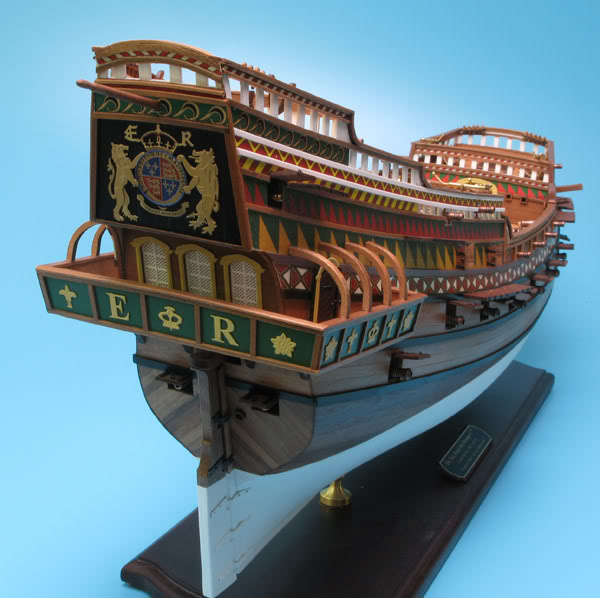
Stern view of a model of the Revenge as an example of a race-built galleon, 1577.
Image from modellmarine.de
Apart from the adoption and refinement of celestial navigation techniques, however, English seafaring capabilities also benefited from some more obvious, physical changes. In 1588, for example, on the eve of the Spanish Armada, a senior Spanish officer believed that the English had “many more long-range guns”. By the 1540s, medieval ironmaking techniques involving the blast furnace had gradually spread from Germany, to Normandy, and thence to the Weald of Sussex and Kent. Whereas in the first half of the sixteenth century England had typically imported three quarters of its iron from Spain, by 1590 it had not only quintupled its consumption of iron but was also almost entirely self-sufficient. And by allowing England to exploit its plentiful domestic deposits of iron, the blast furnace resulted in it producing many more cheap cannon.
Iron guns were in many ways worse for ships than those of bronze. They were heavier, prone to corrosion, and more likely to explode without warning. Bronze guns, by contrast, would first bulge and then split, but in any case tended to last. When the British captured Gorée off the coast of Senegal in 1758, they found a working English-made bronze cannon that dated from 1582. Yet iron was only 10-20% the price of bronze. Although the Royal Navy for decades continued to prefer bronze, cheap, medium-sized cannon of iron proliferated, becoming affordable to merchants, pirates, and privateers — a situation that was unique to England.
English ships were thus especially well-armed, allowing them to access new markets even when they sailed into hostile waters. They were soon some of the only merchants able to hold their own against the latest Mediterranean apex predator, whether it be the Spanish navy, Algeria-based corsairs, or Ottoman galleys. And they were able to insert themselves, sometimes violently, into the inter-oceanic trades — all despite the armed resistance of the Spanish and Portuguese, who had long monopolised those routes. In the 1560s, John Hawkins tried a few times to muscle in on the transatlantic Portuguese and Spanish trade in slaves. With backing from the monarch and her ministers, he captured Portuguese slave ships, raided and traded along the African coastline himself, and then sold slaves in the Spanish colonies of the Americas, sometimes having to attack those colonies before the local governor would allow them to trade. (The attempt was ultimately unsuccessful, as Hawkins’s privateering fleet was all but destroyed in 1568 and the English were not involved in the slave trade again for almost a century.)
The English hold over the hostile markets was only threatened during times of peace on the continent, when their ships’ defensiveness no longer gave them a special advantage. The Dutch usurped English dominance of the trade with Iberia and the Mediterranean, for example, during the Dutch Republic’s truce with Spain 1609-21. Their more efficient ships, especially for bulk commodities — the fluyt invented at Hoorn in the late 1580s — were cheaper to build, required fewer sailors, and were easier to handle. But these advantages only made them competitive when the risk of attack was low, as they were hardly armed. When wars resumed, the English had a chance to regain their position.
Finally, the English acquired a few further advantages when it came to ship design. Thanks to the shipwright Matthew Baker, who had been on the trial voyage Cabot dispatched to the Mediterranean, England experienced a revolution in using mathematics to design ships. Baker’s methods, seemingly developed in the 1560s, allowed him to more cheaply experiment with new forms, and by the 1570s these began to bear fruit. The old ocean-going carracks and galleons, with their high forecastles and aftercastles, became substantially sleeker. Taking inspiration from nature, Baker designed a streamlined, elongated hull modelled below the waterline upon a cod’s head with a mackerel tail. Above the waterline, too, he lowered the forecastle and set it further back, as well as flattening the aftercastle.
Starting in 1570 with his prototype the Foresight, and more fully developed in 1575-77 with the Revenge, these razed or “race-built” galleons gave the English some significant advantages. Drake even chose the Revenge as his flagship to battle the Spanish Armada in 1588, and to lead an ill-fated reprisal invasion of Portugal the following year. The higher castles of carracks and old-style galleons were suited to clearing an enemy’s decks with arrows and gunfire, as well as to defend against boarders. They were designed for combat at close quarters, in which height was an advantage. They were floating fortresses, their imposing height known to inspire terror. The race-built galleons, by contrast, by making the ship less top-heavy, could have longer and lower gundecks, with more of the ship’s displacement devoted to ordnance — especially useful when taking advantage of the cheaper but heavier cannon made of iron. Rather than killing an enemy ship’s sailors and soldiers, the race-built galleons were optimised for blasting through its hull. What they lost in “majesty and terror”, they made up for with overwhelming firepower. They aimed to sink.
Comments Off on Iron cannon, improved celestial navigation techniques, and “race-built” galleons
March 19, 2021
QotD: English food
Maybe the first question is how English cooking got to be so bad in the first place. A good guess is that the country’s early industrialization and urbanization was the culprit. Millions of people moved rapidly off the land and away from access to traditional ingredients. Worse, they did so at a time when the technology of urban food supply was still primitive: Victorian London already had well over a million people, but most of its food came in by horse-drawn barge. And so ordinary people, and even the middle classes, were forced into a cuisine based on canned goods (mushy peas!), preserved meats (hence those pies), and root vegetables that didn’t need refrigeration (e.g. potatoes, which explain the chips).
But why did the food stay so bad after refrigerated railroad cars and ships, frozen foods (better than canned, anyway), and eventually air-freight deliveries of fresh fish and vegetables had become available? Now we’re talking about economics — and about the limits of conventional economic theory. For the answer is surely that by the time it became possible for urban Britons to eat decently, they no longer knew the difference. The appreciation of good food is, quite literally, an acquired taste — but because your typical Englishman, circa, say, 1975, had never had a really good meal, he didn’t demand one. And because consumers didn’t demand good food, they didn’t get it. Even then there were surely some people who would have liked better, just not enough to provide a critical mass.
And then things changed. Partly this may have been the result of immigration. (Although earlier waves of immigrants simply adapted to English standards — I remember visiting one fairly expensive London Italian restaurant in 1983 that advised diners to call in advance if they wanted their pasta freshly cooked.) Growing affluence and the overseas vacations it made possible may have been more important — how can you keep them eating bangers once they’ve had foie gras? But at a certain point the process became self-reinforcing: Enough people knew what good food tasted like that stores and restaurants began providing it — and that allowed even more people to acquire civilized taste buds.
Paul Krugman, “Supply, Demand, and English Food”, https://web.mit.edu/krugman/www/mushy.html.
March 18, 2021
The Hornby Story
Little Car
Published 27 Feb 2020Hornby Railways is a British model railway brand. Its roots date back to 1901, when founder Frank Hornby received a patent for his Meccano construction toy. The first clockwork train was produced in 1920. In 1938, Hornby launched its first 00 gauge train. In 1964, Hornby and Meccano were bought by their competitor, Tri-ang, and sold on when Tri-ang went into receivership. Hornby Railways became independent again in the 1980s, and became listed on the London Stock Exchange, but due to recent financial troubles, reported in June 2017, is presently majority owned by turnaround specialist Phoenix Asset Management.
The script for this video comes from Wikipedia:
https://en.wikipedia.org/wiki/Hornby_…
If you find issues with the content, I encourage you to update the Wikipedia article, so everyone can benefit from your knowledge.To get early ad-free access to new videos, or your name at the end of my videos, please consider supporting me from just $1 or 80p a month at https://www.patreon.com/bigcar
#hornby #hornbyrailways

Comments Off on The Hornby Story
March 17, 2021
Heavy But Effective: Britain’s No4 MkI (T) Sniper Rifle
Forgotten Weapons
Published 29 Aug 2018http://www.patreon.com/ForgottenWeapons
Cool Forgotten Weapons merch! http://shop.bbtv.com/collections/forg…
The main British sniper rifle of World War Two, and arguably one of the best looking military sniper rifles of all time, the No4 MkI (T) was something the British military knew they would want even before the No4 MkI rifle had gone into real production. The first No4 snipers were built on leftover trials rifles from Enfield, and the pattern was formally introduced in February of 1942. First use was in North Africa, but the fighting there was not really suited to sniper rifles, and the weapon’s practical combat debut was in Italy in 1943.
The No4 MkI (T) was a conversion of a standard No4 MkI rifle, using examples chosen for particular good accuracy. They were sent to Holland & Holland to have scope mount bases added and No32 telescopic sights fitted (along with cheek risers on the stocks and having the battle sight aperture ground off to allow room for the scope bell). Between 23,000 and 26,000 were made during the war, and they would continue to be used in the British military for decades, including later conversion into 7.62mm NATO L42A1 rifles [which Ian discusses here].
Contact:
Forgotten Weapons
6281 N Oracle #36270
Tucson, AZ 85704

Comments Off on Heavy But Effective: Britain’s No4 MkI (T) Sniper Rifle
March 16, 2021
Mumford & [REDACTED]
Jack Stacey on the group-mandated self-cancellation of Winston Marshall by his band mates in Mumford & Sons at the behest of a social media mob for the mortal sin of complimenting a book publicly:
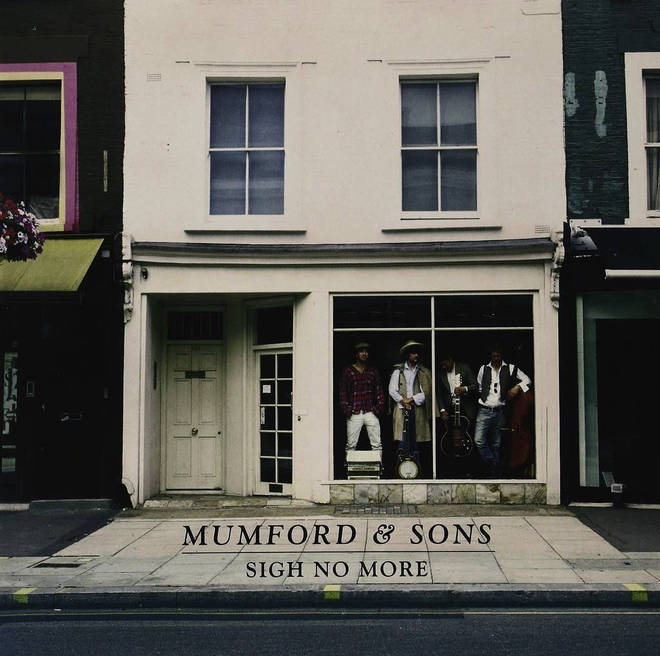
As the band’s most famous lyric goes, he really fucked it up this time. For while the book in question does describe the left’s penchant for totalitarian control disguised as benevolence, it was not the above classic [Nineteen Eighty-Four] (yet to be deemed problematic), but Unmasked by journalist Andy Ngo, which gets Inside Antifa’s Radical Plan to Destroy Democracy in the name of social justice.
Following this transgression against the militant arm of wokery and pressure from the rest of the group for his “increasingly right-wing views”, Marshall the banjoist has pushed his entire Twitter feed down the memory hole leaving only a mea culpa pinned to the start. It states: “Over the past few days I have come to better understand the pain caused by the book I endorsed. I have offended not only a lot of people I don’t know, but also those closest to me, including my bandmates, and for that I am truly sorry.”
He adds in his adopted Newspeak that he will use his absence “to examine my blindspots”, and concludes: “For now, please know that I realise how my endorsements have the potential to be viewed as approvals of hateful, divisive behaviour. I apologise, as this was not at all my intention.”
You would have thought he’d had rats caged to his face to become so repentant. But no, it appears that, as ever, some people got angry on social media, after which his partners at the tweed and ‘tache firm he’d helped set up have made him genuinely believe he deserved it for mucking around in politically incorrect prole territory.
For don’t let the & Sons bit fool you. Like the band’s resulting output, their name was chosen to add an earthy patina to bely the fact that they were, as Bo’ Selecta!’s Mel B might have it, “posh as fook”, rather than as they would have you think: “common as mook”.
Comments Off on Mumford & [REDACTED]
The horrors of British & US Logistics in WW2
TIK
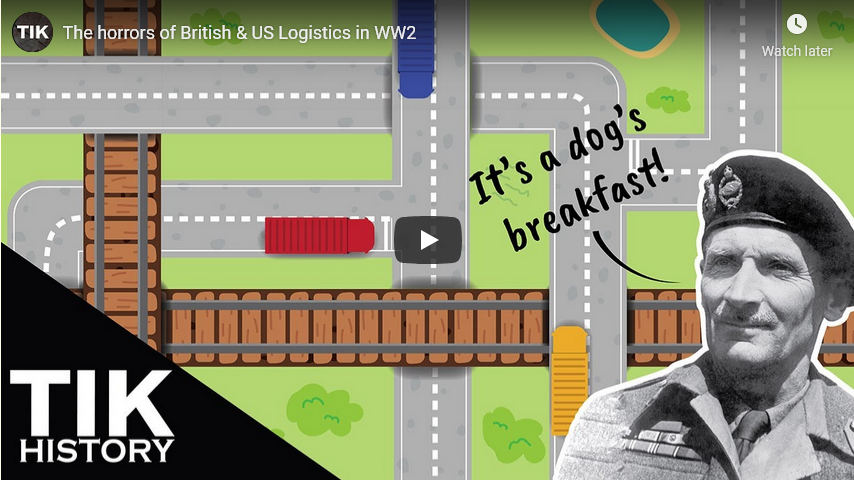
Published 15 Mar 2021The Allies may have had a lot of resources, manpower and industry, but that didn’t mean that their logistics weren’t inefficient or a disorganized mess. Today, we’re going to look at how the British railways were disaster during WW2, how the Americans ran out of fuel on the way to Germany, and why Montgomery called the planning for the invasion of Sicily a “dog’s breakfast”.
⏲️ Videos EVERY Monday at 5pm GMT (depending on season, check for British Summer Time).
The thumbnail for this video was created by Terri Young. Need graphics? Check out her website here https://www.terriyoungdesigns.co.uk/
– – – – –
📚 BIBLIOGRAPHY / SOURCES 📚
Dunn, W. The Soviet Economy and the Red Army, 1930-1945. Praeger Publishers, 1995.
Garvey, J. Operation Husky: The Untold Story of the logistics of the Sicily Invasion. Farm Publications, Kindle 2019.
Hazlitt, H. Economics in One Lesson: The Shortest & Surest Way to Understand Basic Economics. Three Rivers Press, 1979.
MacDonald, J. Supplying the British Army in the Second World War. Pen & Sword Military, Kindle 2020.
Molony, C. The Mediterranean and Middle East, Volume V, The Campaign in Sicily 1943 and The Campaign in Italy 3rd September 1943 to 31st March 1944. The Naval & Military Press LTD 2004, first published in 1973.
Wolmar, C. Fire & Steam: How the Railways Transformed Britain. Atlantic Books, Kindle 2007.British Government, Railways Act 1921, https://www.legislation.gov.uk/ukpga/…
Full list of all my sources https://docs.google.com/spreadsheets/…
– – – – –
⭐ SUPPORT TIK ⭐
This video isn’t sponsored. My income comes purely from my Patreons and SubscribeStars, and from YouTube ad revenue. So, if you’d like to support this channel and make these videos possible, please consider becoming a Patreon or SubscribeStar. All supporters who pledge $1 or more will have their names listed in the videos. For $5 or more you can ask questions which I will answer in future Q&A videos (note: I’m behind with the Q&A’s right now, and have a lot of research to do to catch up, so there will be a delay in answering questions). There are higher tiers too with additional perks, so check out the links below for more details.
https://www.patreon.com/TIKhistory
https://www.subscribestar.com/tikhistoryThank you to my current supporters! You’re AWESOME!
– – – – –
ABOUT TIK 📝
History isn’t as boring as some people think, and my goal is to get people talking about it. I also want to dispel the myths and distortions that ruin our perception of the past by asking a simple question – “But is this really the case?”. I have a 2:1 Degree in History and a passion for early 20th Century conflicts (mainly WW2). I’m therefore approaching this like I would an academic essay. Lots of sources, quotes, references and so on. Only the truth will do.
This video is discussing events or concepts that are academic, educational and historical in nature. This video is for informational purposes and was created so we may better understand the past and learn from the mistakes others have made.
Comments Off on The horrors of British & US Logistics in WW2
March 14, 2021
Tumbling Capitals – MacArthur on the Run – March 13, 1942 – WW2 – 133
World War Two
Published 13 Mar 2021Rangoon in Burma falls to the invaders without a shot, the Dutch East Indies surrender 100,000 men to them at Batavia, and the Japanese land on New Guinea and begin their advance on Port Moresby. The first phase of their offensives is now over. The Philippines still hold out, their armies under siege at Bataan, but Douglas MacArthur, Allied commander there, has made his getaway, one day to hopefully return. American troops do begin landings on New Caledonia, to build a base there to begin the fight back.
Join us on Patreon: https://www.patreon.com/TimeGhostHistory
Or join The TimeGhost Army directly at: https://timeghost.tvFollow WW2 day by day on Instagram @ww2_day_by_day – https://www.instagram.com/ww2_day_by_day
Between 2 Wars: https://www.youtube.com/playlist?list…
Source list: http://bit.ly/WW2sourcesWritten and Hosted by: Indy Neidell
Director: Astrid Deinhard
Producers: Astrid Deinhard and Spartacus Olsson
Executive Producers: Astrid Deinhard, Indy Neidell, Spartacus Olsson, Bodo Rittenauer
Creative Producer: Maria Kyhle
Post-Production Director: Wieke Kapteijns
Research by: Indy Neidell
Edited by: Iryna Dulka
Sound design: Marek Kamiński
Map animations: Eastory (https://www.youtube.com/c/eastory)Colorizations by:
– Mikołaj Uchman
– Norman Stewart – https://oldtimesincolor.blogspot.com/Sources:
– bockelsound from Freesound.orgSoundtracks from the Epidemic Sound:
– Rannar Sillard – “Easy Target”
– Jo Wandrini – “Dragon King”
– Fabien Tell – “Break Free”
– Philip Ayers – “The Unexplored”
– Howard Harper-Barnes – “Underlying Truth”
– Gunnar Johnsen – “Not Safe Yet”
– Reynard Seidel – “Rush of Blood”
– Flouw – “A Far Cry”
– Philip Ayers – “Trapped in a Maze”Archive by Screenocean/Reuters https://www.screenocean.com.
A TimeGhost chronological documentary produced by OnLion Entertainment GmbH.

Comments Off on Tumbling Capitals – MacArthur on the Run – March 13, 1942 – WW2 – 133
March 13, 2021
The Paperback Revolution
The History Guy: History Deserves to Be Remembered
Published 12 Mar 2021Sponsored by Blinkist. The first 100 people who go to https://www.blinkist.com/thehistoryguy are going to get unlimited access for one week to try it out. You’ll also get 25% off if you want the full membership.
Today, the most popular book format in the world is not a traditional hardcover book, nor an ebook, but a paperback — a format that changed the what, how, when and how much the world reads. It is history that deserves to be remembered.
This is original content based on research by The History Guy. Images in the Public Domain are carefully selected and provide illustration. As very few images of the actual event are available in the Public Domain, images of similar objects and events are used for illustration.
You can purchase the bow tie worn in this episode at The Tie Bar:
https://www.thetiebar.com/?utm_campai…All events are portrayed in historical context and for educational purposes. No images or content are primarily intended to shock and disgust. Those who do not learn from history are doomed to repeat it. Non censuram.
Find The History Guy at:
Patreon: https://www.patreon.com/TheHistoryGuy
Please send suggestions for future episodes: Suggestions@TheHistoryGuy.netThe History Guy: History Deserves to Be Remembered is the place to find short snippets of forgotten history from five to fifteen minutes long. If you like history too, this is the channel for you.
Awesome The History Guy merchandise is available at:
teespring.com/stores/the-history-guyScript by THG
#history #thehistoryguy #Books

March 11, 2021
Boris as a latter-day Prince Rupert of the Rhine?
In The Critic, Graham Stewart portrays the British Prime Minister and Sir Keir Starmer, leader of Her Majesty’s loyal opposition in the House of Commons as English Civil War combatants:
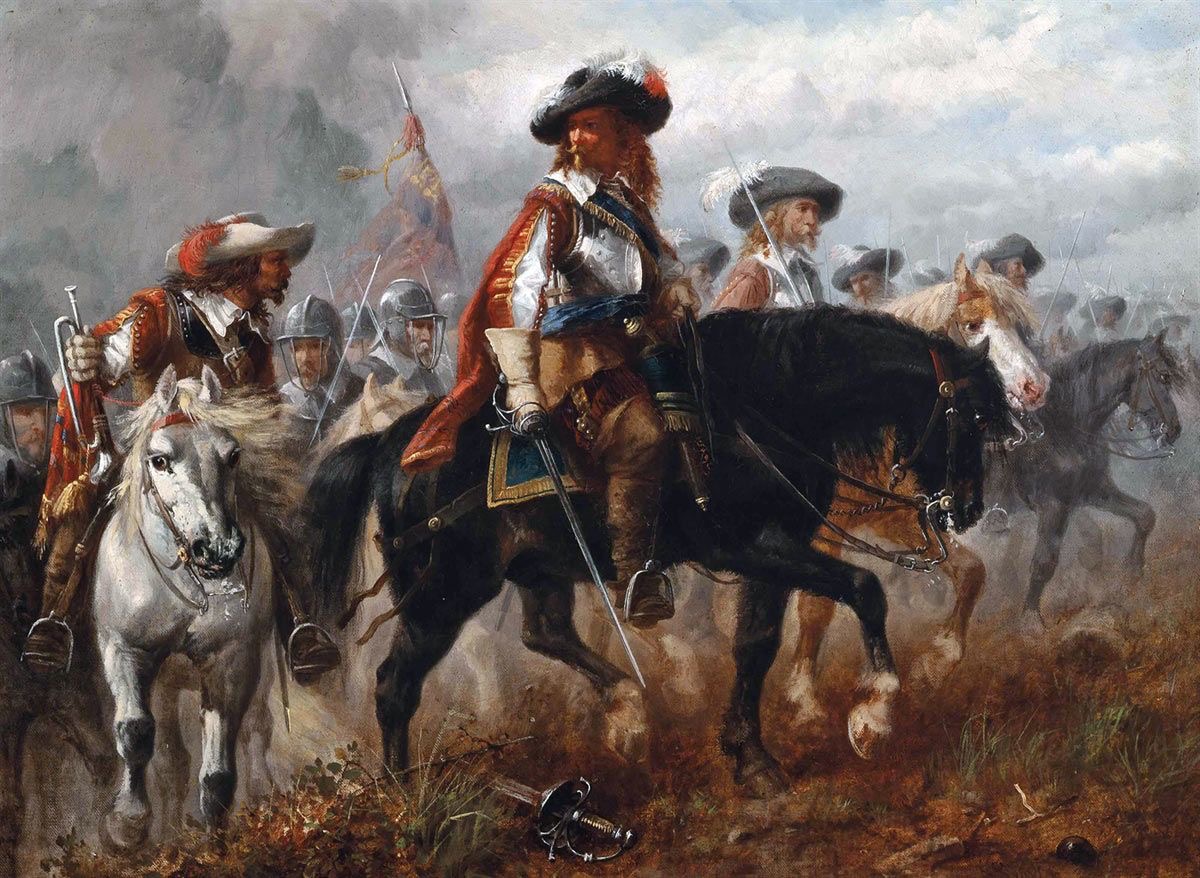
King Charles I and Prince Rupert before the Battle of Naseby 14th June 1645 during the English Civil War.
19th century artist unknown, from Wikimedia Commons.
Prime Minister’s Questions distils into a single gladiatorial contest what thousands of enthusiasts in a charitable organisation called the Sealed Knot perform across the country most summers – namely the re-enactment of battles of the English Civil War.
Unsmiling, relentless, serious to the point of bringing despair to his foot-soldiers as much as his opponents, Sir Keir Starmer is a Roundhead general for our times. Nobody believes better than he that virtue and providence are his shield. This faith sustains him whilst the fickle and ungodly court of popular opinion fails to rally to his command. He believes that holding firm, doggedly probing the enemy with the long pike and short-sword will eventually prevail, no matter how long the march to victory may prove.
Facing him, the generous girth of the nation’s leading Cavalier occupies his command-post. His long, uncut hair resembling a thatch on a half-timbered cottage, Boris Johnson lands at the despatch box as if he has just fallen from his place of concealment in an oak tree, bleary and under-prepared, but confident in assertion. It might be said of him, as Sir Edward Bulwer Lytton once said of the parliamentary style of a previous Tory prime minister, Lord Derby, that Johnson is “irregularly great, frank, haughty, bold – the Rupert of debate.”
Today was one of those occasions when the prime minister did indeed resemble the dashing Prince Rupert of the Rhine. Unfortunately, it was the moment during the decisive civil war battle of Naseby when the great Cavalier commander charged his horsemen through the parliamentary lines with such momentum that they kept going and ended up spending the rest of the day plundering a distant baggage train rather than returning to determine the result of the battle.
Comments Off on Boris as a latter-day Prince Rupert of the Rhine?
March 9, 2021
Tank Chats #98 | 40 Ton Centurion | The Tank Museum
The Tank Museum
Published 27 Mar 2020Here David Fletcher discusses FV4202, the 40 Ton Centurion — a prototype tank built by Leyland in 1956, to evaluate certain features which would later be used in Chieftain.
Support the work of The Tank Museum on Patreon: ► https://www.patreon.com/tankmuseum
Visit The Tank Museum SHOP: ►tankmuseumshop.org
Twitter: ► https://twitter.com/TankMuseum
Instagram: ► https://www.instagram.com/tankmuseum/
Tiger Tank Blog: ► http://blog.tiger-tank.com/
Tank 100 First World War Centenary Blog: ► http://tank100.com/
#tankmuseum #tanks #MuseumFromHome

Comments Off on Tank Chats #98 | 40 Ton Centurion | The Tank Museum


