
The most famous episode of price controls in Roman history was during the reign of Emperor Diocletian (A.D. 244-312). He assumed the throne in Rome in A.D. 284. Almost immediately, Diocletian began to undertake huge and financially expensive government spending projects.
There was a massive increase in the armed forces and military spending; a huge building project was started in the form of a planned new capital for the Roman Empire in Asia Minor (present-day Turkey) at the city of Nicomedia; he greatly expanded the Roman bureaucracy; and he instituted forced labor for completion of his public works projects.
[…]
Diocletian also instituted a tax-in-kind; that is, the Roman government would not accept its own worthless, debased money as payment for taxes owed. Since the Roman taxpayers had to meet their tax bills in actual goods, this immobilized the entire population. Many were now bound to the land or a given occupation, so as to assure that they had produced the products that the government demanded as due it at tax collection time. An increasingly rigid economic structure, therefore, was imposed on the whole Roman economy.
But the worst was still to come. In A.D. 301, the famous Edict of Diocletian was passed. The Emperor fixed the prices of grain, beef, eggs, clothing, and other articles sold on the market. He also fixed the wages of those employed in the production of these goods. The penalty imposed for violation of these price and wage controls, that is, for any one caught selling any of these goods at higher than prescribed prices and wages, was death.
Realizing that once these controls were announced, many farmers and manufacturers would lose all incentive to bring their commodities to market at prices set far below what the traders would consider fair market values, Diocletian also prescribed in the Edict that all those who were found to be “hoarding” goods off the market would be severely punished; their goods would be confiscated and they would be put to death.
In the Greek parts of the Roman Empire, archeologists have found the price tables listing the government-mandated prices. They list over 1,000 individual prices and wages set by the law and what the permitted price and wage was to be for each of the commodities, goods, and labor services.
A Roman of this period named Lactanius wrote during this time that Diocletian “… then set himself to regulate the prices of all vendible things. There was much blood shed upon very slight and trifling accounts; and the people brought no more provisions to market, since they could not get a reasonable price for them and this increased the dearth [the scarcity] so much, that at last after many had died by it, the law was set aside.”
Richard M. Ebeling, “How Roman Central Planners Destroyed Their Economy”, Foundation for Economic Education, 2016-10-05.
April 14, 2020
QotD: The Edict of Diocletian, 301 AD
April 12, 2020
Minimum alcohol pricing – a policy so good you have to lie about it
Scotland has had legal minimum prices for alcoholic beverages since mid-2018. If you read a random selection of mainstream media coverage, you’d know that it’s been a huge success, with vastly improved public health results at a price to consumers measured in mere pennies. As with all propaganda efforts, if you tell the lies often enough, people may believe you:
There has been all sorts of rubbish written about minimum pricing since it was introduced in Scotland in May 2018. Nicola Sturgeon has lied about in the Scottish Parliament. The BBC has gone to extraordinary lengths to spin the policy as a success. The public have been told that alcohol-related hospital admissions have gone down when they have gone up. We have seen the media fall for blatant cherry-picking. We have been told that rates of problem drinking have gone down when we don’t have any evidence either way.
One of the few solid facts — that there were more alcohol-related deaths recorded in Scotland in 2018 than in 2017 — has been sidelined. Instead, the media have focused on a disputed, and relatively small, decline in alcohol sales as if that were an end in itself. Any port in a storm (fortified wine sales have definitely benefited from minimum pricing).
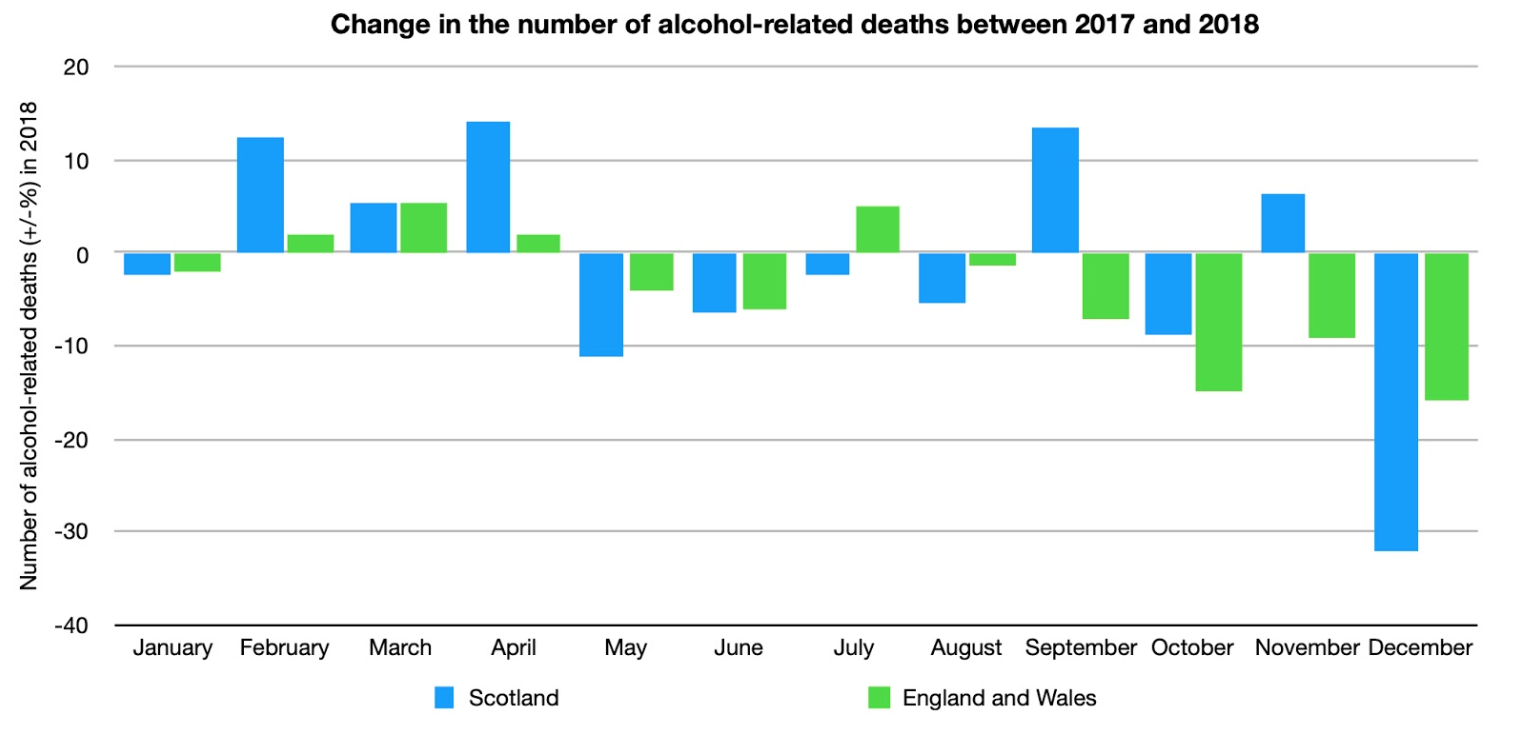
Figures from the calendar year of 2018 are of limited use because minimum pricing didn’t begin until May 1st. Today, for the first time, I can reveal the monthly mortality figures for Scotland, England and Wales. They show that there was no difference between the change in annual death rates from alcohol-related causes, regardless of whether the country had minimum pricing in place. Both England/Wales and Scotland saw a decline between May and December of seven per cent (compared to the previous year).
This graph is published in a new briefing paper I have written for the IEA. It summarises all the evidence gathered to date on deaths, hospitalisations and sales, plus exclusive new data.
Importantly, it contains estimates of the costs to consumers. Among the more outlandish claims made by the Sheffield modellers was the idea that moderate and low income consumers would be barely affected by minimum pricing. They predicted that a low income moderate drinker would only pay an extra 4p a year! This was never realistic, not least because it was based on the minimum price being set at 45p and they defined a moderate drinker as someone consuming the equivalent of just two pints of lager a week, but it worked from a PR perspective because it quelled politicians’ fears about the policy being regressive.
QotD: The Gini coefficient
The redistributionist impulse has brought to the fore metrics such as the Gini coefficient, named after the ur-redistributor, Corrado Gini, an Italian social scientist who developed an early statistical measure of income distribution a century ago. A society where a single plutocrat earns all the income ranks a pure “1” on the Gini scale; one in which all earnings are perfectly equally distributed, the old Scandinavian ideal, scores a “0” by the Gini test. The Gini Index has been renamed or updated numerous times, but the principle remains the same. Income distribution and redistribution seem so crucial to progressives that French economist Thomas Piketty built an international bestseller around it, the wildly lauded Capital.
Through Gini’s lens, we now rank past eras. Decades in which policy endeavored or managed to even out and equalize earnings — the 1930s under Franklin Roosevelt, the 1960s under Lyndon Johnson — score high. Decades where policymakers focused on growth before equality, such as the 1920s, fare poorly. Decades about which social-justice advocates aren’t sure what to say — the 1970s, say — simply drop from the discussion. In the same hierarchy, federal debt moves down as a concern because austerity to reduce debt could hinder redistribution. Lately, advocates of economically progressive history have made taking any position other than theirs a dangerous practice. Academic culture longs to topple the idols of markets, just as it longs to topple statutes of Robert E. Lee.
But progressives have their metrics wrong and their story backward. The geeky Gini metric fails to capture the American economic dynamic: in our country, innovative bursts lead to great wealth, which then moves to the rest of the population. Equality campaigns don’t lead automatically to prosperity; instead, prosperity leads to a higher standard of living and, eventually, in democracies, to greater equality. The late Simon Kuznets, who posited that societies that grow economically eventually become more equal, was right: growth cannot be assumed. Prioritizing equality over markets and growth hurts markets and growth and, most important, the low earners for whom social-justice advocates claim to fight. Government debt matters as well. Those who ring the equality theme so loudly deprive their own constituents, whose goals are usually much more concrete: educational opportunity, homes, better electronics, and, most of all, jobs. Translated into policy, the equality impulse takes our future hostage.
Amity Shlaes, “Growth, Not Equality”, City Journal, 2018-01-21.
April 6, 2020
The Precautionary Principle – “If it saves only one life…”
A guest post at Catallaxy Files on the madness of taking the Precautionary Principle as your guide:

Slide from a presentation by Patti Gettinger, 2011-07-11.
Original slideshow at https://fr.slideshare.net/regsgridlock/the-precautionary-principle-8656034
In the unprecedented trampling of rights characterised by the response to the global pandemic of COVID-19, the common justification is that it will save lives, as though no measure is too great to save even one life.
This has echoes of the Precautionary Principle, which has pushed aside ubiquitous risk management principles in such areas as climate change, invariably to justify unlimited spending which risk management principles would otherwise limit. In other words, it’s a principle which can be used to justify any measure. And here we are.
One fundamental difference between the competing principles is the concept of marginal benefit, which, simply put, is the point where the benefits of an action no longer outweighs the cost. Our new “rules” from the newly formed National Cabinet, of which no legal or constitutional standing exists, has far surpassed the point of marginal benefit.
A person fishing off the coast alone in a small boat is in breach of the rules, as is a person playing golf alone, or a person sunbathing on a rock in the outback, yet in none of these examples can any measurable likelihood of spreading it or catching the disease be identified. These situations would fail any risk management approach, but not the Precautionary principle. Any risk, that is, any potential risk that can not be confidently identified as absolute zero, is a risk not worth taking, but that is not how we live our lives, because we understand that everything involves risk. Driving a car, catching public transport, having a job, not having a job, leaving your house or indeed staying in it involves some level of risk.
Also central to risk management is the concept of mitigation; the potential actions that can reduce, transfer or eliminate identified risks. In the case of COVID-19, many mitigation measures have been identified, and implemented. Such mitigations implemented are travel bans (belatedly), banning large crowds (belatedly), temperature screenings, washing hands, social distancing, pandemic announcements (belatedly, again), face masks (very belatedly), and fit-for-purpose hospitals (you guessed it). All of these easily demonstrate a benefit greater than worst-case scenario costs, yet after being bystanders for weeks, leaders across the globe then overreacted far beyond the demonstrable benefits. At least benefits to us.
QotD: North American downtown “architecture”
The “downtowns” of cities in the eastern half of this American continent were built before the automobile, with pedestrian compactness. So prosperous did we become, so quickly, and so extensive was the building towards the latter end of the nineteenth century, that plentiful evidence remains. The ground-cover is still mostly older buildings, paradoxically thanks to rocketing property values: new buildings must accommodate phenomenal densities, upon tiny footprints. But ten-thousands of apparently “old houses” remain, going on and off market at a million apiece. The principles of money-management have “evolved” over the years, and the idea of “home” as a fungible investment has been universalized. All one needs to acquire one is a small saving and a large credit line. Then one is cut in for all subsequent rounds of poker.
You move in and “re-decorate,” less from personal taste than in anticipation of re-sale. After this process has been repeated a few times, nothing remains of the older building except its “historical” façade, itself somewhat tarted. Travelling about by foot and trolley, I have watched a likely majority of the city’s more attractive “landmark” buildings reduced to fronts only. These are propped by girders, while entirely new (and disproportionately larger) new constructions are bunged in behind.
Thus, nothing remains that is “authentic.” All continuities are destroyed, beyond this tip of the hat — the aesthetic equivalent of that homage which vice pays to virtue.
David Warren, “The scandal of interiors”, Essays in Idleness, 2018-01-25.
April 5, 2020
China’s geostrategic box
ESR looks at the concerns that China may be considering starting a war with the United States in the wake of the Wuhan Coronavirus:
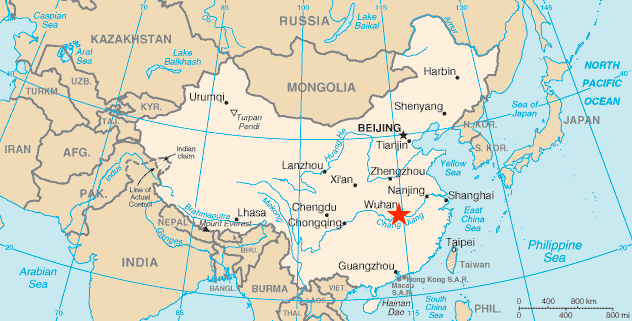
To understand how limited the PRC’s war options are, we can start with a grasp on how difficult and unsatisfying any war of conquest would be due to the geographic box China is in. The obstacles around it are formidable.
To the south, the Himalayan massif makes all of South Asia other than a narrow coastal plain on the Southeast Asian peninsula inaccessible to serious troop movements. There are no roads or rail links. The last time the Chinese tried pushing in that direction, in 1979, they were unable to sustain an offensive at any distance from their railheads and withdrew after less than a month. Their war aim – forcing the North Vietnamese to withdraw its troops from Cambodia – failed.
To the west, the vastness and comparatively undeveloped state of China’s western hinterland is a serious logistical problem before one even gets to the border. At the borders, the Tien Shan and Pamir ranges present a barrier almost as formidable as the Himalayas. External road and rail links are poor and would be easily interdicted.
To the north, movement would be easier. It might be just within logistical possibility for the PLA to march into Siberia. The problem with this idea is that once you’ve conquered Siberia, what you have is … Siberia. Most of it, except for a small area in the south coastal region of Primorsky Kraye, is so cold that cities aren’t viable without food imports from outside the region. Set this against the risks of invading a nuclear-armed Russia and you don’t have a winning proposition.
To the east is the South China Sea. The brute fact constraining the PRC’s ambitions in that direction is that mass movement of troops by sea is risky and difficult. I recently did the math on Chinese sealift craft and despite an expensive buildup since the 1980s they don’t have the capacity to move even a single division-sized formation over ocean. Ain’t nobody going to take Taiwan with one division, they’ve has too much time to prepare and fortify over the last 60 years.
The PRC leadership is evil and ruthless, but it’s also cautious and historically literate and can read maps. Accordingly, the People’s Liberation Army is designed not to take territory but to hold the territory the PRC already has. Its mission is not conquest but the suppression of regional warlordism inside China itself. The capability for the PLA to wage serious expeditionary warfare doesn’t exist, and can’t be built in the near-term future.
It’s often said that the danger of aggressive war by China is a function of the huge excess of young men produced by covert sexual selection and the one-child policy. But to expend those young men usefully you need to get them to where they can fight and are motivated by some prospect of seizing the wives unavailable for them at home. The PRC can’t do that.
The military threat from China is, therefore, a function of what it can do with its navy, its airpower, and its missiles. And what it can do with those against the U.S. is upper-bounded by the fact that the U.S. has nuclear weapons and would be certain to respond to a PRC nuclear or EMP attack on the U.S. mainland by smashing Chinese cities into radioactive rubble.
Within the constraints of conventional warfare waged by navy and air force it is difficult to imagine an achievable set of PRC war aims that gains more than it costs.
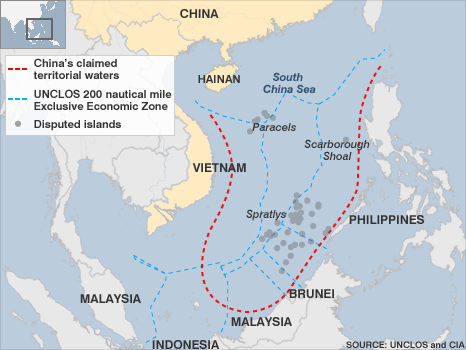
It’s possible — even likely — that the Chinese military has something like the oft-rumoured “ship-killer missiles” that might be able to cripple or sink an American carrier … if it was in range. That makes the South China Sea, the East China Sea, and the west coast of Japan a possible no-go area for US Navy carrier strike groups. A good defensive weapon system to have on hand in case relations with the outside world go “hot”, but not a strategic game-changer. Nobody would be likely to consider anything as dangerous as a seaborne invasion of mainland China, even without the threat of wonder weapons like the ship-killer. And good defensive weapons won’t secure the trade routes that China depends on outside coastal waters.
In a lot of ways your strategic situation is like a scaled-up version of Japan’s in 1941 – you could seize the initiative with a Pearl-Harbor-like initial shock, but you can’t wage a long war because without sealane control you’ll run out of key feedstocks and even food rather rapidly. And unlike the Japanese in 1941, you don’t have the kind of serious blue-water navy that you’d need for sealane control outside the First Island Chain – not with just two carriers you don’t.
There is one way an aggressive naval war could work out in your favor anyway. You can count on the U.S.’s media establishment to be pulling for the U.S. to lose any war it’s in, especially against a Communist or Socialist country. If your war goals are limited to ending U.S. naval power projection in the Western Pacific, playing for a rapid morale collapse orchestrated by agents of influence in the U.S. is not completely unrealistic.
It’s playing with fire, though. One problem is that before you launch your attack you don’t know that your sucker punch will actually work. Another is that, as the Japanese found out after Pearl Harbor, the American public may react to tragic losses with Jacksonian fury. If that happens, you’re seriously screwed. The war will end with your unconditional surrender, and not sooner.
Update: Bone-headed typo in the headline fixed. It’s funny how you can’t see ’em until just after you click the Save button…
April 4, 2020
The media’s grasp of modern logistics
Kurt Schlicter — who, spoiler, isn’t a fan of our news media in general — on the demands by newsbeings for the impossible to be done immediately:
We Americans are truly blessed by having a mainstream media full of brilliant renaissance men, women, and gender non-specific entities who are masters of so many varied and intermittently useful skills and who are eager to share their knowledge with us benighted souls. The pandemic has revealed that every urban Twitter blue check scribbler, MSNBCNN panelist, NYT/WaPo doofus, and barely legal “senior editor” of a website you never heard of, is a Nobel Prize-winning epidemiologist, a master logistician, and a diversity consultant to boot.
[…]
Another hitherto unknown skill that the media believes it possesses is logistics. “Why hasn’t Trump commanded a million ventilators to appear?!” the reporters demand. It’s pretty easy to see where they might have gotten the idea that the moment one articulates a desire to possess something that it magically appears. Capitalism has pretty much made that a reality. If you want something, you can go to a store and get it 24/7, or you can go on Amazon and it’ll be at your Manhattan apartment in 48 hours. Since they have never built anything or transported anything or distributed anything, only benefited from the labor of the unhip people who do those things, it’s only natural that the delayed adolescents who make up our media class imagine that material goods can be simply wished into being. After all, for all practical purposes during normal times, because of the efforts of Americans they look down upon, material goods pretty much can be simply wished into being. But prosperity takes work, not that the media would know.
[…]
Apparently, the media class thinks there are giant warehouses with an endless supply of goods just sitting there, somewhere, waiting. They have no idea about how logistics work, how goods flow quickly from producer to market and how expected resupply levels need a few days to adjust from a 10 percent daily turnover to a 30 percent daily turnover. They have zero appreciation for inventory management because no one they know does unglamorous stuff like that.
It’s all much easier in a socialist command economy. You get nothing and like it. Or don’t like it. Whatever. Here’s your weekly bean allowance. Workers of the world unite. You have nothing to lose but access to toothpaste and toilet paper.
The best part is when the media – the same media that was collectively soiling its Dockers because that mean old Trump was barring direct flights from China because of racism and stuff – demands to know why, back in December, Trump was not commanding a zillion Wuhan Flu tests, a zillion masks, and a zillion ventilators be created, while locking down all of America. Leaving aside the whole lack of an enumerated power to do that thing, in what world would have Trump have convinced anyone – least of all the media that was slobbering over his bogus impeachment at the time – that some bat soup-derived pathogen in BumFoo, China, was going to black swan all over America’s economy? The lack of seriousness by the people who presume to be reporting the news to us is more breathtaking than the damn ChiCom grippe.
Monetary Policy: The Negative Real Shock Dilemma
Marginal Revolution University
Published 15 Aug 2017Imagine a negative real shock, like an oil crisis, just hit the economy. How should the Fed respond?
Decreasing the money supply will help with inflation, but make growth worse. Increasing the money supply will improve growth, but inflation will climb higher. What’s the Fed to do?!

April 1, 2020
QotD: Government spending in theory and practice
Steven Kates, “Classical economic theory and the American recovery”, Catallaxy Files, 2018-01-15.
March 31, 2020
QotD: How the old “mainstream media” fell for fake news
One reason for this is that the internet has turned into a big stage where anyone can try out their act on the public. In the old days, a carny bimbo would have been confined to a traveling carnival, Hollywood, New York or community theater. Maybe she would have ended up in pornography. It was not an easy way to make a living. Today, she can have a twitter account where she flashes photo-shopped pics of herself. Thirsty losers send her money through PayPal or super chats on her YouTube channel.
The low barrier to entry means every female with a desire for the carny life can get on stage from the privacy of her studio apartment. It’s not just females working the new rackets. In a prior age, Mike Cernovich would have been traveling from town to town selling his monkey mind juice to gullible townies at state fairs. Alex Jones would have been mailing people his mimeographed newsletter, where he explained how space aliens control the Federal Reserve Bank.
Most likely, it is the communications revolution that has caused the news media to commit suicide. In the old days, when the audience was fixed, the focus was on maintaining the facade of objectivity. No one was under any illusions about growing the audience, so they focused on keeping the audience. The internet promised a global market and unlimited market share. A relentless drive for eyeballs gave rise to the clickbait journalists turning the media into fake news.
The Z Man, “Carny Town”, The Z Blog, 2019-12-29.
March 30, 2020
“Hoarders” and “gougers” … when the market delivers unwelcome news
Tom Mullen on the efficient functioning of prices in a free market economy:
Market prices are the foundation of civilization. They are the signal that tells producers how much of any one thing to produce. They tell consumers how much to consume or whether to consume a product at all. The reason retailers don’t normally throw away 80 percent of their stock is because market prices tell them how much to have on hand at any one time to meet current demand.
When they miscalculate and buy a little too much, they still don’t typically waste their stock. They put it on sale and meet the demand at a lower price.
To the extent the market is allowed to set prices, producers generally produce what consumers want to buy in the quantities they want to buy. When all supply is consumed and large amounts of consumers are not left with unmet demand, it is referred to as the market “clearing.”
The government is always and everywhere at war with market prices. Regulations creating barriers to entry limit supply, artificially inflating prices. Price controls, including “anti-price gouging” laws override market prices, creating shortages. Subsidies to producers (farm subsidies, for example), allow producers to limit supply, artificially inflating the price.
But when the market works properly, it often delivers news to consumers and to governments that is unpopular, and governments frequently attempt to “hold back the sea” by introducing market distortions:
All these price adjustments by the market are essential for our well-being. They are the cure for the economic disease caused by the government response to the virus and the previous 12 years of monetary inflation and artificially low interest rates.
What is the government doing in response? It is escalating its usual, conventional war on market prices to a nuclear war. It is punishing suppliers of essential goods for raising prices. It is ramping up monetary inflation to historic levels to keep stock prices artificially high and unprofitable businesses alive to go on producing products for which there is no demand. At a time when market prices are more essential to our survival than ever, the government is doing more to override them than ever.
This is not an academic theory that only works on a graph in a classroom. This plays out before our very eyes in the form of essential goods not available to us at any price.
Why is there no toilet paper available? Ask most people and they will say it is because of “hoarders.” These are people who bought far more than they needed in anticipation of future shortages. The people who arrived at the store after the toilet paper is sold out vilify them. Others might just call them prudent.
The same people who vilify hoarders also vilify “price gougers.” They don’t seem to grasp the obvious cause/effect relationship here. If it weren’t for artificial limits on price, i.e., “anti-price gouging” laws, the price of toilet paper would rise dramatically with the surge in demand and the so-called hoarders would not be able to buy nearly as much. That would leave far more for everyone else. The toilet paper market would find the optimal price level where the greatest number of people could get what they need.
The Ontario government, of course, is doing everything they can to obstruct the market from operating freely.
March 29, 2020
QotD: Cargo cults, ancient and modern
To say that Pacific island societies were “relatively undeveloped” is a euphemism; they were primitive backward people who, when first encountered by European explorers, lived in a Neolithic stage of development far behind that of Mesopotamia in 1,500 B.C. That natives of Melanesia were at least 3,000 years behind Western civilization is simply a fact, but facts are now racism. Nevertheless, the point about cargo cult thinking is that these primitive islanders were unable to comprehend the advanced social and economic systems that produced, e.g., steam-powered ships, airplanes and the manufactured goods that the white man’s mechanical contrivances delivered. Utterly ignorant of how and why “cargo” had been produced and transported to their remote islands, the natives were understandably mystified when the arrival of “cargo” was interrupted. So they resorted to imitative rituals by which they believed the return of “cargo” might magically be reinstated.
The 21st-century American might laugh at these primitive superstitions, except that similarly ignorant “monkey see, monkey do” behaviors can be observed in our own society every day. My favorite example is the teenage boy who observes that girls are interested in athletes. The star basketball player in high school is popular with the girls, and so lower-status teenage boys — including the ones with zero athletic aptitude — will often emulate the athletic boys in terms of their attitudes, manners and clothing. This is why you see so many dorky suburban white boys wearing Nikes, NFL jerseys, etc., slouching around and speaking in a rap-influenced slang: “Wazzup, bruh?” These behavioral styles are an attempted imitation of popular black athletes. The clumsy adolescent white boy lacks the essential substance of the black athlete’s appeal, yet superstitiously believes (in cargo-cult manner) that he can obtain popularity by performing a superficial imitation.
Robert Stacy McCain, “The Cargo Cult Mentality”, The Other McCain, 2019-12-20.
March 20, 2020
QotD: Absolute and relative poverty
That the poor of our nation live better than 90 percent of anyone only 100 years ago, better than anyone at all from more than 200 years ago, shows just how fabulous an economic system it is.
Sure, it’s not perfect, it could do with some revisions here and there, but this system — the rule of law, markets, and capitalism — delivers in the one thing that truly matters: raising the living standards of the people, most especially poor people. Even more, no other economic system has managed this at all.
Tim Worstall, “Appalachia’s woes show the success of American capitalism”, Washington Examiner, 2018-01-09.
March 19, 2020
The undifferentiated “labour lump” fallacy in Keynesian grand schemes
At the Continental Telegraph, Tim Worstall explains why old fashioned “shovel ready” infrastructure projects are no longer a viable way to address large scale employment needs:
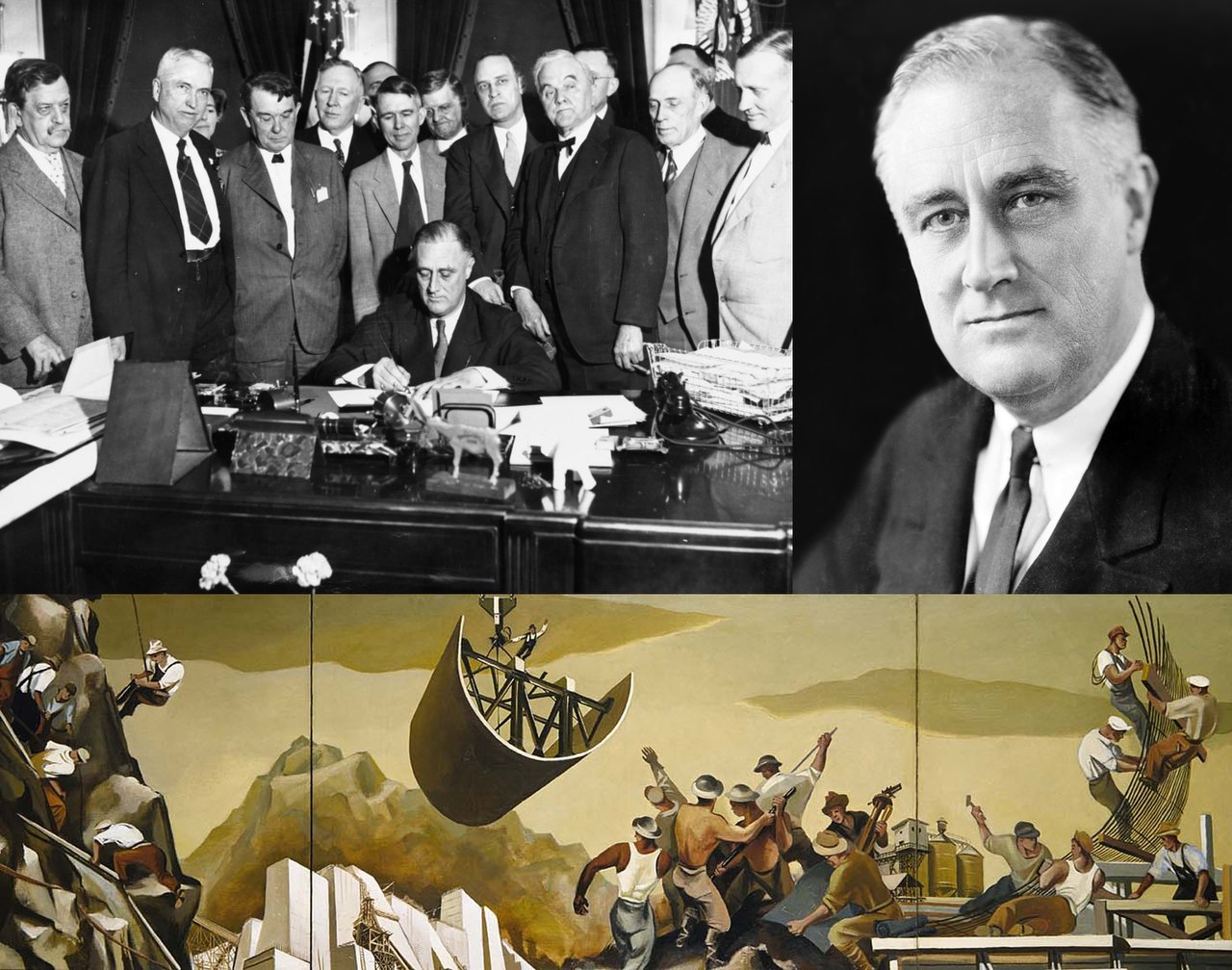
Top left: The Tennessee Valley Authority, part of the New Deal, being signed into law in 1933.
Top right: FDR (President Franklin Delano Roosevelt) was responsible for the New Deal.
Bottom: A public mural from one of the artists employed by the New Deal’s WPA program.
Wikimedia Commons.
We still get some slavering at the thought that in economic hard times we just get everyone off digging ditches. We get to hear Woody Guthrie singing again or something. The mass ranks of peasants dying at the Belomors Canal. Or maybe the navvies building the railways, it’s always difficult to know which historical episode they’ve got in mind.
Any economic down turn is always met with cries of “go build something” and they always do envision some mass mobilisation of labour to do it. The current one seems to be “insulate every house in the country and create jobs in every constituency”. The bit that is always missed being that most people haven’t a clue about how to do such work. The division of labour and specialisation have seen to that.
[…]
Having the diversity advisers – and this is a lovely thought even so – navvie the railways into being is going to be about as effective as having the navvies – and this is a lovely thought even so – doing the diversity advising. Division and specialisation of labor means the one is not a substitute for the other.
It’s only in GuardianWorld that labour is such a lump that can be allocated as the Commissars wish. Which presumably means their economics pages are written by the sports desk which does, to be fair, explain a lot about that output.


