
Warren Buffett has told us that there’s something magical about American capitalism. This isn’t quite true, because other countries have achieved much the same thing. What is true about it is that it is the system itself which has caused the incredible wealth we all enjoy in this modern world. Buffett writes:
In 1776, America set off to unleash human potential by combining market economics, the rule of law and equality of opportunity. This foundation was an act of genius that in only 241 years converted our original villages and prairies into $96 trillion of wealth.
Other places which did much the same thing — that mixture of capitalism, the rule of law and free markets — achieved much the same end. We generally refer to those places as the developed world, while those that didn’t are still the Third World. There is nowhere at all that has become rich, absent some vast natural resource, without adopting this system.
We can show this, too, with the numbers from Angus Madison. The average GDP per capita over history, all countries, all empires, was some $600 a year or so — That’s in today’s dollars, meaning history was, by our standards, abject destitution for everyone. This is also why we use $1.90 a day (at modern American prices) as our measure of global absolute poverty. Because that’s just what the past was and we celebrate when people, a country, a nation, rise above that historical existence.
Tim Worstall, “Appalachia’s woes show the success of American capitalism”, Washington Examiner, 2018-01-09.
March 18, 2020
QotD: The “magic” of capitalism
March 16, 2020
University lectures developed historically due to the extremely high cost of books…
… now that books are extremely cheap, universities should long since have adapted:
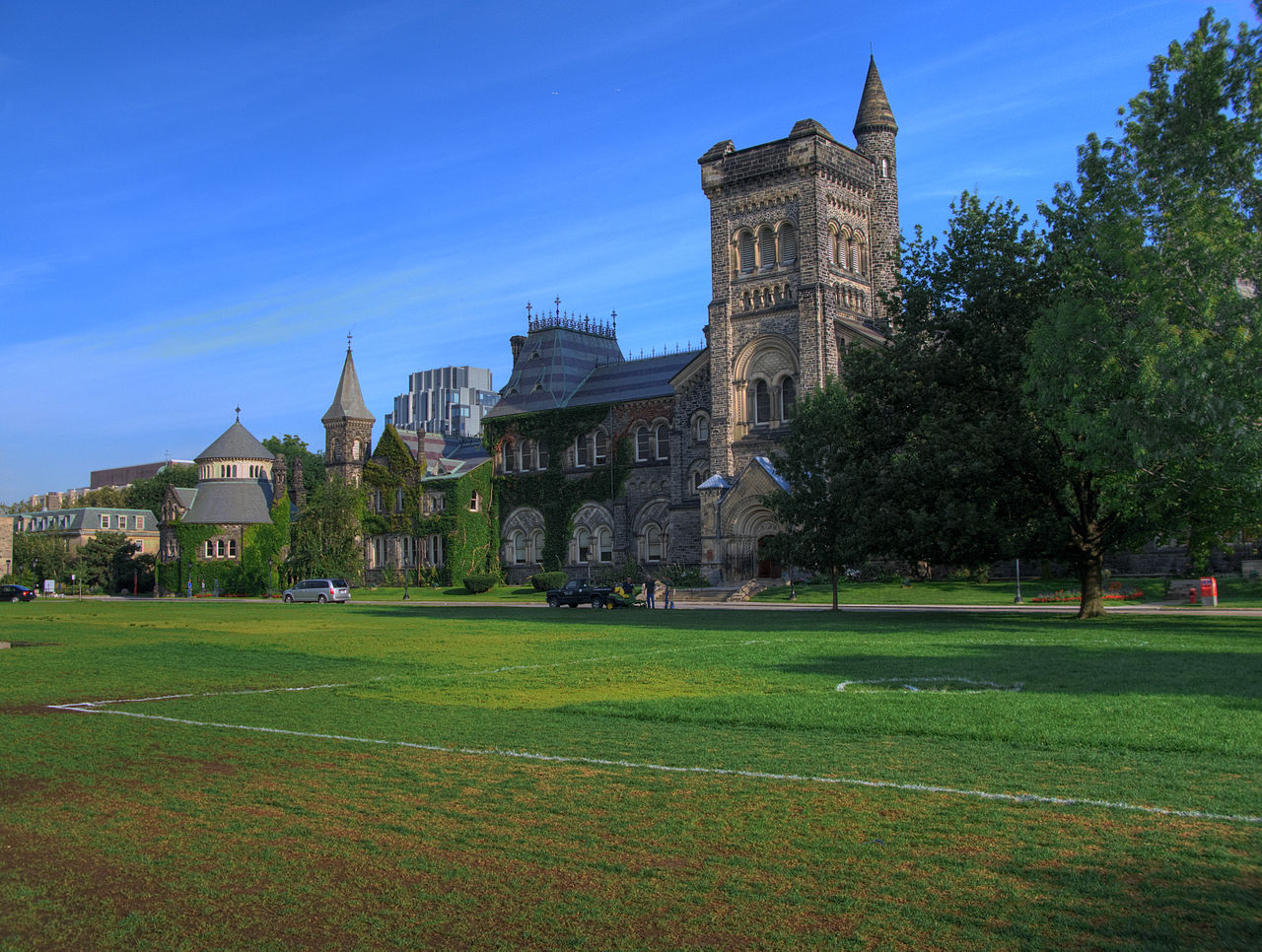
University College, University of Toronto, 31 July, 2008.
Photo by “SurlyDuff” via Wikimedia Commons.
As Brad Delong has been pointing out for years the very method of university teaching arose from a technological issue. Books were expensive. No, expensive. A scholar might amass a library of 50 volumes in a lifetime if they were assiduous at the game. Hundreds indicated an active collector spending significant sums. At which point, to educate the impecunious – students have never been known as the rich – it makes sense for education to be one person with a book reading it to a room full of others. The lecture that is.
Books are now cheap. That education method no longer needs to be.
So too with this idea of essays. Sure, it’s a good thing to be able to research, write down an argument and all these things. But that world out there has changed. Getting someone else to do it for you is now cheap. Less than the money you could earn pulling pints in the time it might take to do it. Well, -ish, -ish, around and about.
This is also all global. Changing UK law to ban the [essay] mills isn’t going to change matters a jot. Nor tittle in fact.
What needs to be changed is the method of education which leads to students being asked to produce essays unsupervised.
What’s so odd is that the educational establishment is near entirely Marxist. The state of technology determines the mode of social relations of whatever it is. OK, technology has changed, the mode of educational relations needs to change.
Essays – just as an example here – must be produced under exam conditions. Done, problem solved.
March 15, 2020
Those damned unintended consequences
Sarah Hoyt on the differences between intention and the real world:
Unintended consequences are the bane of social engineers. They are why the “Scientific” and centralized method of governance never worked and will never work. (Sorry, guys, it just won’t.)
Part of it is because humans are contrary. Part of is because humans are chaotic. And part of it is because like weather systems, societies are so complex it’s almost impossible to figure out what a push in any given place will cause to happen in another place.
This is why price controls are the craziest of idiocies. They don’t work in the way they’re intended, but oh, they work in practically all the ways they’re not. So, take price controls on rent. All they really do is create a market in which housing is scarce, landlords don’t maintain their property AND the only people who can afford to live in cities that have rent control are the very wealthy.
BUT Sarah, you say, aren’t rent controls supposed to make them affordable. Yeah. All that and the good intentions will allow you to go skating in hell on the fourth of July weekend.
Let’s be real, okay? I saw rent control up close and personal in Portugal. Rents were controlled and landlords were penalized for “not keeping the property up”.
In Portugal at the time, and here too, most of the time from what I’ve seen, the administration of property might be some management company, but that’s not who OWNS the damn thing. The owners are usually people who bought the property so it would support them in old age/lean times.
To begin with, you’re removing these people’s ability to make money off their legitimately owned property. And no, they’re not the plutocrats bernie bros imagine. These are often people just making it by.
Second, people are going to get the money some other way, because the alternative is dying. And people don’t want to die or be destitute. So they’re going to find the money. I have no idea what it is in NYC, etc, but in Portugal? it was “key buying.” Sure, you can rent the house for the controlled price, but you have to make a huge payment upfront to “buy the key.” From what I remember this was on the order of a small house down payment. And if you couldn’t do that, you were stuck getting married and living with your parents. And if you say “greedy landlords” — well, see the other thing you could do was leave the lease in your will. So the landlord didn’t know if they’d ever get control of their property back, and they needed to live off this for x years (estimated length of life.) So, that was an unintended consequence. The kind that keeps surfacing in rent-controlled cities in the US.
The same applies to attempts to “help” the homeless. Part of this, as part of all attempts to “fix” poverty is that the people doing it, usually the result of generations of middle class parents and strives assume the homeless and the poor are people like them.
To an extent, they’re correct. The homeless and the poor are PEOPLE. But culture makes a difference, and culture is often based on class and place of upbringing. And the majority of humanity, judging by the world, might be made to strive but are not natural strivers. Without incentive, most of humanity sits back, relaxes and takes what it’s given.
March 12, 2020
QotD: Cryptocurrency versus cash in a modern economy
If you try to deposit it in the bank, they will file a report, and you will shortly be explaining to the government where that money came from. Unless you have a good explanation, you will then be desperately trying to hire a lawyer in order to avoid a trip to the pokey.
Nor can you simply buy a house or a car with that cash, which will raise many, many eyebrows at the bank, and then at the government that bank reports to. You basically can’t make any large purchase in cash without raising a lot of questions. This is why drug dealers spend so much effort figuring out how to launder their ill-gotten gains. Unless you can find some way to put the money in a bank without the government getting suspicious, then all you have, in the words of Jason Bateman’s character, is (approximately) “groceries and gas for the rest of your life.”
And that’s dollars, which are indisputably legal tender. Your cryptocurrency will be even harder to spend. Who wants to trade you legal cash for scrip that’s only good for buying on the black market? How do you find that person? What discount will they demand for giving up their cash?
Bitcoin is currently good for transferring money out of failing states like Venezuela, because in those places, the local currency is so worthless that you’re better off trading it for bitcoin, or for that matter, cans of mackerel. But that presumes there are countries elsewhere with stable governments and strong economies where bitcoins can be turned into real goods. If bitcoins become a good way to evade those governments, those governments will ban them, and desperate people will go back to smuggling diamonds and dollars.
Megan McArdle, “Bitcoin Is an Implausible Currency”, Bloomberg View, 2017-12-27.
March 10, 2020
QotD: Free trade versus protectionism
People trade freely countless times, each and every day. Yes, yes, I’m well aware that such trade isn’t ideally free. Occupational-licensing restrictions, for example, unjustly and harmfully obstruct domestic trade. But the fact remains that today within each country – including within the U.S. – trade is not typically obstructed based on geographic location or political boundaries. And therefore people buy and sell freely within countries. If the case for a policy of free trade were not practical – if it were only a theoretical curiosity – then it would be true that ordinary people would be even richer if the state obstructed their abilities to trade with each other domestically.
It’s a myth also that the economic case for a policy of free trade in any one country requires that other governments also practice free trade. The case for a policy of free trade is, at bottom, a case for unilateral free trade: while nearly everyone in the world would be better off if all governments adopted policies of free trade, nearly everyone in the home country would be better off if the home government adopts a policy of free trade regardless of the policies of other governments.
Protectionism is a nasty mash of logical fallacies, half-truths, hubris, economic ignorance, and cronyist apologetics.
Don Boudreaux, “Quotation of the Day…”, Café Hayek, 2017-12-18.
March 6, 2020
QotD: Mercantilism
Don Boudreaux, “Quotation of the Day…”, Café Hayek, 2017-12-17.
March 5, 2020
Chain Your Woman to the Stove – Feminism in the 1930s | BETWEEN 2 WARS I 1938 Part 2 of 4
TimeGhost History
Published 4 Mar 2020Under the yoke of economic depression and more and more authoritarian rulers, Western women face renewed misogyny, patriarchy, and decreasing independence. But not all women think this is such a bad thing.
Join us on Patreon: https://www.patreon.com/TimeGhostHistory
Hosted by: Indy Neidell
Written by: Spartacus Olsson
Directed by: Spartacus Olsson and Astrid Deinhard
Executive Producers: Bodo Rittenauer, Astrid Deinhard, Indy Neidell, Spartacus Olsson
Creative Producer: Joram Appel
Post-Production Director: Wieke Kapteijns
Research by: Spartacus Olsson
Edited by: Daniel Weiss
Sound design: Marek KamińskiSources:
Bundesarchiv_Bild:
101III-Alber-174-14A, 102-04517A, 102-17313, 102-17818,
111-098-069, 137-055879, 146-1973-010-31, 146-1975-069-35,
146-1976-112-03A, 146-2006-205, 146-2008-0271,
183-2000-0110-500, 183-2005-0502-502, 183-2005-0530-500,
183-E10868, 183-E20457, 183-H28245, 183-J02040,
183-S08630, 183-S68014, 183-S68021, 183-S68029,
noun_pipe By Icon Lauk,
noun_company By wardehpillai,
noun_Farmer By Francisca Muñoz Colina.Colorizations by:
– Daniel Weiss
– Norman StewartSoundtracks from Epidemic Sound:
– “Sophisticated Gentlemen” – Golden Age Radio
– “The Inspector 4” – Johannes Bornlöf
– “Magnificent March 3” – Johannes Bornlöf
– “Last Point of Safe Return” – Fabien Tell
– “Step On It 5” – Magnus Ringblom
– “First Responders” – Skrya
– “Step Lightly” – Farrell Wooten
– “Try and Catch Us Now” – David Celeste
– “Not Safe Yet” – Gunnar Johnsen
– “The Dominion” – Bonnie Grace
– “The Charleston 3” – Håkan ErikssonA TimeGhost chronological documentary produced by OnLion Entertainment GmbH.
From the comments:
TimeGhost History
2 days ago (edited)
So, we take a little break from the geopolitical developments in 1938 to look at the situation of women in the Western World in 1938. We’ve received a lot of requests on the WW2 channel to cover the situation on the home fronts. While we do mention it in the weekly episodes, and War Against Humanity covers the horrid parts of it, WWII was so much more. It literally changed the world’s culture in just six years. To do that subject justice we have asked Anna to join us as host for a new monthly WW2 series: On the Homefront.A few years back Anna was a regular feature on German YouTube on her own channel and some of the bigger YouTube entertainment channels. She left YouTube to finish her studies, and because she was searching for more depth than YT entertainment content was offering her. As Astrid’s and my daughter, and having grown up with Indy around all the time, she has a passion for human history form childhood, especially cultural history.
She also has a personal relationship to this time through her grandparents, Herbert and Renate, Astrid’s parents who served in Germany during the war, on the front and at home. Herbert, a career administrator and later NCO in the Wehrmacht engineer corps, went on after the war to work for the British as translator, and then as a public servant supporting the creation of the Bundeswehr, the German defense forces, and eventually Germany’s contribution as NATO member.
Renate’s father, a bank director, died under mysterious circumstance in 1936 after repeatedly refusing to pay out money belonging to Jewish families to the Nazis. Her mother and sisters soldiered on under the Nazis as best they could, When the war broke out they first suffered under the Allied bombing, losing their home three times. When the bombing became a daily occurrence, Renate was drafted to the German flak and only barely survived the war.
Several years after the war Herbert and Renate met and started a family together. They both passed away only a few years ago, late enough so that Anna had a chance to spend countless hours over 23 years listening to their war stories, and what they took away from it: hope for a better world, and the knowledge that what happened in Germany between 1933 and 1945, must never happen again. Please join us to welcome Anna, our daughter to TimeGhost.
Spartacus
March 4, 2020
QotD: Tax cuts “for the rich”
This is why populism and nationalism, taken to their natural conclusions, always lead to statism. The state is the only expression of the national or popular will that encompasses everybody. So, the more you talk about how the fundamental unit of society is a mythologized collective called “The People” or the nation, the more you are rhetorically empowering the state.
Sure, the Constitution begins with the words “We the People,” but that is not a populist sentiment — it’s a statement of precedence in terms of authority: The people come before the government (not the European notion of the state). The spirit of the Constitution is entirely about the fact that The People are not all one thing. It places the rights of a single person above those of the entire federal government! It assumes not only that the people will disagree among themselves, but that the country will be better off if there is such disagreement. No populist frets about the tyranny of the majority. American patriots do.
But if you recognize that humans create wealth with their brains and their industry and that it therefore belongs to them, you’ll be a little more humble about the state’s “right” to take as much as it wants to spend how it wants. Human ingenuity is the engine of wealth creation, and there is no other.
But that doesn’t mean government doesn’t play a role. Because, as I said, there will be no wealth creation if there is no rule of law. There will be no investment or ingenuity if there is no guarantee that you will be able to collect on that investment or reap the benefits of your innovation. Without such an environment, the biggest mob wins. And when the mob wins, children starve to death in what should be one of the richest countries in the world.
Jonah Goldberg, “America and the ‘Original Position'”, National Review, 2017-12-22.
March 3, 2020
The bottled water and toilet paper hoarders of 2020
Arthur Chrenkoff on one of the oddest features of the current infectious disease panic:

“sold out of bottled water?” by Klara Kim is licensed under CC BY-NC-SA 2.0


This is happening alright, and it’s not some isolated incidents; on my Facebook news feed, at least half a dozen posts from friends in Sydney and Brisbane display photos of Venezuela-style empty shelves at their local supermarkets. The fear is real, and so is the hoarding.
OK, I can understand face masks and hand sanitisers walking off the shelves, as these are the crucial tools in containing the spread of the pandemic. Most face masks – as with so many other products in our shops – are made in China and in the current crisis conditions any new and additional supplies won’t make it out of the country, so whatever is already here is it. And it isn’t, as masks have been the first item to disappear from retail outlets from your local pharmacy to a Bunnings store.
I can also understand the non-perishable food supplies. Even though Australia could be quite self-sufficient if need be (minus the out of season imported fruit and veg), possibly people are stocking up not so much in fear the food will run out but out of reluctance to go out in the public in a few weeks’ time should the situation really turn into a zombie apocalypse. In any case, there is nothing wrong with having a well stocked pantry.
Where I start to no longer understand the consumers is bottled water. We are fortunate to live in a developed country where one can safely drink from a tap. There won’t be shortages of drinkable water under any circumstances – except for a complete societal collapse – and coronavirus is not a water-borne pathogen like those causing cholera or typhoid. If you are still paranoid, you can boil your water before ingesting (just make sure you cool it down).
But it’s the toilet paper that really gets me. Trust me, if things go really belly up, toilet paper is the least of your worries. Humanity has survived for tens of millennia without sanitary tissues, and in their absence any paper or rag or even running water will substitute nicely. Food, water, medicines, electricity, to name just four, are much more crucial in a time of crisis or emergency. Again, it’s true that a lot of toilet paper is manufactured in China or generally overseas and so potentially susceptible to shortages if manufacturing and international transport are affected as they are already. But how much toilet paper does your household require to function? Are you expecting you might need the iron rations of your favourite rolls to last for at least a few months? And if you think that you might not be able to restock on toilet paper until later this year, then – let me repeat myself – don’t you think you will have much bigger problems with ensuring your continuing survival to worry about?
As Norman Lewis points out, the worst hysterics are among the “elites”, not us lumpenproles:
Last week, the world stock markets suffered their worst week since the financial crisis in 2008, with $6 trillion wiped from shares and, in some markets, a sell-off at a rate not seen since the Great Depression almost a century ago. Why? Because global investors are in a panic about the potential economic fallout from the coronavirus epidemic.
Many commentators are making the point that this is mad. Ross Clark argues convincingly in the Spectator that the “most dangerous thing about coronavirus is the hysteria”. Philip Aldrick, economics editor of The Times, agrees. He says it is the “panic we should fear more than the virus itself”.
Our appetite for doom and fear of the unknown are offered as explanations for this behaviour. Risk culture and a predisposition to overreacting to threats are also certainly components of what is happening. But there is another equally important element linked to these that is not being raised – that this madness is not being driven by the “low-information”, knuckle-dragging, gullible ignorant masses, but by the information-rich, university-educated and refined global business and government elites.
The contrast between the responses to coronavirus from the elites and ordinary people has been stark. Even as the level of panic in the mainstream reporting around coronavirus has risen, ordinary people have just gotten on with their lives. The supposedly well-informed elites, who often accuse the “dumb” masses of being vulnerable to hysteria and “fake news”, have themselves been prodded into panic. Meanwhile, where they are not in lockdowns, ordinary people are still going to work, commuting, going to bars … They’re simply getting on with their lives, while taking note of the potential risks.
The elites are in free-falling panic; like a herd of wildebeest, panicked by the sight of a predator and rushing blindly across crocodile-infested waters, they have sparked a potential global economic meltdown. Meanwhile, we see stoic common sense, simple but profound wisdom, on the part of the “great unwashed”.
March 2, 2020
The unexpected electricity bill for Bitcoin
At the Continental Telegraph, Tim Worstall points out that Bitcoin transactions now consume a huge amount of electricity:

“Bitcoin – from WSJ”by MarkGregory007 is licensed under CC BY-NC-SA 2.0
Some will take this as proof that the system of Bitcoin shouldn’t exist, even that we should attempt to close it down. For it is, according to these calculations, using vast amounts of energy:
Just one Bitcoin transaction uses the same amount of electricity as a British household for nearly two months, new figures have shown.
The amount of energy needed to run the cryptocurrency has soared to record annual highs of 77.78 terawatt hours the same as the entire electrical consumption of Chile.
The carbon footprint of a single transaction is the same as 780,650 Visa transactions or spending 52,043 hours watching YouTube, according to calculations by Alex de Vries, a blockchain specialist, at PWC.
“People react with disbelief, but the figures are true,” said Mr de Vries who founded the Digiconomist blog to highlight the impact.
All those calculations are over here.
Downfall of the Superpower China – Ming and Qing Dynasty l HISTORY OF CHINA
IT’S HISTORY
Published 17 Aug 2015With the dynasties of the Ming and the Qing came social security and flourishing international trade. The White Lotus Movement advocated progressive thinking in the time of the conservative Ming dynasty. In 1616 the Qing dynasty came to power. Also known as the Manchu dynasty, the Qing refused to open their borders to limitless trade which led to frustrated European merchants. This caused hostility and mistrust of the “barbaric Chinese”. Shortly thereafter China’s economy lost its race against European Colonialism and would lose military influence after gunpowder reached Europe. All about the fall of the former Chinese superpower in this episode on IT’S HISTORY!
» SOURCES
Videos: British Pathé (https://www.youtube.com/user/britishp…)
Pictures: mainly Picture Alliance
Content:
Twitchett, Denis and Loewe, Michael. The Cambridge History of China. Cambridge University Press.
Wilkinson, Endymion, Chinese History: A New Manual. Harvard University, Asia Center
Loewe, Michael; Shaughnessy, Edward L. The Cambridge History of Ancient China. Cambridge University Press
John M. Roberts A Short History of the World. Oxford University Press
Xu, Pingfang The Formation of Chinese Civilization: An Archaeological Perspective. Yale University Press.
Fairbank, J. K.; Goldman, M. China: A New History. Harvard University Press. ”» ABOUT US
IT’S HISTORY is a ride through history – Join us discovering the world’s most important eras in IN TIME, BIOGRAPHIES of the GREATEST MINDS and the most important INVENTIONS.» HOW CAN I SUPPORT YOUR CHANNEL?
You can support us by sharing our videos with your friends and spreading the word about our work.» CAN I EMBED YOUR VIDEOS ON MY WEBSITE?
Of course, you can embed our videos on your website. We are happy if you show our channel to your friends, fellow students, classmates, professors, teachers or neighbors. Or just share our videos on Facebook, Twitter, Reddit etc. Subscribe to our channel and like our videos with a thumbs up.» CAN I SHOW YOUR VIDEOS IN CLASS?
Of course! Tell your teachers or professors about our channel and our videos. We’re happy if we can contribute with our videos.» CREDITS
Presented by: Guy Kiddey
Script by: Guy Kiddey
Directed by: Daniel Czepelczauer
Director of Photography: Markus Kretzschmar
Music: Markus Kretzschmar
Sound Design: Bojan Novic
Editing: Markus KretzschmarA Mediakraft Networks original channel
Based on a concept by Florian Wittig and Daniel Czepelczauer
Executive Producers: Astrid Deinhard-Olsson, Spartacus Olsson
Head of Production: Michael Wendt
Producer: Daniel Czepelczauer
Social Media Manager: Laura Pagan and Florian WittigContains material licensed from British Pathé
All rights reserved – © Mediakraft Networks GmbH, 2015
February 28, 2020
QotD: Greek and Roman views of markets
Now, if it could be shown that the Aztecs had no concept of market behaviour, and that they were motivated by considerations wholly different from our own, it would be of little consequence. Everything we know about Aztec civilisation raises doubts whether it was worth calling a civilisation. The Aztecs had no writing and were ignorant of metal working and wheeled transport. Their cultural values were expressed in ritual torture, mass human sacrifice and cannibalism. The Mayans and Toltecs and all the others of their sort seem to have been no better. We may deplore the brutality of the Spanish conquest, but still conclude that it was, on balance, a blessing for the peoples of South America.
But it is different with the empires of the ancient Near East — and very different with the Greeks and Romans. These latter races are our intellectual fathers. Everything we ourselves have achieved is built on the foundations they laid. They gave us the names of all our arts and sciences. Eighty per cent of the English vocabulary is derived from Greek or Latin. Knowledge of these languages may be less widely diffused than it was until a century ago. But the general prestige of the Greeks and Romans is barely less now than it was among the mediaeval pilgrims who gaped at the crumbling remains of the Colisseum and the Baths of Diocletian. If it can be shown that they were wholly unlike us in their economic motivations, that would surely place in doubt the notion that market behaviour is natural to us.
And if few people outside the relevant university departments have read Polanyi and Finley, their conclusions are transmitted through popular histories and newspaper articles and television documentaries, and through large numbers of students who, however superficially, are exposed to these conclusions.
Sean Gabb, “Market Behaviour in the Ancient World: An Overview of the Debate”, 2008-05.
February 27, 2020
QotD: Clichés of bad travel writing
Kerry Howley, “But the People Are So Friendly“, Hit and Run, 2005-08-18.
February 25, 2020
“Canada is no longer a viable political construct. It is a dead country walking”
David Solway outlines some of the serious issues Canada needs to tackle … but many of which are issues that the current federal government is striving to avoid tackling:

Canada is presently in the throes of social and political disintegration. A left-leaning electorate has once again empowered a socialist government promoting all the lunatic ideological shibboleths of the day: global warming or “climate change,” radical feminism, indigenous sovereignty, expansionary government, environmental strangulation of energy production, and the presumed efficiency of totalitarian legislation. Industry and manufacturing are abandoning the country in droves and heading south.
Canada is now reaping the whirlwind. The Red-Green Axis consisting of social justice warriors, hereditary band chiefs, renewable energy cronies, cultural Marxists, and their political and media enablers have effectively shut down the country. The economy is at a standstill, legislatures and City Halls have been barricaded, blockades dot the landscape, roads and bridges have been sabotaged, trains have been derailed (three crude-by-rail spillages in the last two months), goods are rotting in warehouses, heating supplies remain undelivered, violent protests and demonstrations continue to wreak havoc — and the hapless Prime Minister, who spent a weak swanning around Africa as the crisis unfolded, is clearly out of his depth and has no idea how to control the mayhem. No surprise here. A wock pupper politico in thrall to the Marxist project and corporate financial interests, Justin Trudeau is generally baffed out when it comes to any serious or demanding concerns involving the welfare of the people and the economic vitality of the nation. Little is to be expected of him in the current emergency apart from boilerplate clichés and vague exhalations of roseate sentiment.
Still, Trudeau may have been right about one thing when he told The New York Times that Canada had no core identity — although this is not what a Prime Minister should say in public. Canada was always two “nations,” based on two founding peoples, the French and the English, which novelist Hugh MacLennan famously described as “two solitudes” in his book of that title. But it may be closer to the truth to portray Canada as an imaginary nation which comprises three territories and ten provinces, two of which, Quebec and Newfoundland, cherish a near-majoritarian conception of themselves as independent countries in their own right. Newfoundland narrowly joined Confederation only in 1949 and Quebec held two successive sovereignty referenda that came a hair’s breadth from breaking up the country.
Quebec separatists don’t need to do much more than sit back, put their feet up, crack a few beers, and watch Justin Trudeau drive the country toward dissolution. Their job is so much easier now…
It is often noted that America is a nation evenly divided between progressivist and conservative populations, a civil dilemma not easily resolved. But Canada is divided approximately 65-35 by these constituencies, and if one considers that the federal Conservative Party in its present manifestation can fairly be described as Liberal Lite, the breakdown is more like 95-5. This means there is no chance of reconciliation between our political disparities, such as they are, and Canada is doomed to plummet down the esker of every failed socialist experiment that preceded it and, indeed, that is presently on display in various foundering nations around the globe — North Korea, Cuba, Venezuela, and counting.
Trudeau père invoked the War Measures Act in 1970 to quell the Quebec separatist movement, the Front de Libération du Québec (FLQ), after a series of bombings and murders. It is obvious that the son has neither the political smarts nor the strength of character to act decisively against those who are busy reducing an already patchwork country into a heap of shards and rubble. And there we find the proof that, whatever Canada may once have been and whatever the talking heads may incessantly proclaim, Canada is no longer a viable political construct. It is a dead country walking.
H/T to Blazing Cat Fur for the link.
February 23, 2020
Justin’s hidden victory – “… in the fight against global warming, this has to have been Canada’s best two weeks EVER”
As Rex Murphy points out, the nattering nabobs of negativity (okay, he didn’t call ’em that) miss the key benefits of Justin Trudeau’s tour de force of ingenious diplomacy and inaction:
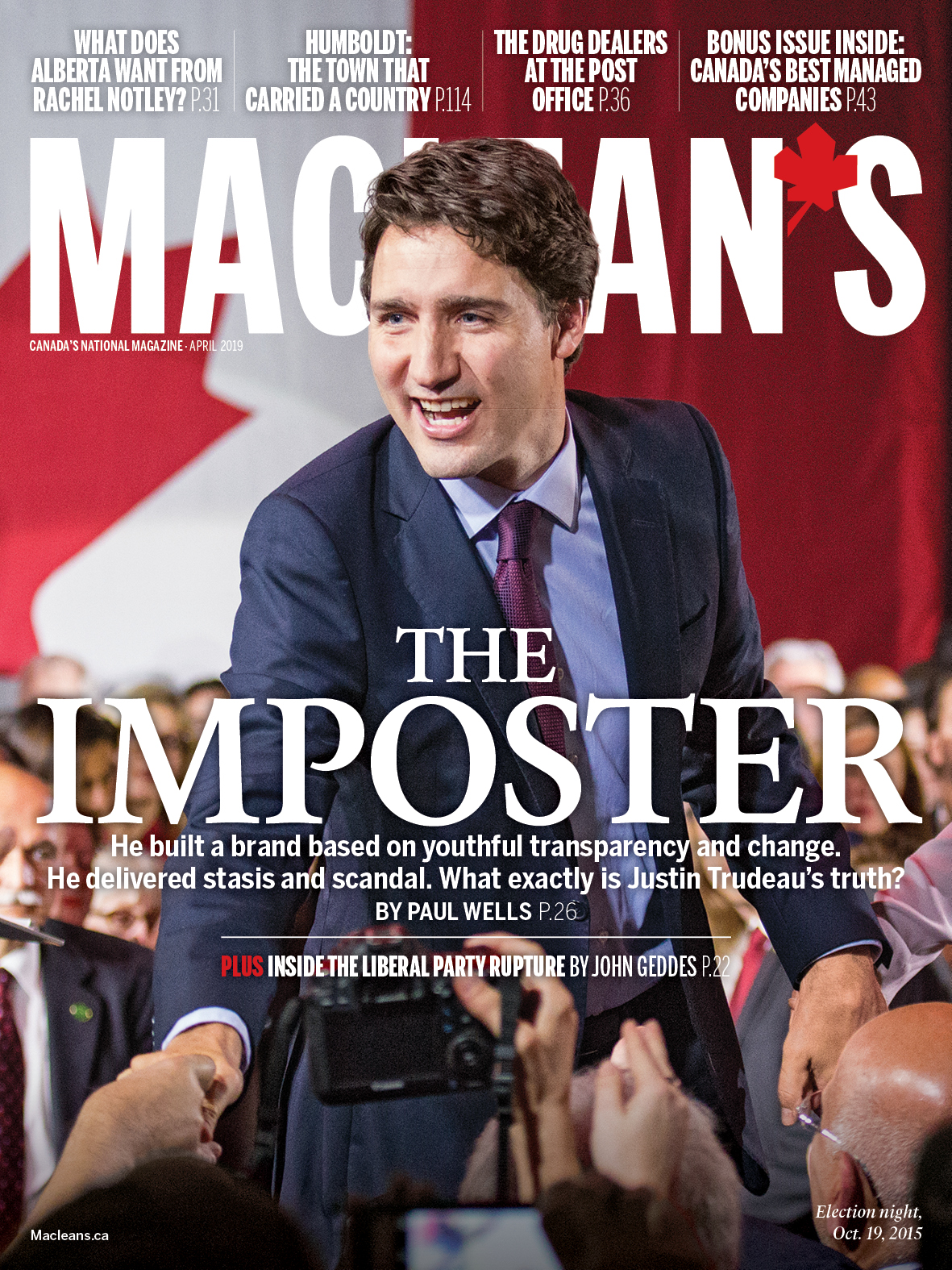
It was at the very heart of Justin Trudeau’s triumph in his first election, that having vanquished the Mordor orcs of Harperland, that the country was going to be served by new thinking and fresh approaches, that anger and conflict would be no more. In an era marked by respectful thinking, exquisitely careful language, above all by the ability to listen, protests would be no more. Concord would reign, all would be sweetness and light.
What few and feeble disputes that might emerge would be defused with a waving of the diversity wand, and a choir drawn from the Liberal backbenches intoning solemnly “this is not who we are as Canadians” before the Centennial Flame on Parliament Hill.
As an ultimate fillip every month a kitten and a ball of wool would be sent to every Canadian household (and Lo, a zen-like tranquillity would settle over the land). To be clear, these would be very progressive kittens, and the wood fair-trade down to the last twisted fibre.
[…]
Looked at in the cool light of reason, in the fight against global warming, this has to have been Canada’s best two weeks EVER. Keep it up and Canada, the whole wide, cold country, can soon declare itself one half-a-continent carbon-emission-free zone. Apocalypse deferred.
How do you spell Hallelujah? Greta Thunberg — Canada has heard you. Find a bamboo raft and come visit us again.


