
You might think that, for example, rich kids at elite universities would be happy because their parents are in the top one per cent of income earners. And they will soon join their parents in this elite guild. But remember, they’re surrounded by other members of the one per cent. Their social circle, their Dunbar number, consists of 150 baby millionaires. Jordan Peterson has discussed this phenomenon. Citing figures from his experience teaching at Harvard in the 1990s, Peterson noted that a substantial proportion of Ivy League graduates go on to obtain a net worth of a million dollars or more by age 40. And yet, he observes, this isn’t enough for them. Not only do top university graduates want to be millionaires-in-the-making; they also want the image of moral righteousness. Peterson underlines that elite graduates desire high status not only financially, but morally as well. For these affluent social strivers, luxury beliefs offer them a new way to gain status.
Thorstein Veblen’s famous “leisure class” has evolved into the “luxury belief class.” Veblen, an economist and sociologist, made his observations about social class in the late nineteenth century. He compiled his observations in his classic work, The Theory of the Leisure Class. A key idea is that because we can’t be certain of the financial standing of other people, a good way to size up their means is to see whether they can afford to waste money on goods and leisure. This explains why status symbols are so often difficult to obtain and costly to purchase. These include goods such as delicate and restrictive clothing like tuxedos and evening gowns, or expensive and time-consuming hobbies like golf or beagling. Such goods and leisurely activities could only be purchased or performed by those who did not live the life of a manual laborer and could spend time learning something with no practical utility. Veblen even goes so far as to say, “The chief use of servants is the evidence they afford of the master’s ability to pay.” For Veblen, Butlers are status symbols, too.
Building on these sociological observations, the biologist Amotz Zahavi proposed that animals evolve certain displays because they are so costly. The most famous example is the peacock’s tail. Only a healthy bird is capable of growing such plumage while managing to evade predators. This idea might extend to humans, too. More recently, the anthropologist and historian Jared Diamond has suggested that one reason humans engage in displays such as drinking, smoking, drug use, and other physically costly behaviors is because they serve as fitness indicators. The message is: “I’m so healthy that I can afford to poison my body and continue to function.” Get hammered while playing a round of golf with your butler, and you will be the highest status person around.
Rob Henderson, “Thorstein Veblen’s Theory of the Leisure Class — A Status Update”, Quillette, 2019-11-16.
February 22, 2020
February 21, 2020
British wages to be further impacted by Brexit
As we were told for years, if Brexit happened there were going to be dire consequences to the British economy, and here’s the latest one:

Employers are complaining that without badly paid immigrant labour they’ll just not be able to get the staff. The answer to which is that they’d better start paying higher wages then, eh?
[…]
The analysis here stems from something Marx got right. It’s competition among capitalists for scarce labour which pushes wages up. If there’s a vast reserve army of the unemployed then anyone needing more straining backs just tosses a crust to those in that army and gets as many limbs and torsos to exploit as desired. But if all are already employed then any desire for extra labour requires tempting it away from current employer and occupation to the new. That means a better job offer. Some mixture of conditions, enjoyment of the job, cash and so on that makes up a more attractive package.
The combination of cheap flights and free movement of labour has meant that the reserve army lives in Wroclaw and Debrecen. It’s also been near unlimited – compared to the size of the UK economy – these past couple of decades.
The absence of free movement – what is being complained about here – will mean that to gain the desired labour those employers are going to have to offer higher wages, higher compensation rather, to those not ordinarily resident or stemming from central Europe.
[…]
But back to the basic complaint here. These employers are complaining that Brexit will mean they’ve got to raise the wages they pay. To which the correct response is “Ah, Diddums”.
February 20, 2020
Why the Nazis Weren’t Socialists – ‘The Good Hitler Years’ | BETWEEN 2 WARS I 1937 Part 2 of 2
TimeGhost History
Published 19 Feb 2020The Nazi economy appears to do well during the 1930s. But this is largely myth, as the German economy under Hitler is based on a self destructive, ideologically or selfishly fuelled irrationality driven by conquest and criminal practice.
Join us on Patreon: https://www.patreon.com/TimeGhostHistory
Hosted by: Indy Neidell
Written by: Spartacus Olsson
Directed by: Spartacus Olsson and Astrid Deinhard
Executive Producers: Bodo Rittenauer, Astrid Deinhard, Indy Neidell, Spartacus Olsson
Creative Producer: Joram Appel
Post-Production Director: Wieke Kapteijns
Research by: Spartacus Olsson
Edited by: Daniel Weiss
Sound design: Marek KaminskiSources:
Bundesarchiv_Bild:
192-269, 183-T0706-503, 183-S68029, 183-S68014,
183-S38324, 183-S33516, 183-S07227, 183-R98364,
183-H29131, 183-H25824, 183-H01704, 183-H13192,
183-H06734, 183-H00455, 183-C12671, 183-86686-0008,
183-2008-0826-506, 183-2008-0826-502, 183-2006-1128-504,
183-2004-0729-507, 183-1989-0630-504, 183-1988-0113-500,
146-2005-0191, 146-1990-048-29A, 146-1990-023-06A,
146-1984-040-26, 146-1981-124-32A, 146-1972-025-10,
102-13533, 102-12733, 102-11649, 102-06795, 102-04640,
145_Bild-P046280, 145_Bild-020683,Colorizations by:
Daniel WeissSoundtracks from Epidemic Sound:
– “Document This 1” – Peter Sandberg
– “March Of The Brave 10” – Rannar Sillard – Test
– “Ominous” – Philip Ayers
– “The Inspector 4” – Johannes Bornlöf
– “Disciples of Sun Tzu” – Christian Andersen
– “Guilty Shadows 4” – Andreas Jamsheree
– “Last Point of Safe Return” – Fabien Tell
– “Death And Glory 1” – Johannes Bornlöf
– “Easy Target” – Rannar Sillard
– “Split Decision” – Rannar Sillard
– “First Responders” – Skrya
– “The Charleston 3” – Håkan ErikssonA TimeGhost chronological documentary produced by OnLion Entertainment GmbH.
From the comments:
Spartacus Olsson
1 day ago
From an intellectual viewpoint, this is perhaps the most challenging episode I have written in this series. First of all it’s hard to make economic policy interesting, even when it’s about the Nazis. It tends to get, well … grey. Second of all it’s not that easy to simplify things without completely losing the essence of what was going on. Third of all, I’m fighting an uphill battle against a post truth, political talking point based on … let’s just call it less than ingenious purposes.Obviously that’s the idea that the Nazis were Socialists. And perhaps that is not so far fetched when you think of the name of their party, the way they framed their anti-semitic rhetoric in a way that it would sound friendly to the working class, and their absolute disregard for telling the truth about anything, and everything. But although we have painstakingly showed you the facts, I am painfully aware that it won’t make a difference to stop the nonsense out there and in here — some pundits will religiously stick to their ideas, because if they don’t, they might have to face that some of the ideas they have are mutual with the people they so desperately want to distance themselves from. The same happened with the far left between the 1930s and 1970s, when they tried with cramped desperation to frame Stalinism as a right wing, Fascist movement — Red Fascism was the term — obviously as much nonsense as the alt-right idea that Naziism is Socialism.
And is it important? Well yes and no — the dumbos will probably get worn out at some point, it’s after all quite challenging to look for ways to distort the record over, and over again. I don’t really care if the extremists try to push their mutual garbage in each other’s lap — as a supporter of democracy and humanism, I have no regard for either end. I do however have an incredible amount of respect for conservatives, liberals, and progressives who are equally dedicated to democracy and human rights — and there is where it matters.
When the far left tries to frame Stalinism as right wing, and the far-right tries to frame Naziism is left-wing, they are trying to co-opt a position of less extremism. It’s an invasive attempt for Communists and (real) Socialists to just look like regular Progressives, and Fascists and Nazis to just look like regular Conservatives. And that my friends is dangerous, to all of us, regardless of our nationality, creed, political affiliation, or opinion — because it is specifically our individual rights and democracy that is at stake in this game. That’s what they want to take away, or in some places stop from developing.

February 16, 2020
The Canadian economy taken hostage while the PM swans around the world schmoozing for a temporary Security Council seat
Chris Selley on the state of play in the stand-off between (some) First Nations protesters and their temporary fellow travellers of the various permanent protest class:

“DSC02285” by Bengt 1955 is licensed under CC BY-NC 2.0


The majority of Wet’suwet’en First Nation members support the Coastal GasLink natural gas pipeline project, and they are in an objectively peculiar situation. On the one hand, the RCMP is doing its best to clear away the protesters and let construction proceed. On the other hand, anti-pipeline protesters claiming solidarity with the Wet’suwet’en have created chaos in their name — most notably the total shutdown of CN Rail’s eastern Canadian network, the cancellation of nearly every Canadian passenger train, and the layoffs and untold economic costs that go with that.
If protesters acknowledge the diversity of opinion among the Wet’suwet’en at all, they will defer to the authority of five hereditary chiefs who oppose the project, or observe that the five elected Wet’suwet’en band councils — all of which have signed community benefits agreements — represent a form of settler democracy imposed by the Indian Act.
[…]
Clearly the Wet’suwet’en are a divided community, including on the most basic questions of how they should be governed. It’s a mess. Mind you, look at the state of Canada as a whole.
Just as the RCMP have court authorization to clear protesters and encampments along the pipeline route, the Ontario Provincial Police have court authorization to clear the Mohawk rail blockade near Belleville, Ont. Unlike the RCMP, the OPP refuses to exercise its authority. And we just have to live with that. Conservative politicians are barking at Justin Trudeau to “enforce the law,” but he doesn’t give orders to the OPP, and neither does Ontario Premier Doug Ford, and nor should we want them to.
Still, you might expect senior ministers to have moderately stern words for folks illegally causing economic harm. You might expect the prime minister, at minimum, to be in the country. Instead, Trudeau spent the week swanning around Africa drumming up support for the UN Security Council seat with which he remains unaccountably obsessed, then decamped for the Munich Security Conference, where he was photographed warmly embracing Iranian foreign affairs minister Mohammad Javad Zarif, five weeks after Iran blew an airliner full of Canadians out of the sky over Tehran.
The Little Potato is probably doubly happy to have a valid (in his own mind) excuse for not being in the country at this particular time. He loves being the centre of attention … as long as that attention is friendly. He doesn’t handle situations well if the tempers are higher and the hostility is rising … like much of Canada right now.
The pipeline is a provincial project, not a federal one, but if the OPP won’t end the blockade and the feds aren’t willing to take truly extraordinary measures, then at some point in the foreseeable future it may well make short-term economic sense to give in to their demands. Maybe the feds can buy the pipeline from Coastal GasLink and shut it down.
And what if the Mohawks do lose interest, or are somehow induced to stand down? That now counts as the best-case scenario, and it will have involved shutting down the CN railway for at least a week — maybe two, maybe three — with enormous consequences for people’s livelihoods and the economy as a whole, all in the name of killing a project supported by the vast majority of Indigenous people affected by it. And it will happen again, as many times as any group wants it to, on whatever issue they want it to, for as long as they want it to. Unless someone in power does something unusually bold and concrete in the very near future – and it’s not even clear what that thing would be — we are well on the road as a country to being terminally screwed. In the meantime, we certainly have no lessons on accountable government to give the Wet’suwet’en.
February 13, 2020
Here’s a deceptive factoid … time for you to get angry to suit someone’s political agenda
Did you know that “Three Billionaires Have More Wealth Than Half of America”!!!???!!! Are you angry now? You’re supposed to be, because this factoid was concocted specifically to make people irrationally angry. Daniel C. Jensen explains how this sound bite was created:

Amazon’s Jeff Bezos, Microsoft’s Bill Gates, and Berkshire Hathaway’s Warren Buffet.
Fox Business.
People between 0 and 24 years of age account for about 32 percent of the United States population of 320 million. Almost all of them are going to be in the bottom half of the wealth distribution for reasons including diaper rash and puberty. That means they account for about 63 percent of the “bottom half of the wealth distribution.” Should it surprise us that some kid fresh out of college does not “hold any stocks or bonds”? Or a kid fresh out of the womb?
Then we must consider people with mental and physical disabilities. They will also tend to be in the bottom half of the wealth distribution because they face greater challenges to building wealth. “About 56.7 million people — 19 percent of the population — had a disability” at last count, according to the United States Census Bureau. But there is overlap between the disabled 19 percent and the young 32 percent of the population. If we assume disabilities are evenly distributed in the population, then young people and non-young disabled people account for 45 percent of the population. So we have now accounted for 90 percent of the “160 million Americans in the bottom half of the wealth distribution.”
Next, we must think about other groups who have had limited wealth-building opportunities. What about the 2.2 million people in jail and prison? What about people in their late twenties who pursued PhDs, law degrees, medical residencies, etc., and are just beginning their careers? Now we are close to accounting for 100 percent of the “bottom half of the wealth distribution.” But this wealth distribution is not what any sensible person would expect it to be.
Maybe the factoid is true. Maybe Jeff Bezos, Bill Gates, and Warren Buffet have more wealth than all of the infants, children, students, handicapped, prisoners, and postgrads combined. But you don’t need a PhD to figure out that’s not useful knowledge. Even if the factoid is true, it’s deceitful. Whoever created it was obviously trying to manipulate people. And we uncovered this deception with nothing but some simple knowledge of the US population.
Next time you encounter an economic factoid, remember that it might be pitting a bunch of newborns against Jeff Bezos, and that hardly seems fair. Thankfully, you can save those babies from certain defeat simply by knowing some basic statistics about your country.
QotD: Libertarianism
Dierdre Nansen McCloskey, Why Liberalism Works: How true Liberal values produce a freer, more equal, properous world for all, 2019.
February 11, 2020
Leaving the Left – Part 9: PJ O’Rourke
Economics in the Media
Published 18 Aug 2016“When I got my first paycheck I found that I netted $82.27 after federal income tax, state income tax, city income tax, Social Security, union dues, and pension fund contribution. I was a communist. I had protested for communism. I had rioted for communism. Then I got a capitalist job and found out we had communism already.”
– The Baby Boom, PJ O’RourkeParliament of Whores: A Lone Humorist Attempts to Explain the Entire U.S. Government
Full Interview with Peter Robinson
https://youtu.be/keJYIkxbieg

February 10, 2020
QotD: Welfare programs as a form of subsidy to employers
But what about other programs like food stamps or housing assistance? These means tested public assistance programs are not tied to work, and we should not expect them to lower wages. Let’s take food stamps, which are available to eligible families whether or not a family member works or not. Indeed, when people are not working, they are more likely to be eligible for food stamps since their family incomes will be lower. Therefore, SNAP [Supplemental Nutrition Assistance Program] is likely to raise, and not lower a worker’s reservation wages — the fallback position if she loses her job. This will tend to contract labor supply (or improve a worker’s bargaining position), putting an upward pressure on the wage. Whether or not wages are increased is an empirical matter: there is evidence that the initial roll-out of the food stamps program across counties in the 1970s lowered work hours, consistent with an increase in the reservation wage. The key point is that it is difficult to imagine how food stamps would lower wages. And if they don’t lower wages, they can’t be thought of as subsidies to low wage employers. The same logic applies to other means tested programs like energy or housing assistance. Moreover, these conclusions hold in a wide array of models of the labor market, including ones that emphasize bargaining or efficiency wage concerns.
Arindrajit Dube, “Public Assistance, Private Subsidies and Low Wage Jobs”, Arindrajit Dube, 2015-04-19.
February 9, 2020
The lightbulb conspiracy again
I’ve banged on a few times over the years about lightbulbs, specifically about our government’s passionate desire for us to abandon the tried-and-tested (and cheap) incandescent bulbs to move first to (ultra-expensive, dim, and potentially dangerous) compact fluorescent bulbs and now to (cheaper, but still not living up to longevity promises) LED bulbs instead. Tim Worstall explains how governments were persuaded to enforce this crony capitalist plot over the years (he’s discussing the European market, but Canadian regulators were doing exactly the same thing):
We all recall when we used to use incandescent light bulbs. Simple, cheap, the result of a century’s worth of fiddling with the basic technology to make it around and about right for the use to which it was put.
A spiral compact fluorescent bulb (CFL).
Image by Sun Ladder via Wikimedia Commons.Then they were banned. Sure, there was that energy and thus planet saving argument but that was always very weak indeed. It was an excuse, not the actual reason itself. The reason was that the big three manufacturers, Phillips, Osram and GE, had invested heavily in the next generation of technology, compact fluorescents. These cost not pennies per bulb but pounds. Rather better profit margins that is. Oh, and also, not subject to that crippling competition from China.
So, we get the EU ban on incandescents, driven entirely by the manufacturers. There’s a lot of the Baptist and Bootlegger in here given the environmentalist support for it.
The problem with the technology being the use of mercury in those bulbs.
An aside, I made my living for a number of years selling weird metals that are added to that mercury. I do actually know quite a bit about the nuts and bolts here. I’m also out of the business and have been for a decade and more. So it’s knowledge driving this, not knife sharpening.
Mercury’s not good stuff to have floating around. So, what happens next? Yep, a decade or a bit more after the incandescents were banned so now they’re coming for the CFLs.

The mercury issue was not as well publicized here in Canada as it was in Australia, for example:
How many of them have looked up the Environment Department’s website to find what its bureaucrats falsely describe as the “simple and straightforward” precautions to take against poisoning should one of these lamps smash:
- Open nearby windows and doors to allow the room to ventilate for 15 minutes before cleaning up the broken lamp. Do not leave on any air conditioning or heating equipment which could recirculate mercury vapours back into the room.
- Do not use a vacuum cleaner or broom on hard surfaces because this can spread the contents of the lamp and contaminate the cleaner. Instead scoop up broken material (e.g. using stiff paper or cardboard), if possible into a glass container which can be sealed with a metal lid.
- Use disposable rubber gloves rather than bare hands.
- Use a disposable brush to carefully sweep up the pieces.
- Use sticky tape and/or a damp cloth to wipe up any remaining glass fragments and/or powders.
- On carpets or fabrics, carefully remove as much glass and/or powdered material using a scoop and sticky tape; if vacuuming of the surface is needed to remove residual material, ensure that the vacuum bag is discarded or the canister is wiped thoroughly clean.
- Dispose of cleanup equipment (i.e. gloves, brush, damp paper) and sealed containers containing pieces of the broken lamp in your outside rubbish bin – never in your recycling bin.
- While not all of the recommended cleanup and disposal equipment described above may be available (particularly a suitably sealed glass container), it is important to emphasise that the transfer of the broken CFL and clean-up materials to an outside rubbish bin (preferably sealed) as soon as possible is the most effective way of reducing potential contamination of the indoor environment.
Bastiat’s parking meters
At the Continental Telegraph, Esteban explains why nineteenth century French writer Frédéric Bastiat would be able to fully explain Atlanta’s parking meter woes even though Bastiat never saw an automobile in his life:

“Parking meter FAIL” by kingdesmond1337 is licensed under CC BY-NC-SA 2.0
One of Frédéric Bastiat’s most famous observations was the importance of recognizing “That which is seen and that which is not seen”. A government agency builds a road, some people get jobs working on the road, voila, look at all the benefits the government has brought us. What is unseen is what would have happened if the government hadn’t taken our resources to build the road, perhaps we would have spent them on something of greater value?
That people often (perhaps usually) overlook the unseen isn’t too surprising, but the inability to see is sometimes striking. A couple of years ago the City of Atlanta decided to get rid of its parking meter enforcement staff and outsource this work to a private sector company (let’s call it NewCo). Some time after the transition there were discussions at the City Council that perhaps they should reverse this decision, or at least find another provider.
What was the source of these complaints? Was NewCo inefficient? Was the City getting less revenue from the meters? No, meter revenues were actually up as were parking ticket revenues. Some misbehavior by NewCo’s employees, bribery, favoritism, kickbacks? No, no, no and no. The problem was that NewCo was doing a better job. Seriously, the City Council was inundated with complaints such as “I was, like, 2 minutes late getting back to my car and they had already ticketed me”. People who had been ticketed as well as many businesses complained about NewCo’s efficiency.
[…]
What really stood out is that no one involved in these discussions – aggrieved parkers or Council members – seemed to think about why we have meters, time limits and tickets. If enforcement is lax, more people overstay their allotted time, one consequence of which is that you have to drive around longer to find a parking space. People notice their parking ticket or the inconvenience of having to run out and feed the meter (that which is seen) but were oblivious to the shortage of parking spaces that is exacerbated by lax enforcement (that which is not seen, or perhaps not identified as connected?).
One wonders how people who live in a City where finding a parking spot is very difficult could “not see” the value of good enforcement. The time spent circling the block, rushing to turn around and grab the space that just opened up before somebody else snagged it, then just missing out and starting the dance over – nobody thought of that? Bueller, anyone?
Emphasis added.
February 8, 2020
Switching over from internal combustion vehicles to electric won’t be cheap … it really won’t be cheap!
At Spiked, Rob Lyons looks at the British government’s recent decision to ban sales of internal-combustion cars in 2035 rather than the earlier target date of 2040:

Nissan Leaf electric vehicle charging.
Photo by Nissan UK
First, at present, electric vehicles cost a lot more than those with internal-combustion engines. For example, one car-buying advice website notes that the Peugeot e-208 is as much as £6,200 more than the standard 208 model. There are government subsidies to help with the cost of electric cars (currently £3,500), but can this be sustained if we all switch? It has already been cut from £4,500 in 2018.
That said, while the purchase price of an electric car may be higher, charging is a lot cheaper than fuelling a regular car. Electric vehicles cost between £4 to £6 per 100 miles to charge at home and £8 to £10 using public charge points, while petrol and diesel cars cost £13 to £16 per 100 miles in fuel (although 60 per cent of the fuel cost is tax).
In theory, maintenance should be cheaper, too, given that electric motors have fewer moving parts than petrol or diesel engines. But to further complicate matters, batteries gradually lose their capacity to hold charge over time. They have to be replaced at the cost of thousands of pounds every few years. (The warranties covering battery replacement varies by manufacturer: Tesla, for instance, offers an eight-year warranty, but the Renault Zoe is covered for just three years.)
Electric cars may be cheaper to own overall, but this is largely down to subsidies and tax breaks, including lower vehicle duties and not having to pay charges in low-emission zones. Still, with the entire car industry throwing its efforts into making electric cars cheaper and increasing battery capacity, costs may well come down somewhat, reducing the need for such breaks. Fingers crossed.
The cost to individual owners will be higher, but the costs to build up the electric charging infrastructure will be distributed among all consumers, not just the owners of vehicles:
This brings us to perhaps the biggest problem: where will the power come from and how will it reach us? Eventually shifting all the energy for cars from oil to electricity means producing much more electricity. Greens are pleased that electricity use is currently decreasing, and a greater proportion of electricity is coming from renewable sources. But the arrival of electric cars en masse would demand a whole lot more electricity, mostly to be used at night.
Unless we want to coat the landscape in wind turbines, which are unreliable in any event, we’ll need other sources of power. More nuclear? Fine by me. But will eco-warriors stand for that? Even if we can produce the juice, having lots of cars charging in the same area may overwhelm the local electricity networks. Who is going to pay for the upgrade?
When all of these factors are considered we have to ask if all this effort will really reduce greenhouse-gas emissions anyway. Digging up the resources required to create all those batteries will be hugely carbon-intensive. Perhaps the most likely outcome of banning sales of new petrol and diesel vehicles is that demand for second-hand vehicles will go up. We could end up like Cubans, nursing venerable old cars for years, way beyond their intended lifespans.
February 7, 2020
QotD: The negative economic and human value of foreign aid
During the past four decades, Western governments have lavished on Africa nearly a half-trillion dollars in aid. But to no good effect. Everyone agrees that Africans remain desperately poor.
Academic studies confirm aid’s ineffectiveness. In his celebrated 2001 book, The Elusive Quest for Growth, former World Bank economist William Easterly carefully reviews aid’s history and concludes that it is one of abject failure.
Indeed, many studies find that aid harms economies. For example, University of Regina economist Tomi Ovaska, writing in the Cato Journal, finds that “a 1 percent increase in aid as a percent of GDP (gross domestic product) decreased annual real GDP per capita growth by 3.65 percent.”
The reasons for this dismal record should be plain to anyone with a rudimentary understanding of economics. Failure of economies to develop is not because of lack of resources. Instead, it’s because of overbearing and corrupt governments, as well as to the dysfunctional social and cultural institutions that keep such governments in power and that are themselves fostered by such governments.
As long as a country is cursed by a malignant government and dysfunctional institutions, no amount of foreign aid will help it.
Don Boudreaux, “Faulty Band-Aid”, Pittsburgh Tribune-Review, 2005-06-18.
January 31, 2020
The little-known golden age of “The Xeriffe” in the 17th century
In the latest Age of Invention newsletter, Anton Howes discusses the economic snapshot of 17th century Europe (and parts of the wider world) provided in the work of Giovanni Botero:
… I’ve spent the past couple of days reading the work of an Italian geographer, Giovanni Botero. His 1590s treatise, on The Strength of all the Powers of Europe and Asia (translated into English in 1601 as The Traveller’s Breviat) tries to provide a comprehensive account of the relative strengths of all the world’s great powers. It can be a bit dry — at times it’s a bit like reading a table of statistics, but in paragraph form, as he goes through every country’s population, geography, and industries, as well as their manpower, the sizes and qualities of their armies and navies, their political systems, taxes, and geopolitical situations. Yet in all that information, we get a snapshot of what characteristics stood out internationally, at a point that was midway through England’s crucial century of change.
I thought I had a pretty good general grasp of the economic history of Europe and the west in the post-Middle Ages period, but Anton mentions something I didn’t know anything about:
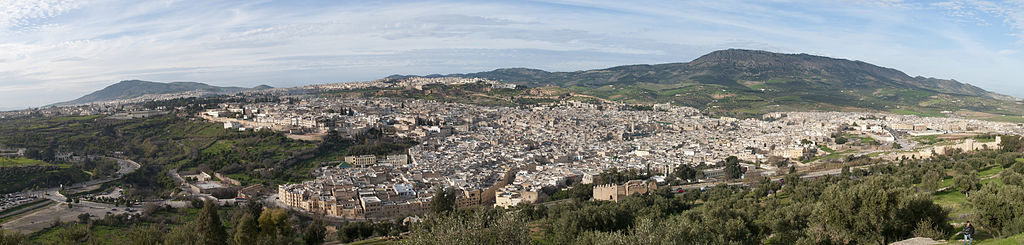
Panoramic view of the Old Medina in Fez, Morocco.
Photo by Michal Osmenda via Wikimedia Commons.
Yet there was another region that Botero singled out in terms of its technological and economic achievements, which I had never heard mentioned before: the land of “The Xeriffe”.
The term is usually rendered as sharif, denoting a descendant of the Prophet Muhammad via his grandson, Hasan ibn Ali. In 1600, the title was claimed by the rulers of the Saadi Empire, centred around Fez, in present-day Morocco. Botero claimed that its cities were of marble and alabaster, decorated with great lamps of brass. In Fez in particular were “200 schools of learning, 200 inns, and 400 water mills, every one driven with four or five wheels”, from which the ruler derived a substantial rent. The city also featured “600 conduits, from whence almost every house is served with water.” Indeed, he noted that “the inhabitants are very thrifty, given to traffic [commerce], and especially to the making of clothes of wool, silk, and cotton.”
So here was a remarkable city. One that was wealthy, populous, somewhat industrialised, and given to trade. It was a centre of learning for the entire region, especially under the long rule of one of its sultans, Ahmad al-Mansur “the Golden” and his immediate successors: the library they amassed forms one of the major surviving collections of Islamic manuscripts on literature and science (which was captured during a war in the seventeenth century, and has been in Spain ever since). The Saadi Empire even had some military might: during its rise it successfully contended with Portugal, and it had a large arsenal of gunpowder weapons, which it put to use in conquering parts of Sub-Saharan Africa. It maintained friendly commercial and diplomatic links with both England and the Dutch Republic, uniting with them in their opposition to Spain.
And yet, the Saadi Empire is never mentioned as an efflorescence [defined as “temporary bubblings up of innovation and economic growth, which ultimately resulted in stagnation or decline”]. It doesn’t even feature in debates about the causes of the Long Divergence — the centuries-long reversal of economic fortunes between northwestern Europe and the Islamic world. The latest major book on the reversal, by Jared Rubin (which is excellent, by the way), is entirely devoted to comparisons with the Ottoman Empire, not discussing Morocco even once. That may just be a product of which sources are most readily available in English, or because there are currently quite a few excellent Turkish economic historians, like Şevket Pamuk or Timur Kuran. It’s also possible that the descriptions of Fez’s wealth were exaggerated, or that there are straightforward explanations for its relative economic decline. But, if we’re to fully understand the causes of the Industrial Revolution in Britain, I think the rise and fall of the Saadi Empire is another efflorescence we need to seriously consider.
January 25, 2020
Refuting the pessimism of Malthus
In the latest edition of Anton Howes’ Age of Invention newsletter, he looks at the predictions of that old gloomy Gus, Thomas Malthus:

The Malthusian trap. For Malthus, as population increases exponentially and food production only linearly, a point where food supply is inadequate will inevitably be reached.
Graph by Kravietz via Wikimedia Commons.
For economies before the Industrial Revolution, population growth was an important and ever-present brake on prosperity — an observation most famously articulated by the Reverend Thomas Malthus. Writing at the end of the eighteenth century, he warned against the promises of improvement. Whereas the optimists looked at the acceleration of innovation around them and claimed infinite horizons for increasing living standards, Malthus pessimistically argued that population would always catch up. Although a new agricultural technology might briefly increase the amount of available food, the inexorability of population growth meant that it would soon be eaten up by extra mouths to feed. The population would end up larger than it was before the new technology, but with that population eventually no richer than it had been to begin with. Economic historians call this the Malthusian regime, or the Malthusian Trap.
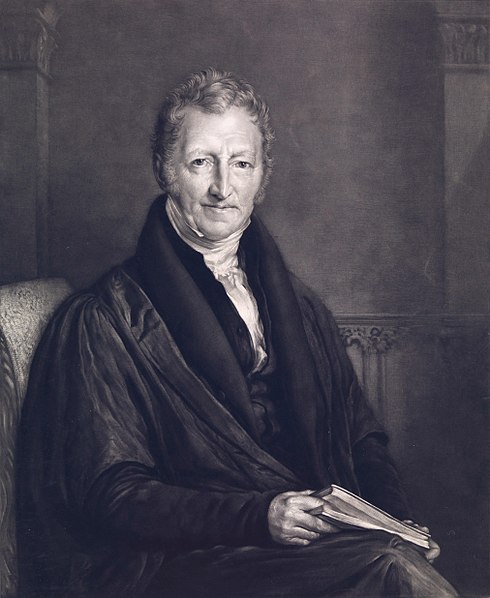
Thomas Malthus.
Portrait by John Linnell, 1834, via Wikimedia CommonsFortunately, Malthus’s pessimism would prove unfounded. Economy after economy has managed to escape the trap. British output had already been outpacing its population for two centuries by the time he was writing — England’s agricultural output alone had increased 171% while its population had grown 113% (not even taking into account the fact that it also increasingly relied on imported food, paid for by its other industries). And in the decades and centuries that followed, England’s output continued to shoot ahead, widening the lead. Output per capita rose and rose, to the extent that Malthus’s worries about overpopulation are now usually applied to resources other than food.
But while Malthus is famous for the theory, he wasn’t its inventor. Well before Malthus, the people who actually lived in the trap seem to have recognised its effects. Concerns about overpopulation may have led to the Garland or Flower Wars of the Aztec Empire and its neighbours: after a series of famines in the 1450s, the local states reportedly began to engage in ritual battles, with the losers captured and sacrificed to the gods. Still earlier, in ancient Greece, the young men of a settlement might be formally conscripted to go forth and colonise other islands and coastlines. They were typically banned from returning home for several years, and in at least one case slingers were posted on the shore to kill any of the colonists who tried to make a break for home. In a whole host of pre-industrial societies, “surplus” infants were often simply exposed to the elements.
By the sixteenth century, with the rise of print culture, Malthusian rationales were being clearly articulated. Here’s Richard Hakluyt writing in 1584, over two hundred years before Malthus:
Through our long peace and seldom sickness (two singular blessings of Almighty God) we are grown more populous than ever heretofore; so that now there are of every art and science so many, that they can hardly live one by another, nay rather they are ready to eat up one another.
It’s a direct statement of the Malthusian regime in action, expressed by one of England’s most influential Elizabethan intellectuals, and written specifically for the attention of the queen. Hakluyt thanked god for the recent and unusual lack of mass death, but now worried about overpopulation leading to low wages and unemployment. And he went on to list many other effects. Hakluyt argued that the misery would lead to unrest, thievery, begging, and “other lewdness”. The prisons filled up, where the poor either “pitifully pine away, or else at length are miserably hanged.”
January 23, 2020
Pascal’s Wager, environmentalists’ version
Hector Drummond indulges in a proper “Fisking” of a recent column in the Telegraph:
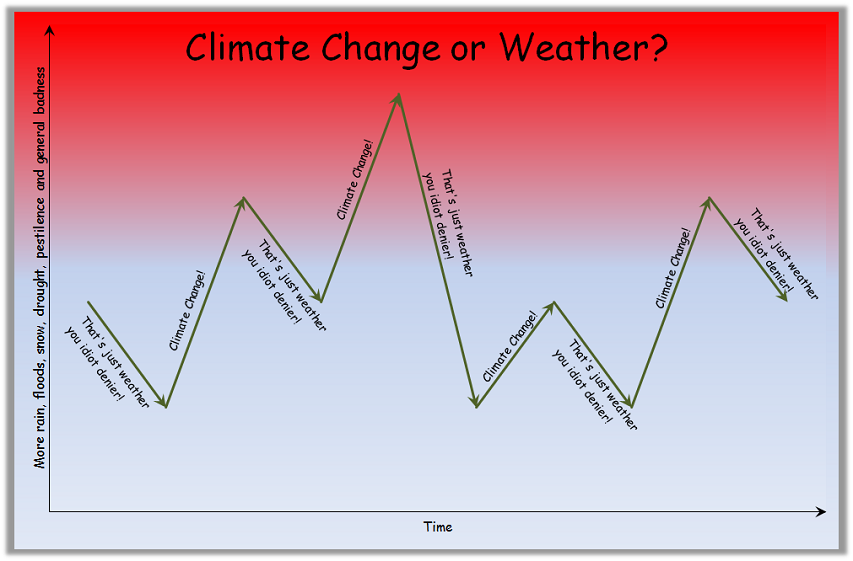
We don’t have to buy into the apocalyptic angst of Greta Thunberg, on show again in Davos yesterday, to recognise that something has to be done.
He actually said “Something Has To Be Done”. How about we do a snow dance, Philip? That’s “something”.
Whether or not you are a sceptic about the impact of CO2 on the climate or question man’s involvement in producing the greenhouse gas, our energy future is a non-carbon one, like it or not.
Our energy future involves a lot of talk about non-carbon energy sources, while relying on “carbon” for a long time to come.
Virtually every government has committed to this as an overt aspect of public policy and those that haven’t, like China or the US, have a rapidly growing green energy sector poised to exploit the move to a carbon‑free future.
You mean the China that’s building coal-fired power plants at a rate of knots? That China?
Later on, the column invokes Pascal’s Wager, which Hector finds both amusing and irritating:
Seriously? Pascal’s Wager, which has been long ridiculed by most scientists and philosophers and thinkers, is now the basis for the largest and riskiest economic and political transformation in human history?
Pascal’s Wager justifies any proposed change in response to any possible threat. It’s possible that all the ducks in the world are really super-intelligent and they’re about to launch a takeover, so we need to kill them all. It’s possible that nylon stockings are eventually going to cause a nuclear explosion. Make your own ones up. The consequences of doing nothing, should these claims turns out to be true, are calamitous. In fact, they’re far more calamitous than most of the possible climate change scenarios.
Proper risk analysis, on the other hand, tells us to look at probabilities of the possible bad outcomes, not just how bad some possible bad outcome would be, were it true. The catastrophic climate change scenarios all have tiny probabilities. Even the IPCC admits that.
[…]
Then we have to look at the costs of the proposed action. The real costs, that is, not just vague claims like “Oh, moving everything to solar energy would be, like, you know, cool, my friend went to this talk once and she said that apparently solar works just as well as coal”. The costs – the real costs – are what needs be weighed against alternative courses of action.
The costs of abandoning fossil fuels are not zero. Not even remotely. Changing to renewables will be massively expensive, destroy jobs, and hinder prosperity, because they cannot provide anywhere near the energy we need. “Generate growth and prosperity” is nonsense, and Johnston should be ashamed of himself for falling for this.


