
To the left any money earned anywhere in the country automatically belongs to the government. This confirms my suspicion that at heart, deep inside, they think of the normal form of government as feudalism. This is because I’ve seen very old land deeds and other documents from when Portugal was a monarchy and it read something like “His Majesty, graciously allows his subject so and so to exert ownership over this parcel of land” the underlying conceit being that the whole land of the whole country belonged to the king, and it was in his purview to hand it out to whomever he pleased for as long as he pleased, while it still belonged to him. (The documents I saw were for things like house plots, not fiefdoms, incidentally.)
The left seems to be going off the same book when they say things like “How will you pay for the tax cuts?” as if the government is OF COURSE entitled to all your money, and if you’re getting some back, that part must be compensated for.
Sarah Hoyt, “The Tragedy of the Squid Farms on Mars”, Libertarian Enterprise, 2018-12-05.
July 4, 2021
QotD: It’s not your money … it’s the GOVERNMENT’S money
July 3, 2021
Taiwan, 2021
Admiral Gary Roughead considers the regional situation of Taiwan in 2021:

Taiwan relief map.
Library of Congress Geography & Map Division via Wikimedia Commons.
There has been a spate of recent articles proffering when the People’s Republic of China (PRC) will likely be capable of invading Taiwan. The prognostications are interesting but unhelpful as they distract from the reality of the range of coercive actions the PRC may impose on Taiwan and what could happen now as a result of the PRC increasing pressure and a related military accident or misstep in the vicinity of Taiwan.
The current American penchant to jump to military options to address thorny global problems often casts the Taiwan dilemma in a superficial bilateral or trilateral military context. That aperture must be opened more fully to consider the realities, attributes, and interests of Taiwan, and how those factors will influence the methods and timing of Beijing’s reunification objective. Moreover, those realities, some inconvenient, must underpin new and broader thinking about how to ensure Taiwan’s existence as a vibrant democracy.
[…]
Changing defense strategy to adjust to new circumstances can’t simply discount the realities of today. The interaction of the Air Forces of Taiwan and the PRC in 2020 was extraordinarily high and costly for Taiwan, and maritime and naval considerations will also continue to loom large for Taiwan’s security.
PRC naval force structure both in terms of capacity (numbers) and capability (effectiveness and quality) has grown impressively in the past two decades and some comparisons are worth noting. There are over 330 ships in the PLA Navy and construction continues at an impressive pace. The Chinese Coast Guard numbers 255 ships. The PLA Navy, except for short episodic out of area deployments of small numbers of ships, is concentrated within the First Island Chain. Taiwan’s navy has 86 ships in service, more than half are coastal patrol craft. Its small Coast Guard of 23 ships is not close to being on par in numbers, ship size, or capability as that of the PRC. The U.S Navy stands at 296 ships. The American fleet enjoys a qualitative advantage, but only approximately 60 percent of the U.S. Fleet is assigned to the Pacific, with 11 of those forward deployed to Japan. The remainder are thousands of miles away.
PLA Air Force and Taiwan Air Force aircraft inventories are similarly imbalanced with fighter numbers 600 (Eastern Theater) and 400 respectively. The PLA Air Force’s fighter total is 1,500 and would inevitably backfill shortages and combat losses. The U.S. Air Force combat coded fighters number 1,011. The PRC’s Air Force and Navy regional concentration is reinforced by a Rocket Force of nearly 1,000 intermediate and lesser range ballistic missiles and 300 ground launched cruise missiles.
China’s focus on “informationized” warfare integrates cyber operations into the PRC’s anti-access area denial strategy and architecture. The BeiDou satellite network enables full autonomy in positioning, navigation, and timing (PNT) information for PLA ground, sea, and air forces and is the essential factor in precision weapon employment. Another contributor to precision engagements and overall situational awareness is China’s 120 reconnaissance and remote sensing satellites. A robust People’s Armed Forces Maritime Militia also provides close-in maritime locating information and has and will interfere with U.S., Taiwanese, and other nations’ naval and maritime operations.
July 2, 2021
Britain’s “agricultural revolution”
In the latest Age of Invention newsletter, Anton Howes wonders about the almost-forgotten revolution that pre-dated the much better known Industrial Revolution:
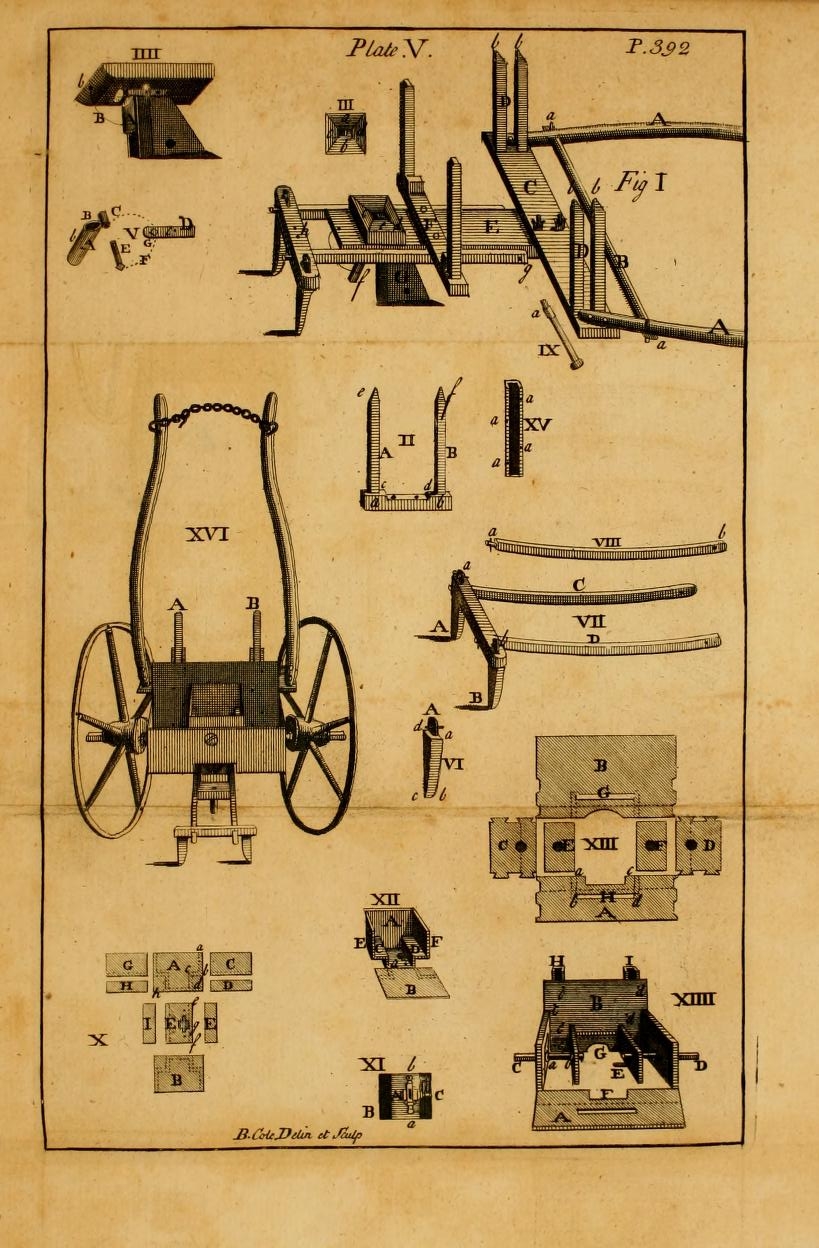
Illustration of a seed drill from Horse-hoeing husbandry, 4th edition by Jethro Tull, 1762 (original work 1731).
Wikimedia Commons.
Whatever happened to “the Agricultural Revolution” of seventeenth and eighteenth-century Britain? In recent years I’ve hardly seen the term used at all, and the last major book on the subject was seemingly published twenty-five years ago. It has become almost totally eclipsed by its more famous sibling “the Industrial Revolution”, with its vivid associations of cotton, coal, and exponential hockey-stick graphs.
Yet for all that popularity, nearly every book investigating the causes of modern economic growth complains about the use of The Industrial Revolution. Even one of the pioneers of economic history, T. S. Ashton, who actually wrote the book The Industrial Revolution, complained on the very second page about the term’s inaccuracy. Much like “Holy Roman Empire”, there’s an error in every word. It involved too many series of changes to really be a The, was about so much more than just industry, and was too gradual a process to properly call a revolution. Yet Ashton had to concede that the term had “become so firmly embedded in common speech that it would be pedantic to offer a substitute.” And this was in 1948. In the intervening three quarters of a century, the term has become all the more difficult to dislodge.
I am, like everyone else, guilty of perpetuating the term Industrial Revolution. It’s a useful shorthand for people to at least get a rough idea of what I’m talking about, for me to then refine. Best to start with what people know, or at least what they think they know, and go from there. You may think of the Industrial Revolution as being about cotton, coal, and steam, but the period also saw major developments in every other industry, from agriculture to watch-making, and everything in-between. And so on. My preferred terms, like “acceleration of innovation”, always require at least a paragraph or two of explanation first.
With the term Agricultural Revolution, however, there’s just no need to reference it. Nobody really talks about it, or has anything more than a very vague conception of what it may mean. At best, people recall a few things from decades-old textbooks: names like “Turnip” Townshend or Jethro Tull, and perhaps a smattering of jargon like selective breeding, crop rotation, or enclosures. Even these are widely misunderstood. See last week’s post, for patrons, on how we get almost everything about the enclosure movement wrong. As for the Agricultural Revolution’s timing, who knows? When, over the course of the sixteenth, seventeenth, eighteenth, and maybe even nineteenth centuries is it supposed to have occurred? With the Industrial Revolution, there’s at least a “classic” period of 1760-1830, with a few decades of leeway. That is of course up for debate, and I’m especially keen on pushing it back much earlier, but it’s at least a half-decent starting point. With the Agricultural Revolution, there’s just no baseline at all. The experts themselves can’t agree.
For all that the term Agricultural Revolution has lost its salience, however, early modern changes to the productivity of agriculture were perhaps the most important of all. The ability to support a much larger population is itself a major economic achievement. For all that we obsess over historical measures of GDP per person, we often forget the much earlier and extraordinary increase in just the sheer number of people. In the early seventeenth century England’s population not only recovered to its pre-Black Death peak of about 5 million, but then from 1700 onwards it began to exceed it. By 1800, after just another century, the population of Britain had doubled to 10 million. And this in a period throughout which the country was a net exporter of grain.
July 1, 2021
John McWhorter reviews Facing Reality by Charles Murray
In the latest installment from It Bears Mentioning, John McWhorter considers Murray’s latest book to be his weakest:

… Facing Reality is seriously disturbing. Murray gives a great deal of evidence for two points. One is that black people aren’t, on the average, as intelligent as other people. The other is that black people in America are more violent than others.
Those who on some level celebrate the latter as black people getting back at the white man in the only way they can, should know that the facts don’t lend themselves to that vigilante justice analysis. More specifically, black people kill each other more than members of other groups kill each other.
I find the violence point relatively unsurprising. Murray stays agnostic as to what the cause of it is; he proposes no genetic analysis, for example. And really, let’s try this. In the 1960s, a new and powerful fashion in black thought, inherited from the general countercultural mood, rejects championing assimilation to proposing that opposition to whiteness is the soul of blackness. Meanwhile, white leftists encourage as many poor black women as possible to go on welfare, hoping to bankrupt the government and inaugurate a fairer America. Soon, being on welfare in poor black communities is a new normal – hardly the usual, but so common that people grow up seeing not working for a living as ordinary. Then at this same time, a new War on Drugs gave poor black men a way of making half of a living by selling drugs on the black market, amidst a violent culture of gangland turf-policing. This feels more natural to them than it would have to their fathers because 1) the new mood sanctions dismissing traditional values as those of a “chump”, 2) it no longer feels alien to eschew legal employment, and 3) the Drug War helps make it that most boys in such neighborhoods grow up without fathers anyway.
The question might be just how black men amidst these changes would not have embraced violence in a new way.
* * *
The point about intelligence, however, is tough reading. Many will try the usual arguments – that race is a fiction (but while there are gray zones, humans do divide into delineable races genetically), that all races have a range from genuises on down (but the issue is that some races have more geniuses than others), that intelligence tests are “biased” somehow (but no one will specify just how, and this sort of bias is decades gone now).
The data, unless Murray is holding back reams of data with opposite results, cut brutally through all of this. It isn’t that black people are on the bottom on one big test in one big study, but that a certain order of achievement manifests itself in one study after another with relentless and depressing regularity. Asians on top, then come the whites, then Latinos, and then black people.
People will insist that none of this has anything to do with intelligence, but one thing cannot be denied – whatever it signifies, black people have a big problem performing on intelligence tests. The consistency of the results, if it is unconnected to intelligence, is clearly connected to something, or the results wouldn’t be so damnedly consistent.
June 28, 2021
Pounds, shillings, and pence: a history of English coinage
Lindybeige
Published 18 Dec 2020I talk for a bit the history of English coinage, and the problems of maintaining a good currency. Once or twice I might stray off topic, but I end with an explanation of why the system worked so well.
Picture credits:
40 librae weight
Martinvl, CC BY-SA 3.0 https://creativecommons.org/licenses/…, via Wikimedia CommonsSceat K series, and others
By Classical Numismatic Group, Inc. http://www.cngcoins.com, CC BY-SA 3.0, https://commons.wikimedia.org/w/index…William I penny, and Charles II crown
The Portable Antiquities Scheme/ The Trustees of the British Museum, CC BY-SA 2.0 https://creativecommons.org/licenses/…, via Wikimedia CommonsBust of Charlemagne
By Beckstet – Own work, CC BY-SA 3.0, https://commons.wikimedia.org/w/index…Edward VI crown
By CNG – http://www.cngcoins.com/Coin.aspx?Coi…, CC BY-SA 3.0, https://commons.wikimedia.org/w/index…Charles II guinea
Gregory Edmund, CC BY-SA 4.0 https://creativecommons.org/licenses/…, via Wikimedia CommonsSupport me on Patreon: https://www.patreon.com/Lindybeige
Buy the music – the music played at the end of my videos is now available here: https://lindybeige.bandcamp.com/track…
Buy tat (merch):
https://outloudmerch.com/collections/…Lindybeige: a channel of archaeology, ancient and medieval warfare, rants, swing dance, travelogues, evolution, and whatever else occurs to me to make.
▼ Follow me…
Twitter: https://twitter.com/Lindybeige I may have some drivel to contribute to the Twittersphere, plus you get notice of uploads.
My website:
http://www.LloydianAspects.co.uk

QotD: Urbanization
Stewart Brand, “Environmental Heresies”, Technology Review, 2005-05
June 18, 2021
Innovation was minimal in the Roman Empire, because slave societies think they don’t need new inventions
Mark Koyama writes for the Foundation for Economic Education on the similarities and differences of the economy of the Roman Empire at its second-century peak and the booming European economies of the 17th and early 18th centuries:
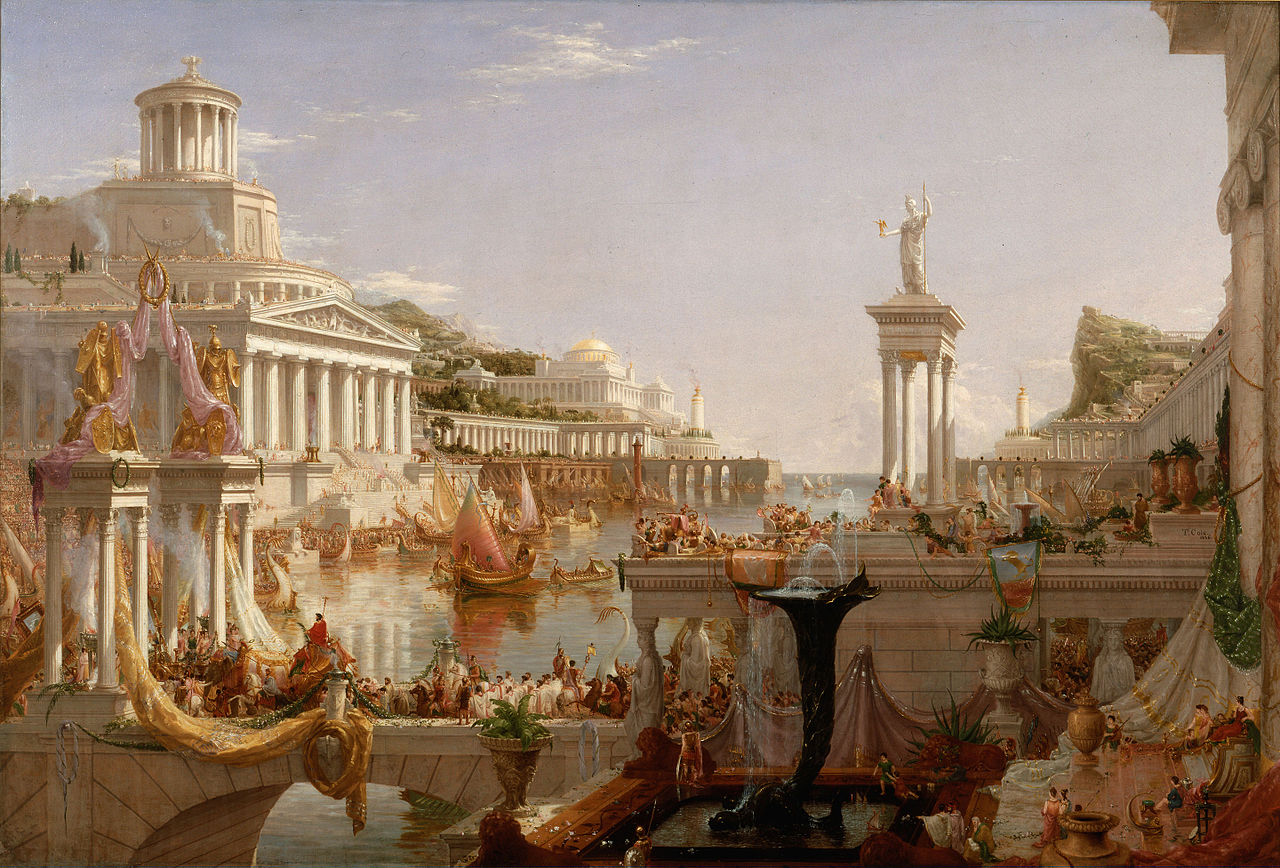
“The Consummation of Empire” from the painting series “The Course of the Empire” by Thomas Cole (1801-1848).
New York HIstorical Society collection via Wikimedia Commons.
The most obvious institutional difference between the ancient world and the modern was slavery. Recently historians have tried to elevate slavery and labor coercion as a crucial causal mechanism in explaining the industrial revolution. These attempts are unconvincing […] but slavery certainly did dominate the ancient economy.
In its attempt to draw together the various strands through which slavery permeated the ancient economy, [Aldo] Schiavone’s chapter “Slaves, Nature, Machines” [in The End of the Past] is a tour de force. At once he captures the ubiquity of slavery in the ancient economy, its unremitting brutality — for instance, private firms that specialized in branding, retrieving, and punishing runaway slaves — and, at the same time, touches the central economic questions raised by ancient slavery: to what extent was slavery crucial to the economic expansion of the period between 200 BCE and 150 AD? And did the prevalence of slavery impede innovation?
It is impossible to do justice to the argument in a single post. Suffice to say that after much discussion, and many fascinating interludes, Schiavone suggests that ultimately the economic stagnation of the ancient world was due to a peculiar equilibrium that centered around slavery.
One can think of this equilibrium as resting on two legs. The first is the observation that the apparent modernity of the ancient economy — its manufacturing, trade, and commerce rested largely on slave labor. The expansion of trade and commerce in the Mediterranean after 200 BC both rested on and drove the expansion of slavery. Here Schiavone notes that the ancient reliance on slaves as human automatons — machines with souls — removed or at least weakened, the incentive to develop machines for productive purposes.
The existence of slavery, however, was not the only reason for the neglect of productive innovation. There was also a specific cultural attitude that formed the second leg of the equilibrium:
None of the great engineers and architects, none of the incomparable builders of bridges, roads, and aqueducts, none of the experts in the employment of the apparatus of war, and none of their customers, either in the public administration or in the large landowning families, understood that the most advantageous arena for the use and improvement of machines — devices that were either already in use or easily created by association, or that could be designed to meet existing needs — would have been farms and workshops
The relevance of slavery colored ancient attitudes towards almost all forms of manual work or craftsmanship. The dominant cultural meme was as follows: since such work was usually done by the unfree, it must be lowly, dirty and demeaning:
technology, cooperative production, the various kinds of manual labor that were different from the solitary exertion of the peasants on his land — could not but end up socially and intellectually abandoned to the lowliest members of the community, in direct contact with the exploitation of the slaves, for whom the necessity and demand increased out of all proportion … the labor of slaves was in symmetry with and concealed behind (so to speak) the freedom of the aristocratic thought, while this in turn was in symmetry with the flight from a mechanical and quantitative vision of nature
Thus this attitude also manifests itself in the disdain the ancients had for practical mechanics:
Similar condescension was shown to small businessmen and to most trade (only truly large-scale trade was free from this taint). The ancient world does not seem to have produced self-reproducing mercantile elites. Plausible this was in part because of the cultural dominance of the landowning aristocracy.
The phenomenon coined by Fernand Braudel, the “Betrayal of the Bourgeois”, was particularly powerful in ancient Rome. Great merchants flourished, but “in order to be truly valued, they eventually had to become rentiers, as Cicero affirmed without hesitation: ‘Nay, it even seems to deserve the highest respect, if those who are engaged in it [trade], satiated, or rather, I should say, satisfied with the fortunes they have made, make their way from port to a country estate, as they have often made it from the sea into port. But of all the occupations by which gain is secured, none is better than agriculture, none more delightful, none more becoming to a freeman'” (Schiavone, 2000, 103).
Such a cultural argument fits perfectly with Deirdre McCloskey’s claim in her recent trilogy that it was the adoption of bourgeois cultural norms and specifically bourgeois rhetoric that distinguished and caused the rise of north-western Europe after 1650.
Feeding “the masses”
Sarah Hoyt looked at the perennial question “Dude, where’s my (flying) car?” and the even more relevant to most women “Where’s my automated house?”:
The cry of my generation, for years now, has been: “Dude, where’s my flying car?”
My friend Jeff Greason is fond of explaining that as an engineering problem, a flying car is no issue at all. It is as a legal problem that flying cars get interesting, because of course the FAA won’t let such a thing exist without clutching it madly and distorting it with its hands made of bureaucracy and crazy. (Okay, he doesn’t put it that way, but I do.)
[…]
But in all this, I have to say: Dude, where’s my automated house?
It was fifteen years ago or so, while out at lunch with an older writer friend, that she said “We always thought that when it came to this time, there would be communal lunch rooms and cafeterias that would do all the cooking so women would be free to work.”
I didn’t say anything. I knew our politics weren’t congruent, but really the only societies that managed that “Cafeterias, where everyone eats” were the most totalitarian ones, and that food was nothing you wanted to eat. If there was food. Because the only way to feed everyone industrial style is to take away their right to choose how to feed themselves and what to eat. And that, over an entire nation, would be a nightmare. Consider the eighties, when the funny critters decided that we should all live on a Russian Peasant diet of carbs, carbs and more carbs. Potatoes were healthy and good for you, and you should live on them.
It will surprise you to know – not — that just as with the mask idiocy, no study of any kind supports feeding the population on mostly vegetables, much less starches. What those whole “recommendations” were based on was “diet for a small planet” and the bureaucrats invincible ignorance, stupidity and assumption of their own intelligence and superiority. I.e. most of what they knew — that population was exploding, that people would soon be starving, that growing vegetables is less taxing on the environment and produces more calories than growing animals to eat — just wasn’t so. But they “knew” and by gum were going to force everyone to follow “the plan”. (BTW one of the ways you know that Q-Anon is in fact a black ops operation from the other side; no one on the right in this country trusts a plan, much less one that can’t be shared or discussed.) Then the complete idiots were shocked, surprised, nay, astonished when their proposed diet led to an “epidemic of obesity” and diabetes. Even though anyone who suffered through the peasant diet in communist countries, could have told the that’s where it would lead, and to both obesity and Mal-nutrition at once.
So, yeah, communal cafeterias are not a solution to anything.
My concern about the “automated house of the future” is nicely prefigured by the “wonders” of Big Tech surveillance devices we’ve voluntarily imported into our homes for the convenience, while awarding untold volumes of free data for the tech firms to market. Plus, the mindset that “you must be online at all times” that many/most of these devices require means you’re out of luck if your internet connection is a bit wobbly (looking at you, Rogers).
June 9, 2021
QotD: Failing to account for mere “women’s work”
Elli Quinn quirked an eyebrow. “How odd. On other worlds, people seem to come in floods, and they’re not necessarily impoverished, either.”
Ethan, diverted, said, “Really? I don’t see how that can be. Why, the labor costs alone of bringing a child to maturity are astronomical. There must be something wrong with your accounting.”
Her eyes screwed up in an expression of sudden ironic insight. “Ah, but on other worlds the labor costs aren’t added in. They’re counted as free.”
Ethan stared. “What an absurd bit of double thinking! Athosians would never sit still for such a hidden labor tax! Don’t the primary nurturers even get social duty credits?”
“I believe,” her voice was edged with a peculiar dryness, “they call it women’s work.”
Lois McMaster Bujold, Ethan of Athos, 1986.
June 8, 2021
If you were trying to destroy American cities from within … what would you be doing differently?
Sarah Hoyt’s latest Libertarian Enterprise post considers the state of US urban areas after more than a year of Wuhan Coronavirus lockdowns, social controls, and medically “justified” repression:

“Homeless encampment above the 101 @ Spring” by Steve Devol is licensed under CC BY-NC-SA 2.0


Look, I’m sure this was suggested by China, and the dunderheads are totally buying it under their Compleate Illusions system.
Sure climate change. Climate change can justify anything. If we told them they needed to burn people alive to prevent climate change, they’d already been building the pyres.
But that’s just sort of a reflexive thing, like a Moslem saying “Insh Allah“. It’s not actually involved in their thinking as such. Or their thinking is not involved in it. whichever.
The truth is that they realized that the Covidiocy has destroyed the cities.
You see they had everything planned. They were going to force more and more of us into the city, because they were going to make running an internal combustion engine so hard. So if you had a job, you’d live in the city. Where you’re more easily controlled. And where they could make you believe bullshit like overpopulation and that — look at all the homeless — we needed more and more welfare. Their idea of their perfect world is the 1930s version of the future. Just megalopolisis, isolated, with people completely controlled. It has the bonus of leaving pristine wilderness outside that, for the elites to build their dachas.
And part of the problem is that they never understand other people have agency and respond to circumstances.
I don’t know what they expected when they went full fashboots and — in the case of Polis, and I bet not the only one — gave homeless the right to camp in every public land, and defecate in public as well as freeing a bunch of felons.
Did they expect this would just scare people more, and they’d lock themselves in, in fear and trembling, allowing the idiots to design society.
Instead, people left. Americans are on the move. I swear half of my friends are moving from more locked to less locked, from bluer to redder. Some demographers have caught on, seeing through the smoke and mirrors, and are confused — most of them being leftist — because Americans are in the middle of a full migration. As full and as all pervading as the movement west. Or after the civil war the movement of black people North.
Some of this must have penetrated the granite-like heads of the ruling left. Or at least the planning left.
They somehow didn’t expect—possibly because they don’t really get technology. I mean, I have my moments, but I swear most democrats were disappointed when laptops started being made with no “cup holders”. They’re at that level of stupid — that a tech that hasn’t been fully implemented, giving us the ability to work from home, would be kicked into high gear from the covidiocy.
I guess they expected people who work mostly from their computers to sit at home watching panic porn on TV and not work?
More importantly, I don’t think they expected people who have to work in person to follow that migration because, well … if you owned a restaurant that the covidiocy killed, you might, for instance, pay heed to the fact people are driving everywhere because, duh, masks on planes, and therefore build a roadside diner or perhaps find a small town that’s underserved and start anew there.
Oh … a lot of people are changing jobs too, and the jobs are no longer binding them to big cities.
Honestly, the only way for big cities to save themselves is to become touristic centers. NYC was halfway there when the covidiocy hit. Only not fully there because lefty governance sucks at making a city safe.
If I were a lefty governor or mayor right now, I’d aim the fashboots at crime and disorder, get rid of the homeless, spruce up the place, and go all out in courting tourism. Then people would move in to cater to the tourists, and eventually other businesses would move in, because that’s where people are.
But leftists don’t think that way. Carrot and incentive is beneath them (of course.) Their idea is rather that they will force those unwashed peasants to do what they want.
June 7, 2021
Dude, where’s my (flying) car?
The latest of the reader-contributed book reviews at Scott Alexander’s Astral Codex Ten looks at Where is my Flying Car? by J. Storrs Hall:

What went wrong in the 1970s? Since then, growth and productivity have slowed, average wages are stagnant, visible progress in the world of “atoms” has practically stopped — the Great Stagnation. About the only thing that has gone well are computers. How is it that we went from the typewriter to the smartphone, but we’re still using practically the same cars and airplanes?
Where is my Flying Car? by J. Storrs Hall, is an attempt to answer that question. His answer is: the Great Stagnation was caused by energy usage flatlining, which was caused by our failure to switch to nuclear energy, which was caused by excessive regulation, which was caused by “green fundamentalism”.
Three hundred years ago, we burned wood for energy. Then there was coal and the steam engine, which gave us the Industrial Revolution. Then there was oil and gas, giving us cars and airplanes. Then there should have been nuclear fission and nanotech, letting you fit a lifetime’s worth of energy in your pocket. Instead, we still drive much the same cars and airplanes, and climate change threatens to boil the Earth.
I initially thought the title was a metaphor — the “flying car” as a standin for all the missing technological progress in the world of “atoms” — but in fact much of the book is devoted to the particular question of flying cars. So look at the issue from the lens of transportation:
Hans Rosling was a world health economist and an indefatigable campaigner for a deeper understanding of the world’s state of development. He is famous for his TED talks and the Gapminder web site. He classifies the wealthiness of the world’s population into four levels:
1. Barefoot. Unable even to afford shoes, they must walk everywhere they go. Income $1 per day. One billion people are at Level 1.
2. Bicycle (and shoes). The $4 per day they make doesn’t sound like much to you and me but it is a huge step up from Level 1. There are three billion people at level 2.
3. The two billion people at Level 3 make $16 a day; a motorbike is within their reach.
4. At $64 per day, the one billion people at Level 4 own a car.
The miracle of the Industrial Revolution is now easily stated: In 1800, 85% of the world’s population was at Level 1. Today, only 9% is. Over the past half century, the bulk of humanity moved up out of Level 1 to erase the rich-poor gap and make the world wealth distribution roughly bell-shaped. The average American moved from Level 2 in 1800, to level 3 in 1900, to Level 4 in 2000. We can state the Great Stagnation story nearly as simply: There is no level 5.
Level 5, in transportation, is a flying car. Flying cars are to airplanes as cars are to trains. Airplanes are fast, but getting to the airport, waiting for your flight, and getting to your final destination is a big hassle. Imagine if you had to bike to a train station to get anywhere (not such a leap of imagination for me in New York City! But it wouldn’t work in the suburbs). What if you had one vehicle that could drive on the road and fly in the sky at hundreds of miles an hour?
Before reading this book, I thought flying cars were just technologically infeasible, because flying takes too much energy. But Hall says we can and have built them ever since the 1930s. They got interrupted by the Great Depression (people were too poor to buy private airplanes), then WWII (airplanes were directed towards the war effort, not the market), then regulation mostly killed the private aviation industry. But technical feasibility was never the problem.
Hall spends a huge fraction of the book on pretty detailed technical discussion of flying cars. For example: the key technical issue is takeoff and landing, and there is a tough tradeoff between convenient takeoff/landing and airspeed (and cost, and ease of operation). It’s interesting reading. But let’s return to the larger issue of nuclear power.
June 1, 2021
Undoing Dr. Beeching’s cuts
In The Critic, Brice Stratford looks at the British government’s “nationalization if necessary, but not necessarily nationalization” scheme to once again reform Britain’s passenger railway network:
Astonishing scenes this week, whereby the Tory government announces a White Paper to re-nationalise the railways. The union bosses and Guardianistas who have called for such policy for decades immediately decided that actually it’s a terrible idea, or that this doesn’t count as re-nationalising because it’s the Conservatives doing it, or that calling the new entity “Great British Railways” just because it will run Great Britain’s railways is so offensive that the entire project should be called off. It’s all very tribal, and very silly, and very 2021, alas.
Of course, the Department for Transport (DfT) is still afraid of admitting that this is in fact renationalisation, as to do so would be to rile up certain elements of the Right, and to admit what we all know: that their generations-long experiment in railway privatisation has been a failure. Today we have a service which is overpriced, unreliable, and generally an unpleasant and ineffective experience from start to finish.
The postwar Labour government included railway nationalization in its many, many reforms to the economic life of Britain and in 1948 the remaining railway systems were unified as British Railways. By the 1960s, the system was losing money at a high rate of speed, so Dr. Beeching was called upon to recommend how to put the railway if not into profit then at least into a much more acceptable rate of loss:
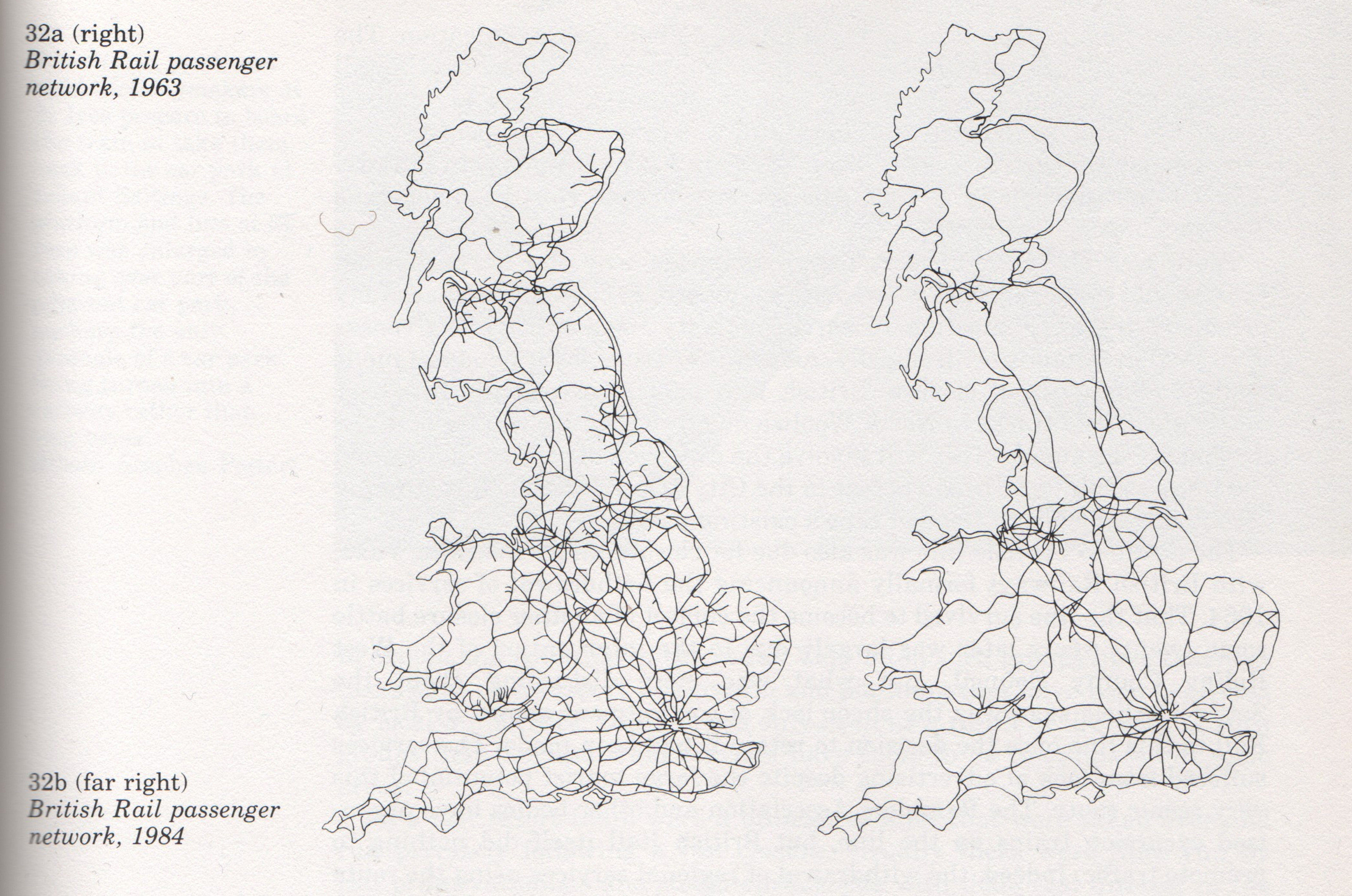
Maps originally from Losing Track by Kerry Hamilton and Stephen Potter (1985), by way of Is Your Journey Really Necessary?, 2012-12-31.
https://isyourjourneyreallynecessary.wordpress.com/2012/12/31/nice-work-if-you-can-get-there/
Click map to enlarge.
The aim of the Beeching cuts, which followed on from a pair of reports written by Dr Richard Beeching in 1963 and 1965 for the British Railway Board (of which he was Chair), was to turn the loss-making British railways network into a profitable enterprise. Prioritising this profitability over all else, he proposed axing about a third of Britain’s then 7000 railway stations, removing passenger service from around 5000 route miles, and cutting 70,000 jobs over three years. The moves were highly controversial, and though they certainly saved money, the social consequences were extensive and the scars remain visible today.
As a consequence of the cuts, Britain became over-reliant on car travel, and over the 1970s and 80s town planners gutted the experientially human-scale city centres in service of this newly favoured road transport. We still very much feel the consequences of the Beeching axe today, whereby a rail journey between neighbouring cities is often only possible by zigzagging up to London and back down again, and public transport between rural communities is limited to one bus service every hour or two in the morning and mid-afternoon, which crawls along at a testudinian pace, further isolating and atrophying the scattered settlements that once were happy, thriving homes.
May 29, 2021
QotD: Academia and capitalism
One of the mistakes folks on the Left make about capitalism is to describe capitalism as mostly about competition. In fact, capitalism is mostly about cooperation, it’s a self-organizing process where people who don’t even know each other cooperate to deliver products and services, facilitated by markets and the magic of prices. Sure, competition exists but it is not the fundamental feature, but an enabler that makes sure the cooperation occurs as efficiently as possible. Capitalism in fact is about zillions of voluntary trades and transactions every day that each make both parties better off — or else both sides would not have agreed to it. Capitalism in fact is a giant positive sum game, a fact that many on the Left simply do not grasp.
Warren Meyer, “Does the Zero-Sum Nature of Academic Success Contribute to the Left-wards Bias of Academia?”, Coyote Blog, 2018-11-09.
May 23, 2021
Peter Zeihan’s geographic-based perspective on world history
In another of the reader-contributed book reviews for Scott Alexander’s Astral Codex Ten, a look at The Accidental Superpower: The Next Generation of American Preeminence and the Coming Global Disorder by Peter Zeihan:

Zeihan’s primary models are influenced by his geographic-based perspective on how our world works. As he puts it in the introduction, “Geopolitics is the study of how place [rivers, mountains, etc.] impacts … everything.” Early chapters discuss what he calls the balance of transport, which is roughly easy transport within a country (for economic development and forming political and cultural ties) and hard transport from outside of it (for defense). These transport issues are inherently tied to geography. What’s the best way to move things? Water-based transportation is extremely cheap. Think 17 cents per container mile vs. $2.40 for semis on an American highway, with a more extreme disparity for other countries, trade between continents, and populations in hard-to-access places. On the defensive side of that equation, geographic features on borders such as deserts, mountains, and oceans get Zeihan’s attention.
He uses ancient Egypt to illustrate a great balance of transport. The reliable water and rich soil of the Nile’s floodplains created near-perfect farming conditions, and the Nile itself allowed easy travel and trade throughout the valley. Combined with impenetrable desert borders, this geography “was one of the few places in the world where there was enough water to survive, and enough security to thrive.” Because of that, the “geography nearly guaranteed that the Egyptians would be on the road to civilization.” He gives us a quick run through Egyptian history to tell a story of that road, beginning with the settlement of the area about eight thousand years ago, consolidation into a single kingdom more than five thousand years ago, and then stagnation as the increasingly centralized government devoted more labor to monument building rather than technological progress, eventually being conquered by seafaring people seeking to rule the Mediterranean.
*****
To escape our pre-civilization/hunter-gatherer days – Zeihan refers to this as “when life sucked” – the mechanism that he identifies is basically a typical economist’s story. Sedentary agriculture as invented by the Egyptians and other ancient cultures became a transformative technology, letting populations grow and devote labor and resources to non-farming purposes. From this, we got specialization, increased production, trade (particularly where there was easy transportation – population centers were always near water) and capital formation in a self-reinforcing cycle. For thousands of years after this transformative technology was introduced, incremental improvements in agriculture and other areas followed, but “a robust, secure, and sustainable food supply” was the base of any civilization.
This cycle accelerated when we harnessed a couple of new packages of technologies over the last six-hundred years. He lumps the source of much progress together with the terms deepwater navigation and industrialization. The first is everything needed to sail the seas, from shipbuilding capabilities to compasses to weapons. Industrialization is exactly what you’re thinking of. He simplifies it as the combination of labor and capital with higher-output energy sources like oil and coal to put productivity on steroids.
Zeihan gives us a story of the Ottoman Empire entering a prolonged decline as deepwater navigation technologies took off in the fourteenth century. These technologies enabled the European powers (first Portugal and Spain, and then England) to capture increasing shares of trade with Asia, dropping prices in Europe and depriving the Ottomans of much of the income to which they had grown accustomed. Most significantly, they turned “the ocean from a death sentence to a sort of giant river.” Trade became global, but it was still mostly among people with nearby water-based transportation.
Industrialization technologies changed that. Steam and coal brought power to mining and transportation, and along with interchangeable parts, improved manufacturing. Chemical breakthroughs led to fertilizers (improving crop yields), and with more transportation options, more land was brought into cultivation. Improvements in cements in the 1820s enabled larger buildings and infrastructure. These technologies continually improved the productivity cycle that began with agriculture.
Zeihan concludes a chapter on America with the “nuts and bolts” of how countries rule the world. “The balance of transport determines wealth and security. Deepwater navigation determines reach. Industrialization determines economic muscle tone. And the three combined shape everything from exposure to durability to economic cycles to outlook.” As we’ll see shortly, he really likes America’s position on all of these factors. But first, we need to understand the other analytical tool that informs Zeihan’s model.
May 18, 2021
QotD: The imaginary problem of having “too much” choice
A famous scene in the film Moscow on the Hudson has Robin Williams as a Soviet immigrant collapsing at the sight of an American coffee aisle, circa 1984. Imagine what would happen in Starbucks.
A free economy multiplies variety, the better to serve buyers with different tastes and different needs and to give people the chance to experience different goods at different times. Arguing that this plenitude is inefficient went out decades ago. The problem with markets, the detractors now say, is that all these choices make us unhappy.
Virginia Postrel, “I’m Pro-Choice”, Forbes, 2005-03-28.


