
Describing situations in which violating a sound rule will make the world a better place is surprisingly easy. The reason for this ease is that the very purpose of rules – “the reason of rules” – is that they are tools to better enable us always-imperfectly informed human beings to successfully navigate a world filled with uncertainty. All that such descriptions require is the assumption that we human beings know more than we know.
An omniscient being would be foolish to bind itself to rules.
When we adopt a rule, we wisely admit our ignorance. For a clever assistant professor or ambitious politician to then describe situations in which violating this or that rule will make the world a better place is to achieve absolutely nothing. Although such descriptions often appear to be ingenious discoveries of means for improving the human condition, such descriptions are nearly always nothing but trite demonstrations that if we knew what we do not and cannot know, then acting in disregard of the rule would bring about a state of affairs better than the state of affairs that would be brought about by following the rule.
Well duh.
As a rule, whenever you encounter someone peddling a scheme for improving the world by giving the state discretion to act in violation of well-established rules – for example, to make workers better off by blocking the operation of the price system with minimum wages, or to enrich residents of the domestic economy by substituting free trade with “strategic trade policies” or “optimal tariffs” – recognize that these scheme peddlers arrogantly assume that they or those who will carry out their schemes possess knowledge and information that human beings, as a rule, do not and cannot possibly ever possess.
Don Boudreaux, “Quotation of the Day…”, Café Hayek, 2019-08-20.
April 16, 2024
QotD: Binding and non-binding rules
April 11, 2024
All the ways A few of the ways Canada is broken
In The Line, Andrew Potter outlines some of the major political and economic pressures that prompted the formation of the Dominion of Canada in 1867, then gets into all the ways some of the myriad ways that Canada is failing badly:

It is useful to remember all this, if only to appreciate the extent to which Canada has drifted from its founding ambitions. Today, there are significant interprovincial barriers to trade in goods and services, which add an estimated average of seven per cent to the cost of goods. Not only does Canada not have a free internal market in any meaningful sense, but the problem is getting worse, not better. This is in part thanks to the Supreme Court of Canada which continues its habit of giving preposterously narrow interpretations to the clear and unambiguous language in the constitution regarding trade so as to favour the provinces and their protectionist instincts.
On the defence and security front, what is there to say that hasn’t been said a thousand times before. From the state of the military to our commitments to NATO to the defence and protection of our coasts and the Arctic to shouldering our burden in the defence of North America, our response has been to shrug and assume that it doesn’t matter, that there’s no threat, or if there is, that someone else will take care of it for us. We live in a fireproof house, far from the flames, fa la la la la. Monday’s announcement was interesting, but even if fully enacted — a huge if — we will still be a long way from a military that can meet both domestic and international obligations, and still a long way from the two per cent target.
As for politics, only the most delusional observer would pretend that this is even remotely a properly functioning federation. Quebec has for many purposes effectively seceded, and Alberta has been patiently taking notes. Saskatchewan is openly defying the law in refusing to pay the federal carbon tax. Parliament is a dysfunctional and largely pointless clown show. No one is happy, and the federal government is in some quarters bordering on illegitimacy.
All of this is going on while the conditions that motivated Confederation in the first place are reasserting themselves. Global free trade is starting to go in reverse, as states shrink back from the openness that marked the great period of liberalization from the early 1990s to the mid 2010s. The international order is becoming less stable and more dangerous, as the norms and institutions that dominated the post-war order in the second half of the 20th century collapse into obsolescence. And it is no longer clear that we will be able to rely upon the old failsafe, the goodwill and indulgence of the United States. Donald Trump has made it clear he doesn’t have much time for Canada’s pieties on either trade or defence, and he’s going to be gunning for us when he is returned to the presidency later this year.
Ottawa’s response to all of this has been to largely pretend it isn’t happening. Instead, it insists on trying to impose itself on areas of provincial jurisdiction, resulting in a number of ineffective programs — dentistry, pharmacare, daycare, and now, apparently, school lunches — that are anything but national, and which will do little more than annoy the provinces while creating more bureaucracy. Meanwhile, the real problems in areas of clear federal jurisdiction just keep piling up, but the money’s all been spent, so, shrug emoji.
What to do? We could just keep going along like this, and follow the slow-mo train wreck that is Canada to its inevitable end. That is is the most likely scenario.
April 10, 2024
We can expect to see a lot more commercial bankruptcies in future
Although Tim Worstall is talking specifically about commercial properties in the UK, I suspect the same basic mechanism is in place here in Canada, the US, and many other countries and the outcomes will be broadly similar: declining retail sales intersecting with rising rents do not result in healthy retail markets.
The specific point is something that has become common to near universal in commercial property leases in the decades since the War. This is that rents can only ever be revised upwards.
So, the standard thing about commercial property is that it’s not so much rented as leased. The difference is not wholly clear but, roughly enough, you can leave a rental and you can’t leave a lease. That is, if you’ve a 21 year lease and you want to leave before the 21 years are up then it’s up to you to find another tenant. Not the landlord — and if that tenant that you do find then leaves/goes bust/doesn’t pay the rent then you have to. At least a rental you can leave.
OK — but that’s all pretty standard. The UK has one more thing. Obviously, there are rent reviews during the period of the lease. Inflation taught landlords that this was something they needed to do after all. OK — but the standard, and it really is standard in UK commercial leases, rent review is upwards only. Now, for most of this past 70 years this hasn’t been a problem. The country has been getting richer, inflation has persisted, retail’s been ever more of the economy, rents have been going up.
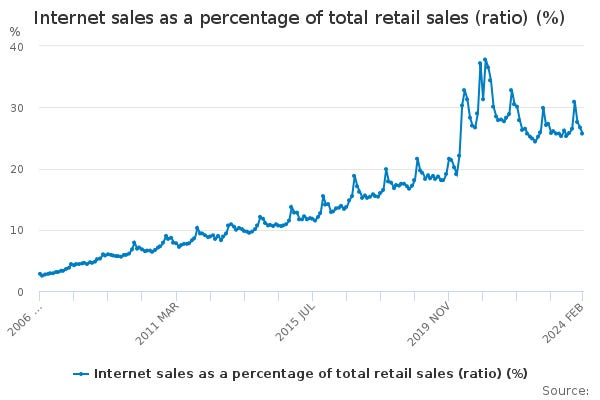
Ah, but now, eh? Firstly, we’ve the internet eating retail.
About, and roughly, 1% of the total market each year moves online. We all thought that the lockdown boom was going to persist and it didn’t. This caused all sorts of problems for all sorts of people — Boohoo ended up terribly overstocked. Made.com was able to come to market and then went bust as the right hand end of that chart happened and we returned to trend after the blip. Revolution Beauty had its own problems but the overvaluation was at least partly to do with this and so on.
But this had already been happening — Intu went bust well before the pandemic, as we know. It’s now about true that 15% or more of UK retail space is empty. Because sales are moving online. This — naturally enough — means that prices, rents, of retail are falling. Well, OK.
But now this meets upwards-only rent reviews. If you’re a new retailer looking for space then the High Streets are your mollusc of choice. You can probably get in on low rents, substantial rent-free periods and even get the landlord to pay your fitting out costs (landlords would much rather give rent-free periods, pay costs of moving in, than let at low rents. Because the terms of their own mortgages and loans make it better for them to keep headline rents stable whatever the hell the truth of the real value is). But if you’re a long established retailer paying high street rents then you’re screwed.
Your new competition might be able to get in by paying half the rent you are. And yes, rent is a really, really, big part of retail in the UK. You are, in fact, fucked and right royally.
QotD: Aprons
Sarah Hoyt, “Teaching Offense”, According to Hoyt, 2019-10-25.
April 8, 2024
“The carbon rebate seems to be one of those rare examples of people getting mad at receiving government money rather than being grateful”
In The Line, Jen Gerson makes a strong argument that the vaunted (by Justin Trudeau and the Liberal Party) carbon tax rebate is actually the big problem with the carbon tax, not the “Conservative misinformation” constantly being pointed at by the government’s paid accomplices in the mainstream media:
Is the purpose of the Liberals’ carbon tax to materially reduce carbon emissions — or is it a wealth redistribution program? I ask because every time the Liberals defend the carbon tax by resorting to the awesomeness of the rebate, what they cease to talk about is how effective it is at actually reducing carbon emissions.
Instead, we fall into an endless series of counterproductive debates about whether what individuals are getting from the rebate equals what they’re paying out in tax. And that debate is repeated every quarter, and each time the carbon tax rises. In other words, our entire political discourse about the tax is centred on wealth redistribution — not emissions.
That makes people suspicious of the government’s actual goals, and skeptical about its claims. This, again, is a problem of message dilution. If you cannot clearly express your intentions, then you’re not going to get political buy-in to your aims. This problem is particularly acute on a policy that is — by definition — demanding a sacrifice of cash and/or quality of life by Canadians. People can get on board with sacrifice, but only if it’s tied to a clear, obtainable, and material objective.
[…]
And here’s where we get into the real dark heart of the problem.
It’s the rebate itself.
I understand why the Canada Carbon Rebate happened. The government wanted to introduce a carbon tax without disproportionately penalizing the poor — the demographic least able to make the investments and lifestyle changes necessary to respond to the tax. But did that relief have to come in the form of a rebate?
Well, no.
There are lots of methods a government can use to ease poverty. But governments love themselves a rebate. Why? Because rebates are normalized vote buying. One that all political parties are guilty of using. The Liberals implemented the rebate thinking Canadians would hit their mailboxes every quarter, see a few hundred bucks, and get warm fuzzy feelings for Papa Trudeau and the natural governing party. “Government’s looking out for me!”
Getting government cheques is popular, and the Liberals were no doubt trying to replicate the appeal of the Canada Child Benefit.
But that didn’t happen here. The carbon rebate seems to be one of those rare examples of people getting mad at receiving government money rather than being grateful. Why?
Well, may I suggest that it’s because every time people open up those cheques, instead of processing the dopamine hit of “free” money, they’re instead reminded of how much they had to pay in to get it. They do the math in their head, think about their rising grocery bills and gas, and come away thinking “not worth it”. Every single quarter, millions of Canadian households are feeling as if they are paying dollars to get dimes — and it’s pissing them right off. Further, demanding they acknowledge they’re better off in the exchange is only adding salt to the wound. Throwing Parliamentary Budget Officer (PBO) reports at them doesn’t change their minds. It just pisses them off more.
To put it more pithily — a benefit is a gift. A rebate is a value proposition. And a hell of a lot of Canadians are looking at this rebate and determining that its value is wanting — all the more so as the goals of that purchase haven’t been clearly articulated.
April 5, 2024
Canada’s carbon tax – “… no emissions policy that doesn’t start with banning private jets can be called ‘fair’ with a straight face”
In The Line, Clarke Ries points out the incredibly uncomfortable truth that no matter how the federal government tries to hide it, the carbon tax regime is going to be painful and the pain is going to be absorbed much more by the rural poor than anyone else:

Minister of Environment and Climate Change Steven Guilbeault, 3 February 2020 (when he was Canadian Heritage Minister).
Screencapture from CPAC video.
Consumption taxes are a straightforwardly-effective policy tool. You simply increase the price of the resource you want to see used less and let people adapt to the simulated scarcity via ingenuity, frugality, lifestyle change, repricing their goods and services, etc. The government doesn’t dictate solutions, it lets people find their own. In the process, the consumption tax dispassionately reveals who’s making the most valuable use of that resource.
[…]
So the question remains, who uses a lot of carbon but doesn’t make a lot of money doing it? Who lives in drafty old single-family houses? Who uses archaic methods of keeping those houses warm, like furnaces that run on heating oil? Who has to drive halfway around the world to reach the nearest grocery store and halfway to the moon for the nearest medical clinic? Who’s making that drive in a battered old ride with terrible fuel economy?
The rural poor.
Not the farmers or the ranchers, who mostly make plenty of dough and often know their way around America’s higher-end resort towns, but the rural poor. The kind of people you disproportionately find in Newfoundland outports, eking out a tenuous living as they wait for the cod to return. You know, reliable Liberal voters.
Put another way, a neutrally-applied carbon tax goes after Maritimers first and hardest — forcing them to close shop on their romantic traditional lifestyle and move into apartment blocks in the nearest city, where they’ll earn more for their labour and emit less carbon doing it.
[…]
Remember: for the carbon tax to do what it says on the tin, somebody has to lose. For the carbon tax to be anything other than a purposeless pain in the ass, somebody — a lot of somebodies, frankly, if the Liberals are serious about cutting carbon emissions to 40 per cent under 2005 levels — must be forced to make significant and unpleasant lifestyle changes.
So let’s assume the Parliamentary Budget Office is right, and that Atlantic Canadians are now, after a second round of special supplements and exemptions, definitely net beneficiaries of the carbon tax. All it’s bought the Liberals is a reprise of the same question: who’s for dinner?
Who’s going to trade in their beater for bus tickets? Who’s going to raise their kids in a condo tower instead of a single-family home? Who’s going to start taking their midwinter vacation in the province next door instead of Palm Springs or Costa Rica? Who’s going to shiver on a cold night instead of raising the thermostat?
Only the most diehard of optimists could believe that the roster of ritual sacrifices will substantially consist of financially-comfortable Canadians. The people who can afford to make investments that reduce their carbon emissions without materially sacrificing their lifestyles will do so. A handful will start biking to work during the summer. Others will install solar panels on top of their detached houses — which are mostly located in neighbourhoods where you’re not even allowed to build a condo tower — and that’s going to be that.
Beneath all the aspirational language, what an effective carbon tax actually does is throw the government into a cage match with Canada’s working class. The truth behind the Liberals’ woes on this file is that as long as they’re committed to the carbon tax as a tool for fighting climate change, their only real choice is which part of the working class they land on when they come off the top rope.
In the still-ongoing “war of the sexes”, when can women just accept they’ve won and cease hostilities?
At the amusingly named Handwaving Freakoutery, you can see a scorecard for the war of the sexes that has been ongoing since I was a child and seems no closer to ending than back in the 1960s:
I say this to make it absolutely clear that unlike a lot of boorishly banal material you might encounter within the wretchedly named “Manosphere”, this is not intended to be a whiny article. I’m not complaining, nor am I calling for societal change or action. I’m simply wondering exactly how dominant female privilege has to get before they declare victory and take their boot off the necks of men. I really don’t know the answer to this question, but we’ll speculate about that below after the wall of graphs. HWFO loves graphs.
Herein we will go point by point through as many measurable societal markers as I can think of, leaving no marker unmarked, and put together a Gender War Scoreboard describing as accurate a snapshot as possible of the current state of the United States. Then we’ll close with some analysis about how badly it would have to get before the women finally just declare victory and move on. This post shall be too big for email.
To assign our score, we will look at sets of data that fall generally into two categories. For victimization ratios and similar, we’ll just look at percentage by gender. For comparing two uncapped sets of data, such as life expectancy, we’ll look at a ratio and make them both add to 100 for an apples-to-apples comparison. Then we’ll add them all up at the end to tally the score.
Salary
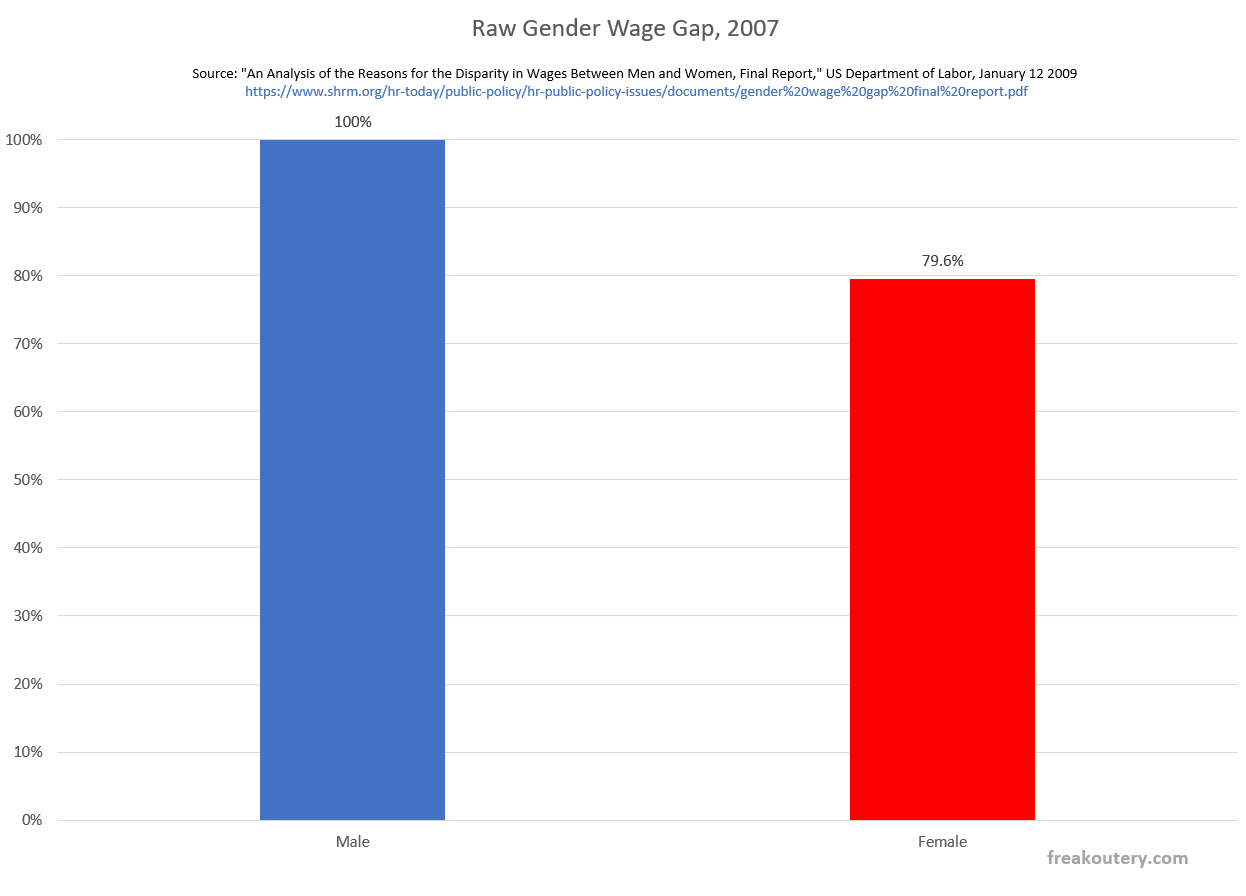
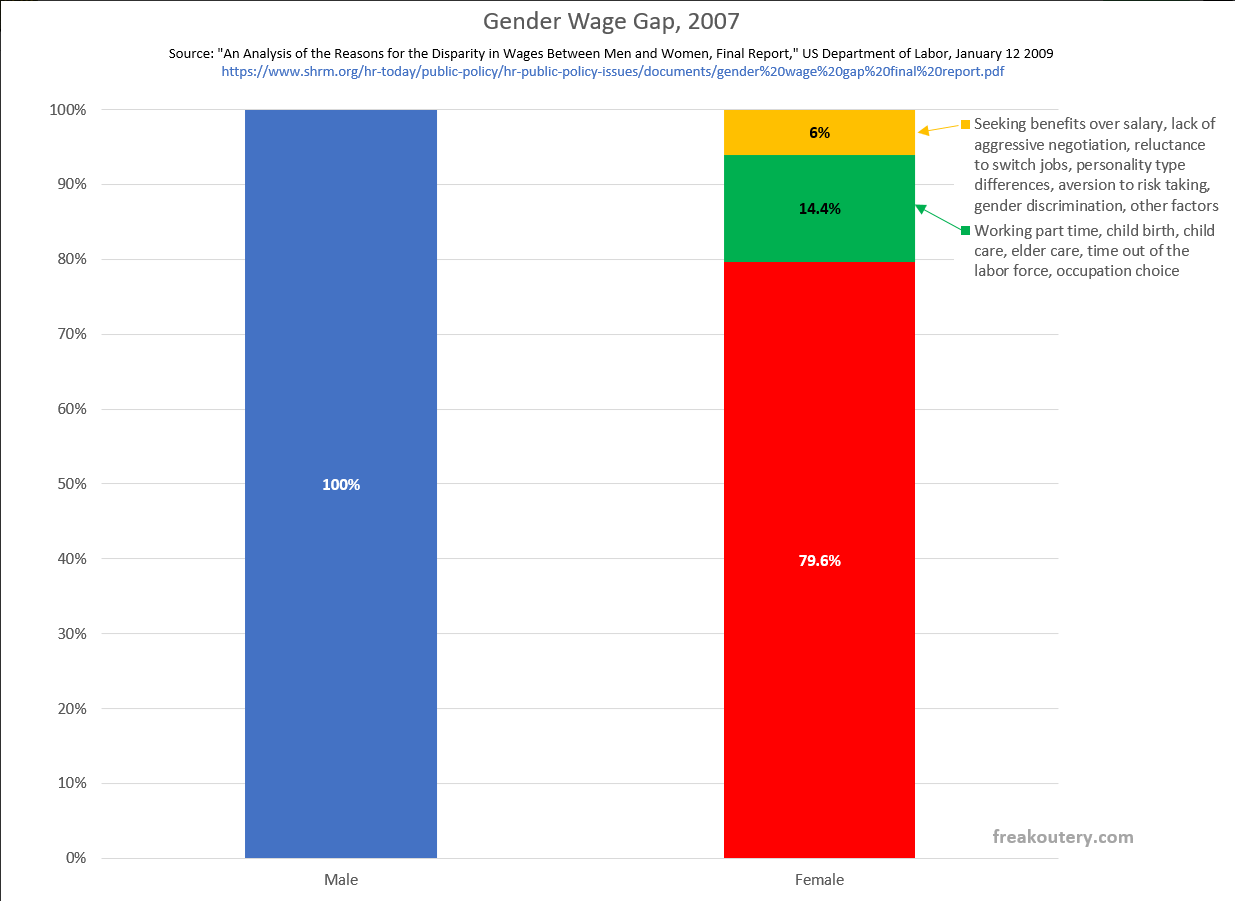
HWFO covered the gender wage gap in 2022, but I’ll summarize it here so you don’t have to read back. According to a 2008 analysis by the Department of Labor, now 16 years old, the raw gender wage gap was 20.4% in 2007:
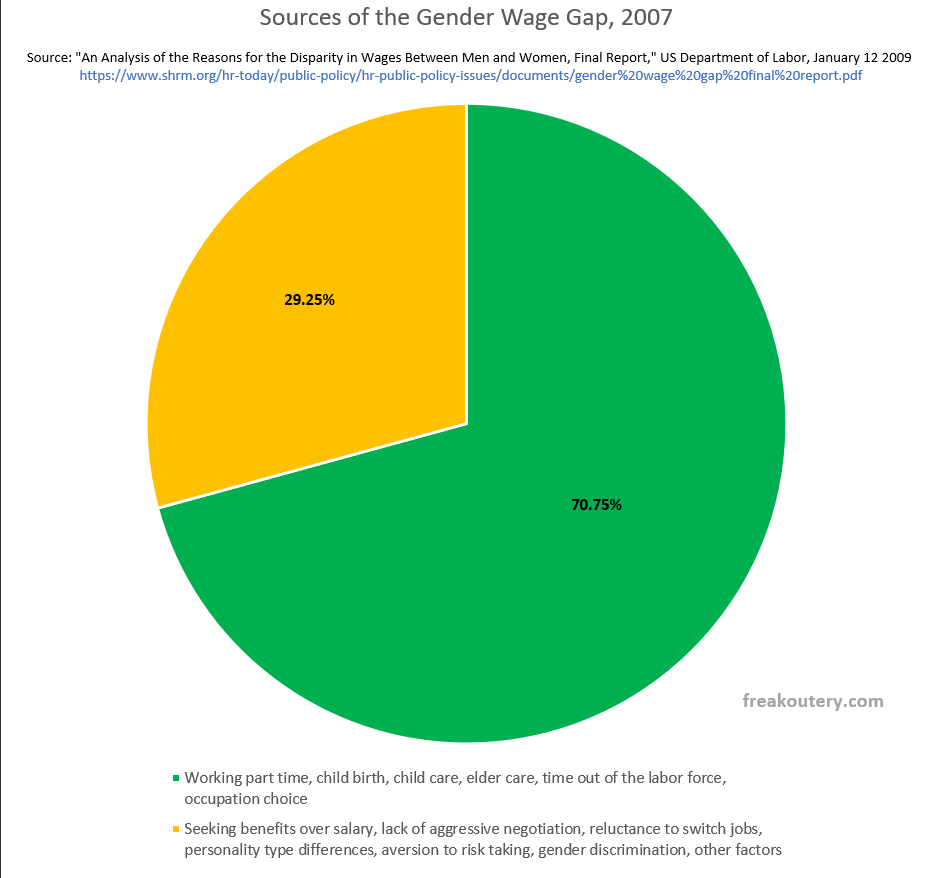
Most of the gap was explainable by career choice and lifestyle choice differences:
When compared properly that looks like this:
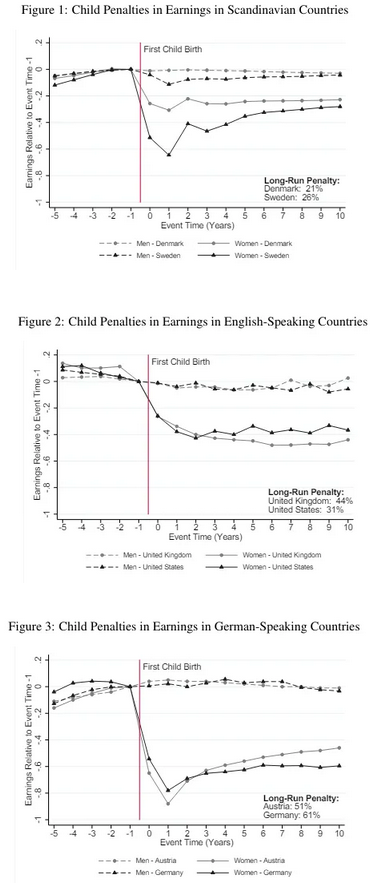
Sixteen years ago, the bits of the gender wage gap that weren’t explained by career and life choice differences only totaled 6%. This fact has been known for a decade and a half and is constantly hidden from view by Pew, the NLWC, and any other major organization that profits from the perception that this gap is large and persistent. It has also assuredly closed to narrower than that 6% in the ensuing decade and a half, but nobody’s replicated the Department of Labor analysis. Look closely at the effects in the green bar identified by the Department of Labor. “Child birth” is how you become a mother. “Child care” is something mothers do. “Working part time” is something mothers do. “Time out of the labor force” is something mothers take. “Occupational choice” is something women change when they become mothers. Here are some graphs from Kleven et al, March 2019:
The solid lines are women. In every studied area, the women make equal or more than the men do up until the birth of their first child, and then they make less. The gender wage gap difference is in the choice to have children. Women choose to make professional concessions to raise a family while the men don’t. Is this fair? Some might say no, but only if they also don’t want to be the primary caregiver for their kids. Some would say yes, for the following two reasons: (1) women choose this, especially in feminist societies, but also (2) men are punished socially for choosing this. If you do not believe me, go make two fake male Tinder profiles with identical cute photos in them, and in the bio of one say “corporate lawyer” and the other say “part time daycare worker” and see which one gets more hits. Then do the same with a female profile. Men are socially punished by women for making the career concession, women are not socially punished by men for making it.
Often when these sorts of “equal pay for equal work” studies are properly controlled for mothering and career choice, they find that men are paid less than women for equal work. Google was pretty famously forced by their neo-progressive staff to do an internal analysis of the subject, and uncomfortably discovered they were overpaying women for being women on an “equal work” basis. The results were twofold. First Google paid all the men a one time bonus, then Google quietly never investigated it again so they could get back to paying women more.
April 3, 2024
QotD: Optional economic reality
Take, for example, support for rent control. Having the state keep the monetary prices of rental units below the values that would arise in free markets is believed by many pols and pundits – and by nearly all “Progressives” – to effectively keep the actual market values of rental units at whatever low prices the state sets. In this reality-is-optional world, when the state pushes down nominal rental prices, the quantity of rental units supplied not only does not fall, it increases to match the increase in the quantity of rental units demanded.
Want more housing for folks with modest incomes? No problem! We’ll just push the rental prices lower to increase ordinary folks’ access to housing. See, the world is such a simple place!
Similar reality-is-optional “solutions” are minimum-wage statutes (for increasing the pay of low-skilled workers) and mandated paid-leave (for increasing the welfare of all workers).
Pondering this strange notion that the state can make market values be whatever the state wants them to be merely by dictating changes in the names of market values – that is, changes in nominal prices – I wondered what the world would be like if miracles more broadly could be worked merely by changing nominal designations. […]
Of course, all such scenarios are ludicrous. Reality isn’t changed merely by reporting that reality is other than what it is. In fact, reality is made worse by false reports because, unable to learn the truth about reality, people act in ways that are inconsistent with reality, thus worsening their situations.
Yes – but why, then, do so many people believe that economic reality is optional? Why do so many people believe that economic reality can be made to be whatever the state wants it to be merely by having the state order that reports of economic reality lie about that reality? All state-imposed price controls – rent control, minimum wages, you name it – are state-dictated lies about reality.
Don Boudreaux, “What if All Reality Were Optional?”, Café Hayek, 2019-09-13.
March 28, 2024
Why European farmers are revolting
spiked
Published Mar 27, 2024Europe’s farmers are rising up – and the elites are terrified. From the Netherlands to Germany to Ireland, farmers are taking to the streets, parking their tractors on the establishment’s lawn, spraying buildings with manure and bringing life to a standstill. The reason? Because unhinged green regulations, dreamt up by European Union bureaucrats, are immiserating them. In this spiked video polemic, Fraser Myers explores the roots of the farmers’ revolt across the continent – and explains why it must succeed. Watch, share and let us know what you think in the comments.
Support spiked:
https://www.spiked-online.com/support/
Sign up to spiked‘s newsletters: https://www.spiked-online.com/newslet…
Check out spiked‘s shop: https://www.spiked-online.com/shop/
March 22, 2024
If you peasants won’t buy EVs voluntarily, the government will make it mandatory
Tom Knighton notes that the government isn’t happy with us dirt people because we’re not all rushing to voluntarily give up our old fashioned internal combustion vehicles and replace them with shiny new electric vehicles like we’re supposed to:

Nissan Leaf electric vehicle charging.
Photo by Nissan UK
I’ve written a lot about electric vehicles (EVs) over my time at Substack. My take is, as it always is, that I like the concept, but they’re not ready for prime time. In particular, their range and recharge time means they lose in a head-to-head comparison with internal combustion engines (ICE).
For some people, even as things currently stand, EVs make sense. They may have charging stations at work and only use them for commutes to and from their place of employment, making all of these concerns irrelevant.
Yet a lot of people don’t have that. They have concerns about EVs and so they don’t see them as a viable option, which is why people aren’t buying them.
Enter the EPA.
It seems that if we won’t willingly do what they want, they’ll just force us to buy something we don’t want.
“Outlaw your car” sounds like such an outrageous phrase, and technically speaking, it isn’t true — but only barely. What practical difference is there between outlawing something, and regulating it out of existence?
That’s exactly what the EPA intends to do this week with strict new rules going forward against gas- and diesel-powered cars and light trucks.
Expected as soon as Wednesday, the Biden EPA “is poised to finalize emissions rules that will effectively require a certain percentage — as much as two-thirds by 2032 — of new cars to be all-electric”, according to Inside EVs. Politico sells the expected rule as one that would “tackle the nation’s biggest source of planet-warming pollution and accelerate the transition to electric vehicles”.
The rule would require carmakers to cut their average emissions of carbon dioxide by 52% between 2027 and 2032. EPA projects that the standard would push the car industry to ensure that electric cars and light trucks make up about 67% of new vehicles by model year 2032.
Of course, this led to pushback by people like dealer groups and car companies who argued, as I typically do, that the American people weren’t ready for that, in part due to the price of EVs and the lack of charging stations.
So the EPA has decided to make it so that we probably can’t afford ICE cars and trucks, either, so we might as well go with EVs instead.
And people wonder why I want to dismantle the EPA at the same time as I dismantle the ATF. It’s for the same damn reason. They just make up rules that impact people’s lives and businesses, all because of their own political agenda.
Of course, raising the prices on all cars by making the emissions standards virtually impossible to meet without making the cars so expensive isn’t going to prompt a lot of people to buy electric. It’ll just make them buy older, less fuel-efficient models.
The market for used cars was already getting pretty spicy before the pandemic. Dealers were barely able to accept trade-in vehicles before they were selling them off the lot to other buyers (and there were waiting lists of willing buyers for certain kinds of vehicles … not even particularly special vehicles, either). I don’t know if that situation has changed since the pandemic, but it indicated to me that the demand for good quality used vehicles must be coming from people who’d consciously chosen not to buy newer, more expensive cars (and pretty much by definition, every EV was more expensive than an equivalant ICE vehicle).
March 21, 2024
Minneapolis rejects Uber (and economic reality)
Jon Miltimore is upset that he won’t be able to use Uber or Lyft ridesharing services in the Twin Cities after the Minneapolis City Council voted to make the business uneconomical:
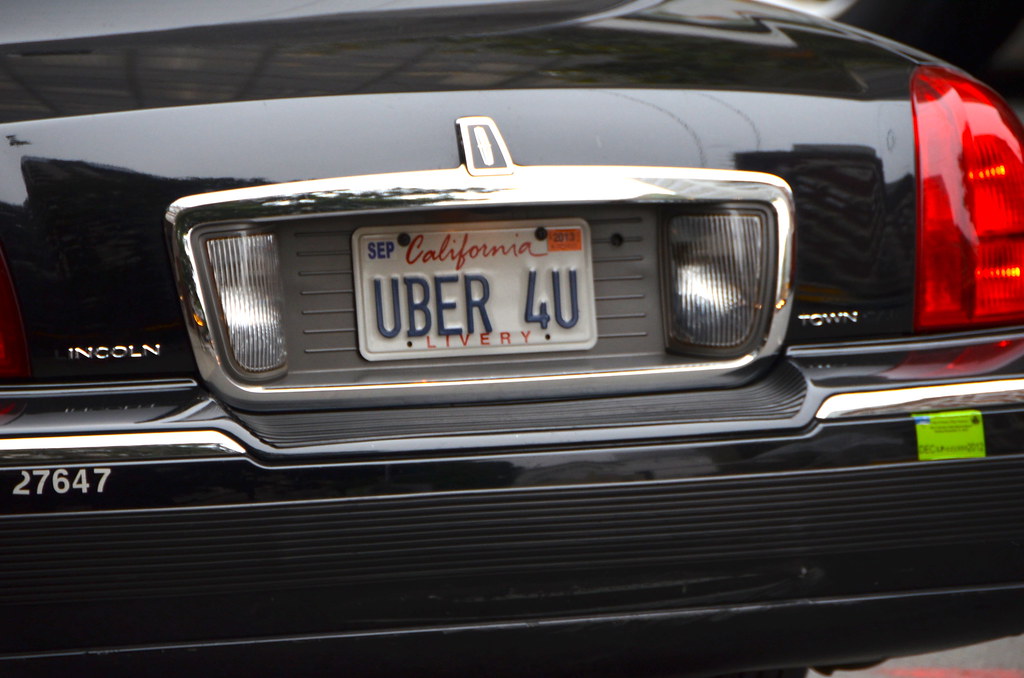
“UBER 4U” by afagen is licensed under CC BY-NC-SA 2.0


The ride-hailing services Uber and Lyft announced last week that they are pulling up stakes in the Twin Cities because of a new ordinance designed to raise driver pay.
The Minneapolis City Council voted 10–3 to override the veto of Mayor Jacob Frey, passing a policy that will raise the pay of drivers to the equivalent of $15.57 per hour.
In response to the plan, Uber and Lyft announced that they will cease offering rides beginning May 1 throughout the entire Twin Cities, the 16th largest metro in the United States, saying operations were economically “unsustainable” under the plan.
“We are disappointed the Council chose to ignore the data and kick Uber out of the Twin Cities, putting 10,000 people out of work and leaving many stranded,” Uber said in a statement.
As a resident of the Twin Cities suburbs, I find this news a bit alarming. In fact, I find it infuriating.
City Council supporters say they simply want drivers to earn the minimum wage, but if that’s the case, they passed the wrong ordinance. The Star Tribune reports that council members “seemed oblivious” to a recent Minnesota Department of Labor and Industry study that concluded drivers could be paid $0.49 per minute and $0.89 per mile and make the minimum wage.
“By contrast, the plan approved by the City Council guarantees a floor of $1.40 per mile and 51 cents per minute,” the newspaper reports.
In other words, the wage plan the council passed doesn’t appear remotely close to the minimum wage. But this ignores the larger problem: Neither the Minneapolis City Council nor the state of Minnesota should be setting the wages of Uber or Lyft drivers.
Nobody is forcing drivers to give rides. The arrangement between ride-share companies and drivers is an entirely voluntary one. This is the beauty of gig work. It allows people flexibility and choice about how they’d like to spend their time.
QotD: South Africa under Thabo Mbeki
Things look very different when political considerations force the majority of an organization to be underqualified (and there are simply not very many qualified or educated black South Africans today, and there were even fewer when these rules went into effect). A shock on that scale can lead to a total breakdown in function, and indeed this is precisely what happened to one government agency after another. Johnson notes that this issue, and particularly its effects on service provision to the rural poor, pit two constituencies against each other which many have tried to conflate, but are actually quite distinct. The immiserated black lower class (which the ANC purported to represent) didn’t benefit at all from affirmative action because they weren’t eligible for government jobs anyway, and they vastly preferred to have the whites running the water system if it meant their kids didn’t get cholera. The people actually benefited by Mbeki’s affirmative action policies were the wealthy and upwardly-mobile black urban bourgeoisie, a tiny minority of the country, but one that formed the core of Mbeki’s support.
That same small group of educated and well-connected black professionals was also the major beneficiary of Mbeki’s other signature economic policy: Black Economic Empowerment (BEE). Oversimplifying a bit, BEE was a program in which South African corporations were bullied or threatened into selling some or all of their shares at favorable prices to politically-connected black elites, who generally returned the favor by looting the company’s assets or otherwise running it into the ground (note that this is not the description you will find on Wikipedia). The whole thing was so astoundingly, revoltingly corrupt that even the ANC has had to back off and admit in the face of criticism from the left that something went wrong here.
What made BEE so “successful” is that it was actually far more consensual than you might have guessed from that description. In many cases, the white former owners of these corporations were looking around at the direction of the country and trying to find any possible excuse to unload their assets and get their money out. The trouble was that it was difficult to do that without seeming racist, because obviously racism was the only reason anybody could have doubts about the wisdom of the ANC. The genius of BEE is that it allowed these white elites to perform massive capital flight while simultaneously framing it as a grand anti-racist gesture and a mark of their confidence in the future of the country.
This is one particular instance of a more general phenomenon, which is that at this stage pretty much everybody was pretending that things were going great in South Africa, when things were clearly not, in fact, going great. But this was the late 90s and early 00s, the establishment media had a much tighter hold on information than it does today, and so long as nobody had an interest in the story getting out, it wasn’t going to get out. Everybody who mattered in South Africa wanted the story to be that the end of apartheid had resulted in a peaceful and harmonious society, and everybody outside South Africa who’d spent decades supporting and fundraising for the ANC wanted this to be the story too.
John Psmith, “REVIEW: South Africa’s Brave New World, by R.W. Johnson”, Mr. and Mrs. Psmith’s Bookshelf, 2023-03-20.
March 18, 2024
Life among the WEIRD
Rob Henderson reviews The WEIRDest People in the World: How the West Became Psychologically Peculiar and Particularly Prosperous by Joseph Henrich:

The word “WEIRD” stands for “Western, Educated, Industrialized, Rich, Democratic.” It is also a convenient way to communicate that people from such societies are psychologically different from most of the rest of the world and from most humans throughout history.
In short, the Western Church (Henrich’s term for the branch of Christianity that rose to power in medieval Europe) enacted a peculiar set of taboos, prohibitions, and prescriptions regarding marriage and family. This dissolved Europe’s kin-based institutions, and gave rise to a more individualistic psychology, which in turn spurred the creation of impersonal markets in which people grew used to interacting with and trusting unrelated strangers, and propelled the development of voluntary institutions, universally applicable laws, and innovation.
Characteristics of WEIRD people
WEIRD people are hyper-individualistic, self-obsessed, nonconformist, analytical, and value consistency. We try to be “ourselves” across social contexts and prize “authenticity”.
The book reviews research indicating that Americans rate those who show behavioral consistency during interactions in different contexts as more “socially skilled” and “likable” compared to those who are more behaviorally flexible. In contrast, non-WEIRD people view personal adjustments as reflecting social awareness and maturity.
In addition to valuing behavioral consistency, WEIRD people are more likely to feel guilt than shame. In contrast, non-WEIRD people are more likely to experience shame as opposed to guilt. Shame is the result of not living up to the expectations of one’s community. Guilt is a private emotion that results from falling short of our own expectations, rather than the community’s.
Relatedly, a recent study found that people can experience shame for being accused of actions they didn’t commit. The accusation alone was enough to elicit this powerful emotion. Shame is a reaction to others believing we did something bad rather than a reaction to actually doing something bad.
Delayed gratification also appears to be more prevalent in WEIRD societies. When researchers offered WEIRD people the choice between a smaller monetary payment up front, or a larger sum later, they tended to choose the larger sum. In contrast, most non-WEIRD people preferred the immediate, smaller, reward.
Interestingly Henrich relays data suggesting that greater patience is most strongly linked to positive economic outcomes in lower-income countries. Put differently, the tendency to defer gratification seems to be especially more important for economic prosperity in countries where formal institutions are less effective. This pattern holds within countries as well, such that patient people obtain higher incomes and more education. Patience is related to success after controlling for IQ and family income, and, even within the same families, more patient siblings obtain more education and higher earnings later in life.
Moreover, WEIRD people are more likely to adhere to rules even in the absence of external sanctions. The book reports that until 2002, U.N. diplomats from other countries were immune from having to pay parking tickets in New York City. Diplomats from the UK, Sweden, Canada, and other countries received a total of zero parking tickets. But diplomats from Bulgaria, Egypt, and Chad, among other non-WEIRD countries accumulated more than 100 tickets per member of their respective delegations. When diplomatic immunity was lifted, parking violations declined, but the gap between countries persisted.
But while they may be patient and rule-following, WEIRD people are more likely to be fair-weather friends. Relative to other populations, WEIRD people assign higher value to impartiality and show less favoritism toward friends, family members, and co-ethnics. We are more likely to abhor nepotism and believe in universally applicable principles.
March 15, 2024
Peter Turchin’s notion of the “overproduction of elites”
Severian is on a mini-vacation at the moment, but still managed to find time to share some thoughts about Turchin’s “overproduction of elites”:

University graduation – a large crowd of students at a graduation ceremony in Ottawa, Ontario. This was the thumbnail image used on the “Elite overproduction” Wikimedia page, which seemed quite appropriate.
Photo by Faustin Tuyambaze via Wikimedia Commons.
Let us consider “the overproduction of elites”. Those who love Peter Turchin’s work love this phrase, as it finally gives a name to a phenomenon we’ve all noticed: The creation, promotion, and indeed valorization of what would more properly be called social barnacles — they don’t move, can’t change, and eventually bring whatever they infest to a complete halt. Those who dislike his work often haven’t read it, so they object to the use of the word “elite” — again, these are social barnacles; what’s elite about them?
Which is precisely Turchin’s point — “elite” is a descriptor of their lifestyle, and most importantly their self-image; it is almost perfectly opposed to their actual utility. The modern Ed Biz is set up to do little else but produce these (pseudo) elites, and therefore a kind of Say’s Law takes hold. Say’s Law, you’ll recall, is vulgarly summarized as “Supply creates its own demand,” and that’s what we see with the (pseudo) elites churned out by every college in the land — they expect, indeed they demand, “jobs” commensurate with their “education”, and thus make-work “jobs” in the Apparat are brought into being.
They take out massive student loans to get the “jobs”; they “work” the “jobs” to service the debt, and so on.
But that’s true of most “white-collar” “jobs” these days. What separates the “elites”, in Turchin’s usage, from the rest of them is not their utility, or lack thereof — the economy, such as it is, would function just as well (or not) with far fewer lawyers, accountants, insurance adjusters, and so on. The difference, comrades, is what we must call Revolutionary Class Consciousness,
stealingnationalizingsocializingliberating a phrase from Lenin.An accountant, I’d wager, views his work as a technical specialty. They’re “rude mechanicals” (that’s Shakespeare, darlin’; evidently Mr. Ringo is an educated man). Maybe not so “rude” — accountants make good scratch; they’re middle to upper-middle class, economically — but basically technicians. Accounting is a highly-trained, well-compensated job, but that’s all it is: A job. Accounting is what an accountant does; it’s not what an accountant IS. Contrast that to the overproduced “elites”, in Turchin’s sense, and you see what Turchin’s sense really means: An “elite” really IS his job title.
Note the shift: His job title. As we all know, so many of the overproduced “elite” do no meaningful work. How could they? We could easily do this for most any “job” in the Apparat, but one example will suffice. Consider “Journalist”. Formerly called “Reporter”, and back then it required some actual productive output. Some “shoe leather”, as the phrase was. To find out what they were up to at City Hall, you actually had to physically go down to City Hall and follow the Mayor around. These days — the days when Reporters are now Journalists — it’s just stenography. And not even real stenography, Claudine Gay-style stenography — the Mayor’s press secretary (who probably went to college with you) emails you a press release; you change a word or two and then reprint it, basically verbatim, under your byline.
A monkey could be trained to do it. Hell, a chatbot could be trained to do it, and that’s probably a good quick-and-dirty definition of a Turchin-style overproduced “elite”: If whatever “work” he does could easily be replaced by a chatbot, with no appreciable drop-off in either productivity or quality. Because that’s the key to understanding these people: They know damn good and well, at some almost-but-not-quite conscious level, that they’re social barnacles. That is the “base” upon which the “superstructure” — again stealing terms from Onkel Karl — of their Revolutionary Class Consciousness is built.
March 14, 2024
The insane pursuit of a “zero waste economy”
Tim Worstall explains why it does not make economic sense to pursue a truly “zero waste” solution in the vast majority of cases:

It’s entirely possible to think that waste minimisation is a good idea. It’s also possible to think that waste minimisation is insane. The difference is in what definition of the word “waste” we’re using here. If by waste we mean things we save money by using instead of not using then it’s great. If by waste we mean just detritus then it’s insane.
Modern green politics has — to be very polite about it indeed — got itself confused in this definitional battle. Which is why we get nonsense like this being propounded as potential political policy:
A Labour government would aim for a zero-waste economy by 2050, the shadow environment secretary has said.
Steve Reed said the measure would save billions of pounds and also protect the environment from mining and other negative actions. He was speaking at the Restitch conference in Coventry, held by the thinktank Create Streets.
Labour is finalising its agenda for green renewal and Reed indicated a zero-waste economy would be part of this.
This would mean the amount of waste going to landfill would be drastically reduced and valuable raw materials including plastic, glass and minerals reused, which would save money for businesses who would not have to buy, import or create raw materials.
The horror here does depend upon that definition of waste. Or, if we want to delve deeper, the definition of resource that is being saved.
[…]
OK. So, we’ve two possible models here. One is homes sort into 17 bins or whatever the latest demand is. Or, alternatively, we have big factories where all unsorted rubbish goes to. To be mechanically sorted. Right — so our choice between the two should be based upon total resource use. But when we make those comparisons we do not include that household time. 25 million households, 30 minutes a week, 450 million hours a year. At, what, minimum wage? £10 an hour (just to keep my maths simple) is £4.5 billion a year. That household sorting is cheaper — sorry, less resource using — than the factory model is it?
And that little slip — cheaper, less resource using — is not really a slip. For we are in a market economic system. Resources have prices attached to them. So, we can measure resource use — imperfectly to be sure but usefully — by the price of different ways of doing things. Cool!
At which point, recycling everything, moving to a zero waste economy, is more expensive than the current system. Therefore it uses more resources. We know this because we always do have to provide a subsidy to these recycling systems. None of them do make a profit. Or, rather, when they do make a profit we don’t even call them recycling, we call them scrap processing.
Which all does lead us to a very interesting even if countercultural conclusion. The usual support for recycling is taken to be an anti-price, anti-market, even anti-capitalist idea. Supported by the usual soap dodging hippies. But, as actually happens out in the real world, recycling is one of those things that should be — even if it isn’t — entirely dominated by the price system and markets. Even, dread thought, capitalism. We should only recycle those things we can make a profit by recycling. Because that’s now prices inform us about which systems actually save resources.


