Quotulatiousness

November 21, 2023

Javier Gerardo Milei, President-elect of Argentina

Filed under: Americas, Economics, Liberty, Politics — Tags: , , , — Nicholas @ 03:00

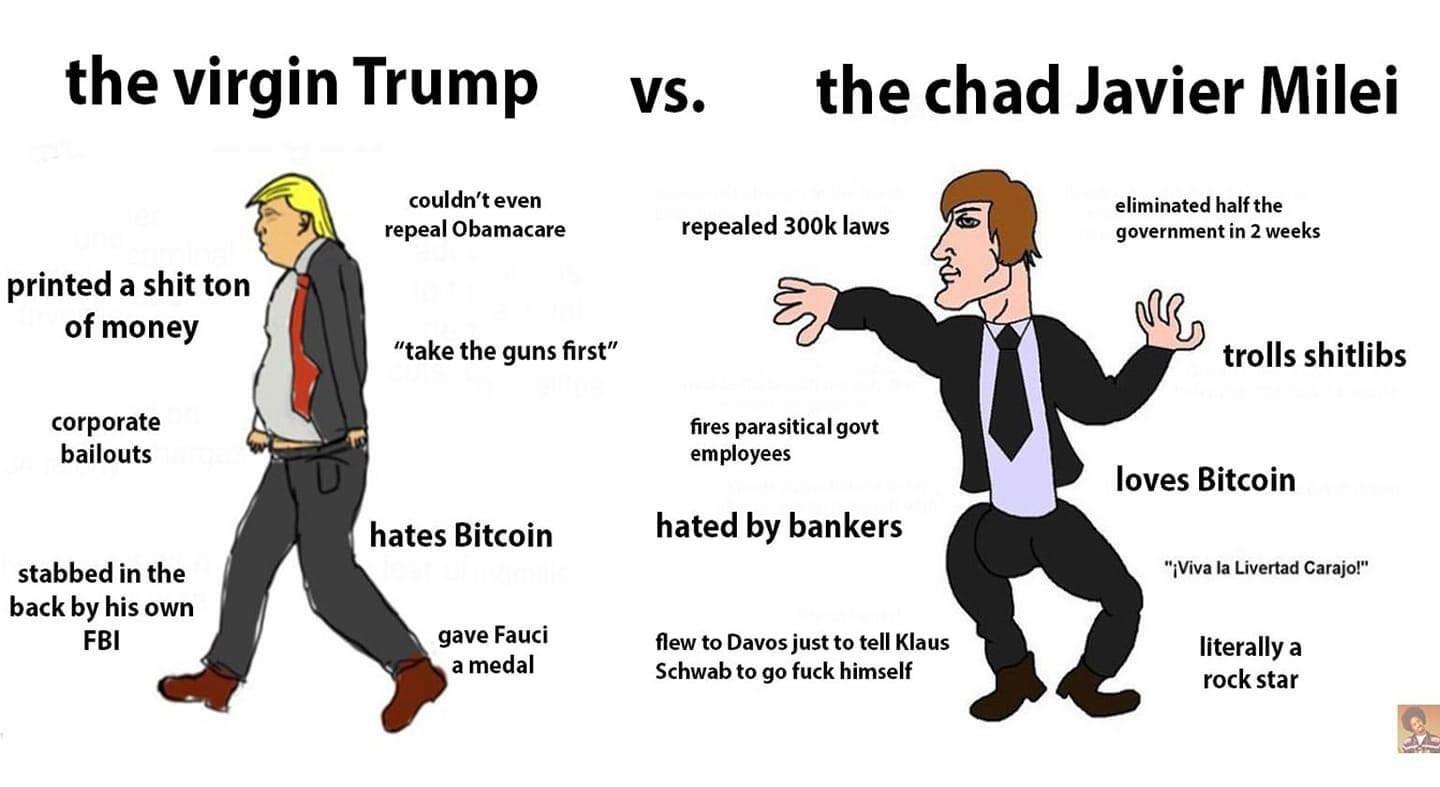
On the current evidence, Argentina has finally decided to turn away from both communism and Peronism to try something radically different in the person of newly elected Javier Gerardo Milei, variously described (disapprovingly) in the English-language press as “far right”, “extreme right”, “Trump-like”, and most alarmingly, “libertarian”. Here’s what Wikipedia had to say about him (before the edit wars get serious on his page):

Javier Milei, 8 October 2022.
Photo attributed to Vox España via Wikimedia Commons.

Javier Gerardo Milei (/miˈleɪ/ mee-LAY, Spanish pronunciation: [xaˈβjeɾ xeˈɾaɾðo miˈlej]; born 22 October 1970) is an Argentine politician, economist, and author who is the President-elect of Argentina.[1] Before rising to political prominence, Milei initially gained notability as an economist, as the author of multiple books on economics and politics, and for his distinct political philosophy.

As an economist, Milei is a vocal proponent of the Austrian School. He has critiqued the fiscal policies of various Argentine administrations and he advocates for reduced government spending. As a university professor, he has taught courses in macroeconomics, economic growth, microeconomics, and mathematics for economists.[2] He is also the author of numerous books and has hosted radio programs, including Demoliendo mitos and Cátedra libre. In 2021, he entered politics and was elected as a national deputy representing the City of Buenos Aires for La Libertad Avanza. During his tenure, he limited his legislative activities to voting, focusing instead on critiquing what he describes as Argentina’s political elite and its propensity for high government spending. Milei has pledged not to raise taxes and has donated his national deputy salary through a monthly raffle. He was a presidential candidate in the upcoming 2023 general election,[3] with Victoria Villarruel as his vice-presidential running mate.[4] He advanced to the run-off of the presidential election, in which he faced Sergio Massa.[5] On 19 November 2023, he won the run-off election with 56% of the vote to Massa’s 44% to become President-elect.[6]

David Warren certainly seems to like the cut of Milei’s jib:

Mr Milei not only swept the “youth” vote, but he did that while declaring: “Killing children is not a human right!” He mocked an accumulation of political corrections, while dropping a few more “flinch bombs” worthy of the XVIIth-century bishops who evangelized that country.

The outgoing president, another tedious Peronist like our pope, shared the old presidential palace with decorative plants. Carlos, my correspondent, claims that he could make Justin Trudeau look intelligent. If true, this would be an extraordinary accomplishment. He also leaves an amazing national debt, hyperinflation, energy shortages, &c.

Mr Milei seems to have won as Mr Trump once did in the United States: by not flinching. A point may be reached in national decline when even the young will pitch out the Peronistas. Godspeed to them, when they reach this point.

Nevertheless, one must continue to despise politics. Carlos echoes Borges: “No matter how bad an Argentine government is, the next will be worse”.

The Buenos Aires Times, quoted by Brian Peckford:

Milei promised to return Argentina, one of the richest countries in the world a century ago, to its former glory, after decades of stagnation, mostly under the populist Peronist coalition – big on welfare and government spending.

The president-elect vowed “a limited government, respect for private property and free trade. The model of decadence has come to an end. There is no way back.”

Milei offered special thanks to former president Mauricio Macri and failed opposition presidential candidate Patricia Bullrich, who threw their support behind him after defeat in the first round and helped bring over their voters to his force.

He also thanked scrutineers from his party and those from the opposition PRO party that had worked to protect and count votes at polling stations.

Milei ended his speech with his traditional trademark rallying call: “Viva la libertad carajo!” (“fucking long live freedom”).

News of the libertarian’s victory prompted wild scenes from supporters on the streets of Buenos Aires. The area around the Hotel Libertador, his traditional bunker for election night, was swamped by revellers celebrating his win.

It’s often said that socialists will dismiss any failures by socialist governments by declaring that it wasn’t “real socialism”. This is equally true for other political and philosophical beliefs:

November 20, 2023

The latest scam – Natural Asset Companies (NACs)

Filed under: Economics, Environment, Government, Politics, USA — Tags: , , , — Nicholas @ 05:00

Elizabeth Nickson on the US Securities and Exchange Commission’s plan to magic up some new ways to “financialize” national parks and other federally regulated places for the benefit of the hyper-wealthy and well-connected:

Soon to be a financially performing asset of BlackRock?
Grand Canyon of the Yellowstone, 21 June 2021. Photo by Grastel via Wikimedia Commons.

Delayed but not stopped, the U.S. government is planning a rule that allows for America’s protected lands, including parks and wildlife refuges, to be listed on the N.Y. Stock Exchange. Natural Asset Companies (NACs) will be owned, managed, and traded by companies like BlackRock, Vanguard, and even China.

The deadline was Friday, but earlier this week, the deadline was postponed until January. This is the usual criminal feint from the environmental movement and the administrative state. People are complaining? Let’s put it off till they go back to sleep. Then we will steal their birthright late at night, in precisely the manner we have stolen everything else.

[…]

The entire universe envies the lush interior of the U.S. Increasingly empty, it is filled with a cornucopia of minerals, fiber, food, waters, extraordinarily fertile soil as well as well-ordered, educated, mostly docile people. Worth in the quadrillions, if one could monetize and trade it, financialize it, the way the market has financialized the future labor of Americans, well, it would be like golden coins raining from the sky.

On October 4th, the Securities and Exchange Commission filed a proposed rule to create Natural Asset Companies (NACs). A twenty-one day comment period was allowed, which is half the minimum number of days generally required and when they postponed passing the rule, they did not extend the comment period. “Nope, shut up,” they said.

NACs will allow BlackRock, Bill Gates, and possibly even China to hold the ecosystem rights to the land, water, air, and natural processes of the properties enrolled in NACs. Each NAC will hold “management authority” over the land. When we are issued carbon allowances, owners of said lands will be able to claim tax deductions and will be able to sell carbon allowances to businesses, families and townships. In the simplest of terms, that’s where the money will be made. WE peons will be renting air from the richest people on earth.

The following are eligible for NACs: National Parks, National Wildlife Refuges, Wilderness Areas, Areas of Critical Environmental Concern, Conservation Areas on Private and Federal Lands, Endangered Species Critical Habitat, and the Conservation Reserve Program. Lest you think that any conserved land is conserved in your name, the largest Conservation organization in the U.S., is called The Nature Conservancy, or TNC, which, while being a 501(c)3, also holds six billion dollars of land on its books. Those lands have been taken using your money via donations and government grants, and transferred to the Nature Conservancy, which can do with those lands what it wills.

If this rule passes, America’s conserved lands and parks will move onto the balance sheets of the richest people in the world. Management of those lands will be decided by them and their operations, to say the least, will be opaque.

μολὼν λαβέ, buddy.

November 19, 2023

“This was a law despised by almost everybody who hasn’t personally had intimate relations with an old-growth tree or an orca”

Colby Cosh meditates on the unexpectedly sensible decision by a Federal Court judge, striking down the Feral government’s virtue-signal-made-law on single-use plastic items:

“Single use plastic objects on pink background” by wuestenigel is licensed under CC BY 2.0 .

On Thursday a Federal Court judge, the Hon. Angela Furlanetto, startled the Dominion by essentially sweeping aside the Liberal government’s ban on a short list of single-use plastic items, including grocery bags, cutlery, takeout containers and drinking straws. This was a law despised by almost everybody who hasn’t personally had intimate relations with an old-growth tree or an orca. We all now live in a world where we accumulate large numbers of cloth grocery bags and eat takeout meals off of wooden disposable cutlery in the name of the environment; meanwhile, we no longer accumulate the “single-use” grocery bags that us skinflints used to hoard and reuse before consigning them harmlessly to a landfill.

All right, maybe it’s a stupid law that does more environmental harm than good. Federal governments are allowed to make those! But Justice Furlanetto, asked for judicial review by Alberta and Saskatchewan and a coalition of petrochemical processors, concluded that the actual rule was “both unreasonable and unconstitutional”.

Her judgment is a thorny 200-paragraph monster, but the innermost logic of it is simple. The federal Environmental Protection Act allows Ottawa to ban or restrict “toxic” substances that might enter the environment. In 2021 the Liberals made a cabinet order essentially saying “These here single-use plastic items are hereunto declared to be toxic. Abracadabra!” No one can show that these items are actually poisonous in the ordinary sense, and the listed items weren’t condemned as substances, i.e., for their chemical content or composition. The reasoning of the government was that if an Arctic lynx might choke on the ring from a six-pack of Labatt Blue, that kinda sorta makes the plastic in the ring “toxic”, and justifies the federal government in the use of its criminal-law power.

I don’t know if anyone at the cabinet table anticipated how this argument would fare under a “reasonableness” analysis with lawyers for two provinces, plus Dow Chemical and Imperial Oil, among others, on the opposite side. But the government almost certainly faced a piece of extra bad luck in having the case go before Justice Furlanetto, a jurist with hard-science credentials that include a master’s degree in biochemistry. She did not like the slippery game being played with the concept of “toxicity”, not one bit.

In her judgment she observes that the explicitly stated rationale for the plastics ban was that “all plastic manufactured items have the potential to become plastic pollution”. Justice Furlanetto found this reasoning to be puzzlingly ass-backward. “The basic principle of toxicity for chemicals is that all chemical substances have the potential to be toxic,” she writes. “However, for a chemical substance to be toxic it must be administered to an organism or enter the environment at a rate (or dose) that causes a high enough concentration to trigger a harmful effect. In this instance, the reverse logic appears to be applied: all PMI are identified as toxic because they are made of plastic and because all plastic is deemed to have the potential to become plastic pollution.”

November 18, 2023

QotD: Teaching Marx’s Labour Theory of Value in university

You have to deal with Marx and Marxists in every nook and cranny of the ivory tower, of course, but when you teach anything in modern history you have to confront him head on. Since Marx was a shit-flinging nihilist pretending to be a philosopher while masquerading as an economist, economics is the easiest entry point to his thought. So I’d go at him head-on.

The Labor Theory of Value makes intuitive sense, especially to college kids, who consider themselves both idealists and socially sophisticated. So, I’d tell them, we all agree: Nike’s sneakers cost $2 to make, but sell for $200; therefore, the other $198 must be capitalist exploitation, right? In a socially-just world, sneakers would never cost more than $2, since that’s the amount of “socially useful” labor that went into making them.

To really get them thinking, at that point I’d offer to trade them my shoes, which were of course the butt-ugliest things I could find, bought special at the local Salvation Army just for that purpose. “These cost $2,” I’d tell them. “They’re my social justice shoes. Who’s willing to trade? Oh, nobody? Why ever not?” Or I’d come to class in a plain Wal-Mart t-shirt, on which I’d written “I Heart [This University]” in Magic Marker. Same deal, I’d tell them. “The stuff you guys are wearing sends the same message, but I’ve been in the bookstore, I know for a fact that the hoodie you’re wearing [pointing to the most dolled-up Basic Becky I could find] costs $75. My shirt only cost $2. We’re both telling the world that we love [this university], but yours cost a whole lot more. You, Becky, are taking like $73 out of the mouths of poor people by wearing that … right?”

Repeat as often as needed, until they get the idea that “price” isn’t the same thing as “cost”. This isn’t physics class, I’d tell them, where we can assume away important real-world stuff like friction. Out here in the real world, we have to take stuff like “overhead” and “taxes” into account, such that even if those ugly sneakers or that crappy college-logo t-shirt only “cost” $2 at the point of manufacture, getting them onto the shelves at the the store here in College Town adds a whole bunch more. And then there’s demand, which we’ve already covered. I offered to trade y’all my shoes. Hell, I offered to give away my homemade t-shirt, and nobody took me up on it. You might change your tune if you were naked – and here we will note that this was the kind of situation Karl Marx was putatively addressing – but if you have any choice at all you’ll stick with what you have, because nobody in his right mind wants to wander around campus in a homemade t-shirt …

In short, I’d tell them, price is information. Done right – in an absolutely free market, the capital-L Libertarian paradise, which is of course as bong-addled a fantasy as Marx’s – price is perfect information. Nike’s sneakers don’t sell for $200 because that’s what it cost to make them. The $200 is the aggregate of all those costs we talked about before – cost of materials, labor, transportation, taxes, and, as we’ve seen by the fact that y’all still won’t trade me shoes, the most important piece of information, demand.

Severian, “Velocity of Information (I)”, Founding Questions, 2020-12-26.

November 17, 2023

QotD: The essential meaninglessness of “happiness” surveys

Filed under: Economics, Quotations — Tags: , , — Nicholas @ 01:00

The reality identified here … is the reason why good economists pay no attention to so-called “happiness studies”. Human wants being unlimited, each and every person – apart from, perhaps, the rare Gandhi – always experiences a vast array of unsatisfied wants. This lack of satisfaction is felt, by many, as a kind of unhappiness – at least as a kind of unhappiness that will strike many people to report it as such on “happiness surveys”.

The good economist understands that ever-greater prosperity does not bring ever-greater felt happiness. But the good economist also understands that people are indeed better off, in a real sense, the higher is their material standard of living. Greater material prosperity brings opportunities to experience new wants, wants that people less prosperous never experience. Inability to satisfy all of these new wants makes many people feel “unhappy”. But were these same people less materially prosperous, they would be at least equally “unhappy” for want of ability to satisfy needs that their current higher level of material prosperity enables them to satisfy.

Another piece of reality revealed by Rogge’s point is that worries about technology or trade destroying opportunities to work are misguided. As long as human beings have unmet desires and unfilled wants, human beings will have opportunities to work.

Don Boudreaux, “Quotation of the Day…”, Café Hayek, 2019-08-02.

November 16, 2023

Why progressives love all forms of public transit

Theophilus Chilton reminds conservatives and other non-progressives that trains, buses, and other forms of mass transit are beloved of the left at least partly because the more people depend on it, the more control the government gains over their freedom of movement:

TTCImages by Canadian8958
Wikimedia Commons

Ask most people on the broad Right what they think about public transportation and they’d probably tell you that they don’t like it. And it’s not just because of the smell and the gum stuck to the seats. Most of us, deep down inside, at least in some subconscious way, feel that mass public transportation is just a little bit communist.

[…]

This is probably much of the reason why we’re in love with the automobile. With the wide-open spaces and abundant road system we enjoy in America, most Rightists would never dream of trying to force everyone to use an archaic, 19th century technology like trains now that we don’t have to. The automobile is a symbol of freedom. You can go wherever there’s a road, no matter how big or small, when you’re in an automobile. You’re not boxed in with dozens of other people on a line that goes one place only. This is why we generally tend to view air travel as a necessary evil — if somebody invented a car that could get us from Boston to Los Angeles in six hours for a business meeting, we’d probably opt for that instead of getting groped by your friendly neighborhood TSA agent.

Progressive leftists know all of this. They know that the freedom to travel where we want, when we want, how we want, is a psychological buttress to our sense of liberty. Pod-people stay put and go where they’re told. Free men hop into their ’67 Mustang and lay rubber in front of a Dairy Queen three towns over from their own.

Hence, in their never-ending quest to gain total control over our lives, the Left has been putting into play a number of plans designed to limit our freedom of travel.

In case you weren’t aware, one of the purposes served by forcing gasoline prices sky-high is to make private automobile travel prohibitively expensive for more and more people. This has been a major thrust in the “global warming” nonsense that the Left has pushed as well — cars supposedly account for the lion’s share of carbon dioxide emissions (even though they actually don’t), so their use needs to be reduced. Way back in the Obama administration, somebody in the Congressional Budget Office accidentally let the cat out of the bag that it would be a great, absolutely smashing, idea to tax Americans for each mile they drive. Every so often the idea gets resurrected in the media, but thankfully doesn’t seem to have gotten much traction yet. Of course, this is essentially what already happens to us anywise, since we have to pay taxes on each gallon we buy to drive those miles. Presumably, this mileage tax would be added on top of the gas taxes already in place.

The whole point to this is not to “stop global warming”. Let’s face it, those in the know at the top of the progressive hierarchy know that global warming is a hoax. They know it’s just prole-feed for the useful idiots in their own ranks and for the easily swayable among the public at-large. The point to inducing people to stop driving cars is not to save the earth, but to reduce the freedom of movement that people have. Take away cars and you take away the ability of most people to travel for pleasure. You take away their means of conveniently conducting much of their commerce and other business. You would prevent them from being able to have forest hideaways and beach homes. In short, you prevent the middle and working classes from having the same things that the rich can have, you keep them from having lifestyles that even begin to approach the type, if not the extent, of the global transnational elite. Most of all, you would take away that psychological sense of freedom that the ability to move about unhindered gives to people. It’s about forcing us all into the Agenda 2030 “You’ll own nothing and be happy” scenarios that the globalist world-planners have prepared for us.

More recently, and more concretely, is the Congressional effort (which ineffectual Republicans failed to stop) that would direct automobile manufacturers to include a “kill switch” into all vehicles made after 2026, a device which would allow authorities to shut down a vehicle remotely. Ostensibly, the reason would be if the driver is acting like he or she is driving while impaired (i.e. it’s FoR yoUr SaFeTy!!1!). Of course, we know the actual reason is to provide bureaucrats and functionaries in the managerial state the means to freeze the movement of dissidents and others who run afoul of the Regime’s dictates. Don’t think they’d do that? Well, these are the same people who just put the infant son of a J6 defendant on the no-fly terrorist watch list.

So, what would have to replace private automobile travel, once nobody but the super-rich will be allowed it? Public mass transportation, of course. Buses, light rail, subways. This has already largely happened to those poor unfortunates who dwell within our large cities and for whom the lack of parking, expensive personal property taxes, and archaic road systems have already removed the automobile from being a viable alternative. The lefties work to extend this system even to places, such as smaller cities, the suburbs, and even the exurbs, where such systems normally would not be “needed” or desired. Make parking in the city so scarce as to be impossible to find, or so expensive that you’d rather take the bus. Provide “free” bus service (paid for by the taxes of productive, automobile-driving people, of course) to encourage people to stop polluting. In several places, the lefties keep trying to push their light rail boondoggles so that the system can be extended between cities — no more need to have people killing Mother Gaia with highway driving. These public systems are there to take up the slack once private transportation is turned into road pizza.

So how does this affect our freedom? Well, it’s because of the fact that mass transportation is inherently restrictive in its approach to people delivery. A bus route can’t include every single possible place that people might want to get on or off the bus. It only follows certain routes. Same with AmTrak, with light rail, subways, etc. It’s easier, then, to control the access which people have to transportation.

November 10, 2023

QotD: Economic distortions of slavery in the Antebellum South

Filed under: Economics, History, Quotations, USA — Tags: , , , , — Nicholas @ 01:00

This notion that slavery somehow benefited the entire economy is a surprisingly common one and I want to briefly refute it. This is related to the ridiculously bad academic study (discussed here) that slave-harvested cotton accounted for nearly half of the US’s economic activity, when in fact the number was well under 10%. I assume that activists in support of reparations are using this argument to make the case that all Americans, not just slaveholders, benefited from slavery. But this simply is not the case.

At the end of the day, economies grow and become wealthier as labor and capital are employed more productively. Slavery does exactly the opposite.

Slaves are far less productive than free laborers. They have no incentive to do any more work than the absolute minimum to avoid punishment, and have zero incentive (and a number of disincentives) to use their brain to perform tasks more intelligently. So every slave is a potentially productive worker converted into an unproductive one. Thus, every dollar of capital invested in a slave was a dollar invested in reducing worker productivity.

As a bit of background, the US in the early 19th century had a resource profile opposite from the old country. In Europe, labor was over-abundant and land and resources like timber were scarce. In the US, land and resources were plentiful but labor was scarce. For landowners, it was really hard to get farm labor because everyone who came over here would quickly quit their job and headed out to the edge of settlement and grabbed some land to cultivate for themselves.

In this environment the market was sending pretty clear pricing signals — that it was simply not a good use of scarce labor resources to grow low margin crops on huge plantations requiring scores or hundreds of laborers. Slave-owners circumvented this pricing signal by finding workers they could force to work for free. Force was used to apply high-value labor to lower-value tasks. This does not create prosperity, it destroys it.

As a result, whereas $1000 invested in the North likely improved worker productivity, $1000 invested in the South destroyed it. The North poured capital into future prosperity. The South poured it into supporting a dead-end feudal plantation economy. As a result the south was impoverished for a century, really until northern companies began investing in the South after WWII. If slavery really made for so much of an abundance of opportunities, then why did very few immigrants in the 19th century go to the South? They went to the industrial northeast or (as did my grandparents) to the midwest. The US in the 19th century was prosperous despite slavery in the south, not because of it.

Warren Meyer, “Slavery Made the US Less Prosperous, Not More So”, Coyote Blog, 2019-07-12.

November 4, 2023

QotD: The munificent benefits of big government

So, the things that capitalism produces have fallen in price over the past couple of decades. That’s the pure and unadorned free market capitalism that is. The things where we’ve a managed sorta capitalism have still fallen relative to wages. The things where the government is rather more responsible for production – education and healthcare – have risen in price with respect to wages.

This is the argument that government should run more of the economy of course.

No, don’t laugh, it is. Because these things are rising in price is exactly why, so the argument goes, government must regulate and control more, so as to lower the price.

Tim Worstall, “Ain’t Capitalism Great? Price Changes Over The Last 20 Years”, Continental Telegraph, 2019-07-13.

October 28, 2023

The transition from burning wood to burning coal

Filed under: Britain, Economics, Europe, History — Tags: , , , , — Nicholas @ 03:00

The latest Age of Invention newsletter touches on some of the details Anton Howes uncovered while researching some work on commission for Britain’s NESTA (formerly the National Endowment for Science, Technology and the Arts):

An image of coal pits in the Black Country from Griffiths’ Guide to the iron trade of Great Britain, 1873.
Image digitized by the Robarts Library of the University of Toronto via Wikimedia Commons.

Here are a few key things that I hadn’t really fully appreciated until undertaking this particular commission, though each has provided even more threads I still need to pull on:

ONE. The transition to coal was started by finding ways to exploit the lower-grade, cheaper and more sulphurous coals: initially by finding ways to burn it in people’s homes that would not leave everyone crying and coughing from the stinking fumes; and then with the expanded supply of even the lowest-grade coals making it cost-effective to do things like boil seawater in pans to make salt. The very lowest-grade coal was termed simply “pan coal”. While I’m pretty certain that these innovations were responsible for much of the rise of coal — coal-fuelled salt pans were even the foundation of the Scottish Lowlands economy going into the eighteenth century — the actual inventors involved are still a bit of a mystery. It’s something I need to return to, as “lots of anonymous people just invented through trial and error and adaptation” just doesn’t cut it for me — I’ve never found such stories to be true upon closer investigation.

TWO. Nobody ever talks about lime! Lime was one of the few things burnt with coal since ancient times, but largely to produce mortar for building. The increased availability of cheaper coal in the sixteenth century, however, meant that lime also soon found much wider use as a soil acidity regulator, as well as to control some pests and improve the absorption of fertilisers. It was especially favoured for sandy soils, allowing the conversion of barren heaths to agricultural land by increasing the soil’s water retention.

Yet lime is a huge blind spot for economic historians, despite it increasing the productivity of what was still by far the largest portion of the economy: agriculture. I have a rough and ready test of whether economic historians are paying enough attention to an industry, which is to look up the word in Stephen Broadberry et al.’s British Economic Growth 1270-1870, most scholars’ go-to resource on how historical British output is estimated. Lime is mentioned only once, and only as an input to the construction industry, for mortar. We should know more about lime’s impact.

THREE. Coal, through its various effects on agriculture, also led to an increase in the availability of grain, in turn leading to an abundance of muscle power. Horses were the literal workhorses of industrial cities, grinding the pigments for dyes and paints, tobacco for snuff, charred bones for shoe polish, tannin-rich oak bark for leather, flint for glass and ceramics, and grain for flour, beer, and spirits. Horses fulled cloth, pounded rags into paper, flatted metal into sheets, and bored pipes, guns and even cannon. And of course they powered the transportation infrastructure, hauling the waggons and barges laden with goods.

A theme I keep coming across when I do my research is that there was a lot of effort put into what we might call the “improvement of animals”. I’ve touched on this briefly before, but I get a sense that there’s a whole lot of iceberg lying in wait under the surface for me to uncover. It likely extended to dogs, for example, who like horses were also often used for mechanical tasks. Just yesterday, for example, I read an account by a visitor to 1630s Bristol mentioning how the roasting spits at its inns were driven by dogs in treadwheels. At some point I need to go through all this evidence I’ve inadvertently collected.

FOUR. The Dutch Republic’s Golden Age did not fail because it lacked energy sources. I had already suspected this, as it never rang true, but had not quite appreciated the extent of the evidence: the fairly rapid collapse of so many Dutch industries in the 1650s-80s was, if anything, accompanied by a super-abundance of energy. Both peat and grain were in fact cheaper than ever, largely as a result of plummeting demand. Even the products made using wind —such as the timber sawn for ships along the windy banks of the Zaan river — failed to survive the general collapse in demand.

If energy had been lacking, we would have expected the prices of peat and grain to have been at all-time highs, not in a slump. Indeed, the lack of demand for peat and grain, by sapping demand for infrastructure projects like bog drainage and canal-building, is what led to the re-flooding of much of the Dutch countryside. The causes of the collapse are still something of a mystery to me, but I now feel very confident in ruling the energy theory out.

October 22, 2023

The “Green New Deal” is great … for the well-connected wealthy elites

Filed under: Cancon, Economics, Environment, Government, Politics — Tags: , , , — Nicholas @ 05:00

Elizabeth Nickson — who lives in British Columbia, hands-down the “greenest” province in Canada — somehow isn’t a fan of the way our kakistocratic “elites” are pushing us all toward their utopian “green” world:

A few years ago when I was building my house, I attended a “green” building conference in San Francisco. Gavin Newsom and Bobby Kennedy, Jr. were giving keynote addresses, and across the conference floor were strewn hundreds of booths of builders, engineers, architects, visionaries, and commercial interests selling every manner of material, equipment, skill sets, and propaganda. Buildings, I was told, emit 59 percent of carbon emissions, and green builders would shut that down. And it would be profitable.

At the time I was neutral but dubious. I had completed a “green” subdivision and had promised puzzlingly powerful members of “the community” that I would build a “green” house. It wasn’t a requirement but it was an acceptable challenge and I knew I would be fascinated by the exercise.

I followed the LEED (Leadership in Energy and Environmental Design) platinum template, contracted the job myself. I wanted to build a healthy house, which meant as little chemical off-gassing as possible. Despite my savings, which were considerable, it still cost 40 percent more than a traditional stick-frame. The geothermal system cost $35,000 more than traditional heating and no, I have not “made back that money.” Today that cost would be north of $150,000.

We’re all in this together, right?

The only reason I am not bankrupt is that where I live is so restricted as to land use, housing prices have skyrocketed. Only the rich can afford to live here. My property with its “improvements,” which is to say my money and labor, is now worth 30 times my initial investment. This is known as old-fashioned economics, wherein you restrict supply and prices, via demand, go up.

This too is a perfect micro-illustration of the “Green Economy” or the the “Green New Deal.” It is “green” only for the wealthy or privileged by virtue of education. It is very, very “green” for those who profit from it. The people who took my extra money, other than the giant suction hose of government, were mostly those demanded by “green” theology: engineers (5), lawyers (3), surveyors (2), wildlife consultants (2), and permitting bureaucrats. Those requirements have doubled in the intervening years.

Today, life is very green for the hosts of eager young professionals at that conference who have in the intervening years insinuated themselves into every government structure, inserting siphons whereby they literally suck money out of the system in torrents of green. When I think of that conference, full of bright-eyed (expensively educated) enthusiasts, who were hell-bent on selling their ideas to the wider culture, I think: who the hell brought you up? Because this is a moral question, a profoundly ethical question. And everything you do is profoundly immoral.

The U.S. Supreme Court recently rejected an appeal that would overturn the econometrics of carbon pricing, i.e. that the Biden administration is placing too high an estimate on the future social cost of carbon emissions. Who can know the social cost of carbon emissions? But it means shuttering 450,000 shale jobs because think of the future.

October 21, 2023

Paul Krugman lives in a fantasy world where “The war on inflation is over. We won, at very little cost”

Filed under: Economics, Government, Media, Politics — Tags: , , , — Nicholas @ 03:00

Inflation continues to roar, despite calming words from government officials and legacy media pundits, as anyone who buys groceries could tell you. We long ago gave up going out for dinner, and now we’re very much living week-to-week and hoping the money lasts the whole month. Until my wife’s pension comes in late in the month, we’re utterly skint and trying to avoid spending any money at all. At Ace of Spades H.Q., Buck Throckmorton refutes the pro-government propaganda of, among others, Paul Krugman:

Monty used to use this image at Ace of Spades H.Q., and I certainly think it’s appropriate to include it here.

My household’s monthly grocery bill continues to steadily increase, despite the grocery list containing a pretty consistent basket of goods. We are spending more but not bringing home any more groceries. I am blessed that inflation has not forced us to cut back what we buy, but that hardly seems like an “expectation smashing” spending spree.

This article points out that several categories of retailers are not seeing any revenue growth at all, including clothing stores, electronics and appliance retailers, and sporting goods stores. In other words, these dry goods retailers are seeing declining unit sales as consumers are forced to redirect their decreasing purchasing power toward food, housing, and utilities.

    Sales excluding auto and gas increased 0.6%, above estimates for a 0.1% increase compiled by Bloomberg.

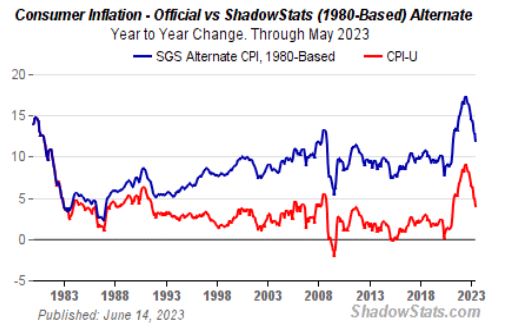
That 0.6% monthly increase in spending annualizes to a 7.2% increase in spending over one year. As we’ve discussed often, the government’s published inflation figures are completely fraudulent, with the Bureau of Labor Statistics reporting that as of September the annual inflation rate is just 3.7%, down from 4.0% in May 2023.

John Williams’ website (shadowstats.com) tracks inflation using the same measurements used in the Carter era. The chart below is updated through May 2023, showing the official 4% inflation as reported by the US government (red line) versus inflation if calculated the same way it was calculated in 1980 (blue line.) Actual inflation is more than 12%, which is 3 times the official bogus government figure.

Therefore, the “expectation smashing” consumer spending that the media is reporting is not even keeping up with actual inflation, which means that consumers are bringing home less in the way of retail goods, despite the increased dollar amount they are spending.

This tweet below is not a parody. Nobel Prize winning propagandist economist Paul Krugman actually stated that excluding food, energy and shelter, “The war on inflation is over. We won, at very little cost.”

Thanks, Mr. Krugman, that’s very helpful. While inflation may be out of control on food, energy, and shelter, those are unnecessary discretionary expenditures. If people will just forego extravagances such as feeding their families and putting a roof over their children’s heads, they’ll do just fine in Biden’s economy.

October 11, 2023

QotD: A rational army would run away …

Filed under: Economics, History, Military, Quotations — Tags: , , , , — Nicholas @ 01:00

It is a thousand years ago somewhere in Europe; you are one of a line of ten thousand men with spears. Coming at you are another ten thousand men with spears, on horseback. You do a very fast cost-benefit calculation.

    If all of us plant our spears and hold them steady, with luck we can break their charge; some of us will die but most of us will live. If we run, horses run faster than we do. I should stand.

Oops.

I made a mistake; I said “we”. I don’t control the other men. If everybody else stands and I run, I will not be the one of the ones who gets killed; with 10,000 men in the line, whether I run has very little effect on whether we stop their charge. If everybody else runs I had better run too, since otherwise I’m dead.

Everybody makes the same calculation. We all run, most of us die.

Welcome to the dark side of rationality.

This is one example of what economists call market failure — a situation where individual rationality does not lead to group rationality. Each person correctly calculates how it is in his interest to act and everyone is worse off as a result.

David D. Friedman, “Making Economics Fun: Part I”, David Friedman’s Substack, 2023-04-02.

September 25, 2023

QotD: The economics of American slavery

Filed under: Economics, History, Quotations, USA — Tags: , , , , — Nicholas @ 01:00

Growing cotton … unlike sugar or rice, never required slavery. By 1870, freedmen and whites produced as much cotton as the South produced in the slave time of 1860. Cotton was not a slave crop in India or in southwest China, where it was grown in bulk anciently. And many whites in the South grew it, too, before the war and after. That slaves produced cotton does not imply that they were essential or causal in the production.

Economists have been thinking about such issues for half a century. You wouldn’t know it from the King Cottoners. They assert, for example, that a slave was “cheap labor”. Mistaken again. After all, slaves ate, and they didn’t produce until they grew up. Stanley Engerman and the late Nobel Prize winner Robert Fogel confirmed in 1974 what economic common sense would suggest: that productivity was incorporated into the market price of a slave. It’s how any capital market works. If you bought a slave, you faced the cost of alternative uses of the capital. No supernormal profits accrued from the purchase. Slave labor was not a free lunch. The wealth was not piled up.

The King Cotton school has been devastated recently in detail by two economic historians, Alan Olmstead of the University of California at Davis and Paul Rhode of the University of Michigan. They point out, for example, that the influential and leftish economist Thomas Piketty grossly exaggerated the share of slaves in U.S. wealth, yet Edward Baptist uses Piketty’s estimates to put slavery at the center of the country’s economic history. Olmstead and Rhode note, too, from their research on the cotton economy that the price of slaves increased from 1820 to 1860 not because of institutional change (more whippings) or the demand for cotton, but because of an astonishing rise in the productivity of the cotton plant, achieved by selective breeding. Ingenuity, not capital accumulation or exploitation, made cotton a little king.

Slavery was of course appalling, a plain theft of labor. The war to end it was righteous altogether — though had the South been coldly rational, the ending could have been achieved as in the British Empire in 1833 or Brazil in 1888 without 600,000 deaths. But prosperity did not depend on slavery. The United States and the United Kingdom and the rest would have become just as rich without the 250 years of unrequited toil. They have remained rich, observe, even after the peculiar institution was abolished, because their riches did not depend on its sinfulness.

Dierdre McCloskey, “Slavery Did Not Make America Rich: Ingenuity, not capital accumulation or exploitation, made cotton a little king”, Reason, 2017-07-19.

September 23, 2023

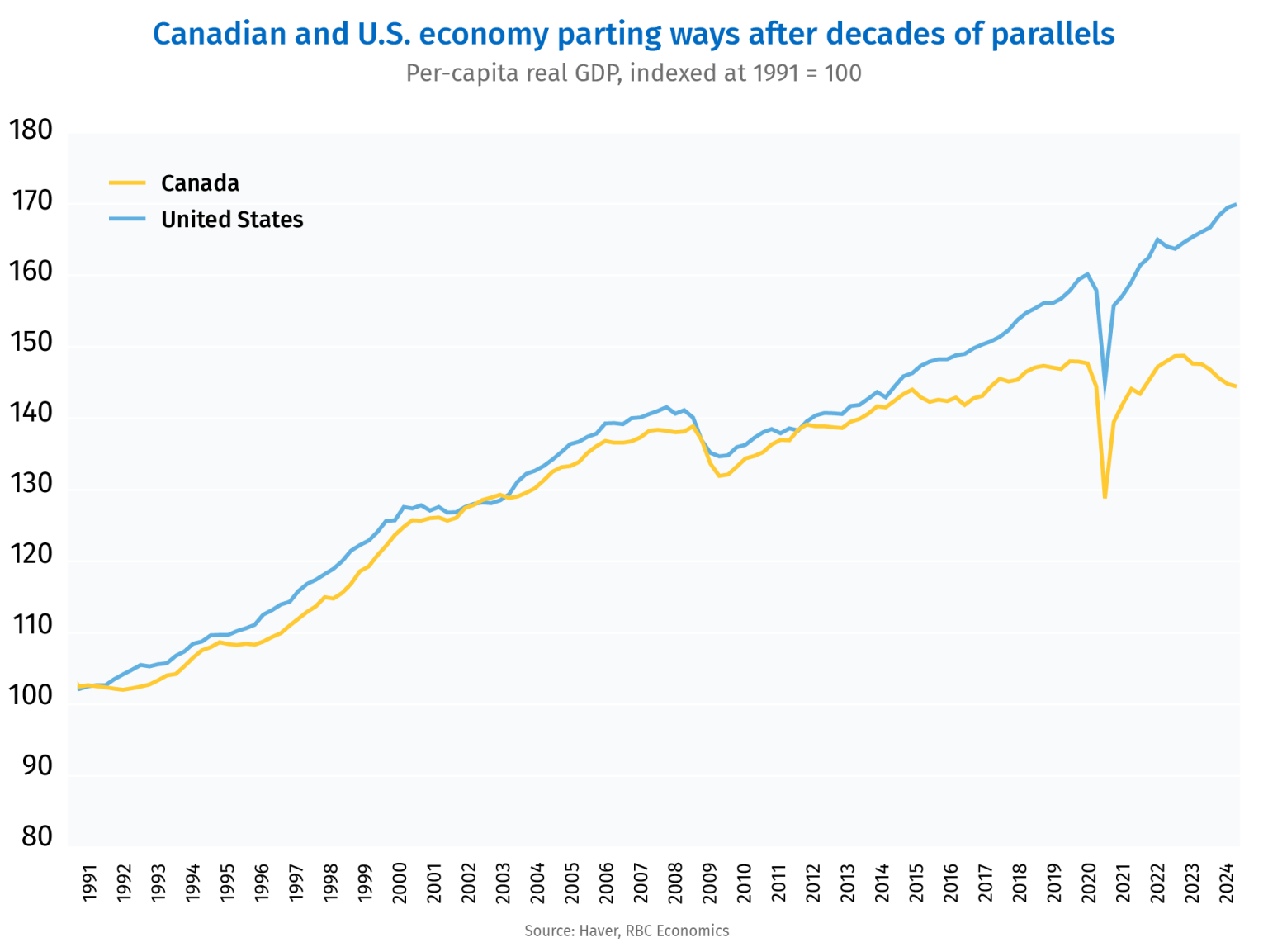
“Canada is, as a whole, a naive, spoiled country that stands a pretty good chance of getting punched in the face by reality”

Filed under: Cancon, Economics, Government, Media, Politics — Tags: , , — Nicholas @ 05:00

In The Line, Matt Gurney praises both the delivery and the content of a recent report by the Business Council of Canada urging Canadian governments to pay a lot more attention to economic security issues that seem to be almost universally neglected in favour of mediagenic gestures and battlespace prep for the next election.

But as I was reading the report, there was this nagging thought in the back of my mind. Why is the Business Council of Canada trying to impress upon the government (and the country at large) the importance of economic security? Why do we need a report from top business leaders to remind our political leadership that poor countries aren’t generally safe and peaceful ones, and that there are countries out there that would wish us harm and that we need to be on guard against? Like, shouldn’t we know that already? Because none of this stuff is revolutionary. It’s all extremely basic stuff that any mature country should just sort of intuitively grasp. Right?

And that’s when the shoulder-slumping realization lands on you like a ton of bricks. We should, but in this country, we don’t. We just don’t. Because, well ….

Uh oh.

It seems to me that a country shouldn’t need a report to impress upon key civilian leadership that economic prosperity is the cornerstone of all security, or that, on the flip side, security is a prerequisite for prosperity. Toronto is a fair bit rougher than it used to be these days — join us at our event next month! — but when I leave the house to run an errand, I’m reasonably confident I’m not going to be abducted by a band of roving pirates prowling the leafy streets of Leaside. When I head up north for the weekend, it doesn’t occur to me that there’ll be a checkpoint along the route, looking to shake me down or carry off my children into slavery. In the mornings, when I lurch out of bed with a groan that gets louder with each passing year, I expect that the light switch will indeed result in light and that the faucet in the bathroom will provide clean water. I don’t have to worry about whether the water treatment plant has been bombed or the power lines shelled.

Many of my Canadian readers may find the above absurd or, at least, a bit of hyperbole. But that’s the point. As I have written many times before, almost everything we do in this country, and almost our entire self-identity as Canadians, accepts internal security and safety from military attack as an ironclad given, just by default. That makes sense: that has been the norm for us, for a long time. It seems absurd precisely because how distant it seems from our normal.

But it isn’t the norm in any historical sense much beyond a human lifetime or two or three, even in Canada. And more to the point, as the voice-over guys in the commercials say, past performance may not be indicative of future results.

We are not owed prosperity in perpetuity. We are not guaranteed security by virtue of our niceness. These are precious things that require more than just good luck — and good luck, thank God, is something Canada still does seem to have. In addition to luck, though, we need realistic understandings of our strengths, weaknesses and the threats we face. We need political leadership that is mature and aware enough to understand the difference between political interest and national interest, and that is seized enough with these issues to devote the necessary resources to building up and preserving our security, from all reasonably foreseeable threats. That includes not just investments of money and people, but also simply intellectual bandwidth and emotional toil. We have to think, hard, about things that aren’t nice to think about, and have robust, effective institutions and a critical mass of people with the necessary combination of mindset, academic and professional training and lived experience to be effective at foreseeing, heading off and, when necessary, managing crises that threaten our safety and prosperity. We need a supportive bureaucracy that is efficient and task-focused and doesn’t get in the way of all this vital work.

Does any of this sound like Canada to you?!

Does it sound like the leader of any of our governments, or any of the people who’ll replace those leaders? Does it sound like any of our institutions except the ones specifically tasked with security and defence? You know, the ones we habitually starve so we can spend a few extra bucks and a bit more political capital on something a bit more pleasing to the average voter? Does it sound like the sort of thing smart, well-read and educated Canadians spare a single solitary moment thinking about as they go about their day to day lives?

Of course not. No one does, and our politics reflect this. These just aren’t issues of concern in Canada outside of the military, the intelligence agencies and a few fellow journalists and academics I could probably recount here in their totality by their first names.

September 8, 2023

QotD: Rents and taxes in pre-modern societies

In most ways […] we can treat rent and taxes together because their economic impacts are actually pretty similar: they force the farmer to farm more in order to supply some of his production to people who are not the farming household.

There are two major ways this can work: in kind and in coin and they have rather different implications. The oldest – and in pre-modern societies, by far the most common – form of rent/tax extraction is extraction in kind, where the farmer pays their rents and taxes with agricultural products directly. Since grain (threshed and winnowed) is a compact, relatively transportable commodity (that is, one sack of grain is as good as the next, in theory), it is ideal for these sorts of transactions, although perusing medieval manorial contacts shows a bewildering array of payments in all sorts of agricultural goods. In some cases, payment in kind might also come in the form of labor, typically called corvée labor, either on public works or even just farming on lands owned by the state.

The advantage of extraction in kind is that it is simple and the initial overhead is low. The state or large landholders can use the agricultural goods they bring in in rents and taxes to directly sustain specialists: soldiers, craftsmen, servants, and so on. Of course the problem is that this system makes the state (or the large landholder) responsible for moving, storing and cataloging all of those agricultural goods. We get some sense of how much of a burden this can be from the prominence of what seem to be records of these sorts of transactions in the surviving writing from the Bronze Age Near East (although I should note that many archaeologists working on the ancient Near Eastern economy are pushing for a somewhat larger, if not very large, space for market interactions outside of the “temple economy” model which has dominated the field for quite some time). This creates a “catch” we’ll get back to: taxation in kind is easy to set up and easier to maintain when infrastructure and administration is poor, but in the long term it involves heavier administrative burdens and makes it harder to move tax revenues over long distances.

Taxation in coin offers potentially greater efficiency, but requires more particular conditions to set up and maintain. First, of course, you have to have coinage. That is not a given! Much of the social interactions and mechanics of farming I’ve presented here stayed fairly constant (but consult your local primary sources for variations!) from the beginnings of written historical records (c. 3,400 BC in Mesopotamia; varies place to place) down to at least the second agricultural revolution (c. 1700 AD in Europe; later elsewhere) if not the industrial revolution (c. 1800 AD). But money (here meaning coinage) only appears in Anatolia in the seventh century BC (and probably independently invented in China in the fourth century BC). Prior to that, we see that big transactions, like long-distance trade in luxuries, might be done with standard weights of bullion, but that was hardly practical for a farmer to be paying their taxes in.

Coinage actually takes even longer to really influence these systems. The first place coinage gets used is where bullion was used – as exchange for big long-distance trade transactions. Indeed, coinage seemed to have started essentially as pre-measured bullion – “here is a hunk of silver, stamped by the king to affirm that it is exactly one shekel of weight”. Which is why, by the by, so many “money words” (pounds, talents, shekels, drachmae, etc.) are actually units of weight. But if you want to collect taxes in money, you need the small farmers to have money. Which means you need markets for them to sell their grain for money and then those merchants need to be able to sell that grain themselves for money, which means you need urban bread-eaters who are buying bread with money, which means those urban workers need to be paid in money. And you can only get any of these people to use money if they can exchange that money for things they want, which creates a nasty first-mover problem.

We refer to that entire process as monetization – when I talk about economies being “monetized” or “incompletely monetized” that’s what I mean: how completely has the use of money penetrated through this society. It isn’t a one-way street, either. Early and High Imperial Rome seem to have been more completely monetized than the Late Roman Western Empire or the early Middle Ages (though monetization increases rapidly in the later Middle Ages).

Extraction, paradoxically, can solve the first mover problem in monetization, by making the state the first mover. If the state insists on raising taxes in money, it forces the farmers to sell their grain for money to pay the tax-man; the state can then take that money and use it to pay soldiers (almost always the largest budget-item in an ancient or medieval state budget), who then use the money to buy the grain the farmers sold to the merchants, creating that self-sustaining feedback loop which steadily monetizes the society. For instance, Alexander the Great’s armies – who expected to be paid in coin – seem to have played a major role in monetizing many of the areas they marched through (along with breaking things and killing people; the image of Alexander the Great’s conquests in popular imagination tend to be a lot more sanitized).

Bret Devereaux, “Collections: Bread, How Did They Make It? Part IV: Markets, Merchants and the Tax Man”, A Collection of Unmitigated Pedantry, 2020-08-21.

« Newer PostsOlder Posts »

Powered by WordPress