
The railroads [in the decades immediately following the U.S. civil war] saw advantages to regulation. Unstable prices, disliked by rail customers, could also be detrimental to the railroads. A recession in 1884 led to the failure of a number of railroads, and the railroads wanted to undertake pooling arrangements for their mutual profitability. Thus, the railroad industry, which was very competitive, wanted the ICC [Interstate Commerce Commission] to stabilize rates, regulate routes, and protect their profitability. Essentially, the ICC cartelized the industry, allowing it to be more profitable than it could have been in a more competitive unregulated environment.
Randy Holcombe, Liberty in Peril: Democracy and Power in American History, (2019).
February 4, 2024
QotD: American railroads and the Interstate Commerce Commission
February 2, 2024
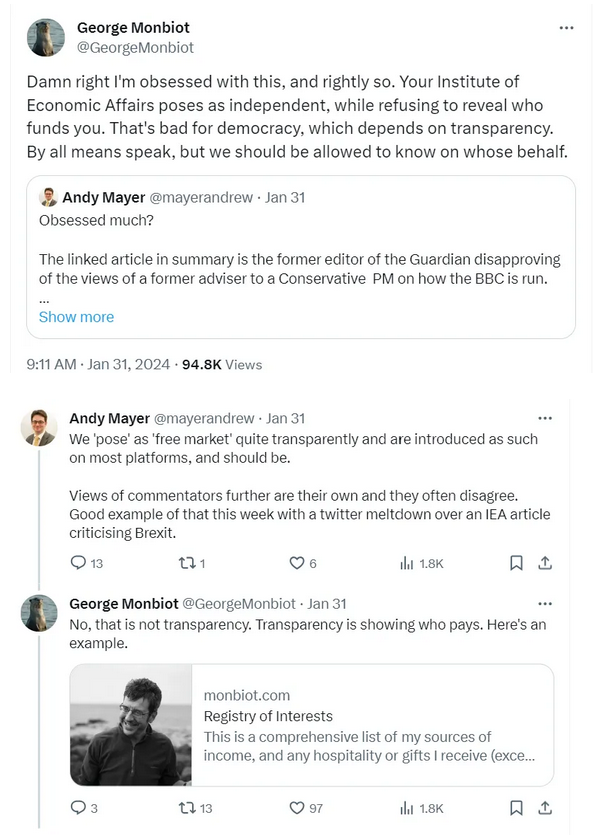
“Who funds you?”
Tim Worstall considers George Monbiot (lovingly known as “The Moonbat” to early bloggers) and his demand that others make their sources of income transparent to show whether their opinions are being “bought” by shady interested parties:
George Monbiot has his positive attributes. His change of mind on nuclear power in the face of the evidence from Fukushima — that no one at all died from three reactors going pop, while 15k and more did from the tsunami and therefore he became in favour of nuclear — is an example. OK, that’s rather hitting someone over the head with a cluebat but it’s also true that Caroline Lucas didn’t manage to note that same point. So, there is that. Even if “more aware of reality that Caroline Lucas” is a low bar to have to clear.
George can also rather dig himself into holes. As he is here with his insistence about funding of varied think tanks and so on.
And, OK, let’s go look at George’s registry of interests […]
OK, that’s the sword that George declares he’s going to live by. Fair play and all that.
Except, except. Last year was pretty good, book royalties flowing in and more power to that typing. The core earning is The Guardian, royalties on top. Not unusual for a writer to be honest. Gain a core contract that produces an ongoing and assured income, spend time floating books or other work out there to see what happens to income. Freelancing is certainly a great deal more fun if you already know where the monthly nut is going to come from with such a core contract.
But, but.
Book royalties, umm, Penguin? Used to be part owned by Pearson, also at the time owners of the Financial Times. So that’s a connection into the shadowy world of international capitalists. It’s now Bertelsman, so foreign international capitalists to boot. Macmillan? They admitted to bribery in Sudan over a school books contract. So a link to international thieving capitalists too. HarperCollins? That’s Murdoch, no more need be said, right?
But, but, a reasonable response would be that this is all far removed from the level George works at. That would be a fair enough response too.
But note the thing here. By agreeing that there’s some level of connection which is too ephemeral to matter we are agreeing that this thing called the corporate veil exists. We can indeed don the tin foil hats and connect near anything we want. Pretty much all Europeans are 16th cousins for example. So I — and George — am/are responsible for WWI because we’re both related to the Kaiser, Emperor and Tsar all at the same time. It’s our family wot dun it, see? Within economic connections that concept, that there’s this thing ‘ere which is responsible not the further connections away from that, is called that corporate veil. I shop at Sainsbury’s sometimes. The Labour Minister husband of a Sainsbury’s heiress employed two butlers (before dumping her for his boyfriend if memory serves). It’s possible to claim that I therefore fund dual butlership but it’s not a claim that all that many are going to regard as valid.
But The Guardian, that core contract. The newspaper seems to have returned to profit recently but there was a decade or so there where it was losing tens of millions a year — and more in some 12 month periods. Those losses were covered by the profits from Autotrader more than anything else. So, George was funded by the facilitation of climate destruction through the trade in internal combustion engined cars.
If, you know, we wanted to put it that way.
January 31, 2024
The LA Times recently laid off a bunch of “activists masquerading as reporters”
Tom Knighton illustrates one of the reasons so many legacy news organizations are being forced to cut back on staff in hopes of staying afloat:
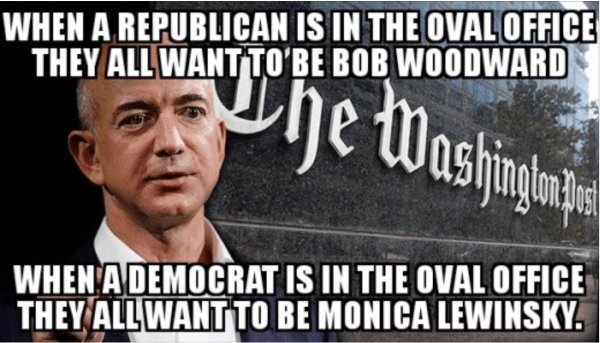
Last week, the LA Times announced a massive layoff of journalists. They were just one of several places that kicked the activists masquerading as reporters to the curb.
This, of course, was met with consternation by the journalistic field as a whole.
Everyone seemed ready to warn of doom and gloom, telling us how important they are to society and that we need them.
Yet absolutely none of them seemed remotely interested in actually examining why the field is shrinking so horrifically.
Sure, the current landscape is very different due to technological advancements. For example, there’s places like Substack where I can reach out to readers directly instead of needing to filter things through a newspaper’s editorial voice.
But journalists also did this to themselves.
[…]
Because journalism’s “inherently political” tribe uses their politics to decide which stories are worth reporting. Journalists, if we can even really call them that anymore, aren’t simply sharing truth. They’re amplifying some stories and smothering others.
How often do we see stories claiming so-and-so is a white supremacist because he favors welfare reform or a tougher stance on illegal immigration? How many publications amplified the nonsense about Border Patrol agents “lassoing” illegal immigrants because of a picture they didn’t understand?
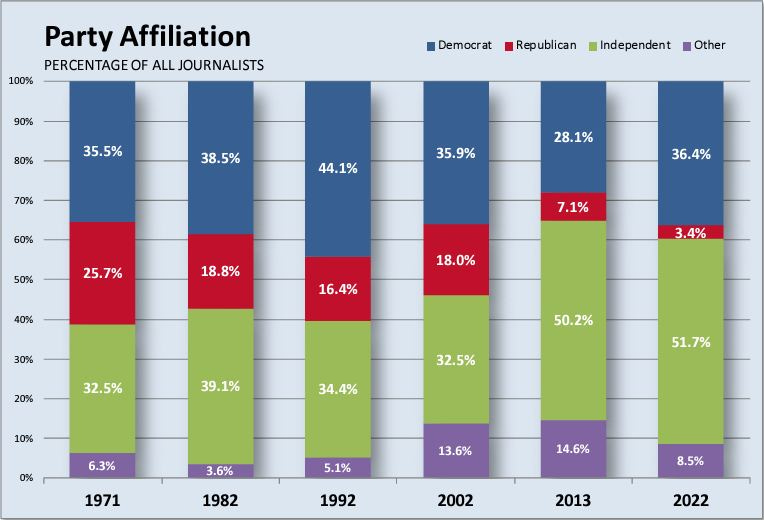
Journalism doesn’t represent the American people. It represents the Democratic Party.
In 1971, Republicans accounted for just over a quarter of all journalists. In 2022, they were 3.4 percent.
Original can be found here – https://www.theamericanjournalist.org/
Now, in 1971, those independents were probably divided between left-leaning and right-leaning to some degree or another, though the survey didn’t capture that.
In 2022, I suspect many who called themselves independent did so because they thought the Democrats were too right-leaning for their tastes.
What’s more, despite the lack of ideological diversity, that same source found that only 21.8 percent see that as needing to change.
What’s more, starting in 2016, news publications really stopped even trying to pretend they were unbiased. A form of blatantly activist journalism became common, with virtually every news agency in the nation showing at least some signs of it.
January 28, 2024
Adolescence is “a profoundly unnatural life-stage”
Sarah Hoyt on the plight of the younger Millennials and the Gen Z kids in our over-supervised safety-at-all-costs culture today:
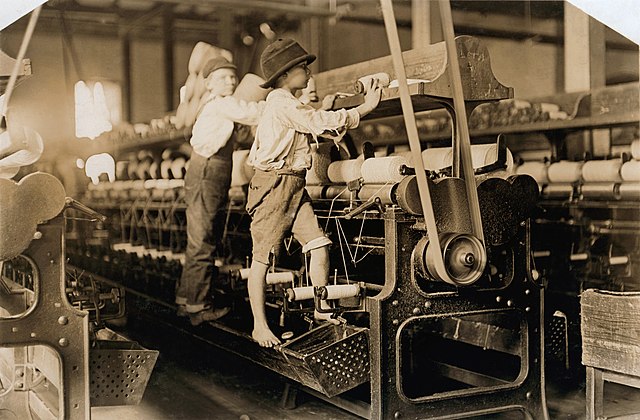
Child labour laws did generally get younger children out of dangerous places like mines, mills, and factories. Modern child labour laws instead keep young adults from gaining work experience in many cases.
Photo of pre-teen children working in a mill in Macon, Georgia in 1909. Photo NCLC.01581, Library of Congress via Wikimedia Commons.
Mostly, it gets attributed to “kids these days” but unless you have kids, these days, you don’t know how they are bound. And even if you do, you might not realize it, because all you see is the infantilization of a generation, and not that they, themselves, aren’t the ones doing the infantilizing, but all those “good rules” and regulations and laws are doing it.
I realized about 10 years ago that my son’s generation was about 10 years behind where we were. In their mid twenties they were doing things we did in our teens. It was disconcerting. And even I had no idea why, other than too much regimentation in school, too much of a never end of button counting, and not enough room or freedom to think or be on their own.
Since then … I’ve seen more. And a lot of the reason they are younger than we were is that the entire world is geared not to let them grow up. I mean, let’s be glad that — unprepared or not — they’re legal adults at 18, or people would be denouncing them for walking alone down the street, without an “adult” at 25.
There’s also … adolescence is in some ways a profoundly unnatural life-stage, and more or less invented in the 20th century. In the past, sure, people were children, and people grew to be adults, but there wasn’t this protracted time period where they were adults in size and at least some ability, but weren’t allowed to be adults: they weren’t allowed to earn or spend, or make their own decisions, for years.
The earn or spend thing is important. Kids used to grow along with their tasks. Read Tudor or colonial memoirs, and you find four year olds looking after cows or horses, or learning Latin, or other unlikely things even for twelve year olds in our time.
Mom went to work at 10 and started getting a salary. It wasn’t much, and 90% of it went to her parents’ budget. But she was working, holding down a job, doing things that were maybe not at adult level, but could lead to it, eventually, if she applied herself. This was normal for her generation. In my own generation, amid the working class, most people went to work at 10. Heck, amid the middle class, most people went to work at 15 or so, after 9th grade. Were they more mature than the rest of us that went all the way to college?
I wouldn’t have thought that at the time, but yes, of course they were. Most of my elementary school classmates were married, with kids by the time my biggest worries were final exams. Of course, with my intellectual pride I looked down on them but now I understand they were managing a very difficult job, which at the time I could not have done.
I always feel stunned and shocked when someone says the kids should be “holding down two jobs like I was at 16” or “working to pay their way through college”. (That last is a giggle as it has two impossibilities. Finding a job that pays enough after college which has a lot of make-work expectations, and making a full-time middle-class salary, which is what college costs these days.) Two Jobs. At 16. The difficulties in giving work to 16 year olds, increasingly restriction of hours, etc. combined with chaotic scheduling in the only unskilled jobs remaining (mostly just retail) means that until recently none of them could find A job. Let alone two. And the recently was during Covid. I haven’t seen so many little 16 year olds cashiering, or serving at tables recently. And that’s because most people I’m seeing are around my age: I guess unemployment is biting hard.
But you know, all these strong rules against “child labor” mean that most kids hit 18 or, if they’re going to college, 22 or — more likely, as most degrees (remember make work?) are taking 6 or 7 years — 24, with absolutely no job experience. Which means their applications aren’t even looked at. Not seriously.
Honestly, almost every young person — particularly young men — I know who found a job, and is doing relatively well, did so through contacts. Through friends of friends. Through knowing someone.
This is a bad sign, because it’s how Portugal functions, and it is not in any way shape or form meritocracy, which in turn contributes to other things falling apart.
But more and more what I’m seeing is young people hitting their mid twenties lost, and doing this, and doing that, and trying this and trying that, and nothing ever gels. To make things worse, they don’t have the habits mom had by 10, because they haven’t been allowed to acquire them.
There was a similar generation — one, while here we’re well into two — in Portugal, where unemployment was so bad (the generation before mine) that most people weren’t “established” on a path till their mid thirties. I’d guess about half of them never got the knack of it: of the day to day of working, fulfilling the work duties, just … the unglamorous day to day that makes us adults.
January 21, 2024
QotD: The life-cycle of bureaucracies
Gentle reader must understand that I am not speaking only of “guvmint”, but of bureaucracy, at large. The thing is not necessarily a government department. Any big corporation will quickly show symptoms. The only difference between “public” and “private” is in longevity. A private bureaucracy will kill its host, but thanks to the power of taxation, a public bureaucracy can be long sustained. It is also backed by law and police action, which even today is more effective than mere pointless rules and regulations. The latter, however, are more nimble in expansion, and prepare the ground for law — the full spiritual stasis.
David Warren, “Austrian schoolboy”, Essays in Idleness, 2019-09-17.
January 20, 2024
Why Tyrian Purple Dye Is So Expensive | So Expensive | Insider Business
Insider Business
Published 21 Jan 2023Making authentic Tyrian purple dye starts with extracting a murex snail gland. After a series of painstaking steps, Tunisian dye maker Mohamed Ghassen Nouira turns as much as 45 kilograms of snails into a single gram of pure Tyrian purple extract. When he’s done, he can sell it for $2,700. Some retailers sell a gram of the pigment for over $3,000. In comparison, 5 grams of synthetic Tyrian purple costs under $4.
So, why is real Tyrian purple so hard to make? And is that why it’s so expensive?
(more…)
January 19, 2024
Music journalism, RIP
Ted Gioia explains why music journalism is collapsing and who committed the murder:
Just a few weeks ago, Bandcamp laid off 58 (out of 120) employees — including about “half of its core editorial staff“.
And Bandcamp was considered a more profitable, stable employer than most media outlets. The parent company before the recent sale (to Songtradr) and subsequent layoffs, Epic Games, will generate almost a billion dollars in income this year — but they clearly don’t want to waste that cash on music journalism.
Why is everybody hating on music writers?
Many people assume it’s just the same story as elsewhere in legacy media. And I’ve written about that myself — predicting that 2024 will see more implosions of this sort.
Sure, that’s part of the story.
But there’s a larger problem with the music economy that nobody wants to talk about. The layoffs aren’t just happening among lowly record reviewers — but everywhere in the music business.
- Universal Music announced layoffs two days ago.
- YouTube announced layoffs yesterday.
- Soundcloud announced last week that the company is up for sale — after two rounds of layoffs during the last 18 months.
- Spotify announced layoffs five weeks ago.
- That same week, Tidal announced layoffs.
- A few weeks earlier, Amazon Music laid off employees on three continents.
Meanwhile, almost every music streaming platform is trying to force through price increases (as predicted here). This is an admission that they don’t expect much growth from new users — so they need to squeeze old ones as hard as possible.
As you can see, the problem is more than just music writers — something is rotten at a deeper level.
What’s the real cause of the crisis? Let’s examine it, step by step:
- The dominant music companies decided that they could live comfortably off old music and passive listeners. Launching new artists was too hard — much better to keep playing the old songs over and over.
- So major labels (and investment groups) started investing huge sums into acquiring old song publishing catalogs.
- Meanwhile streaming platforms encouraged passive listening — so people don’t even know the names of songs or artists.
- The ideal situation was switching listeners to AI-generated tracks, which could be owned by the streaming platform — so no royalties are ever paid to musicians.
- These strategies have worked. Streaming fans don’t pay much attention to new music anymore.
I’ve warned about each of these — but we are now seeing the long-term results.
This is why Pitchfork is in deep trouble. If people don’t listen to new music, they don’t need music reviews.
And they don’t need interviews with rising stars. Or best of year lists. Or any of the other things music writers do for their readers.
But this problem will get much, much worse. Even the people who made these decisions will suffer — because living in the past is never a smart business strategy.
If these execs were albums, they’d deserve a zero score on the Pitchfork scale.

January 16, 2024
Why Real Dijon Mustard Is So Expensive | So Expensive Food | Business Insider
Insider Business
Published 12 Jul 2022Dijon mustard has a tangier, sharper, and spicier flavor compared to other types of mustard. It takes its name from the town of Dijon in Burgundy, France, where it originated. But despite its name, the majority of Dijon mustard that is sold all over the world doesn’t come from France. The few jars that do will cost you up to six times more than regular Dijon mustard (or double if we want to compare it to Grey Poupon). So how is real Dijon mustard different? And why is it so expensive?
Editor’s Note: In this video, the translations at 2:10 and 3:16 are incorrect. The rind of the mustard seed is wrongly referred to as “sound of mustard”. The correct translation is mustard bran. Insider regrets the error.
(more…)
January 13, 2024
The ongoing encrapification of the internet – “When I hear the phrase ‘web platform’ I reach for my gun”
Ted Gioia used to be a techno-optimist, eagerly looking forward to ever-improving online experiences. He, like so many of us, has reluctantly come to the conclusion that those hopes are fading out of sight:
I once loved new technology. I lived in the heart of Silicon Valley for 25 years, and was bursting with enthusiasm for its free-wheeling mission to transform the world — and have some fun along the way.
When the Worldwide Web made its debut, I thought I’d found Nirvana. It was like tech was turning everything into a game.
But look at me now. When I hear the phrase “web platform” I reach for my gun.
Where did it go wrong? Did I just get old and embittered? Or did something change in the tech world?
Let me share a story that might help us decide.
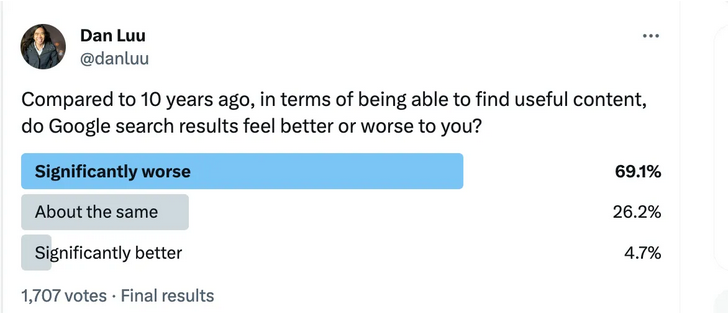
What kind of business spends hundreds of billions over 10 years — just to get worse?
This is a story about the birth of the search engine.
There were no commercial search engines back in 1993. But a Stanford student named David Filo compiled a list of his 200 favorite websites.
His buddy Jerry Yang helped turn this into an online list. They called it “Jerry’s Guide to the Worldwide Web”. Filo and Yang added new websites every day to their list — and classified them according to categories.
This turned into Yahoo.
Here’s my favorite part of the story: These two students didn’t even know they were running a business.
They did it for fun. They did it out of love. They did it because it was cool. “We wanted to avoid doing our dissertations”, Yang later explained.
But a venture capitalist named Mike Moritz heard about Filo and Yang, and tracked them down. The founders of Yahoo were living in total squalor in a trailer littered with stale food and pizza boxes, strewed alongside sleeping bags and overheating computers. A phone rang constantly — but nobody bothered to pick it up.
Moritz was dismayed by this dorm-room-gone-wild ambiance, but he was impressed with the students’ web searching technology. So he asked them the obvious question: How much did they plan to charge users?
Filo and Yang had no answer for this. They wanted to give their tech away for free.
Yahoo wasn’t even selling ads back then. It wasn’t tracking users and selling their private information. It didn’t even have a bank account.
But it was a community and had millions of users.
That was a word you heard frequently in Silicon Valley in the early days. People didn’t build web platforms — they formed online communities.
It was a FUN community. People enjoyed being a member. Even the absurd name Yahoo was part of the game — although early investors hated it.
Yang’s job title was “Chief Yahoo”. Filo’s position was “Cheap Yahoo”.
Investors always hate those kinds of things.
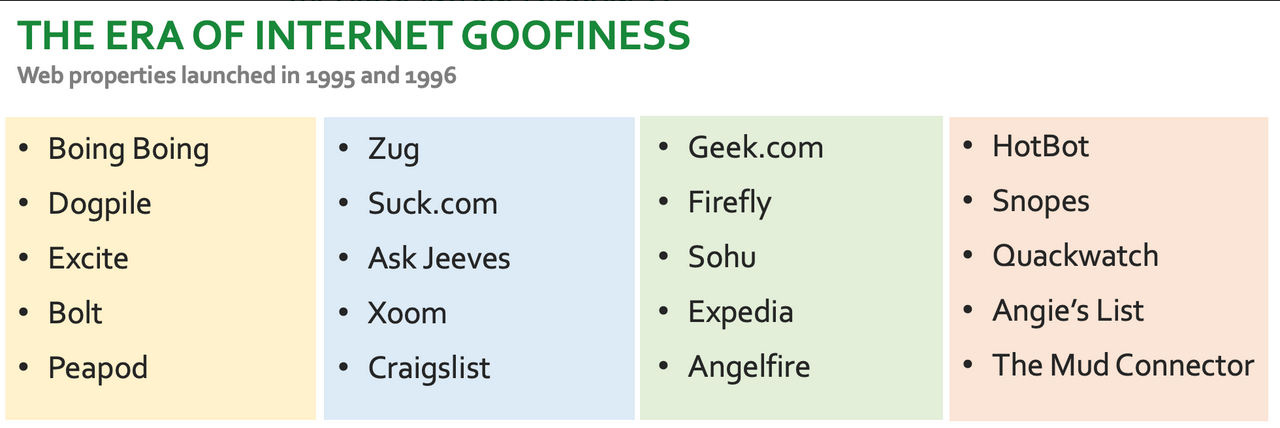
But a new web business, back then, was expected to have a silly name. Here are some of the websites launched in the mid-1990s.
Moritz wanted to turn Yahoo into a business. And the founders realized that their fun community was growing faster than they could handle in their down-and-out trailer. So they sold out 25% of Yahoo for $1 million.
January 3, 2024
They all spy on you, the FBI, RCMP, MI5 … and apparently your Subaru
JoNova linked to this disturbing little article explaining what legal rights you give away merely by being a passenger in a modern Subaru vehicle:

Subaru is a Japanese car company started back in the 1950s. Their all-wheel drive, sporty SUVs and cars are popular with outdoor types and the LGBT+ community (and your privacy researcher’s Mom … Mom swears by Subaru and has since the 1980s). Popular models in the Outback, Forester, Crosstrek, Impreza, Legacy, the sporty WRX, and the electric Solterra. The MySubaru app and Subaru’s Starlink connected services offer up all the usual connected car things like remote start/stop, lock/unlock, honk your horn and flash your lights from bedroom, automatic collision notification, multimedia services like navigation and news, trip logs, and a way to manage other people who might drive your Subaru with boundary, speed, and curfew alerts. So, do we love Subaru’s privacy? Not really. But hey, they aren’t the worst car company we reviewed, so there’s that.
Here’s something you might not realize. The moment you sit in the passenger seat of a Subaru that uses connected services, you’ve consented to allow them to use — and maybe even sell — your personal information. According to their privacy policy, that means things like your name, location, “Audio recordings of Vehicle Occupants“, and inferences they can draw about things like your “characteristics, predispositions, behavior, or attitudes“. Call us bonkers, but we don’t think that simply sitting in the passenger seat of someone’s Subaru should mean you consent to having any of your personal information use for, well, pretty much anything at all. Let alone potentially sold to data brokers or shared with third party marketers so they can target you with ads about who knows what based on the the inferences they draw about you because you sat in the back seat of a Subaru in the mountains of Colorado. We’re gonna really call out Subaru for this, because they lay it out so clearly in their privacy policy, but please know, Subaru isn’t the only car company doing this sort of icky thing.
If you go read Subaru’s privacy policy (or don’t, we did it for you, you can just read our review here), you’ll see at the very start they say this: “This Privacy Policy applies to each user of the Services, including any ‘Vehicle Occupant’, which includes each driver or passenger in a Subaru vehicle that uses Connected Vehicle Services, such as Subaru Starlink (such vehicle, a ‘Connected Vehicle’), whether or not such driver or passenger is the vehicle owner or a registered user of the Connected Vehicle Services. For the avoidance of doubt, for purposes of this Privacy Policy, ‘using’ the Services includes being a Vehicle Occupant in a Connected Vehicle.” So yeah, they don’t want there to be any doubt that when you sit in a connected Subaru, you’ve entered the world of using their services.
December 15, 2023
Bill S-210 “isn’t just a slippery slope, it is an avalanche”
You sometimes get the impression that the only person in Ottawa who actually pays attention to online privacy issues is Michael Geist:

“2017 Freedom of Expression Awards” by Elina Kansikas for Index on Censorship https://flic.kr/p/Uvmaie (CC BY-SA 2.0)
After years of battles over Bills C-11 and C-18, few Canadians will have the appetite for yet another troubling Internet bill. But given a bill that envisions government-backed censorship, mandates age verification to use search engines or social media sites, and creates a framework for court-ordered website blocking, there is a need to pay attention. Bill S-210, or the Protecting Young Persons from Exposure to Pornography Act, was passed by the Senate in April after Senators were reluctant to reject a bill framed as protecting children from online harm. The same scenario appears to be playing out in the House of Commons, where yesterday a majority of the House voted for the bill at second reading, sending it to the Public Safety committee for review. The bill, which is the brainchild of Senator Julie Miville-Duchêne, is not a government bill. In fact, government ministers voted against it. Instead, the bill is backed by the Conservatives, Bloc and NDP with a smattering of votes from backbench Liberal MPs. Canadians can be forgiven for being confused that after months of championing Internet freedoms, raising fears of censorship, and expressing concern about CRTC overregulation of the Internet, Conservative MPs were quick to call out those who opposed the bill (the House sponsor is Conservative MP Karen Vecchio).
I appeared before the Senate committee that studied the bill in February 2022, where I argued that “by bringing together website blocking, face recognition technologies, and stunning overbreadth that would capture numerous mainstream services, the bill isn’t just a slippery slope, it is an avalanche”. As I did then, I should preface criticism of the bill by making it clear that underage access to inappropriate content is indeed a legitimate concern. I think the best way to deal with the issue includes education, digital skills, and parental oversight of Internet use including the use of personal filters or blocking tools if desired. Moreover, if there are Canadian-based sites that are violating the law in terms of the content they host, they should absolutely face investigation and potential charges.
However, Bill S-210 goes well beyond personal choices to limit underage access to sexually explicit material on Canadian sites. Instead, it envisions government-enforced global website liability for failure to block underage access, backed by website blocking and mandated age verification systems that are likely to include face recognition technologies. The government establishes this regulatory framework and is likely to task the CRTC with providing the necessary administration. While there are surely good intentions with the bill, the risks and potential harms it poses are significant.
The basic framework of Bill S-210 is that it creates an offence for any organization making available sexually explicit material to anyone under the age of 18 for commercial purposes. The penalty for doing so is $250,000 for the first offence and up to $500,000 for any subsequent offences. Organizations (broadly defined under the Criminal Code) can rely on three potential defences:
- The organization instituted a “prescribed age-verification method” to limit access. It would be up to the government to determine what methods qualify with due regard for reliability and privacy. There is a major global business of vendors that sell these technologies and who are vocal proponents of this kind of legislation.
- The organization can make the case that there is “legitimate purpose related to science, medicine, education or the arts”.
- The organization took steps required to limit access after having received a notification from the enforcement agency (likely the CRTC).
The enforcement of the bill is left to the designated regulatory agency, which can issue notifications of violations to websites and services. Those notices can include the steps the agency wants followed to bring the site into compliance. This literally means the government via its regulatory agency will dictate to sites how they must interact with users to ensure no underage access. If the site fails to act as instructed within 20 days, the regulator can apply for a court order mandating that Canadian ISPs block the site from their subscribers. The regulator would be required to identify which ISPs are subject to the blocking order.
December 9, 2023
The coming Micro-Macro culture war … and who’s going to win it
Ted Gioia outlines the dismal state of the “macro” culture — television, movies, newspapers, book publishing and all the big corporations that control them — with the dynamism of the “micro” culture:
In the beginning, all culture was microculture.
You knew what was happening in your tribe or village. But your knowledge of the wider world was limited.
So you had your own songs and your own stories. You had your own rituals and traditions. You even had your own language.
But all these familiar things disappeared when you went off into the world. That was dangerous, however. That’s why only heroes, in traditional stories, go on journeys.
You learn on the journey. But you might not survive.
But all that changed long before I was born.
In my childhood, everything was controlled by a monoculture. There were only three national TV networks, but they were pretty much the same.
When I went to the office, back then, we had all watched the same thing on TV the night before. We had all seen the same movie the previous weekend. We had all heard the same song on the radio while driving to work.
The TV shows were so similar that they sometimes moved from CBS to NBC, and you never noticed a change. The newscasters also looked pretty much the same and always talked the same — with that flat Midwestern accent that broadcasters always adopted in the US.
The same monoculture controlled every other creative idiom. Six major studios dominated the film business. And just as Hollywood controlled movies, New York set the rules in publishing. Everything from Broadway musicals to comic books was similarly concentrated and centralized.
The newspaper business was still local, but most cities had 2 or 3 daily newspapers — and much of the coverage they offered was interchangeable. Radio was a little more freewheeling, but eventually deregulation allowed huge corporations to acquire and standardize what happened over the airwaves. [NR: I suspect the “freewheeling” went away once the government started imposing regulations, and the corporate consolidation was enabled when they “deregulated” the radio licensing regime several decades later.]
When I went to work in an office, back then, we had all watched the same thing on TV the night before. We had all seen the same movie the previous weekend. We had all heard the same song on the radio while driving to work.
And that’s why smart people back then paid attention to the counterculture.
The counterculture might be crazy or foolish or even boring. But it was still your only chance to break out of the monolithic macroculture.
Many of the art films I saw at the indie cinema were awful. But I still kept coming back — because I needed the fresh air these oddball movies provided. For the same reason, I read the alt weekly newspapers and kept tabs on alt music.
In fact, whenever I saw the word alt, I paid attention.
That doesn’t mean that I hated the major TV networks, or the large daily newspaper, or 20th Century Fox. But I craved access to creative and investigative work that hadn’t been approved by people in suits working for large organizations.
The Internet should have changed all this. And it did — but not much. Even now the collapse in the monoculture is still in its early stages.
But that’s about to change.
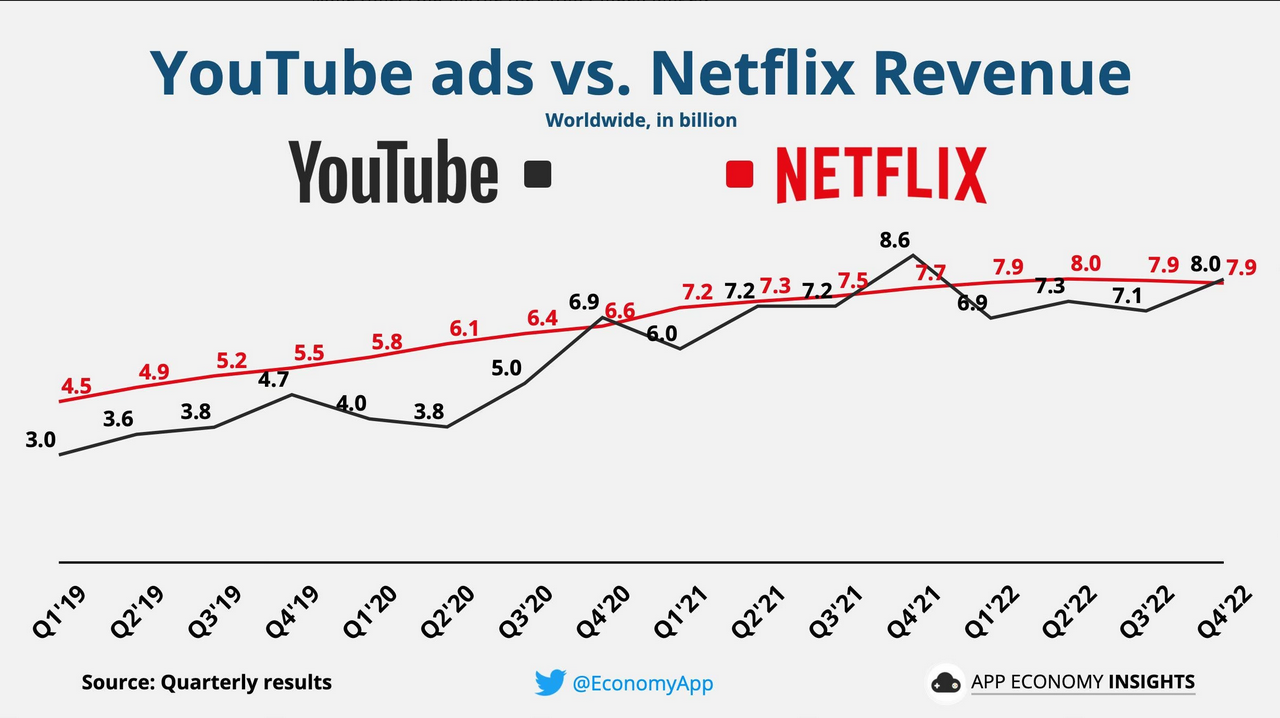
If you don’t pay close attention, the media landscape seems pretty much the same now as it did in the 1990s. The movie business is still controlled in Hollywood. The publishing business is still controlled in New York. The radio stations are still controlled by a few large companies. And instead of three national TV networks plus PBS, we have four dominant streaming platforms — who control almost 70% of the market.
So we still live in a macro culture. But it feels increasingly claustrophobic. Or even worse, it feels dead.
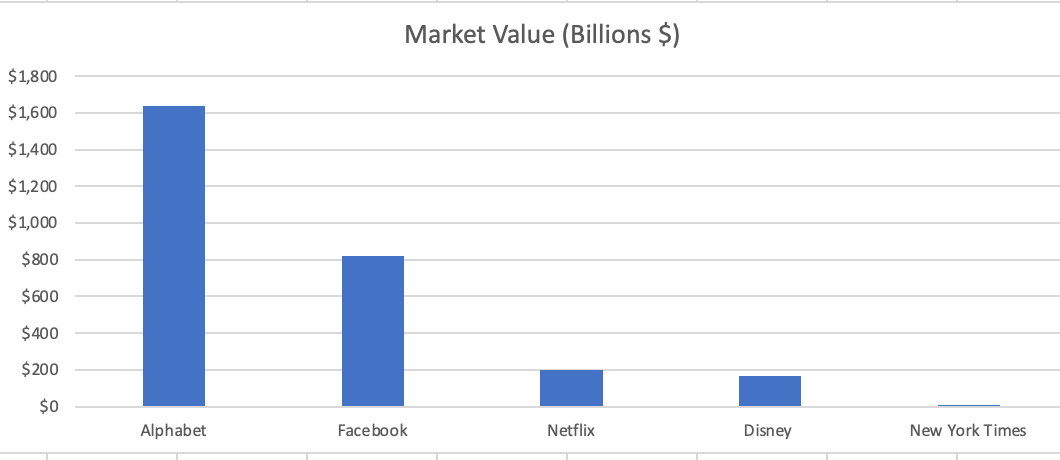
Meanwhile, a handful of Silicon Valley platforms (Google, Facebook, etc.) have become more powerful than the New York Times or Hollywood studios or even Netflix. It’s not even close — the market capitalization of Google’s parent Alphabet is now almost ten times larger than Disney’s.
But here’s the key point — these huge tech companies rely on the microculture for their dominance.
Where is Facebook without users contributing photos, text and video? Where is Google’s YouTube without individual creators?
In terms of economic growth or audience capture, the microculture has already won the war. But it doesn’t feel that way.
Why not?
First and foremost, Silicon Valley is a reluctant home for the microculture. To some extent Alphabet and Facebook are even going to war with microculture creators — they try to make money with them even while they punish them.
- So Mark Zuckerberg needs creators, but won’t even let them put a live link on Instagram and limits their visibility on Facebook and Threads.
- Alphabet needs creators to keep YouTube thriving, but gives better search engine visibility to total garbage that pays for placement.
- Twitter also claims it wants to support independent journalists — but if you’re truly independent from Elon Musk, your links are brutally punished by the algorithm.
This tension won’t go away, and next year it will get worse. The microculture will increasingly find itself at war with the same platforms they rely on today.
And legacy media and non-profits are even more hostile to emerging media. Go see who wins Pulitzer Prizes, and count how many journalists on alternative platforms get honored.
I’ll save you the trouble. They don’t.
December 8, 2023
The Real Betty Crocker’s Pineapple Upside Down Cake
Tasting History with Max Miller
Published 22 Aug 2023
(more…)
December 2, 2023
Joe Biden solves the inflation problem, fat!
Like any lying dog-faced pony soldier would know, it’s as easy as saying “Trunalimunumaprzure“:
Inflation is kicking just about everyone in the junk here lately, regardless of whether that junk is an innie or an outie. It’s been rough on a lot of us, but I know just how hard it’s been on me and mine.
Prices are up significantly over the last few years and my income isn’t up nearly as much. This creates issues with our finances. The upside is that it’s forced me to be better with money.
But prices are still higher than Willie Nelson on a SpaceX flight.
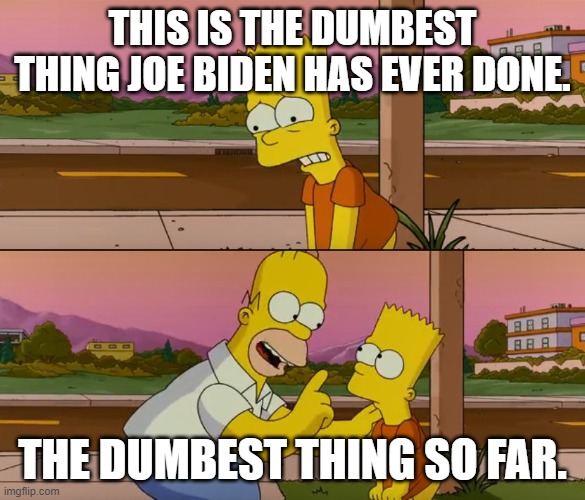
Luckily, President Joe Biden has figured out the solution to all our problems. He’s going to just tell companies to drop prices.
This week, the White House announced the launch of a Council on Supply Chain Resilience, created with the hope to “strengthen America’s supply chains” and “lower costs for families.”
…
President Joe Biden delivered remarks from the White House on Monday to announce the new council’s creation. He touted the lower inflation rate and falling grocery prices but admonished American companies for, in his view, not going far enough.
“Let me be clear: To any corporation that has not brought their prices back down — even as inflation has come down, even as supply chains have been rebuilt — it’s time to stop the price gouging,” Biden warned, imploring them to “giv[e] the American consumer a break.”
Here’s the issue, at least as I see it.
At Thanksgiving, it was noted here that prices are nearly 20 percent higher than in 2019. This while inflation has supposedly decreased. Prices are still high because it’s not so much that inflation has fallen but that the rate of inflation’s increase has fallen. It doesn’t mean prices should drop, only that they should increase at a slower rate.
December 1, 2023
QotD: The OODA loop
OODA theory is worth reading about in more depth for anyone interested in … well, any kind of competitive dynamics, actually – military, commercial, individual, anything. The Wikipedia article is a good start. Stripped to its essentials, the theory is that competing entities have to go through repeated iterations of observing conditions, relating observation to a generative theory, deciding what option to pursue, and acting. Victory tends to go to the competitor who can run this cycle the fastest.
OODA theory was originally generalized from the observation that in fighter design, maneuverability (especially a shorter turning radius) beats straight-line speed. When you get inside your opponent’s OODA loop, either physically or conceptually, you can attack him from unexpected angles. You can be where he isn’t. You have the initiative; he is reduced to reacting, often with too little and too late.
Eric S. Raymond, “The Smartphone Wars: Tightening the OODA Loop”, Armed and Dangerous, 2011-02-18.


