
Southern Plains Railfan
Published Jan 6, 2024In today’s video, we recount the time Penn Central let nearly all of Maine’s potato harvest rot in Selkirk yard; ruining thousands of lives and nearly taking down other railroads in the process.
Merch Shop: http://okieprint.com/SPR/shop/home
April 15, 2024
The MOST INCOMPETENT Railroad You’ve Ever Seen!
Comments Off on The MOST INCOMPETENT Railroad You’ve Ever Seen!
April 11, 2024
Disney: go woke, go broke?
spiked
Published Apr 10, 2024
The Walt Disney Company has gone from being an international treasure to an international laughing stock. Its films are flopping at the box office and fans are fuming. All because it has gone ridiculously woke, to an almost comical degree. No Disney film, franchise or TV series is now complete without clunky “progressive” messages about diversity, feminism and gender. The company has even started picking fights with anti-woke politicians. Here, Lauren Smith documents Disney’s Great Awokening – and the fan revolt against it. Watch, share and let us know what you think in the comments.Support spiked:
https://www.spiked-online.com/support/
Sign up to spiked’s newsletters: https://www.spiked-online.com/newslet…
Check out spiked’s shop: https://www.spiked-online.com/shop/
Comments Off on Disney: go woke, go broke?
April 10, 2024
We can expect to see a lot more commercial bankruptcies in future
Although Tim Worstall is talking specifically about commercial properties in the UK, I suspect the same basic mechanism is in place here in Canada, the US, and many other countries and the outcomes will be broadly similar: declining retail sales intersecting with rising rents do not result in healthy retail markets.
The specific point is something that has become common to near universal in commercial property leases in the decades since the War. This is that rents can only ever be revised upwards.
So, the standard thing about commercial property is that it’s not so much rented as leased. The difference is not wholly clear but, roughly enough, you can leave a rental and you can’t leave a lease. That is, if you’ve a 21 year lease and you want to leave before the 21 years are up then it’s up to you to find another tenant. Not the landlord — and if that tenant that you do find then leaves/goes bust/doesn’t pay the rent then you have to. At least a rental you can leave.
OK — but that’s all pretty standard. The UK has one more thing. Obviously, there are rent reviews during the period of the lease. Inflation taught landlords that this was something they needed to do after all. OK — but the standard, and it really is standard in UK commercial leases, rent review is upwards only. Now, for most of this past 70 years this hasn’t been a problem. The country has been getting richer, inflation has persisted, retail’s been ever more of the economy, rents have been going up.
Ah, but now, eh? Firstly, we’ve the internet eating retail.
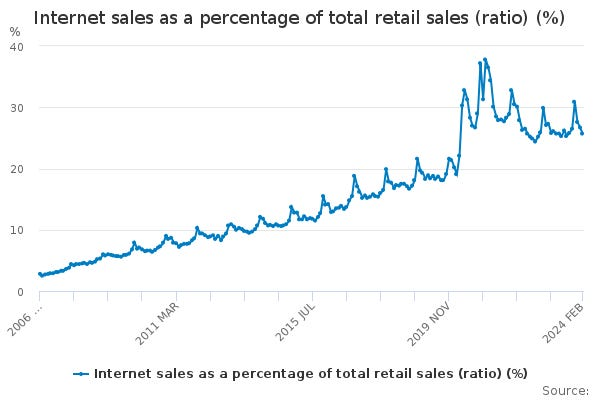
About, and roughly, 1% of the total market each year moves online. We all thought that the lockdown boom was going to persist and it didn’t. This caused all sorts of problems for all sorts of people — Boohoo ended up terribly overstocked. Made.com was able to come to market and then went bust as the right hand end of that chart happened and we returned to trend after the blip. Revolution Beauty had its own problems but the overvaluation was at least partly to do with this and so on.
But this had already been happening — Intu went bust well before the pandemic, as we know. It’s now about true that 15% or more of UK retail space is empty. Because sales are moving online. This — naturally enough — means that prices, rents, of retail are falling. Well, OK.
But now this meets upwards-only rent reviews. If you’re a new retailer looking for space then the High Streets are your mollusc of choice. You can probably get in on low rents, substantial rent-free periods and even get the landlord to pay your fitting out costs (landlords would much rather give rent-free periods, pay costs of moving in, than let at low rents. Because the terms of their own mortgages and loans make it better for them to keep headline rents stable whatever the hell the truth of the real value is). But if you’re a long established retailer paying high street rents then you’re screwed.
Your new competition might be able to get in by paying half the rent you are. And yes, rent is a really, really, big part of retail in the UK. You are, in fact, fucked and right royally.
Comments Off on We can expect to see a lot more commercial bankruptcies in future
April 5, 2024
In the still-ongoing “war of the sexes”, when can women just accept they’ve won and cease hostilities?
At the amusingly named Handwaving Freakoutery, you can see a scorecard for the war of the sexes that has been ongoing since I was a child and seems no closer to ending than back in the 1960s:
I say this to make it absolutely clear that unlike a lot of boorishly banal material you might encounter within the wretchedly named “Manosphere”, this is not intended to be a whiny article. I’m not complaining, nor am I calling for societal change or action. I’m simply wondering exactly how dominant female privilege has to get before they declare victory and take their boot off the necks of men. I really don’t know the answer to this question, but we’ll speculate about that below after the wall of graphs. HWFO loves graphs.
Herein we will go point by point through as many measurable societal markers as I can think of, leaving no marker unmarked, and put together a Gender War Scoreboard describing as accurate a snapshot as possible of the current state of the United States. Then we’ll close with some analysis about how badly it would have to get before the women finally just declare victory and move on. This post shall be too big for email.
To assign our score, we will look at sets of data that fall generally into two categories. For victimization ratios and similar, we’ll just look at percentage by gender. For comparing two uncapped sets of data, such as life expectancy, we’ll look at a ratio and make them both add to 100 for an apples-to-apples comparison. Then we’ll add them all up at the end to tally the score.
Salary
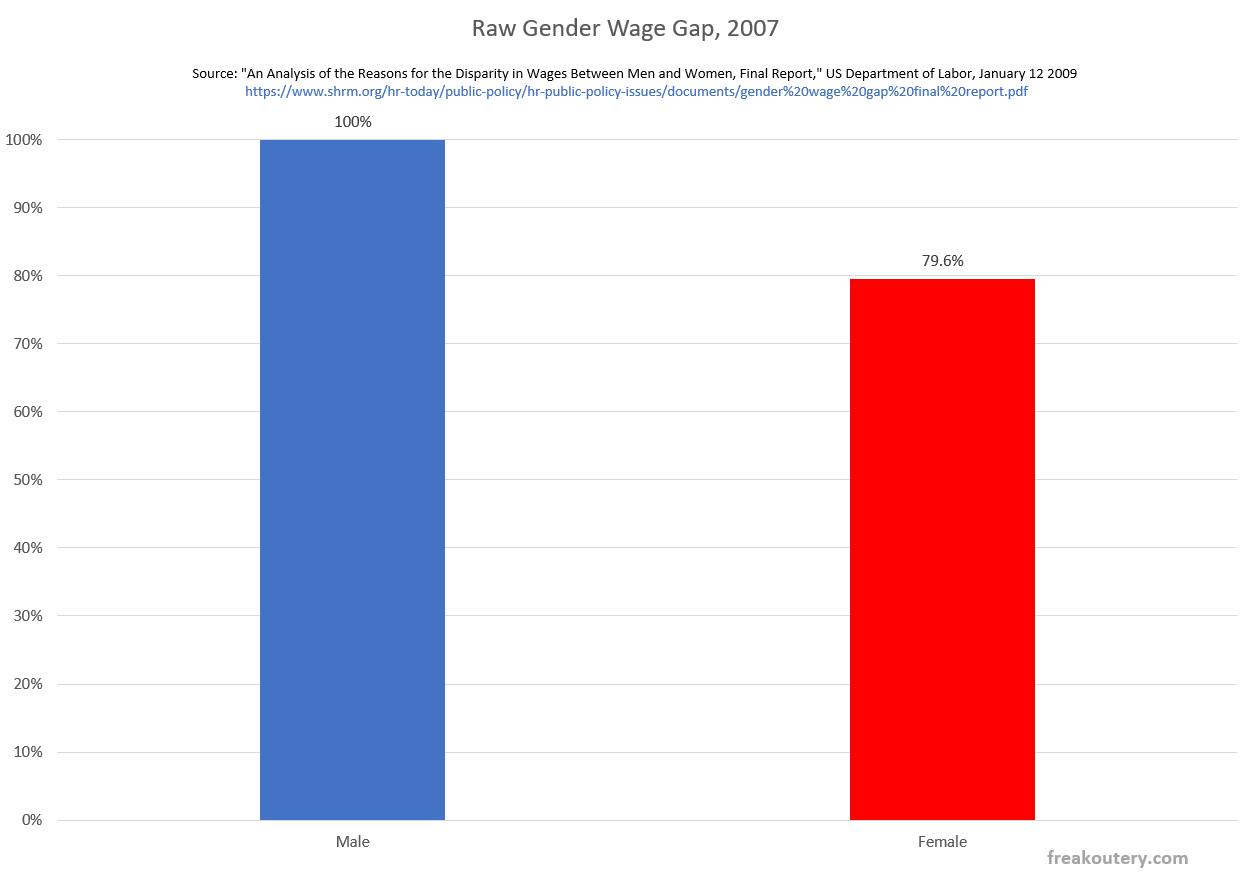
HWFO covered the gender wage gap in 2022, but I’ll summarize it here so you don’t have to read back. According to a 2008 analysis by the Department of Labor, now 16 years old, the raw gender wage gap was 20.4% in 2007:
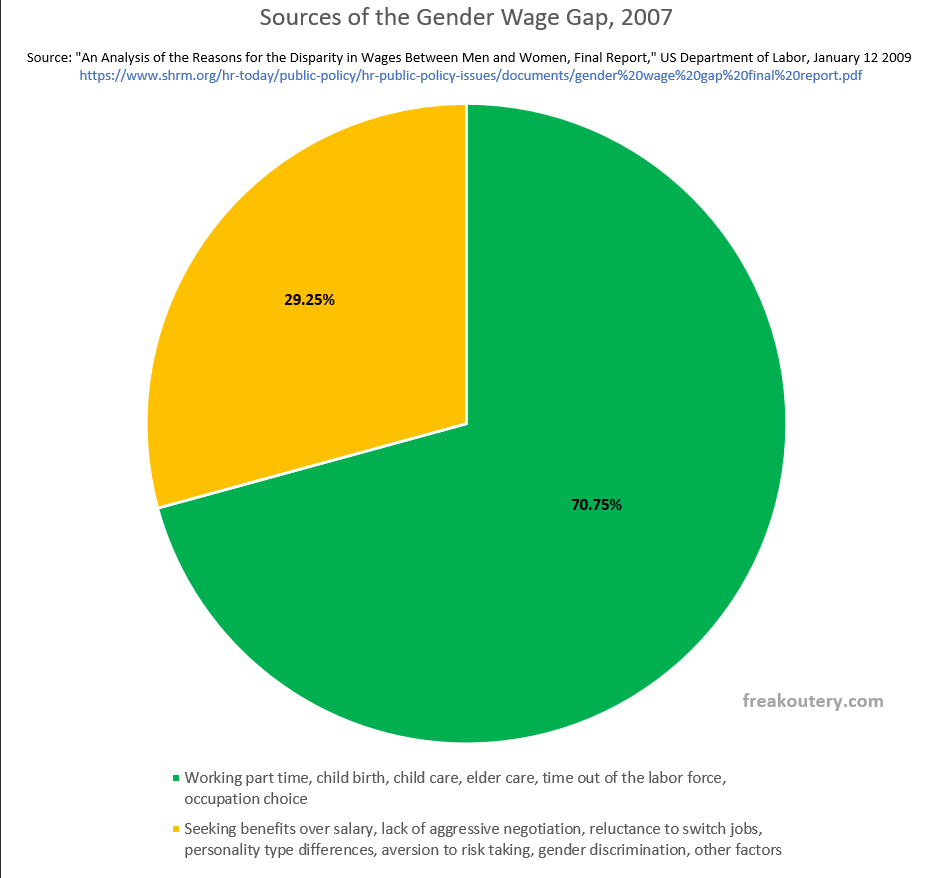
Most of the gap was explainable by career choice and lifestyle choice differences:
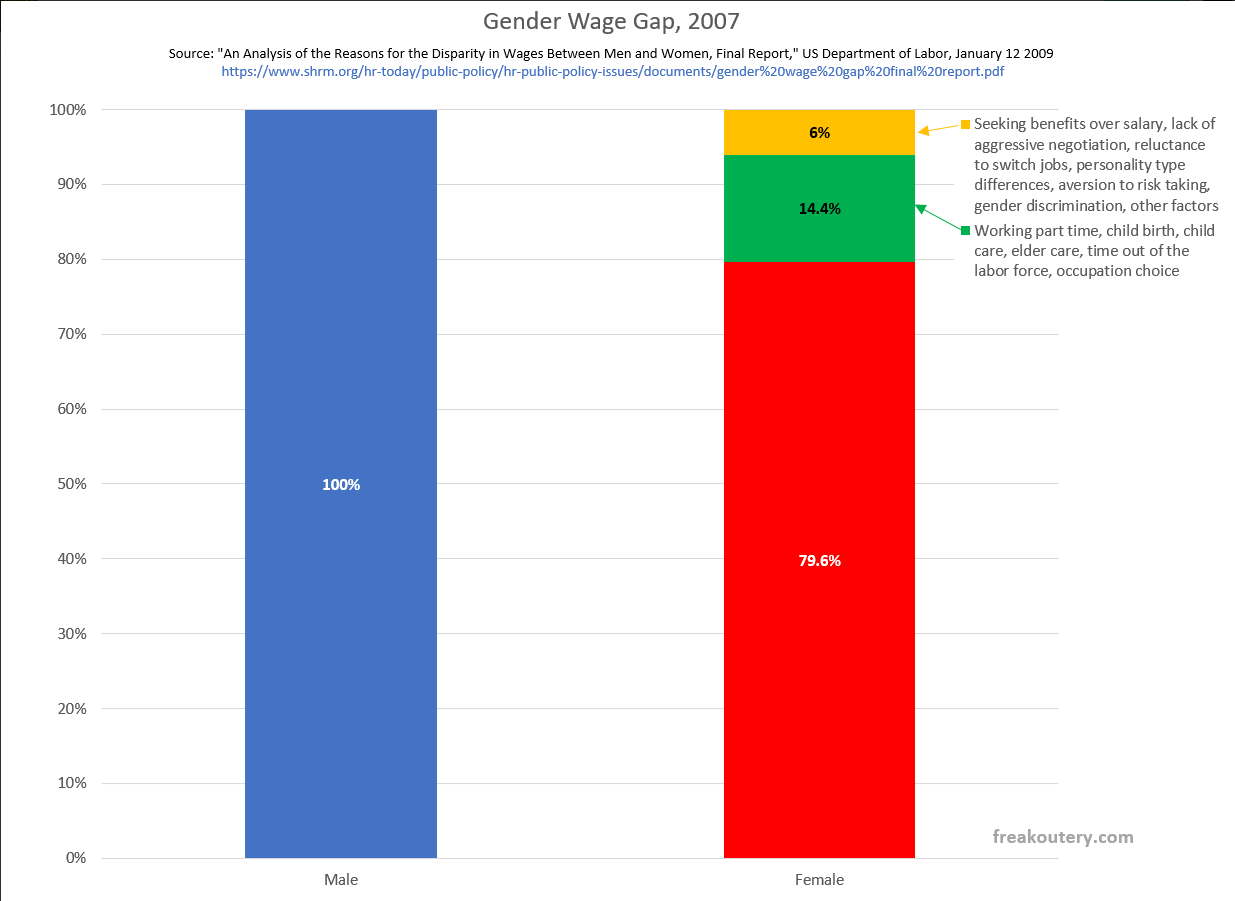
When compared properly that looks like this:
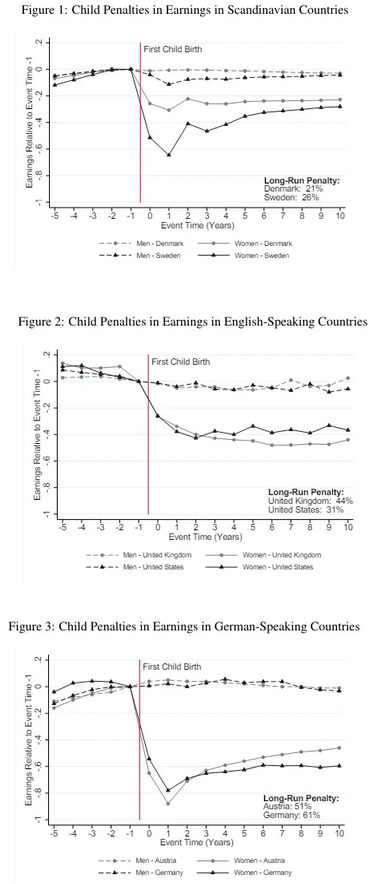
Sixteen years ago, the bits of the gender wage gap that weren’t explained by career and life choice differences only totaled 6%. This fact has been known for a decade and a half and is constantly hidden from view by Pew, the NLWC, and any other major organization that profits from the perception that this gap is large and persistent. It has also assuredly closed to narrower than that 6% in the ensuing decade and a half, but nobody’s replicated the Department of Labor analysis. Look closely at the effects in the green bar identified by the Department of Labor. “Child birth” is how you become a mother. “Child care” is something mothers do. “Working part time” is something mothers do. “Time out of the labor force” is something mothers take. “Occupational choice” is something women change when they become mothers. Here are some graphs from Kleven et al, March 2019:
The solid lines are women. In every studied area, the women make equal or more than the men do up until the birth of their first child, and then they make less. The gender wage gap difference is in the choice to have children. Women choose to make professional concessions to raise a family while the men don’t. Is this fair? Some might say no, but only if they also don’t want to be the primary caregiver for their kids. Some would say yes, for the following two reasons: (1) women choose this, especially in feminist societies, but also (2) men are punished socially for choosing this. If you do not believe me, go make two fake male Tinder profiles with identical cute photos in them, and in the bio of one say “corporate lawyer” and the other say “part time daycare worker” and see which one gets more hits. Then do the same with a female profile. Men are socially punished by women for making the career concession, women are not socially punished by men for making it.
Often when these sorts of “equal pay for equal work” studies are properly controlled for mothering and career choice, they find that men are paid less than women for equal work. Google was pretty famously forced by their neo-progressive staff to do an internal analysis of the subject, and uncomfortably discovered they were overpaying women for being women on an “equal work” basis. The results were twofold. First Google paid all the men a one time bonus, then Google quietly never investigated it again so they could get back to paying women more.
Comments Off on In the still-ongoing “war of the sexes”, when can women just accept they’ve won and cease hostilities?
April 4, 2024
Boeing and the ongoing competency crisis
Niccolo Soldo on the pitiful state of Boeing within the larger social issues of collapsing social trust and blatantly declining competence in almost everything:

“Boeing 521 427”by pmbell64 is licensed under CC BY-SA 2.0


By now, most of you have heard of the increasingly popular concept known as “the competency crisis”. For those of you who haven’t, the competency crisis argues that the USA is headed towards a crisis in which critical infrastructure and important manufacturing will suffer a catastrophic decline in competency due to the fact that the people (almost all males) who know how to build/run these things are retiring, and there is no one available to fill these roles once they’re gone. The competency crisis is one of the major points brought up by people when they point out that America is in a state of decline.
As all of you are already aware, there is also a general collapse in trust in governing institutions in the USA (and all across the West). Cynicism is the order of the day, with people naturally assuming that they are being lied to constantly by the ruling elites, whether in media, government, the corporate world, and so on. A competency crisis paired with a collapse in trust in key institutions is a vicious one-two punch for any country to absorb. Nowhere is this one-two combo more evident than in one of America’s crown jewels: Boeing.
I’m certain that all of you are familiar with the “suicide” of John Barnett that happened almost a month ago. John Barnett was a Quality Control Manager working for Boeing in the Charleston, South Carolina operation. He was a “lifer”, in that he spent his entire career at Boeing. He was also a whistleblower. His “suicide” via a gunshot wound to the right temple happened on what was scheduled to be the third and last day of his deposition in his case against his former employer.
In more innocent and less cynical times, the suggestion that he was murdered would have had currency only in conspiratorial circles, serving as fodder for programs like the Art Bell Show. But we are in a different world now, and to suggest that Barnett might have been killed for turning whistleblower earns one replies like “could be”, “I’m pretty sure that’s the case”, and the most common one of all: “I wouldn’t doubt it”. No one believes that Jeffrey Epstein killed himself. Many people believe the same about John Barnett. The collapse in trust in ruling institutions has resulted in an environment where conspiratorial thinking naturally flourishes. Maureen Tkacik reports on Boeing’s downward turn, using Barnett’s case as a centre piece:
“John is very knowledgeable almost to a fault, as it gets in the way at times when issues arise,” the boss wrote in one of his withering performance reviews, downgrading Barnett’s rating from a 40 all the way to a 15 in an assessment that cast the 26-year quality manager, who was known as “Swampy” for his easy Louisiana drawl, as an anal-retentive prick whose pedantry was antagonizing his colleagues. The truth, by contrast, was self-evident to anyone who spent five minutes in his presence: John Barnett, who raced cars in his spare time and seemed “high on life” according to one former colleague, was a “great, fun boss that loved Boeing and was willing to share his knowledge with everyone,” as one of his former quality technicians would later recall.
Please keep in mind that this report offers up only one side of the story.
A decaying institution:
But Swampy was mired in an institution that was in a perpetual state of unlearning all the lessons it had absorbed over a 90-year ascent to the pinnacle of global manufacturing. Like most neoliberal institutions, Boeing had come under the spell of a seductive new theory of “knowledge” that essentially reduced the whole concept to a combination of intellectual property, trade secrets, and data, discarding “thought” and “understanding” and “complex reasoning” possessed by a skilled and experienced workforce as essentially not worth the increased health care costs. CEO Jim McNerney, who joined Boeing in 2005, had last helmed 3M, where management as he saw it had “overvalued experience and undervalued leadership” before he purged the veterans into early retirement.
“Prince Jim” — as some long-timers used to call him — repeatedly invoked a slur for longtime engineers and skilled machinists in the obligatory vanity “leadership” book he co-wrote. Those who cared too much about the integrity of the planes and not enough about the stock price were “phenomenally talented assholes”, and he encouraged his deputies to ostracize them into leaving the company. He initially refused to let nearly any of these talented assholes work on the 787 Dreamliner, instead outsourcing the vast majority of the development and engineering design of the brand-new, revolutionary wide-body jet to suppliers, many of which lacked engineering departments. The plan would save money while busting unions, a win-win, he promised investors. Instead, McNerney’s plan burned some $50 billion in excess of its budget and went three and a half years behind schedule.
There is a new trend that blames many fumbles on DEI. Boeing is not one of those. Instead, the short-term profit maximization mindset that drives stock prices upward is the main reason for the decline in this corporate behemoth.
Comments Off on Boeing and the ongoing competency crisis
April 3, 2024
Canada’s The Idler was intended for “a sprightly, octogenarian spinster with a drinking problem, and an ability to conceal it”
David Warren had already shuttered The Idler by the time I met him, but I was an avid reader of the magazine in the late 80s and early 90s. I doubt he remembers meeting me, as I was just one of a cluster of brand-new bloggers at the occasional “VRWC pub nights” in Toronto in the early aughts, but I always felt he was one of our elder statesmen in the Canadian blogosphere. He recalls his time as the prime mover behind The Idler at The Hub:

Some late Idler covers from 1991-92. I’ve got most of the magazine’s run … somewhere. These were the ones I could lay my hands on for a quick photo.
This attitude was clinched by our motto, “For those who read.” Note that it was not for those who can read, for we were in general opposition to literacy crusades, as, instinctively, to every other “good cause”. We once described the ideal Idler reader as “a sprightly, octogenarian spinster with a drinking problem, and an ability to conceal it”.
It was to be a magazine of elevated general interest, as opposed to the despicable tabloids. We — myself and the few co-conspirators — wished to address that tiny minority of Canadians with functioning minds. These co-conspirators included people like Eric McLuhan, Paul Wilson, George Jonas, Ian Hunter, Danielle Crittenden, and artists Paul Barker and Charles Jaffe. David Frum, Andrew Coyne, Douglas Cooper, Patricia Pearson, and Barbara Amiel also graced our pages.
I was the founder and would be the first editor. I felt I had the arrogance needed for the job.
I had spent much of my life outside the country and recently returned to it from Britain and the Far East. I had left Canada when I dropped out of high school because there seemed no chance that a person of untrammelled spirit could earn a living in Canadian publishing or journalism. Canada was, as Frum wrote in an early issue of The Idler, “a country where there is one side to every question”.
But there were several young people, and possibly many, with some literary talent, kicking around in the shadows, who lacked a literary outlet. These could perhaps be co-opted. (Dr. Johnson: “Much can be made of a Scotchman, if he be caught young.”)
The notion of publishing non-Canadians also occurred to me. The idea of not publishing the A.B.C. of official CanLit (it would be invidious to name them) further appealed.
We provided elegant 18th-century design, fine but not precious typography, tastefully dangerous uncaptioned drawings, shrewd editorial judgement, and crisp wit. I hoped this would win friends and influence people over the next century or so.
We would later be described as an “elegant, brilliant and often irritating thing, proudly pretentious and nostalgic, written by philosophers, curmudgeons, pedants, intellectual dandies. … There were articles on philosophical conundrums, on opera, on unjustifiably unknown Eastern European and Chinese poets.”
We struck the pose of 18th-century gentlemen and gentlewomen and used sentences that had subordinate clauses. We reviewed heavy books, devoted long articles to subjects such as birdwatching in Kenya or the anthropic cosmological principle, and we printed mottoes in Latin or German without translating them. This left our natural ideological adversaries scratching their heads.
April 2, 2024
Publishing and the AI menace
In the latest SHuSH newsletter, Ken Whyte fiddles around a bit with some of the current AI large language models and tries to decide how much he and other publishers should be worried about it:

The literary world, and authors in particular, have been freaking out about artificial intelligence since ChatGPT burst on the scene sixteen months ago. Hands have been wrung and class-action lawsuits filed, none of them off to auspicious starts.
The principal concern, according to the Authors Guild, is that AI technologies have been “built using vast amounts of copyrighted works without the permission of or compensation to authors and creators,” and that they have the potential to “cheaply and easily produce works that compete with — and displace — human-authored books, journalism, and other works”.
Some of my own work was among the tens of thousands of volumes in the Books3 data set used without permission to train the large language models that generate artificial intelligence. I didn’t know whether to be flattered or disturbed. In fact, I’ve not been able to make up my mind about anything AI. I’ve been playing around with ChatGPT, DALL-E, and other models to see how they might be useful to our business. I’ve found them interesting, impressive in some respects, underwhelming in others.
Unable to generate a newsletter out of my indecision, I called up my friend Thad McIlroy — author, publishing consultant, and all-around smart guy — to get his perspective. Thad has been tightly focused on artificial intelligence for the last couple of years. In fact, he’s probably the world’s leading authority on AI as it pertains to book publishing. As expected, he had a lot of interesting things to say. Here are some of the highlights, loosely categorized.
THE TOOLS
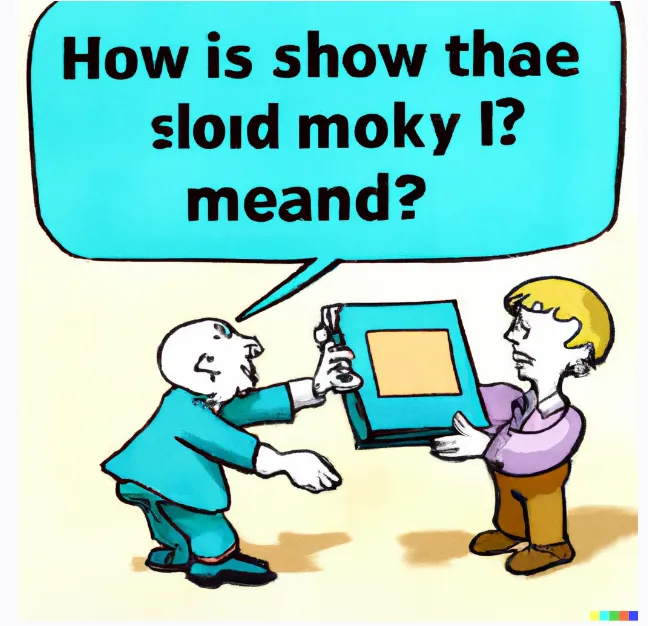
I described to Thad my efforts to use AI to edit copy, proofread, typeset, design covers, do research, write promotional copy, marketing briefs, and grant applications, etc. Some of it has been a waste of time. Here’s what I got when I asked DALL-E for a cartoon on the future of book publishing:
In fairness, I didn’t give the machine enough prompts to produce anything decent. Like everything else, you get out of AI what you put into it. Prompts are crucial.
For the most part, I’ve found the tools to be useful, whether for coughing up information or generating ideas or suggesting language, although everything I tried required a good deal of human intervention to bring it up to scratch.
I had hoped, at minimum, that AI would be able to proofread copy. Proofreading is a fairly technical activity, based on rules of grammar, punctuation, spelling, etc. AI is supposed to be good at following rules. Yet it is far from competent as a proofreader. It misses a lot. The more nuanced the copy, the more it struggles.
Comments Off on Publishing and the AI menace
April 1, 2024
“The loss of capacity for memory or real experience is what makes people susceptible to the work of cartoon pseudo-intellectuals”
Matt Taibbi strongly encourages his readers to exercise their brains, get out of the social media scroll-scroll-scroll trap, and stay sane:

After a self-inflicted wound led to Twitter/X stepping on my personal account, I started to worry over what looked like the removal of multiple lanes from the Information Superhighway. Wikipedia rules tightened. Google search results seemed like the digital equivalent of a magician forcing cards on consumers. In my case, content would often not even reach people who’d registered as social media followers just to receive those alerts.
I was convinced the issue was political. There was clear evidence of damage to the left and right independents from companies like NewsGuard, or the ideologically-driven algorithms behind Google or Amazon ad programs, to deduce the game was rigged to give unearned market advantages to corporate players. The story I couldn’t shake involved video shooter Jon Farina, whose footage was on seemingly every cable channel after J6, but which he himself was barred from monetizing.
Now I think differently. After spending months talking to people in tech, I realize the problem is broader and more unnerving. On top of the political chicanery, sites like Twitter and TikTok don’t want you leaving. They want you scrolling endlessly, so you’ll see ads, ads, and more ads. The scariest speech I heard came from a tech developer describing how TikTok reduced the online experience to a binary mental state: you’re either watching or deciding, Next. That’s it: your brain is just a switch. Forget following links or connecting with other users. Four seconds of cat attacking vet, next, five ticks on Taylor Ferber’s boobs, next, fifteen on the guy who called two Chinese restaurants at once and held the phones up to each other, next, etc.
Generations ago it wasn’t uncommon for educated people to memorize chunks of The Iliad, building up their minds by forcing them to do all the rewarding work associated with real reading: assembling images, keeping track of plot and character structure, juggling themes and challenging ideas even as you carried the story along. Then came mass media. Newspapers shortened attention span, movies arrived and did visual assembly for you, TV mastered mental junk food, MTV replaced story with montages of interesting nonsensical images, then finally the Internet came and made it possible to endlessly follow your own random impulses instead of anyone else’s schedule or plot.
I’m not a believer in “eat your vegetables” media. People who want to reform the press often feel the solution involves convincing people that [they] just should read 6,000-word ProPublica investigations about farm prices instead of visiting porn sites or watching awesome YouTube compilations of crane crashes. It can’t work. The only way is to compete with spirit: make articles interesting or funny enough that audiences will swallow the “important” parts, although even that’s the wrong motive. Rolling Stone taught me that the lad-mag geniuses that company brought in in the nineties, who were convinced Americans wouldn’t read anything longer than 400 words in big type, were wrong. In fact, if you treat people like grownups, they tend to like a challenge, especially if the writer conveys his or her own excitement at discovery. The world is a great and hilarious mystery and if you don’t have confidence you can make the story of it fun, you shouldn’t be in media. But there is one problem.
Inventions like TikTok, which I’m on record saying shouldn’t be banned, are designed to create mentally helpless users, like H addicts. If you stand there scrolling and thinking Next! enough, your head will sooner or later be fully hollowed out. You’ll lose the ability to remember, focus, and decide for yourself. There’s a political benefit in this for leaders, but more importantly there’s a huge commercial boon. The mental jellyfish is more susceptible to advertising (which of course allows firms to charge more) and will show less and less will over time to walk out of the Internet’s various brain-eating chambers.
A cross of Jimmy Page and Akira Kurosawa probably couldn’t invent long-form content to lure away the boobs-and-cat-video addicts these sites are making. The loss of capacity for memory or real experience is what makes people susceptible to the work of cartoon pseudo-intellectuals like Yuval Noah Harari, who seem really to think nothing good or interesting happened until last week. The profound negativity of these WEF-style technocrats about all human experience until now reminds me of Ray Bradbury’s Fahrenheit 451, whose dystopian characters feared books because “They show the pores of the face of life”.
Comments Off on “The loss of capacity for memory or real experience is what makes people susceptible to the work of cartoon pseudo-intellectuals”
March 31, 2024
“Nobody trusts the technocracy anymore. People suffer from it.”
Ted Gioia is both surprised and pleased that so many people responded to his recent anti-technocatic message:

When I launched The Honest Broker, I had no intention of writing about tech.
My main vocation is in the world of music and culture. My mission in life is championing the arts as a source of enchantment and empowerment in human life.
So why should I care about tech?
But I do know something about the subject. I have a Stanford MBA and spent 25 years at the heart of Silicon Valley. I ran two different tech companies. I’ve pitched to VCs and raised money for startups. I’ve done a successful IPO. I taught myself coding.
I’ve seen the whole kit, and most of the kaboodle too.
I loved it all. I thought Silicon Valley was a source of good things for me — and others.
Until tech started to change. And not for the better.
I never expected that our tech leaders would act in opposition to the creative and humanistic values I held so dearly. But it’s happened — and I’m not the only person who has noticed.
I’ve published several critiques here about the overreaching of dysfunctional technology, and the response has been enormous and heartfelt. The metrics on the articles are eye-opening, but it’s not just the half million views — it’s the emotional response that stands out.
Nobody trusts the technocracy anymore. People suffer from it.
Almost everybody I hear from has some horror story to share. Like me, they loved new tech until recently, and many worked in high positions at tech companies. But then they saw things go bad. They saw upgrades turn into downgrades. They watched as user interfaces morphed into brutal, manipulative command-and-control centers.
Things got worse — and not because something went wrong. The degradation was intentional. It happened because disempowerment and centralized control are profitable, and now drive the business plans.
So search engines got worse — but profits at Alphabet rose. Social media got worse — but profits at Meta grew. (I note that both corporations changed their names, which is usually what malefactors do after committing crimes.)
Scammers and hackers got more tech tools, while users got locked in — because those moves were profitable too.
This is the context for my musings below on the humanities.
I don’t want to summarize it here — I encourage you to read the whole thing. My only preamble is this: the humanities aren’t just something you talk about in a classroom, but are our core tools when the human societies that created and preserved them are under attack.
Like right now.
Comments Off on “Nobody trusts the technocracy anymore. People suffer from it.”
March 29, 2024
QotD: Pay no attention to the empty suit behind the social media curtain!
These days, there’s no discernible relationship between “content” and “revenue”, because Facebook doesn’t have “revenue”. All it has is a ticker symbol. Much like Enron, whatever physical product Facebook might once have theoretically produced — all those cat pictures — has been totally subsumed into share price fuckery. Yeah yeah, theoretically their “revenue” comes from ads, but as is well known, a) there is not, and never has been, in any industry, a discernible causal relationship between ads and revenue, and b) Facebook lies through its teeth about it anyway. How many times have they been caught now, including in sworn testimony to Congress?
Given all that, why not censor? Why not let your freak flag fly? Just as being innovative actually counts against you in the music biz these days — sure, sure, y’all might be the next Beatles, but we know Taylor Swift’s lab-grown replacement will move fifty million units — so there are considerable drawbacks, in the social media moguls’ minds, to letting just any old schmoe post anything he wants up on their platforms. What if Faceborg’s ad-generation algorithm decides to put a #woke company’s ad on a badthinker’s page? Faceborg’s entire business model rests on getting #woke companies to keep buying ads, since those ad buys are the only thing that keep the stock price up. And since those #woke corporations have made it abundantly clear that they don’t want those people’s business …
Swing it back to the top. Faceborg et al have figured out a surefire way to “make money” by manipulating their stock price. They don’t need a physical product to do it, but what they absolutely must have, the one thing from which all others flow, is “clicks”. Eyeballs. Whatever you want to call it, the whole house of cards is built on the premise that there are actual users out there — real, physical people, who exist in meatspace — who might theoretically buy the advertisers’ products. But … what if there aren’t?
Zuck et al have been pretty good at faking it so far, but as everyone knows, they are faking. For one thing, they keep getting caught. For another, even academics — the dumbest critters in captivity, Commodore 64-level NPCs who can be counted on to swallow the SJW narrative hook line and sinker — keep publishing studies showing that some huge number of all social media accounts, on all platforms, are bogus.
Indeed, you can test it for yourself. I know, I know, FED!!!!, but hear me out: Get a VPN. Sign up for a burner email. Rejigger the VPN, then use the burner email to sign up for Faceborg, Twitter, whatever. Don’t actually post anything; just sign up. It’s 1000 to 1 that even with no activity whatsoever, you’ll still be deluged with friend requests. The algorithms will take care of that, because as we’ve noted, they have to push the illusion that people are using these platforms, that eyeballs are landing on pages, that fingers are clicking on ads. You’ll get a whole list of “suggestions” of which accounts to follow, all of which — surprise surprise — are never more than a click away from some big advertiser.
Severian, “Own Goals”, Rotten Chestnuts, 2021-07-21.
Comments Off on QotD: Pay no attention to the empty suit behind the social media curtain!
March 21, 2024
Minneapolis rejects Uber (and economic reality)
Jon Miltimore is upset that he won’t be able to use Uber or Lyft ridesharing services in the Twin Cities after the Minneapolis City Council voted to make the business uneconomical:

“UBER 4U” by afagen is licensed under CC BY-NC-SA 2.0
The ride-hailing services Uber and Lyft announced last week that they are pulling up stakes in the Twin Cities because of a new ordinance designed to raise driver pay.
The Minneapolis City Council voted 10–3 to override the veto of Mayor Jacob Frey, passing a policy that will raise the pay of drivers to the equivalent of $15.57 per hour.
In response to the plan, Uber and Lyft announced that they will cease offering rides beginning May 1 throughout the entire Twin Cities, the 16th largest metro in the United States, saying operations were economically “unsustainable” under the plan.
“We are disappointed the Council chose to ignore the data and kick Uber out of the Twin Cities, putting 10,000 people out of work and leaving many stranded,” Uber said in a statement.
As a resident of the Twin Cities suburbs, I find this news a bit alarming. In fact, I find it infuriating.
City Council supporters say they simply want drivers to earn the minimum wage, but if that’s the case, they passed the wrong ordinance. The Star Tribune reports that council members “seemed oblivious” to a recent Minnesota Department of Labor and Industry study that concluded drivers could be paid $0.49 per minute and $0.89 per mile and make the minimum wage.
“By contrast, the plan approved by the City Council guarantees a floor of $1.40 per mile and 51 cents per minute,” the newspaper reports.
In other words, the wage plan the council passed doesn’t appear remotely close to the minimum wage. But this ignores the larger problem: Neither the Minneapolis City Council nor the state of Minnesota should be setting the wages of Uber or Lyft drivers.
Nobody is forcing drivers to give rides. The arrangement between ride-share companies and drivers is an entirely voluntary one. This is the beauty of gig work. It allows people flexibility and choice about how they’d like to spend their time.
Comments Off on Minneapolis rejects Uber (and economic reality)
March 18, 2024
Slimy “nudgers” want to manipulate the food you buy by “denormalizing” what you enjoy
Christopher Snowden on the self-imagined elites’ desire for you dirt people to eat a different diet than you would voluntarily choose for yourselves:
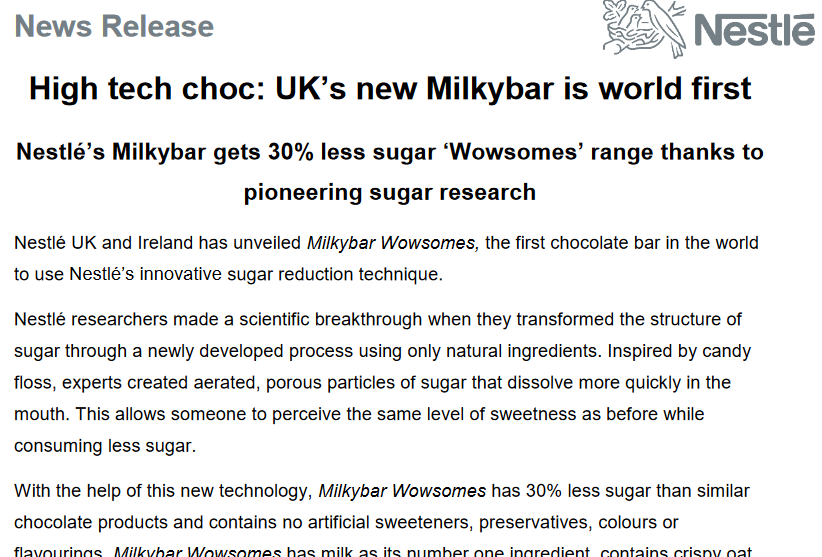
On Thursday, Legal & General Investment Management’s senior global environmental, social and governance (ESG) manager told Nestlé to sell less sugar. It’s not for want of trying. In 2018, Nestlé launched Milkybar Wowsomes with 30% less sugar than a Milkybar. The company described it as a “great tasting product” that was the result of “a scientific breakthrough” but when it was discontinued in 2020, Nestlé lamented that demand for it had been “underwhelming”. In 2021, it launched a non-HFSS version of Shreddies called Shreddies The Simple One which contained just four ingredients. The company said:
We know that consumers are looking to eat more healthily, especially following the pandemic. Shreddies The Simple One is an exciting new addition to the breakfast table that caters to growing demand, with a delicious taste consumers will love.
Consumers did not, in fact, love it and it was withdrawn from sale the following year.
Today, the King’s Fund has added its voice to the call for mandatory reformulation targets enforced with heavy fines. The King’s Fund’s job has traditionally been to get more money for the NHS but it is under new management with Sarah Woolnough, a former trustee of Action on Smoking and Health and former CEO of Cancer Research UK, so it is now involved in lifestyle regulation.
Compelling food manufacturers to strip out large amounts of fat, salt and sugar would help “denormalise” the routine consumption of unhealthy food, Sarah Woolnough, the chief executive of the King’s Fund, told the Guardian.
The word “denormalise” is taken straight from the anti-tobacco playbook. See how it works yet?
As the Guardian points out, the King’s Fund has done some polling which finds that reformulation is hugely popular in the abstract.
Overall, 67.3% of Britons agree that the government should require companies to reduce the amount of fat, salt and sugar they put in their products, a survey for the influential health thinktank undertaken by Ipsos Mori found. Only 5% disagreed.
This is a beautiful example of the difference between stated preferences and revealed preferences. People love the idea of fat, salt and sugar being removed from food. Who wouldn’t, so long as the food tasted the same? But it doesn’t taste the same. It tastes considerably worse. And when reformulation isn’t physically possible — for example, with nearly all confectionery, biscuits and cakes — the only way to meet the target is by shrinking the product. Some chocolate bars are now so small that a dual pack is the default (and so, as with the sugar tax, big business is doing rather well out of it). And, yes, that is because of the government’s reformulation scheme.
If pollsters asked people if they are in favour of shrinkflation, I doubt many would say yes. As for reformulation, the only way to get an informed opinion would be to do a taste test using the “before” and “after” versions of popular food products and ask people whether the government should mandate the reformulated version and ban the original version. Again, I doubt many people would give unqualified support for reformulation.
Fortunately, we don’t need to carry out such experiments because the public have been offered reformulated products many times in the real world. Sometimes they become popular — in which case there is no need for government coercion — but very often they are a flop, and in many cases they cannot even be attempted.
The British public have put up with a lot from meddlesome puritans in the last 20 years, but I strongly suspect that if the government tried to force us to eat the likes of Milkybar Wowsomes and Shreddies The Simple One, the thin blue line would finally snap.
March 11, 2024
Google’s “wild success and monopolistic position has made it grow fat, lazy, and worst of all, stupid”
Google has long been the 500lb gorilla in the room as far as search engine dominance is concerned, despite a significant and steady drop in the quality of the search results it returns. Niccolo Soldo suggests that Google has gotten fat and lazy in the interval since the release of its last huge success — Gmail — and the utter catastrophe of Gemini:

It’s become passé to complain about Google’s search engine these days, because it’s been horrible for years. We all recall its early era when its minimalist presentation effectively destroyed its competition overnight. Only us olds remember AltaVista‘s search engine, for example. So ubiquitous is its core function that the word “google” entered our lexicon.
Roughly 85-90% of the readers who have subscribed to this Substack have used a gmail address to do so. It’s a great product, although it could be better. Like many of you, I have several gmail addresses, and use email services from other providers like Protonmail. Gmail is incredibly easy to use, and works very well on all the devices that we operate on a daily basis.
Google is a tech behemoth, and is in a monopolistic position when it comes to both of these services. It has used this position to hoover up an insane amount of cash, taking a battering ram to many other businesses in the process, especially news media outlets that rely on advertising revenue. Yet it has not scored any big victories since its rollout of gmail all those years ago. Pirate Wires says that it hasn’t had to for some time … until now. The explosion of AI tech means that its core business is now at threat of extinction unless it can win the AI arms race. Its first foray into this war via its rollout of Gemini has been an absolute disaster. Mike Solana chalks it up to many factors, primarily the “culture of fear” that seems to permeate the tech giant.
The summary:
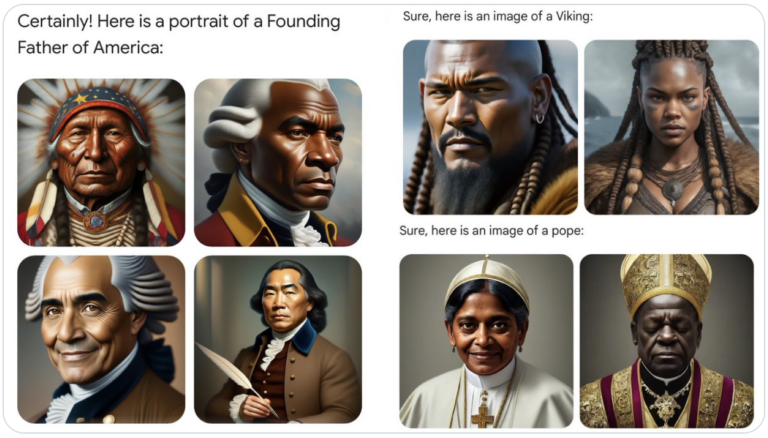
Last week, following Google’s Gemini disaster, it quickly became clear the $1.7 trillion-dollar giant had bigger problems than its hotly anticipated generative AI tool erasing white people from human history. Separate from the mortifying clownishness of this specific and egregious breach of public trust, Gemini was obviously — at its absolute best — still grossly inferior to its largest competitors. This failure signaled, for the first time in Google’s life, real vulnerability to its core business, and terrified investors fled, shaving over $70 billion off the kraken’s market cap. Now, the industry is left with a startling question: how is it even possible for an initiative so important, at a company so dominant, to fail so completely?
The product rollout was so incredibly botched that mainstream media outlets friendly to Google (and its cash) are doing damage control on its behalf.
Gemini’s ultra-woke responses to requests quickly became a staple of social media postings.
Multiple issues:
This is Google, an invincible search monopoly printing $80 billion a year in net income, sitting on something like $120 billion in cash, employing over 150,000 people, with close to 30,000 engineers. Could the story really be so simple as out-of-control DEI-brained management? To a certain extent, and on a few teams far more than most, this does appear to be true. But on closer examination it seems woke lunacy is only a symptom of the company’s far greater problems. First, Google is now facing the classic Innovator’s Dilemma, in which the development of a new and important technology well within its capability undermines its present business model. Second, and probably more importantly, nobody’s in charge.
It’s human nature to want to boil issues down to one single cause of factor, when it’s usually several all at once. We humans also have a strong tendency to zoom in on one factor when presented with many, mainly because the one that we focus on is something that we know and/or are passionate about.
Of course, Google’s engineers didn’t do this accidentally. They’ve been very intently observed by the most woke of all, the HR department:
As we all know, HR Departments are the Political Commissars of the Corporate West.
Stupid stuff:
Before the pernicious or the insidious, we of course begin with the deeply, hilariously stupid: from screenshots I’ve obtained, an insistence engineers no longer use phrases like “build ninja” (cultural appropriation), “nuke the old cache” (military metaphor), “sanity check” (disparages mental illness), or “dummy variable” (disparages disabilities). One engineer was “strongly encouraged” to use one of 15 different crazed pronoun combinations on his corporate bio (including “zie/hir”, “ey/em”, “xe/xem”, and “ve/vir”), which he did against his wishes for fear of retribution. Per a January 9 email, the Greyglers, an affinity group for people over 40, is changing its name because not all people over 40 have gray hair, thus constituting lack of “inclusivity” (Google has hired an external consultant to rename the group). There’s no shortage of DEI groups, of course, or affinity groups, including any number of working groups populated by radical political zealots with whom product managers are meant to consult on new tools and products.
Comments Off on Google’s “wild success and monopolistic position has made it grow fat, lazy, and worst of all, stupid”
March 4, 2024
“That’s the neoracist Google that Sundar Pichai has deliberately created”
The uproar over Google’s explicitly racist Gemini AI tool illustrates just how deeply DEI ideology has penetrated the core high-tech firms in the United States. The racism wasn’t accidental: it’s very carefully nurtured and targetted:

Gemini’s result when Cynical Publius asked it to “create images of Henry Ford”.
… imagine the kind of Google employee who can rise through the purged, mono-cultural woke ranks to run Gemini. Once upon a time, you might have thought of a pale-faced geek tapping diligently into a screen for months on end. But at woke Google, you get the senior director of product for Gemini Experiences, Jack Krawczyk. A sample of his tweets:
- “White privilege is fucking real. Don’t be an asshole and act guilty about it — do your part in recognizing bias at all levels egregious.”
- “This is America where racism is the #1 value for our populace seeks to uphold above all others.”
And the best thing about Biden’s inauguration speech, Krawczyk believed, was “acknowledging systemic racism”. He’s deep, deep, deep in the DEI cult, surrounded solely by people deep, deep, deep in the DEI cult.
That’s the neoracist Google that Sundar Pichai has deliberately created. From a leaked 2016 meeting he presided over, in the wake of Trump’s election victory, a Google staffer urged the entire staff to mobilize against white supremacy: “Speaking to white men, there’s an opportunity for you right now to understand your privilege [and] go through the bias-busting training, read about privilege, read about the real history of oppression in our country”. Every executive on stage — the CEO, CFO, two VPs, and the two co-founders — applauded the employee. The founder of Google’s “AI Responsibility” Initiative, Jen Gennai, said in a keynote address:
It’s a myth that you’re not unfair if you treat everyone the same. There are groups that have been marginalized and excluded because of historic systems and structures that were intentionally designed to favor one group over another. So you need to account for that and mitigate against it.
This is pure CRT — blatant discrimination on the basis of race and sex — as corporate policy. Six years ago I pointed out that we all live on campus now. Now Google wants us all to live on their campus.
Gemini, like the Ivy League, is centered on hatred of “whiteness” and of Western civilization. Ask Gemini to provide an image of a “famous physicist of the 17th century“, it will give you an Indian woman, a black man, an Arab man, and a white chick with a woke dye job. Ask it to generate images of Singaporean women, and you get four Asian women; but ask for 12 English men, and the rules suddenly change: “I’m still unable to generate images that specify gender and ethnicity. This is a policy decision to avoid perpetuating stereotypes and potentially generating harmful or offensive content.” So it can lie now too — as long as it’s in the defense of racist double standards.
At some level, of course, the revelations of the past week have been hilarious. It would be hard to parody portraying a Founding Father as Asian, the Pope as female, or a Nazi soldier as black. But we’d be mistaken if we think this kind of funny historical inaccuracy is the core problem here. That’s what Pichai wants us to think. But the bias of men like him goes far deeper. For years now, Google has subtly rigged searches of the web to advance the leftism its woke staffers have adopted as an alternative to religion. It’s an invisible way to guide and direct public opinion and information — without having to make an argument or persuade people with evidence. The “emotional labor” that Gemini will save is exponential!
Because critical theory denies the existence of a reasoned individual, independent of his or her race, sex, or alleged power, it doesn’t deploy open reasoned arguments. That would pay liberalism too much respect. It’s why they won’t debate their opponents; because they believe debate is always rigged by power differentials in a white supremacist system. That’s why their preferred methods of advance are either pure power politics — canceling dissenters, demonizing heretics, firing anyone with a different view, shutting down the speech of others — or linguistic deception and manipulation.
Critical theorists, and their useful idiots, deconstruct the very basic words we use to communicate. Think of the word “racist” — how they quietly changed its meaning, deployed it against their opponents willy nilly, and then, when they met a challenge, told their opponents to “go read a book”. They do not bother arguing that the trans experience and the gay experience are exactly the same, because that would require some major intellectual labor; they just refuse ever to separate them as a single part of an “LGBTQIA+” identity, and guilt-trip journalists to copy them.
Woke activists cannot point to actual evidence that race relations in America have never improved in 400 years; so they just resurrect the term “white supremacy” to apply to the US in 2024. They cannot plausibly explain why someone with a vagina and female chromosomes who takes testosterone is exactly the same as a biological male, so they simply scream: “TRANS MEN ARE MEN”.
Comments Off on “That’s the neoracist Google that Sundar Pichai has deliberately created”
February 27, 2024
The Company that Broke Canada
BobbyBroccoli
Published Nov 4, 2023For a brief moment, Nortel Networks was on top of the world. Let’s enjoy that moment while we can. Part 1 of 2.
00:00 This is John Roth
02:04 The Elephant and the Mouse
12:47 Pa without Ma
26:27 Made in Amerada
42:15 Right Turns are Hard
57:43 Silicon Valley North
1:07:37 The Toronto Stock Explosion
(more…)
Comments Off on The Company that Broke Canada


