
11 Dickens, as you know, never got round to starting his home page.
12 I once absent-mindedly ordered Three Mile Island dressing in a restaurant and, with great presence of mind, they brought Thousand Island Dressing and a bottle of chili sauce.
13 I didn’t go to university. Didn’t even finish A-levels. But I have sympathy for those who did.
14 It is said that your life flashes before your eyes just before you die. That is true, it’s called Life.
15 Only in our dreams are we free. The rest of the time we need wages.
16 The trouble with having an open mind, of course, is that people will insist on coming along and trying to put things in it.
17 Five exclamation marks, the sure sign of an insane mind.
18 Taxation is just a sophisticated way of demanding money with menaces.
19 The pen is mightier than the sword if the sword is very short, and the pen is very sharp.
20 Most of the great triumphs and tragedies of history are caused not by people being fundamentally good or fundamentally evil, but by people being fundamentally people .
Selected by Martin Chilton for The Telegraph, 2015-08-27.
December 13, 2015
QotD: A few more selected Terry Pratchett quotes
December 9, 2015
SF “war in space” memes of improbability
Charles Stross explains several SF novel shibboleths that make him want to hurl the book against the nearest wall, including so many “war in space” stories:
Newton’s Second Law, for dummies. E = 1/2 * (mv2) — it’s not just a good idea, it’s the law. Notice the huge distances I alluded to above? Well, to get between planet A and planet B in anything approximating reasonable human time spans, you need to go fast. And if you go fast, your velocity relative to the bodies around you is also high. In event of an inelastic collision the kinetic energy transfer is proportional to the square of your velocity; and this has drastic consequences for space ships. Suppose you’re in low Earth orbit and you hit a piece of space junk, for example a screw that’s fallen off someone else’s ship. It’s traveling in pretty much the same orbit as you, but inclined at 30 degrees. What happens? What happens is you get a happy fun experience much like being hit by a bullet from a high-calibre sniper’s rifle, because (I can’t be bothered to do the trig here) it’s packing a velocity component angled across your path at a goodly fraction of orbital velocity, and at orbital velocity a kilogram of water packs kinetic energy equal to about ten times its mass in exploding TNT.
You know what a high-speed car crash looks like, right? Space ships travel a lot faster than that: if they hit something, it’s going to be very messy indeed. And that’s at sluggish orbital velocities; if you starship is barreling along at about 85% of the speed of light general relativity has something to say on the subject and it’s kinetic energy is equal to about half it’s rest mass — the equivalent of a 10 megaton hydrogen bomb for every kilogram of hull weight. (The pilot’s space-suited body alone packs the energetic punch of a Peak Strangelove 1980s USA/USSR strategic nuclear exchange.)
Human bodies are basically squishy sacks of goopy grease and water emulsions held together by hydrogen bonds and disulphide bridges between protein molecules and glommed onto some big lumps of high-grade chalk. We evolved in a forgiving, water-dominated low-velocity world where evolution didn’t bequeath us nervous systems able to comprehend and deal with high energy interactions other than in an “ooh, that lightning bolt was close! Where’s cousin Ugg?” kind of way. We can’t even see objects that flash across our visual field in less than 50 milliseconds — a duration in which, at orbital velocity, an object will have travelled on the order of half a kilometer.
Intuition and high energy regimes: do the math, or your space combat will be a whole bundle of nope.
(Other related cognitive errors include but are not limited to: Napoleonic navies clashing in space and firing broadsides back and forth at one another’s line of battle … spaceships with continuous high acceleration fusion-powered motors or similar that don’t glow white-hot then melt because vacuum is an insulator and shedding that much heat is a hard engineering problem (hint: a 100 ton spaceship accelerating at 1g requires 1 megaJoule of thrust: using a photon rocket for maximum efficiency that’s going to require 3 x 10¹⁵ watts of juice going in, if it’s 99.9% effective at heat dissipation that means it’s racking up around three terawatt of leakage, and that’s equivalent to about 45 kilotons of nuclear explosions per minute of waste heat) … warships using active radar to hunt for one another (hint: active sensor reach is inversely proportional to the fourth power of the emission strength, passive sensors obey the inverse square law) … warships using stealth in space (hint: infrared emissions, second hint: the background temperature you want to avoid standing out against is 2.73 degrees Kelvin, i.e. liquid Helium temperature) …
Oh for fuck’s sake, don’t get me started on war in space, we’ll be here forever unless we just throw physics to the winds of fiction and delegate all our hand-waving to magic hyperspace or cyberspace technology or something.
December 6, 2015
QotD: A few selected Terry Pratchett quotes
1 Stories of imagination tend to upset those without one.
2 A marriage is always made up of two people who are prepared to swear that only the other one snores.
3 Geography is just physics slowed down, with a couple of trees stuck in it.
4 An education was a bit like a communicable sexual disease. It made you unsuitable for a lot of jobs and then you had the urge to pass it on.
5 The truth may be out there, but the lies are inside your head.
6 Give a man a fire and he’s warm for the day. But set fire to him and he’s warm for the rest of his life.
7 Real stupidity beats artificial intelligence every time.
8 In ancient times cats were worshipped as gods. They have not forgotten this.
9 The space between the young readers eyeballs and the printed page is a holy place and officialdom should trample all over it at their peril.
10 “Educational” refers to the process, not the object. Although, come to think of it, some of my teachers could easily have been replaced by a cheeseburger.
Selected by Martin Chilton for The Telegraph, 2015-08-27.
December 5, 2015
A life of crime … derailed
At American Digest, Gerard Van der Leun recalls how his budding teenage life of crime was brought to a sudden halt:
As a teenager my addiction to science fiction paperbacks often came into conflict with my ongoing cash-flow problem. To wit, I hadn’t any. But, for a few brief, shining weeks I did discover a resource better than cash for acquiring science-fiction paperbacks — my pants.
Yes, at some point it dawned on my tiny teenage brain that, if I could just get these piles of paper down the front of my pants and walk without a waddle out the door of the store, the latest Asimov or Heinlein would be free. What was even better was my discovery that I could, after reading these stolen gems, take them back to the bookstore from which I boosted them and sell them back to that dull owner for a credit to buy other paperbacks. Cost of stock: $0, Price received: $0.25, Profit — infinite. What a business! I was a confirmed capitalist. I even thought of a name for my company, World Wide Pants, and was quite upset years later when David Letterman stole it from me.
Of course I knew on some level that stuffing things down my pants, waddling out of a store and then coming back later to sell the purloined items back was …. a teeny bit wrong. But the bookstore owner had so many science fiction books and I had so few. “From bookstores according to their stock, to me according to my need to read,” seemed to be my moral code at the time. Besides, I wasn’t “really” stealing them because I “returned” them for a fee. It was a way of letting the bookstore owner sort of reverse-rent them to me.
I started small — maybe a slim collection of short stories like The Green Hills of Earth, or a novella such as “Children of the Atom,” would find their way to their temporary home between my belt and my underwear. But then I decided to expand. After all, it seemed to me that my pants had room to spare especially if I let my shirt tails hang out. Once that was in my mind, I started to up the ante and began to go for multiple copies of Ace Doubles. My pants became, in effect, a small bookshelf.
The owner of the bookstore down in the slums of Sacramento was, I was certain, clueless as to what was going on. He was a wispy simulacra of William Burroughs with the gray haze of alcohol hovering about him and a tendency to give me a smile that was a little too warm whenever I came into the shop. He’d often disappear into a curtained nook with the sign “Special Titles — Ask for admittance” thumbtacked to the bookshelf next to it.
My undoing came one day when I think I had probably added a full two inches to my waistline in the science fiction section. I waddled to the cash register with one tattered copy of some space opera and slid my quarter across the counter. He looked at it, looked at me, took the quarter and slid the book into a flimsy paper bag and handed it back. “See you soon,” he said with a wink. I turned and had gotten out the door and a couple of steps down the sidewalk when the bony hand of retribution clutched my shoulder. “I see you’re gaining a little weight,” he said in a voice that betrayed an unhealthy interest in Lucky Strikes. “I think we need to talk to your parents about this. Come on back in.”
There’s no way to describe the churning, burning hunk of fear that forms in your stomach the first time you’re busted. If, at that moment, you could chose between death and juju, death would win every time — but only because you don’t know that you’ll get death only after juju.
November 30, 2015
Charles Stross cover reveal for The Nightmare Stacks

The Nightmare Stacks (UK edition)
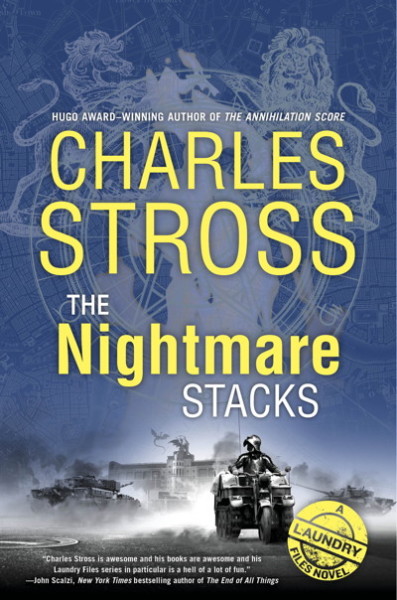
The Nightmare Stacks (North American edition)
Charlie Jane Anders talked to Charles about the book and the series:
How has the Laundry Files series changed and evolved in the dozen years or so that you’ve been writing it? Are there elements that you’re still surprised became so prominent?
I’ve been writing the Laundry Files series for 16 years at this point. When I began, I intended the short novel “The Atrocity Archive” (published with “The Concrete Jungle” in the book The Atrocity Archives — note the plural!) as a one-shot. It was only a few years later, when people began asking for more, that I had any idea of writing a sequel, and only with the third book, 8 years in, that I realized I needed a Plan. And because the book’s narrator, Bob, had been aging in line with the real world as I wrote the first three books, the most obvious plan was: track Bob’s career as he grows older, more senior, and more cynical.
This turned out to be a really fortuitous choice. It allowed me to fix some minor inconsistencies in the earlier books; because they’re Bob’s workplace memoir, he often gets the wrong end of the stick at first then learns better about some aspect of the job over time. It also allowed me to deepen him as a character, adding complexity to the narrative as he ages and possibly becomes more self-aware (although he doesn’t really have to grow up until books 8 or 9).
What I really wasn’t expecting was that Bob’s life would take over — and that the most important events in it would end up taking place off-screen, so far off-screen that I needed to pick new narrative voices! His wife Mo, for example, exhibits a very unvarnished perspective on Bob’s seemingly bottomless reserves of self-delusion in The Annihilation Score, and demonstrates that the series is very much about the Laundry as an organization, rather than just being Tales of Bob. And in The Nightmare Stacks I had to leave Bob behind entirely in order to give a worm’s eye view of the start of events that will give rise (eventually) to the climax of the series.
This book features a new character, Alex, instead of Bob. What’s the reason for switching focus?
In The Atrocity Archives Bob starts out as a twenty-something tech support guy who has blundered into a Len Deighton spy thriller (with added tentacles). By the start of The Rhesus Chart, Bob has leveled up so far that he can wade into a nest of vampires — admittedly rather inexperienced vampires — and escape with mildly damaged dignity and a stack of paperwork. Power-ups are a constant problem for any multi-book series that riffs off the Hero’s Journey: how do you engage with the underdog when your protagonist has risen from Midshipman to Admiral of the Fleet?
Alex is in some ways not dissimilar to Bob in his early incarnation. There are drastic differences: Alex has powers of his own — although they come at a drastic price. But Alex takes us back to the guy who gets sent to fix the cabling rather than spending all his time in policy meetings. And he’s got a young guy’s problems and social anxieties, unlike Bob (who by this point is in his early forties).
November 18, 2015
QotD: Piketty’s pessimism
Piketty’s theory is that the yield on capital usually exceeds the growth rate of the economy, and so the share of capital’s returns in national income will steadily increase, simply because interest income is growing faster than the income the whole society is getting. Let us therefore bring in the government to implement “a progressive global tax on capital” — to tax the rich. It is, he says, our only hope. Reading the book is a good opportunity to understand the latest of the leftish worries about capitalism, and to test its economic and philosophical strength. Piketty’s worry about the rich getting richer is indeed merely the latest of a long series going back to Thomas Malthus, David Ricardo, and Karl Marx. Since those founding geniuses of classical economics, trade-tested progress has enormously enriched large parts of humanity — which is now seven times larger in population than in 1800 — and bids fair in the next 50 years or so to enrich everyone on the planet. And yet the left routinely forgets this most important secular event since the invention of agriculture — the Great Enrichment of the last two centuries — and goes on worrying and worrying in a new version every half generation or so.
All the worries, from Malthus to Piketty, share an underlying pessimism, whether from imperfection in the capital market or from the behavioral inadequacies of the individual consumer or from the Laws of Motion of a Capitalist System. During such a pretty good history from 1800 to the present, the economic pessimists on the left have nonetheless been subject to nightmares of terrible, terrible faults. Admittedly, such pessimism sells. For reasons I have never understood, people like to hear that the world is going to hell, and become huffy and scornful when some idiotic optimist intrudes on their pleasure. Yet pessimism has consistently been a poor guide to the modern economic world.
Deirdre N. McCloskey, “How Piketty Misses the Point”, Cato Policy Report, 2015-07.
November 15, 2015
The more likely explanation for the fall in eBook sales
Sarah Hoyt explains why you should be darned careful not to base your business plans on wishful thinking:
Of course ebooks from traditional publishers are a) unreasonably priced (No, really. There is a book I’m dying to get. It’s $17 for ebook. It’s $32 for the hardcover. You know, I have KULL subscription and the indie books aren’t as good as this particular book should be, but it takes a lot of not as good at 9.99 a month to compare to those prices.) b) often stupidly formatted/edited c) even more often on themes/by authors I have no interest in. (Other than Baen, I currently read two other authors. Period. Oh, and one in mystery.)
Or to put it another way, traditional publishers went to war with Amazon to be allowed to price their books astronomically high. Amazon let them. They priced books at same price as hardcover or a little under (a very little.) E-book sales fell, compared to what they were when books were tops 9.99. Um….
Let me see if I can explain this as I would a child: your little friends love and adore your cupcakes. So you decide to set up shop and make a batch in your easy-bake oven, and sell them for ten cents a piece. Since your friends’ on average have an allowance of a dollar a week, you sell out of the whole batch in hours. So you think “Hey, I can make more.” You set the price at a dollar per cupcake. No one buys them. Your conclusion is “My friends no longer like cupcakes and prefer to eat vegetable sticks.”
Would anyone but a two year old buy that narrative? Well, according to publishers this is a perfectly sane thing to say. I mean, if people won’t buy your overpriced ebooks, it must mean they are going back to paper. Happy days are here again. Let’s build warehouses for all those books we’ll be shipping out to the no-longer existent big-chain bookstores! We’ll be able to control what books make it by our push again! We’re rich, rich, I tell you.
But it’s not just publishers. A friend sent me this article, and I scratched my head and frowned at it and said, in my deep thinking way, “Wut?” This is sort of like if you told your mom your friends’ refusal to buy your $1 a piece cupcakes was because they liked celery more and she said “Sounds legit. For your birthday party we’ll have ONLY celery.”
November 12, 2015
“Camille Paglia is an intellectual flamethrower”
In The Chronicle of Higher Education, Rachel Toor talks to Camille Paglia:
Not long after she had splashed onto the scene with the publication of her first book, Sexual Personae: Art and Decadence From Nefertiti to Emily Dickinson, and followed that up with an essay in The New York Times claiming that Madonna was the future of feminism, I went to see Camille Paglia speak on a panel about political correctness at New York University. My recollection is of being frisked by armed guards before being allowed to enter the auditorium, but it’s more likely we just had to empty our pockets and go through a metal detector. That I thought the extra protection was for the professor from a small arts college in Philadelphia, and not for another speaker on the dais, Edward Said, tells you something about how Paglia was regarded in the circles in which I traveled.
Camille Paglia is an intellectual flamethrower. She’s fearless. She can be bully-mean and a name caller. She makes some people really, really mad. But she’s also a serious thinker who has been able to write important scholarly books that cross over into a wide readership, and you can regularly find her byline in national magazines, where it’s always a treat to read her sentences. Whether she’s writing about the Obama administration, characterizing cats (in Sexual Personae) as the “autocrats of self-interest,” rhapsodizing about The Real Housewives, or bludgeoning feminists, Christopher Hitchens, or Jon Stewart, she is sometimes right and never boring.
I approached her for this series with trepidation. I was eager to hear what she had to say about writing, but, to be honest, I was a little afraid of her (she called my former boss, Stanley Fish, a “totalitarian Tinkerbell”). Silly me. Camille could not have been more gracious, personable, or fun. She did tell me with a bit of glee that my former employer, Oxford University Press, was one of the seven publishers who rejected Sexual Personae. Thankfully that was before I started working there.
November 10, 2015
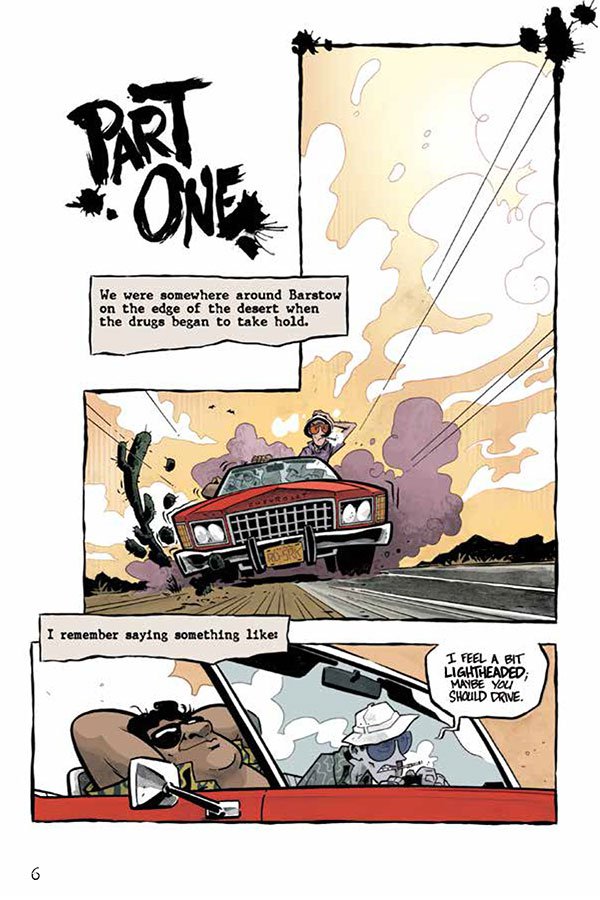
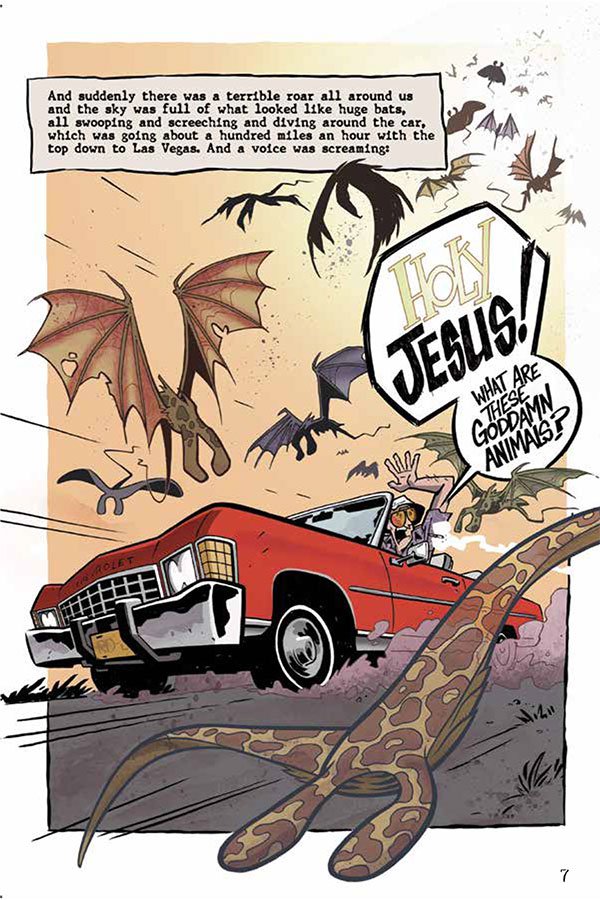
A graphic novelization of Fear and Loathing in Las Vegas
Hunter S. Thompson’s iconic book Fear and Loathing in Las Vegas has been re-imagined in Troy Little’s graphic novel:
November 3, 2015
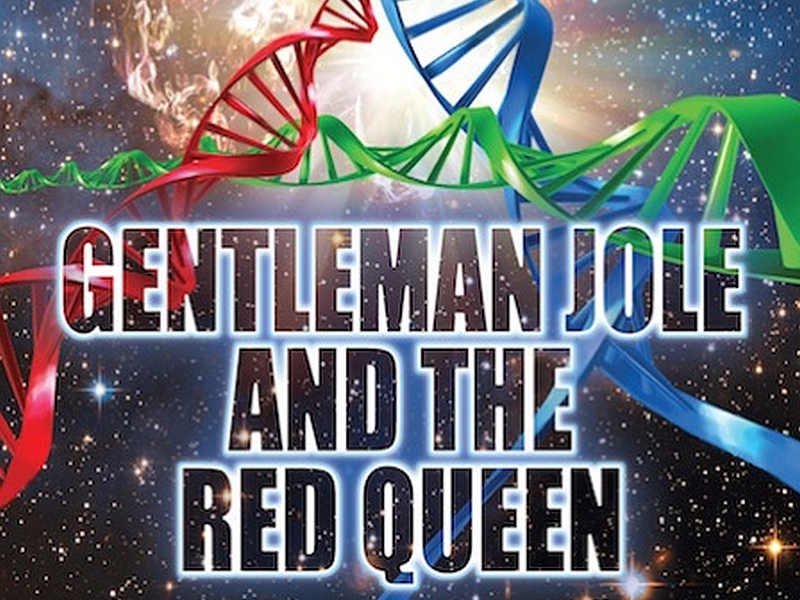
Lois McMaster Bujold’s Gentleman Jole and the Red Queen
The book isn’t out yet, but it’s starting to get some interesting reviews, including this one by Gopal Sathe for NDTV Gadgets 360:
We will not discuss the plot too much here, but we will certainly say that the book is going to be one of the most divisive ones in the series. Not because of its writing, or the twists and turns that the plot follows, but simply because of the subject matter — Bujold has already confirmed to fans that this book is not a war story, and that it is about grown-ups. In classic science fiction fashion, Bujold uses her alien settings and advanced technology to directly address the questions and concerns we are facing today, about age and gender and relationships and modern culture. And she does a brilliant job of it, as usual.
The book does drop a rather big revelation about a major character, and although the groundwork has been laid out in earlier books in the series (if sparingly), it still feels like an unexpected surprise. So it’s a good thing that Bujold gets the twist out of the way quickly, and matter-of-factly. This means that the book is given the breathing room to tell its own story, instead of twisting itself into knots around this revelation.
Outside of the main story, the B-plot figures around some typical Bujold tropes — military and logistics feature heavily, as does urban planning, and inter-cultural relations — but these all feel a little underdeveloped in Gentleman Jole and the Red Queen. But despite a few small missteps, this book feels like one of Bujold’s most cohesive and mature works, and so it’s perhaps fitting that it’s in this book that she finally returns to the planet Sergyar, which was also the stage for Shards of Honor, the first full novel in the Vorkosigan Saga.
There are frequent references and callbacks to the first book, and reflections on how the story has matured over time, and this works really well in establishing a sense of history to the novel. Even if you aren’t familiar with the adventures that the various members of the Vorkosigan family have had, the sense of real characters who have lived storied lives is clear, and does a lot to ground some of the more fanciful creatures and creations that we find in the book.
QotD: Liberal arts programs
… liberal-arts programs have been ailing for decades. The humane thing would be to let them die with whatever modicum of dignity they have left.
My purpose in this essay is not to defend (or attack) “the arts” (the aaaaahts, in my plummiest fake English accent). The arts don’t need defending (or attacking), and even if they did, there are lots of thick books written by people who are far smarter than me making the case. This essay is, instead, a broadside against university humanities departments, which are mostly terrible and not really worth rescuing.
We don’t need university liberal arts programs to expose us to culture. Want some culture in your life? Hit YouTube and you can get all the culture you can choke down, for free. Art, music, dance, guided tours of great museums. Literature? The local library might still have a few books lying around if it hasn’t given itself over completely to being a day-care facility for the homeless. Amazon will sell you any book you want, from The Pilgrim’s Progress to The Brothers Karamazov to The Vagina Monologues and deliver it to your portable reading device in a matter of seconds. Amazon will also sell you a Blu-Ray of any opera or great film you want, and have it delivered right to your door by the next day. (Or stream it right to your TV, iPad, or smartphone.) Embarrassed for funds? You can download tens of thousands of public-domain books, films, and pieces of music for free from a variety of sources. In short, art has been transformed from a luxury good to a commodity good.
“But wait!” the academics cry. “Who’s going to teach you how to understand all this stuff? How to interpret it? How to uncover all the subtleties and meanings in it?”
In this response you get two fallacies for the price of one: that the average citizen requires someone to perform this task, and that universities are capable of performing it even if it were necessary.
Monty, “DOOM (culturally speaking)”, Ace of Spades H.Q., 2014-10-28.
October 19, 2015
October 15, 2015
S.L.A. Marshall, Dave Grossman, and the “man is naturally peaceful” meme
The American military historian S.L.A. Marshall was perhaps best known for his book Men Against Fire: The Problem of Battle Command in Future War, where he argued that American military training was insufficient to overcome most men’s natural hesitation to take another human life, even in intense combat situations. Dave Grossman is a modern military author who draws much of his conclusions from the initial work of Marshall. Grossman’s case is presented in his book On Killing: The Psychological Cost of Learning to Kill in War and Society, which was reviewed by Robert Engen in an older issue of the Canadian Military Journal:
As a military historian, I am instinctively skeptical of any work or theory that claims to overturn all existing scholarship – indeed, overturn an entire academic discipline – in one fell swoop. In academic history, the field normally expands and evolves incrementally, based upon new research, rather than being completely overthrown periodically. While it is not impossible for such a revolution to take place and become accepted, extraordinary new research and evidence would need to be presented to back up these claims. Simply put, Grossman’s On Killing and its succeeding “killology” literature represent a potential revolution for military history, if his claims can stand up to scrutiny – especially the claim that throughout human history, most soldiers and people have been unable to kill one another.
I will be the first to acknowledge that Grossman has made positive contributions to the discipline. On Combat, in particular, contains wonderful insights on the physiology of combat that bear further study and incorporation within the discipline. However, Grossman’s current “killology” literature contains some serious problems, and there are some worrying flaws in the theories that are being preached as truth to the men and women of the Canadian Forces. Although much of Grossman’s work is credible, his proposed theories on the inability of human beings to kill one another, while optimistic, are not sufficiently reinforced to warrant uncritical acceptance. A reassessment of the value that this material holds for the Canadian military is necessary.
The evidence seems to indicate that, contrary to Grossman’s ideas, killing is a natural, if difficult, part of human behaviour, and that killology’s belief that soldiers and the population at large are only being able to kill as part of programmed behaviour (or as a symptom of mental illness) hinders our understanding of the actualities of warfare. A flawed understanding of how and why soldiers can kill is no more helpful to the study of military history than it is to practitioners of the military profession. More research in this area is required, and On Killing and On Combat should be treated as the starting points, rather than the culmination, of this process.
October 12, 2015
Is the ballpoint pen the reason we all write so badly now?
In The Atlantic, Josh Giesbrecht postulates that our penmanship went south in parallel with the rise of the ballpoint pen:
Recently, Bic launched a campaign to “save handwriting.” Named “Fight for Your Write,” it includes a pledge to “encourage the act of handwriting” in the pledge-taker’s home and community, and emphasizes putting more of the company’s ballpoints into classrooms.
As a teacher, I couldn’t help but wonder how anyone could think there’s a shortage. I find ballpoint pens all over the place: on classroom floors, behind desks. Dozens of castaways collect in cups on every teacher’s desk. They’re so ubiquitous that the word “ballpoint” is rarely used; they’re just “pens.” But despite its popularity, the ballpoint pen is relatively new in the history of handwriting, and its influence on popular handwriting is more complicated than the Bic campaign would imply.
The creation story of the ballpoint pen tends to highlight a few key individuals, most notably the Hungarian journalist László Bíró, who is credited with inventing it. But as with most stories of individual genius, this take obscures a much longer history of iterative engineering and marketing successes. In fact, Bíró wasn’t the first to develop the idea: The ballpoint pen was originally patented in 1888 by an American leather tanner named John Loud, but his idea never went any further. Over the next few decades, dozens of other patents were issued for pens that used a ballpoint tip of some kind, but none of them made it to market.
These early pens failed not in their mechanical design, but in their choice of ink. The ink used in a fountain pen, the ballpoint’s predecessor, is thinner to facilitate better flow through the nib—but put that thinner ink inside a ballpoint pen, and you’ll end up with a leaky mess. Ink is where László Bíró, working with his chemist brother György, made the crucial changes: They experimented with thicker, quick-drying inks, starting with the ink used in newsprint presses. Eventually, they refined both the ink and the ball-tip design to create a pen that didn’t leak badly. (This was an era in which a pen could be a huge hit because it only leaked ink sometimes.)
The Bírós lived in a troubled time, however. The Hungarian author Gyoergy Moldova writes in his book Ballpoint about László’s flight from Europe to Argentina to avoid Nazi persecution. While his business deals in Europe were in disarray, he patented the design in Argentina in 1943 and began production. His big break came later that year, when the British Air Force, in search of a pen that would work at high altitudes, purchased 30,000 of them. Soon, patents were filed and sold to various companies in Europe and North America, and the ballpoint pen began to spread across the world.
October 5, 2015
QotD: The value scale of literature
The lowest forms of literature are, in descending order: pornography, the staff recommendations at the Tribeca Barnes & Noble, diet/fitness books, celebrity cookbooks, books of poetry written by pop stars, and, at the bottom of this unsavory slag heap, political memoirs, which have all of the narrative sophistication of pornography with none of the enjoyable bits.
Kevin D. Williamson, “A Plague of Memoirs: A courageously awesome American story of awesomely American courage”, National Review, 2014-10-06.


