The programmes of the Two Minutes Hate varied from day to day, but there was none in which Goldstein was not the principal figure … Somewhere or other he was still alive and hatching his conspiracies: perhaps somewhere beyond the sea, under the protection of his foreign paymasters, perhaps even — so it was occasionally rumoured — in some hiding-place in Oceania itself …
Goldstein was delivering his usual venomous attack upon the doctrines of the Party — an attack so exaggerated and perverse that a child should have been able to see through it, and yet just plausible enough to fill one with an alarmed feeling that other people, less level-headed than oneself, might be taken in by it …
The sight or even the thought of Goldstein produced fear and anger automatically … But what was strange was that although Goldstein was hated and despised by everybody, although every day and a thousand times a day, on platforms, on the telescreen, in newspapers, in books, his theories were refuted, smashed, ridiculed, held up to the general gaze for the pitiful rubbish that they were — in spite of all this, his influence never seemed to grow less. Always there were fresh dupes waiting to be seduced by him. A day never passed when spies and saboteurs acting under his directions were not unmasked by the Thought Police.
George Orwell, Nineteen Eighty-Four, 1949.
April 14, 2021
QotD: Emmanuel Goldstein, the Enemy of the People
April 8, 2021
Andrew Doyle defends freedom of speech in his new book
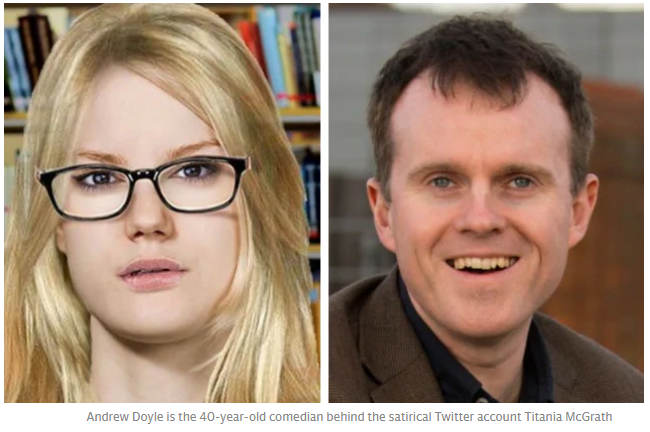
In The Critic, Simon Evans reviews Free Speech And Why It Matters by Andrew Doyle (who is perhaps best known on this side of the pond for his ultrawoke Twitter persona “Titania McGrath”):
When I am weaker than you, I ask you for Freedom, because that is according to your principles; when I am Stronger than you, I take away your freedom because that is according to my principles.
Frank Herbert, Children of DuneIt is most peculiar. If the counter-culture had a dominant theme, it was the right to criticise the establishment and to question orthodoxy of all kinds. Back in the Sixties, it was central to its mission to Expand your Consciousness, man. And it worked. Walls came tumbling down. Yet now, everywhere you look, it seems the elements of society — students, academics, comedians — that one would most naturally associate with that freedom of expression, are introducing caveats and qualifiers to that principle faster than you can cry “Stop Little Pol-Pot, Stop!” They are turning, before our very eyes, into actual scolds.
It must be supposed that what was once the siege army, camped outside the moat like Occupy Wall Street, has captured the castle, for they are demanding that the walls be re-erected. That “hate” speech be distinguished from free speech and dealt with accordingly. That freedom of speech need not mean freedom from consequences. And a general suspicion is at large, among the young, that free speech is some sort of artefact of complacent boomer self-indulgence, like Steely Dan and second homes. No longer counter-culture, but decidedly counter-revolutionary.
I’m a comedian, and these have been strange times for our trade. Brexit saw comedians side with the mirthless neo-liberal consensus, against the humorous, sceptical grumble of the common rabble. The same thing happened in America, with bar-room stand-ups horrified by the vulgarity of Trump. And now the latest revision sees many of my fellow jesters and fools unsure whether people can really be trusted with free speech.One might have thought this issue had been settled long ago, in this country, and in liberty’s favour. But no, it seems we need to sharpen our tools once again, and Andrew Doyle’s new book is an excellent place to start.
Making the case for the defence, Doyle’s book is terse, restrained and as carefully argued as a QC’s summing-up in a top-drawer courtroom drama. Whether his command of the material comes from his doctorate in Renaissance literature or his experience of defending the comedy character Titania McGrath from infuriated wokerati, who knows? It is a beautifully balanced and comprehensive overview that will of course be read by no one who needs to hear it.
It is admirably historically literate. Doyle takes a quote from Milton’s Areopagitica as his epigram, with the old poet, declaiming over the din of the Civil War, as defiant as Satan himself, “Give me liberty to know, to utter, and to argue freely according to conscience, above all liberties.”
This sets the tone for the whole book, but Doyle also presents arguments intended to appeal to those who insist that we live in a society. With the compromises that entails. This was most famously recognised by notorious cis-hetero white man and free speech absolutist John Stuart Mill, who was surveying the world from the heights of Victorian Exceptionalism when he published the still unsurpassed On Liberty.
April 5, 2021
The Ahuman obsession
Theodore Dalrymple considers the work of an English professor who advocates for the extinction of the human race:
Professor MacCormack’s main idea seems to be that the only way to save the planet from destruction is for humanity not to reproduce itself and thereby to die out within a generation or two. She wants to make the world safe for the worms and the wasps, though her scheme would be hard luck on those species that parasitize only Man. They would have to die out too. But, as the Reverend Charles Caleb Colton put it in 1821, “Let no man presume to think that he can devise any plan of extensive good, unalloyed with evil.” If Man dies out, so too will Wuchereria bancrofti, one of the filarial parasites that cause elephantiasis, along with other such species, but I suppose that this is but a small price to pay for the immense benefit overall wrought by the extinction of Mankind.
Naturally, I sent for her latest book, The Ahuman Manifesto: Activism for the End of the Anthropocene. Thanks to the epidemic all the libraries were shut, though in other respects the virus’ efforts to end the Anthropocene were, from the professor’s rather special point of view, feeble or pathetic, with only 2,000,000 deaths so far and 6,998,000,000 to go. If I wanted to read the book, I would have to buy it.
I am an obsessional reader; that is to say, when I start a book I feel obliged to read it through from cover to cover. Moreover, I would rather read anything than nothing at all. Once in Los Angeles I was stuck in a hotel bedroom with nothing to read but the yellow pages (there were still telephone directories in those days), from which I learned a humiliating lesson. Books have long been at the center of my life, but I discovered how unimportant they are in the lives of most people. There was about half a page devoted in the yellow pages to bookshops, but scores to private detectives. No wonder Philip Marlowe chose Los Angeles as his place of work.
But Professor MacCormack’s book defeated me, not only sapping my will to read further but inducing a state almost of catatonia. It certainly cured me, at least temporarily, of my obsessional desire to finish any book that I have started. Her style made The Critique of Pure Reason seem as light and witty as The Importance of Being Earnest. She appears to think that the English plural of manifesto is manifesti rather than manifestos; I admit that it conjured up in my mind a new Italian dish, gnocchi manifesti.
Open the book at any page and you will find passages that startle by their polysyllabic meaninglessness combined with the utmost crudity. By chance, I opened the book to page 144 and my eye fell on the following:
The multiplicity of becoming-cunt as an assemblage reassembles the tensors upon which it expresses force and by which force is expressed upon its various planes and dimensions.
I have known deteriorated schizophrenic patients to speak more sensibly and coherently than this.
March 30, 2021
QotD: Static societies and disruptive outsiders
Stable societies with unchanged boundaries, Olson observed, “tend to accumulate more collusions and organizations for collective action over time.” Instead of accepting rules that encourage overall growth, these collusive organizations — trade groups and labor unions were paradigmatic examples — fight to keep what they have, slowing down “a society’s capacity to adopt new technologies and to reallocate resources in response to changing conditions,” thus reducing economic efficiency. Decline follows.
Olson pointed to Japanese stagnation under the Tokugawa shogunate, when, “before Admiral Perry’s gunboats appeared in 1854, the Japanese were virtually closed off from the international economy.” Ruling Japanese society, he writes, “were any number of powerful za, or guilds, and the shogunate or the daimyo often strengthened them by selling them monopoly rights.” The guilds “fixed prices, restricted production and controlled entry in essentially the same way as cartelistic organization elsewhere.”
A second example: Great Britain, “the major nation with the longest immunity from dictatorship, invasion and revolution” and, consequently, Olson explained, suffering “this century a lower rate of growth than other large, developed democracies.” In Olson’s view, the weak performance resulted from limits on change established by a “powerful network of special-interest organizations,” which included labor unions, industrial groups, and aristocratic cliques. By the 1970s, after the conservative government of Edward Heath fell in a losing battle with striking miners, many deemed Britain ungovernable. Olson contrasted the British situation with that of postwar Germany and Japan, where the chaos and destruction of wartime defeat wiped away established industrial and retail groups, leaving the field open to newcomers like Soichiro Honda or the Albrecht family (creators of international supermarket giant Aldi), who could work economic magic.
The word “ungovernable” was also used to describe New York in the 1960s and 1970s, when Mike Quill’s transit union ran roughshod over Mayor John Lindsay’s attempts to control public-sector wage growth. New York was a long-established city with lots of political collusion. The old Tammany Hall could broker deals to keep Gotham going, but Lindsay’s successor, Abe Beame, proved too weak to resist any special interest that wanted more spending or government favors. New York’s spending kept rising even as public services worsened, until bankruptcy loomed and public power wound up in the hands of the unelected Municipal Assistance Corporation. Thankfully, New York reformed itself economically, at least to some extent, under Mayors Rudolph Giuliani and Michael Bloomberg, as Britain did under Prime Minister Margaret Thatcher. Sufficiently strong leaders can buck entrenched insiders.
Edward L. Glaeser, “How to Fix American Capitalism”, City Journal, 2020-12-13.
March 25, 2021
Hunter S. Thompson’s Fear and Loathing in Las Vegas
I first read Thompson’s Fear and Loathing in the late 1970s and being as callow and inexperienced as most teenagers, I took it for a mostly factual exploit (along with many older readers who didn’t have my excuse for gullibility). I passed the book on to one of my friends who became mildly obsessed with “Raoul Duke” and the adventures recounted in the book. I’ve long since lost touch with him, but I’m sure he’d be horribly disappointed to discover that Thompson probably imagined 90% of it:
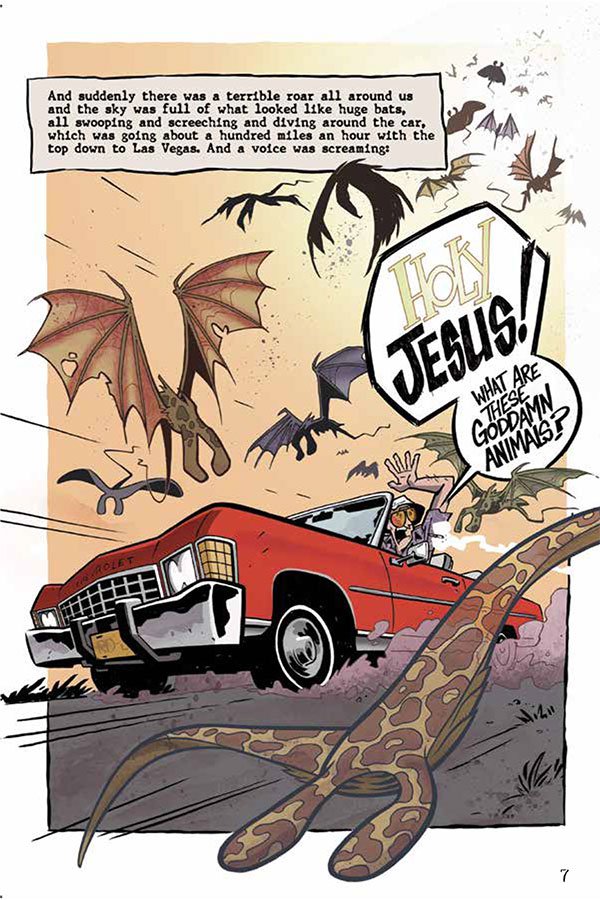
We were somewhere around Barstow on the edge of the desert when the drugs began to take hold. I remember saying something like “I feel a bit lightheaded; maybe you should drive …” And suddenly there was a terrible roar all around us and the sky was full of what looked like huge bats, all swooping and screeching and diving around the car, which was going about a hundred miles an hour with the top down to Las Vegas.
From the outset, Fear and Loathing in Las Vegas is an outrageous and darkly amusing tale of two crazed men turned loose in the world’s capital of decadence. Raoul Duke and Doctor Gonzo, clearly based upon Thompson and Acosta, are carrying a veritable pharmacopoeia in the trunk of their rented car, and throughout the novel they abuse a litany of substances as they stumble through casinos, bars, and hotels terrorising staff and patrons alike. Though Duke and Gonzo are, like the real Thompson and Acosta, tasked with covering the Mint 400, their assignment is quickly lost in the carnage. Near the end of the book, Duke admits he “didn’t even know who’d won the race.”
If you are unfamiliar with Thompson’s work, you may wonder why it matters that their efforts to complete a minor assignment ended in failure. Authors like Ernest Hemingway had mined their journalistic experience for material to incorporate into their fiction, so it is hardly unusual that Thompson would find inspiration for a novel whilst covering the Mint 400. But his approach with this book went beyond mere inspiration. Throughout Fear and Loathing, reality and imagination are blurred to the extent that no one really has much idea of what really happened on their trip.
[…]
In this letter, he made the startling confession that Fear and Loathing had not merely exaggerated the debauchery that took place in Vegas, but that there had in fact been no drugs at all. Could this really be true? Was the most notorious drug book of its era really inspired by a drug-free journey?
Before we can answer that, it is important to note the chronology of events on which the book was based. Whilst the book portrays the two men tearing apart hotels and casinos over a period of several days, there were in fact two distinct trips. First, they went to cover the Mint 400 on Mach 21st–23rd, then they returned for the National District Attorneys’ Conference on Narcotics and Dangerous Drugs on April 25th–29th. Thompson simply rolled the two events together into a single narrative. The evidence suggests that, during the first trip, Thompson and Acosta drank heavily and perhaps smoked a little pot, but certainly did no serious drug-taking. The famed pharmacopeia in the trunk of their convertible was fictitious:
The trunk of the car looked like a mobile police narcotics lab. We had two bags of grass, seventy-five pellets of mescaline, five sheets of high-powered blotter acid, a salt shaker half full of cocaine, and a whole galaxy of multi-colored uppers, downers, screamers, laughers … and also a quart of tequila, a quart of rum, a case of Budweiser, a pint of raw ether and two dozen amyls.
As tempting as it is to believe that this existed, it was a product of Thompson’s prodigious imagination. He was, however, keen to keep his readers in the dark, hence his letter to Silberman and the inclusion of his photo on the back cover. Since childhood, he had been obsessed with appearing as an outlaw, yet real outlaws never explicitly said that’s what they were. They merely hinted at it.
Of course, Thompson’s “drug-diet” did consist of various illegal substances, which made his descriptions of their effects rather convincing, but not only did he remain mostly drug-free in Vegas, he also wrote the novel with little more than beer and tobacco in his system. Back home in Colorado, he polished his story carefully through many drafts. The result was a far more intelligent and coherent work than almost anything else he published.
It was only during the second of the two trips that they began to consume drugs, but even then their indulgence was mild when compared with Duke and Gonzo’s extravagant excesses. They had marijuana, a few pills, and possibly some mescaline, but nothing else. His descriptions of LSD came from experiments several years earlier, the parts about adrenochrome were entirely fabricated, and — surprisingly — Thompson had not yet tried cocaine by 1971.
March 23, 2021
QotD: Marx was right … but not about the proletariat
Those fuckheads achieved class consciousness here in the last 30 years, and now they’re doing what Marx said the Proletariat would – making Revolution, overturning the system, causing the State to wither away as they pursue their own interests against tradition, religion, all enemies foreign and domestic. Theirs is a “Marxism” boiled down to its essence: Nihilistic, suicidal envy.
[…]
Once they achieve class consciousness, the Revolution is inevitable – Marx was right about that, too. There are only so many places in the Apparat, after all, and the number of talented, ambitious people in the Empire — even now, after a century’s worth of mandatory “education” — far exceeds the number of make-work jobs the Apparat, any Apparat, can support. Provided we survive it, it will be some cold comfort, watching the bewilderment in their faces as they’re lined up against the wall. Ever read Darkness at Noon?
Severian, “Skynet Becomes Self-Aware”, Rotten Chestnuts, 2020-12-11.
March 20, 2021
The rise of Turkish leader Recep Tayyip Erdogan
Scott Alexander reviews Soner Cagaptay’s recent book The New Sultan: Erdogan And The Crisis Of Modern Turkey:
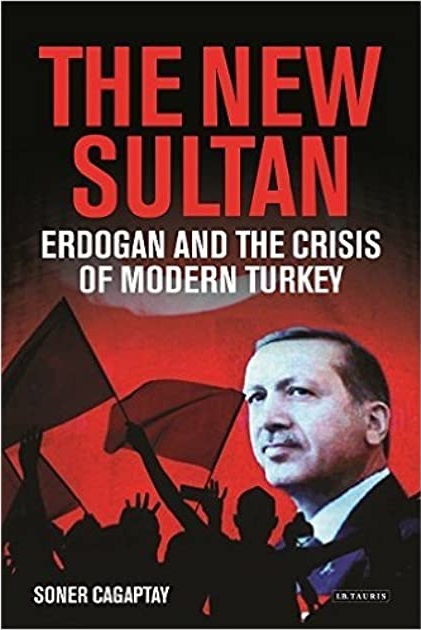
If you only learn one thing from this post: it’s pronounced “air-do-wan”.
If you learn two things from this post, learn that, plus how a country which starts out as a flawed but somewhat-liberal democracy can lapse into near-dictatorship over the course of a few years.
I got The New Sultan: Erdogan And The Crisis Of Modern Turkey because, as a libertarian, I spend a lot of time worrying about the risk that my country might backslide into illiberal repression. To develop a better threat model, I wanted to see how this process has gone in other countries, what the key mistakes were, and whether their stories give any hints about how to prevent it from happening here. Recep Tayyip Erdogan transformed Turkey from a flawed democracy to a partial dictatorship over the past few decades, and I wanted to know more about how.
As an analysis of the rise of a dictator, this book fails a pretty basic desideratum: it seems less than fully convinced the dictator’s rise was bad. Again and again I found myself checking to make sure I hadn’t accidentally picked up a pro-Erdogan book. I didn’t; author Soner Cagaptay is a well-respected Turkey scholar in a US think tank who’s written other much more critical things. The fact is, Erdogan’s rise is inherently a pretty sympathetic story. If he’d died of a heart attack in 2008, we might remember him as a successful crusader against injustice, a scrappy kid who overcame poverty and discrimination to become a great and unifying leader.
I want to go into some of this in more depth, because I think this is the main reason why Erdogan’s example doesn’t generalize to other countries. What went wrong in Turkey was mostly Turkey-specific, a reckoning for Turkey’s unique flaws. Erdogan rose to power on credible promises to help people disenfranchised by the old system; by the time he turned the tables and started disenfranchising others in turn, it was too late to root him out. If there’s a general moral here, it’s that having the “good guys” oppress and censor the “bad guys” is fun while it lasts, but it’s hard to know whether you’re building up a karmic debt, or when you’re going to have to pay the piper.
Given how hard it is to convince people of that moral, let’s go through the full story in more detail.
And given that it’s impossible to discuss modern Turkey without at least briefly touching on the founder of the country, here’s an amusing apocryphal story about “The Father of the Turks”:
Medieval Turkey was dominated by the Ottoman Empire, officially an Islamic caliphate though in practice only inconsistently religious, ruled by autocratic sultans and a dizzying series of provincial governors. As time passed, they fell further and further behind Western Europe; by World War I, they were a mess. As the stress of the war caused the empire to fracture, General Mustafa Kemal seized power, reorganized the scraps of Ottoman Anatolia into modern Turkey, and was renamed ATATURK, meaning “Father of Turks”.
Ataturk was born in Ottoman-controlled Greece, and was typical of a class of military officers at the time who were well-educated and “Europeanized”. He wanted to turn backwards Turkey into an advanced Western country — and Western countries were mostly secular. He saw Islam — the religion of the old Ottoman Empire — as a roadblock, and passed various laws meant to relegate it to the margins of public life.
(my favorite Ataturk story, probably apocryphal, was that he passed a law banning women from wearing hijabs. Nobody followed it and the police wouldn’t enforce it, so he passed a second law requiring prostitutes to wear hijabs, after which other women abandoned them. As far as I can tell this is an urban legend, but it captures the spirit of the sort of measures he took to drag Turkey, kicking and screaming, into secular modernity.)
March 16, 2021
Mumford & [REDACTED]
Jack Stacey on the group-mandated self-cancellation of Winston Marshall by his band mates in Mumford & Sons at the behest of a social media mob for the mortal sin of complimenting a book publicly:
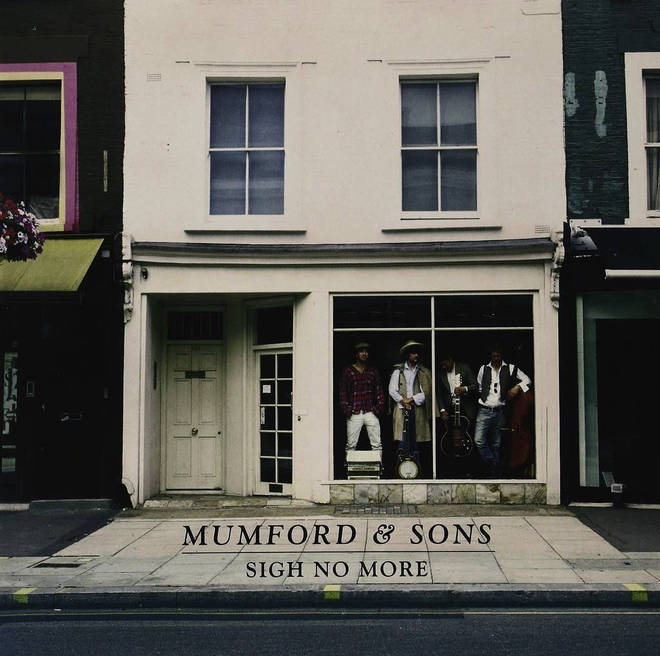
As the band’s most famous lyric goes, he really fucked it up this time. For while the book in question does describe the left’s penchant for totalitarian control disguised as benevolence, it was not the above classic [Nineteen Eighty-Four] (yet to be deemed problematic), but Unmasked by journalist Andy Ngo, which gets Inside Antifa’s Radical Plan to Destroy Democracy in the name of social justice.
Following this transgression against the militant arm of wokery and pressure from the rest of the group for his “increasingly right-wing views”, Marshall the banjoist has pushed his entire Twitter feed down the memory hole leaving only a mea culpa pinned to the start. It states: “Over the past few days I have come to better understand the pain caused by the book I endorsed. I have offended not only a lot of people I don’t know, but also those closest to me, including my bandmates, and for that I am truly sorry.”
He adds in his adopted Newspeak that he will use his absence “to examine my blindspots”, and concludes: “For now, please know that I realise how my endorsements have the potential to be viewed as approvals of hateful, divisive behaviour. I apologise, as this was not at all my intention.”
You would have thought he’d had rats caged to his face to become so repentant. But no, it appears that, as ever, some people got angry on social media, after which his partners at the tweed and ‘tache firm he’d helped set up have made him genuinely believe he deserved it for mucking around in politically incorrect prole territory.
For don’t let the & Sons bit fool you. Like the band’s resulting output, their name was chosen to add an earthy patina to bely the fact that they were, as Bo’ Selecta!’s Mel B might have it, “posh as fook”, rather than as they would have you think: “common as mook”.
“… because who doesn’t like to see both wine snobs and the French taken down a peg or two?”
In The Critic, Henry Jeffreys sadly notes the passing of Steven Spurrier, perhaps best known for organizing the “Judgement of Paris” in 1976:

The wine world lost one of its giants this week in Steven Spurrier. He’s one of the very few people who managed to put the subject on the front pages of the world’s newspapers when he organised the so-called Judgement of Paris competition in 1976.
This was a blind tasting judged by the great and good of the French wine world pitting the might of Bordeaux and Burgundy, against California, a place whose wines most Europeans had never even tasted. Surely France could not lose. But thrillingly, and deliciously, it did, with Californian wines coming top in both the white and red categories. It inspired a book and a feature film Bottle Shock starring Alan Rickman as Spurrier. In fact, the media, particularly over here and in the US, has never lost interest. Perhaps because who doesn’t like to see both wine snobs and the French taken down a peg or two?
More significantly, it marked the arrival of American and later Australian, Chilean and other New World wines. Fittingly, I first met Spurrier at a round table tasting for an upmarket Chilean wine. These tastings could be nerve-wracking affairs for new writers. They still fill me with anxiety. I never know what to say as the big beasts of the wine world opine. Sometimes, the cellar rooms where such tastings are often held seem much too small for all those jostling egos.
I was sat next to Spurrier and, much to my surprise, he asked me my opinion on the wines, something I don’t think any other writer had done up to that point. He then engaged with what I said, and said something like, “yes, I think you’ve got it there.” Or words to that effect. It’s quite hard to express how startling this experience was to someone outside the wine world. It’s like Martin Scorsese asking your opinion on film making.
March 13, 2021
The Paperback Revolution
The History Guy: History Deserves to Be Remembered
Published 12 Mar 2021Sponsored by Blinkist. The first 100 people who go to https://www.blinkist.com/thehistoryguy are going to get unlimited access for one week to try it out. You’ll also get 25% off if you want the full membership.
Today, the most popular book format in the world is not a traditional hardcover book, nor an ebook, but a paperback — a format that changed the what, how, when and how much the world reads. It is history that deserves to be remembered.
This is original content based on research by The History Guy. Images in the Public Domain are carefully selected and provide illustration. As very few images of the actual event are available in the Public Domain, images of similar objects and events are used for illustration.
You can purchase the bow tie worn in this episode at The Tie Bar:
https://www.thetiebar.com/?utm_campai…All events are portrayed in historical context and for educational purposes. No images or content are primarily intended to shock and disgust. Those who do not learn from history are doomed to repeat it. Non censuram.
Find The History Guy at:
Patreon: https://www.patreon.com/TheHistoryGuy
Please send suggestions for future episodes: Suggestions@TheHistoryGuy.netThe History Guy: History Deserves to Be Remembered is the place to find short snippets of forgotten history from five to fifteen minutes long. If you like history too, this is the channel for you.
Awesome The History Guy merchandise is available at:
teespring.com/stores/the-history-guyScript by THG
#history #thehistoryguy #Books

March 5, 2021
QotD: P.G. Wodehouse’s Jeeves and Wooster
Everybody has those books, and authors, that they go to when they are in need of escapism. For me, PG Wodehouse’s Jeeves and Wooster series have always been these tales. Nightly incursions into their pages during the pandemic made the misery and boredom of those long days and weeks considerably more bearable. He wrote 35 short stories and 11 novels featuring the duo, beginning in 1915 with Extricating Young Gussie (although purists prefer to begin with Leave it to Jeeves which appeared the following year and features the most recognisable incarnation of the characters), and ending shortly before his death in 1975 with 1974’s Aunts Aren’t Gentlemen. Undoubtedly, if Wodehouse had somehow lived another five or ten years, there would have been more stories, but his prolific dedication to “the graft” has left us with a truly splendid collection of tales, all revolving around a pre-lapsarian world that was always a fantastical creation, even when Wodehouse began writing. By the time of the last book’s publication, when Britain was immersed in the three-day week and the dying days of the Heath government, the events depicted bore as much relation to readers’ everyday lives as if Wodehouse had been writing about events on Mars.
This was, of course, the point from the beginning. As Evelyn Waugh, a great admirer, famously said, “Mr. Wodehouse’s idyllic world can never stale. He will continue to release future generations from captivity that may be more irksome than our own. He has made a world for us to live in and delight in.” Nobody has ever sat down to read about the adventures of Jeeves, Bertie, Bingo Little, Gussie Fink-Nottle, the terrifying Aunt Agatha and Roderick Spode (to say nothing of his black short-wearing followers) and expected gritty social realism.
Instead, they have come to marvel at the twentieth century’s greatest comic prose stylist’s apparently endless invention, in which matrimony is a predicament to be averted at all costs, where the distaste of one’s gentleman’s gentleman for an ill-considered sartorial faux pas can lead to a (happily temporary) breakdown in amicable relations, and where the sole work undertaken by Bertie is to contribute an article about “What the well-dressed man is wearing” to his aunt’s periodical. Like his prize for scripture knowledge, he remains proud of this modest achievement, and continually refers to it throughout his adventures.
Alexander Larman, “The enduring appeal of Jeeves and Wooster”, The Critic, 2020-10-16.
March 1, 2021
Why the Bronze Age Collapse matters today. Dr. Eric Cline (If Civilization Collapsed Would We Know?)
Study of Antiquity and the Middle Ages
Published 13 Jun 2020Ladies and Gentlemen we arrive finally to the part of our series that you have all been waiting for! And that is the Bronze Age Collapse and here to guide us through it is none other than Dr. Eric Cline, the rock star archaeologist, historian and author of none other than 1177 BC!
He will give us an overview history of the collapse along with sharing his own personal views on the subject! Guiding us briefly through archaeology, trade, national politics, and contact in the ancient Mediterranean we will get a nice picture of the Bronze Age and how it all came crashing down in a perfect storm of events. But what is ever more awesome is he even gives us the inside scoop on why he wrote 1177 BC? And how he did it!
But at the end of this episode we come to our modern world and Dr. Cline explains why the Bronze Age Collapse matters today. What we need to look at when comparing it to our modern world and the current events and impacts affecting our world. Did the peoples living through the Bronze Age Collapse know they were living in a collapse? And he asks a delicate and intense question and that is if civilization collapsed today would we know?
Check out our new store! teespring.com/stores/the-history-shop
Support Dr. Eric Cline at the links below!
Personal web page: https://ehcline.com
Get all of his books here at his Amazon Author page:
https://www.amazon.com/s?i=stripbooks…GW pages:
https://cnelc.columbian.gwu.edu/eric-…https://anthropology.columbian.gwu.ed…
https://gwu.academia.edu/EricCline
Image credits: Manna Nader, Gabana Studios Cairo
Hittite 3D City and intro footage credits: 3D reconstruction of Imperial Hittite Karkemish by Giampaolo Luglio, Turco-Italian Archaeological Expedition to Karkemish directed by Nicolò Marchetti (University of Boologna)
KARKEMISH (Carchemish) 1300 BC (3D) – The Southern Capital of the Empire Hittite
Music Attribution: Herknungr – Megaliths | Dark Neolithic Meditive Shamanic Ambient Music https://youtu.be/oc8FQwNjPu0
QotD: Anti-semitism in Harold Lamb’s novels
Of course it’s possible Lamb was simply replaying anti-Semitic attitudes he had absorbed somewhere. But in reading these stories I had another moment like the one in which I understood that [Edgar Rice] Burroughs [Wikipedia] was using “white” as culturist code for “civilized”. It was this: the behavior of Lamb’s Jewish merchants made adaptive sense. Maybe they were really like that!
Consider: The Jews of Lamb’s milieu lived under Christian and Islamic rulers who forbade them from carrying weapons, who despised them, who taxed and persecuted them with a heavy hand. If you were a Jew in that time and place, exhibiting courage and the warrior virtues that Lamb was so ready to recognize in a Mongol or an Afghani was likely to earn you a swift and ugly death.
Under those conditions, I’m thinking that being cowardly and avaricious and toadying would have been completely sensible; after all, what other options than flattering the authorities and getting rich enough to buy themselves out of trouble did Jews actually have?
Lamb seems to have have mined the historical sources pretty assiduously in his portrayals of other cultures and races. Rather than dismissing Lamb’s Jews as creatures of his prejudices, I think we need to at least consider the possibility that he was mostly replaying period beliefs about Jewish merchants, and that those beliefs were in fact fairly accurate. He certainly seems to have tried to do something similar with the other flavors of human being in his books.
Nowadays we tend to interpret Lamb’s Jewish merchants through assumptions that read something like this: (1) All racial labels are indications of racist thinking, and (2) all race-associated stereotypes are necessarily false, and (3) all racial labels and race-related stereotypes are malicious. But it seems to me that, at least as I read Burroughs and Lamb, all these assumptions are highly questionable. As long as you hold them, you can’t notice what “whiteness” in Burroughs really means, or account for the genuine multiculturalism of Lamb’s books.
Eric S. Raymond, “Reading racism into pulp fiction”, Armed and Dangerous, 2010-01-18.
February 27, 2021
QotD: What the instructions in Haynes manuals really mean
Translation: Will be corroded into place … Clamp with adjustable spanner then beat repeatedly with a hammer.Haynes: This is a snug fit.
Translation: You will skin your knuckles! … Clamp with adjustable spanner then beat repeatedly with hammer.Haynes: This is a tight fit.
Translation: Not a hope in hell matey! … Clamp with adjustable spanner then beat repeatedly with hammer.Haynes: As described in Chapter 7 …
Translation: That’ll teach you not to read through before you start, now you are looking at scary photos of the inside of a gearbox.Haynes: Pry …
Translation: Hammer a screwdriver into …Haynes: Undo …
Translation: Go buy a tin of WD40 (industrial size).Haynes: Ease …
Translation: Apply superhuman strength to …Haynes: Retain tiny spring …
Translation: “Crikey what was that, it nearly had my eye out”!Haynes: Press and rotate to remove bulb …
Translation: OK — that’s the glass bit off, now fetch some good pliers to dig out the bayonet part and remaining glass shards.Do it by the book — the real meaning of Haynes instructions.
February 26, 2021
Waymarkers of the American caste system
Scott Alexander reviews Paul Fussell’s Class: A Guide Through The American Status System, and finds Fussell has helpfully delineated how an outsider can guess someone’s class (or caste, as Fussell would prefer) … at least how that outsider could do so in 1983:
The upper class is old money. The people you think of as rich and famous — tech billionaires, celebrities, whatever — aren’t upper class. However privileged they started off, they still had to put in at least a smidgeon of work to get their money, which disqualifies them. Real uppers inherit. Even famous people who come from old money usually aren’t central examples of upper class; the real upper class has no need to seek fame. They mostly just throw parties — but not interesting parties, because that would imply they have something to prove, which they don’t. They live in mansions — but not awesome mansions they designed themselves with some kind of amazing gaming room or something, because that would imply they have something to prove, which they don’t. They live in meticulously boring mansions and throw meticulously boring parties. They have the best and classiest versions of everything, but it’s a faux pas to compliment any of it, because that would imply that they were the sort of people who might potentially not have had the best and classiest version of that thing. They fill their houses with Picassos and exquisite antique furniture, and none of them ever express the slightest bit of satisfaction or praise about any of it. You have never heard of any of these people, although you might recognize the last name they share with a famous ancestor (Rockefeller, Ford, etc).
The middle classes are salaried professionals, starting with the upper-middle class. Jeff Bezos, for all his billions, is only upper-middle-class at best. So are many of the other people you think of as rich and famous and successful. The upper-middle-class likes New England, Old England, yachts, education, good grammar, yachts, chastity, androgyny, the classics, the humanities, and did I mention yachts?
The middle class is marked by status anxiety. The working class knows where they stand and are content. The upper-middle class has made it; they’re fine. And the upper class doesn’t worry about status because that would imply they have something to prove, which they don’t. But the middle class is terrified. These are the people with corporate jobs who say things like “I’ve got to make a good impression at the meeting Tuesday because my boss’ boss will be there and that might determine whether I get the promotion I’m going for”. The same attitude carries into the rest of their lives; their yards and houses are maintained with a sort of “someone who could change my status might be watching, better make a good impression”. They desperately avoid all potentially controversial opinions — what if the boss disagrees and doesn’t promote them? What if the neighbors disagree and they don’t get invited to parties? They are the most likely to be snobbish and overuse big words, the most obsessed with enforcing norms of virtuous behavior, and the least interested in privacy — asserting any claim to privacy would imply they have something to hide. Their Official Class Emotions are earnestness and optimism; they are the people who patronize musicals like Annie and Man of La Mancha where people sing saccharine songs about hopes and dreams and striving, and the people who buy inspirational posters featuring quotes about perseverance underneath pictures of clouds or something.
Proles do wage labor. High proles are skilled craftspeople like plumbers. Medium and low proles are more typical factory workers. They have a certain kind of freedom, in that they don’t have status anxiety and do what they want. But they’re also kind of sheep. They really like mass culture — the more branded, the better. These are people who drink Coca-Cola (and feel good about themselves for doing so), visit Disneyland (and accept its mystique at face value), and go on Royal Caribbean cruises. When they hear an ad say a product is good, they think of it as a strong point in favor of buying the product. They feel completely comfortable expressing their opinions, but their opinions tend to be things like “Jesus is Lord!”, “USA is number one!”, “McDonalds is so great!”, and “Go $LOCAL_SPORTS_TEAM!”. They are weirdly obsessed with cowboys (Fussell says cowboys represent the idea that poorer people are freer and more authentic than rich office-worker types, plus the West is the prole capital of the USA) and with unicorns (Fussell: “I’ve spent six months trying to find out exactly why, and I’m finally stumped”). When they have unique quirks, they tend to be things like “collecting lots of Disney memorabilia” or “going powerboating slightly more often than the other proles do”. There’s also a sort of desperate prole desire to be noticed and individuated, which takes the form of lots of “Personalized X” or “Y with your name on it”, and also with making a lot of noise (see: powerboating). Fussell describes the most perfectly prole piece of decor as “a blue flameproof hearthrug with your family name in Gothic letters beneath seven spaced gold stars and above a golden eagle in Federal style”.
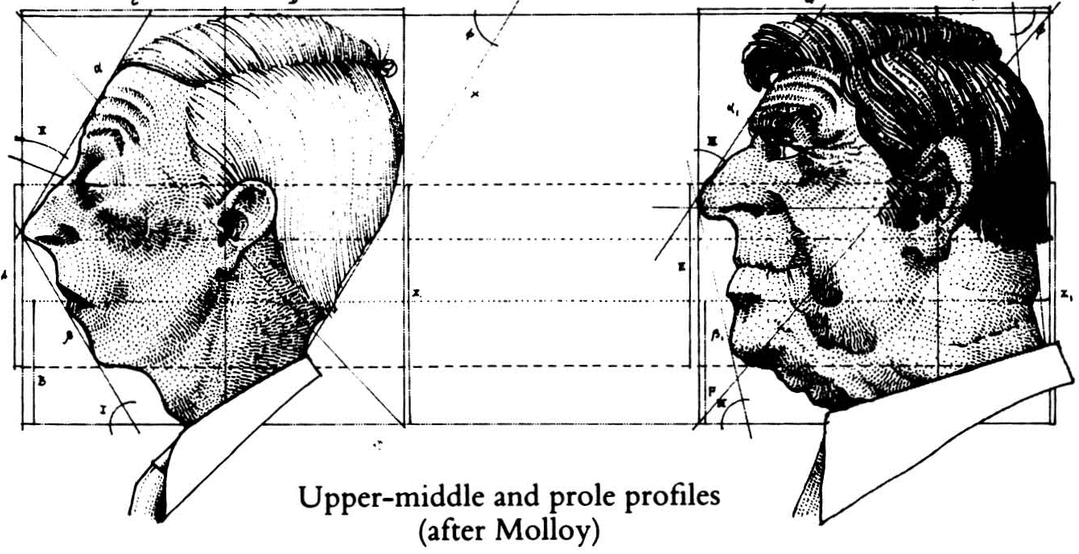
It’s impossible to tell when Fussell is serious vs. joking. The section on the physiognomy of different classes has to be a joke, right? But then how did he come up with the Virgin vs. Chad meme in 1983? Also, why does my brain keep telling me these are John McCain and Donald Trump?
A friend urges me to think of these not as “rich/successful people” vs. “poor/unsuccessful people”, but as three different ladders on which one can rise or fall. The most successful proles are lumber barons or pro athletes or reality TV stars. These people are much richer and more powerful than, say, a schoolteacher, but they’re still proles, and the schoolteacher is still middle class. Likewise, a very successful middle class person might become a professor or a Senator or Jeff Bezos, but this doesn’t make them even a bit upper class.
(I’m not sure it’s possible to be a more or less successful upper class person; being successful would imply having something to prove, which they don’t).