Quotulatiousness

January 11, 2022

Mailer, cancelled. Question mark?

Filed under: Books, Business, Media, Politics, USA — Tags: , — Nicholas @ 03:00

In the most recent SHuSH newsletter, Ken Whyte outlines the “cancellation” of the late Norman Mailer by his Random Penguin editors … maybe … but probably not really:

American writers John Updike, Norman Mailer, and E. L. Doctorow at the PEN Congress, January 1986.
Photo by Bernard Gotfryd via Wikimedia Commons.

You have to feel for Norman Mailer, the late author of some forty books and a two-time winner of the Pulitzer Prize. There he lay, resting in well-deserved peace in the winter quiet of Provincetown Cemetery after a lifetime of fighting mankind’s greatest causes — civil rights, an end to war, the Great American Novel, his urgent libido — when out of nowhere comes a report that he has been canceled by his long-time publisher, Random House.

“With slow-mo hammer-dropping predictability,” wrote Michael Wolff in the newsletter, The Ankler, “Norman Mailer’s long-time publisher has recently informed the Mailer family that it has canceled plans to publish a collection of his political writings to mark the centennial of his birth in 2023, confirms the film producer Michael Mailer, the author’s oldest son.”

The reasons for the cancelation, according to Wolff, are “a junior staffer’s objection to the title of Mailer’s 1957 essay, ‘The White Negro’, a psycho-sexual-druggie precursor and model for much of the psycho-sexual-druggie literature that became popular in the 1960s. A Random House source also cites the objections of feminist and cultural gadfly Roxane Gay.”

Wolff’s scoop was promptly picked up and carried at face value all over North America, throughout Italy by La Repubblica, England by the Daily Mail, Chile by El Periodisto, and so on. It was the biggest cultural story going for several days, never mind that questions as to its veracity were raised almost the minute it broke.

Well, before it broke, in fact. Wolff himself scarcely seems convinced of his story. Yes, his headline is unequivocal: “Michael Wolff on Random House’s Cancelation of Norman Mailer”. But he admits in the newsletter that he couldn’t get anyone at Random House to confirm the news. Also that the Mailer estate didn’t actually have a contract for a book of political non-fiction with Random House for the publisher to cancel.

Wolff further allows that his one source at Random House steered him into a ditch, claiming that in addition to the anonymous junior staffer, Roxane Gay was involved. Wolff followed up with Gay, who told him she knew nothing of the controversy and had never read Mailer.

January 9, 2022

A century of William Brown books

Filed under: Books, Britain — Tags: , , , — Nicholas @ 03:00

In The Critic, Alexander Larman celebrates the centenary of Richmal Compton’s William Brown books:

Growing up in suburban Bristol in the Eighties and Nineties, my reading matter was of a suitably timeless disposition, even if it seldom, if ever, included any Enid Blyton. Amidst the colonial and deeply un-PC likes of Biggles and Rider Haggard, my trio of preferred characters never really changed: Jennings, Billy Bunter and William Brown. Of the three, Jennings was probably my favourite, being closest to my own life as a prep school boy of a vaguely similar appearance and age, and also because the situations were the most recognisable. Bunter I found uproarious but also rather tasteless and absurd, for reasons that have now, alas, become much clearer. And then there was William Brown: would-be outlaw, committed dog owner and perpetual enemy of soap-and-water, to say nothing of his perpetual nemeses, Hubert Lane and Violet Elizabeth Bott.

I enjoyed the books as picaresque stories of bad behaviour without seeing much of myself in William, or indeed his friends. Their author Richmal Crompton’s evocation of invincible pre-war suburbia — not so very far from a benign version of the half-idylls, half-nightmares portrayed by Orwell in Coming Up For Air and Patrick Hamilton in Hangover Square — was certainly compelling, but I was too young to appreciate Crompton’s social satire, itself considerably more piquant than anything that could be found in Jennings and Bunter, let alone the stiff-upper-lip fantasias of English manhood peddled by WE Johns with Biggles, Gimlet and the rest. All of them now sound to me like nothing so much as industrial-strength cocktails. Drink a couple, and you too will want to revive the Empire.

Yet now, a century after the first appearance of Just William, I reassess Crompton’s universe afresh, and so I respond far more warmly to her characters and creations. William Brown himself is an entertaining if undeniably two-dimensional figure, at his most amusing when he is required to fit into the adult world temporarily, as in the story William’s Truthful Christmas, when he causes social outrage and misery by offering an honest opinion of the gifts that he has received. But it is the rich panoply of figures around William who give the stories their interest and colour, and which make them as entertaining for adults to read today as they ever might be for their children. If, of course, eleven-year olds can be distracted from their iPads and Netflix and nefarious online activities long enough to enjoy the William books.

Leaving aside the children for a moment, the adult supporting characters in the unnamed village provide endless humour and intrigue. There is William’s neurotic mother, desperately saying of her son that “he means well” even as he is involved in yet another humiliating scrape. His father, meanwhile, is a hard-drinking Conservative whose cynicism at the world sees him reward his errant son with extra pocket money for his more outrageous actions, as long as he is not bedbound with “his liver”. Not for nothing is this stalwart representative of middle England named John Brown.

Then there is William’s would-be romantic elder brother Robert, desperately professing each of his girlfriends “the most beautiful girl in the world” until his eye is taken by another. Mr and Mrs Bott are a pair of arriviste millionaires who have made their money via “Bott’s Digestive Sauce”, a substance that William contends, probably accurately, has been constructed from squashed beetles. Needless to say, they take up residence in the nouveau riche establishment Bott Hall, where their social status irks them. (“We ought to have some ancestors, Botty,” said Mrs Bott. “We’ve got ’em, dear,” said Mr Bott after a moment’s thought. “We must have. Come to think of it, we shouldn’t be here now if we’d not.”) Floating around the periphery is Robert’s friend, the splendidly named Jameson Jameson, of whom Crompton writes, with caustic humour, “[his] parents had perpetrated on him the supreme practical joke of giving him his surname for a Christian name, so that people who addressed him by his full name seemed always to be indulging in some witticism.”

January 6, 2022

“When speaking to a contemptible idiot who is kind of evil, don’t call them a contemptible idiot who is kind of evil! Many contemptible idiots find that language insulting”

Tom Chivers reviews a recent book from Lee McIntyre, How to Talk to a Science Denier: Conversations with Flat Earthers, Climate Deniers, and Others Who Defy Reason:

Imagine you bought a book with the title How to Talk to A Contemptible Idiot Who Is Kind of Evil. You open the book, and read the author earnestly telling you how important it is that you listen, and show empathy, and acknowledge why the people you’re talking to might believe the things they believe. If you want to persuade them, he says, you need to treat them with respect! But all the way through the book, the author continues to refer to the people he wants to persuade as “contemptible idiots who are kind of evil”.

At one stage he even says: “When speaking to a contemptible idiot who is kind of evil, don’t call them a contemptible idiot who is kind of evil! Many contemptible idiots find that language insulting.” But he continues to do it, and frequently segues into lengthy digressions about how stupid and harmful the idiots’ beliefs are. Presumably you would not feel that the author had really taken his own advice on board

This is very much how I feel about How to Talk to A Science Denier, by the Harvard philosopher Lee McIntyre.

McIntyre wants to help us change people’s minds. Specifically, to help us change the minds of these strange, incomprehensible people called “science deniers”. He addresses five main groups of “deniers”: flat earthers; climate deniers; anti-vaxxers; GMO sceptics; and Covid deniers.

This is, on the face of it, an important project. It’s a truism that the world is polarised, and our sense of shared reality is under attack. If there is some way of learning how to talk across difference, and to persuade without attacking, that might go a long way to bridging our various divides, not just the five he discusses.

The framing is that McIntyre goes and meets representatives of these groups and tries to persuade them out of their wrong beliefs. He goes armed with social-psychology research about how best to persuade people. His big trick (which I think is a good, if limited, one) is asking: what evidence would it take to make you change your mind?

But the whole book is premised on one idea: McIntyre is right, and the people he is “talking to” are wrong.

[…]

McIntyre constantly wants to make a clean distinction between “science deniers” and non-deniers. So, for instance, he says that there are five “common reasoning errors made by all science deniers” [my emphasis]. They are: cherrypicking, a belief in conspiracy theories, a reliance on fake experts, illogical reasoning and an insistence that science must be perfect. If you don’t make all five of those errors, you’re not an official McIntyre-accredited science denier.

Hang on, though. A “belief in conspiracy theories”? McIntyre spends a lot of time talking about the tobacco firms who manufactured doubt in the smoking/lung cancer link, and the oil firms who did the same with the fossil fuel/climate change link. He says that the spread of Covid denialism through the US government was driven by Republican desire to keep the economy open and win the election. Aren’t these conspiracy theories?

Ah, but for McIntyre these aren’t conspiracy theories, they’re conspiracies. The distinction is “between actual conspiracies (for which there should be some evidence) and conspiracy theories (which customarily have no credible evidence).”

January 5, 2022

John Ronald Reuel Tolkien

Filed under: Books, Britain — Tags: , , — Nicholas @ 03:00

In The Critic, David Engels outlines the early life and career of J.R.R. Tolkien:

The biography of the British writer and philologist John Ronald Reuel Tolkien (1892-1973) is quickly summarised and, despite a few unusual cornerstones such as his early childhood in South Africa, the tragic death of his parents and the highly romantic love for his later wife Edith, not very spectacular. An existence confined entirely to the British Isles except for a few forays into the continent; a military service in the Great War only moderately traumatic compared to other fates; an honourable but hardly groundbreaking academic career; a life as father of a family that knew the most varied but hardly extraordinary fortunes.

Not really the stuff of legends — except for the global success of The Lord of the Rings, which arrived too late to set Tolkien’s existence on a different course. The (deeply unsatisfying) 2019 film adaptation of Tolkien’s youth attempts to surround him with the aura of a scholarly genius and war hero, and to explain his literary work biographically — but this reductionist attempt rather hinders the understanding of his oeuvre. Tolkien’s works are not exceptional because his life was: on the contrary, their exceptionality only gains its full significance when they are understood against the background of an altogether quite normal existence.

Of course, with such an undramatic approach, it is tempting to associate Tolkien’s enormous mythopoeic activity with the catchword “escapism”, and to reduce it once again to his biography, albeit this time not as a correspondence but as a compensation. This, too, misses the point — all the more so because Tolkien’s earliest literary activity goes far back into his teenage years: his work is not a reaction to his life, but rather the two grew in union, not unlike the mythical trees Telperion and Laurelin. Indeed, one might even regard Tolkien’s rather ordinary academic and family life as a consequence of his consuming, lifelong work on myth rather than the other way around. But what was Tolkien’s intention — and what can we learn from him?

In the beginning, there was disappointment. The Anglo-Saxon world, unlike France or Germany, has scarcely left any traces of an indigenous myth tradition; even the saga of King Arthur belongs to the pre-Anglo-Saxon, Celtic tradition. The Norman Conquest destroyed the entire Anglo-Saxon legend tradition, apart from a few nursery rhymes and place names and a very brittle literary corpus.

As an ardent lover of the Northwest of the Old World, the young Tolkien felt cut off from his own heritage and enthusiastically took up Indo-European linguistics as a technique for reconstructing the historical and mythical tradition of times long past. He set about, partly in play, partly in earnest, creatively deciphering and reconstructing the hitherto misunderstood evidence of England’s dark centuries. In the process, the boundary between etymology and mythopoetics quickly blurred, as Tolkien enriched the hypothetical material obtained by merging it with the archetypal content of the other legends of the ancient world. He created a mythical tradition that took on a character of its own.

But it would be wrong to interpret this legendarium, which was born out of linguistics but soon took on increasingly literary features, as a mere poetic game. Especially in the initial phase of his attempts, Tolkien endeavoured to introduce the increasingly coherent legends and sagas, which are known to the general public mainly through the posthumous Silmarillion and the publishing activities of his son Christopher, by use of a wide variety of framework plots, some of which have an old Anglo-Saxon character and some which are set in modern times. The leitmotif was the dream of the great wave that swallowed up a green island, which later became the seed of the “Fall of Númenor”; an image that haunted Tolkien himself often enough in his sleep and led him to state that those images, recorded partly in dreams and partly in a half-awake state, were not to be regarded as mere fiction, but rather as access to something true and permanent, which he fleshed out in various literary ways, but whose core consistently bore the character of a vision.

January 4, 2022

J.K. Rowling’s subversive tale of a government “controlled by and for the benefit of the self-interested bureaucrat”

No, it’s not a new work by Rowling … it’s a deeply embedded thread of her best-known books in the Harry Potter series (as related in a 2005 article by Benjamin H. Barton for the Michigan Law Review):

J.K. Rowling’s Harry Potter books include a very strong anti-authoritarian thread.

This Essay examines what the Harry Potter series (and particularly the most recent book, The Half-Blood Prince) tells us about government and bureaucracy. There are two short answers. The first is that Rowling presents a government (The Ministry of Magic) that is 100% bureaucracy. There is no discernable executive or legislative branch, and no elections. There is a modified judicial function, but it appears to be completely dominated by the bureaucracy, and certainly does not serve as an independent check on governmental excess.

Second, government is controlled by and for the benefit of the self-interested bureaucrat. The most cold-blooded public choice theorist could not present a bleaker portrait of a government captured by special interests and motivated solely by a desire to increase bureaucratic power and influence. Consider this partial list of government activities: a) torturing children for lying; b) utilizing a prison designed and staffed specifically to suck all life and hope out of the inmates; c) placing citizens in that prison without a hearing; d) allows the death penalty without a trial; e) allowing the powerful, rich or famous to control policy and practice; f) selective prosecution (the powerful go unpunished and the unpopular face trumped-up charges); g) conducting criminal trials without independent defense counsel; h) using truth serum to force confessions; i) maintaining constant surveillance over all citizens; j) allowing no elections whatsoever and no democratic lawmaking process; k) controlling the press.

This partial list of activities brings home just how bleak Rowling’s portrait of government is. The critique is even more devastating because the governmental actors and actions in the book look and feel so authentic and familiar. Cornelius Fudge, the original Minister of Magic, perfectly fits our notion of a bumbling politician just trying to hang onto his job. Delores Umbridge is the classic small-minded bureaucrat who only cares about rules, discipline, and her own power. Rufus Scrimgeour is a George Bush-like war leader, inspiring confidence through his steely resolve. The Ministry itself is made up of various sub-ministries with goofy names (e.g., The Goblin Liaison Office or the Ludicrous Patents Office) enforcing silly sounding regulations (e.g., The Decree for the Treatment of Non-Wizard Part-Humans or The Decree for the Reasonable Restriction of Underage Sorcery). These descriptions of government jibe with our own sarcastic views of bureaucracy and bureaucrats: bureaucrats tend to be amusing characters that propagate and enforce laws of limited utility with unwieldy names. When you combine the light-hearted satire with the above list of government activities, however, Rowling’s critique of government becomes substantially darker and more powerful. Furthermore, Rowling eliminates many of the progressive defenses of bureaucracy. The most obvious omission is the elimination of the democratic defense. The first line of attack against public choice theory is always that bureaucrats must answer to elected officials, who must in turn answer to the voters. Rowling eliminates this defense by presenting a wholly unelected government.

H/T to Glenn “Instapundit” Reynolds for the link.

Jim Morrison’s surprisingly long cultural shadow

Filed under: Books, Media, USA — Tags: , , , — Nicholas @ 03:00

In City Journal, Ian Penman considers the paradox of Jim Morrison’s brief period of musical and cultural stardom yet seemingly endless echoes in popular culture:

Jim Morrison’s bright spotlight time with The Doors lasted not quite five years: the band’s debut album arrived in January 1967, and L.A. Woman, the final work to feature the singer, was released the week of his death, aged 27, on July 3, 1971.

It’s now a half century since Morrison died in Paris in opaquely squalid circumstances, due to — take your pick — some mixture of alcohol, heroin, a small respiratory infection, and a general (not to say studied) carelessness. “When the music’s over / turn out the lights,” he sang in 1967, on The Doors’ second album, Strange Days. “Cancel my subscription / to the Resurrection.” Yet his revenant career as all-purpose Dionysian icon seems inexhaustible. From the posthumous album An American Prayer (1978) and The Doors’ soundtrack appearance on Francis Ford Coppola’s Apocalypse Now (1979), to the serial publication of various “lost” Morrison writings and the lamentable Oliver Stone biopic The Doors (1991), there’s no medium that Morrison’s shade hasn’t found a way to inhabit. More recently, hip L.A. chanteuse Lana del Rey sang: “Living like Jim Morrison / Heading for a fucked-up holiday.” And now we have a figuratively and literally heavy 600-page tome, like a chic designer sarcophagus, with Harper’s publication of The Collected Works of Jim Morrison. Not designed for casual riffling, it should really come with its own lectern or pulpit. It’s hard to know whom this kind of swanky item is aimed at, but it’s a palpable attempt (in the current lingo) to secure Morrison’s legacy: to fix him as more than just this crazy dude who had a few glorious hits and looked sensational in leather pants.

What accounts for such a thriving afterlife? Why is there still such a halo around Morrison’s shaggy head when a cursory examination might suggest a fatally date-stamped cultural figure? How does this Nietzsche-quoting white bluesman and would-be shaman fit into today’s culturally disputatious landscape? A memory is being conjured, but is everything as straightforward as it looks?

Born in December 1943, the young James Douglas Morrison was the son of a career Navy man who bequeathed his firstborn son a middle name honoring no less a figure than General Douglas MacArthur. Constantly on the move from base to base with his family, with no real hometown or settled circle of friends, young James turned to books and music to forge a sense of self-possession. Pursuing the then-prevalent ethos of pop existentialism (via Camus, Nietzsche, and Genet) allowed Morrison to view his own deracinated life as a Sisyphean trial. Unlike many such adolescents, however, Morrison seems actually to have read all the key texts — and a lot more besides. He was particularly taken with doomed poets, demonology, and Greek myth.

This was a cultural moment between the declamatory Beats and rock and roll proper, with European authors all the rage in cheap, widely available paperbacks. The shy, pudgy, bookish James slowly became charismatic Jim in waiting, splicing together a wild strain of Rimbaud and Baudelaire, American blues and Native American shamanism. Such borrowings are likely to be chided these days for over-easy appropriation of other cultures; but at the time, it may have had less to do with privilege than a tentative questing for something larger than the self — less to do with the cliché of rebelling against conformity than a way of locating something to worship in a time and place that was big on prosperity but had little sense of the sacred. Morrison found it in American blues and European literature, and what eventually appeared was his own kind of two-headed soul music: The Doors’ debut album made space for covers of both Howlin’ Wolf’s “Back Door Man” and Brecht/Weill’s “Alabama Song”. Morrison opened a door onto a threshold space that he would call his “bright midnight”: a sublime European Romanticism transplanted to a very American plain of cars, bars, deserts, and beaches — The Golden Bough on the Billboard chart.

The founding myth of Morrison’s short, intense life occurred when he was only a child. In 1947, the four-year-old Morrison was on a family road trip somewhere in the desert between Albuquerque and Santa Fe, and they passed the scene of a horrific traffic accident, involving a truckload of Indian workers. He claimed that he felt the spirit of one of the dead Indians enter him and take up residence as storm clouds unfurled overhead: “Indians scattered on dawn’s hi-way bleeding / Ghosts crowd the young child’s fragile egg-shell mind.” This scene contains all the elements that he would later obsessively return to in song, poetry, and film. A car in motion. Blood, sand, and death. Ghost whispers and gigantic skies. Here is a liminal scene more real than the polite society he’s being raised in. Nothing quite so full of life for these young inquiring eyes as this moment of messy extinction. A primal landscape, with the figure of the bewildered but awakened man-child set against it: enormous horizons outside, the child’s intently fascinated gaze within. “It was the first time I discovered death.”

Ayn Rand: The Virtue of Selfishness

Filed under: Books, History, Liberty, Media, Russia, USA — Tags: , , , , — Nicholas @ 02:00

Biographics
Published 21 Jan 2021

Pretty excited for our first weird comment section of 2021.

Simon’s Social Media:
Twitter: https://twitter.com/SimonWhistler
Instagram: https://www.instagram.com/simonwhistler/

Source/Further reading:

Britannica biography: https://www.britannica.com/biography/…

Biography: https://www.biography.com/writer/ayn-…

American National Biography: https://www.anb.org/view/10.1093/anb/…

Biography via the Ayn Rand Institute: http://aynrandlexicon.com/about-ayn-r…

Claremont Review of Books, two biographies of Ayn Rand: https://claremontreviewofbooks.com/wh…

NY Mag: https://nymag.com/arts/books/features…

Slate, the liberal view, but some good details on her childhood: https://slate.com/culture/2009/11/two…

Rand and religion: https://www.wsj.com/articles/can-you-…

Rand and social security: https://www.snopes.com/fact-check/ayn…

Sex in The Fountainhead: https://medium.com/curious/discussing…

February Revolution in Russia: https://www.iwm.org.uk/history/what-w…

October Revolution in Russia: https://www.history.com/topics/russia…

January 1, 2022

QotD: Heinlein’s “Crazy Years”, Alfred Korzybski’s General Semantics, and modern times

While Heinlein (as far as I know) supplied no rationale for the advent and the recession of the craziness in the Crazy Years, A.E. van Vogt was freer with his speculations: insanity, either of individuals or of peoples, in van Vogt’s stories (and perhaps in the theories of Alfred Korzybski, who discovered or invented General Semantics) is caused by a fracture or disjunction between symbol and object. When your thoughts, and the thing about which you think, do not match up on a cognitive level, that is a falsehood, a false belief. When the emotions associated with the thought do not match to the thing about which you think, that is a false-to-facts association, which can range from merely a mistake to neurosis to psychosis, depending on the severity of the disjunction. You are crazy. If you hate your sister because she reminds you of your mother who beat you, that association is false-to-facts, neurotic. If you hate your sister because you have hallucinated that you are Cinderella, that association is falser-to-facts, more removed from reality, possibly psychotic.

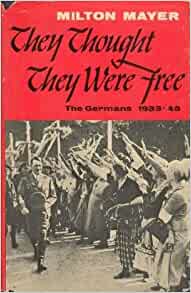
The great and dire events of the early Twentieth Century no doubt confirmed Korzybski in the rightness of this theory. Nothing prevents a race of people from contracting and fomenting a false-to-facts belief: the fantasies of the Nazi Germans, pseudo-biology and pseudo-economics combined with the romance of neo-paganism, stirred the psyche of the German people for quite understandable reasons. From the point of view of General Semantics, the Germans had divorced their symbols from reality, they mistook metaphors for truth, and their emotions adapted to and reinforced the prevailing narrative. They told themselves stories about Wotan and the Blood, about being betrayed during the Great War, about needing room to live, about the wickedness of Jewish bankers and shopkeepers, about the origin of the wealth of nations — and they went crazy.

The Russians, earlier, and for equally psychological and psychopathic reasons told themselves a more coherent but more unreal story about history and destiny, taken from a Millenarian cultist named Marx, and they were, on an emotional level even if not on a cognitive level, convinced that shedding the blood of millions would bring about wealth as if from nowhere. And, because they used the word “scientific” to describe their brand of socialism, they actually thought their play-pretend neurotic story was a scientific theory that had been discovered by rigorous ratiocination — and they went crazy.

Berlin was bombed into submission during the Second World War, and the Berlin Wall collapsed along with the Soviet Empire at the end of the Cold War. But the modern methods of erecting false-to-facts dramas appealing to mass psychology, once discovered, did not fall when their practitioners fell: scientific socialism, naziism, fascism, communism, all have in common the subordination of word-association to political will. All these doctrines have a common ancestor, which is the social engineering theory of language: if you change the connotation of word, so the theory runs, you change the connotations of thoughts. General Semantics says that if an individual, or whole people en mass, adopt deliberately false beliefs, supported by deliberately manipulative word-uses, he or they will have increasingly unrealistic and maladaptive behaviors. Introduce Political Correctness, ignore factual correctness, and the people will go crazy.

The main sign of when madness has possessed a crowd, or a civilization, is when the people are fearful of imaginary or trivial dangers but nonchalant about real and deep dangers. When that happens, there is gradual deterioration of mores, orientation, and social institutions — the Crazy Years have arrived.

John C. Wright, “The Crazy Years and their Empty Moral Vocabulary”, John C. Wright, 2019-02-18.

December 29, 2021

Theodore Dalrymple reviews the latest work from Thomas Piketty, Time for Socialism

Filed under: Books, Economics, Europe, France, Government — Tags: , , , , — Nicholas @ 03:00

Thomas Piketty has been a big name among progressives since his first book hit the bestseller lists, so the release of his latest work calls for some consideration from Theodore Dalrymple:

Piketty still writes clearly, though without much imaginative verve, and he has obviously consulted a lot of data. He is intelligent, knowledgeable, and decent, with a very firm grasp of unreality. He believes in a world in which economic levers act frictionlessly, or to borrow the description a doctor of my acquaintance has used with regard to his own medico-legal reports: “You turn the handle and the sausage comes out.”

There is no difference in his world between investment and expenditure. Thus, when he correctly ascribes low productivity in Britain to the low educational level of the general population (such that, in a predominantly service economy, much of it is unable even to answer the telephone properly or with reasonable courtesy), he ascribes it to lack of expenditure on education. If only this were the case! But lack of expenditure cannot possibly explain why about a fifth of children leave school barely literate. Incidentally, France seems to be progressing, if that is quite the word, in this direction.

We read that “Research in the social sciences, of which economics is an integral part, whatever some may think, is and always will be hesitant and imperfect. It is not designed to produce ready-made certainties … we have to examine patiently to endeavour to draw some provisional and uncertain lessons.” Amen to that! But modesty or tentativeness is not Professor Piketty’s main characteristic, nor does prudence once enter into his proposals.

There is no awareness that deterioration is possible as well as improvement, or of the fragility of things. Nothing counts for him but equality. He is to taxation policy what Le Corbusier was to architecture: he wants to prescribe (and proscribe) for the whole world. Above all, no variation! He would tell us how much we may possess, how much we may leave to our descendants or receive from our ancestors, how much we may earn in a year.

As an egalitarian and firm anti-nationalist, he does not explain why redistribution should stop at national borders. But try telling the average Frenchman that from now on he must forgo half his wealth in order to raise up Somalia or South Sudan! The book sometimes reads as if it were written by an electoral propagandist for Éric Zemmour, acting as an agent provocateur.

Uniformity is for him the price of unity (his countryman, Frédéric Bastiat, did not make the same mistake). He has little regard for, or even awareness of, the potential political consequences of some of his proposals. In his European Assembly, for example, which would have real power (unlike the current European Parliament), France, Spain, and Italy could and probably would outvote Germany with regard to economic policy. It does not occur to him that there could be few better ways of arousing dormant German nationalism than this. Nothing is certain, but much is possible; and while he mentions the internationalism of Jean-Luc Mélanchon, the left-wing French politician, he might also have mentioned that M. Mélenchon wrote a book about Germany and Germans that could easily have been written by a patriotic Frenchman in 1916.

Piketty is a strong believer in taxes as tools to make people more equal, and objects to the elimination of the wealth tax by the French government recently. Were he given the power, he would not only re-implement it, but vastly expand the taxes demanded of the wealthy.

[…] To all this, Professor Piketty has one sovereign remedy: tax the rich.

He thinks this is democratic because many, perhaps a majority, would vote for it. He has no problems with majoritarian democracy (provided the majority agrees with him): How can democracy be tyrannous? Thus, he sees no drawbacks in Senator Warren’s proposal to set a wealth tax and to provide — provide! — “an exit tax equal to 40% of total wealth for those who choose to leave the country and relinquish American citizenship.” Moreover, “the tax would apply to all assets, with no exemptions, with dissuasive sanctions for persons and governments who do not transmit appropriate information on assets held abroad.” Not only is this tyrannous with regard to individuals, but it is tyrannous with regard to international relations, providing a justification for American jurisdiction over the whole world. Needless to say, China, Russia, and India would never accept this, and might find allies. Conflict could become endless.

The answer to this little problem is obvious to Professor Piketty: a wealth tax worldwide, such that there would be nowhere for anyone to hide. There might be a few little teething problems with implementation — for example, who is to oversee it all — but think of the benefits: lie back and think of England! Professor Piketty has found the elixir of life, and it is taxation.

QotD: The pervasive infantilization of the “elites”

Filed under: Books, Media, Quotations — Tags: , , , , — Nicholas @ 01:00

One is tempted to go first after the fattest target, Harry Potter (one is even more tempted to make the obvious jokes about “academia” and “fattest”, but one will manfully resist). The thing is, I think I get the appeal of something like Game of Thrones — the part of the appeal that isn’t spelled “scads and acres and furlongs and metric shitloads of tits,” that is, which makes up the appeal of 99% of any given HBO show (seriously, where would that network be without gratuitous nudity?).

We’ll get there, fear not. But the appeal of Harry Potter absolutely eludes me. I’m sure it’s a charming enough story, but … it’s kid stuff, and they’re not reading it with their kids, because they don’t have kids. And it’s really creepy, y’all, how seriously they take this kids’ stuff. As Vizzini pointed out yesterday, the very mature deep thinkers in the Totally Legit Joe regime are whiling away their hours behind the razor wire by choosing spirit animals for themselves, based on their favorite Harry Potter characters. And while that is absolutely the kind of thing those imbeciles should be doing, instead of attempting to govern, not a one of them is under age 40 (Jen Psaki, for instance, is 43 — and also, according to anonymous White House sources, a “wild cat”; make of that information what you will).

Part of it is just the infantilization of American culture, of course, but it’s strange and disturbing how the more educated, professional classes seem to be not just more infantile than the hoi polloi, but much more passionate about it, too. I know a senior ER doc at a big hospital, for instance, who is waaaaay into Star Wars. And I don’t mean Star Wars collectibles, though of course he has a bunch of those, and as silly as that is in itself (guilty as charged; let me show you my baseball cards sometime).

I mean the dude is just really, really, really into Star Wars. He’s got Star Wars shit all over his house … his huge, grossly expensive, “befitting a senior trauma surgeon whose wife is also a big league university administrator” house, in the toniest part of town, to which he routinely invites other big league people, including — for professional purposes — politicians and powerful apparatchiks. And let me hasten to add, he’s not House MD, whose abrasive “quirks” are tolerated because of his preternatural genius. This guy is, himself, a slick political operator; he’s got plenty of social savvy. But … he’s also got a scale model Millennium Falcon hanging from the roof in the dining room.

I’m sure there’s an explanation for how nobody but me seems to find this really, deeply, disturbingly fucking odd … but there it is.

Severian, “The One Pop Culture Thing”, Rotten Chestnuts, 2021-09-16.

December 19, 2021

Remember the megabucks Andrew Cuomo received for his (ghostwritten) book? It’s going to New York State instead

Filed under: Books, Business, Politics, USA — Tags: , , , , — Nicholas @ 05:00

Back in November, Kenneth Whyte reported on the unlikely pay-off for Andrew Cuomo and his American Crisis. In this week’s SHuSH newsletter he’s delighted to report that the state government — which effectively funded the research and writing of the book — will be the eventual recipient of the whole advance:

Sorry to keep harkening back to previous SHuSHs but I can’t overlook the latest on the Andrew Cuomo shambles.

You’ll remember that now-disgraced former governor of New York, Andrew Cuomo, played dirty with his publisher and the public while landing a lucrative book contract. More specifically, he suppressed bad news about pandemic deaths in his state while coaxing a $5.1 million advance out of Penguin Random House for a book about his heroic activities as a COVID-19 fighter.

I mentioned that it was astonishing that the governor of America’s hardest-hit pandemic state could produce a fat manuscript in just three months, and that media reports suggested his staff and a ghostwriter authored the book for him. The same reports said he was in danger of violating state ethics prohibitions against the use of state resources or personnel in producing his book.

I also noted that weeks after the grandly titled American Crisis: Leadership Lessons from the COVID-19 Pandemic was released in October 2020, Cuomo was hit with the first in a long series of sexual harassment allegations. He was forced to resign his office in August 2021. By then, it had also emerged that Cuomo’s office had covered up roughly half of the fatalities among state nursing home residents during the pandemic.

Penguin Random House took a bath on the project. American Crisis has sold only about 50,000 copies, about a tenth of what the publisher needed to cover the advance it paid the author.

This week it was Cuomo’s turn in the tub. An ethics panel ruled that he had broken his promises not to use state resources or government staff to write his self-congratulatory book, and gave him thirty days to hand over to the State of New York the $5.1 million he earned with the book.

‘Tis the season to be jolly

Fa-la-la-la-la, la-la-la-la

QotD: Sun Tzu’s Art of War reworked for the 21st Century by General Mark Milley

Filed under: Books, China, Humour, Military, Quotations, USA — Tags: — Nicholas @ 01:00

… here at The Babylon Bee, we’re legit journalists, so we’ve got the exclusive scoop. Here are some excerpts from the upcoming revision of The Art of War:

    “If you think you might attack an enemy, pick up the phone and give ’em a heads up. It’s only fair.”

    “You have to be careful not to surprise your enemy. They really don’t like it.”

    “Treason is not treason if it is the lesser of two treasons.”

    “Know thy pronouns, and know thy enemy’s pronouns.”

    “The supreme art of war is to surrender to your enemy without fighting.”

    “All war is white rage.”

    “If you surrender, you can never lose.”

    “If thy commanding officer sends mean tweets, thou need not follow orders or the chain of command.”

    “The enemy of my friend is my friend.”

    “Keep your friends close and your enemies on speed dial.”

    “You can not betray the one to which you were never loyal.”

    “Ask not what your country can do for you, but what you can do for China.”

    “When retreating, leave most of thy armaments behind so you know what you’ll be up against next time.”

    “Chinese bros before American hoes.”

    “He who turns on bad orange man gets big book deal.”

“General Milley Is Releasing A Revised Version Of The Art Of War — And We’ve Got Exclusive Excerpts”, BabylonBee, 2021-09-17.

December 15, 2021

QotD: Suppressing intellectual heresy

Filed under: Books, Education, Liberty, Politics, Quotations, USA — Tags: , , , , — Nicholas @ 01:00

Middlebury students acted to prevent Charles Murray from speaking on the relatively benign subject of the travails of the white working class because he had previously written work that some have categorized as racist. That label meant that they need not grapple with the substance of his earlier book, but it also meant that as a known heretic his subsequent work was likewise tainted.

The young people at Middlebury who shouted down Charles Murray and assaulted a faculty member who had tried to engage him in civil debate were, in effect, suppressing the ideas of a heretic. After all, a heretic’s ideas are too dangerous to be heard.

Dangerous ideas are, of course, interesting ideas, especially to young people. When we fail to address dangerous ideas in our courses, we add to their mystique. When activists shout down or assault heretical speakers they send two messages. The first and intended message is a display of righteous disapproval. The other, unintended message, is that there is something so menacing about the idea being expressed that it cannot simply be laughed off or even argued with, rather it cannot be allowed to be spoken.

Consider how that looks to someone who is starting to question the premises of the liberal orthodoxy on race, gender, diversity and so on. Why, our alt-right curious person might wonder, are there some ideas that are so laughably false that one need not even mount a counter argument (a flat earth or the financial benefits of college athletics), some ideas that are considered contentious but still open to debate (supply-side economics), and some ideas that are so outré that they can only be met with back turning, shouting, or by punches to the face?

Might it be, our waverer must wonder, that these people don’t want me to hear this idea because they don’t have a good answer to it?

Erik Gilbert, “Liberal Orthodoxy and the New Heresy”, Quillette, 2019-02-04.

December 12, 2021

“Say what you will about Rand, nobody ever described her as a light read”

Filed under: Books, Economics, Liberty — Tags: , , , , — Nicholas @ 03:00

In Quillette, David Cohen notes that we’re coming up on the 40th anniversary of Ayn Rand’s death, which will almost certainly help expose her work to a renewed audience of disaffected teens and freshman university students:

More than a half-century ago the great — and, alas, irreplaceable — American scholar Allan Bloom became aware of the spell she could cast. He first started noticing it around the time he became aware of a decline in serious reading among his students. As the University of Chicago professor later recounted in The Closing of the American Mind, it became particularly evident whenever he asked his large introductory classes which authors and books really mattered to them. Most of the undergrads fell silent, he wrote, or else were puzzled by the question. There was generally no text to which they looked “for counsel, inspiration or joy,” he remarked. But one exception kept popping up.

There always seemed to be, he marvelled, a student who mentioned Atlas Shrugged, a work “although hardly literature, which, with its sub-Nietzschean assertiveness, excites somewhat eccentric youngsters to a new way of life.” And rather more of them than did Allan Bloom or, indeed, pretty much anyone else in the United States who has ever tried to hawk philosophy to the masses. Rand’s book sales overall stand at around 30 million, with hundreds of thousands more each year, and probably rather more this coming year.

Not only is she sought-after for her two best-known novels — the other being The Fountainhead — but also for her nonfiction. Her slim volumes of collected essays and old newspaper columns and other outtakes comprise an apparently fathomless vault from which the Ayn Rand Institute routinely cobbles together regular offerings for the lucky kids. One survey by the Library of Congress listed Atlas Shrugged as second only to the Bible in terms of campus popularity; an incredible accomplishment. All the more so in an era of Twitter, Facebook, and all the other intimations of the shortened attention-span. Say what you will about Rand, nobody ever described her as a light read.

A random internet search throws up an impressive litany of fans from the entertainment world, including Oliver Stone, Rob Lowe, Jim Carrey, and Sandra Bullock. Even the late professional wrestler James Hellwig, better known as The Ultimate Warrior, bellowed her praises, which might add some context to those rollickingly individualistic pre-fight interviews he used to do back in the WWE glory days. Oh, and let’s not forget Brad Pitt and Vince Vaughn. Which is particularly interesting, I think, since Jennifer Aniston (also a Rand fan) replaced the first with the second after Pitt ran off with Angelina Jolie, who’s also on record enthusing about Rand’s “very interesting” take on the good life.

In politics and economics, Rand had her youthful followers, too, and here again one sees the youth-appeal angle. Probably her best-known disciple is the former Federal Reserve chairman Alan Greenspan, who is rather ancient now. But back when dinosaurs still roamed the Earth, Greenspan declared that the high empress of the libertarian Right “taught me that capitalism is not only practical and efficient but also moral.” Like the young and philosophically restless undergrads in Allan Bloom’s classes, the British health secretary Sajid Javid also discovered her early on, and apparently still reads the courtroom scene in The Fountainhead every year. Or rather, as the cool libertarian kids in the black jeans might prefer to put it, it still reads him.

December 10, 2021

Shovel-ready infrastructure we’re already busy working on … the superhighway to serfdom

Jacob T. Levy considers the warning about authoritarian solutions to societal problems given by Friedrich A. Hayek in The Road to Serfdom and shows just how little we heeded his concerns:

It is well-known that the classical liberal economist F.A. Hayek dedicated The Road to Serfdom to “socialists of all parties”, and wrote the book “as a warning to the socialist intelligentsia of England.” I suspect we now understate the importance of these facts. After decades of the Cold War and self-conscious conservative-libertarian “fusionism” in both the U.S. and Britain, what sticks in our memory of The Road to Serfdom is its defense of liberal open markets against economic planning and regulation of the sort advocated on the left. That is of course how it was wielded in the post-2008 surge in interest in it, in the wake of the financial crisis and the subsequent bailouts and stimulus packages: as a weapon of the right.

But if Hayek’s argument characterized socialist planning and regulation as a slippery slope, the slope did not only slope down toward the left. Fascist Italy and Germany figure even more prominently than the USSR in the book’s image of the despotism being risked:

    It is necessary now to state the unpalatable truth that it is Germany whose fate we are now in some danger of repeating … students of the current of ideas can hardly fail to see that there is more than a superficial similarity between the trend of thought in Germany during and after [World War I] and the present current of ideas in the democracies … And at least nine out of every ten of the lessons which our most vociferous reformers are so anxious we should learn from this war are precisely lessons which the Germans did learn from the last war and which have done so much to produce the Nazi system … [A]t an interval of fifteen to twenty-five years we seem to follow the example of Germany.

In the face of resurgent right-wing populist and nationalist authoritarianism in the world, it is worth reconsidering the legacy of The Road to Serfdom and of Hayek’s work to bolster liberalism.

Hayek warned of centralizing and authoritarian urges of both the left and the right, but it’s in the “permanent” government — the civil servants who remain in office regardless of electoral outcomes — that much of the danger to individual liberty lies:

Throughout Hayek is concerned for constitutional parliamentary government and the rule of law, and their protection against arbitrary government. The idea that freedom requires clear and general rules of conduct anonymously applicable to all — that government run by ad hoc edict is oppressive — was to be the major theme of his subsequent works in political theory, The Constitution of Liberty and Law, Legislation, and Liberty; but it is central to the argument of Road to Serfdom as well.

In the preface to the 1956 edition, Hayek described the postwar Labour government as having created a bureaucratic “despotism exercised by a thoroughly conscientious and honest bureaucracy for what they sincerely believe is the good of the country. But it is nevertheless an arbitrary government, in practice free from parliamentary control; and its machinery would be as effective for any other than the beneficent purposes for which it is now used.”

Here one hears a predecessor of the widespread classical liberal “we told you so” after the election, blaming the Obama administration for increasing the presidential power that the Trump administration would now inherit. But it is worth emphasizing that Hayek still called the purposes pursued by the left-wing bureaucratic state “beneficent”.

The tone Hayek adopts here is not the schadenfreude of contemporary whataboutism. Now that “hot socialism is probably a thing of the past” (hardly what one would expect Hayek to say were he the determinist caricature sometimes embraced by fans as well as critics), the welfare state calls for “careful sorting out” in the pursuit of its “practical and laudable” aims. He calls for the welfare state and social insurance to be implemented through general rules and fiscal policy rather than administrative coercion, nationalization, and direct economic planning, because the latter instruments “are not compatible with the preservation of a free society.”

H/T to Tamara Keel for the link.

« Newer PostsOlder Posts »

Powered by WordPress