
Nebulous Media
Published 20 Dec 2022Andrew Roberts joins Douglas Murray on this episode to discuss Winston Churchill. The two discuss the soldier, writer and prime minister in detail, leaving nothing off limits. Should the British Bulldog stay cancelled?
(more…)
June 27, 2023
Uncancelled History with Douglas Murray | EP. 05 Winston Churchill
Comments Off on Uncancelled History with Douglas Murray | EP. 05 Winston Churchill
June 26, 2023
America can’t build anything these days and “it’s all Ralph Nader’s fault”
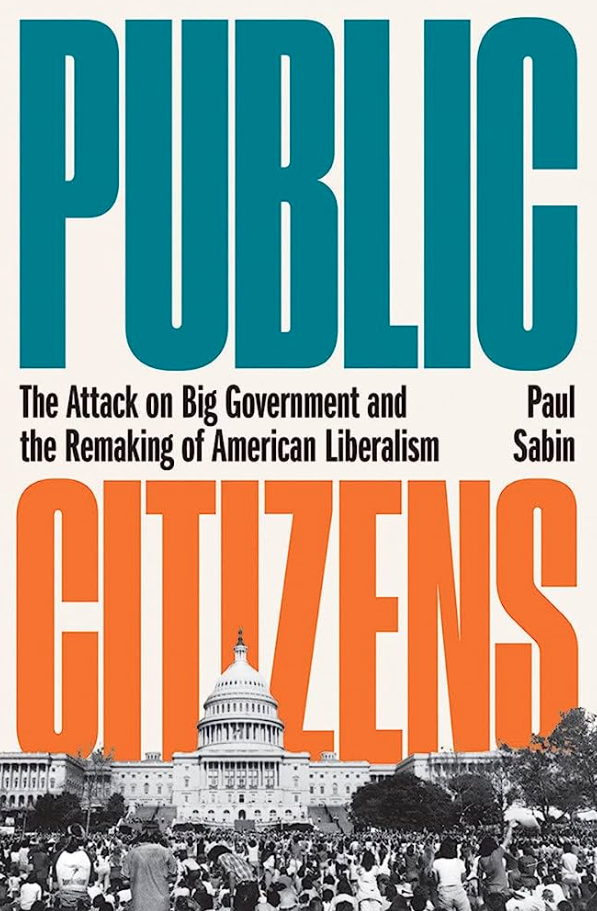
One of the readers of Scott Alexander’s Astral Codex Ten has contributed a review of Public Citizens: The Attack on Big Government and the Remaking of American Liberalism by Paul Sabin. This is one of perhaps a dozen or so anonymous reviews that Scott publishes every year with the readers voting for the best review and the names of the contributors withheld until after the voting is finished:
Today, pundits across the political spectrum bemoan America’s inability to build.
Across the country, NIMBYs and status-quo defenders exploit procedural rules to block new development, giving us a world where it takes longer to get approval for a single new building in San Francisco than it did to build the entire Empire State Building, where so-called “environmental review” is weaponized to block even obviously green initiatives like solar panels, and where new public works projects are completed years late and billions over budget — or, like California’s incredible shrinking high-speed rail, may never be completed at all.
Inevitably, such a complex set of dysfunctions must have an equally complex set of causes. It took us decades to get into this mess, and just as there’s no one simple fix, there’s no one simple inflection point in our history on which we can place all the blame.
But what if there was? What if there was, in fact, a single person we could blame for this entire state of affairs, a patsy from the past at whom we could all point our censorious fingers and shout, “It’s that guy’s fault!”
There is such a person, suggests history professor Paul Sabin in his new book Public Citizens: The Attack on Big Government and the Remaking of American Liberalism. And he isn’t isn’t a mustache-twirling villain — he’s a liberal intellectual. If you know him for anything, it’s probably for being the reason you know what a hanging chad is.
That’s right: it’s all Ralph Nader’s fault.
How’d he do it? By creating what’s now called the public interest movement: a new form of activism through which citizens force change — or, more often, block change — by suing the government. Though it was begun with the best of intentions and achieved some real good along the way, this political innovation led to the constipated governance we all complain about today.
How did a movement launched by an unassuming 30-year-old lawyer become the dominant form of activism in the country, and completely change the way our government operates?
To find out, we have to go back to a time before Ralph Nader had even hit puberty — the era of the New Deal.
[…]
It is the inherent nature of politics that no reform works forever, because the next generation of political entrepreneurs will inevitably discover new ways to bend the process to their will. Eventually, there will always be another Dick Fosbury revealing a way to work the system that no one saw coming.
Still, I do think some of the blame for the way this all panned out can be laid on Nader’s particular personal idiosyncrasies. His ironclad black-and-white view of the world, combined with his near-pathological aversion to dealmaking and compromise, made him uniquely suited to a form of activism that focused on regulatory and legal action rather than coalition-building and electoral politics. Nader was infamously rigid and inflexible, so it’s no surprise that his movement was too. But a less rules-oriented movement might have created fewer of the bureaucratic barriers that have now become a hindrance to progressive action.
Much like the movement whose story it tells, Public Citizens the book is a worthwhile project that nonetheless suffers from significant flaws. The main problem is that it can’t decide if it’s a historical narrative or a work of political theory. As a work of political theory, it doesn’t take nearly a strong enough stand — I’ve made explicit a lot of claims that are only lightly implied in the book. I think we’re making the same argument, but the book makes its argument with such a delicate touch that it’s hard to be 100% sure.
As a historical narrative, Public Citizens has a much simpler problem: it’s boring. The author writes like an academic (which, to be fair, he is), and the book is quite light on colorful details. The uncreative chapter titles (chapter three is called “Creating Public Interest Firms”) give you a taste of what the writing is like. One particularly egregious issue is how little biographical information is provided about Nader, even though the majority of the book is about him. For someone who apparently subscribes to the Great Man theory of history, the author includes surprisingly little information about the Great Men themselves. Any interesting biographical fact you read in this review — even something as basic as the fact that Nader never married—is almost certainly something I found through other sources.
Paradoxically, this book manages to be simultaneously boring and too concise. It’s over in less than 200 generously-spaced pages, and I frequently had to look stuff up on the internet to get a full understanding of what was going on. I get the sense that the author is trying to give this book mass appeal, but come on: anyone who’s willing to read a nerdy book like this is willing to read an additional hundred pages or so. Besides, Robert Caro and Ron Chernow have proven that people will read thousand-page tomes if the story is compelling and the details are juicy.
Basically, my critique of Public Citizens is like that old Catskills joke about the restaurant where the food is terrible — and the portions are too small.
Comments Off on America can’t build anything these days and “it’s all Ralph Nader’s fault”
June 25, 2023
Fifty years after The Princess Bride was published
William Goldman’s novel The Princess Bride was not a blockbuster, nor did the movie adaptation get a huge box office when it released in 1987. Yet despite apparent early mediocrity, it became a cult classic. It’s now fifty years after the book came out, and Kevin Mims has a look back at both the novel and the movie:
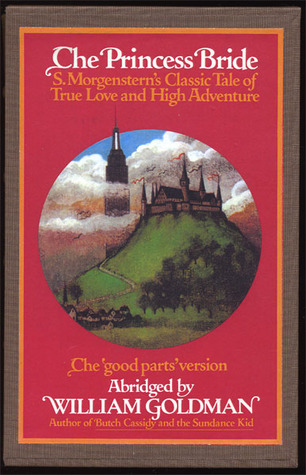
Even by the eccentric standards of fantasy literature, William Goldman’s 1973 novel The Princess Bride is extremely odd. The book purports to be an abridged edition of a classic adventure story written by someone named Simon Morgenstern. In a bizarre introduction (more about which in a moment), Goldman claims merely to have acted as editor. Unlike Rob Reiner’s much-loved 1987 film adaptation, the book’s full title is The Princess Bride: S. Morgenstern’s Classic Tale of True Love and High Adventure, The “Good Parts” Version. Yes, all that text actually appeared on the cover of the book’s first hardcover edition (all but the first three words have been scrubbed from the covers of most subsequent editions).
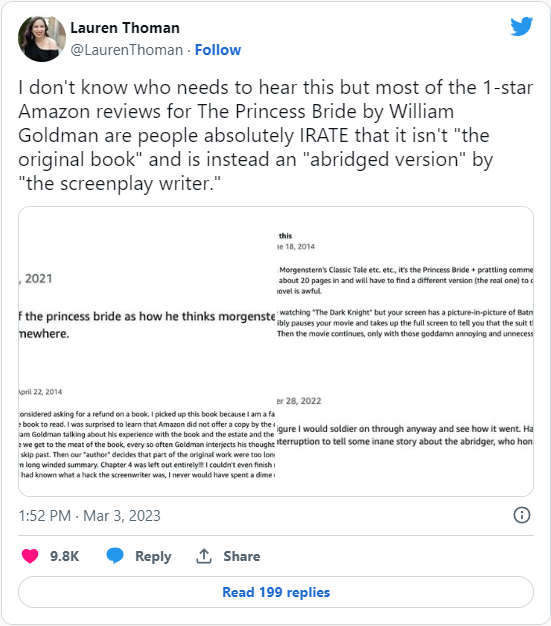
In the 1990s, I worked at a Tower Books store in Sacramento. Every few months, someone would come into the store and ask if we had an unabridged edition of S. Morgenstern’s The Princess Bride. The first time this happened, a younger colleague who had worked there longer than I had told my customer, “The Princess Bride was written by William Goldman. There is no S. Morgenstern. Goldman made him up.” The customer wasn’t convinced. “It’s metafiction,” my colleague explained. “A novel that comments on its own status as a text.” When the customer had left, my colleague told me that a lot of people still believe there is an original version of the novel available somewhere, written by Morgenstern. Having fallen in love with the story via the Hollywood film, they were now looking for the ur-text.
Although I was a big fan of William Goldman, I had never read The Princess Bride. My wife and I saw the film when it first appeared in American theaters, and we have rewatched it several times since on VHS and DVD. Only about 10 years ago did I actually get around to reading the novel. And when I did, I found myself sympathizing with all those people who still believe that, somewhere in the world, there exists an unedited edition.
In his introduction, Goldman tells us that S. Morgenstern was from the tiny European nation of Florin, located somewhere between Germany and Sweden, which is where the story’s action takes place. Such a place never existed, but it’s not surprising that many 21st-century American readers don’t know the names of every current and former European kingdom. European history is littered with microstates that rose briefly and then vanished without leaving much of a trace. Back in the 1990s, before Internet access became commonplace, confirming the existence of a small defunct European statelet would have involved a trip to the library.
But readers in the 1970s might have been more alive to Goldman’s ruse. Back then, metafiction was all the rage. John Barth became a literary superstar (among the academic set, anyway) with books like The Sot-Weed Factor (which, like The Princess Bride, is a fantastical comic adventure supposedly written by a fictional author) and Giles Goat-Boy (the text of which, Barth writes in the foreword, was said to have been written by a computer). In 1983, Goldman would publish a second novel behind the Morgenstern pseudonym, titled The Silent Gondoliers, but this time he removed all mention of himself, even from the copyright page.
Comments Off on Fifty years after The Princess Bride was published
June 22, 2023
QotD: Nuclear non-proliferation and the Russo-Ukraine war
The failure of the earlier League of Nations was crucial to preparing the way for the Second World War. Today, we see none of this, with most participants — excepting North Korea and Iran — still playing by the rules. This is where we return to Nevil Shute. Twice, using his technical expertise, Shute attempted to predict future war in a novel, and twice he got it wrong. With On the Beach, the author wrote of a 37-day war that “had flared all around the northern hemisphere”. Albania had dropped a “cobalt bomb” on Naples, which escalated into wider conflicts and eventually a Russo-Chinese exchange.
As one of Shute’s characters, a scientist, explained, “The trouble is, the damn things got too cheap. The original uranium bomb cost about fifty thousand quid towards the end. Every little pipsqueak country like Albania had a stockpile of them, and every little country that had that, thought it could defeat the major countries in a surprise attack”. Significantly, Shute’s future war, set in 1963, wasn’t triggered by the usual NATO-Warsaw Pact arsenals of nuclear weapons, but the proliferation of them elsewhere. Then, as now, it is not Russian or Chinese aggression that should worry those with nightmares of nuclear cataclysm, but that of other countries. Thanks to the NPT, IAEA and the UN, these possibilities are contained. Today, the world’s weapons of mass destruction stand at one tenth of their number during the Cold War.
Indeed, the very origins of the current Ukraine crisis illustrate how the international order has managed to contain potential proliferation. When the Soviet Union disintegrated in 1991, Ukraine possessed the world’s third largest nuclear arsenal, greater than those of Britain, France and China combined. Kyiv soon realised it couldn’t afford to maintain the warheads and remain a credible nuclear military power. A solution was found, whereby the weapons would be destroyed, but only in exchange for security assurances that the United States and Russia would respect Ukraine’s independence, sovereignty and territorial integrity.
What Ukraine signed on 5 December 1994 was the Budapest Memorandum of Security Assurances, in which Bill Clinton for the United States, Boris Yeltsin for Russia and John Major for Great Britain promised to protect Ukraine and its territorial integrity in recognition of Kyiv surrendering the protection of its nuclear arsenal. There was no mention of military guarantees, which Ukraine assumed were implied. Additionally, Kyiv promised to adhere to the Non-Proliferation Treaty (NPT).
After the annexation of Crimea by Russia in 2014, the G7 nations complained that Russia had breached the Budapest Memorandum. Vladimir Putin replied evasively that since, in his view, a new regime had seized power from Ukraine’s previously pro-Moscow premier Viktor Yanukovych, “Russia has not signed any obligatory documents with this new state”. Since then, Russia has lied and prevaricated over its betrayal of Budapest. In 2016, Sergey Lavrov went so far as to claim, “Russia never violated Budapest memorandum. It contained only one obligation, not to attack Ukraine with nukes” — a gross distortion of the Memorandum’s many obligations.
However, the West responded in 2014 only with mild economic sanctions. Arguably, the apathy of the anti-interventionist Barack Obama and David Cameron, influenced by a London awash with Russian money, emboldened Vladimir Putin. Few experts disagree that had the West responded in 2014 as they did in 2022, Russia’s expansionist ambitions into Ukraine would have ended long ago. Yet, there is plenty of room for optimism. The Russo-Ukraine conflict has not spread because of the international order and its treaties. Apart from North Korea and Iran, neither of whom have quite perfected their devilish devices, nuclear proliferation of third parties has been held in check.
The Kremlin shows no sign of taking steps to escalate to a nuclear level. It is not in its interests, or those of its allies, to do so. None of the 32 nations who recently abstained from condemning Russia in the 24 February UN vote would welcome Vladimir Putin and his cronies flinging nukes around. The qualified support of major powers like China, India and Pakistan is attached to the cheap oil and arms procurements they have negotiated with Moscow. Any hint of Tsar Vladimir “going nuclear” would see their abstentions morph into support for the West. Putin, for all his rhetoric, cannot afford to go it alone with just the six who voted with him at the UN. In military terms, they offer nothing.
The world’s various international arms treaties provide plenty of optimism that this will remain a regional war. So far, Putin’s threats have melted away as the morning mist. The scenario he implies, akin that in On the Beach and other nuclear-war-scare novels and films, is so unlikely as to be discounted. They and all the rest of the post-apocalyptic genre are written as nail-biting entertainment, not history or current affairs.
Peter Caddick-Adams, “Putin, Shute and nukes”, The Critic, 2023-03-09.
Comments Off on QotD: Nuclear non-proliferation and the Russo-Ukraine war
June 21, 2023
“Luttwak tweets with unparalleled Boomer energy, primarily in a write-only mode, at times seemingly oblivious to the waves he causes”
John Psmith reviews the second edition of Edward Luttwak’s Coup d’État: A Practical Handbook. I read the first edition in the mid-70s, when it seemed like coup attempts were an almost weekly news item from any number of exotic tropical locations:
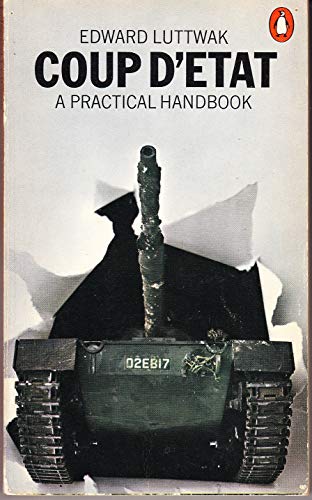
First things first: you need to get the revised, second edition of this book. Why? Because the introduction to the second edition is an excuse for the author to brag about all the bloodstained and bullet-riddled copies of the first edition that have been found among the personal effects of palace security chiefs, spymasters, and air force officers. Perhaps, he gloats, they should have read it more carefully, or perhaps they should have waited for the second edition.
None of this should come as a surprise if you follow Edward Luttwak on Twitter, where his account is characterized by a judicious degree of irascibility and gloating. Yes, I regret to inform you that he’s on Twitter. But unlike some of my other favorite authors who succumbed to the analgesic call of the Great Blue Bird, the medium has not totally destroyed him yet. Luttwak tweets with unparalleled Boomer energy, primarily in a write-only mode, at times seemingly oblivious to the waves he causes. This is good, because it means we get to read his internal monologue, but without the reward loop of social media hacking his amygdala and progressively turning him into a self-parody.
Or perhaps his descent into self-parody was arrested by the fact that he was already a bit of a self-parody. Luttwak came from a Jewish family in communist Romania, spent some time in Palermo where he totally wasn’t involved in the war between the authorities and the mob,1 and provided “consulting services to multinational corporations and government agencies, including various branches of the U.S. government and the U.S. military”, before retiring to the life of gentleman scholar and cattle rancher (and prolific Twitter poaster) in rural Argentina. Along the way he picked up a PhD and wrote a massive pile of books about history, war, diplomacy, and political theory, all while pissing off the authorities in those fields with his epistemic trespassing.
But all of that was still far in the future when he wrote this book about coups. When the non-recommended first edition came out, Luttwak was a tender twenty-six years old, and working tenderly as a consultant for the energy industry in Africa and the Middle East. This raises some questions, questions that Luttwak absolutely refuses to answer, sometimes coyly and sometimes vehemently. Were I concerned about my reputation as a third-world fixer for oil companies, I would simply not write a practical guide to launching coups, but to each his own.
What is a coup? Also known as a putsch, a palace rebellion, or my personal favorite, a pronunciamiento; there are a lot of words for it, many of them in Spanish (you know what they say about Eskimos and their words for snow). The basic definition is a bloodless or almost bloodless extrajudicial transfer of power whereby a group of conspirators is able to turn the machinery of the state against itself, seizing control quickly and cleanly and without triggering a civil war. Note how different this is from other sorts of exceptional transfers of power. In a revolution, all of the institutions in a society are burned down and replaced. A coup is the opposite — only the very top level of the system is swapped out, and the new boss quickly and seamlessly resumes ruling through the machinery of the old regime. Ideally, citizens who aren’t especially politically engaged wouldn’t even notice.
This leads us to a guess as to the most coup-friendly sorts of polities: ideally they should be highly centralized and efficient bureaucratic states, but with very low democratic engagement or popular investment in politics. The first half is important, because without an efficient government machine, there’s nothing for the coup plotters to grab onto. A coup is an action by a tiny group of people who would lose instantly in any fair fight — the only chance they have is to magnify their power by hijacking a system that was already pretty good at controlling the country. It also helps that soldiers, policemen, and citizens in a bureaucratized society are already conditioned to obey impersonal authority, and therefore are more likely to do what the new guy says if he’s careful to use the old, familiar forms. Anarchists love to talk about how anarchy is like a vaccination against foreign occupation, because occupiers generally lack the state capacity to administer newly acquired territories without existing state machinery to co-opt, and that argument is even more true for coups.
1. Also unclear: which side he was not-involved on.
Comments Off on “Luttwak tweets with unparalleled Boomer energy, primarily in a write-only mode, at times seemingly oblivious to the waves he causes”
June 18, 2023
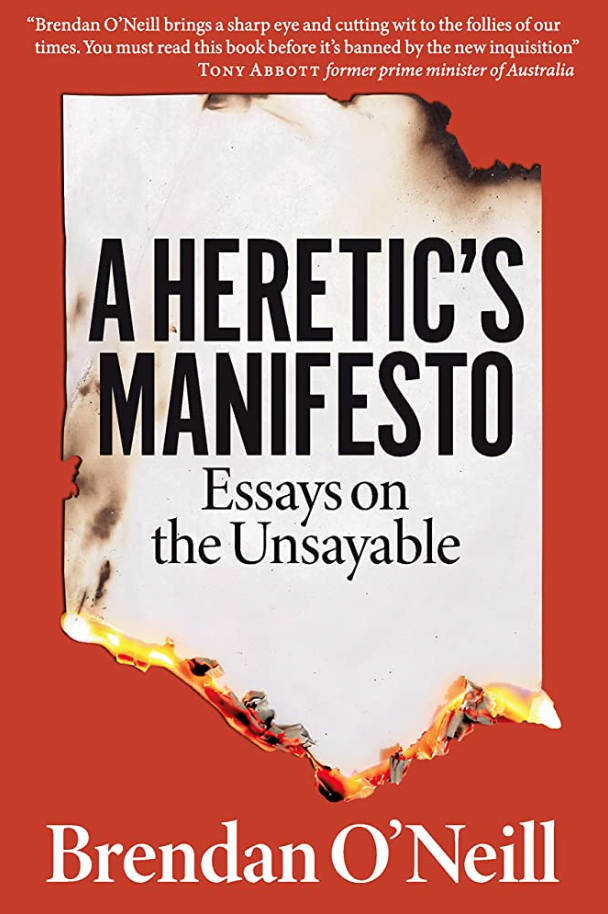
Brendan O’Neill’s new book, A Heretic’s Manifesto
This is an extract from A Heretic’s Manifesto thanks to Spiked:
Words hurt, they say. This is the ideological underpinning to so much censorship today – the idea that words wound, as a punch might wound. The imagery of violence is deployed in almost every call for censure in the 21st-century West. Speech has been reimagined as aggression, hence “microaggressions”. People speak of feeling “assaulted” by speech. “Words, like sticks and stones, can assault; they can injure; they can exclude” – that’s the thesis of Words That Wound, an influential tome published in 1993. Activists claim to feel “erased” by controversial or disagreeable utterances. Trans campaigners speak darkly of “trans erasure”, as if words from the other side of the divide, the speech of gender-critical feminists, might contain that most awesome and nullifying power of genocide.
Words make us feel “unsafe”, people say. Witness the rise and rise of Safe Spaces on university campuses, designed to ensure students’ psychic security against the terrible threat of their hearing an idea they disagree with. Safe Spaces recreate the state of childhood, complete with colouring books and ice cream, speaking to how determinedly some long to retreat from the adult world of hurtful chatter and brickbats.
The United Nations wrings its hands over “hate speech and real harm” (my emphasis). The “weaponisation of public discourse for political gain” can lead to “stigmatisation, discrimination and large-scale violence”, it says. Better keep a check on those hurtful words. One US university even maintains a list of “words that hurt“. It includes the phrase “You guys”. That scandalous utterance “erases the identities of people who are in the room” and “generalise[s] a group of people to be masculine”. Shut it down. Silence that act of violence.
Both the formal and informal punishment of words rests on the belief that they can wound. Laws in Europe claim to guard people from speech that is alarming, distressing, hurtful. The overlords of social media censor speech for “the wellbeing of our community“. Everywhere the cry goes up: words injure, they can cut like a knife, they can be used as “weapons to ambush, terrorise, wound, humiliate and degrade“. And just as the law protects us from such dreadful things when they are done to our bodies with fists and kicks, surely it should also protect us from them when they are done to our minds with words and ideas. Surely our psychic wellbeing should be accorded as much respect by the powers-that-be as our physical integrity is.
The temptation of many of us who believe in freedom of speech, in the liberty of all to utter their beliefs and ideas, is to damn this claim that “words hurt” as a libel against public discourse. As a slippery untruth that is cynically designed to depict words as all-powerful, as containing so much energy, so much heat, that they can lay waste to self-esteem and even make us fret over erasure, over being wiped out entirely by that sore comment or that disturbing idea. Actually, we often say, words are just words. They’re not sticks, they’re not stones, they’re words. They won’t kill you, they won’t hurt you, you’ll be fine. They say words are a force of nature like no other, we say: “Relax. It’s just speech.”
We need to stop doing this. We need to stop countering the new censors by accusing them of exaggerating the power and the potency of words. We need to stop responding to their painting of speech as a dangerous, disorientating force by defensively pleading that words don’t wound because they’re just words. We need to stop reacting to their branding of speech as a weapon, as a tool of ambush and degradation, by effectively draining speech of its power and saying: “It’s only speech.” As if speech were a small thing, almost an insignificant thing, more likely to contain calming qualities than upsetting ones, more likely to help us overcome conflict rather than stir it up, more likely to offer a balm to your soul than to stab at it as a knife might stab at your body.
For when we do this, we play down the power of words. And that includes the power of words to wound. Words do wound. It’s true. Words hurt people, they hurt institutions, they hurt belief systems. Words make churches tremble and ideologies quake. Words inflict pain on priests and princes and ideologues. Words upend the social order. Words rip away the comforting ideas people and communities might have wrapped themselves in for decades, centuries perhaps. Words ambush the complacent and degrade the powerful. Words cause discord, angst, even conflict. Isn’t every revolution in history the offspring of words? Of ideas? Words do destabilise, they do disorientate. People are right to sometimes feel afraid of words. Words are dangerous. When they say words wound, we should say: “I agree.”
Comments Off on Brendan O’Neill’s new book, A Heretic’s Manifesto
June 13, 2023
Why The Far Side is a masterclass in storytelling
The Gaze
Published 26 Dec 2019The Far Side by Gary Larson is one of the best and most praised cartoons in history. But what makes The Far Side so good? What is the legacy of Gary Larson? And most importantly: what can we learn from The Far Side?
0:00 Pixar and Storytelling
1:22 How Gary Larson tells a story
2:42 The Far Side facts and figures
3:22 The level of detail in The Far Side
4:04 Telling a story with one image and a punchline
5:09 What is The Far Side about?
7:11 Gary Larson and naturalism
7:40 Controversy over The Far Side
8:10 The legacy of The Far Side
9:00 Conclusion
(more…)
June 12, 2023
“The more recent four or five years at Indigo have been a disastrophe”
In the latest SHuSH newsletter, Ken Whyte outlines the rise and fall of Canada’s biggest bookstore chain that stopped trying to be a bookstore chain and now appears to be looking for a new identity to assume in the wake of several board resignations and the announced resignation of Heather Reisman, the founder and public face of the chain:

“Indigo Books and Music” by Open Grid Scheduler / Grid Engine is licensed under CC0 1.0

Indigo opened its first bookstore in Burlington in 1997 and quickly expanded across the country in competition with the Chapters chain, which it bought in 2001. Heather’s husband, Gerry Schwartz, provided much of the financing in these years. Gerry is the controlling shareholder of Onex, a private equity firm that now has about $50 billion in assets under management.
Influential in Ottawa, the Schwartz-Reismans managed to convince the federal government to approve Indigo’s purchase of Chapters and also keep the US book chain Borders from moving north into Canada — a double play that cleared the field of meaningful competition and wouldn’t have happened in a country with serious antitrust enforcement.
Heather, as Indigo CEO, cast herself as the queen of Canadian literature, making personal selections of books to her customers, hosting book launches, interviewing celebrity authors, etc.
From a financial perspective, Indigo took about five years to get rolling after the Chapters acquisition. It looked steady through the late aughts and into the teens when Amazon showed up in force. Indigo’s share price caved. Unable to convince Ottawa to push Amazon back across the border, Heather adopted a new strategy, backing out of books and recasting Indigo as a general merchandiser selling cheeseboards, candles, blankets, and a lot of other crap to thirtyish women. “We built a wonderful connection with our customers in the book business,” she famously said. “Then, organically, certain products became less relevant and others were opportunities.” This charmed investors, if not the book community, and Indigo’s share price hit a high of $20 a share in 2018. By then, books, as a share of revenue, had fallen from 80 percent of revenue to below 60 percent (they are now 46 percent).
The more recent four or five years at Indigo have been a disastrophe. With its eighty-eight superstores and eighty-five small-format stores, the company lost $37 million in 2019, $185 million in 2020, and $57 million in 2021. Things looked somewhat better in 2022 with a $3 million profit, but its first three quarters of 2023 (Indigo has a March 28 year-end) resulted in an $8 million loss and its fourth quarter featured one of the most spectacular cyberhacks in Canadian commercial history. The company’s website was breached and its employment records held for ransom, resulting in a ten-day blackout for all of the company’s payment systems and a month-long outage in online sales. The share price is now $2.00 or one tenth the 2018 high.
ANALYSIS AND IRRESPONSIBLE SPECULATION
Given everything Indigo has been through over the last several years, and especially the last several months, it’s not surprising that Heather wants to pack it in. She’s seventy-four and super wealthy. There’s nothing but a desperately hard slog ahead for her money-losing company. Why stay?
Still, this has the feel of something that blew up at a board meeting, or in advance of a board meeting. It’s highly irregular for a company to lose almost half its directors in a single day. If these changes had been approached in conventional fashion, there would have been more in the way of messaging and positioning, especially regarding Heather. For all intents and purposes, she is Indigo. It wouldn’t exist without her. They ought to be throwing her a retirement parade and presenting her with a golden cheeseboard. Instead, all she’s getting, for now, are a few cliches in a terse press release.
It’s also weird that this all happened days before we get the company’s year-end results (they were out by this time last year). My guess is that the board got a preview, that the picture is ugly, that there are big changes afoot, and that the directors were nudged out as the start of a major retrenchment or given the option of sticking around for a bloodbath and chose instead to exit.
Comments Off on “The more recent four or five years at Indigo have been a disastrophe”
June 10, 2023
Do you also dream of apocalypse?
John Psmith certainly does, as he explains before plunging into a review of a book on Chinese warfare between 300 and 900 AD:
I have a secret confession to make. Late at night, when Mrs. Psmith and the Psmithlets are all tucked away in their beds, I like to stay up in my study and fantasize about … the end of the world. But not just any end of the world, because most apocalypses are very boring. For example: “AI unleashes killer nanobots that turn everybody into paperclips.” Yawn. How dull. Where’s the drama in that? No, like all disordered fantasies, mine are fun, and ever-so-conveniently constructed to push the bounds of plausibility while still being technically possible. I’m mostly fantasizing about apocalypses where almost everybody dies, but where one dashing and well-prepared man with pluck and determination and a giant pile of book reviews can restore an island of order and civilization. Hey come on, it could happen!
Most apocalypses would be awful — we would all die instantly, or else we would all die slowly and painfully, but somewhere perfectly balanced in the middle are the apocalypses that would be very exciting, and those are the emotional driver that lead me to engage in a mild degree of prepping. Now like all potential addicts, I have some hard and fast rules, clear lines that prevent me from spending all my family’s savings on refurbishing an old missile silo. My main rule is that any prepping I do has to have a dual use in some less exciting but more likely scenario.
So I store a lot of water in my basement because, look the US government tells me it could be useful in the event of a regional or local disaster. We have emergency bags pre-packed that include a list of rendezvous locations a day’s walk from our house because, hey, there are all kinds of reasons we might need that, okay? I own this tool so I can shut off my gas in the event of an earthquake and totally not because it looks handy for bludgeoning feral packs of marauders, so stop judging me. I have precious metals buried in the ground in a secret location because, uhhh … it’s good to have a tail-risk hedge in your portfolio, all right? What’s that? Why is there ammo in there too? Look, a good portfolio should be anti-fragile …
I think all of this is why I like Chinese history so much, because it’s just way crazier, bloodier, and more apocalyptic than the history of most other places. In Western Europe civilization collapsed once (okay fine, twice (okay, fine, three times)), and we’re still ruminating over it and working through this unending cultural psychodrama like some civilization-scale therapy addict. Meanwhile, in China, civilization collapsing is like Tuesday. The history of China is an endless cycle of mini-apocalypses in which the entire political, economic and moral order gets razed to the ground and Mad Max conditions prevail for a few decades or centuries, until somebody gathers enough power in his hands to establish a new dynasty and all is peaceful and harmonious under heaven. A few hundred years later, that new regime grows tired and old, the Mandate of Heaven slips away, and the cycle repeats.

Comments Off on Do you also dream of apocalypse?
George MacDonald Fraser – Quartered Safe Out Here
We Have Ways of Making You Talk
Published 16 Jan 2023Merry Christmas from “We Have Ways of Making You Talk”. Over the next 12 days Al and James are reading extracts from some of their favourite books about the Second World War. Today Al is reading from Quartered Safe Out Here, by George MacDonald Fraser.
(more…)
Comments Off on George MacDonald Fraser – Quartered Safe Out Here
June 2, 2023
“Montgomery was a military talent; Slim was a military genius”
Dr. Robert Lyman is a known fan of Field Marshal Slim (as am I, for the record), not only for his brilliant military achievements, but also as a writer:
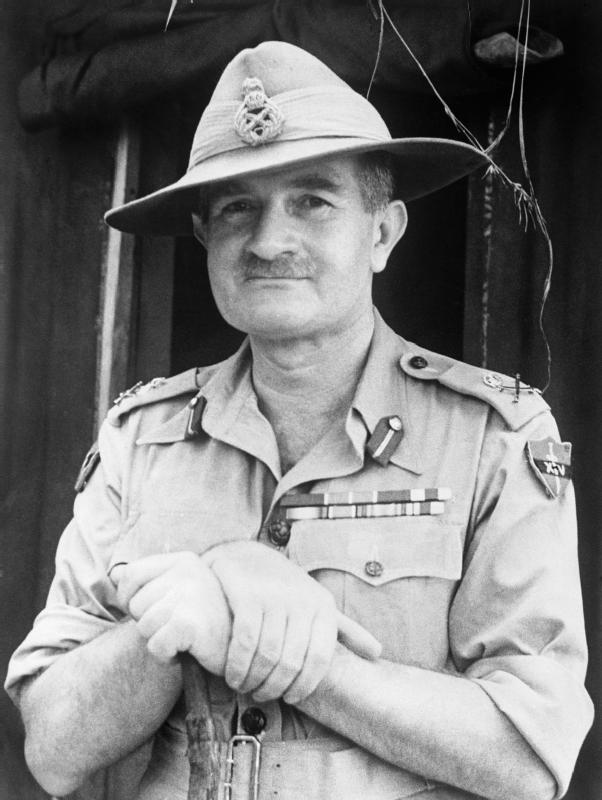
Field Marshal Sir William Slim (1891-1970), during his time as GOC XIVth Army.
Portrait by No. 9 Army Film & Photographic Unit via Wikimedia Commons.
How many British generals have been able to write as well as they could fight? Strangely perhaps, quite a few. Field Marshal Sir Michael Carver (Dilemmas of the Desert War, The Seven Ages of the British Army), General Sir David Fraser (And We Shall Shock Them), General Sir John Hackett (The Third World War) and Major General John Strawson (Beggars in Red) are four outstanding soldier-writers that spring immediately to mind. Even Monty wrote his memoirs. And in our own day I’ve read plenty of competent books from a slew of men who’ve reached the top of the profession of arms. The work of some, like that of General Sir Richard Sherriff (2017: War with Russia), Major General Mungo Melvin (Manstein) and Brigadier Allan Mallinson (Too Important for the Generals et al), could be described as outstanding. Julian Thompson and Richard Dannatt also fit this bill. But by far and away the best of Britain’s soldier-writers in the last century was also probably the greatest soldier – and field commander – of them all: Bill Slim. He was, more properly, Field Marshal William J. Slim KG, GCB, GCMG, GCVO, GBE, DSO, MC, KStJ, the onetime General Officer Commanding the famous 14th Army – the so-called Forgotten Army – of Burma fame. He was, in this author’s view, the greatest British general of the last war (to avoid further debate, let’s just agree that Monty failed as a coalition commander, whereas Slim excelled). Slim’s ability as a general is perfectly summed up by the historian Frank McLynn:
Slim’s encirclement of the Japanese on the Irrawaddy deserves to rank with the great military achievements of all time – Alexander at Gaugamela in 331 BC, Hannibal at Cannae (216 BC), Julius Caesar at Alesia (58 BC), the Mongol general Subudei at Mohi (1241) or Napoleon at Austerlitz (1805). The often made – but actually ludicrous – comparison between Montgomery and Slim is relevant here … there is no Montgomery equivalent of the Irrawaddy campaign … Montgomery was a military talent; Slim was a military genius.1
Some hint of Bill Slim’s fluency with the written word to complement his ability as a soldier came with the publication of Defeat into Victory in 1956, his superb retelling of the Burma story. Apart from its remarkable tale – the humiliation of British Arms in 1942 eventually overturned by a triumphant (and largely Indian) army in 1945 (87% of Slim’s army was Indian) – the quality of the writing was astonishing. Its author, a man who would be appointed Chief of the Imperial General Staff in 1949 (following Monty), the first Sepoy General ever to do so, and by Attlee no less, could clearly wield a pen every bit as he could destroy Japanese armies in battle (a feat he achieved twice, first in 1944 and again in 1945). When the book was first published it was an instant publishing sensation with the first edition of 20,000 selling out immediately. The Field recorded: “Of all the world’s greatest records of war and military adventure, this story must surely take its place among the greatest. It is told with a wealth of human understanding, a gift of vivid description, and a revelation of the indomitable spirit of the fighting man that can seldom have been equalled – let alone surpassed – in military history.” The London Evening Standard was as effusive in its praise: “He has written the best general’s book of World War II. Nobody who reads his account of the war, meticulously honest yet deeply moving, will doubt that here is a soldier of stature and a man among men.” The author John Masters, who served in the 14th Army, wrote in the New York Times on 19 November 1961 that it was “a dramatic story with one principal character and several hundred subordinate characters”, arguing that Slim was “an expert soldier and an expert writer”. The book remains a best seller today.
The following year Slim also published an anthology of speeches and lectures, loosely based on the theme of leadership, called Courage and Other Broadcasts. Then in 1959 he published his second book, Unofficial History, which bears out in full Masters’ description of Slim as a superb writer. It was a deeply personal, honest though light hearted account of events during his service. It received widespread acclaim. The author John Connell described it as “for the most part uproarious fun. If Bill Slim hadn’t been a first-rate soldier, what a short story writer he might have made.” For its part, The National Review wrote: “One of the most significant aspects of Field Marshal Slim’s book is the affectionate respect he shows when he writes about British and Indian soldiers. He finds plenty to amuse him too. I doubt whether a kindlier or truer description of the contemporary soldier has been given anywhere than in Unofficial History … It is one of the most delightful and amusing books about modern campaigning I have ever read.”
1. The General Wondered Why https://amzn.eu/d/45gHfOH
Comments Off on “Montgomery was a military talent; Slim was a military genius”
June 1, 2023
Recent discoveries in ancient DNA
The Psmiths, John and Jane, decided to jointly review a book by David Reich called Who We Are and How We Got Here: Ancient DNA and the New Science of the Human Past. This is Jane’s first contribution to an extended email thread between the Psmiths:
The problem with history is that there just isn’t enough of it. We’ve been around for, what, fifty thousand years? Conservatively.1 And we’ve barely written things down for a tenth of that. Archaeological excavation can take you a little farther back, but as the archaeologists always like to remind us, pots are not people. If you get lucky with a society that made things out of durable materials in a cold and/or dry environment (or you get very lucky with anaerobic preservation of organic materials, like in ice or bogs), maybe you can trace a material culture’s expansion and contraction across time and space. But that won’t tell you whether it’s a function of people moving and taking their stuff with them, or people’s neighbors going “ooh, using string to make patterns on your pots, that’s cool” and copying it. It certainly doesn’t tell you what their descendants were doing several thousand years later, potentially in an entirely different place and probably using an entirely different suite of technologies. Trying to understand what happened in the human past based on the historical and archaeological records is like walking into a room where a bomb has gone off and trying to reconstruct the locations of all the objects before the explosion. You can get some idea, but it’s all very broad strokes. And actually it’s worse than that, because it wasn’t just one explosion, it was lots, and we wouldn’t even know how many if we didn’t have a way of winding the clock back. But these days we do, and it’s ancient DNA.
Sometime between when my grandfather gave me a copy of Luca Cavalli-Sforza’s Genes, Peoples, and Languages for my birthday and when you and I decided to read Reich’s book together, two big things happened: humans got really, really good at sequencing and reading genomes, and Svante Pääbo’s lab in Leipzig got really, really good at extracting DNA from ancient bones. (How they developed their procedures is actually a really interesting story, which Pääbo retells in his book, but Reich — whose lab uses the same techniques on an industrial scale — gives a good, brief summary of how it works.) Together, these two advances unlocked … well, not quite everything about the deep past, but an absolutely enormous amount. Suddenly we can track the people, not just the pots, and the story is more complicated and fascinating than anything we might have expected. I’ve written elsewhere about some of the aDNA discoveries about human evolution (Neanderthal admixture, the Denisovans, etc.), but I’m even more excited about what ancient DNA reveals about our more recent past. Luckily, that’s what Reich spends most of the book on, with discussion of ancient ghost populations who now exist only in admixture and then chapters on the specific population genetic histories of Europe, India, North America, East Asia, and Africa, each of which contains some discoveries that would make (at least the more sensible) archaeologists and historical linguists go “well, duh” and others that are real surprises.
One of the “duh” stories is the final, conclusive identification of the people who brought horses, wagons, and Indo-European languages to Europe with the Yamnaya culture of the Pontic Steppe and their descendants. (David Anthony gives a very good overview of the archaeological case for this in The Wheel, the Horse, and Language, including some very cool experimental archaeology about horse teeth; you have my permission to skim the sections on pots.) My favorite surprising result, though, comes from a little farther north. People usually assume that Native Americans and East Asians share a common ancestor who split from the ancestors of Europeans and Africans before dividing into those two populations, but when Reich’s lab was trying to test the idea they found, to their surprise, that in places where Northern European genomes differ from Africans’, they are closer to Native Americans than to East Asians. Then, using a different set of statistical techniques, they found that Northern European populations were the product of mixture between two groups, one very similar to Sardinians (who are themselves almost-unmixed descendants of the first European farmers) and one that is most similar to Native Americans. They theorized a “ghost” population, which they called the “Ancient North Eurasians”, who had contributed DNA both to the population that would eventually cross the Bering land bridge and to the non-Early European Farmer ancestors of modern Northern Europeans. Several years later, another team sequenced the genome of a boy who died in Siberia 24kya and who was a perfect match for that theorized ghost ANE population.
But we’ve already established that I’m the prehistory nerd in this family; were you as jazzed as I was to read about the discovery of the Ancient North Eurasians?

1. That’s the latest plausible date for the arrival of full “behavioral modernity” in Africa, though our genus goes back about two million years, tool use probably three million, and I think there’s a good case that Homo was meaningfully “us” by 500kya. (That’s “thousand years ago” in “I talk about deep history so much I need an acronym”, fyi.)
Comments Off on Recent discoveries in ancient DNA
May 31, 2023
Alvin Toffler may have been utterly wrong in Future Shock, but I suspect his huge royalty cheques helped soften the pain
Ted Gioia on the huge bestseller by Alvin Toffler that got its predictions backwards:
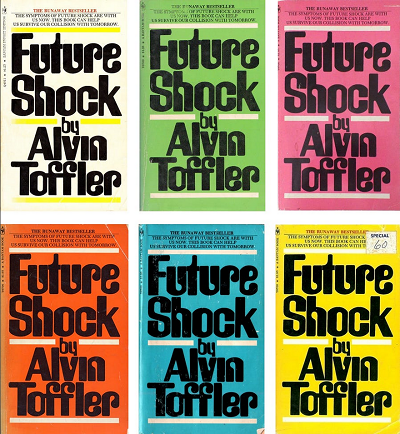
Back in 1970, Alvin Toffler predicted the future. It was a disturbing forecast, and everybody paid attention.
People saw his book Future Shock everywhere. I was just a freshman in high school, but even I bought a copy (the purple version). And clearly I wasn’t alone — Clark Drugstore in my hometown had them piled high in the front of the store.
The book sold at least six million copies and maybe a lot more (Toffler’s website claims 15 million). It was reviewed, translated, and discussed endlessly. Future Shock turned Toffler — previously a freelance writer with an English degree from NYU — into a tech guru applauded by a devoted global audience.
Toffler showed up on the couch next to Johnny Carson on The Tonight Show. Other talk show hosts (Dick Cavett, Mike Douglas, etc.) invited him to their couches too. CBS featured Toffler alongside Arthur C. Clarke and Buckminster Fuller as trusted guides to the future. Playboy magazine gave him a thousand dollar award just for being so smart.
Toffler parlayed this pop culture stardom into a wide range of follow-up projects and businesses, from consulting to professorships. When he died in 2016, at age 87, obituaries praised Alvin Toffler as “the most influential futurist of the 20th century”.
But did he deserve this notoriety and praise?
Future Shock is a 500 page book, but the premise is simple: Things are changing too damn fast.
Toffler opens an early chapter by telling the story of Ricky Gallant, a youngster in Eastern Canada who died of old age at just eleven. He was only a kid, but already suffered from “senility, hardened arteries, baldness, slack, and wrinkled skin. In effect, Ricky was an old man when he died.”
Toffler didn’t actually say that this was going to happen to all of us. But I’m sure more than a few readers of Future Shock ran to the mirror, trying to assess the tech-driven damage in their own faces.
“The future invades our lives”, he claims on page one. Our bodies and minds can’t cope with this. Future shock is a “real sickness”, he insists. “It is the disease of change.”
As if to prove this, Toffler’s publisher released the paperback edition of Future Shock with six different covers — each one a different color. The concept was brilliant. Not only did Future Shock say that things were constantly changing, but every time you saw somebody reading it, the book itself had changed.
Of course, if you really believed Future Shock was a disease, why would you aggravate it with a stunt like this? But nobody asked questions like that. Maybe they were too busy looking in the mirror for “baldness, slack, and wrinkled skin”.
Toffler worried about all kinds of change, but technological change was the main focus of his musings. When the New York Times reviewed his book, it announced in the opening sentence that “Technology is both hero and villain of Future Shock“.
During his brief stint at Fortune magazine, Toffler often wrote about tech, and warned about “information overload”. The implication was that human beings are a kind of data storage medium — and they’re running out of disk space.
Comments Off on Alvin Toffler may have been utterly wrong in Future Shock, but I suspect his huge royalty cheques helped soften the pain
May 30, 2023
Ban all the words!
Chris Bray reflects on the historical context of literature bans:
Before the Civil War, Southern states banned abolitionist literature. That ban meant that postmasters (illegally!) searched the mail, seized anti-slavery tracts, and burned them. And it meant that people caught with abolitionist pamphlets faced the likelihood of arrest. The District of Columbia considered a ban, then didn’t pass the thing, but Reuben Crandall was still arrested and tried for seditious libel in 1833 when he was caught with abolitionist literature. He was acquitted, then died of illness from a brutal pre-trial detention. Seizure, destruction, arrest: abolitionist literature was banned.
The Soviet writer Yevgeny Zamyatin wrote a 1924 novel, We, depicting a world in which an all-powerful government minutely controlled every aspect of life for an enervated population, finding as an endpoint for their ideological project a surgery that destroyed the centers of the brain that allowed ordinary people to have will and imagination. The Soviet government banned Zamyatin’s work: They seized and destroyed all known copies, told editors and publishers the author was no longer to allowed to publish, and sent Zamyatin into exile, where he died without ever seeing his own country again. Seizure, destruction, exile: Yevgeny Zamyatin’s work was banned.
During World War I, the federal government banned literature that discouraged military service, including tracts that criticized conscription. Subsequently, “socialists Charles Schenck and Elizabeth Baer distributed leaflets declaring that the draft violated the Thirteenth Amendment prohibition against involuntary servitude”. They were arrested, convicted, and imprisoned. The Supreme Court upheld the conviction. Anti-conscription literature was banned: It was seized and destroyed, and people caught distributing it were sent to prison.
In 2023, the tedious midwit poet Amanda Gorman posted on Twitter that she was “gutted” — the standard emotion for tedious midwits — to discover that one of her poems had been “banned” by a school in Florida. The news media raced to proclaim that Florida schools are banning books, the leading edge of the Ron DeSantis fascist wave.
As others have already said, Gorman’s boring poem was moved from an elementary school library shelf to a middle school library shelf, without leaving the library
Comments Off on Ban all the words!
May 29, 2023
QotD: The size of the Great Library
“It was the largest library in the ancient world, containing over 700,000 books.”
It is entirely possible that it was the largest library in the ancient world, though we have no way of confirming this given that we have little reliable information about the size of its collection. Despite this, popular sources regularly repeat the huge figures given for the number of books in the library in several ancient sources, and usually opt for the ones that are the highest. Shakespeare scholar Stephen Greenblatt’s popular history The Swerve: How the Renaissance Began (Vintage, 2012) won critical acclaim and even garnered him a Pulitzer Prize, despite being panned by actual historians for its many howlers and weirdly old-fashioned historiography (see my detailed critical review here, with links to other scathing critiques by historians). Greenblatt’s account sticks closely to the nineteenth century narrative of “the dark ages” beloved by New Atheists, so it’s hardly surprising that the myths about the Great Library feature prominently in his account. Thus he informs his readers with great assurance that:
“At its height the Museum contained at least half a million papyrus rolls systematically organised, labelled and shelved according to a clever new system … alphabetical order.” (Greenblatt, p. 88)
The figure of “half a million scrolls” (or even “half a million books”) is the one that is usually bandied about, but even that colossal number is not quite enough for some polemicists. Attorney and columnist Jonathan Kirsch plumped for a much higher number in his book God Against the Gods: The History of the War Between Monotheism and Polytheism (Viking, 2004)
“In 390 AD … a mob of Christian zealots attacked the ancient library of Alexandria, a place where the works of the greatest rarity and antiquity had been collected … some 700,000 volumes and scrolls in all.” (Kirsch, p. 278)
Obviously the larger the collection in the Great Library the more terrible the tragedy of its loss, so those seeking to apportion blame for the supposed destruction of the Library usually go for these much higher numbers (it may be no surprise to learn that it’s the monotheists who are the “bad guys” in Kirsch’s cartoonish book). But did the Great Library really contain this huge number of books given that these numbers would represent a large library collection even today?
As with most things on this subject, it seems the answer is no. […] Some of these figures are interdependent, so for example Ammianus is probably depending, directly or indirectly, on Aulus Gellius for his “700,000” figure, which in turn is where Kirsch gets the same number in the quote above. Others look suspiciously precise, such as Epiphanius’ “54,800”. In summary of a lot of discussion by critical scholars, the best thing to say is that none of these figures is reliable. In her survey of the historiography of the issue, Diana Delia notes “lacking modern inventory systems, ancient librarians, even if they cared to, scarcely had the time or means to count their collections” (see Delia, “From Romance to Rhetoric: The Alexandrian Library in Classical and Islamic Traditions”, The American Historical Review, Vol. 97, No. 5, Dec. 1992, pp. 1449-67, p. 1459). Or as another historian once put it wryly “There are no statistics in ancient sources, just rhetorical flourishes made with numbers.”
One way that historians can make estimates of the size of ancient libraries is by examining the floor plans of their ruins and calculating the space their book niches would have taken up around the walls and then the number of scrolls each niche could hold. This works for some other ancient libraries for which we have surveyable remains, but unfortunately that is not the case for the Mouseion, given that archaeologists still have to guess where exactly it stood. So Columbia University’s Roger S. Bagnall has taken another tack. In a 2002 paper that debunks several of the myths about the Great Library (see Bagnall, “Alexandria: Library of Dreams”, Proceedings of the American Philosophical Society, Vol. 146, No. 4, Dec. 2002, pp. 348-362), he begins with how many authors we know were writing in the early Hellenistic period. He notes that we know of around 450 authors for whom we have, at the very least, some lines of writing whose work existed in the fourth century BC and another 175 from the third century BC. He points out that most of these writers probably only wrote works that filled a couple of scrolls at most, though a small number of them – like the playwrights – would have had a total corpus that filled many more than that, even up to 100 scrolls. So by adopting the almost certainly far too high figure of an average of 50 scrolls to contain the work of each writer, Bagnall arrives as a mere 31,250 scrolls to contain all the works of all the writers we know about to the end of the third century. He notes:
“We must then assume, to save the ancient figures for the contents of the Library, either that more than 90 percent of classical authors are not even quoted or cited in what survives, or that the Ptolemies acquired a dozen copies of everything, or some combination of these unlikely hypotheses. If we were (more plausibly) to use a lower average output per author, the hypotheses needed to save the numbers would become proportionally more outlandish.” (Bagnall, p. 353)
Bagnall makes other calculations taking into account guesses at what number of completely lost authors there may have been and still does not manage to get close to most of the figures given in our sources. His analysis makes it fairly clear that these numbers, presented so uncritically by popular authors for rhetorical effect, are probable fantasies. As mentioned above, when we can survey the archaeology of an ancient library’s ruins, some estimate can be made of its holdings. The library in the Forum of Trajan in Rome occupied a large space 27 by 20 metres and Lionel Casson estimates it could have held “in the neighbourhood of 20,000 scrolls” (Casson, p. 88). A similar survey of the remains of the Great Library of Pergamon comes to an estimate of 30,000 scrolls there. Given that this library was considered a genuine rival to the Great Library of Alexandria, it is most likely that the latter held around 40-50,000 scrolls at its height, containing a smaller number of works overall given that ancient works usually took up more than one scroll. This still seems to have made it the largest library collection in the ancient world and thus the source of its renown and later myths, but it’s a far cry from the “500,000” or “700,000” claimed by uncritical popular sources and people with axes to grind.
Tim O’Neill, “The Great Myths 5: The Destruction Of The Great Library Of Alexandria”, History for Atheists, 2017-07-02.
Comments Off on QotD: The size of the Great Library


