In their insistence on judging the value of a work of art principally in terms of its moral qualities, the publishers of today are heirs to a tradition of puritanism going back to Plato. But there has long been an anti-puritanical argument available too, the most notorious of them being the one articulated by Oscar Wilde: that to assess art in moral terms is to commit some sort of category mistake. “There is no such thing as a moral or an immoral book. Books are well-written, or badly written. That is all.” But that argument was never very persuasive by itself, and contains a large non sequitur. Why should that be “all”? Why can’t it be that part of what we’re saying in calling a book well-written is that it is morally exemplary? Surely it is those who call on us to leave our moral values at the door who have some explaining to do.
George MacDonald Fraser himself sometimes seemed to take Wilde’s view of the matter. He zealously repudiated, in his non-fiction, all attempts to defend his fiction as covertly anti-colonial, taking great pleasure in mocking critics who “hailed it as a scathing attack on British imperialism”. Was he “taking revenge on the 19th century on behalf of the 20th”? “Waging war on Victorian hypocrisy”? Were the books, as one religious journal was supposed to have claimed, “the work of a sensitive moralist” highly relevant to “the study of ethics”? No, he said, The Flashman Papers were to be taken “at face value, as an adventure story dressed up as the memoirs of an unrepentant old cad”.
Is Fraser’s avowed amoralism the whole story? In one respect, the Flashman books are certainly amoral: they embody no systematic view that colonialism was wrong, illegitimate, unjust. (Nor, come to it, do they embody the view that it was right, legitimate and just.) As Fraser appears to see it in his fiction, empire was simply the default mode of political life in much of the world. This indeed was the case for much of human history. To be colonised was generally a misfortune for the colonised, but the individual coloniser was neither hero nor villain, just a self-interested actor acting on what he believed to be the necessities of his time and place.
We live in a world where we are constantly exercised by the problem of complicity. We wonder: am I complicit in climate change because I just put on the washing machine? In a sufficiently inclusive sense of the word “complicit”, of course I am: one of countless agents whose everyday actions add a tiny bit more carbon to the atmosphere. But outside an ethics seminar, what I’d tell you is that I was just doing my laundry because the clothes were beginning to stink.
Fraser was a deft enough writer to force his characters to confront the larger, what we today might call “structural” questions, in terms that belong to their own times, not to ours. At a pivotal moment in Flash for Freedom, Flashman is enslaved himself in America. Thrown into a cart with a charismatic slave called Cassy, he gets to hear her relish the irony of his position: “Well, now one of you knows what it feels like … Now you know what a filthy race you belong to.” Is there any hope of escape, he asks her desperately. None, she replies, “there isn’t any hope. Where can you run to, in this vile country? This land of freedom! With slave-catchers everywhere, and dogs, and whipping-houses, and laws that say I’m no better than a beast in a sty!” Flashman has the grace to be silent; what can he say?
Nikhil Krishnan, “Harry Flashman’s imperial morality”, UnHerd, 2022-12-26.
April 5, 2023
QotD: Harry Flashman’s adventures were not intended as “covert anticolonialism”
April 3, 2023
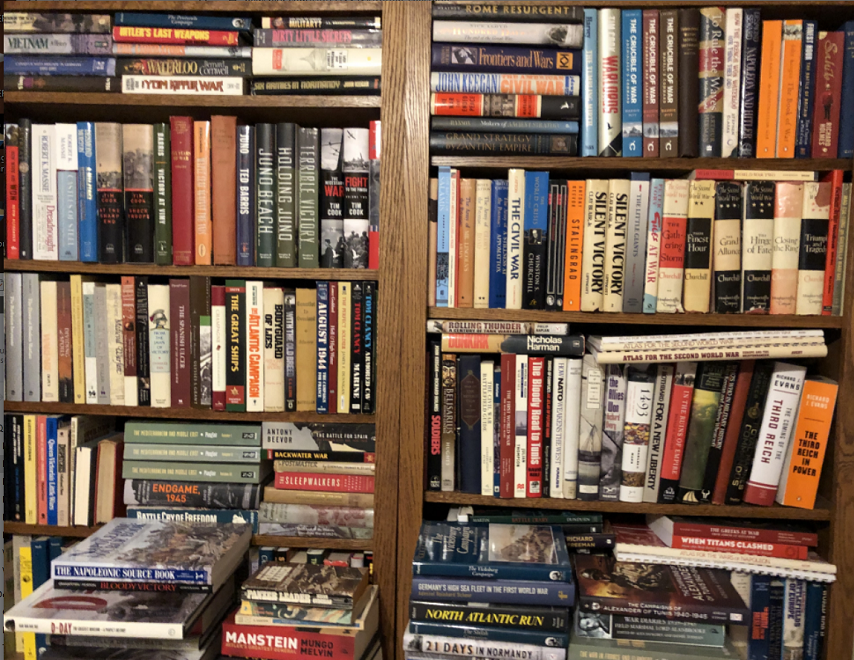
QotD: An odd habit of some owners of used books
… the technique was not suitable to the acres of human skin now routinely disfigured as a means of individual self-expression, and those who had inscribed on themselves the name of their beloved, usually on a scroll wrapped around a heart, had to content themselves with a tattooed erasure of that name when it no longer corresponded to that of the current beloved, usually by blue lines. The names of children, by contrast, even when no longer seen or visited, let alone supported financially, were not crossed off or inked out. That would have been cruelty toward them in the same way that having their names tattooed in the first place was undying love for them. One didn’t just wear one’s heart on one’s sleeve; one’s sleeve was one’s heart.
When it comes to erasing from their skin names from the past, however, the tattooed are as nothing compared with some owners of secondhand books. They score through the names of previous owners inscribed on fly-leaves with something approaching vengeance, so that they are no longer legible. They are like Stalin in his desire to expunge a purged person, such as Yagoda, not only from the written record but also from the photographic record. The new owners of secondhand books not only do not want the name of the previous owners to be legible, it is as if they wanted them never to have existed. In the days before black felt-tipped pens, which can erase all trace of a person’s name at a stroke, or in effect throw him into an unmarked grave, the name was often scratched over repeatedly, with a strange assiduity, until no letter of it was legible. I have examples of this peculiar conduct dating back to the 18th century.
What does it mean, this fury against previous owners? I suspect that it indicates an attempted denial of mortality, an assertion that the book has now fallen into the hands of its rightful and final owner, that it will remain his (I think this is an almost exclusively male phenomenon) till the end of time. The evidence of previous ownership is thus a reminder of how futile such a wish is — a reminder that one does not own anything, certainly nothing of any value such as a book that one wishes to preserve, by more than temporary leasehold. We are keepers of our valuables rather than owners of them, at least if we feel it wrong to destroy them.
Theodore Dalrymple, “Tattoo Much”, Taki’s Magazine, 2017-06-10.
April 1, 2023
QotD: P.G. Wodehouse and Sir Oswald Mosley
The majority of his tales are set in country houses, replete with conservatories, libraries, gun rooms, stables and butler’s pantries. Letters arrive by several posts a day, telegrams by the hour. Trains run on time from village stations. Other than the pinching of policemens’ helmets, there is order and serenity. Necklaces are filched, silverware is purloined, butlers snaffle port, chums are impersonated, romances develop in rose gardens, but nothing lurks to fundamentally reorder society.
There was one exception. The object of Wodehousian scorn was the moustachioed leader of Britain’s black-shirted Fascists, Sir Oswald Mosley, 6th Baronet. A fencing champion at school, dashing war record in the Flying Corps, and a Member of Parliament, he was the recipient of an inherited title, with a family tree that stretched back to the 12th century, a country house and a Mayfair residence. In Wodehouseland, Mosley is transformed into the equally aristocratic Roderick Spode, 7th Earl of Sidcup.
Plum was intolerant of even the vaguest of threats to the established order of things. He voiced his dislike of Spode through Bertie Wooster, likening the fascist leader to one of “those pictures in the papers of dictators, with tilted chins and blazing eyes, inflaming the populace with fiery words on the occasion of the opening of a new skittle alley”. Plum focussed his gaze on the Spode/Mosley moustache, which was “like the faint discoloured smear left by a squashed black beetle on the side of a kitchen sink”, describing its owner as “one who caught the eye and arrested it”.
The proto-dictator appeared, thought Wodehouse, “as if Nature had intended to make a gorilla but had changed its mind at the last moment”. Every reader would have known it was Mosley in the crosshairs, because Spode was the leader of a fascist group called the “Saviours of Britain, also known as the Black Shorts”. The transition of attire is because, as another of Wodehouse’s masterful creations, Gussie Fink-Nottle, observed, “by the time Spode formed his Association, there were no black shirts left in the shops”.
A different Wodehouse character warned, “Never put anything on paper … and never trust a man with a small black moustache.” Indeed, anyone “whose moustache rose and fell like seaweed on an ebb-tide” was best avoided. Plum could have been referring to Mosley or Hitler. The former, as leader of Britain’s real-life black shirts, was an unashamed admirer of the latter, and he interned in Holloway prison during the war. Afterwards, as an advocate of what we today would call Holocaust denial, he moved to Paris where he died in 1980. His political journey was interesting. Mosley started as a Conservative, drifted leftwards into the Labour Party, then further left into his own independent party, which evolved into the right-wing British Union of Fascists.
Modelled on the Italian and German fascist movements, Mosley and his supporters came to believe that “Jewish interests commanded commerce, the Press, the cinema, dominated the City of London, and killed British industry with their sweatshops”. Fascism lurking in the upper classes troubled Plum Wodehouse so greatly that Spode and his Black Shorts appeared in five of his works between 1938–74.
Peter Caddick-Adams, “Coups and coronets”, The Critic, 2022-12-13.
March 29, 2023
The obscure Polish banker who foresaw the carnage and deadlock of the First World War
Jon Miltimore on one of the few people to realize the increased deadliness and growing size of modern armies foreclosed any possibility of a quick, glorious war that would have the troops “home for Christmas”:

Jan Bloch, author of The War of the Future in its Technical, Economic and Political Relations (1898).
One man who did portend the carnage was Jan Bloch, a Polish banker and railroad baron who moonlighted as a military theorist. In 1898, Bloch published a little-noticed six-volume work titled The War of the Future in its Technical, Economic and Political Relations. The following year, the work was re-published in a single volume under a new title: Is War Now Impossible?
In the work, Bloch, who had closely studied Britain’s campaign in Africa during the Boer War, explained that modern weaponry had become so deadly that it had fundamentally changed warfare. Bayonet charges and cavalry flanking maneuvers were obsolete in an era defined by sophisticated earthworks and precision projectiles, he suggested.
Everybody will be entrenched in the next war. It will be a great war of entrenchments. The spade will be as indispensable to a soldier as his rifle. The first thing every man will have to do, if he cares for his life at all, will be to dig a hole in the ground. War, instead of being a hand-to-hand contest in which the combatants measure their physical and moral superiority, will become a kind of stalemate, in which neither army is able to get at the other, threatening each other, but never being able to deliver a final and decisive attack.
War would be “impossible” in the sense that it would be suicidal. Neither side would be able to gain a decisive advantage, battles along massive contiguous fronts would continue indefinitely.
Was Bloch suggesting that modern man had vanquished war by making it so deadly and terrible? Hardly. He argued that humans would be slow to realize the changes, and the results would be catastrophic.
At first there will be increased slaughter — increased slaughter on so terrible a scale as to render it impossible to get troops to push the battle to a decisive issue. They will try to, thinking that they are fighting under the old conditions, and they will learn such a lesson that they will abandon the attempt forever. Then, instead of war fought out to the bitter end in a series of decisive battles, we shall have as a substitute a long period of continually increasing strain upon the resources of the combatants. The war, instead of being a hand-to-hand contest, in which the combatants measure their physical and moral superiority, will become a kind of stalemate, in which neither army being willing to get at the other, both armies will be maintained in opposition to each other, threatening the other, but never being able to deliver a final and decisive attack …
That is the future of war — not fighting, but famine, not the slaying of men, but the bankruptcy of nations and the breakup of the whole social organization …
First World War generals don’t get much credit for their varied efforts to break the trench warfare deadlock, and later historians certainly piled on for the leaders’ collective failure to resolve the problem, but as Bret Devereaux pointed out, there was no easy solution. Artillery wasn’t the answer, nor were the famed German Stoßtruppen, nor the technical innovation of tanks, nor air power (either tactical or strategic). The technology of the day provide no one answer, but the leaders tried everything they could and the bleeding went on.
March 28, 2023
WEIRD World – basing all our “assumptions about human nature on psych lab experiments starring American undergraduates”
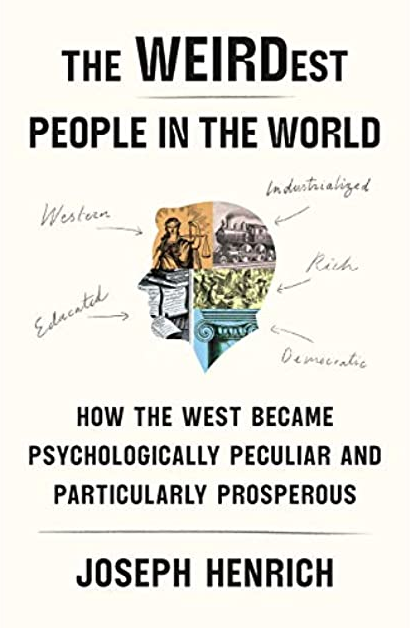
Jane Psmith reviews The WEIRDest People in the World: How the West Became Psychologically Peculiar and Particularly Prosperous by Joseph Henrich:
Until 2002, diplomats at the United Nations didn’t have to pay their parking tickets. Double-parking, blocking a fire hydrant, blocking a driveway, blocking an entire midtown Manhattan street — it didn’t matter; when you have diplomatic plates, they let you do it. In the five years before State Department policy changed in November 2002, UN diplomats racked up a whopping 150,000 unpaid parking tickets worth $18 million in fines. (Among other things, the new policy allowed the city to have 110% of the amount due deducted from the US foreign aid budget to the offending diplomats’ country. Can you believe they never actually did it? Lame.) Anyway, I hope you’re not going to be surprised when I say that the tickets weren’t distributed evenly: the nine members of Kuwait’s UN mission averaged almost 250 unpaid tickets apiece per year (followed by Egypt, Chad, Sudan, Bulgaria, and Mozambique, each between 100 and 150; the rest of the top ten were Albania, Angola, Senegal, and Pakistan). The UK, Canada, Australia, Denmark, the Netherlands, Sweden, and Norway had none at all. The rest of the rankings are more or less what you’d expect: for example, Italy averaged three times as many unpaid tickets per diplomat as France and fifteen times as many as Germany.
What did the countries with the fewest unpaid parking tickets have in common? Well, they generally scored low on various country corruption indexes, but that’s just another way of saying something about their culture. And the important thing about their culture is that these countries are WEIRD: western, educated, industrialized, rich, and democratic. But they’re also, in the grand scheme of human history, weird: their inhabitants think differently, behave differently, and value different things than most humans. Among other things, WEIRD people are individualistic, nonconformist, and analytical. They — okay, fine, we — are particularly hard-working, exhibit low time preference, prefer impersonal rules we apply universally, and elevate abstract principles over contextual and relationship-based standards of behavior. In other words, WEIRD people (as Joseph Henrich and his colleagues pointed out in the influential 2010 paper where they coined the phrase) are outliers on almost every measure of human behavior. Wouldn’t it be silly for an entire academic discipline (and therefore an entire society ideologically committed to Trusting The Experts) to base all its assumptions about human nature on psych lab experiments starring American undergraduates? That would give us a wildly distorted picture of what humans are generally like! We might even do something really dumb like assume that the social and political structures that work in WEIRD countries — impersonal markets, constitutional government, democratic politics — can be transplanted wholesale somewhere else to produce the same peace and prosperity we enjoy.
Ever since he pointed out the weirdness of the WEIRD, Henrich has been trying to explain how we got this way. His argument really begins in his 2015 The Secret of Our Success, which I reviewed here and won’t rehash. If you find yourself skeptical that material circumstances can drive the development of culture and psychology (unfortunately the term “cultural Marxism” is already taken), you should start there. Here I’m going to summarize the rest of Henrich’s argument fairly briefly: first, because I don’t find it entirely convincing (more on that below), and second, because I’m less interested in how we got WEIRD than in whether we’re staying WEIRD. The forces that Henrich cites as critical to the forging of WEIRD psychology are no longer present, and many of the core presuppositions of WEIRD culture are no longer taken for granted, which raises some thought-provoking questions. But first, the summary.
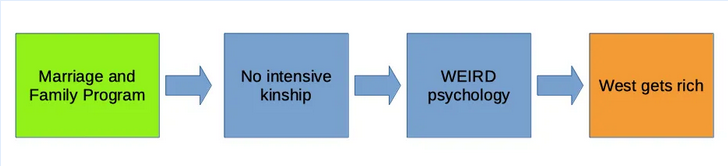
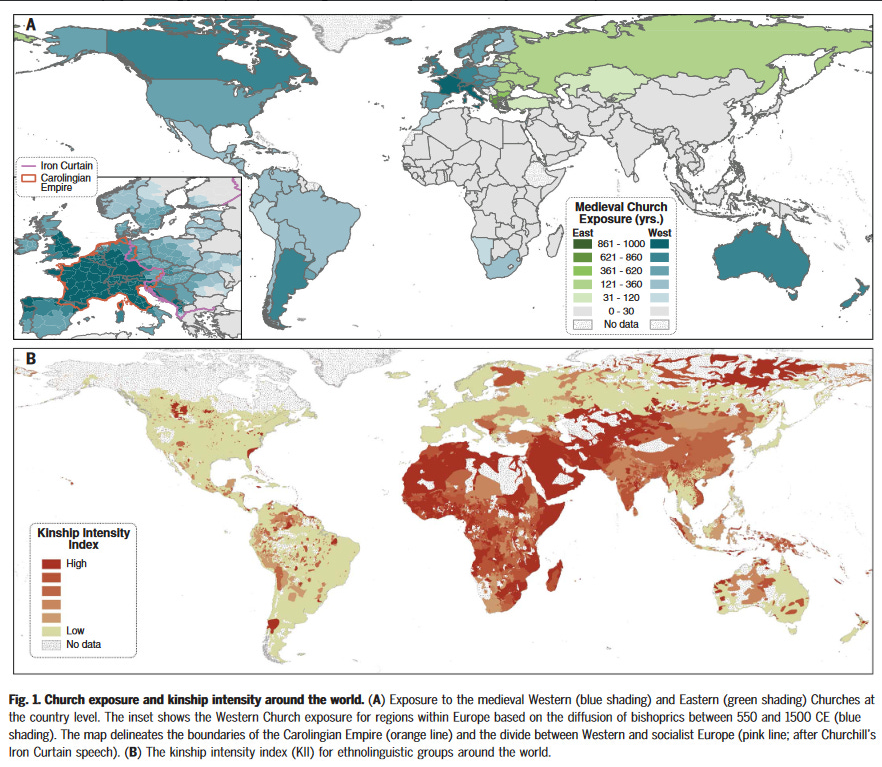
Henrich argues that the critical event setting the West on the path to Educated, Industrialized, Rich, and Democratic was the early medieval western Church’s ban on cousin marriage. That might seem a little odd, but bear in mind that most of the humans who’ve ever lived have been enmeshed in incredibly dense kin networks that dictate obligations, responsibilities, and privileges: your identity is given from birth, based simply on your role as a node in an interdependent network. When societies grow beyond the scale of a family, it’s by metaphorically extending and intensifying these kinship bonds (go read our review of The Ancient City for more on this). These kinship networks perpetuate themselves through marriage, and particularly through marriage to relatives, whether blood or in-laws, to strengthen existing connections. Familial or tribal identities come first, before even the claims of universal religions, as when Wali Khan, a Pakistani politician, phrased his personal allegiances as “I have been a Pashtun for six thousand years, a Muslim for thirteen hundred years, and a Pakistani for twenty-five.” You could imagine Edwin of Northumbria or Childeric saying something pretty similar.
Then, beginning in the 4th century, the western Church began to forbid marriages to relatives or in-laws, the kinship networks began to wither away, and alternative social technologies evolved to take their place. In place of the cousin-marriers’ strong tight bonds, conformity, deference to traditional authority, and orientation toward the collective, you get unmoored individuals who have to (or get to, depending on your vantage point) create their own mutually beneficial relationships with strangers. This promotes a psychological emphasis on personal attributes and achievements, greater personal independence, and the development of universalist social norms. Intensive kinship creates a strong in-group/out-group distinction (there’s kin and there’s not-kin): people from societies with strong kinship bonds, for instance, are dramatically more willing to lie for a friend on the witness stand. WEIRD people are almost never willing to do that, and would be horrified to even be asked. Similarly, in societies with intensive kinship norms, you’d be considered immoral and irresponsible if you didn’t use a position of power and influence to benefit your family or tribe; WEIRD people call that nepotism or corruption and think it’s wrong.
March 24, 2023
QotD: The academic specializations of the Great Library
[Carl] Sagan’s roll call of Greek scientists who he claims worked at the Great Library makes it sound like some kind of ancient Mediterranean MIT: Eratosthenes, Hipparchus, Euclid, Dionysius of Thrace, Herophilos, Archimedes, Ptolemy and so on. Unfortunately, only one of these people – Eratosthenes – can definitely be said to be associated with the Great Library. Two others from Sagan’s list – Dionysius and Ptolemy – may have been. And once you take out all the others, that really leaves only Eratosthenes and (maybe) Conon of Samos and, much later, Ptolemy as scholars of the Great Library who did anything like what we would call “science”. We can perhaps shoehorn in Euclid and the physicians and anatomists Herophilos and Erasistratos, depending on when the Mouseion was established, but overall the evidence for the institution as some great centre of scientific research is actually rather thin.
Which means it is perhaps less surprising to learn, on examining the sources, that the Great Library was actually celebrated mainly for a specialisation which is about as far from modern science as possible: the study of poetry. This makes some sense, given that the Mouseion was dedicated to the Muses, four of whom represented forms of verse. The works of Homer, in particular, were a primary focus of study across the Greek world and his poems permeated thought, writing and everyday speech rather like the works of Shakespeare and the texts of the Bible do today. It was the scholars of the Mouseion who, on gathering and comparing copies of the Illiad and Odyssey from across the Greek-speaking world, noticed textual differences large and small and established the kind of textual analysis still used by editors to this day; working to determine the best possible text from the manuscript variants. Other works of Greek poetry, such as the odes of Pindar, were also analysed and studied in a similar way, as were the works of the great Athenian playwrights.
The importance of literary studies at the Mouseion can be seen by analysing the specialisations of the men we know were directors of the institution and therefore “librarians” of the Great Library. […] of these scholars, only Eratosthenes is known for doing anything that we would consider “science”, the others were devoted to literary and textual analysis, poetry and grammar. Of course, these scholars were polymaths and most of them would probably have ranged over many topics including areas of mathematics and natural philosophy; Eratosthenes himself was nicknamed “Beta” because he covered so many disciplines he was something of a jack of all trades and master of none, so his colleagues mocked him as “Number 2” in all subjects. That aside, the idea that the Mouseion was a major centre of scientific speculation is at best an exaggeration and largely yet another fantasy.
Tim O’Neill, “The Great Myths 5: The Destruction Of The Great Library Of Alexandria”, History for Atheists, 2017-07-02.
March 21, 2023
Few professions are as “optimism biased” as primary school teachers
Freddie deBoer was commissioned to write this for a professional publication for teachers, but it was “too hot” for the editors, so he’s posted it to his Substack instead:
There’s a bias that runs throughout our educational discourse, coming from our media, academia, and the think tanks and foundations that have such sway in education policy. It’s a bias that exists both because of a natural human desire to see every child succeed and because the structural incentives in the field make rejecting that bias professionally risky. The bias I’m talking about is optimism bias, the insistence that all problems in education are solvable and that we can fix them if only we want to badly enough. At least a half-century of research, spending, policy experimentation, and dogged effort has utterly failed to close the gaps that so vex our political class. But still we hear the same old song about how we could close those gaps tomorrow if we really wanted to, an attitude that has distorted education policy and analysis for decades.
My first book, The Cult of Smart, was a commercial failure. It was released during the height of the pandemic and thus my ability to promote it was limited, but by any measure the market rejected it. It’s tough to produce a labor of love like that and find that few people were interested in it.
But there was a silver lining: since publication in 2020 I’ve heard from dozens and dozens of teachers, thanking me for putting their thoughts to print. These educators come from public, private, and charter schools, from schools with affluent study bodies and schools that are mired in poverty, from big city school districts and from low-population regional rural schools. And again and again, these teachers shared the same perspective: they agreed with the book’s overall argument, and often had thought similar things themselves for years, but felt they could not express them publicly for fear of professional consequences.
The essential argument of the book is that overwhelming empirical evidence shows that students sort themselves into academic ability bands in the performance spectrum early in life, with remarkable consistency; that the most natural and simplest explanation for this tendency is that there is such a thing as individual academic potential; and that the most likely source of this individual academic potential is likely influenced by genes. When we look at academic performance, what we see again and again is that students perform at a given level relative to peers early in schooling and maintain that level throughout formal education. (I make that case at considerable length here.) A vast number of interventions thought to influence relative performance have been revealed to make no difference in rigorous research, including truly dramatic changes to schooling and environment. Meta-analyses and literature reviews that assess the strength of many different educational interventions find effect sizes in the range of .01 to .3 standard deviations, small by any standards and subject to all sorts of questions about research quality and randomization. Even the most optimistic reading of the research literature suggests that almost nothing moves the needle in academic outcomes. Almost nothing we try works.
This implies that common sense is correct and that individual students have their own natural or intrinsic level of academic potential, which we have no reason to believe we can dramatically change. I believe that we can change large group disparities in education (such as the racial achievement gap) by addressing major socioeconomic inequalities through government policy. But even after we eliminate racial or gender gaps, there will be wide differences between individual students, regardless of pedagogy or policy. When Black students as a group score at parity with white students, there will still be large gaps within the population of Black students or white or any other group you can name, and we have no reliable interventions to make the weakest perform like the strongest.
My book’s argument is attractive to teachers because they’ve lived under an educational ideology that insists that every student is a budding genius whose potential waits to be unlocked by a dedicated teacher – and which holds teachers to that unachievable standard. From the right, they’re subject to “no excuses” culture, the constant insistence from the education reform movement that student failures are the result of lazy and feckless teachers; from the left, they’re subject to a misguided egalitarianism that mistakes the fact that every child is important and deserves to be nurtured for the idea that every child has perfectly equal potential. The result is a system that presses teachers to deliver learning outcomes in their classrooms that they can’t possibly achieve. But many of them feel that they can’t push back, for fear of professional consequences. If they speak frankly about the fact that different students have different levels of individual potential, they’ll likely be accused of shirking their duty.
March 20, 2023
QotD: The world of “Plum”
“It was a confusion of ideas between him and one of the lions he was hunting in Kenya, that caused A. B. Spottsworth to make the obituary column. He thought the lion was dead, and the lion thought it wasn’t.” The author of these lines, P.G. Wodehouse, understood a thing or two about humour. Written seventy years ago, his wit sparkles on, undimmed.
The maestro also knew a thing or two about politics. This is strange, for few of his nearly one hundred novels, short stories or plays betray more than a nodding acquaintanceship with the great upheavals of the 20th century. Enquiring deeper, the connoisseur will find that his eternal creation, Jeeves — the discreet, silent, valet-cum-butler extraordinaire — was named in honour of a popular English cricketer who died on the Somme in 1916. The subject himself, in a post-1945 volume, admitted to his employer Bertie Wooster that he had “dabbled somewhat in the Commandos” during the Second World Conflagration.
War and turmoil are there, lurking in the background, if successfully banished from much of his writing. Sadly, Pelham Grenville (forenames he hated, so adopted the moniker “Plum” instead) was naïve. Loafing professionally in France when the Wehrmacht knocked on his door for tea and crumpets in 1940, he and his wife were interned as enemy aliens. In 1941, Plum agreed to record five broadcasts to the USA, then neutral. Entitled How to be an Internee without previous Training, they comprised playful anecdotes about his experiences as a prisoner of the folk in field grey. I’ve read them. They are rib-tickling and harmless, and his American readers lapped them up. Alas, his British fan club took a different view.
The devotees of Bertie Wooster, Reginald Jeeves, the Earl of Emsworth, Sir Roderick Glossop and Co. were at first stunned, then vexed and finally branded the poor author a traitor. Although a post-war MI5 investigation exonerated him, a hurt Wodehouse thereafter lived in exile on Long Island. Fortunately for us, the flow of humour continued unabated, but Plum’s hard-earned Knighthood for conjuring up the essence of Bottled Englishness was long delayed until the New Year’s Honours of 1975. He died soon after, on St Valentine’s Day, aged ninety-three.
This lapse of judgement was all the more extraordinary given his ability to spot a scoundrel at one hundred paces. Threats to the serene, ordered nature of English society in which he resided — indeed helped to create — were few. In Wodehouse’s Garden of Eden, there is a definite hierarchy of earls and aunts, bishops, baronets and young blades, stationmasters and policemen.
The majority of his tales are set in country houses, replete with conservatories, libraries, gun rooms, stables and butler’s pantries. Letters arrive by several posts a day, telegrams by the hour. Trains run on time from village stations. Other than the pinching of policemens’ helmets, there is order and serenity. Necklaces are filched, silverware is purloined, butlers snaffle port, chums are impersonated, romances develop in rose gardens, but nothing lurks to fundamentally reorder society.
Peter Caddick-Adams, “Coups and coronets”, The Critic, 2022-12-13.
March 18, 2023
“Strongmen” all run the same basic “playbook” says scholar
Chris Bray considers the arguments made by Ruth Ben-Ghiat that ropes every “strongman” together into a single, coherent strategy that applies at all times and under all circumstances:
Holocaust scholars have always argued from every possible perspective, and will always argue from every possible perspective, about causation. There’s a school gathered around “No Hitler, no Holocaust”, and there’s Zygmunt Bauman, who barely mentions the man in an argument about the inherently dehumanizing tendencies of the modern bureaucratic state. Christopher Browning depicts a battalion of Order Police participating in state-organized mass killing because of cowardice, habitual obedience, and social compliance; Daniel Goldhagen replies that no, Germans killed Jews because Germans hated Jews, full stop. But in this extraordinary diversity of voices, there is argument. If you ask, why did this happen?, many answers follow — growing out of questions about the operation of power, the limits of moral agency, the basic human willingness to comply, and so on, that aren’t easy to answer.
Then comes 21st century American political scholarship.
Here’s how the publisher explains this book:
Ruth Ben-Ghiat is the expert on the “strongman” playbook employed by authoritarian demagogues from Mussolini to Putin—enabling her to predict with uncanny accuracy the recent experience in America and Europe. In Strongmen, she lays bare the blueprint these leaders have followed over the past 100 years, and empowers us to recognize, resist, and prevent their disastrous rule in the future …
Vladimir Putin and Mobutu Sese Seko’s kleptocracies, Augusto Pinochet’s torture sites, Benito Mussolini and Muammar Gaddafi’s systems of sexual exploitation, and Silvio Berlusconi and Donald Trump’s relentless misinformation: all show how authoritarian rule, far from ensuring stability, is marked by destructive chaos.
All that stuff is the same, see, “from Mussolini to Putin”. Pinochet and Berlusconi are the same, Russia and Italy are the same, new postcolonial nations and old reborn nations are the same, resource economies and service economies are the same, 1922 is 2016, modern culture is postmodern culture, mass media is social media — all in a blended mass of social reality and cultural factors, turning the March on Rome and mean tweets into the same “playbook”, which is also the same “blueprint”.
What caused the Bolshevik revolution? Lenin said so. What caused the Holocaust? Hitler said so. Why was there political violence in Chile? Pinochet said so. You can see the richness and complexity of single-actor history with blueprints and playbooks.
Turning the urgent precision of this analysis to the task of understanding contemporary politics, scholars know that Trump’s personality is very bad, but is DeSantis more badderer in the badness of his mean and bad personality? Does he use the playbook, exactly like Lenin and Mobutu Sese Seko? Is he running Florida just like the Congo? (Is Kristi Noem precisely identical to Joe Stalin, Idi Amin, and Tiberius? Depends on how she does in the primaries.)
It’s politics without politics, stripped of systems, processes, principles, historical uniqueness, geographic and economic factors, and competing forces in culture and society. Political power is a weight falling off a table onto a lever; the leader acts, his instruments are acted upon, and the machine of society moves according to the force and direction applied by the leader. Is it significant that our particular political moment is postindustrial, urbanizing, and increasingly made up of social and economic interactions mediated through an electronic screen? No, Trump is using Lenin’s playbook. Politics is all the same, and entirely about names and personalities.
March 15, 2023
Not only is the science “settled” … it’s already in the school textbooks
David Friedman on his attempts to follow up on claims made in a textbook on climate change already in use in US public schools:
Introduction to Modern Climate Change by Andrew Dessler is an elementary climate science textbook, now in its third edition. In Chapter 9, “Impacts of Climate Change”, it has:
Scientists predict that sea level will rise 47 to 73 cm (19 to 29 inches) above 1995–2014 levels by 2100. This may not sound like a significant challenge, but it is much larger than the 18 cm of sea level experienced over the twentieth century, which is already challenging for many who live near sea level. Like temperature, these predictions of sea-level rise might sound small but, also like temperature, they are not. In Florida, for example, a sea-level rise in the middle of the projected range would inundate 9 percent of Florida’s current land area at high tide. This includes virtually all of the Florida Keys as well as 70 percent of Miami-Dade County. Almost one-tenth of Florida’s current population, or nearly 2 million people, live in this vulnerable zone, and it includes residential real estate valued at hundreds of billions of dollars. It also includes important infrastructure, such as two nuclear reactors, three prisons, and 68 hospitals.
That struck me as implausible, given what else I had seen on the effect of sea level rise. The footnote for the claim was to Stanton and Ackerman (2007), which turned out to be not a peer reviewed journal article but a report commissioned by the Environmental Defense fund, an environmentalist group. It includes the same claims, but for 27 inches of sea-level rise not the 24 inches that is Dessler’s “middle of the projected range”. It refers the reader to Appendix C for “detailed sources and methodology”. Going there, I found:
To estimate the impact of sea-level rise on land area, populations, and public and private assets and infrastructure, we began with a 1:250,000 Digital Elevation Model (DEM) map of the State of Florida, and divided the state into “vulnerable” and “not vulnerable” zones demarcated by 1.5 meters of elevation and other factors described by Titus and Richman (2000) as corresponding to 27 inches of sea-level rise.
So what they are showing as the vulnerable area is not the 27 inch or 24 inch contour but the 1.5 meter (5 feet) contour. The explanation, from Titus, J.G. and C. Richman (2001). “Maps of lands vulnerable to sea level rise: modeled elevations along the US Atlantic and Gulf coasts“. Climate Research 18: 205–228, a journal article written by two EPA people and presumably peer reviewed:
Thus, at a typical site, the 1.5-meter contour would be flooded by spring high tides (i.e., high tides during new and full moons) when sea level rises 80 cm
Figure 1 below (Titus and Richman Figure 4) is a map of Florida with the region within the 1.5 meter contour colored red, the region between 1.5 and 3.5 blue. Dessler’s middle of the projected range is 60 cm. Stanton and Ackerman’s 27 inches is 68.6 cm. The map shows what its authors claim would be flooded at 80cm.
Figure 2 below is a population density map of Florida from Wikipedia to which I have added the 1.5m contours from Figure 1. The large flooded area on the southern tip of Florida includes none of the densely populated area around Miami; only one of the tiny areas farther north appears to be in part on a populated area. That is not surprising — areas very close to sea level are likely to be marsh, in this case the everglades, and poor places to build on.
Stanton and Ackerman claim that their own calculations, using data bases of elevation and population, produce a total population in the at-risk area of 1.5 million. That was the figure Dessler gave in his first edition, presumably increased to almost 2 million in the third edition to reflect the increase in Florida’s population. Figure 2 shows why I don’t believe it. The flooded areas are in places almost all of which have very low population density, making it hard to see how flooding nine percent of the land area, most of it in the everglades, can flood almost ten percent of the population. Even if all of the Florida Keys are flooded, their total population is only about 80,000.
That problem is in addition to the fact that Dessler’s claim is for 60 cm of sea level rise, Stanton and Ackerman’s, from which Dessler got his figure for how many people are flooded, is for 68.6 cm (27 inches), and Titus and Richman get the 1.5 m contour that Stanton and Ackerman say they are using by assuming 80cm of sea level rise. Further reasons for suspicion are that Stanton and Ackerman gave figures for sea level rise substantially higher than either the IPCC figure at the time or the current IPCC figure, which suggests that they were trying to make the consequences of climate change look as scary as possible, and that they write “1.5 meters of elevation and other factors described by Titus and Richman (2000) as corresponding to 27 inches of sea-level rise” when Titus and Richman actually describe 1.5 meters as corresponding to 80 cm (31.5 inches) of sea level rise.
March 14, 2023
“Strangely, my friends have a more negative view of the feminist movement than I do”
Bryan Caplan explains why he chooses to write the books he writes:
Almost by definition, writing controversial books tends to provoke negative emotional reactions. Anger above all. Anger which, in turn, inspires fear. And not without just cause; the sad story of Salman Rushdie sends shivers down the spine of almost any writer. If you write controversial books — or care about someone who does — you should be at least a little afraid of the anger your writing inspires.
[…]
In contrast, when I announced the imminent publication of Don’t Be a Feminist, the fear went through the roof. Several folks warned me of “career suicide”. Others told me that I had no idea what horrors awaited me. Friends staged mini-interventions on my behalf.
The underlying premise, naturally, was that the feminist movement is at once terribly powerful and horribly bad-tempered.
My best guess is that the warnings are overblown. Strangely, my friends have a more negative view of the feminist movement than I do. Whether my guess is right or wrong, though, all this intense, widespread fear really ought to trouble the feminist conscience.
If I said, “Hi” to one of my kids’ friends, and they responded by fleeing in terror, my reaction would be, “Did I do something to scare him?” I would ask my kids, “Why was he so afraid of me?” If such incidents started to repeat, I would be severely troubled. “I thought I came off as a friendly dad, but I guess I’m seen as an ogre.”
The same applies if I were a feminist, and I discovered that critics are literally afraid to criticize feminism. If only a few critics feared feminism, my question would be, “What did we do to scare them?” If I discovered that fear of feminism was widespread, a full soul-search would be in order. “I thought we came off as a friendly movement, but I guess we’re seen as ogres.”
And guess what? Fear of feminism plainly is widespread.
What, then, are feminists doing wrong? Above all, cultivating and expressing vastly too much anger. Sharing your angry feelings is an effective way to dominate the social world, but a terrible way to discover the truth or sincerely convince others. Maybe you don’t mean to scare others; maybe you’re just acting impulsively. Yet either way, the fear feminists inspire is all too real.
March 12, 2023
“Indigo is no longer a bookseller but a general merchandiser with a sideline in books”
In the latest edition of the SHuSH newsletter, Ken Whyte looks at the dismal financial (and technological) picture for Indigo in the Canadian market:

“Indigo Books and Music” by Open Grid Scheduler / Grid Engine is licensed under CC0 1.0
As you’ve heard, the bookselling chain was hacked, its employment records held for ransom. Indigo (rightly) refused to pay and the hackers are now expected to release the employees’ personal data on the dark web.
This all started a month ago. The company’s website went down along with its in-store credit and debit systems. The payment systems came back after about ten days. A new website was built and launched at the beginning of March. It is a much-reduced site with a much reduced catalog of books.
The repercussions will be enormous for both Indigo and the publishing community.
One of the things overshadowed by the hacks was the release of Indigo’s third-quarter results, covering the crucial holiday season. As we’ve noted before, the company’s finances are unsettling. It lost $37 million in 2019, $185 million in 2020, and $57 million in 2021. Things looked somewhat better in 2022 with a $3 million profit, but the first two quarters of 2023 (Indigo has a March 28 year-end) showed a loss of $41.3 million, about $10 million worse than in the first two quarters of the previous year.
The hope was that a blockbuster holiday season would get Indigo’s year back on track.
It didn’t happen. Revenue for Q3 2022 came in at $423 million, down $8 million from last year, with pre-tax profits of $36 million, down from $45 million last year.
After three quarters, Indigo now stands at an $8 million loss. The company’s fourth quarter, covering the first three months of the calendar year, is usually terrible (all retail suffers in the deep of winter). If this fourth quarter goes like the last, Indigo will be looking at a $30 million loss for its full year. But this fourth won’t go like the last because of the hack. I have no idea what it will cost in terms of lost sales and unexpected expenditures (or what will be covered by insurance). It’s hard to imagine the company not doing worse than $30 million after such a catastrophic event.
Most of Canada’s mid-size to large publishers sell somewhere between 25 percent and 60 percent of their books through the chain. The outage will hurt revenue for both publishers and authors. If there’s a silver lining here, it’s that it occurred in a dead season. But the knock-on effects will be substantial. I’m told Indigo has no visibility into its store sales or current stock levels across the chain. It’s being very cautious about bringing in new books apart from the most in-demand titles. Publishers I’ve spoken to say sales to Indigo are down and they expect returns to be large and late. (Booksellers send unsold inventory back to publishers for full refunds and the bulk of these come in the months after the holidays).
By the way, the latest results showed that Indigo is no longer a bookseller but a general merchandiser with a sideline in books. Blankets and cheeseboards accounted for more than 50 percent of the company’s total revenue over the holidays. Print was 46 percent, down from 54 percent earlier in 2022 and 67.4 percent eight years ago. The movement away from bookselling is picking up steam. I hope you like Amazon because it and the few independent bookstores Chapters/Indigo hasn’t manage to kill will be all that’s left of Canadian bookselling before very long.
The young British officer’s attitude toward his men
Dr. Robert Lyman has been working on pulling together various newspaper and magazine articles written by Field Marshal William Slim before the Second World War, to be published later this year. I believe this will include everything he included (in shorter form in some cases) in his 1959 book Unofficial History plus many others. In this excerpt from “Private Richard Chuck, aka The Incorrigible Rogue”, Slim recounts taking command of a company of recent conscripts while recuperating from wounds received earlier in WW1:
“Light duty of a clerical nature,” announced the President of the Medical Board. Not too bad, I thought, as I struggled back into my shirt. “Light duty of a clerical nature” had a nice leisurely sound about it. I remembered a visit I had paid to a friend in one of the new government departments that were springing up all over London at the end of 1915. He had sat at a large desk dictating letters to an attractive young lady. When she got tired of taking down letters, she poured out tea for us. She did it very charmingly. Decidedly, light duty of a clerical nature might prove an agreeable change after a hectic year as a platoon commander and a rather grim six months in hospital. Alas, after a month in charge of the officers’ mess accounts of a reserve battalion, with no more assistant than an adenoidal “C” Class clerk, I had revised my opinion. My one idea was to escape from “light duty of a clerical nature” into something more active. Reserve battalions were like those reservoirs that haunted the arithmetic of our youth — the sort that were filled by two streams and emptied by one. Flowing in came the recovered men from hospitals and convalescent homes and the new enlistments; out went the drafts to battalions overseas. When the stream of voluntary recruits was reduced to a trickle the only way to restore the intake was by conscription, and this was my chance.
It had been decided to segregate the conscripts into a separate company as they arrived. I happened to be the senior subaltern at the moment and I applied for command of the new company. Rather to my surprise, for I was still nominally on light duty, I got it. The conscripts, about a hundred and twenty of them, duly arrived. They looked very much like any other civilians suddenly pushed into uniform, awkward, bewildered, and slightly sheepish, and I regarded them with some misgiving. After all, they were conscripts; I wondered if I should like them.
The young British officer commanding native troops is often asked if he likes his men. An absurd question, for there is only one answer. They are his men. Whether they are jet-black, brown, yellow, or café-au-lait, the young officer will tell you that his particular fellows possess a combination of military virtues denied to any other race. Good soldiers! He is prepared to back them against the Brigade of Guards itself! And not only does the young officer say this, but he most firmly believes it, and that is why, on a thousand battlefields, his men have justified his faith.
In a week I felt like that about my conscripts. I was a certain rise to any remark about one volunteer being worth three pressed men. Slackers? Not a bit of it! They all had good reasons for not joining up. How did I know? I would ask them. And I did. I had them, one by one, into the company office, without even an N.C.O. to see whether military etiquette was observed. They were quite frank. Most of them did have reasons — dependants who would suffer when they went, one-man businesses that would have to shut down. Underlying all the reasons of those who were husbands and fathers was the feeling that the young single men who had escaped into well-paid munitions jobs might have been combed out first.
[…]
We had now advanced far enough in our training to introduce the company to the mysteries of the Mills bomb. There is something about a bomb which is foreign to an Englishman’s nature. Some nations throw bombs as naturally as we kick footballs, but put a bomb into an unschooled Englishman’s hands and all his fingers become thumbs, an ague affects his limbs, and his wits desert him. If he does not fumble the beastly thing and drop it smoking at his — and your — feet, he will probably be so anxious to get rid of it that he will hurl it wildly into the shelter trench where his uneasy comrades cower for safety. It is therefore essential that the recruit should be led gently up to the nerve-racking ordeal of throwing his first live bomb; but as I demonstrated to squad after squad the bomb’s simple mechanism, I grew more and more tired with each until I could no longer resist the temptation to stage a little excitement. I fitted a dummy bomb, containing, of course, neither detonator nor explosive, with a live cap and fuse. Then for the twentieth time I began!
When you pull out the safety-pin you must keep your hand on the lever or it will fly off. If it does it will release the striker, which will hit the cap, which will set the fuse burning. Then in five seconds off goes your bomb. So when you pull out the pin don’t hold the bomb like this!’
I lifted my dummy, jerked out the pin, and let the lever fly off. There was a hiss, and a thin trail of smoke quavered upwards. For a second, until they realized its meaning, the squad blankly watched that tell-tale smoke. Then in a wild sauve qui peut they scattered, some into a nearby trench, others, too panic-stricken to remember this refuge, madly across country, I looked round, childishly pleased at my little joke, to find one figure still stolidly planted before me. Private Chuck alone held his ground, placidly regarding me, the smoking bomb, and his fleeing companions with equal nonchalance. This Casablanca act was, I felt, the final proof of mental deficiency — and yet the small eyes that for a moment met mine were perfectly sane and not a little amused.
“Well,” I said, rather piqued, “hy don’t you run with the others?” A slow grin passed over Chuck’s broad face.
“I reckon if it ‘ud been a real bomb you’d ‘ave got rid of it fast enough,” he said. Light dawned on me.
“After this, Chuck,” I answered, “you can give up pretending to be a fool; you won’t get your discharge that way!”
He looked at me rather startled, and then began to laugh. He laughed quietly, but his great shoulders shook, and when the squad came creeping back they found us both laughing. They found, too, although they may not have realized it at first, a new Chuck; not by any means the sergeant-major’s dream of a soldier, but one who accepted philosophically the irksome restrictions of army life and who even did a little more than the legal minimum.
March 11, 2023
“… when people are sticking warning labels on P.G. Wodehouse, something is seriously wrong”
In The Conservative Woman, Alan Ashworth stands aghast at the very notion of putting a content warning on an adaptation of a P.G. Wodehouse short story:
Dominic Sandbrook in the Mail on Sunday draws attention to BBC Radio 4 Extra and its latest repeat of an adaptation of P.G. Wodehouse’s Psmith in the City. It is preceded by an announcement that listeners should steel themselves for “some dated attitudes and language”.
You don’t say. The story was written well over a century ago, appearing first as a serial in The Captain magazine in 1908 and 1909 before being published as a book by A & C Black in 1910.
In it Psmith (the P is silent) and his old school friend Mike Jackson are reunited when they find themselves working for the New Asiatic Bank, a thinly disguised portrait of the Hongkong and Shanghai Bank (now HSBC) where Wodehouse himself endured a torrid spell before his writing career took off.
The two chums have several run-ins with management and Mike is eventually fired before Psmith solves all his problems and has him reinstated. Of course, as always in Wodehouse’s world, there is no sex, no angst, nothing to frighten the horses.
So why the BBC announcement? Sandbrook writes: “At first I wondered if this must be some mistake. Perhaps the warning had been transposed from some more dangerous programme, such as a stand-up show by Bernard Manning?
“But the warning was meant for Psmith. So what were these toxic and potentially traumatising attitudes? For the life of me, I still don’t really know.
“At one point, Psmith talks of going ‘out East’, where you have ‘a dozen native clerks under you, all looking up to you as the Last Word in magnificence’. But was that it? Did that merit a warning?
“As it happens, this radio adaptation was made in 2008. Did the actors realise they were participating in something steeped in sick imperialistic assumptions? I doubt it.
“Venturing into the cesspit of social media, I often find Left-wing pundits insisting there is no such thing as cancel culture and that the whole thing is an evil Tory myth.
“But when people are sticking warning labels on P G Wodehouse, something is seriously wrong. Indeed, you could hardly find a more ludicrous target, because he was one of most tolerant, generous-spirited writers imaginable. So generous-spirited that he’d probably have laughed this off. ‘I never was interested in politics,’ Wodehouse once remarked. ‘I’m quite unable to work up any kind of belligerent feeling.’
“Being cut from a meaner cloth, however, I do feel worked up about it. When I think of these finger-wagging commissars sitting in judgment on a writer who has given so much pleasure to so many readers, I feel like Bertie Wooster’s Aunt Agatha, gearing herself up before a titanic tirade.
“Do we really need a warning that P G Wodehouse is ‘dated’? What next? A lecture before Hamlet, to warn us that poisoning your wife or killing your uncle is now considered poor form? A warning before Roald Dahl or Ian Fleming?
“But, of course, Dahl and Fleming don’t need warnings now, for they have been posthumously updated.”
March 9, 2023
“… the French Resistance effect is beginning to appear: After the Nazis leave France, everyone says they were always with the Resistance”
Chris Bray notices what we’re not supposed to be noticing:

French women accused of collaborating with the Germans are paraded through the streets by members of the French Resistance after liberation, Summer 1944.
Original photo from the German Federal Archive via Wikimedia Commons.
Almost two years ago, with a moral panic still consuming the world and the narrative shift far in the future, the journalist Laura Dodsworth published a tough, concise, well-argued book describing the very deliberate efforts of the British government to create a widespread state of fear — that’s the title of the book, by the way — that would paralyze ordinary people and compel them to comply with harsh and repressive public health measures. You’ll be shocked to hear that she was attacked and vilified; one prominent review called State of Fear “an outrageously dumb book selling conspiracy hooey”.
Then, in 2023, Isabel Oakeshott gave us the halfwit government minister Matt Hancock’s pathetic whatsapp messages — in which he clumsily babbles about creating a state of fear to get the public to obey the government — and the rest is history. Laura Dodsworth was demeaned and defamed, and then she was vindicated.
Moral panics always fade. Manufactured crises always crack and collapse. Propaganda always has a “sell by” date, and then it turns rancid. The effect is comparable to what Warren Buffett says about a recession: When the tide goes out, you can see who’s been swimming naked.
This is where we are with the January 6 narrative, as the most horrible attack on Our Democracy™ since the Civil War collides with the image of a dork in Viking horns calmly wandering the hallways with a police escort. The political class is taking it well.
This image speaks:
That’s violent insurrectionist Jacob Chansley walking calmly through a crowd of police officers who aren’t making the slightest effort to stop him. That’s what happened. Other things also happened, and some of them involved violence and broken windows, but this is the act in the center ring of the circus. Now, the lawyer who represented this violent insurrectionist says plainly that Jacob Chansley was the victim of Brady violations, and other January 6 defendants are racing to raise the same point in court. The tide is going out.
[…]
And it seems possible to me, or rather it seems likely to me, that the French Resistance effect is beginning to appear: After the Nazis leave France, everyone says they were always with the Resistance. As narratives shift, and the moral meaning of an act during a moral panic is recoded, people may begin to remember their choices differently. We’ll see.