The History Guy: History Deserves to Be Remembered
Published 22 Apr 2019USS Pennsylvania was in dry dock when the attack came at Pearl Harbor. The History Guy remembers part of her history that may have been forgotten.
This episode was originally posted December 7, 2017. It has been updated to correct some errors in the original, and new footage of USS Pennsylvania has been added.
This is original content based on research by The History Guy. Images in the Public Domain are carefully selected and provide illustration. As images of actual events are sometimes not available, images of similar objects and events are used for illustration.
All events are portrayed in historical context and for educational purposes. No images or content are primarily intended to shock and disgust. Those who do not learn from history are doomed to repeat it. Non censuram.
Find The History Guy at:
Patreon: https://www.patreon.com/TheHistoryGuy
The History Guy: History Deserves to Be Remembered is the place to find short snippets of forgotten history from five to fifteen minutes long. If you like history too, this is the channel for you.
Awesome The History Guy merchandise is available at:
https://teespring.com/stores/the-hist…Script by THG
#ushistory #thehistoryguy #usspennsylvania
December 7, 2020
USS Pennsylvania and Pearl Harbor
December 6, 2020
December 4, 2020
A Japanese Bureaucratic Mess – WW2 Special
World War Two
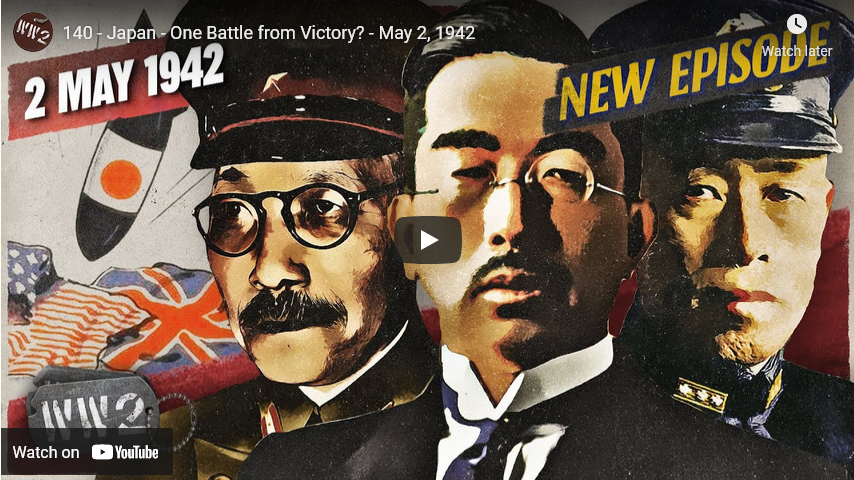
Published 3 Dec 2020Contrary to popular belief, Imperial Japan was not an absolute monarchy marching (or sailing) to war with singular vision and purpose. Rather, it was a dysfunctional government of competing factions, players and interests.
Join us on Patreon: https://www.patreon.com/TimeGhostHistory
Or join The TimeGhost Army directly at: https://timeghost.tvFollow WW2 day by day on Instagram @ww2_day_by_day – https://www.instagram.com/ww2_day_by_day
Between 2 Wars: https://www.youtube.com/playlist?list…
Source list: http://bit.ly/WW2sourcesWritten and Hosted by: Indy Neidell
Director: Astrid Deinhard
Producers: Astrid Deinhard and Spartacus Olsson
Executive Producers: Astrid Deinhard, Indy Neidell, Spartacus Olsson, Bodo Rittenauer
Creative Producer: Maria Kyhle
Post-Production Director: Wieke Kapteijns
Research by: Indy Neidell
Edited by: Michał Zbojna
Sound design: Marek Kamiński
Map animations: Eastory (https://www.youtube.com/c/eastory)Colorizations by:
Julius Jääskeläinen – https://www.facebook.com/JJcolorization/
Jaris Almazani (Artistic Man) – https://instagram.com/artistic.man?ig…Sources:
From the Noun Project: company soldiers by Andrei Yushchenko, Government by Nithinan Tatah, Shiro by Simon Child, War by Nhor, House by Eucalyp from the Noun ProjectSoundtracks from the Epidemic Sound:
“ES_Paths of a Samurai” – Mandala Dreams
“ES_Sights of the Tokyo Tower” – Sight of Wonders
“ES_The Bloom of Cherry Blossoms” – Sight of Wonders
“ES_Immovable As The Mountain” – Yi Nantiro
“ES_Pacific Shores” – Mandala DreamsArchive by Screenocean/Reuters https://www.screenocean.com.
A TimeGhost chronological documentary produced by OnLion Entertainment GmbH.

November 30, 2020
Malayan Emergency 1948-1960
The Cold War
Published 28 Sep 2019Our series on the history of the Cold War period continues with a documentary on Malayan Emergency of 1948-1960 during which the British empire was challenged by the emerging Malayan Communist Party. These events led to the independence of Malaya.
Consider supporting us on Patreon: https://www.patreon.com/thecoldwar
November 29, 2020
November 27, 2020
Japanese Plague Bombs – War Against Humanity 023 – November 1941, Pt. 2
World War Two
Published 26 Nov 2020Japanse deploys biological weapons in China, leading to un unspecified number of deaths. Meanwhile, European Jews from Germany and their occupied territories are deported to Eastern Europe, where Jews are already being killed by the thousands.
Join us on Patreon: https://www.patreon.com/TimeGhostHistory
Or join The TimeGhost Army directly at: https://timeghost.tvFollow WW2 day by day on Instagram @ww2_day_by_day – https://www.instagram.com/ww2_day_by_day
Between 2 Wars: https://www.youtube.com/playlist?list…
Source list: http://bit.ly/WW2sourcesHosted by: Spartacus Olsson
Written by: Joram Appel and Spartacus Olsson
Director: Astrid Deinhard
Producers: Astrid Deinhard and Spartacus Olsson
Executive Producers: Astrid Deinhard, Indy Neidell, Spartacus Olsson, Bodo Rittenauer
Creative Producer: Maria Kyhle
Post-Production Director: Wieke Kapteijns
Research by: Joram Appel and Spartacus Olsson
Edited by: Miki Cackowski
Sound design: Marek Kamiński
Map animations: Eastory (https://www.youtube.com/c/eastory)Colorizations by:
Mikołaj Uchman
Spartacus Olsson
Jaris Almazani (Artistic Man), https://instagram.com/artistic.man?ig…Sources:
Bundesarchiv
Visuotinė-lietuvių-enciklopedija
Yad Vashem 2725/5, 4613/360, 85DO1, 142BO7, 4613/1055, 4147/32, 8747/3, 4360/99, 4613/525, 4572/3, 4572/2, 4572/4
USHMM
Picture of Jezdimir Dangic, courtesy of pogledi.rs
from the Noun Project: Skull by Muhamad UlumSoundtracks from the Epidemic Sound:
Farrell Wooten – “Blunt Object”
Yi Nantiro – “A Single Grain Of Rice”
Philip Ayers – “Trapped in a Maze”
Gavin Luke – “Drifting Emotions 3”
Gunnar Johnsen – “Not Safe Yet”
Cobby Costa – “From the Past”Archive by Screenocean/Reuters https://www.screenocean.com.
A TimeGhost chronological documentary produced by OnLion Entertainment GmbH.
From the comments:
World War Two
3 hours ago
We often get the question how we cope with researching, editing and hosting a series which is almost exclusively about human suffering. Indeed, for every episode that we make, Miki, Spartacus and I spend hours researching, reading accounts and scrolling through gruesome pictures. It is hard or stressful at times, and of course it impacts us emotionally.There’s a couple of things that help us get through this. The purpose with which we’re doing this, which is to learn, share and contribute to awareness so that this may never be forgotten definitely adds to our resilience. We have set up a small-scale support system between us, and we try to talk and share our emotions whenever we need to.
We recognise that some of you watching this may deal with similar questions. Talking about it, wether digitally or in person, helps us understand and process. We believe that exploring the motivations and fears of perpetrators and victims also helps to stay in touch with the human dimension behind staggering statistics. We try our best to keep this series down to earth with a close eye on the humane aspect – both in content and our community.
Thank you all for your support and kind comments,
Cheers,
Joram
Horse Lords: A Brief History of the Scythians
History Time
Published 30 Jan 2018This video is about the Scythians. One of the first horse cultures on Earth.
Are you a budding artist, illustrator, cartographer, or music producer? Send me a message! No matter how professional you are or even if you’re just starting out, I can always use new music and images in my videos. Get in touch! I’d love to hear from you.
If you liked this video and have a spare dollar you can help support the channel here:-
http://www.patreon.com/historytimeUKI’ve compiled a reading list of my favourite history books via the Amazon influencer program. If you do choose to purchase any of these incredible sources of information then Amazon will send me a tiny fraction of the earnings (as long as you do it through the link) (this means more and better content in the future) I’ll keep adding to and updating the list as time goes on:-
https://www.amazon.com/shop/historytimeMusic used:-
Ross Bugden – “Parallel”, “Last Dawn”, “Titans”, “Olympus”I try to use copyright free images at all times. However if I have used any of your artwork or maps then please don’t hesitate to contact me and I’ll be more than happy to give the appropriate credit.
—Join the History Time community on social media:-
Instagram:-
https://www.instagram.com/historytime…
Twitter:-
https://twitter.com/HistoryTimeUK
November 25, 2020
The Coolest Gun You Will See All Day: China’s Type 64 Silenced Pistol
Forgotten Weapons
Published 14 Aug 2020http://www.patreon.com/ForgottenWeapons
https://www.floatplane.com/channel/Fo…
Cool Forgotten Weapons merch! http://shop.bbtv.com/collections/forg…
The Type 64 is a dedicated suppressed pistol first introduced in 1965 and used in the Vietnam War. It uses a rimless version of the .32 ACP cartridge (7.65x17mm) in a 9-round Makarov-like magazine. Despite outward similarity to the Makarov (especially the grip), the design is wholly unique internally. It uses basically a miniaturized AK bolt to allow the shooter to select between blowback semiauto functioning and single shot manual operation. The bolt’s rotating locking lugs prevent it from cycling when locked, in a very clever alternative use of the rotating bolt system. The suppressor has two chambers, using a combination of baffles and wire mesh as suppressor elements. In addition to standard ammunition, a plastic-sabot frangible load was also developed for use in situations like airline hijackings, and this loading is why some sources reference a maximum effective range of 15 meters.
For all its technical cleverness, the Type 64 is a rather heavy pistol, at 1.8kg / 4 pounds. It was replaced in 1967 by the substantially lighter and simpler Type 67, which weighed only 1.05kg / 2.3 pounds. This particular Type 64 was originally owned by Mitch Werbell III, giving it an even more interesting history …
Contact:
Forgotten Weapons
6281 N. Oracle #36270
Tucson, AZ 85740
November 24, 2020
The History of Fabric Is the History of Civilization
ReasonTV
Published 23 Nov 2020Virginia Postrel’s new book explores economics, politics, and technology through textiles.
——————
Full text and links: https://reason.com/video/2020/11/23/t…Follow us on Twitter: https://twitter.com/reason
Reason is the planet’s leading source of news, politics, and culture from a libertarian perspective. Go to reason.com for a point of view you won’t get from legacy media and old left-right opinion magazines.
—————-The Fabric of Civilization: How Textiles Made the World, a new book by former Reason editor in chief Virginia Postrel, is a rich, endlessly fascinating history of the remarkable luck, invention, and innovation that made our fabric-rich world possible.
The book aims to make the mundane miraculous. Consider cotton. Most of the cotton we grow today is descended in part from a plant species that evolved in Africa and somehow got over to what is now Peru, where it mixed with New World strains.
“The fact that we have cotton at all, that it exists anywhere, is amazing,” says Postrel. “It happened long before there were human beings, but much more recently than when the continents were together. So we don’t know. It could have gotten caught up in a hurricane. It could have floated on a piece of pumice. So it’s this random, very unlikely happening that had tremendous world-changing consequences.”
The story of textiles is rife with attempts at protectionism and prohibition. In 17th and 18th century Europe, countries banned the importation of super-soft, super-colorful cotton prints from India known as calicos because they threatened domestic producers of everything from lower-quality cotton fabric to luxury silks. “For 73 years, France treated calico the way the U.S. treats cocaine,” Postrel says. “There was this huge amount of smuggling, and they were constantly ratcheting up the penalties [so] that they got quite grotesque, at least for the major traffic.” Some of “the earliest writings of classical liberalism are in this context, people saying not only is this not working, but … it is unjust to be sentencing people to the galleys in order to protect silk makers’ profits.”
Postrel also documents how the Luddites, the 19th century English textile workers famous for smashing the power looms threatening to put them out of work, owed their jobs to an earlier technological breakthrough: the spinning machines that emerged in the late 1700s.
“If you go back to that earlier period, when spinning machines were introduced, the same thing happened,” she says. “They had their own period of rebelling against the new technologies and saying they’re putting people out of work.”
The book also upends some contemporary myths, such as the claim that commercial production of hemp for clothing was a casualty of the war on drugs. “Hemp historically was a very coarse kind of fabric for poor people who didn’t have an alternative,” says Postrel. “It was replaced by cotton for good reasons. Cotton was also affordable, but it was soft and washable and just a much better fabric.”
“Human beings live in history and we inherit the legacies, positive and negative, of that history,” says Postrel, whose previous books include The Power of Glamour, The Substance of Style, and The Future and Its Enemies. Discussing the large themes of her work she says, “All you can do is start from where you are and try to do better from where you are.”
Narrated by Nick Gillespie. Edited by Isaac Reese.
Music: “Thoughts,” by ANBR
Photos: World History Archive/Newscom; The Print Collector Heritage Images/Newsroom; The “Réale” returning to port, Med/CC BY-SA 3.0; Smithsonian National Museum of African American History and Culture/CC0; Battle of Grand Port, Rama/Wikimedia Commons/CC BY-SA 2.0 FR; Fine Art Images Heritage Images/Newscom; Seton, M., Müller, R., Zahirovic, S., Gaina, C., Torsvik, T., Shephard, G., Talsma, A., Gurnis, M., Turner, M., Maus, S., and Chandler, M., 2012, Global continental and ocean basin reconstructions since 200 Ma: Earth-Science Reviews, v. 113, no. 3-4, p. 212-270
November 22, 2020
November 19, 2020
Japanese Type 10 Light Grenade Projector (aka Knee Mortar)
Forgotten Weapons
Published 24 Mar 2018In the aftermath of World War One, the Japanese military saw the utility of infantry-portable light grenade launchers instead of rifle grenades, and adopted the Type 10 in 1921 (Taisho 10). It went into production in 1923 at the Tokyo Army Arsenal, although the great Tokyo earthquake led to production being moved to Nagoya, where about 11,000 were made between 1925 and 1937. The Type 10 was a remarkably light and handy weapon, weighing just 5.5lb (2.5kg) and disassembling into a transport configuration the size of a wine bottle.
The larger Type 89 grenade launcher was adopted in 1929, which led to the older Type 10s being relegated to use for illumination and signaling, which they did through the end of World War Two.
http://www.patreon.com/ForgottenWeapons
Cool Forgotten Weapons merch! http://shop.bbtv.com/collections/forg…
If you enjoy Forgotten Weapons, check out its sister channel, InRangeTV! http://www.youtube.com/InRangeTVShow
Contact:
Forgotten Weapons
6281 N Oracle #36270
Tucson, AZ 85704
I posted Ian’s review of the Type 89 here.
November 16, 2020
QotD: India’s civil service
The process was started in October last year. Here we are at the end of August 10 months later. And we’ve still managed to get no closer at all to hiring any accountants.
Now, one good thing about the Indian civil service is that it carries on the old British practice of entry being by competitive examination. This at least loosens the possibility of influence and bribery determining who gets hired. But now think of the incompetence with which the process is being carried out. We’ve at least 7 months here just to mark the exam papers!
And that is really what ails India. The snail’s pace of the bureaucracy. It would actually be far better if the place had near no government rather than the one it has. Anarchy is indeed preferable to a system which allows near nothing to happen officially. Because what happens when a bureaucracy is so slow that it strangles the ability to do anything legally is that it is all done in illegal anarchy anyway. Some 85% of the Indian economy is over in the unregistered, untaxed and informal sector. Precisely and exactly because the official sector is run by that bureaucracy that cannot even hire the occasional accountant. A bonfire of the babus would improve the place immeasurably.
Tim Worstall, “What’s Wrong In India – All 8,000 Fail Goa’s Exam To Be Government Accountants”, Continental Telegraph, 2018-08-23.
November 9, 2020
QotD: The Children of Men becomes disturbingly real in Japan
To western eyes, contemporary Japan has a kind of earnest childlike wackiness, all karaoke machines and manga cartoons and nuttily sadistic game shows. But, to us demography bores, it’s a sad place that seems to be turning into a theme park of P.D. James’ great dystopian novel The Children Of Men. Baroness James’ tale is set in Britain in the near future, in a world that is infertile: The last newborn babe emerged from the womb in 1995, and since then nothing. It was an unusual subject for the queen of the police procedural, and, indeed, she is the first baroness to write a book about barrenness. The Hollywood director Alfonso Cuarón took the broad theme and made a rather ordinary little film out of it. But the Japanese seem determined to live up to the book’s every telling detail.
In Lady James’ speculative fiction, pets are doted on as child-substitutes, and churches hold christening ceremonies for cats. In contemporary Japanese reality, Tokyo has some 40 “cat cafés” where lonely solitary citizens can while away an afternoon by renting a feline to touch and pet for a couple of companiable hours.
In Lady James’ speculative fiction, all the unneeded toys are burned, except for the dolls, which childless women seize on as the nearest thing to a baby and wheel through the streets. In contemporary Japanese reality, toy makers, their children’s market dwindling, have instead developed dolls for seniors to be the grandchildren they’ll never have: You can dress them up, and put them in a baby carriage, and the computer chip in the back has several dozen phrases of the kind a real grandchild might use to enable them to engage in rudimentary social pleasantries.
P.D. James’ most audacious fancy is that in a barren land sex itself becomes a bit of a chore. The authorities frantically sponsor state porn emporia promoting ever more recherché forms of erotic activity in an effort to reverse the populace’s flagging sexual desire just in case man’s seed should recover its potency. Alas, to no avail. As Lady James writes, “Women complain increasingly of what they describe as painful orgasms: the spasm achieved but not the pleasure. Pages are devoted to this common phenomenon in the women’s magazines.”
As I said, a bold conceit, at least to those who believe that shorn of all those boring procreation hang-ups we can finally be free to indulge our sexual appetites to the full. But it seems the Japanese have embraced the no-sex-please-we’re-dystopian-Brits plot angle, too. In October, Abigail Haworth of The Observer in London filed a story headlined “Why Have Young People in Japan Stopped Having Sex?” Not all young people but a whopping percentage: A survey by the Japan Family Planning Association reported that over a quarter of men aged 16–24 “were not interested in or despised sexual contact.” For women, it was 45 per cent.
Mark Steyn, The [Un]documented Mark Steyn, 2014.
November 8, 2020
QotD: Tribal and post-tribal economies
… it was a problem of permitting, by and large. Portugal isn’t as bad, mind, nowhere near but in the seventies a lot of places were designated “green belts” everywhere, so that to build on them (and you had to build on them, or you were stymied in growth) you had to know who to bribe, and of course have the money to do it. This isn’t the only reason why favelas end up housing even the middle class. There’s a ton of other reasons, including but not limited to land ownership and property rights, and a shit-ton of stuff. But permitting is part of it.
This is because people don’t view their public posts as something they do to make society better/serve society or even do a job, but as a way to enrich themselves/benefit their friends/make it easier to make money in the future.
Everything, from truly shoddy workmanship to rushed, corner/cutting work, to outright corruption comes from viewing a job not as something you take pride in and work to do your best at, but from viewing a job as an opportunity to enrich yourself and your family while doing as little work as humanly possible. In fact in some societies, this is viewed as a duty. As someone in comments cited there are places in Africa where locals can’t run a shop, because all their relatives near and distant will expect to be given merchandise for free … or even money out of the till.
A lot of this is because the idea of the individual as independent of the tribe and the family is a very new thing in most of the world. We kind of have a head start on it because we are/are descended from those who left family and tribe behind.
[…]
Also in most of the world working for money is vaguely shameful. Particularly so if you’re working for someone else. […] And even here not only does that attitude persist, but it’s trying to make itself normal. Particularly in politics.
So, take pride in what you do, and do the best job you can. It’s not just important for you, it’s a building block of society. Do the best you can, and control as much as you can, so maybe you will have just reward which is an incentive to do better.
This way is civilization built. This way do things actually improve.
Sarah Hoyt, “BUILD!”, According to Hoyt, 2018-07-25.