World War Two
Published 5 Nov 2020Cordell Hull is the face of American diplomacy in 1941 as it navigates the precarious road to war against Imperial Japan.
Join us on Patreon: https://www.patreon.com/TimeGhostHistory
Or join The TimeGhost Army directly at: https://timeghost.tvFollow WW2 day by day on Instagram @ww2_day_by_day – https://www.instagram.com/ww2_day_by_day
Between 2 Wars: https://www.youtube.com/playlist?list…
Source list: http://bit.ly/WW2sourcesHosted by: Indy Neidell
Written by: Francis van Berkel and James Newman
Director: Astrid Deinhard
Producers: Astrid Deinhard and Spartacus Olsson
Executive Producers: Astrid Deinhard, Indy Neidell, Spartacus Olsson, Bodo Rittenauer
Creative Producer: Maria Kyhle
Post-Production Director: Wieke Kapteijns
Research by: James Newman
Edited by: Miki Cackowski
Sound design: Marek Kamiński
Map animations: Eastory (https://www.youtube.com/c/eastory)Colorizations by:
Norman Stewart – https://oldtimesincolor.blogspot.com/
Mikolaj Uchman
Spartacus OlssonSources:
Naval History & Heritage Command
http://maps.bpl.org
FDR Presidential Library & Museum
Picture of MS St. Louis in Hamburg, United States Holocaust Memorial Museum, courtesy of Herbert and Vera Karliner
from the Noun Project: Skull by Muhamad Ulum, Handshake by priyanka, Pickaxe by Luke Anthony Firth, oil barrel by BomSymbolsSoundtracks from the Epidemic Sound:
Howard Harper-Barnes – “London”
Johannes Bornlof – “The Inspector 4”
Farell Wooten – “Blunt Object”
Philip Ayers – “Trapped in a Maze”
Johannes Bornlof – “Deviation In Time”Archive by Screenocean/Reuters https://www.screenocean.com.
A TimeGhost chronological documentary produced by OnLion Entertainment GmbH.
November 6, 2020
An American Globalist – Cordell Hull – WW2 Biography Special
November 3, 2020
QotD: Water pricing
Near all freshwater availability problems come from the fact that farmers get it cheap or for free, diverting it from much more valuable uses like keeping people alive if they drink it. This is true in California – we’ve actually cases of farmers using $400 of water to grow $100 of alfalfa – as it is in Pakistan. There are cases of people growing water hungry crops in near drought areas just because they get that water too cheaply.
[…]
Gaining revenue with which to build dams is useful, it most certainly is. But that’s not the only function of pricing. The cash to increase supply, great, but the very fact of charging will reduce demand. And we should be charging what it costs to produce the water too. So charges should cover 100% of the costs of the dams, not just 25%.
It’s entirely possible that charging that full cost will mean that no farmers want the water. OK, then we shouldn’t build the dam, should we? For if the value of the water – measured by what people will pay – is less than the cost of its provision, then that’s value destroying, providing the water. The dam makes us all poorer, therefore we shouldn’t build it.
The point here being – and it’s an important one – that prices affect both supply and demand. They’re what brings them into balance even. So, yes, charge for water, but not just so that we can pay to increase supply, also so that we, merely by charging, reduce demand.
Tim Worstall, “Pakistan’s Chief Justice Almost Right – Charge For Water, Not For Dams, But To Charge For Water”, Continental Telegraph, 2017-07-17.
October 29, 2020
Cranking This War Up to Eleven – Hideki Tojo – WW2 Biography Special
World War Two
Published 28 Oct 2020A man who was both Japan’s War Minister and Prime Minister, who played a large role in escalating the already daunting scale of the war in China to a world war against multiple world powers. We learn about his life from his birth in Tokyo in 1884 to his execution at Sugamo prison in Tokyo in 1948.
Join us on Patreon: https://www.patreon.com/TimeGhostHistory
Or join The TimeGhost Army directly at: https://timeghost.tvFollow WW2 day by day on Instagram @ww2_day_by_day – https://www.instagram.com/ww2_day_by_day
Between 2 Wars: https://www.youtube.com/playlist?list…
Source list: http://bit.ly/WW2sourcesWritten and Hosted by Indy Neidell
Director: Astrid Deinhard
Producers: Astrid Deinhard and Spartacus Olsson
Executive Producers: Astrid Deinhard, Indy Neidell, Spartacus Olsson, Bodo Rittenauer
Creative Producer: Joram Appel
Post-Production Director: Wieke Kapteijns
Research by: Indy Neidell
Edited by: Karolina Dołęga & Iryna Dulka
Sound design: Marek Kamiński
Map animations: Eastory (https://www.youtube.com/c/eastory)Colorizations by:
Carlos Ortega Pereira, BlauColorizations – https://www.instagram.com/blaucolorizations
Jaris Almazani (Artistic Man) – https://instagram.com/artistic.man?ig…
Mikołaj Uchman
Norman Stewart – https://oldtimesincolor.blogspot.com/Archive by Screenocean/Reuters https://www.screenocean.com.
A TimeGhost chronological documentary produced by OnLion Entertainment GmbH.
October 28, 2020
QotD: The Gurkhas
For 20 years between the wars [Field Marshal Viscount Slim] was a Gurkha officer, as so many of the 14th Army’s fighting generals were. Indeed, for a time, they were known on the front as the “Mongol Conspiracy.” Slim loves the Gurkhas, whose language he speaks. His favourite stories are of Gurkhas. He tells of the paratroopers who were to jump at 300 feet. As they had never jumped before, their Havildar [Sergeant] asked if they might go a little nearer the ground for their first jump. He was told that this was impossible because the parachutes would not have time to open. “Oh,” said the Gurkha, “so we get parachutes, eh?”
October 27, 2020
What Happened 100 Years Ago? – October 1920 I THE GREAT WAR
The Great War
Published 26 Oct 2020It’s time for our monthly summary of the events 100 years ago.
» SUPPORT THE CHANNEL
Patreon: https://www.patreon.com/thegreatwar» OUR PODCAST
https://realtimehistory.net/podcast – interviews with World War 1 historians and background info for the show.» BUY OUR SOURCES IN OUR AMAZON STORES
https://realtimehistory.net/amazon *
*Buying via this link supports The Great War (Affiliate-Link)» MORE THE GREAT WAR
Website: https://realtimehistory.net
Instagram: https://instagram.com/the_great_war
Twitter: https://twitter.com/WW1_Series
Reddit: https://reddit.com/r/TheGreatWarChannel»CREDITS
Presented by: Jesse Alexander
Written by: Jesse Alexander
Director: Toni Steller & Florian Wittig
Director of Photography: Toni Steller
Sound: Toni Steller
Editing: Toni Steller
Motion Design: Philipp Appelt
Mixing, Mastering & Sound Design: http://above-zero.com
Maps: Daniel Kogosov (https://www.patreon.com/Zalezsky)
Research by: Jesse Alexander
Fact checking: Florian WittigChannel Design: Alexander Clark
Original Logo: David van StepholdContains licensed material by getty images
All rights reserved – Real Time History GmbH 2020
October 23, 2020
October 21, 2020
Aryan invasion, migration theory (Truth or fiction) India documentary
Epimetheus
Published 24 Jan 2018Aryan invasion, migration theory (Truth or fiction) India documentary
Epimetheus on Patreon
https://www.patreon.com/Epimetheus1776David Frawley Aryan invasion videos
https://www.youtube.com/watch?v=qych3…
https://www.youtube.com/watch?v=jyz_S…Tags:
Aryan invasion india, india history, indian history, documentary, history of india, india,history, india documentary, hindi, 2018, ancient india, indus valley civilization, 5,000 Years History of India documentary, Aryan migration theory, Aryan invasion theory, indo-aryan, indo Aryan migration
October 19, 2020
Sarah Hoyt – “… I’ve been feeling like I’m at the end of a Bond movie, and the villain is telling me his big master plan and how Western Civilization is tied to the train tracks and can’t escape”
In the latest Libertarian Enterprise, Sarah Hoyt explains why she’s not expecting the US federal election next month to resolve anything, at least not in a positive way:
At this point I hold about a 10% chance the Democrats/Socialists/Communists (interchangeable now that the masks are off) don’t fraud their way into full power, pack the court and rip our system apart, to install (yet again) a form of communism. This is complicated by the fact that a lot of them are in China’s pockets. Or rather, China has been filling their pockets for a long while. We might find ourselves working for racist, hegemonic overlords, besides suffering all the ills of a descent into communism. (By the way, they’ve already been doing this to some extent to the less fortunate countries, including most African countries. The left in the US and Europe believes this is benevolence. And that Chinese aren’t racist. I wouldn’t believe it, if it hadn’t been said to me over and over.)
There is maybe another 25% of chance we’ll find ourselves in CW II, now with even more foreign interference. What comes out of that, G-d only knows, and I’m not Him. Which is good, because I have trouble enough being me.
And there is a very strong chance that even if Trump wins the White House, besides continuing to have to drive a car where the wheel is disconnected (the extent of which I wasn’t even fully sure of until this month) he won’t do more than delay the crash.
Sometimes here, and particularly at insty, because I tend to do that really late at night when I’m exhausted and less able to control my moods, you’ll catch a hint of how hopeless I feel our situation to be.
In fact since the lockdown, I’ve been feeling we were screwed. That the lockdown was imposed all over the world on such flimsy evidence, that countries and churches, and every cultural institution not only submitted to it but kept telling the people how much it was needed sent me into a deep depression from which I haven’t fully recovered. (Again, the evidence that this virus was MAYBE as bad as the flu has been before our eyes since the beginning. You don’t need special equipment to see it. The homeless were congregating and not dying in droves. The people in slums in the third world weren’t dying at a higher rate than usual. And there were the numbers from the Diamond Princess. Which some idiot here tried to justify with “but they got the best treatment.” In a floating petri dish. With no special equipment. May G-d have mercy on the soul of every idiot who bought that bullshit.).
This last week, on the other hand, I’ve been feeling like I’m at the end of a Bond movie, and the villain is telling me his big master plan and how Western Civilization is tied to the train tracks and can’t escape.
Oh, not the massive corruption of the Biden crime family. I mean seriously. Any of you who didn’t know already that Crackhead McStripperbang wasn’t being paid for foreign countries for his services must have been living under a rock.
Not even the ridiculous, immediate coordination with which our tech overlords moved to clamp down on that information and preventing it from reaching the virgin ears of most of our willfully and willingly ignorant countrymen.
No, what discouraged me most was the “sexual preference” suddenly becoming a slur and Webster dictionary falling in line. (Seriously, guys, sexual preference goes way beyond orientation. For instance, my sexual preference is monogamous and with someone I love. If you think that there’s no preference involved, you must think people have absolutely no control over their impulses.) Because that bullshit couldn’t happen, even in the most totalitarian of conspiracies.
And that’s the terrifying thought. These people are no more conspiring than your breaklines being cut are a conspiracy not to stop the car.
They are a result of deep inlaid propaganda and misseducation which cause a lot of people to try to fall into line with the “word from above” and be “right” with those they view as the smart people and the masters of society.
October 18, 2020
Russian Civil War in Central Asia I THE GREAT WAR 1920
The Great War
Published 17 Oct 2020Sign up for Curiosity Stream and get Nebula bundled in: https://curiositystream.com/thegreatwar
By the fall of 1920, the Russian Civil War had unleashed three years of ethnic and internal conflict in Central Asia, and there was no end in sight. In this episode we’ll catch up on the dramatic events of the former Russian imperial lands in Central Asia from the revolution right up to the end of 1920, 100 years ago.
» SUPPORT THE CHANNEL
Patreon: https://www.patreon.com/thegreatwar» OUR PODCAST
https://realtimehistory.net/podcast – interviews with World War 1 historians and background info for the show.» BUY OUR SOURCES IN OUR AMAZON STORES
https://realtimehistory.net/amazon *
*Buying via this link supports The Great War (Affiliate-Link)» SOURCES
Baumann, Robert F. Russian-Soviet Unconventional Wars in the Caucasus, Central Asia, and Afghanistan, Combat Studies Institute, 2010.Becker, Seymour. Russia’s Protectorates in Central Asia: Bukhara and Khiva, 1865-1924, RoutledgeCurzon, 2004.
Brower, Daniel R. Turkestan and the Fate of the Russian Empire, Routledge, 2010.
Buttino, M. “Study of the Economic Crisis and Depopulation in Turkestan, 1917–1920”, Central Asian Survey, no. 4, 1990, pp. 59-74, doi:10.1080/02634939008400725.
Campbell, Ian W. Knowledge and the Ends of Empire: Kazak Intermediaries and Russian Rule on the Steppe, 1731-1917, Cornell University Press, 2017.
Everett-Heath, Tom. Central Asia: Aspects of Transition, Routledge, 2003.
Hiro, D. Inside Central Asia, Abrams, 2011.
Keller, Shoshana. Russia and Central Asia: Coexistence, Conquest, Convergence, University of Toronto Press, 2020.
Khalid, A. “Central Asia Between the Ottoman and the Soviet Worlds”, Kritika: Explorations in Russian and Eurasian History, no. 2, 2011, pp. 451-76, doi:10.1353/kri.2011.0028.
Khalid, Adeeb. “The Bukharan People’s Soviet Republic in the Light of Muslim Sources”, Die Welt Des Islams, no. 3, 2010, pp. 335-61, doi:10.1163/157006010×544287.
Khalid, Adeeb. Making Uzbekistan: Nation, Empire, and Revolution in the Early USSR, Cornell University Press, 2019.
Khalid, Adeeb. The Politics of Muslim Cultural Reform: Jadidism in Central Asia, Oxford University Press, 2000.
Loring, B. “‘Colonizers With Party Cards’: Soviet Internal Colonialism in Central Asia, 1917–39”, Kritika: Explorations in Russian and Eurasian History, no. 1, 2014, pp. 77-102, doi:10.1353/kri.2014.0012.
Olcott, M. B. “The Basmachi or Freemen’s Revolt in Turkestan 1918–24”, Soviet Studies, no. 3, 1981, pp. 352-69, doi:10.1080/09668138108411365.
Poujol, Catherine. “Jews and Muslims in Central Asia”, A History of Jewish-Muslim Relations: From the Origins to the Present Day, edited by Abdelwahab Meddeb, Benjamin Stora, Jane Marie Todd and Michael B. Smith, Princeton University Press, Princeton; Oxford, 2013, pp. 258–268.
Sahadeo, Jeff. Russian Colonial Society in Tashkent: 1865-1923, Indiana University Press, 2010.
Sokol, Edward D. The Revolt of 1916 in Russian Central Asia, Johns Hopkins University Press, 2016.
» MORE THE GREAT WAR
Website: https://realtimehistory.net
Instagram: https://instagram.com/the_great_war
Twitter: https://twitter.com/WW1_Series
Reddit: https://reddit.com/r/TheGreatWarChannel»CREDITS
Presented by: Jesse Alexander
Written by: Jesse Alexander
Director: Toni Steller & Florian Wittig
Director of Photography: Toni Steller
Sound: Toni Steller
Editing: Toni Steller
Motion Design: Philipp Appelt
Mixing, Mastering & Sound Design: http://above-zero.com
Maps: Daniel Kogosov (https://www.patreon.com/Zalezsky)
Research by: Jesse Alexander
Fact checking: Florian WittigChannel Design: Yves Thimian
Original Logo: David van StepholdContains licensed material by getty images
All rights reserved – Real Time History GmbH 2020
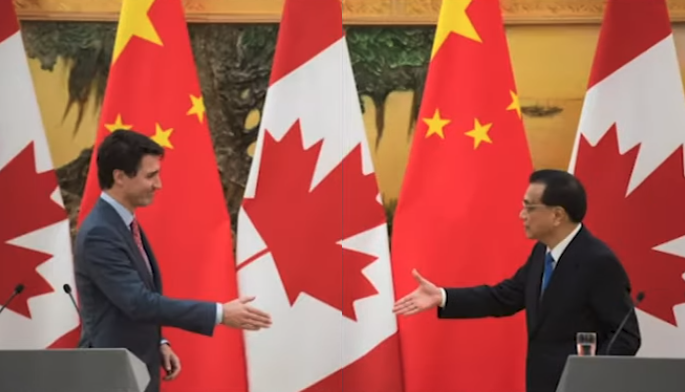
The diplomatic spat with China is “forcing the prime minister to bring out the biggest guns in his arsenal: his really serious socks”
The Line shows just how seriously Justin Trudeau is taking China’s most recent not-so-veiled threats against Canadians in Hong Kong:
The warm glow of a good feed faded quickly in Ottawa, alas, where our nice little vacation from history continues its unravelling apace. China’s ambassador to Canada is issuing increasingly dire threats to the safety of our citizens, specifically the hundreds of thousands of Canadians living in Hong Kong, forcing the prime minister to bring out the biggest guns in his arsenal: his really serious socks, a very frowny photograph by Adam Scotti, and, we expect, the imminent announcement that on top of all her current duties, Chrystia Freeland will be appointed Progressive Minister In Charge Of Figuring Out What The Hell We Should Do About China But Not In A Way That Offends Anyone The Middle Class Build Back Green Error Error Program Alarm—
Whoa! Sorry! The Freeland Job Generator glitched again. No surprise, considering the miles Trudeau has put on it in only five years. Let’s hope it doesn’t give out entirely — we’d need 47 years to procure another one.
Anyway, as to the matter at hand, your Line editors are pragmatic folk. Canada can’t punch at the same level as China; under Mr. Trudeau, indeed, despite all our for-Liberal-egos-only preening about Canada being back, we can’t even punch at the same level as Ireland and Norway. But it’s time Canadians face facts: we can either continue pretending that China’s increasingly aggressive and threatening behaviour is a problem that will go away if we ignore it long enough, or we can at least pretend that we have balls and take what actions we can. Obviously we’re not going to send a fleet to parade up and down their coast, but there are things we can realistically do, and we aren’t. Australia, for instance, also in Beijing’s sights, has rolled out a series of measures to curtail China’s substantial influence there. Canada ought to be doing the same. And we could start by immediately banning Huawei, and encouraging every other country that would listen — which doesn’t seem to be many — that they should too.
Do we expect the Liberal government to do this? No. Making money shilling for the Chinese regime is the best thing to happen to post-politics Liberals since Ontario’s air ambulance service. But they should do this. And the delay is only gonna make it hurt more when events eventually force us to accept that China is not our friend, never has been, and never will be under the current political leadership.
October 16, 2020
“The Art of War” – Wisdom of Sun Tzu – Sabaton History 089 [Official]
Sabaton History
Published 15 Oct 2020Sun Tzu says: “The Art of War is of vital importance to the state. It is a matter of life and death, a road either to safety or to ruin.” The Chinese Art of War by Sun Tzu is one of the most influential books in history. Throughout the centuries it would accompany generals, statesmen, and philosophers alike. Those who follow his teachings, who safeguard themselves against defeat and make sure of victory before the battle is fought, will triumph. Those who know everything about themselves and their enemies will achieve supreme excellence.
The Art of War by Sun Tzu Text: https://www.gutenberg.org/files/132/1…
Support Sabaton History on Patreon: https://www.patreon.com/sabatonhistory
Listen to “The Art of War” on the album The Art of War:
https://music.sabaton.net/TheArtOfWarWatch the Official Live Clip of “The Art of War” here:
https://www.youtube.com/watch?v=aYoK1…Listen to Sabaton on Spotify: http://smarturl.it/SabatonSpotify
Official Sabaton Merchandise Shop: http://bit.ly/SabatonOfficialShopHosted by: Indy Neidell
Written by: Markus Linke and Indy Neidell
Directed by: Astrid Deinhard and Wieke Kapteijns
Produced by: Pär Sundström, Astrid Deinhard and Spartacus Olsson
Creative Producer: Maria Kyhle
Executive Producers: Pär Sundström, Joakim Brodén, Tomas Sunmo, Indy Neidell, Astrid Deinhard, and Spartacus Olsson
Community Manager: Maria Kyhle
Post-Production Director: Wieke Kapteijns
Editor: Karolina Dołega
Sound Editor: Marek Kaminski
Maps by: Eastory – https://www.youtube.com/c/eastory
Archive: Reuters/Screenocean – https://www.screenocean.comVisual Sources:
– Pictures of Ming Dinasty courtesy of Yprpyqp from Wikimedia
– Pictures from the period of Opium War courtesy of Massachusetts Institute of Technology © 2010 Visualizing Cultures
– Wellcome Images
– Major National Historical and Cultural Site in China
– Pictures of The Art of War book courtesy of vlasta2, bluefootedbooby on flickr.com
– Metmuseum
– Picture of Eastern Han Calvary courtesy of GaryLee Todd from Wikimedia
– Granger Archive
– Hallwyl Museum
– Nomura Art Museum
– The icons from The Noun Project: Man by vanila, Asian woman by Jaime Serra, Wise Man by Éléonore SabatéAll music by: Sabaton
An OnLion Entertainment GmbH and Raging Beaver Publishing AB co-Production.
© Raging Beaver Publishing AB, 2019 – all rights reserved.
October 10, 2020
China’s national memories are oddly inconsistent
At UnHerd, Bill Hayton looks at the one conflict between China and a western nation that bulks disproportionally large in the current Chinese government’s historical grievance-bank:

“The 98th Regiment of Foot at the attack on Chin-Kiang-Foo, 21 July 1842.”
Painting by Richard Simkin (1840-1926) via Wikimedia Commons.
Take three mid-19th century Asian conflicts: one killed 20 million people, one killed well over 100,000 and a third killed 20,000. Which one, despite being barely noticed by the Chinese government at the time, is the most discussed today and has become emblematic of an historic clash between East and West?
The immensely deadly Taiping Rebellion between 1850 and 1864 and the vicious conflict between “Hakka” and “Cantonese” peoples between 1855 and 1867 are barely known outside China, despite their far bloodier impacts on human lives. We know vastly more about the “First Opium War” of 1840 because it has played a totemic role in two political arenas: one in China and one in the UK. And in both places, the origins of the war have been obscured and distorted to suit political agendas.
In China, the “Opium War” marks the beginning of what the Communist Party currently calls the “century of national humiliation” — a period of unrelenting misery that only ended in 1949 with the Party’s victory in the Chinese Civil War. It is a narrative that underpins both the Party’s right to rule China and its increasingly assertive foreign policy. In Britain, the narrative of the war has been a weapon wielded variously by Liberal critics of a Whig government, puritan campaigners against drugs, leftist opponents of British foreign policy and Twitter-users claiming that white people are inherently racist. All these critiques and narratives caricature the evidence.
In the comic-book version, the British Empire went to war in 1840 to force an illegal and immoral drug, opium, down the respiratory passages of the Chinese people, purely for its own ill-gotten ends. This narrative is oddly patronising. It assumes that the Chinese side were merely naïve dupes, hapless victims to imperial power. It is time to recognise that there were several protagonists in the First Opium War.
On one side were the British free-traders, men who wanted an end to Chinese restrictions on commerce, whether of cotton or opium. There was also an East India Company anxious to maintain its good relations with local officials, and a London government and its critics with their own agendas. On the other was an imperial court in Beijing split between reformers and a clique of Chinese conservative “scholar-officials” intent on keeping foreign influence at bay. In the middle was an Asian financial problem triggered by a European war.
October 9, 2020
The passing of the “unipolar moment”
In The Dominion Ben Woodfinden considers the return of foreign policy concerns to Canadian politics after a multi-decade disappearance:
The collapse of the Soviet Union ushered in what the late Charles Krauthammer, in a famous Foreign Affairs essay [PDF], called the “unipolar moment” in which the United States became the unquestioned global hegemon, with no true political, economic, or ideological rivals left. We have been living for the last three decades in this moment.
But Krauthammer’s use of “moment” is deliberate. Krauthammer readily admitted that unipolarity was temporary, and that “no doubt, multipolarity will come in time.” Were he alive today, Krauthammer would probably be ready to proclaim the unipolar moment over. Great power rivalry is back, and the COVID-19 pandemic has accelerated this, killing off any hopes that the relationship between an increasingly aggressive China and the United States could be anything other than adversarial.
This rivalry looks set to become the defining feature of the post-COVID international order, and as the Meng Wanzou case and the kidnapping of the two Michaels reveals, Canada finds itself unavoidably caught in the middle of this burgeoning rivalry. Where Canada fits into this is now one of the most important questions facing our country today.
Canada’s relationship with the United States is our most important relationship. We are unavoidably connected to our neighbour, and our relationship with the United States is a largely amiable one. But despite our integration and close ties with America, Canada remains a sovereign nation, and most Canadians retain a desire for Canada to continue to behave and act like one. Similarly, while it is a Canadian pastime to criticize the flaws and failings of our southern neighbour, we still share the same fundamental democratic values. Thus when it comes to figuring out where Canada stands in the middle of this new great power rivalry, we have little choice but to be broadly aligned with the United States and other free democratic nations.
[…]
Canada can accomplish these goals by prioritizing the strengthening of our relationship with other democratic nations that share our values and are also wary of the rise of an aggressive China with global ambitions. There is no shortage of other nations that fit this description. Most obvious are other Commonwealth nations with which we share common values and history. I’ve written before here in defence of CANZUK, a proposed agreement between Canada, Australia, New Zealand, and the United Kingdom that would strengthen economic ties and prioritize foreign policy and military coordination between these four nations. This is a good start, and strengthening the relationship between other Westminster nations to ensure that we all have an independent voice alongside America would be valuable to all prospective CANZUK members. [Federal Conservative leader Erin] O’Toole was an early supporter of CANZUK during his 2017 leadership bid, and this is something we should prioritize.
Another Commonwealth nation that Canada should prioritize the strengthening of economic and political relations with is India, a nation also threatened by an assertive China. While Canada-India relations have soured under the current government, rebuilding this relationship should be a priority. The current Indian government is not without its controversies and diaspora politics in Canada is complicated to put it mildly. But in the face of a confrontational and dangerous Chinese regime, we don’t have much choice other than to pursue closer and warmer relations with India, even if this will displease some.