
Army University Press
Published 22 Nov 2024The Battle of Huế is known for urban combat, destruction, and anguish. The city of Huế mattered to all the combatant forces. The city and its people paid the price. Interviews with noted subject matter experts Drs. Pierre Asselin, Gregory Daddis, James Willbanks, and Cpt. Wyatt Harper are augmented with archival audio and film, and detailed maps. This documentary places the Battle of Huế within the context of Hanoi’s 1968 Tet Offensive. How North Vietnam, South Vietnam, and the United States perceived the Vietnam War in 1967 and 1968 are central to this documentary. Covered are the key moments of the battle — including the People’s Armed Forces of Vietnam (PAVN) and People’s Liberation Armed Forces (PLAF) planning and assault on Hue. The responses of the Army of the Republic of Vietnam (ARVN), Vietnam Marine Corps (VNMC), the United States Marine Corps (USMC), and the U.S. Army (USA) are addressed to offer insight into an informative example of urban warfare.
0:02:39 – Why the Tet Offensive
0:10:53 – Why Huế
0:15:53 – Military Decision Making Process | Doctrine
0:26:51 – Warfighting Function | Doctrine
0:27:59 – Paralysis by analysis | Doctrine
0:33:15 – Courses of action | Doctrine
0:38:22 – Weather and operations | Doctrine
0:40:52 – Huế Massacre
0:41:18 – My Lai
0:46:05 – Huế and Modern Warfare
April 14, 2025
Huế: Battle for the Heart of Vietnam
April 9, 2025
The Korean War Week 42 – Seize Hwacheon Reservoir? A Dam Good idea – April 8, 1951
The Korean War by Indy Neidell
Published 4 Apr 2025Operation Rugged is in full swing, and it’s taking a decent amount of territory, but Matt Ridgway is worried about the possibility of the enemy blowing the dam at the Hwacheon Reservoir and flooding his army, so he gets set to try and soon take it. Meanwhile there’s an explosion in Congress in Washington DC, when the Minority Leader openly reads Douglas MacArthur’s letter of his plans for the war that are diametrically opposed to those of President Harry Truman. Truman realizes that he’s going to have to remove MacArthur from UN command.
Chapters
00:57 Recap
01:31 When to Fire MacArthur?
03:53 Joe Martin Speaks
07:11 Operation Rugged
09:23 The Hwacheon Reservoir Dam
13:35 Summary
13:51 Conclusion
(more…)
Battle of Saipan 1944: Total War in the Pacific
Real Time History
Published 15 Nov 2024In June 1944, an armada of warships and landing craft is getting ready for D-Day. Thousands of American soldiers are about to attack a prepared enemy with formidable defenses. But this isn’t Normandy, this is the island of Saipan. And the bloody battle there will bring total war to the Pacific.
Chapters:
00:00 Why the US Landed on Saipan
01:46 American Plan for Saipan
03:38 Japanese Defenses on Saipan
05:08 Preparations for D-Day on Saipan
06:39 D-Day on Saipan
08:46 Marine Combat Shotguns on Saipan
14:48 Japanese Counterattack
16:30 D-Day Plus 3 on Saipan
17:01 Battle of the Philippine Sea
20:45 D-Day Plus 7-9 on Saipan
22:33 D-Day Plus 11-15 on Saipan
24:10 Japanese Banzai Charge on Saipan
26:46 Civilian Casualties on Saipan
27:57 End of the Battle of Saipan
28:48 Battles of Tinian and Guam
30:04 Epilogue
(more…)
April 8, 2025
What did Alexander the Great eat?
Tasting History with Max Miller
Published 26 Nov 2024Game hens roasted with a hazelnut and herb sauce
City/Region: Rome | Macedonia
Time Period: 1st CenturyThrowing lavish feasts was one foreign custom that Alexander the Great was all too happy to adopt. We don’t have any recipes from Alexander’s court, so I looked to the ancient Roman cookbook, De re coquinaria, to find a recipe that used ingredients that Alexander would have had.
The herbs and seasonings in the sauce combine to form a new complex flavor that is delicious. The hazelnuts are prominent and form a wonderful crust on the game hens, and the garum adds its distinctive savory umami note. You can either make the sauce and serve it forth with poultry that you’ve already cooked, or roast the birds with the sauce like I did.
Aliter Ius in Avibus, Another Sauce for Birds:
Pepper, parsley, lovage, dried mint, safflower, pour in wine, add toasted hazelnuts or almonds, a little honey with wine and vinegar, season with garum. Add oil to this in a pot, heat it, stir in green celery and calamint. Make incisions in the birds and pour the sauce over them.
— Apicius de re coquinaria, 1st century
April 5, 2025
Troops, Tanks, Trucks: What’s Inside A Division? – A Korean War Special
The Korean War by Indy Neidell
Published 4 Apr 2025Who exactly is fighting in Korea? What’s changed under the hood since the start of the war? How many showers do you need to keep 17,214 soldiers smelling like roses? Today Indy breaks down the units that make up the frontline and answers these questions, looking at American, North Korean, Chinese, South Korean, and British units and what they consist of.
Chapters
00:00 Intro
00:44 Benefits and Limitations
02:04 A US Division
06:12 The Communist Forces
09:56 Other UN Forces
13:00 Conclusion
(more…)
April 3, 2025
1947 Newscast: Spies, Aliens, and Collapsing Empires! – W2W 18
TimeGhost History
Published 2 Apr 20251947 is a pivotal year: The British Empire crumbles as India and Pakistan gain independence amidst violence and mass migration. Truman launches a Cold War against Soviet communism, while spies infiltrate governments worldwide. Nations sign treaties reshaping Europe; Chuck Yeager breaks the sound barrier, and rumours swirl of aliens crashing at Roswell. Join us for the headlines that reshaped history!
(more…)
April 2, 2025
The Korea War Week 41 – One Order Away from WWIII – April 1, 1951
The Korean War by Indy Neidell
Published 1 Apr 2025The UN forces have again crossed the 38th Parallel in many places, but High Command is worried about Soviet intervention, which could ultimately force them to withdraw from Korea entirely. However, plans are still set for Operation Rugged to soon go into action — aiming into the Iron Triangle.
Chapters
00:00 Intro
00:58 Recap
01:46 Soviet Intervention?
04:22 Operation Rugged
07:01 Task Force 77
09:36 South Korean Porters
11:02 MacArthur and McClellan
13:55 Summary
14:13 Conclusion
(more…)
April 1, 2025
Carney chooses not to dump Paul Chiang as Liberal candidate in Markham-Unionville
Update: The National Post is reporting that Chiang has dropped out of the campaign.
Liberal leader Mark Carney may believe he’s showing something something strength and something something compassion by allowing Paul Chiang to stay on the ballot as the official Liberal candidate despite the awful optics of the situation:
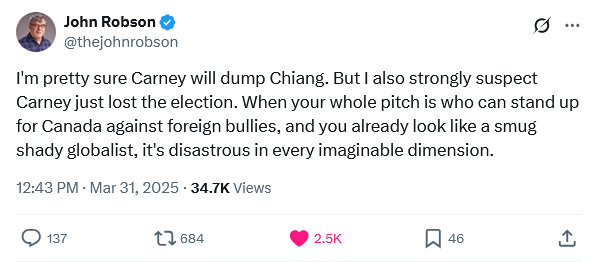
In the National Post, Anthony Furey says that the decision indicates that Carney values China’s values ahead of Canadian values:
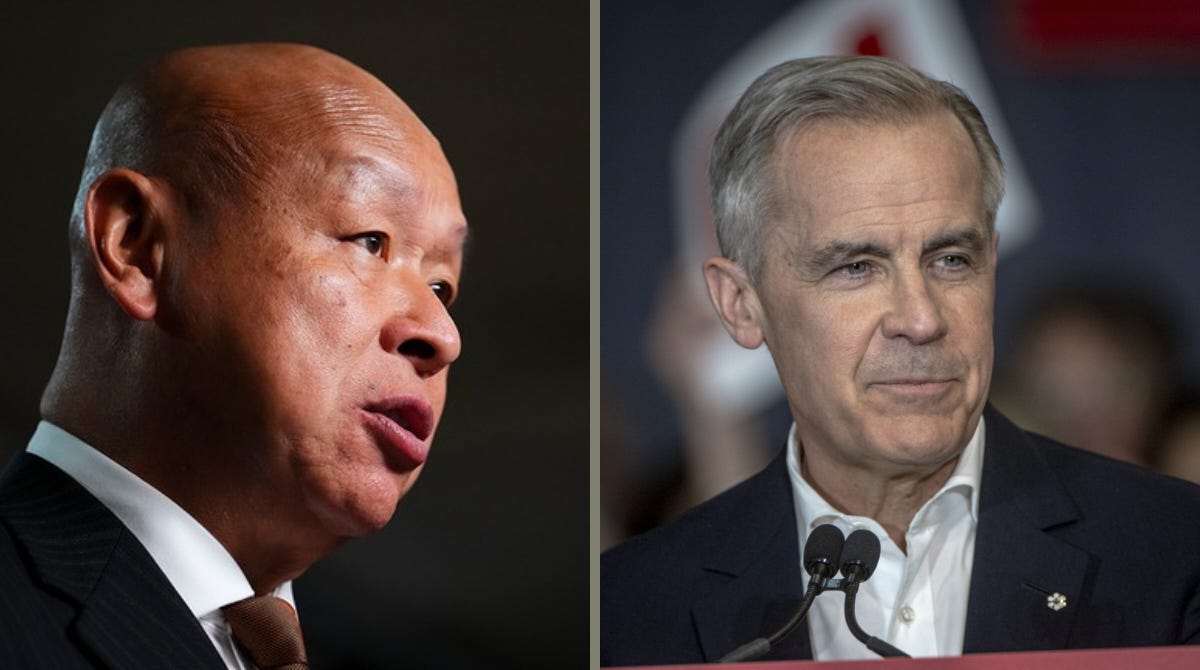
Liberal MP Paul Chiang, left, and Liberal leader Mark Carney, right.
Mark Carney’s mishandling of the Paul Chiang scandal has got to be one of the worst cases of poor judgment in recent Canadian political history. From the moment the story broke, it was a no-brainer that Chiang could not remain as a Liberal MP and as the Liberal candidate in Markham-Unionville.
The fact Carney didn’t immediately do the right thing was a problem. And that he’s now defiant in keeping Chiang on despite several days of significant pushback seriously calls his judgment into question.
On Friday, the civil rights group Toronto Association for Democracy in China broke the scandal on remarks Chiang made about Conservative candidate Joe Tay that appeared in Chinese-language newspaper Ming Pao Toronto.
“To everyone here, you can claim the $1 million bounty (on Joe Tay) if you bring him to Toronto’s Chinese consulate,” Chiang said during an ethnic media conference in January.
Jaws dropped when the news spread. Dozens of human rights groups have already condemned the remarks.
Hong Kong Watch, a human rights advocacy group, wrote in a statement: “It is clear that this is a Parliamentarian suggesting to a broad community that a political opponent be taken against their will and handed over to the custody of a foreign government that has a well-documented history of wrongfully detaining Canadian citizens and using coercion to get Canadian citizens to return to (China).”
[…]
Yet Liberal leader Mark Carney is downplaying it and standing by Chiang.
“The comments were deeply offensive,” Carney said on Monday. “This is a terrible lapse of judgment by Mr. Chiang. He has apologized for those comments.”
If they are that offensive and if Chiang’s judgment is that poor, why keep him on as a member of the team?
Carney was hammered with repeated questions to that effect from the news media but was firm that Chiang would remain as a candidate. He also seems to think that Chiang being a police officer makes the remarks less of an issue, when it clearly makes it a much bigger problem.
“Mr. Chiang is a veteran policeman with more than a quarter century of service to his community,” Carney told the press. “And he will continue his candidacy going forward, having made those apologies very clearly to the individual, to the community and moving forward to serve.”
From the outside, it looks less like Carney is trying to stand up for a member of his party and more as though he’s desperate to hang on to that seat (perhaps Liberal internal polls aren’t quite as rosy in the GTA as the public polls are showing at the moment).
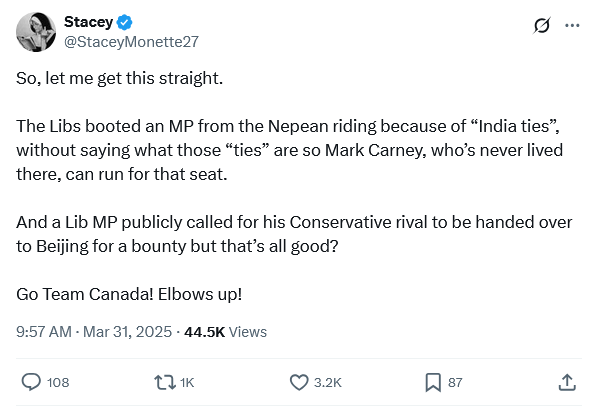
Also on the social media site formerly known as “Twitter”, Dan Knight posts a long note on the situation:
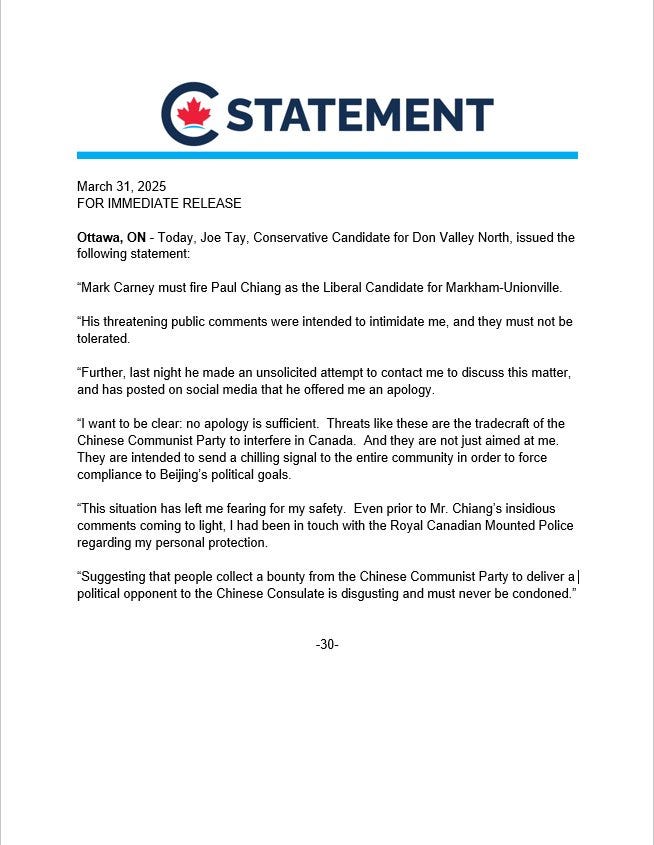
This is no longer just a political scandal — this is a national disgrace. Joe Tay, the Conservative candidate targeted by Paul Chiang’s shocking comments, has now broken his silence — and it’s nothing short of damning.
In his official statement, Tay pulls no punches. He calls Chiang’s words what they are: “threatening public comments … intended to intimidate me”. Not debate. Not disagreement. Intimidation. And Tay makes it crystal clear: “no apology is sufficient”. Why? Because this isn’t some offhand gaffe — this is the exact playbook of the Chinese Communist Party, imported straight into Canadian politics.
Let that sink in. A Canadian MP, standing on Canadian soil, echoed a bounty issued by a hostile foreign regime. And the man targeted — Joe Tay — says it plainly: “Suggesting that people collect a bounty from the Chinese Communist Party to deliver a political opponent to the Chinese Consulate is disgusting and must never be condoned.”
Disgusting — and yet, here we are. Paul Chiang is still in the Liberal fold. Mark Carney, the man who wants to run the country, says nothing. Meanwhile, Tay is left fearing for his safety — already in touch with the RCMP before the public even knew what Chiang had said.
This is the state of Canadian politics under the Liberal machine: where the only people paying a price are the ones speaking out. Where the candidate who exposes foreign interference is the one who needs police protection. And the one who parrots CCP propaganda? He gets to keep his seat.
Even Michael Chong — a guy who knows firsthand what CCP intimidation looks like — is stepping in and asking the obvious question: Why is Paul Chiang still a Liberal candidate?
Chong just posted on X (formerly Twitter) that at least three Canadians have already been coerced into returning to the People’s Republic of China against their will. Against their will. Think about that. Beijing is actively running transnational repression ops on Canadian soil — and now, one of Carney’s own candidates is joking about turning a political opponent over to the CCP for a cash reward. And we’re supposed to believe the Liberals take foreign interference seriously?
Chong’s post includes actual evidence — parliamentary testimony, U.S. indictments, and RCMP-relevant keywords like “United Front”, “overseas station”, and “minutes or less”. In other words, this isn’t conspiracy talk. This is real. It’s happening. And it’s been happening under the Liberals’ watch.
And still, Paul Chiang stays in the race. No suspension. No investigation. Nothing from Carney, the security-cleared savior of the Liberal establishment.
And here’s where the hypocrisy hits terminal velocity.
Remember, Mark Carney has a security clearance. That’s been his whole pitch. That somehow he is more qualified to lead Canada because he has access to classified intelligence. Because he is in the know. He’s the grown-up in the room. The steady technocrat with one foot in the Privy Council and the other in Davos.
Well, here’s a question: What good is a security clearance if your own MPs are acting like a propaganda arm for Beijing?
Because while Mark “Bank of China” Carney sits on his classified briefings, his Liberal MP Paul Chiang is out there, on camera, floating the idea that a Conservative candidate should be delivered to a Chinese consulate to “claim the bounty” placed on his head by the Chinese Communist Party.
Let’s repeat that: A Canadian MP is echoing a CCP-issued bounty, and Carney — the man with all the intelligence, all the briefings, all the supposed national security credentials — says nothing. Not a peep. Not even a token tweet.
So what exactly is that security clearance buying us, Mark? If you’re such an expert on foreign threats, why can’t you recognize one when it’s sitting in your own caucus?
It’s a joke. The entire premise of Carney’s leadership bid is unraveling in real time. He promised Canadians he could stand up to foreign interference — meanwhile, his own candidate in Markham–Unionville is out there sounding like a CCP press secretary. And instead of showing leadership, Carney hides behind talking points, closed-door fundraisers, and his carefully curated media handlers.
Joe Tay is right. This isn’t just about intimidation — it’s about sending a “chilling signal to the entire community”. And the message from Carney is loud and clear: if you’re a threat to the Liberal regime, they’re not just coming for your policies. They’re coming for you.
Security clearance? Please. It’s not leadership if you only speak up when it’s politically convenient. And if Carney won’t condemn this, then he’s not qualified to lead a PTA meeting, let alone a country.
Mao Murders One Million Landlords – W2W 17 – 1947 Q4
TimeGhost History
Published 31 Mar, 2025In 1947, Mao’s Communist forces launch massive counter-offensives, turning the tide of the Chinese Civil War. As Nationalist troops led by Chiang Kai-shek desperately hold their positions, the Communists gain ground through ruthless tactics — including brutal land reforms and psychological warfare. With battles raging from Manchuria to Central China, this conflict will decide the fate of millions. Is Chiang’s collapse now inevitable?
(more…)
Americans DON’T KNOW about this workbench
Rex Krueger
Published 27 Nov 2024The workbench western woodworking didn’t know it needed.
March 31, 2025
The first genuine “bozo moment” of the federal election campaign
I saw a mention on social media that an Ontario candidate had publicly suggested that his primary opponent be dragged off to the Chinese embassy for some kind of reward, and I assumed it was another example of something being taken wildly out of context … but no:
Liberal MP Paul Chiang, left, and Liberal leader Mark Carney, right.
So let’s just recap, because this is almost too surreal to believe.
A sitting Liberal Member of Parliament — Paul Chiang — stood in front of a Chinese-language media outlet in January 2025 and said that if someone were to kidnap Joe Tay, a Conservative candidate and Canadian citizen, and deliver him to the Chinese Consulate in Toronto, they could “claim the one-million-dollar bounty”. That wasn’t some fringe YouTuber or anonymous social media post. That was a sitting MP, elected to represent Markham—Unionville, who also happens to serve as the Parliamentary Secretary to the Minister of Diversity and Inclusion.
Let me be crystal clear here: that’s not just inappropriate. That’s not just “deplorable”. That’s language lifted directly from the Chinese Communist Party’s playbook. Joe Tay is on a real bounty list. Not fantasy. Not fiction. A real HK$1 million bounty placed on his head by the Hong Kong police for supporting democracy and speaking out against tyranny.
And what happens when a Canadian MP echoes that threat — on Canadian soil?
Nothing.
As of right now—this minute — Paul Chiang is still an MP in good standing in with the Liberals. Not suspended. Not removed from caucus. No RCMP probe. No parliamentary discipline. Nothing.
And the Carney campaign? The Liberal Party’s new face? Crickets. Absolute silence. Carbon Tax Carney, Trudeau’s old money-man turned globalist messiah, who’s spent the last month talking about “foreign interference” and demanding Pierre Poilievre get a security clearance? Not a word. Apparently, if a Conservative doesn’t submit to Ottawa’s surveillance state, it’s a national crisis. But if a Liberal MP plays mouthpiece for Beijing and jokes about abducting a political opponent? It’s just … Tuesday.
Imagine for a second that a Conservative MP had said anything remotely close to this — maybe even joked about placing a bounty on a Liberal politician funded by a foreign regime. Every major newsroom in the country would have declared martial law. CBC would be live for 72 hours straight. The RCMP would have launched a task force. But because it’s a Liberal, they issue a press release. A shrug. A “deplorable” comment, followed by a half-hearted apology and — get this — no consequences.
As former prime minister Justin Trudeau amply demonstrated, consequences are for other people, not members of the Liberal caucus.
March 29, 2025
Why India and Pakistan Hate Each Other – W2W 015 – 1947 Q3
TimeGhost History
Published 23 Mar 2025In 1947, the British divide the Raj into two nations, India and Pakistan, triggering one of the deadliest mass migrations in history. Sectarian violence between Hindus, Sikhs, and Muslims leaves at least 200,000 dead and displaces millions more. Hastily drawn borders turn neighbours into enemies. The partition’s bloody legacy will lead to decades of tension, war, and bloodshed.
(more…)
March 27, 2025
Ban the swastika? Are you some kind of racist?
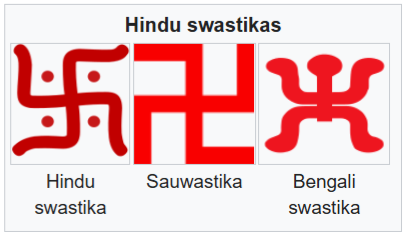
In Ontario, the elected council for the Region of Durham has been reacting to a few painted swastika graffiti around the region over the last couple of months. To, as a politician might say, “send a message”, they proposed banning the use of the swastika altogether … failing to remember that it’s not just neo-Nazi wannabes who use it:
Durham council is adjusting the wording of its calls for a national ban on the Nazi swastika, or “Hakenkreuz“.
This follows efforts by religious advocates to distance their own symbols from the genocidal German fascist regime.
Swastikas often appear in Jain, Hindu and Buddhist iconography.
“The word ‘swastika’ means ‘well-being of all’,” explained Vijay Jain, president of Vishwa Jain Sangathan Canada, at Wednesday’s regional council meeting. “It’s a very sacred word. […] We use it extensively in our prayers.”
“Many Jain and Hindi parents give their children the name ‘Swastika’,” he added. “Many Hindi and Jain people, they keep their [business’s] name as ‘Swastika’. If you go to India, you’ll find the ‘Swastika’ name prominently used.”
“We stand in solidarity with the Jewish community and fully support all of the efforts by authorities to address growing antisemitism in Canada,” he said.
Regional council made its initial call for a ban on Nazi swastikas in February, after two separate incidents of the antisemitic symbol being scrawled inside a washroom at the downtown Whitby library.
On Wednesday, councillors voted to revise that motion to replace the word “swastika” with the term “Nazi symbols of hate”.
B’nai Brith Canada has been spearheading a petition campaign to have the Nazi symbol banned across the country.
The group has increasingly opted to refer to it by the alternative names “Nazi Hooked Cross” or “Hakenkreuz“.
On March 20, B’nai Brith put out a joint statement with Vishwa Jain Sangathan and other religious advocacy groups, calling for further differentiation between the symbols.
“These faiths’ sacred symbol (the Swastika) has been wrongfully associated with the Nazi Reich,” wrote Richard Robertson, B’nai Brith Canada’s Director of Research and Advocacy. “We must not allow the continued conflation of this symbol of peace with an icon of hate.”
Uncovered: The CIA’s Secret War That Shook Stalin! – W2W 16 – 1947 Q3
TimeGhost History
Published 26 Mar 2025In 1947, the Cold War intensifies as the Truman and Zhdanov Doctrines divide the world into opposing camps. The CIA is born to counter communist threats, while Stalin’s Cominform tightens its grip across Eastern Europe. From Berlin’s streets crawling with double agents, to covert American election meddling in Italy, espionage becomes the frontline of this global showdown. Welcome to a new age of spies, secret doctrines, and ruthless intelligence wars.
(more…)
March 26, 2025
The Korean War Week 040 – MacArthur Sandbags Truman – March 25, 1951
The Korean War by Indy Neidell
Published 25 Mar 2025Harry Truman is moving forward with his plans to somehow end the fight with the Chinese, but Douglas MacArthur takes a hatchet to those plans. Truman is furious, and the question remains, for how long will MacArthur’s defiance be tolerated? In the field, Operations Ripper, Courageous, and Tomahawk are in action, but are all disappointing for the UN forces, as they fail in their mission to destroy the enemy’s war making capacity. They don’t actually do much of that at all.
Chapters
00:00 Intro
00:51 Recap
01:08 Operation Ripper Ends
04:09 Operation Courageous
06:20 Operation Tomahawk
09:44 MacArthur’s Sabotage
13:27 Summary
13:36 Conclusion
(more…)


