
Two centuries of émigré rule had changed the South forever, but the North had also changed, which brings me to the second great theme of Chinese history to emerge in this period: the polarity between settled farmer and nomadic barbarian. This has always been viewed as a sharp dichotomy in official imperial historiography, but as I discuss at length in my review of The Art of Not Being Governed, the reality was that it was always more of a spectrum. When times got tough, or when state capacity waned, formerly loyal peasants had a tendency to migrate to the peripheries and start lynching nosy census-takers. In fact, this probably accounts for many of the seemingly vast swings in population that China has had over the centuries.1
But this time it wasn’t just Chinese peasants moving around and changing the way they lived. For the first time in recorded history, the Chinese civilizational heartland of the Yellow River valley was invaded and occupied by a massive number of non-Chinese people. It’s an extremely sensitive and difficult to discuss topic in China, but there is genetic evidence of substantial steppe admixture in Northern Chinese lineages, and it seems likely that this is around when it kicked off. Meanwhile, remember that huge numbers of Northern Chinese were migrating to the South at around this time. Our best guess from both ancient DNA and linguistic2 evidence is that the modern Southern Chinese are pretty close to what the Northern Chinese were a couple thousand years ago, while the modern Northern Chinese have a good amount of Turkic and Mongolic ancestry.
The thing is you don’t even need to look at the genetics, it’s also quite apparent from the literary, artistic, and military record that over time a hybrid aristocracy emerged in the North with influences from both the old Chinese nobility and the invaders. The change is visible in everything from fighting style (suddenly Chinese armies are using cavalry), to fashion (pants!), to preferred hobbies (suddenly a lot more archery and falconry). It was this mixed-blood elite that finally reunified North and South China, and eventually gave rise to the glorious Tang dynasty.
This may have been the most shocking fact I learned from this book. I’d always thought of the Tang as the most quintessentially Chinese of all Chinese rulers (and moreover the real beginning of “modern” Chinese history). Chinese people tend to think that way too — “Tang” is a still-used archaic ethnonym for the Chinese ethnicity (the same way that it’s recently gotten trendy in the West to use a different archaic ethnonym, also the name of an ancient dynasty, “Han”).3 The idea that the Tang actually represented an intrusion of alien Turkic influences into Chinese society is not at all the mainstream view within China, but it’s pretty much the Western scholarly consensus, and Graff lays it out convincingly.
There’s a lot more to say about the great Tang, and this book has a lot of details on their expeditions past the Tarim Basin into Central Asia and their battles with Arab armies. But all of that is getting back into the well-covered part of Chinese history, the part that you can read about anywhere else. And I’ve gotten all the way to the end of this review while neglecting the most important part: were there preppers in the Jin dynasty, and if so how did they deal with the total breakdown of society followed by two centuries of anarchy?
Were there ever. While most of the country fell prey to bands of marauders and tribesmen who roamed the land committing unspeakable crimes, there were a few village headmen and petty aristocrats who constructed fortifications, stockpiled food and weaponry, and carved order out of chaos. There, in their redoubts, they kept the flame of civilization alive and sheltered their people against the long night. If you ever run into me at a party, there’s even odds I’ll quote this passage at you:
When his home was threatened by troops of one of the princely armies in 301, [Yu Gun, a minor official] led his kinsmen and other members of the community into the high country to the northwest. “In this high and dangerous defile, he blocked the footpaths, erected fortifications, planted [defensive] hedges, examined merit, made measurements, equalized labor and rest, shared possessions, repaired implements, measured strength and employed the able, making all things correspond to what they should.” On several occasions when bandits threatened his hilltop sanctuary, he was able to deter them simply by deploying his armed followers in orderly ranks.
There’s so much that’s beautiful in this passage, I feel like I could write an entire book about it. One thing I love is the way it embodies Joseph de Maistre’s aphorism that “contre-révolution ne sera point une révolution contraire, mais le contraire de la révolution.” Yu doesn’t just oppose strength with strength, he battles the insanity and entropic forces raging outside his walls by creating hierarchy, tranquility, and harmony within. His “armed followers in orderly ranks” are a military manifestation of the “making all things correspond to what they should” that preceded them. And there’s something very profound and very true in the image of the forces of disorder recoiling from his little island of civilization like a vampire faced with a crucifix.
John Psmith, “REVIEW: Medieval Chinese Warfare, 300-900 by David A. Graff”, Mr. and Mrs. Psmith’s Bookshelf, 2023-06-05.
1. Yes, alas, this means some of the death tolls parodied in the “Chinese history be like” meme are almost certainly exaggerations. When the census says 160 million one year and 120 million the next, it’s possible that a ton of people died, but it’s also possible that it just got a lot harder to take a census.
2. All the high mountains and sheltered valleys in Southern China mean it has massively greater linguistic diversity than the North, but many of those languages actually turn out on closer inspection to be snapshots of Northern Chinese languages at some much earlier point in history. It’s more evidence, consistent with the genetic evidence, that repeated waves of migrants have entered Southern China from the North, and then stayed fairly isolated.
3. The word in Chinese for overseas Chinatowns literally translates as something like “Tang people street”.
May 7, 2025
QotD: China’s millennia-long struggles between farmers and nomads
May 4, 2025
The Clean German Myth, Doomed B-17 Pilots, and Japan’s Rapid Victories – Out of the Foxholes Live
World War Two
Published 3 May, 20205Indy and Sparty tackle some more of your interesting questions in another live Out of the Foxholes. Today they look at loss rates of B-17 crews, the myth of the clean Wehrmacht, and ask why the West was apparently so unprepared for Japan’s attack.
(more…)
April 30, 2025
The Korean War Week 45 – The Chinese Spring Offensive Begins! – April 29, 1951
The Korean War by Indy Neidell
Published 29 Apr 2025This is a week of nothing but battle action as the Chinese Spring Offensive crashes down on the UN forces like a tidal wave — literally hitting them along all of the front lines across the whole Korean Peninsula.
Chapters
00:00 Intro
00:46 Recap
01:59 The First Night
07:25 The Next Day
10:19 The Eastern Sector
13:56 The Kapyong Road
15:57 The Gloster Surrounded
19:48 Flight of the Glosters
(more…)
April 29, 2025
The US Cancels Tariffs and Saves the World – W2W 025
TimeGhost History
Published 28 Apr 2025After seeing the devastating effects of the trade war that ravaged the global economy between the world wars, in 1948 the US is determined to usher in an age of free trade and global cooperation that will last until the spring of 2025.
(more…)
April 27, 2025
Nuking the Reich: What If the War Had Dragged On? – Out of the Foxholes Live
World War Two
Published 26 Apr 2025Indy and Sparty bring you another episode of Out of the Foxholes Live! Today they talk about Thailand’s relationship with Japan, ask why the Americans firebombed Japanese cities even after cutting off the country’s supplies, and they tackle a big one: would the Allies have nuked Germany?
(more…)
QotD: Fighting against Japan in the Pacific
And lord knows the Americans took the bait, more than once. If “bait” is really the right word, because if you’ve got no choice … the early campaigns in the Solomons were so legendarily nasty for that reason: You have no choice but to go right up the pipe to seize an objective, and if you do, the enemy has no choice but to go right up the pipe to get it back.
The genius of the later American strategy — and credit where it’s due, few people have a lower opinion of MacArthur than I, but this was brilliant — was to simply go around. Heavy bomber strips are a must, and in the even fewer places in the Pacific that can take heavy bombers, the Americans had no choice but to go right up the chute … but carrier airpower can do a hell of a lot, particularly when it can move about completely unmolested by the enemy. Thus the Americans turned all those guaranteed meat grinders the Japanese had set up for them into big open-air POW camps, without bothering to go in there and force them to surrender (which, of course, they wouldn’t). Have fun starving in your bunkers, boys; we’ll just leave a covering naval detachment, to make sure you can’t evacuate; see you when the war’s over.
Severian, “Strategy”, Founding Questions, 2021-11-21.
April 24, 2025
“Call for Admiral Ackbar! Paging Admiral Ackbar. Admiral Ackbar to the white courtesy phone, please.”
What a wonderful, heartwarming story: those cuddly folks in Beijing are reaching out to Canada to “partner with” as a way of warding off American “bullying”. How nice! What a great idea! With the best possible intentions. What could possibly go wrong?

China’s ambassador says Beijing is offering to form a partnership with Canada to push back against American “bullying”, suggesting the two countries could rally other nations to stop Washington from undermining global rules.
“We want to avoid the situation where humanity is brought back to a world of the law of the jungle again,” Chinese Ambassador Wang Di told The Canadian Press in a wide-ranging interview.
“China is Canada’s opportunity, not Canada’s threat,” he said through the embassy’s interpreter.
Wang — whose office requested the interview with The Canadian Press — said that China and Canada appear to be the only countries taking “concrete and real countermeasures against the unjustified U.S. tariffs” imposed by U.S. President Donald Trump.
“We have taken notice that, faced with the U.S.’s unilateral bullying, Canada has not backed down,” he said. “Instead, Canada is standing on the right side of the history, on the right side of international fairness and justice.”
He said Beijing and Ottawa should work together to convince other countries not to placate the Trump administration and to make Washington pay a price for breaking global trade rules.
Roland Paris, who leads the University of Ottawa’s graduate school of international affairs, said Beijing has long sought to reshape international institutions to advance its own interests — efforts that often have put China at odds with Ottawa’s foreign policy.
He said Canadian businesses should take a cautious approach to China, where they still face the risk of import bans and arbitrary detainment.
“The mercenary use of tariffs and non-tariff barriers that we’re seeing from the Trump administration has been practised for a long time by China in different forms,” Paris said.
“China has played its own version of hardball and abused trade rules in the past to coerce countries, including Canada, that have dared to displease Beijing.”
As the rivalry between the U.S. and China has intensified, Canada has generally followed Washington’s lead on restricting certain types of commerce with China.
Last fall — in an effort to protect Canadian auto sector jobs and allay American concerns about threats to supply chains — the federal government imposed 100 per cent tariffs on imports of Chinese-made electric vehicles that all but banned Chinese EVs from the Canadian market.
Canada alleged unfair trade practices including “a state-directed policy of overcapacity and oversupply,” and “lack of rigorous labour and environmental standards”.
Beijing retaliated by imposing large tariffs on Canadian canola and pork — duties Wang said Beijing is happy to drop if Ottawa drops its own tariffs.
In totally unrelated news, a Conservative candidate has been advised by the RCMP to “pause in-person campaigning” in the current federal election campaign due to threats originating in the People’s Republic of China:
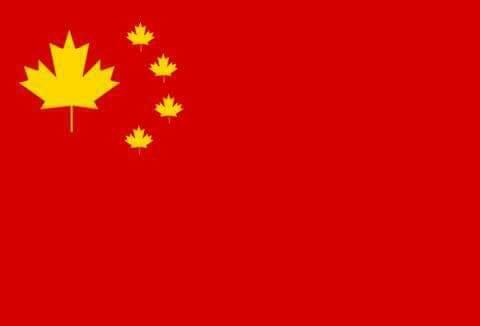
Joseph Tay, the Conservative candidate identified by federal authorities as the target of aggressive Chinese election interference operations, paused in-person campaigning yesterday following advice from federal police, The Bureau has learned.
Two sources with awareness of the matter said the move came after the SITE Task Force — Canada’s election-threat monitor — confirmed that Tay is the subject of a highly coordinated transnational repression operation tied to the People’s Republic of China. The campaign seeks not only to discredit Tay, but to suppress the ability of Chinese Canadian voters to access his campaign messages online, via cyber operations conducted by Beijing’s internet authorities.
Now, with six days until Canada’s pivotal vote — in an election likely to be decided across key Toronto battleground ridings — it appears that Tay’s ability to reach voters in person has also been downgraded.
Tay, a journalist and pro-democracy advocate born in Hong Kong, is running for the Conservative Party in the Don Valley North riding. Federal intelligence sources have confirmed that his political activities have made him a top target for Beijing-linked online attacks and digital suppression efforts in the lead-up to next week’s federal election.
Tay’s need to suspend door-knocking yesterday in Don Valley North echoes concerns raised in a neighbouring riding during the 2021 federal campaign — where The Bureau previously uncovered allegations of Chinese government intimidation and targeting of voters and a Conservative incumbent. According to senior Conservative sources, Chinese agents attempted to intimidate voters and monitor the door-to-door campaign of then-incumbent MP Bob Saroya in Markham–Unionville.
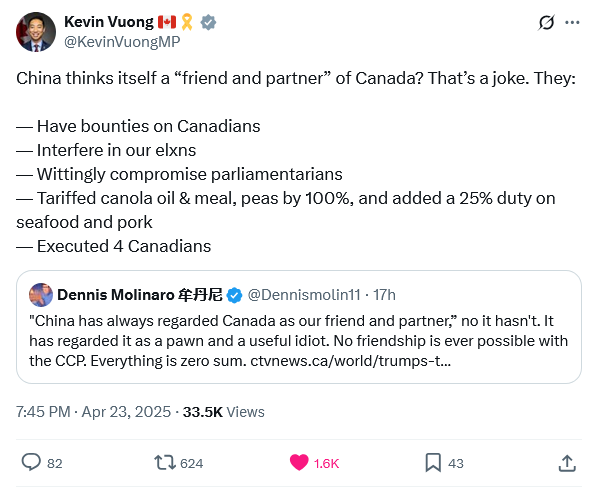
Update: Spotted on the social network formerly known as Twitter:
April 23, 2025
The Korean War Week 44 – Mac’s Lies Boil Truman’s Blood – April 22, 1951
The Korean War by Indy Neidell
Published 22 Apr 2025The stage is set for the Chinese Communist Forces’ next big offensive in Korea, but that is not where American eyes are fixed this week. Instead, focus swings to Washington D.C. where the recently-fired Douglas MacArthur arrives and proceeds to address crowds and Congress alike. It soon becomes clear that he will not go gentle into that good night.
Chapters
00:00 Intro
00:58 Recap
01:46 Soviet Intervention?
04:22 Operation Rugged
07:01 Task Force 77
09:36 South Korean Porters
11:02 MacArthur and McClellan
13:55 Summary
14:13 Conclusion
(more…)
April 22, 2025
Rise of Japan: 1st Sino-Japanese War 1894-95
Real Time History
Published 18 Apr 2025In 1894, tensions are rising in East Asia. There’s trouble in the small but strategically-located Kingdom of Korea, as rival factions in the royal family fight for power and against popular uprisings. Shaken by a major revolt, Korea’s King Kojong calls on China for help – but Japan intervenes, setting off a war that will devastate Korea and upend the old order in Asia.
(more…)
April 21, 2025
The Battles That Broke the Chinese Nationalists – W2W 22 – 1948 Q2
TimeGhost History
Published 20 Apr 2025This episode, we see the Chinese Civil War turn decisively against Chiang Kai-Shek. Mao’s Communists score great victories on the battlefield while the Nationalists face economic collapse. How much longer can Chiang hold on?
(more…)
April 20, 2025
Did Britain Bomb The Wrong Targets in WW2? – Out of the Foxholes Live
World War Two
Published 19 Apr 2025Today Indy and Sparty answer questions on the French colonies, Pykrete and iceberg aircraft carriers Japan’s invasion of India, and they talk about Britain’s misguided strategic bombing strategy.
(more…)
April 19, 2025
QotD: Allied air and sea operations won WWII
The Allies won the war by using air power to destroy the German and Japanese capacity both to produce military equipment and to transport it to the battlefield. By 1944-45, the Germans and Japanese could not use their economies to arm and supply their armies on the battlefield, leading to their inevitable defeat.
In the European war, American and British airpower: (a) directly destroyed a significant amount of productive capacity, (b) rendered remaining capacity far less efficient, (c) made it impossible for the Germans to defeat western ground forces, and (d) compelled the Germans to waste tremendous resources on air defense and exorbitant, ultimately ineffective vengeance weapons.
In the Pacific, the United States used carrier-based airpower, submarines, and bomber-deployed mines to isolate Japan from the resources of the empire it conquered in 1941-42. American bombers also directly destroyed factories and transportation systems, leading to similar levels of economic dysfunction as in Germany.
Anonymous, “Your Book Review: How the War Was Won“, Astral Codex Ten, 2024-08-09.
April 17, 2025
QotD: Explaining mid-century American support of Chiang Kai-Shek and the Republic of China
PR: Because the missionaries in China had decided that it was going to become their great project, channeling that global do gooder impulse that had lain dormant since the end of the Civil War as their Great Cause — the missionaries were the grandchildren of the abolitionists and they took their fanaticism straight from that movement. China was to be “saved” from paganism, Catholicism and colonialism and they formed some kind of proto-NGO, ensuring that their views were made the policy of the government. It is not a coincidence that both Chaing and his wife were Protestant Christian converts (at least nominally) That impulse to “nation build” China into a facsimile of Progresssive Christian America (excluding, of course, the Old Confederacy) is the source of the drive to make their fantasy real, like that Utopian impulse we described the other day that is a bedrock of the Juggalo mindset. To find the roots of the China obsession you have to understand the power of the missionary movement. Nothing to me sums it up better than Kenneth Wherry, who became a big player in the China Lobby, with his mix of naivety, pathological altruism, and religious fervor-
With God’s help, we will lift Shanghai up and up, ever up, until it is just like Kansas City …
[…]
That’s an important point — the Protestants never had the same fervor to make Vietnam or Cuba or even the Philippines (even though it was OUR colony) into Kansas City, because they were either already Catholic or had a minority Catholic elite. China, however, gave them that sweet Protestant fix in making a new China with the “right” kind of Christianity. It’s also why they hated Japan so — Japan had slammed the door on Protestant missionaries pretty hard and their Christian minority (in Nagasaki, ironically) was Catholic.
From the comment thread on “WNF: A Twofer”, Founding Questions, 2025-01-15.
April 16, 2025
The Korean War Week 43 – Truman Dismisses MacArthur! – April 15, 1951
The Korean War by Indy Neidell
Published 15 Apr 2025It’s finally happened, President Harry Truman has relieved Douglas MacArthur of command. If you’ve followed us lately you’ll know the why, but today you’ll see then how, when, and where. But the fight in the field goes on- this week fighting for control of the Hwacheon Reservoir.
(more…)
Food in the Japanese-American Internment Camps of World War 2
Tasting History with Max Miller
Published 3 Dec 2024Tuna noodle casserole made with spaghetti, and rice with canned apricots for dessert
City/Region: Topaz War Relocation Center, Utah
Time Period: 1943In 1942, anyone of Japanese ancestry in the United States was forcibly sent to live in incarceration camps. Food was often in the form of leftover military rations that was augmented by crops grown by the people living in the camps, but there were also canteens that sold food and sundries. These items were great luxuries as the Japanese Americans living in the camps made only about 1/5 of a typical wage and included things like Ovaltine, apple juice, and canned tuna.
This recipe, from a newspaper printed in the Topaz War Relocation Center, makes a tasty, if basic, tuna noodle casserole. I would add more of the paprika, or really some more spices in general, but I really like the lightly crunchy texture of the bread crumbs and the celery.
If you’d like to serve this forth with dessert, as I did, then you simply need some cooked white rice and some canned apricots with syrup.
(more…)


