Quotulatiousness

November 15, 2012

Latest advances in “trouser-cough suppression”

Filed under: Health, Japan, Technology — Tags: — Nicholas @ 10:34

Lester Haines has a bit of fun with this “news” article:

Pairs of fart-absorbing underpants designed to contain the copious trouser cough output from Irritable Bowel Syndrome sufferers have proved a hit with Japanese businessmen.

Manufacturer Seiren expressed pleasant surprise that their guff-busting smalls had attracted the attention of suits more accustomed to allocating most of their underwear budget to schoolgirls’ used knickers.

Spokeswoman Nami Yoshida said: “It took us a few years to develop the first deodorant pants that are comfortable enough to wear in daily life but efficient in quickly eliminating strong smells.

November 11, 2012

The natural lifecycle of a “monopoly”

Filed under: Asia, China, Economics, Technology — Tags: , , — Nicholas @ 12:53

In Forbes, Tim Worstall celebrates the natural end to a “monopoly” — the quasi-monopoly of Chinese exports of rare earth compounds:

These past several years I’ve been shouting to all who would listen that while China does indeed have a stranglehold on current production of rare earths that’s not something that we really need to worry about. For the important thing about rare earths is that they’re not rare (nor earths either). There are plenty of deposits around and we can get all we need from other areas of the world if we should care to.

    The same cannot be said of Kuantan, the Malaysian locale where Lynas plans to build a rare earth processing plant, a type of facility residents and Australian supporters say, in online campaigns, will result in “millions of tonnes of toxic radioactive waste left behind”.

    Residents took Lynas to court in Malaysia, resulting in the suspension of its operating licence. That decision was overturned yesterday.

Lynas is the company desiring to mine the Mt. Weld deposit (a nice rich one it is too). They are going to separate the RE concentrate at that plant in Malaysia. There’s been a vocal campaign against the licensing of that extraction plant and Lynas has, as above, just succeeded in over-turning a previous license refusal. Once up and operating fully the plant should supply some 20,000 tonnes a year of REs. This is a substantial portion of demand outside China: it’s some 15% or so of entire global demand in fact.

And thus we again see how an apparent monopoly isn’t really all that much use to the supposed monopolist. It certainly was true that China supplied 95-97% of the world’s REs. Largely because they were willing to mine and supply at prices that made it not worth anyone else’s while to do so. But when they tried to constrain supply, to exercise that monopoly, instead of being able to exploit us all they simply encouraged the competition that destroys that monopoly.

Markets do indeed work and the only monopoly that can really be exploited is one that isn’t contestable. And an attempted monopoly in something as common as rare earths simply is contestable and thus cannot be exploited.

November 6, 2012

China’s economic statistics

Filed under: China, Economics — Tags: , — Nicholas @ 11:52

If you’ve been following the blog for a while, you’ll know that I’ve been rather skeptical about the official statistics reported by Chinese government and media sources. I’ve been rather more skeptical about western media outlets that depend on these statistics as if they were issued by the US, Canadian, or British governments — China does not have a stable and transparent way of gathering or compiling economic data, but even more to the point they have significant political reasons for using the reported statistics for political reasons.

In Forbes, Tim Worstall looks at retail car sales in China’s luxury market for a recent example:

For China is a large enough place, and different enough, that you can spin the same statistics any way that you want to. For example, take a couple from today’s new about car sales in the country. Apparently you can now buy the top of the line Bentley on same day service, no wait for delivery […]

The jump in sales was 30% for China. So are car sales slowing down? Or not? Is BMW’s stonkingly good quarter just because they have been filling the dealers’ lots? Is Bentley’s bad one because they did that last quarter? Are BMW counting deliveries to dealers, as the official statistics do, or are they counting true sales?

This is one of the problems with looking at Chinese economic statistics. The place doesn’t necessarily compile all the numbers the same way we do: nor does it necessarily compile them in a consistent manner across the country.

November 4, 2012

Invasive Albion disorder: only 10% of countries have never been invaded by Britain

Filed under: Africa, Americas, Asia, Books, Britain, Europe, History, Pacific — Tags: , — Nicholas @ 11:21

In the Telegraph, Jasper Copping explains why all those taunts about “perfidious Albion” are at least 90% deserved:

Every schoolboy used to know that at the height of the empire, almost a quarter of the atlas was coloured pink, showing the extent of British rule.

But that oft recited fact dramatically understates the remarkable global reach achieved by this country.

A new study has found that at various times the British have invaded almost 90 per cent of the countries around the globe.

The analysis of the histories of the almost 200 countries in the world found only 22 which have never experienced an invasion by the British.

Among this select group of nations are far-off destinations such as Guatemala, Tajikistan and the Marshall Islands, as well some slightly closer to home, such as Luxembourg.

The analysis is contained in a new book, All the Countries We’ve Ever Invaded: And the Few We Never Got Round To.

Stuart Laycock, the author, has worked his way around the globe, through each country alphabetically, researching its history to establish whether, at any point, they have experienced an incursion by Britain.

H/T to Colby Cosh for the link.

October 28, 2012

Malaysian group calls for “Films that carry confusing messages” to be banned

Filed under: Asia, Media, Religion — Tags: , , , , — Nicholas @ 11:52

A Bollywood film is at the centre of controversy in Malaysia:

An influential Muslim youth group said today that Bollywood superstar Shah Rukh Khan’s “My Name Is Khan” movie confuses Muslims as it promotes liberal Islam and religious pluralism, and warned Malaysian broadcasters not to air the hit film.

The Muslim youth group’s statement comes after the Malay right-wing group Perkasa’s call last week for Muslims nationwide to boycott award-winning singer Jaclyn Victor for singing the Malay-language Christian song “Harapan Bangsa”, which she has said is meant for Christians.

“Angkatan Belia Islam Malaysia (ABIM) strongly protests the screening of ‘My Name Is Khan’ on TV3 on the second Hari Raya Aidil Adha.

“Films that carry confusing messages clearly shouldn’t (tidak wajar) be screened by a main Malaysian television station,” the group’s vice-president Ahmad Saparudin Yusup said in a statement today.

He questioned the timing of the film screening, saying that it raises the question of where the “media’s care and responsibility in their broadcasting materials” went.

H/T to Blazing Cat Fur for the link.

October 24, 2012

Indonesia turns to India for help with their Russian-built aircraft

Filed under: India, Military, Russia, Technology — Tags: , , — Nicholas @ 08:02

Strategy Page on the odd post-sales attitude of Russian aviation manufacturers:

Indonesia knows that India has learned how to deal with shabby Russian support. For example, earlier this year India went public with yet another complaint about the Su-30 fighters it buys from Russia. This time it was an unspecified “design flaw” in the electronic flight control system. This bit of information was made public because India has found that more discreet communications about these matters results in little or no action from the Russians. For example, India has been pressuring Russia for several years to do something about component failures in the Russian designed AL-31 engines that power the Indian Su-30MKI jet fighters. There have been several AL-31 failures because of this in both Indian and Russian Su-30s.

[. . .]

India buys bare bones fighters from Russia and equips these Su-30MKIs with Israeli sensors and communications gear. In many respects, the Indian made Su-30s, the Su-30MKI, is the most capable version available, due to its Israeli and European electronics and the well trained Indian pilots. The 38 ton SU-30MKI is most similar to the two seat American F-15E fighter-bomber. Even though equipped with Western electronics, the aircraft cost less than $40 million each, about half what an equivalent F-15 costs. The Su-30MKI can carry more than eight tons of bombs and hit targets over 1,500 kilometers away.

Indonesia has already become disenchanted with its Su-30s and announced last August the six Su-30 jet fighters it ordered from Russia earlier this year (for $78 million each) would be the last Russian fighters purchased. Indonesia already has ten Su-27s and Su-30s, and wanted at least 16 of these modern aircraft so they will have a full squadron.

October 20, 2012

The Himalayan fault line of 1962

Filed under: China, History, India, Military — Tags: , , , , — Nicholas @ 00:02

In a brief but bloody altercation high up in the Himalayan mountains, Chinese forces attacked and defeated Indian troops along part of the extensive border between the two nations. In History Today, Gyanesh Kudaisya looks back at the events of 50 years ago:

China and India share the longest disputed frontier in the world, extending over 4,000 km, with a contentious Line of Actual Control across the Himalayas. Fifty years ago, on October 19th, 1962, border skirmishes between China and India escalated into a full-scale war across the mountainous border. Hostilities continued for over a month, during which China wrestled 23,200 sq kms of territory from India and inflicted heavy casualties. The Indian government acknowledged the loss of over 7,000 personnel, with 1,383 dead, 1,696 missing in action and 3,968 captured by the enemy. The Chinese also conceded ‘very heavy’ losses. Then, quite suddenly, on November 21st, China announced a unilateral ceasefire and a return to border posts held by its army prior to the conflict, while retaining some 4,023 sq km of territory in the Ladakh region.

This brief war has come to define relations between Asia’s two largest countries and the border issue remains unresolved. Beijing still claims over 92,000 sq km of territory, mainly in the northeastern Indian state of Arunachal Pradesh.

The war was a dramatic turning point for India. Most Indians saw it as a ‘stab in the back’, a grave act of betrayal by the Chinese leadership, whom Jawaharlal Nehru, India’s first prime minister (1947-64), had lauded as brothers in the heyday of a friendly relationship in the mid-1950s. This was reflected in Panchsheel, ‘Five Principles of Peaceful Coexistence’, upon which in 1954 China and India inked a bilateral treaty, and the 1955 Bandung conference, where Nehru had personally introduced Chinese premier Zhou Enlai to Afro-Asian delegates in order to minimise China’s isolation.

October 13, 2012

Chinese shipyards adapt to slower international sales

Filed under: Business, China, Military — Tags: , , — Nicholas @ 11:17

Strategy Page on one of the ways Chinese ship builders are adapting to a tougher market for new ships:

Recent photos from China show three 1,500 ton coastal patrol ships (“cutters” in American parlance.) being built simultaneously, next to each other. This is part of a 36 ship order, in part to help the domestic ship building industry, for the China Marine Surveillance (CMS). Seven of the new ships are the size of corvettes (1,500 tons), while the rest are smaller (15 are 1,000 ton ships and 14 are 600 tons). The global economic recession has hit shipbuilding particularly hard over the last four years, and China is one of the top three shipbuilding nations in the world. For a long time coastal patrol was carried out by navy cast-offs. But in the last decade the coastal patrol force has been getting more and more new ships (as well as more retired navy small ships). Delivery of all 36 CMS ships is to be completed in the next two years.

The CMS service is one of five Chinese organizations responsible for law enforcement along the coast. The others are the Coast Guard, which is a military force that constantly patrols the coasts. The Maritime Safety Administration handles search and rescue along the coast. The Fisheries Law Enforcement Command polices fishing grounds. The Customs Service polices smuggling. China has multiple coastal patrol organizations because it is the custom in communist dictatorships to have more than one security organization doing the same task, so each outfit can keep an eye on the other.

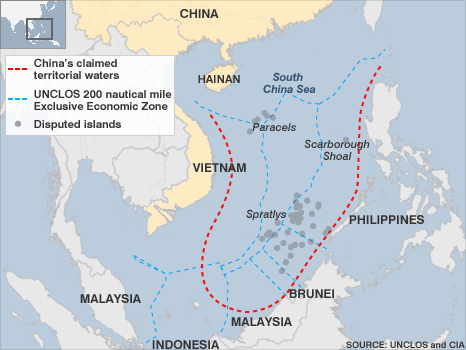
CMS is the most recent of these agencies, having been established in 1998. It is actually the police force for the Chinese Oceanic Administration, which is responsible for surveying non-territorial waters that China has economic control over (the exclusive economic zones, or EEZ) and for enforcing environmental laws in its coastal waters. The new program will expand the CMS strength from 9,000 to 10,000 personnel. CMS already has 300 boats and ten aircraft. In addition, CMS collects and coordinates data from marine surveillance activities in ten large coastal cities and 170 coastal counties. When there is an armed confrontation over contested islands in the South China Sea, it’s usually CMS patrol boats that are frequently described as “Chinese warships.”

October 10, 2012

Is “national security” just another term for “protectionism”

Filed under: Business, Cancon, China, Government, Technology — Tags: , , , — Nicholas @ 10:16

Daniel Ikenson at the Cato@Liberty blog:

Chinese telecommunications companies Huawei and ZTE long have been in the crosshairs of U.S. policymakers. Rumors that the telecoms are or could become conduits for Chinese government-sponsored cyber espionage or cyber attacks on so-called critical infrastructure in the United States have been swirling around Washington for a few years. Concerns about Huawei’s alleged ties to the People’s Liberation Army were plausible enough to cause the U.S. Committee on Foreign Investment in the United States (CFIUS) to recommend that President Bush block a proposed acquisition by Huawei of 3Com in 2008. Subsequent attempts by Huawei to expand in the United States have also failed for similar reasons, and because of Huawei’s ham-fisted, amateurish public relations efforts.

So it’s not at all surprising that yesterday the House Permanent Select Committee on Intelligence, yesterday, following a nearly year-long investigation, issued its “Investigative Report on the U.S. National Security Issues Posed by Chinese Telecommunications Companies Huawei and ZTE,” along with recommendations that U.S. companies avoid doing business with these firms.

But there is no smoking gun in the report, only innuendo sold as something more definitive. The most damning evidence against Huawei and ZTE is that the companies were evasive or incomplete when it came to providing answers to questions that would have revealed strategic information that the companies understandably might not want to share with U.S. policymakers, who may have the interests of their own favored U.S. telecoms in mind.

It’s not just the United States, either: Canada is also getting wary of Huawei.

The Canadian government has said that it will be invoking a “national security exemption” as it hires firms to build a secure network, hinting that Chinese telco Huawei could be excluded.

The exemption allows the government to kick out of the running any companies or nations considered a security risk, which coming in the wake of the US report earlier this week labelling Huawei and ZTE as security threats, strongly indicates they’re out of the bidding.

Prime Minister Stephen Harper’s top media spokesman refused to say for sure whether the government had Huawei in mind when invoking the exemption.

“The government is going to be choosing carefully in the construction of this network and it has invoked the national security exception for the building of this network,” he said, according to the Calgary Herald.

October 6, 2012

Not all engineering degrees are equivalent

Filed under: China, Education, India, USA — Tags: , — Nicholas @ 11:20

In the Wall Street Journal, a comparison of university education in the US and in other countries:

Both India and China have intense national testing programs to find the brightest students for their elite universities. The competition, the preparation and the national anxiety about the outcomes make the SAT testing programs in the U.S. seem like the minor leagues. The stakes are higher in China and India. The “chosen ones” — those who rank in the top 1% — get their choice of university, putting them on a path to fast-track careers, higher incomes and all the benefits of an upper-middle-class life.

The system doesn’t work so well for the other 99%. There are nearly 40 million university students in China and India. Most attend institutions that churn out students at low cost. Students complain that their education is “factory style” and “uninspired.” Employers complain that many graduates need remedial training before they are fully employable.

[. . .]

The U.S. and the U.K. are ranked first and second, driven by raw spending, their dominance in globally ranked universities and engineering graduation rates. China ranks third and India fifth, largely on enrollment (Germany is fourth). The reasons for U.S. supremacy are clear: For one, it spends the most money on education, disbursing $980 billion annually, or twice as much as China and five times as much as India. It is also the most engineer-intensive country, with 981 engineering degrees per million citizens, compared with 553 for China and 197 for India.

American universities currently do a better job overall at preparing students for the workforce. The World Economic Forum estimates that 81% of U.S. engineering graduates are immediately “employable,” while only 25% of Indian graduates and 10% of Chinese graduates are equally well prepared. “Chinese students can swarm a problem,” a dean at a major Chinese university told us. “But when it comes to original thought and invention, we stumble. We are trying hard to make that up. We are trying to make technical education the grounding from which we solve problems.”

October 4, 2012

The zero-sum trading myth

Filed under: Business, Cancon, China, Economics — Tags: — Nicholas @ 09:44

In Maclean’s, Stephen Gordon decries the undying myth that if one party to a trade is benefitting then the other must be losing:

In The Myth of the Rational Voter, Bryan Caplan argues that the most important obstacles to implementing sound economic policies are not lobby groups or the ability of other special interests to influence politicians, but certain systemic, irrational beliefs of the electorate. This is hardly an encouraging conclusion, but if we needed any more evidence for at least one aspect of his thesis, the CNOOC-Nexen takeover is providing it.

One of the prejudices identified by Caplan is what he calls anti-foreign bias: “a tendency to underestimate the economic benefits of interaction with foreigners.” According to popular (mis)perception, dealing with foreigners is to be mistrusted: if they want something from us, then they must perceive some benefit from the exchange. And if foreigners are gaining, then Canadians must be losing.

September 25, 2012

Chinese Navy commissions first aircraft carrier, the Liaoning

Filed under: China, Military — Tags: , , — Nicholas @ 09:13

China’s first aircraft carrier has been commissioned under the name Liaoning (not Shi Lang as most earlier reports had stated). Chinese news agency Xinhua posted this report earlier today:

China’s first aircraft carrier was delivered and commissioned to the People’s Liberation Army (PLA) Navy Tuesday after years of refitting and sea trials.

Overseen by President Hu Jintao and Premier Wen Jiabao, the carrier was officially handed over by the navy’s main contractor, the China Shipbuilding Industry Corporation, at a ceremony held at a naval base in northeast China’s port city of Dalian.

President Hu, also chairman of the Central Military Commission (CMC), endorsed a PLA flag and naming certificate to Senior Captain Zhang Zheng, commanding officer of China’s first carrier, the Liaoning.

“Today will be forever remembered as China’s Navy has entered an era of aircraft carrier,” Zhang told Xinhua on the carrier’s flight deck.

“When I received the PLA flag from the President, a strong sense of duty and commitment welled up in my heart,” said Zhang who has served as commanding officer on the Navy’s frigate and destroyer.

The carrier, rebuilt from the Soviet ship Varyag, was renamed “Liaoning” and underwent years of refitting efforts to install engines, weapons, as well as a year-long sea trial.

BBC News has a series of photos of the Liaoning from purchase to commissioning:


Click to see full-size images at the BBC website

Earlier reports on the progress of the carrier (under the name Shi Lang) can be found here.

September 24, 2012

US Navy works with Chinese Navy ship for anti-piracy exercise

Filed under: Africa, China, Military, USA — Tags: , , , — Nicholas @ 09:07

This is an unusual arrangement, but it makes sense in the larger picture:

The U.S. Navy and the Chinese Navy conducted their first joint anti-piracy drill. A Chinese frigate (the 4,000 ton Type 54A Yiyang) and an American destroyer (the 8,200 ton Burke class Churchill) carried out several training operations over five hours. This included joint use of communications as well as boarding and onboard search procedures. This was done in the Gulf of Aden, off Somalia.

While there was some PR angle to this, the crews of the two ships did get a useful look at how the other side operates. More to the point, it was a useful drill in the event that Chinese and American warships found themselves dealing with the same bunch of Somali pirates. Both sides will distribute what was learned throughout their respective fleets.

All this is part of a trend. China is becoming more inclined to work with ships from other nations patrolling the pirate infested waters off Somalia. Earlier this year, for example, China, India, and Japan agreed to have their warships off the Somali coast coordinate operations to more efficiently protect civilian ships in the area. Chinese and Indian warships have been operating independently off Somalia, while Japanese ships have been operating with Task Force 151. Most warships on anti-piracy duty belong to TF 151. Most of the remainder work with EUNFS (European Union Naval Force Somalia). But some nations continue to operate independently, more or less. In these cases there is always some communication, coordination, and sharing of information with TF 151 and EUNFS.

September 19, 2012

Pakistan’s predicament

Filed under: Asia, Government, India, USA — Tags: , — Nicholas @ 07:58

Strategy Page outlines the nasty situation the Pakistani government finds itself in:

The Pakistani government has asked the U.S. government to stop publically demanding that Pakistan take action against the terrorist sanctuary in North Waziristan. Such public demands make it more difficult for Pakistan to act as such an operation would be jumped on by the Pakistani media as Pakistan taking orders from the United States. This is a deadly accusation in Pakistan, where decades of government enthusiasm for Islamic radicalism and hatred of the United States has made it impossible for a Pakistani government to have cordial relations with America. The way the local culture works in Pakistan, this attitude means America can be blamed for just about every problem in Pakistan. That would include the persistent poverty, corruption, bad government and constant threat of another military coup. Pakistan means, literally, “Land of the Pure” and that means it’s easy for Pakistanis to believe that their problems must be caused by some external force. The United States and India have been tagged as the cause of Pakistan’s problems for so long that it’s simply not acceptable for any Pakistani politician or media outlet to describe the source of Pakistan’s problems any differently. Actually, there are a growing number of politicians and media outlets who are questioning the traditional attitudes towards the U.S., India and the personal responsibility of Pakistanis. Alas, such heretical opinions can still get you killed and many such Pakistanis emigrate or keep silent. In Pakistan, politics is very much a contact sport.

[. . .]

Pakistan has actually been sponsoring terrorist groups for decades but has so far managed to avoid admitting it. Those efforts are failing now that the U.S. and India have been pressing Pakistan more energetically to shut down terrorist operations in its territory. The recent U.S. designation of the Haqqani Network (based in North Waziristan and long under the not-so-subtle protection of the Pakistani military) as an international terrorist organization has annoyed Pakistan a great deal. For decades, it’s been no secret in Pakistan that Haqqani has government sponsorship. But the official position of the Pakistani government was that Haqqani either didn’t exist or had no government recognition or support. The U.S. presented compelling evidence to the contrary, which was another way of calling several decades’ worth of Pakistani officials liars. This designation means the Americans will now prosecute government and non-government organizations working with Haqqani. The Pakistani government knows this means specific individuals and organizations within the Pakistani government as well as banks and other commercial organizations. The U.S. prosecutors have proved to be quite relentless since September 11, 2001 and the Pakistani nightmare is retired military and intelligence officials being arrested while vising Europe or the Americas. Suddenly, the world is a more dangerous place for many Pakistani officials and businessmen who worked with Haqqani over the years. Likewise, India won’t let up on pressuring Pakistan to shut down Islamic terror groups based in Pakistan that are continuing to support Islamic terrorism in India. Pakistan has officially shut down 43 terror groups (all but two of them since September 11, 2001), and that includes 14 so far this year. But the U.S. and India point out that most of these groups simply disband and reform under another name and continue to be left alone by the Pakistani government.

September 15, 2012

Malaysia working on its “homosexual problem”

Filed under: Asia, Liberty, Religion — Tags: , , — Nicholas @ 10:43

From the Guardian:

The Malaysian government has begun holding seminars aiming to help teachers and parents spot signs of homosexuality in children, underscoring a rise in religious conservatism in the country.

So far, the Teachers Foundation of Malaysia has organised 10 seminars across the country. Attendance at the last event on Wednesday reached 1,500 people, a spokesman for the organisation said.

“It is a multi-religious and multicultural [event], after all, all religions are basically against that type of behaviour,” said the official.

The federal government said in March that it is working to curb the “problem” of homosexuality, especially among Muslims who make up over 60% of Malaysia’s population of 29 million people.

According to a handout issued at a recent seminar, signs of homosexuality in boys may include preferences for tight, light-coloured clothes and large handbags, local media reported.

[. . .]

Official intolerance of gay people has been on the rise. Last year, despite widespread criticism, the east coast state of Terengganu set up a camp for “effeminate” boys to show them how to become men.

H/T to Christopher Taylor for the link.

« Newer PostsOlder Posts »

Powered by WordPress