
Rob Henderson coined the fantastically useful phrase “luxury beliefs”, and regularly points out examples of people expressing beliefs that allow them to virtue signal at little or no cost, yet if the ideas were implemented would harm those not as privileged as the speaker:

New York City mayor Zohran Mamdani, 10 February 2024.
Photo by Kara McCurdy via Wikimedia Commons.
In a recent New York Times interview, Zohran Mamdani, New York City’s socialist mayor, struggled to define “working class”.
At one point he was asked point-blank, “How do you define the working class?”
Mamdani replied, “I think if you have to work to pay your bills, I think that that is one definition of being a part of the working class”.
After some pushback from the interviewer, Mamdani said he would draw the line at “about a million dollars a year”. I have no idea how he can say that without any embarrassment, but that’s why he’s a politician and I’m not. Say what you will about him, but the man knows his base. These are the people who claim to be the champions of women yet — and please forgive what has now become a hackneyed line — can’t define what a woman is, and they claim to be the champions of the working class, yet can’t define what the working class is. Or they redefine both terms to be so expansive that they could potentially encompass just about everyone.
This is where the luxury belief class has steered us.
Anyone who isn’t a millionaire gets to be working class now. It sounds absurd but that’s where we’re at now. Remember during the primaries in 2015, Bernie Sanders said that “the millionaires and the billionaires” need to pay their fair share? At some point over the past decade, he dropped “millionaires” because he became one. Now you see the millionaires condemning only the billionaires. Mark my words, at some point in the not-too-distant future, you will see the billionaires disparaging the trillionaires. Maybe inflation will hasten that phenomenon.
Anyway, in that Mamdani interview, the focus on defining class by money is revealing.
People often conflate social class with economic class. This allows us to talk about the former while pretending we are talking about the latter.
It is easier to discuss income than educational pedigree, accent, hairstyle, clothing, taste, or zip code.
But education usually signals social class more clearly than income does.
Research has found that parental educational attainment is the most important objective indicator of social class. This is because, compared with parental income, parental education is a more powerful predictor of a child’s future lifestyle, tastes, and opinions. If your parents went to college but you didn’t, you’re still middle-class or higher. Not working class.
Education shapes habits, networks, and outlook long after the degree is earned. Higher education bestows cultural capital: patterns of speech, tastes, opinions, and expectations about life. Income may rise and fall over a lifetime. The worldview formed in selective institutions usually endures. By that standard, college graduates, regardless of earnings, are not working class.
Education also shapes political views more strongly than income does.
In 2021, Ezra Klein pointed out that “We tend to think of class as driven by income” but that “A high school dropout who owns a successful pest extermination company in the Houston exurbs might have an income that looks a lot like a software engineer’s at Google, while an adjunct professor’s will look more like an apprentice plumber’s. But in terms of class experience — who they know, what they believe, where they’ve lived, what they watch, who they marry and how they vote, act and protest — the software engineer is more like the adjunct professor.”
Plainly, a PhD who takes a job driving a taxi will tend to vote like other PhDs, not like other taxi drivers, especially if he or she also has a parent with a college degree.
It was so much easier to recognize the British classes, at least back in the 1960s that is:
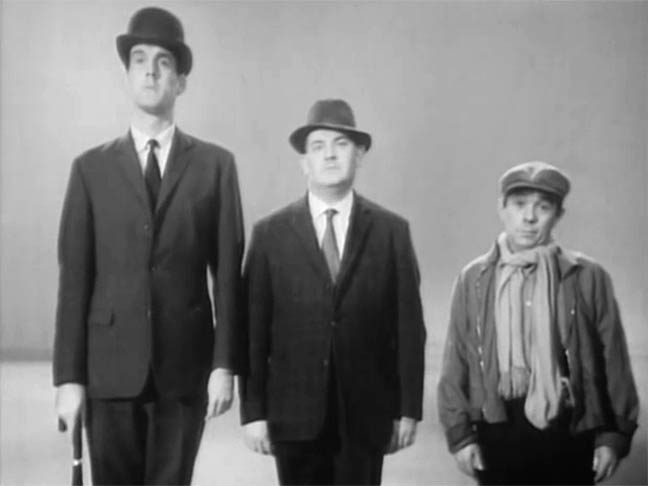
John Cleese, Ronnie Barker, and Ronnie Corbet as the avatars of the British upper, middle, and lower classes
Original version from The Frost Report, 7 April 1966.


