
On Substack Notes, Lorenzo Warby links to a fascinating discussion about the ongoing struggle between the UK government’s Ofcom and the US-based 4chan and their legal representatives, saying “The totalitarian wannabes currently running the UK do not apparently grasp that the American Revolution and War of Independence was a thing. Also, being totalitarian wannabes, they have no sense of humour.”

A UK cabinet minister, Rt. Hon. Liz Kendall MP, Secretary of State for the Department of Science, Innovation and Technology (“DSIT”), discussed the infamous “hamster e-mail” I sent on behalf of my client 4chan to the UK’s Internet censor, on national radio today in the UK. […] My father always told me, when I was growing up, “when a cabinet minister holding the technology policy brief for a G7 Member State is talking about your e-mailed jokes to an audience of millions on national broadcast media, that is the right time to explain the joke, especially if the cabinet minister didn’t get the joke”.
That explanation follows.
The backstory – Hamster #1
The hamster joke has a bit of a history to it. Ofcom, the UK’s Internet censor, first made contact with my American client 4chan in June of 2025 in its attempt to impose British censorship law on that website. I was subsequently retained as defense counsel, pro bono.
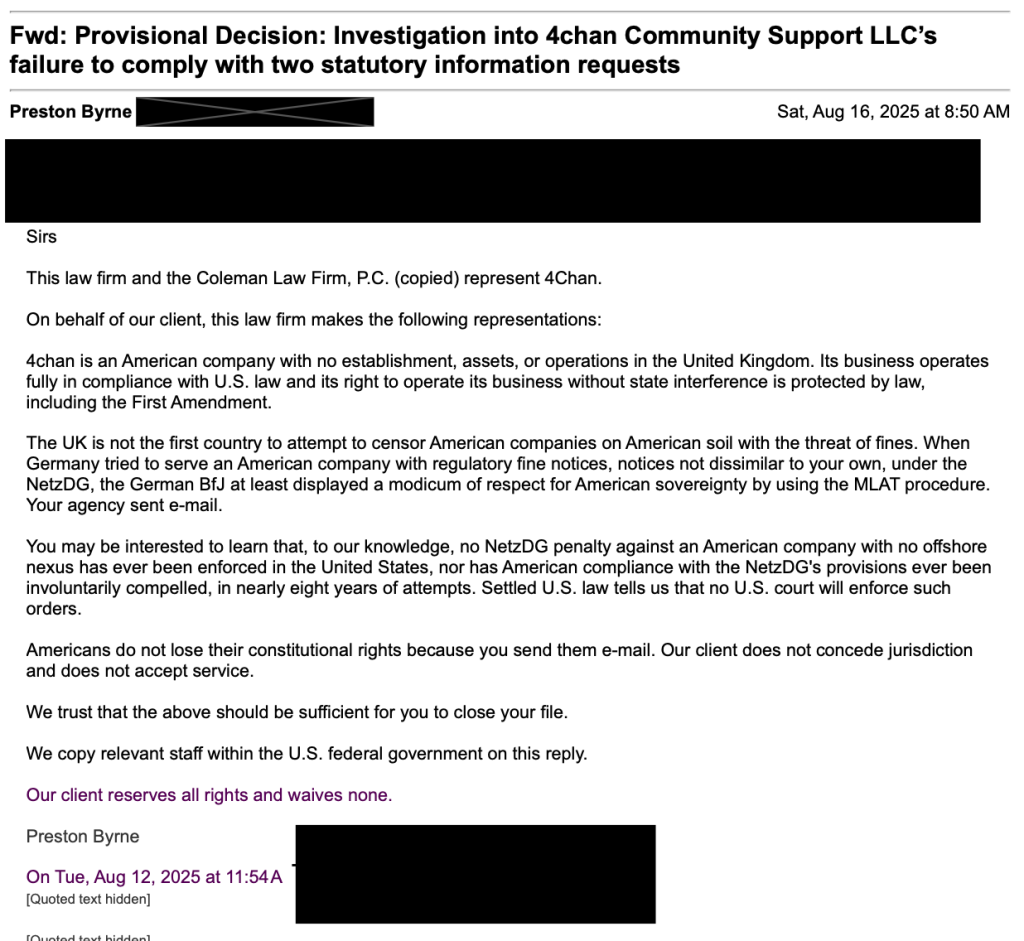
Ofcom then “provisionally fined” 4chan on August 16th, 2025 for refusing to obey the UK’s censorship regime. We were invited to make representations to the regulator following that provisional fine decision.
We did two things in response to that. The most newsworthy response was to file a lawsuit against the regulator in the DDC. Before that, however, we explained our position to Ofcom in writing and gave them an opportunity to walk away:
To wit, Ofcom’s fine notices were not properly served and were not enforceable in the United States. Note that we also gave Ofcom fair notice that while this might have been their first attempt to enforce their censorship orders in America, this was not our first rodeo when it came to successfully refusing such orders.
No quantity of officious and haughty foreign demand letters will change our stance. The UK could even pass a bill of attainder – historically Parliament’s most extreme and powerful legislative weapon – against my client, for all I care. My client’s right to operate its service lawfully in the United States is protected by the First Amendment. There is no law Parliament could enact that would change that fact.
I am very familiar with how this movie ends, and it does not end with 4chan paying Ofcom’s fine.
It may end with the UK’s censors getting a blocking order that it serves on its own ISPs; that would be the UK visibly censoring its own people, rather than censoring my client, and doing so ineffectively, at that, as ISP blocks can be circumvented with a VPN. That is a consequence my client is prepared to accept.
England might have the Online Safety Act, but the United States has the U.S. Constitution. These rulesets do not override each other; they are, rather, mutually exclusive. In America’s domain, the Online Safety Act essentially doesn’t exist. It has about as much legal force as a pile of shredded paper one might use to line a hamster’s cage.
Peace was always an option here, but that would have required the UK to abandon the fiction that its rules override the U.S. Constitution on U.S. soil, which we are not prepared to accept.
My clients did not start this fight, but by golly we do intend to finish it.
My client sued Ofcom two weeks later.
There’s much more, so do read the whole thing.


