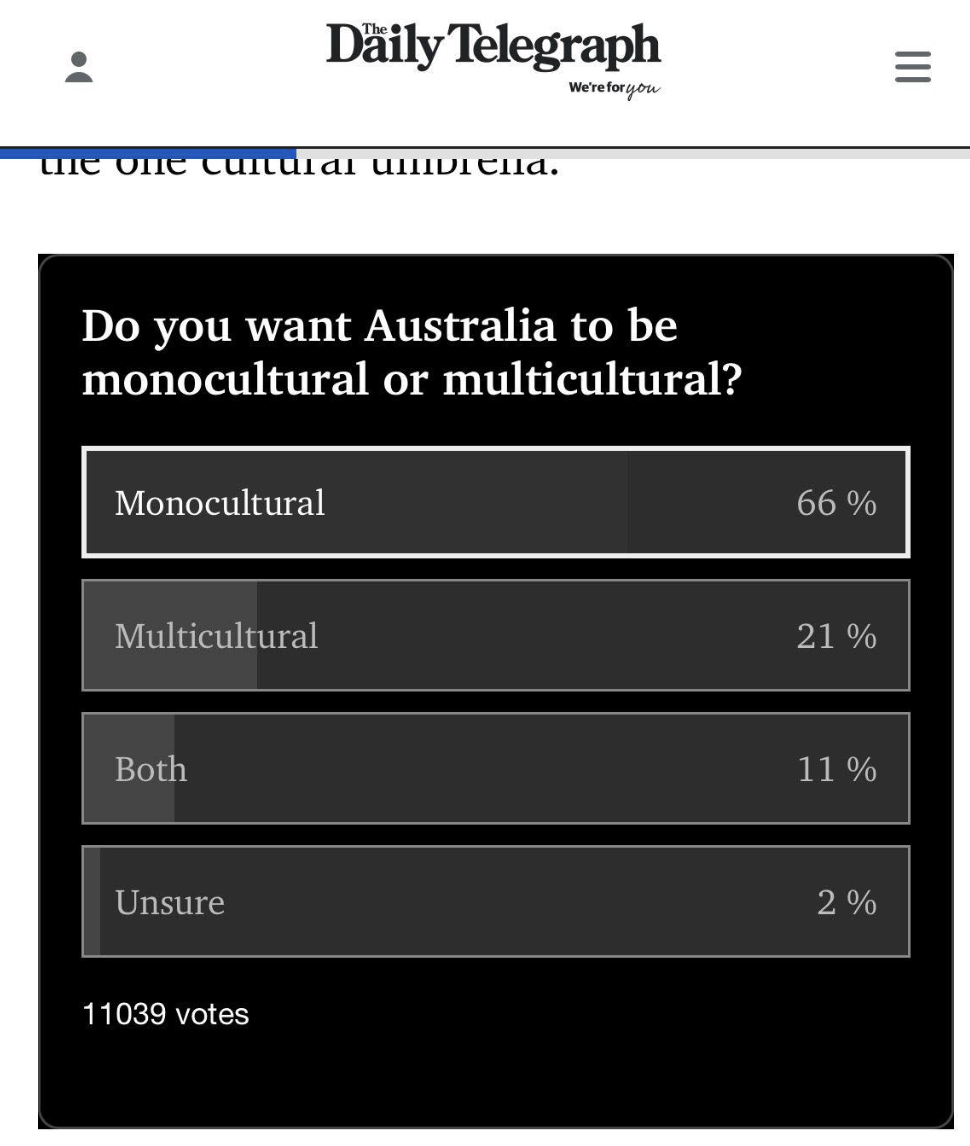
Australia, like the rest of the Anglosphere (with the notable exception of the United States) has adopted multiculturalism as a secular national religion, yet all is not well Down Under, as Celina illustrates:
Pauline Hanson’s National Press Club address last week has thrust the conversation of multiculturalism back into the centre of Australian politics. With One Nation now the most popular party in the polls, her pledge for a “monoculture” is no longer being pushed into the fringes. Yet, as it stands One Nation doesn’t really have any concrete policy on how to abolish multiculturalism.
Firstly, we must distinguish what is meant by multiculturalism in relation to politics. Multiculturalism is not just the presence of different cultural practices in Australia. That is a deliberate straw-man. “Abolish multiculturalism and you lose your Bah mi or Chinese takeaways” is a lazy reductionism pushed by people who are either stupid or as a sarcastic question from the left about the lack of One Nations ability to provide actual policy.
Multiculturalism, as it operates in Australia, is the institutionalisation of minority ethnic and religious lobbying. It is a system in which governments treat organised ethnic, religious and minority identity-based groups as permanent stakeholders with privileged access to policy-making. These groups receive taxpayer funding, sit on advisory bodies, submit formal recommendations, and see their priorities turned into law on hate speech, anti-discrimination, social cohesion and diversity policy. The broader Australian public is expected to accept the resulting consensus.
The Machinery That Actually Exists
Australia maintains a Minister for Multicultural Affairs, an Office for Multicultural Affairs inside the Department of Home Affairs, an Australian Multicultural Council, and a Ministerial Forum on Multicultural Affairs. States have their own legislation: the Multicultural NSW Act, Victoria’s Multicultural Victoria Act, South Australia’s Multicultural Act, Queensland’s Multicultural Recognition Act and others. They create recurring funding streams, annual reporting obligations, advisory councils and grants programs that sustain an entire ecosystem of peak bodies, settlement providers and advocacy organisations.
Commonwealth multicultural grants run into tens of millions annually. Additional streams exist for “social cohesion”, security upgrades for specific communities and settlement services. Peak bodies such as the Federation of Ethnic Communities’ Councils of Australia (FECCA), the Executive Council of Australian Jewry (ECAJ), the Australian Federation of Islamic Councils (AFIC) and the Hindu Council routinely prepare submissions, appear before inquiries and maintain ongoing relationships with ministers and bureaucrats. Personnel overlap between federal and state advisory structures is visible and recurring.
This is what political scientist Theodore Lowi called “interest group liberalism“.1 Lowi’s insight was that the pluralist system does not represent the public interest but rather rewards whichever organised groups can gain access to the machinery of government. The democratic problem is that the state has granted specific groups a structural position that ordinary, unorganised citizens do not enjoy. This results in something called mobilisation of bias, as coined by E.E. Schattschneider. described this form of power as the “mobilisation of bias“, where “some issues are organised into politics while others are organised out“.2,3
- https://en.wikipedia.org/wiki/Interest_group_liberalism
- https://www.powercube.net/analyse-power/forms-of-power/hidden-power/
- (2011). “Mobilization of bias”. In K. Dowding (Ed.) Encyclopedia of power (pp. 424-424). SAGE Publications, Inc., https://doi.org/10.4135/9781412994088.n234