
There are few Canadian companies who’ve done more to trash their own reputation than Tim Hortons over the last decade or so. What used to be everyone’s coffee chain of choice, through breathtaking abuse of the Temporary Foreign Worker scheme and other shady employment practices, has now become one of the most detested companies in the land. Everyone I’ve talked to seems to have their own Tim Hortons anecdotes, and none of them are complimentary to the firm or its largely non-Canadian workforce. Last week, Dunkin’ Donuts announced that they would be re-entering the Canadian market and suddenly Tim Hortons claims they’ll be hiring a whole bunch of Canadian workers to staff their restaurants:



If you believe yesterday’s announcement that Tim Hortons plans to dial back its use (and clear abuse) of the Temporary Foreign Worker Programme (TFWP) to hire “10,000 people locally” out of the goodness of its heart, I have a below-sea-level basement apartment to sell you in Richmond, B.C.’s peat-based Delta soil.
Let’s start with the obvious: If those 10,000 positions suddenly exist now, they never should have been outsourced to begin with. And yet, Tim Hortons spent the better part of a decade lobbying the Canadian federal government to increase and maintain workforce percentage caps that directly impacted thousands of positions, and influenced the entirety of the Canadian labour market.
Rather than ever lobbying for a specific number of individuals (because, again, they didn’t have an actual need when the market was showing a perpetual 20+ percent youth unemployment rate), Tim Hortons and its parent company, Restaurant Brands International Inc., instead lobbied to manipulate the overall percentage (or cap) of TFWs allowed per restaurant. During supposed “pandemic-era shortages”, they successfully massaged wilful dupes in government to increase that cap, allowing up to 30 percent of a restaurant’s workforce to consist of TFWs.
When the federal government finally cut the cap back down to 10 percent to curb immigration numbers, Tim Hortons heavily lobbied through 2024 and late 2025 to raise the limit back to 20 percent or 30 percent. Up until yesterday, they argued that rural and remote franchises continued to face severe labour shortages.
What they actually face is competition from Dunkin’ Donuts, with the popular American coffee chain set to break ground on its first Canadian locations in 2026, under a plan to aggressively expand to 600-700 locations nationwide.
If one were to charitably take Tim’s sudden shift in labour strategy at face value, this framing of yesterday’s announcement from the Globe and Mail might be enough to let bygones be bygones.
Tim Hortons was one of the biggest proponents of the TFWP, a controversial immigration stream that expanded in popularity during the pandemic and came to symbolise some of the failings of the Trudeau-era immigration strategy.
Restaurant Brands International Inc., Tim Hortons’ parent company, is also pledging to stop lobbying the federal government to expand the TFWP, citing the high youth unemployment rate.
But the devil, they say, is in the details; in this instance, in the lack thereof. That “10,000 people locally” includes foreign students, and TFWs already in the country, with both groups still on active and expired permits in the millions.
And that’s just the start: graduates on Post-Graduation Work Permits (PGWP), and individuals under the International Mobility Program (IMP) do not require a Labour Market Impact Assessment (LMIA). Meaning a single restaurant could be staffed almost 100% by temporary visa holders, but if those employees are international students or PGWP holders, Tim’s corporate metrics classify them as “local hires”, not TFWs.
That also means Tim’s supposed “cap” on TFWs was never an inherently honest number.
Corporate cynicism is nothing new, but Tim Hortons’ hiring practices have effectively replaced tens of thousands of part time jobs for Canadian teens with full- and part-time jobs for foreign students, temporary foreign workers, asylum seekers, illegal immigrants, visa-overstayers, and any other kind of cheap and exploitable employee who can be depended upon to meekly accept whatever working conditions are on offer with minimal chance of anyone appealing to health inspectors or federal regulators. Very convenient for Tim Hortons and their franchisees. Not very Canadian, but very convenient.
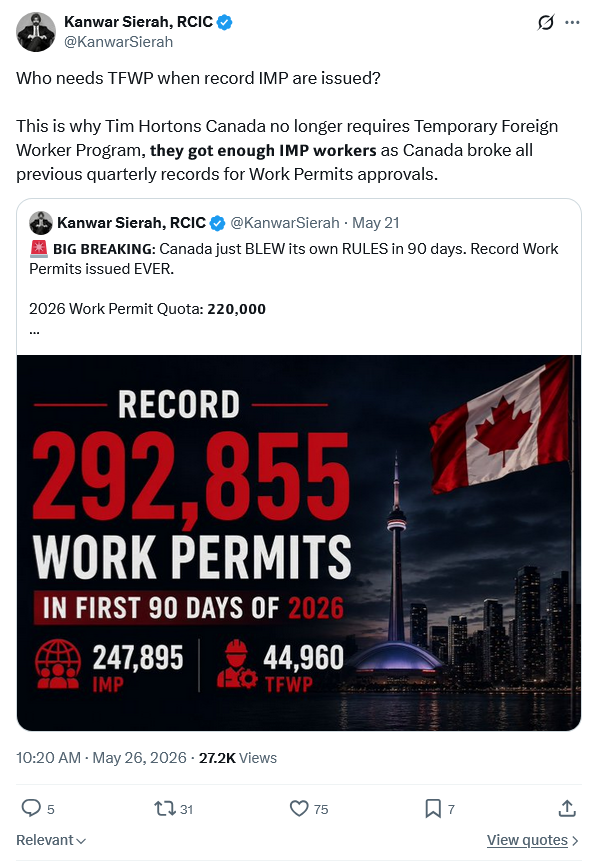
Update: Perhaps another reason that Tim Hortons is backing away from the TFW designation is that the government has given them an even easier way to hire foreign workers:
Mark Carney is lying to you.
In the first 90 days of 2026, Canada issued 292,855 work permits, smashing the full-year target of 220k–230k.
247,895 under IMP (International Mobility Program)
44,960 under TFWP
Why employers love the IMP:
It’s a much cheaper, faster, and easier alternative to the TFWP.
Key Financial & Practical Benefits of IMP (vs TFWP):
No LMIA required → Saves $770+ per worker (no $1,000 LMIA fee)
No mandatory job advertising to Canadians
Much faster processing (weeks vs months)
Lower compliance costs — only $230 employer fee
Fewer obligations around housing, wages, and recruitmentMore flexible permits for workers (easier to retain staff)
This is exactly why companies like Tim Hortons and many in hospitality/retail have shifted heavily to IMP workers. It’s faster, cheaper, and bypasses most of the strict labour market tests required under the TFWP.
That would seem to explain Tim Hortons’ sudden change of heart rather more than the risk of increased competition by a revived Dunkin’ Donuts expansion.


