
Warfare is fundamentally about breaking the enemy’s will to fight. This can be done with violence, or without it – before the fight even starts, through raw intimidation. Working from this understanding, military theorists have divided the history of warfare into five generations.
First Generation Warfare, abbreviated 1GW, was war as it was waged from the dawn of civilization up through roughly the Civil War. This style of conflict involved massed line infantry, equipped with spears, pikes, swords, or line-of-sight ranged weapons such as longbows, crossbows, or muskets. The basic tactic was to draw up two large groups of armed men, bring them into close contact, and have them hack at one another until one side grew demoralized by the slaughter, at which point their line would break and the real slaughter could begin.
Industrial or Second Generation Warfare (2GW) brought rifled firearms, machine-guns, and indirect artillery. Men could now be killed at a great distance, without ever seeing the enemy. Camouflage, concealment, and cover became the keys to victory. Its heyday was roughly from the Civil War to the Great War.
Mechanized warfare or 3GW arrived with the internal combustion engine and powered flight. Tactics now depended on speed and manoeuvrability. It dawned with the Second World War and reached its apogee with the invasion of Iraq.
Mechanized warfare created an overwhelming advantage for large industrial states. Small states and non-state actors responded with 4GW, which can be thought of as televisual warfare – combat via propaganda. This is war as fought with cameras and media distribution networks. It is guerrilla warfare via weaponized morality: using the enemy’s own military actions against it by showing the consequences of war for one’s civilian population to the enemy civilian population. Bait the enemy into killing babies, then ask them how many more babies they’re willing to murder. Think Vietnam, Afghanistan, Iraq.
The response to 4GW is 5GW – warfare by psyop, utilizing misinformation and sentiment engineering. Its characteristic weapons platform is the social network. Where 4GW seeks to use the enemy’s own morality against it, 5GW seeks to change that morality, to transform the enemy’s inner nature, getting the enemy to attack themselves for you, to surrender with open arms and smiles on their faces … ideally, without the enemy even realizing that they’re under attack.
John Carter, “Political Conflict in the Age of Psychic Warfare”, Postcards From Barsoom, 2024-03-01.
August 10, 2025
QotD: The “generations” of warfare
August 9, 2025
Carney hints at backing away from Trudeau’s digital policy catastrophes
Michael Geist on the possibility that Prime Minister Mark Carney is starting to recognize just how damaging to Canadian interests the previous government’s various online bills have been:

Digital policies did not play a prominent role in the last election given the intense focus on the Canada-U.S. relationship. Prime Minister Mark Carney started as a bit of a blank slate on the issue, but over the past few months a trend has emerged as he distances himself from the Justin Trudeau approach with important shifts on telecom, taxation, and the regulation of artificial intelligence. Further, recent hints of an openness to re-considering the Online News Act and heightened pressure from the U.S. on the Online Streaming Act suggests that a full overhaul may be a possibility.
This week’s decision to let the CRTC’s decision on wholesale access to fibre broadband networks stand is a case in point. Last November, the Justin Trudeau-led government sent the CRTC’s initial ruling back to the Commission for reconsideration, noting that it “has concerns about future and ongoing investments in broadband infrastructure and services in Ontario and Quebec, including in rural, remote and Indigenous communities, and concerns that those investments could, if they are unprofitable, lead to a decline in quality and consumer choice in the retail Internet services market”. Nine months later, the CRTC came back with the roughly same ruling. That led to yet another request for a cabinet review but this time the government stood by the CRTC despite significant industry opposition. New leader, dramatically new approach.
The CRTC is example was preceded by the decision to eliminate the digital services tax. While the strategic approach seemed misguided – dropping the DST should have garnered more than just an agreement from the U.S. to return to the bargaining table – some noted at the time that perhaps Carney wasn’t a supporter of the DST and had few qualms with rescinding it. The tax had been a foundational part of the government’s campaign to “make web giants pay” but in a matter of 72 hours in late June it was gone.
The government has also shifted its approach on AI regulation. After months of supporting Bill C-27 and the EU-style AI regulatory approach, a new government brought a new minister and a new approach. Evan Solomon, the newly installed AI and Digital Innovation Minister, used his first public speech as minister to pledge that Canada would move away from “over-indexing on warnings and regulation” on AI. That too represents a significant shift in approach, particularly since Trudeau had embraced the EU style regulatory model.
Then there is the Online News Act and Online Streaming Act. When asked about the Online News Act this week, Carney seemed to suggest he was open to change, stating “this government is a big believer in the value of … local news and the importance of ensuring that that is disseminated as widely and as quickly as possible. So, we will look for all avenues to do that.” While that isn’t a clear commitment to change, it is far from an ironclad commitment to legislation is viewed by many to have done more harm than good. Further, reports indicate that the U.S. Congress is escalating pressure to rescind the Online Streaming Act, which may put that law on the chopping block, particularly if a court appeal strikes down elements of the bill or the CRTC’s implementation of the law puts the bill on the Trump radar screen.
Alert the non-crime hate incident police: soccer star proclaims pride in being English!
In Spiked, Obadiah Mbatang discusses a recent disturbing incident of a member of the Lionesses (England’s female national soccer team) saying something completely unacceptable to the great and the good:

So the Lionesses were victorious in the UEFA Women’s Euros, holding the title they won in 2022. England forward Chloe Kelly, who scored the decisive penalty in the final against Spain, declared after the match: “I am so proud to be English”.
To hear a sports star make such a simple and patriotic statement was, for most of us, a pleasant breath of fresh air. Just as refreshing has been the muted response to her declaration of national pride. In the week or so since, there have been no online campaigns denouncing Kelly’s views as “problematic”. This raises the question: is it just the Lionesses who are allowed to be patriotic?
Compare the response to Kelly’s post-match comment with the recent treatment of Courtney Wright, a 12-year-old schoolgirl from the West Midlands. A few weeks ago, she wore a Union Jack dress inspired by the Spice Girls to her school’s “Culture Day”, in which pupils were encouraged to “proudly represent their heritage”. Courtney, who had also prepared a speech celebrating Shakespeare and fish and chips, was put into isolation by her school and then sent home. Essentially, she was told it was unacceptable to express pride in being British.
What followed next gave us a fascinating, if depressing, insight into the online left. Aaron Bastani, co-founder of Novara Media, came out in defence of Courtney. “A white British person being proud of their country and its accomplishments does not make them racist”, Bastani said on X. “Either all groups get to celebrate identity and culture, or none.” Yet for striking a fair-minded and consistent approach, he was attacked by his largely left-wing audience.
One notable assault came from Eleanora Folan, who runs the hugely popular “Stats for Lefties” X account. Folan said celebrating British culture “literally does” make someone racist because “the concept of white ‘identity’ is inherently exclusionary and racist”, adding that “all of Britain’s ‘accomplishments’ were built on racism and imperialism”.
Now, I suspect Eleanora and many on the left would never say that Nigerians should view their heritage as “evil” because of the Biafran War and the anti-Igbo pogroms of the 1960s and 1970s. Does anyone on the left talk about King Ghezo’s determined efforts in the 19th century to maintain slavery, even as the British tried to stamp it out in his West African kingdom? Would they say that British people of Arab descent should be ashamed because of Arab slavery of Africans, which still persists to some extent today? Should British people of Rwandan Hutu descent be ashamed because of the Rwandan genocide? Of course not.
Admittedly, there is no shortage of right-wing whataboutery that uses the histories of other countries to avoid discussing the darker aspects of Britain’s past. But that is not what is going on here. Courtney’s treatment by her school, and those online leftists blasting her as racist, reveals that self-loathing oikophobia remains one of the dominant prejudices of the left.
Erma EMP36: External Form Factor of the MP40
Forgotten Weapons
Published 26 Mar 2025The German military began looking for a new submachine gun design in secret in the mid 1930s. There is basically no surviving documentation, but the main contenders appear to have featured: Hugo Schmeisser’s MK-36,II and Erma’s EMP-36. Today we are taking a look at one of two known examples of the Erma design at the VHU in Prague. Designed by Heinrich Vollmer, this is a plain blowback open bolt system chambered for 9x19mm. It is massively more complicated than such a simple design has any right to be, though. Elements like the tiny set screw holding together the recoil spring assembly and the detachable bolt face are, frankly, nutty to include in a prospective military design.
However, Vollmer’s design had a number of external design features that were deemed very desirably by the German military. The pistol grip and very compact underfolding stock were both admirable, and the muzzle rest system was also of interest (in a simplified form). Ultimately, the result of testing of the Erma and Schmeisser prototypes was a combination of their features into a hybrid design. The Erma provided the external form factor, and the Schmeisser contributed the internal mechanics for the MP38 and in turn MP40.
(more…)
QotD: The New Newspeak
I’ve read their explanation a few times and it seems to boil down to the idea that all people of African descent all around the world are somehow one single identifiable entity, while white and brown people are too diverse and variegated to be treated the same way. (The Times explains: “We’ve decided to adopt the change and start using uppercase ‘Black’ to describe people and cultures of African origin, both in the United States and elsewhere.”)
Given the extraordinary diversity of the African continent, and the vast range of cultural, ethnic, religious, and tribal differences among Americans of African descent — new immigrants and descendants of slaves, East and West Africans, people from the Caribbean and South America, and the Middle East — this seems more than a little reductionist. As Times contributor Thomas Chatterton Williams has noted, there are “371 tribes in Nigeria alone. How can even all the immigrants from Nigeria, from Igbo to Yoruba, be said to constitute a single ethnicity? Let alone belong to the same ethnicity as tenth-generation descendants from Mississippi share-croppers?” The point, of course, is to ignore all these real-life differences in order to promote the narrative that critical race theory demands: All that matters is oppression.
Andrew Sullivan, “China Is a Genocidal Menace”, New York, 2020-07-03.
August 8, 2025
Debunking the idea that Japan was about to surrender anyway
Dr. Robert Lyman on the common misunderstanding of Japan’s situation in July and August of 1945 — no, they weren’t “on the brink of surrender so atomic bombing was unjustified” … instead, they were intending to make the assault on the Home Islands the biggest bloodbath ever:
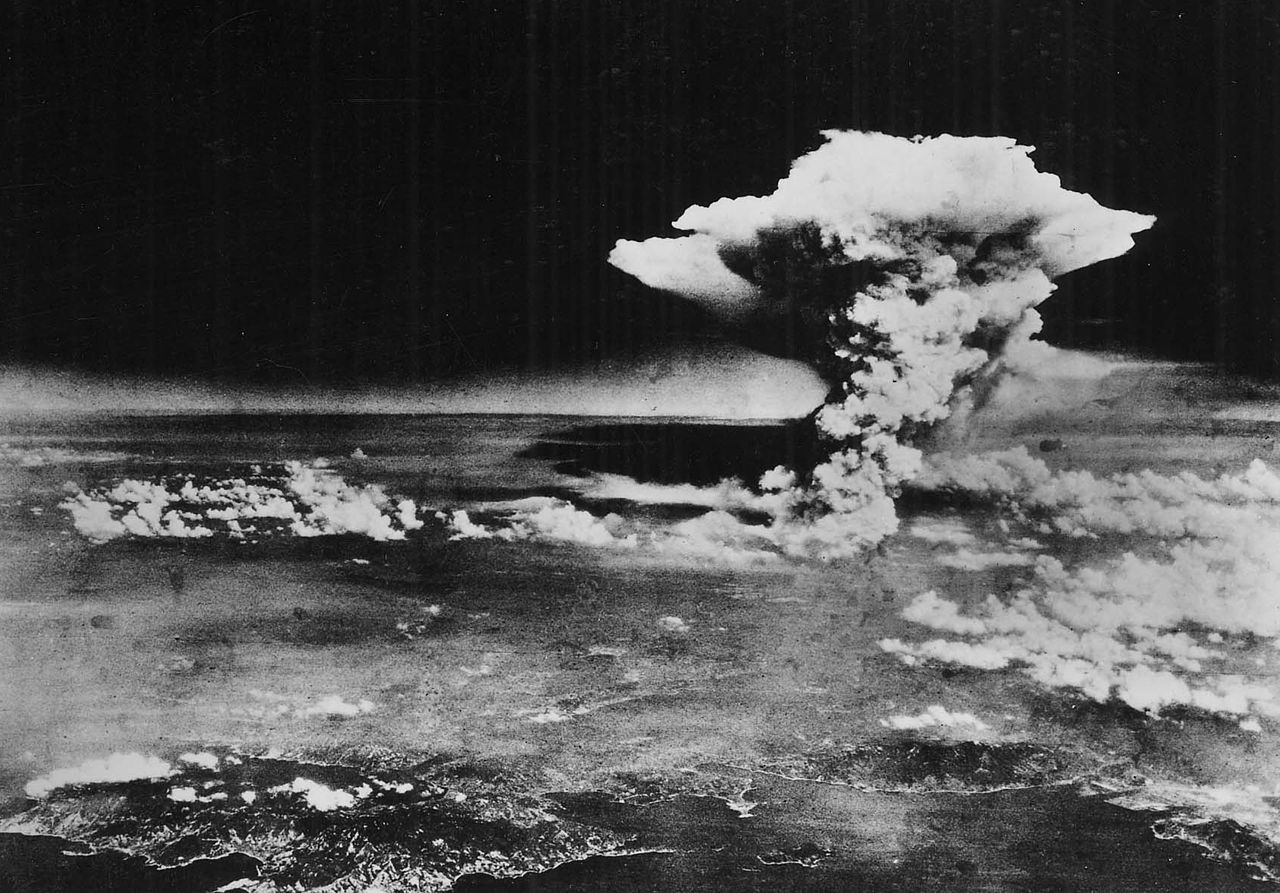
Atomic cloud over Hiroshima, taken from “Enola Gay” flying over Matsuyama, Shikoku, 6 August, 1945.
US Army Air Force photo via Wikimedia Commons.
It’s the anniversary of Hiroshima again today. I wasn’t going to write anything to mark the event (more coming next week on VJ Day), but I’ve been triggered already by nonsense on the radio which suggests that the atomic bombs on Hiroshima and Nagasaki were unnecessary, because Japan was about to surrender.
Nonsense. There is not a shred of real evidence to support this idea. In fact, the evidence that Japan wanted to keep on fighting is irrefutable. And yet this lie persists, despite the deluge of scholarly work demonstrating Japan’s commitment to the ritual suicide of its entire nation right until the end, when Hirohito pulled the plug. If you are in any doubt about the facts of the case, as opposed to the propaganda, read Toland’s Rising Sun (1970), Frank’s Downfall (2001), Spector’s In The Ruins of Empire (2007), Pike’s Hirohito’s War and, more recently, Stewart Binn’s Japan’s War (2025). All are excellent, clear, analytical and well researched. There are lots more, too.
Why does this canard keep on popping up? Is it because people don’t read? Or is it that they just don’t want to believe in the necessity of such a dramatic event to force Japan to surrender and thus bring about an end to the greatest man-made tragedy the world has ever suffered? The origins of this wishful myth in fact derives from hard right nationalist propaganda in post-war Japan (driven by Admiral Suzuki himself), quickly lapped up by the gullible and wishful thinkers in the West. Its one of the most enduring of the Hiroshima and Nagasaki myths, in part because it seems palatable to many, and because it is inherently anti-American.
What is the real story? In short, the Allies tried hard to persuade Japan to surrender. They demonstrated unequivocally to Japan that it was going to lose the war by defeating its armies and by beginning the long, slow and painful crawl towards the Japanese home islands. All the books I’ve mentioned note the extreme chaos of Japanese decision-making before and during the war. Who really was in charge? Who could one talk to, to secure a commitment to negotiate? In any case, the chaotic government under Koiso which replaced that of General Tojo following the fall to the Americans of Saipan in 1944, made not a single effort to engage with the Allies to seek terms. This government also collapsed on 5 April 1945. The replacement prime minister was Admiral Suzuki, and it was from this man that the myth seems to have arisen, after the war, that Japan was considering surrender and that the A-bombs were unnecessary. This is not true. During his entire time as Prime Minister he resolutely refused to do anything but continue to fight, unless the ending of the war could be secured on Japan’s terms. There were some initiatives to persuade the Suzuki government to surrender, but none of them amounted to much, because they didn’t engage directly with the government in Tokyo, and they didn’t derive from the Allied powers. The evidence that peace-feelers were being put out by various sources (such as the Vatican) in 1944 and 1945 is evidence only that the Japanese government ignored them. None were taken seriously in Tokyo.
Indeed, throughout the period of the Suzuki government, the war parties were dominant. In early June the military Supreme Command submitted a paper entitled The Fundamental Policy to be Followed Henceforth in the Conduct of the War, in which it demanded that the government confirmed that Japan would fight to the very last Japanese in an act of national suicide leading to the “honourable death of the hundred million”:
With a faith born of eternal loyalty as our inspiration, we shall – thanks to the advantages of our terrain and the unity of our nation, prosecute the war to the bitter end in order to uphold our national essence, protect the Imperial land and achieve our goals of conquest.
The proposition was passed, not unanimously, but overwhelmingly nonetheless.
There were some in the government – interestingly including Tojo himself – who saw that this was self-defeating, and that Japan must negotiate to secure acceptable peace terms. Naively, it was hoped that this would enable it to retain parts of its empire. Suzuki was part of this group who thought that Japan could negotiate favourable terms to end the war, in the form of a negotiated settlement such as that had brought about the end of the Russo-Japanese war in 1905, but when he suggested this in parliament on 13 June he was shouted down by the war mongers. Hirohito then endorsed an approach to the Soviets in late June. Bizarrely – though Moscow was neutral in the Far Eastern war at this point – Tokyo’s emissaries suggested that the USSR and Japan join forces to rule the world. It was yet more evidence of how Tokyo fundamentally misunderstood the world, and its enemies, and the way the war would have to end: complete and utter surrender by Japan.
Moscow, of course, scorned these “negotiations” as meaningless.
Germany’s Darkest Night Yet? – Rise of Hitler 21 – September 1931
World War Two
Published 7 Aug, 2025September 1931: Berlin descends into chaos as Nazis unleash a violent pogrom on Jewish New Year — while the police stand by. The scandal of the Kurfürstendamm riot rocks Germany, but the month’s headlines don’t stop there: Hitler’s niece is found dead under mysterious circumstances, France’s leaders visit Berlin to a frosty reception, and Japanese troops invade Manchuria. Extremists surge at the polls as democracy teeters — can the Republic survive?
(more…)
China’s short- to medium-term reaction to Trump’s tariffs
In Reason, Liz Wolfe outlines some of the reasons China has not been suffering under the tariffs President Trump has levied on them over the last few months (unlike, say, Canada):
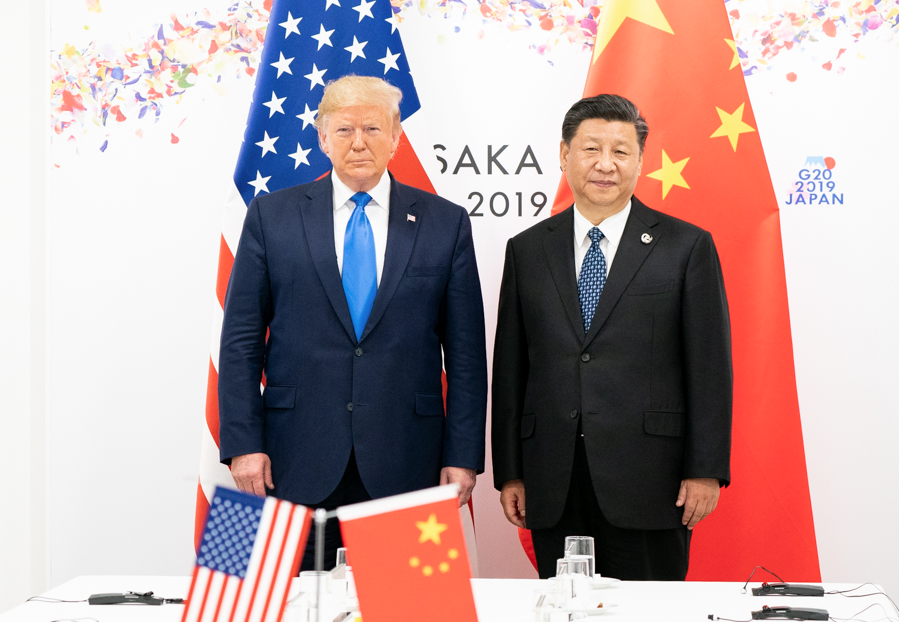
President Donald Trump and PRC President Xi Jinping at the G20 Japan Summit in Osaka, 29 June, 2019.
Cropped from an official White House photo by Shealah Craighead via Wikimedia Commons.
Total Chinese exports surged in July … but not to us. Compared to July 2024, Chinese exports were up 7.2 percent last month. “Its exports to Southeast Asia and Africa, key regions for reshipment to the United States, rose more than twice as fast as its overall exports”, per The New York Times‘ reading of the data. “China’s exports to the European Union, its main alternative to the American market, were also up very strongly.”
Specifically, “data released Thursday by the customs authorities showed the pickup was driven by strong growth in shipments to the European Union, Southeast Asia, Australia, Hong Kong and other markets, which more than made up for the fourth month of double-digit declines in US purchases”, reports Bloomberg.
Predictably, even the threat of tariffs has been enough to dampen trade. Remember, Washington and Beijing are still operating under a 90-day truce — set to expire on August 12, though it could be extended if a new agreement is reached — that holds off the imposition of higher tariff levels, namely, the tit-for-tat tariff increases that both countries had threatened. The truce also staves off export controls on certain critical rare-earth minerals and items that fall into the technology category. But still, current tariff levels mean a baseline 30 percent tariff on Chinese imports, which has been enough to depress trade.
For those in the Trump administration who are worried about trade deficits in particular, I suppose the good news is that we’ve made progress there: “For the last several decades, China has been selling as much as $4 worth of goods to the United States for each $1 of American goods that it buys”, reports The New York Times. Following China’s admission into the World Trade Organization, the trade deficit rose. Now, “tariffs have begun to reduce the imbalance. The United States announced on Tuesday that its overall trade deficit had narrowed in June to $60.2 billion, the smallest in nearly two years.”
It’s not clear why Trump administration officials, and the president himself, are so worried about trade deficits as something to eliminate for their own sake. We are dependent on Chinese goods to a rather substantial degree, which would pose a problem in the event of war with China (which is why the previous administration focused on improving our semiconductor manufacturing capabilities back in 2022). But you can just as easily make the case that it’s the vast volume of trade between the two countries — the deeply intertwined economies so reliant on each other (despite China’s claims of autarky and, more amusingly, communism) — that are incentivizing continued decent relations.
A few factors are at play that might help to explain why you likely haven’t felt a drastic increase in prices just yet. First, since there’s been a long lead-up to this trade war, many larger importers have stockpiled product over the last few months, so shortages haven’t been felt yet — they’ve just been selling off product they’ve been storing. Second, China has already managed to divert some stages of manufacturing to other countries—namely Vietnam — and some larger companies already have factories up and running in other Southeast Asian countries to avoid the “made in China” or “shipped from China” labeling. Expect more transshipping and manufacturing-locale creativity as a means of throwing customs officials off the scent.
The Rise and Fall of Books in Ancient Rome
toldinstone
Published 21 Mar 2025This video explores how books were published and distributed in ancient Rome.
Chapters
0:00 Introduction
0:30 Literacy and texts
1:19 Libraries
2:09 Scrolls and codices
3:13 Bookstores and booksellers
4:07 Helix
5:13 Publication
6:17 Luxury and vintage books
7:14 Bestsellers
8:10 The end of the book trade
QotD: Accelerating back towards bicamerality
This hypothesis seems to explain a few huge, otherwise perplexing facts of Leftist behavior. First: The further Left a person is, the more desperate xzhey are to put everyone else into one, and only one, category. Starting, of course, with themselves — I often joke that they’re trying to get their own bespoke “sexuality” so refined that no one else in the world could possibly share it. That would relieve them from the burden of ever actually having to be intimate — sexually or otherwise — with anyone. They can sit in the dark in their masks, eating bugs and watching Netflix, totally alone, forever.
I’m joking, but I’m not kidding. They really do seem to want that. And bicamerality explains it. I’ve also frequently likened them to the “zooanthrops” from The Book of the New Sun, from whence my stupid nom de blog comes. In that book, the literal end of the world was just around the corner — the sun, long expanded into a cool red giant, was about to go out, possibly within the current generation’s lifetime. Because of that, some people decided to “lay the burden of consciousness down” — they had themselves lobotomized and dumped in the woods.
Again, I’m joking, but I’m not kidding: Doesn’t that seem to be what so many on the Left really want? To be relieved of the burden of thought?
It applies even more so when they’re forced to interact with the world. We’ve all seen how desperate they are to shove people into one, and only one, box. Actually “desperate” is too mild a word — nothing frightens them more than the fact that a person can look one way, but actually be another way. It’s why they’re such slaves to fashion — literal fashion, not just fads trending on Twitter. Even before Der Hamsterkauf you could tell a Leftist just by looking at them, pretty much 100% of the time. Afterwards … well, we’ve all advanced a lot of explanations for why they’re so bizarrely insistent on the mask, especially for children: It’s their new purity ritual. They’re all chicks, and that’s the ultimate chick herd behavior. They’re just sadists. And so on.
But what if it’s as simple as The Mask relieves them, as nothing else can, from a significant source of interpersonal stress? “Interpersonal” again is too mild a word. They don’t want to “get to know you”. They don’t even want to talk to you. Hell, they don’t even want to share the same air with you, and do you see what I mean? Their “lives” would be so much better if we all had to wear colored patches on our jumpsuits, Dachau-style, telling everyone exactly what we are (exactly and only). Barring that, they’d love to reimpose some of the old medieval sumptuary laws — again, you will eat the bugs, because that’s what you deserve, peasant! But it’s not just that. It’s also a huge stress relief for them, to be able to tell a person’s social status at a glance.
Consider further (just briefly) how much a non-victim Victim fries their circuits. A gay conservative, say, or a pro-life woman, or a black “acting White” (your average liberal makes your average rapper look like a paragon of tolerance when it comes to that particular sin, though of course the liberal dresses it up in a thousand syllables of fugly jargon). Even though “the sex you’re attracted to” has no possible relationship to “your stance on the tax code”, the Left has made it so — first as a cynical political maneuver, but now because it minimizes their “interpersonal” (again, for lack of a better word) stress.
The tl;dr here is that your typical Leftist seems to spend all xzheir time in xzheir own head — always labeling, cataloging, frantically shoving everyone and everything into its own little box. But they do this, I think, because they know subconsciously that once they’ve got everything shoved into one and only box, forever, they’ll never have to think again … and that’s what they really want. A life of perfect unconscious bliss, where any “decision” that needs to get made comes from the blinking box.
Severian, “Striving Towards Bicamerality”, Founding Questions, 2022-03-20.
August 7, 2025
“The Beer Store seems to be going down faster than, well, a nice, cold beer”
In The Line Scott Stinson discusses the precipitous fall in the fortunes of Ontario’s former beer retail behemoth now that beer is available in — shock! horror! — grocery stores and even (gasp!) convenience stores:

“The Beer Store” by Like_the_Grand_Canyon is licensed under CC BY-NC 2.0


A major Ontario retailer announced last month that it would permanently close 20 locations in August. This follows the closure of 10 of its stores just over a week before that, and precedes the planned shuttering of 10 more locations in September.
What business could possibly be swooning this much? A general retailer pummelled by Amazon? An exporter battered by Trump’s tariffs?
Nope: Beer. Seriously. The Beer Store seems to be going down faster than, well, a nice, cold beer.
Welcome to the uniquely weird world of alcohol sales in the province of Ontario, where somehow selling beer has become a struggling business.
Some background is probably required, for those who, understandably, must think by this point that I am full of shit.
For ages the vast majority of Ontario’s beer sales ran through The Beer Store, a chain of 450-ish outlets that was co-owned by Canada’s largest brewers. You could also get beer at the provincially owned LCBO, but the largest size available there was a six-pack. That was it. This system was exceedingly unfriendly to consumers, but owing to our puritan roots and the fact that the brewers had excellent lobbyists at Queen’s Park, it remained that way through decades — and governments of all three major parties.
About a decade ago, the Toronto Star got its hands on one of the agreements between The Beer Store and the province, which revealed what a sweetheart deal it was getting. Among other things, the deal greatly restricted the degree to which the LCBO could compete in beer retail, which caused much frothing over the fact that The Beer Store, long since owned by multinational conglomerates, was getting preferential treatment over the province’s own booze outlet.
The Liberal government of the day responded by loosening The Beer Store’s stranglehold on beer retail, but just a little: allowing it to be sold at a limited number of grocery stores, a hilariously small step but one that in Ontario was nevertheless a great leap forward.
Doug Ford’s Conservative government had long wanted to expand alcohol sales much further, but always stumbled over the fact that The Beer Store had a deal that prohibited such expansion until 2026. But then Ford wanted to hold an election last spring and he convinced The Beer Store to let him break that deal a year early for $225 million, which always seemed like an awfully steep price to move up that expansion by what amounted to a number of months.
It’s only in recently, though, that it has become clear how spectacularly dumb that giant payment was in the first place.
The Arctic, strategically speaking
CDR Salamander suggests we tilt our globes (you have a globe on your desk, don’t you?) 90 degrees and consider the Arctic Ocean:
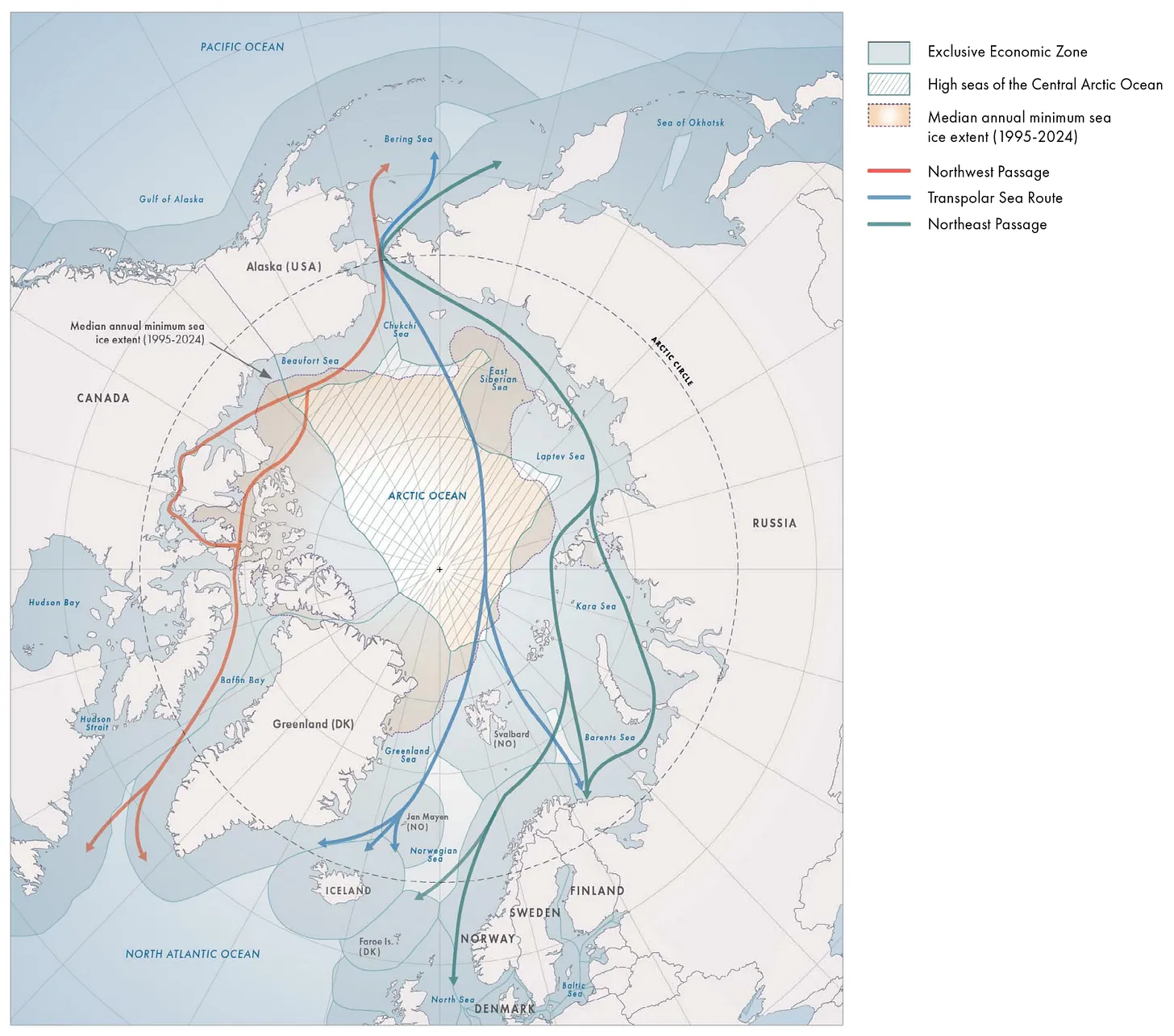
First things first, as it is the focus of the report, let’s go to the chart room and properly define the, “Central Arctic Ocean”.
There it is, the horizontally shaded bit outside everyone’s EEZ.
The chart comes from the report in question by RAND: The Future of Maritime Presence in the Central Arctic Ocean.
Before we dive in — and the Front Porch knows exactly where I am going here — I need to point out again what we see at the very top where all the red, green, and blue lines intersect. You can’t miss it, and it should have you screaming to whatever direction The Pentagon is from where you sit.
Yes kiddies, that is the Bering Strait, half of which is ours, and the other side is Russia. As you move from the Arctic into the greater Pacific or from the Pacific to the Arctic, you have to pass through that strait, and before it the American Aleutian Islands.
As we’ve covered here before, we have criminally avoided leveraging the blessings of the geography bequeathed to our nation, that of controlling both the inner and outer gates to the Arctic Ocean from the Pacific.
I should not have to explain to you the importance of the Arctic shores of Alaska to anyone. Challengers to the security of our resources in the north, both old and new, are back on the scene. We are a decade late in building a base at Nome and reactivating Adak. I covered that in a previous Substack linked in the prior sentence. Read it and come back if you need to catch up.
A weakness of much of the RAND report is, it is mostly based on stale talking points about immediate climate change in the Arctic, and questionably alarmist assumptions about the Arctic climate for the rest of the century, which seem more suited to the first Obama Administration, but put this to the side.
Should the climate in the Arctic mid-century trend towards the more ice or less, the simple facts remain — the competition in the Arctic is only increasing and the time to act on this new reality is now.
War Rationing on the Italian Home Front during WWII
Tasting History with Max Miller
Published 4 Mar 2025Dry, dense wartime version of a traditional chestnut cake with lemon zest and no sugar
City/Region: Italy
Time Period: 1942Food shortages in Italy began years before WWII broke out, and cookbooks that focused on food scarcity had been published as early as 1935. They included recipes for things like soup made from vegetable peels and, like this recipe’s cookbook, instructions for cleaning when soap was rationed.
Castagnaccio is a traditional Tuscan chestnut cake, and this sugarless version is, I imagine, a far cry from what it should be. The cake is very dry, then turns gummy when you chew it, and I definitely recommend having something to wash it down (though you should probably just make a non-wartime version). The flavor isn’t bad, and the lemon really comes through, but it could really use some kind of sweetener.
Chestnut flour cake (without sugar).
What a sweet and lucky surprise to find in your pantry, still in its bag, some chestnut flour which you had completely forgotten about (an incredible thing, indeed, in these times!). Well, such a surprising and lucky circumstance happened to me, in these days, and since you must immediately take advantage of every piece of luck, I…measured 200 grams of the sweet flour; I poured it in a small bowl; I added half a tablespoon of oil, a pinch of salt and only the grated yellow part of a lemon zest; I mixed everything with as much milk as needed (I would have used water if I didn’t have milk at home); I added a whole sachet of yeast; I mixed everything well again; I poured everything in an oiled cake pan; I put the pan in the oven (not too hot); and…when I saw that the cake was swollen and baked…when I put it on the table in front of my family…insatiable gluttons…when the cake was celebrated…
“how lucky we were, mom, since you forgot about the flour” (the kids);
“today’s sweet cake is truly delicious” (the husband);
“what a pity the cake is so small” (the servant girl in her mind)
“it’s lucky that I was able to find such a good remedy for my unforgivable forgetfulness” (me, in my heart).”
— 200 Tips for…these times by Petronilla, 1942
QotD: The lost-then-found-again Hittite civilization
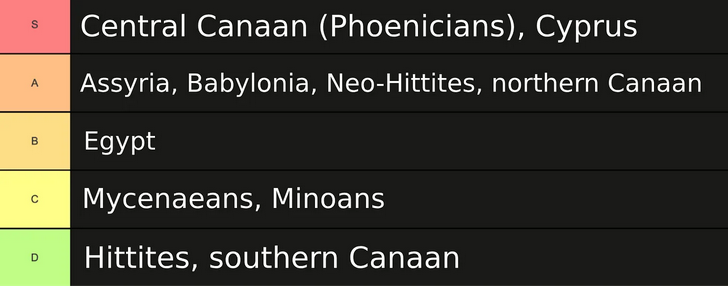
… Mycenaean Greece was as much an outlier as sub-Roman Britain: the civilizational collapse in the Aegean was unusually prolonged and severe compared to the fates of many of the other peoples of the Late Bronze Age. Here I have helpfully reformatted Cline’s chart of how resilient the various societies proved:
Let’s take a brief tour through the various fates of these societies. I’ll come back to the Phoenicians at the end, because their example raises interesting questions when considered in contrast with the Mycenaeans. For the moment, though, let’s begin like civilization itself: in Mesopotamia.
Before the Late Bronze Age Collapse, the Assyrian and Babylonian empires had numbered among the Great Powers of the age: linked by marriage, politics, war, and trade to the other mighty kings, they spent much of their time conducting high-level diplomacy and warfare. As far as we can tell, they did well in the initial collapse: there’s a brief hiatus in Assyrian royal inscriptions running from about 1208 to 1132 BC, but records resume again with the reign of Aššur-reša-iši I and his repeated battles with his neighbor to the south, the Babylonian king Nebuchadnezzar I (no relation). But although the kings of the late twelfth century continued much as their Bronze Age predecessors had — waging war, building palaces, going hunting, accepting tribute, collecting taxes, and ordering it all recorded in stone and clay — the world had changed around them. No longer were there huge royal gifts sent to and from fellow great kings, “My Majesty’s brother”1 overseas; now their diplomatic world consisted of tiny petty kings of nearby cities who could be looted or extorted at will.
Mesopotamia didn’t escape unscathed forever: beginning around 1080 BC, texts begin to record severe droughts, invading Aramaeans, and total crop failures. There was a major drought in 1060 BC, and then both the Assyrian and Babylonian records record further drought every ten years like clockwork — sometimes accompanied by plague, sometimes by “troubles and disorder” — until the end of the eleventh century BC. Most of the tenth century was equally dire, with chronicles recording grain shortages, invasions, and a cessation of regular offerings to the gods.
But unlike the Mycenaeans, and in spite of real suffering (ancient Babylonia is estimated to have lost up to 75% of its population in the three hundred years after the Collapse), both Mesopotamian empires were able to hang on to civilization. There were still kings, there were still scribes, and there were still boundary stones on which to record things like “distress and famine under King Kaššu-nadin-ahhe”. And when conditions finally improved, Assyria and Babylonia were both able to bounce back. When at last the Assyrian recovery began under Aššur-dan II (934-912 BC), for example, he (or more realistically, his scribe) was able to write: “I brought back the exhausted people of Assyria who had abandoned their cities and houses in the face of want, hunger, and famine, and had gone up to other lands. I settled them in cities and homes which were suitable and they dwelt in peace”. Clearly, Assyria still retained enough statehood to effect the sort of mass population transfer that had long been a feature of Mesopotamian polities.2
Over the next few centuries, the Neo-Assyrian Empire would come to dominate the Near East, regularly warring with (and eventually conquering) Babylon and collecting tribute from smaller states all over the region. At its peak, it was the largest empire history had ever known, covering a geographic extent unsurpassed until the Achaemenids. The Babylonians had to wait a little longer for their moment in the sun, but near the end of the seventh century they overthrew their Assyrian overlords and ushered in the Neo-Babylonian Empire. (Less than a century later, Cyrus showed up.)
So how did Babylon and Assyria hold on to civilization — statehood, literacy, monumental architecture, and so forth — when the Greeks lost it and had to rebuild almost from scratch? Unfortunately, Cline doesn’t really answer this. He offers extensive descriptions of all the historical and archaeological evidence for the diverse fates of various Late Bronze Age societies, but only at the very end of the book does he briefly run through the theories (and even then it’s pretty lackluster). He does have a suggestion about the timing — the ninth century Assyrian resurgence lines up almost perfectly with the abnormally wet conditions during the Assyrian megapluvial — but why was it the Assyrians who found themselves particularly well-positioned to take advantage of the shift in the climate? Why not, say, the Hittites?
Sometime around 1225 BC, the Hittite king Tudhaliya IV wrote to his brother-in-law and vassal, Shaushgamuwa of Amurru, that only the rulers of Egypt, Babylonia, and Assyria were “Kings who are my equals in rank”.3 A mere thirty years later, though, his capital city of Hattusa would lie abandoned and destroyed. Modern excavators describe ruins reduced to “ash, charred wood, mudbricks and slag formed when mud-bricks melted from the intense heat of the conflagration”.
And with that, the Hittites essentially vanished from history.
They were so thoroughly forgotten, in fact, that when nineteenth-century archaeologists discovered the ruins of their civilization in Anatolia, they had no idea who these people were. (Eventually they identified the new sites with the Hittites of the Bible, who lived hundreds of years later and hundreds of miles to the south, out of sheer ¯\_(ツ)_/¯.)4
What happened to the Hittites? Well, Cline suggests the usual mélange of drought, famine, and interruption of international trade routes, as well as a potential usurpation attempt from Tudhaliya’s cousin Kurunta, but the actual answer is that we’re not sure. Given the timing, they may have been the first of the Late Bronze Age dominos to fall; given the lack of major rivers in central Anatolia, they may have been uniquely susceptible to drought. Hattusa may have been abandoned before the fire — its palaces and temples show little sign of looting, suggesting they [may] already have been emptied out — but many other sites in the Hittites’ central Anatolian heartland were destroyed around the same time, and some of those have bodies in the destruction layer. But whatever the order of events, Hittite civilization collapsed as thoroughly and dramatically as the Mycenaeans’ had done, and with a similar pattern of depopulation and squatters in the ruins. Unlike the Mycenaeans, though, the Hittites would never be followed by successors who inherited their culture; the next civilization of Anatolia was the Phrygians, who probably arrived from Europe in the vacuum following the Hittites’ fall.
There was one exception: in the Late Bronze Age, cadet branches of the Hittite royal family had ruled a few small satellite statelets in what is now northern Syria, and many of these “Neo-Hittite” polities managed to survive the Collapse. A tiny, far-flung corner of a much greater civilization, they nevertheless outlasted the destruction of their metropole and maintained Hittite-style architecture and hieroglyphic inscriptions well into the Iron Age.5 (They would be swallowed up by the Neo-Assyrian Empire in the late eighth century BC.) And though the Neo-Hittite kings ruled over tiny rump states, we’re now able to translate inscriptions in which they referred themselves by the same titles the Bronze Age Hittite “Great Kings” had employed. The records of their larger neighbors, which had a much greater historical impact, seem to have followed suit: the Neo-Hittites in Syria probably actually were the Hittites of the Bible! Chalk up another one for nineteenth century archaeology.
Jane Psmith, “REVIEW: After 1177 B.C., by Eric H. Cline”, Mr. and Mrs. Psmith’s Bookshelf, 2024-07-08.
1. I really think we should bring back monarchs referring to themselves as “my Majesty”. So much cooler than the royal “we”. Or combine them: “our Majesty”!
2. The Babylonian Captivity, much later in the Iron Age, was far from historically unique.
3. The list actually reads, “the King of Egypt, the King of Babylonia, the King of Assyria,
and the King of Ahhiyawa” — the strikethrough appears in the original clay tablet! A generation earlier, under Tudhaliya’s father Hattusili III, the Hittite texts had consistently referred to the king of Ahhiyawa as a “great King” and a “brother”, but apparently the geostrategic position of the Mycenaean ruler had degraded substantially.4. We now know that the Hittites spoke an Indo-European language and referred to themselves “Neshites”, but the name has stuck.
5. I went looking for a good historical analogy for the Neo-Hittite kingdoms and discovered, to my delight, the Kingdom of Soissons, which preserved Romanitas for a few decades after the fall of the Western Roman Empire. The Neo-Hittites lasted a lot longer.
August 6, 2025
Actual data demolishes the “climate catastrophe” narrative
At The Conservative Woman, Paul Homewood summarizes the findings of a new report for the US Department of Energy:
A report by five independent, eminent scientists has blown apart the myth of catastrophic climate change, destroying the case for Net Zero in the process.
Judith Curry, Roy Spencer, Ross McKitrick, John Christy and Steve Koonin are all highly respected leaders in their respective fields. Their report was commissioned by the US Department of Energy (DOE) but written with no editorial oversight by the DOE and with no political influence whatsoever. Although it specifically covers the US, its findings have worldwide ramifications.
The 151-page report, A Critical Review of Impacts of Greenhouse Gas Emissions on the US Climate, reviews scientific certainties and uncertainties in how anthropogenic carbon dioxide (CO2) and other greenhouse gas emissions have affected, or will affect, the nation’s climate, extreme weather events, and selected metrics of societal well-being.
Maybe the most relevant part concerns extreme weather. According to the report: ‘Most extreme weather events in the US do not show long-term trends. Claims of increased frequency or intensity of hurricanes, tornadoes, floods, and droughts are not supported by US historical data. Additionally, forest management practices are often overlooked in assessing changes in wildfire activity. Global sea level has risen approximately 8 inches since 1900, but there are significant regional variations driven primarily by local land subsidence; US tide gauge measurements in aggregate show no obvious acceleration in sea level rise beyond the historical average rate.
A few graphs from the report tell the story, and you can see them at the end of this article.
- US landfalling hurricanes show no long-term trends, either in frequency or intensity;
- Heatwaves were much worse than now before the 1960s;
- Temperature extremes are reducing, as a greater number of extremely hot days is more than offset by fewer extremely cold ones;
- There has been a marked decline in the number of the strongest tornadoes, EF3 to EF5, since the 1970s. The increased numbers of weaker tornadoes is the result of better observation methods, including Doppler radar, not an actual increase;
- US droughts were much more severe for most of the historical record going back to 1895;
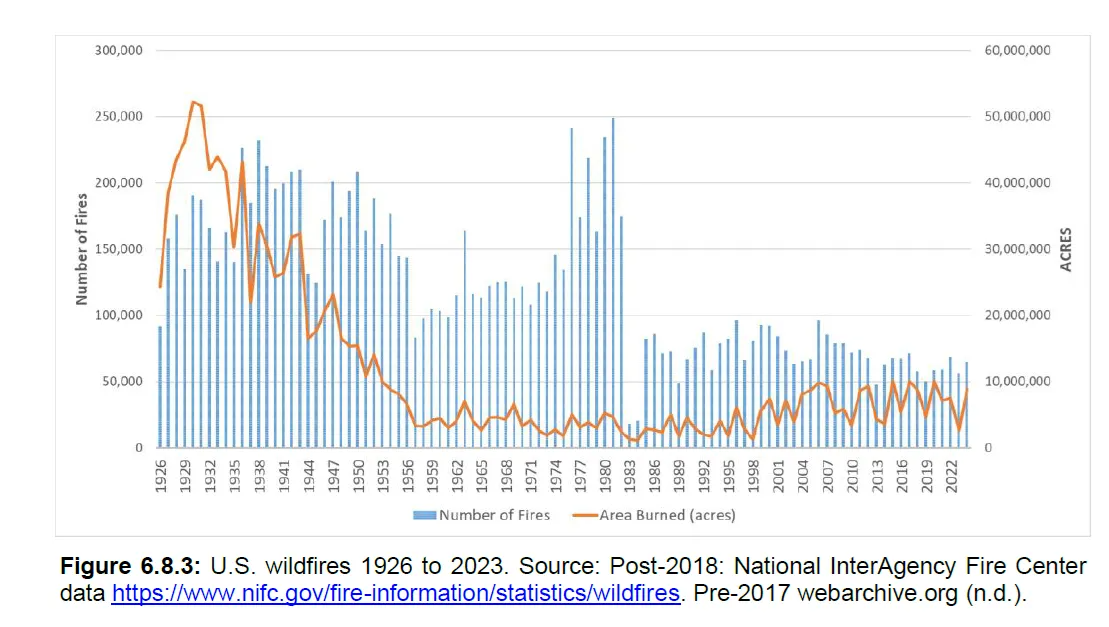
- While wildfire activity has marginally increased since the 1980s, it was considerably worse up to the Second World War. Most of these long-term changes are caused by fire management practices, not climate changes;
- Tide gauges all around the US show the same story – a slow and steady sea level rise beginning in the mid 19thC. The rate of rise can vary considerably from station to station because of local factors. New York and the rest of the Atlantic Coast, for example, has been subsiding since the Ice Age; Galveston is sinking as a direct result of groundwater withdrawals.
The scientists pour scorn on weather attribution computer models, which have become the media’s go-to source for climate apocalypse stories. These attribution models routinely claim that extreme weather events have been made more likely because of global warming. They are dismissed in the report, which highlights the lack of high-quality data and reliance on deficient climate models. Other scientists have not been so kind!


