
The Korean War by Indy Neidell
Published 5 Aug 2025The Kaesong peace talks keep dragging on, and where any demarcation line should be drawn continues to the biggest obstacle to progress. The war continues, though, and plans for new offensives and blockades are being hashed out. But who exactly are the forces fighting this war? This week we take a closer look at the Communist forces and the American chain of command.
Chapters
00:00 Hook
00:37 Intro
00:50 Recap
01:11 The 38th Parallel Issue
02:51 War Without Victory
04:58 US Chain of Command
09:21 Plans and Alternatives
10:58 UN Air Power
13:19 The Communist Forces
18:28 Summary
18:49 Conclusion
19:45 CTA
(more…)
August 6, 2025
The Korean War Week 59 – Who’s Really Running the Korean War? – August 5, 1951
Comments Off on The Korean War Week 59 – Who’s Really Running the Korean War? – August 5, 1951
Do journalists’ “unnamed sources” have to actually exist? Asking for an imaginary friend …
At The Rewrite, Peter Menzies discusses the growing trend of Canadian journalists depending on “unnamed sources” to fill in details in their political stories:
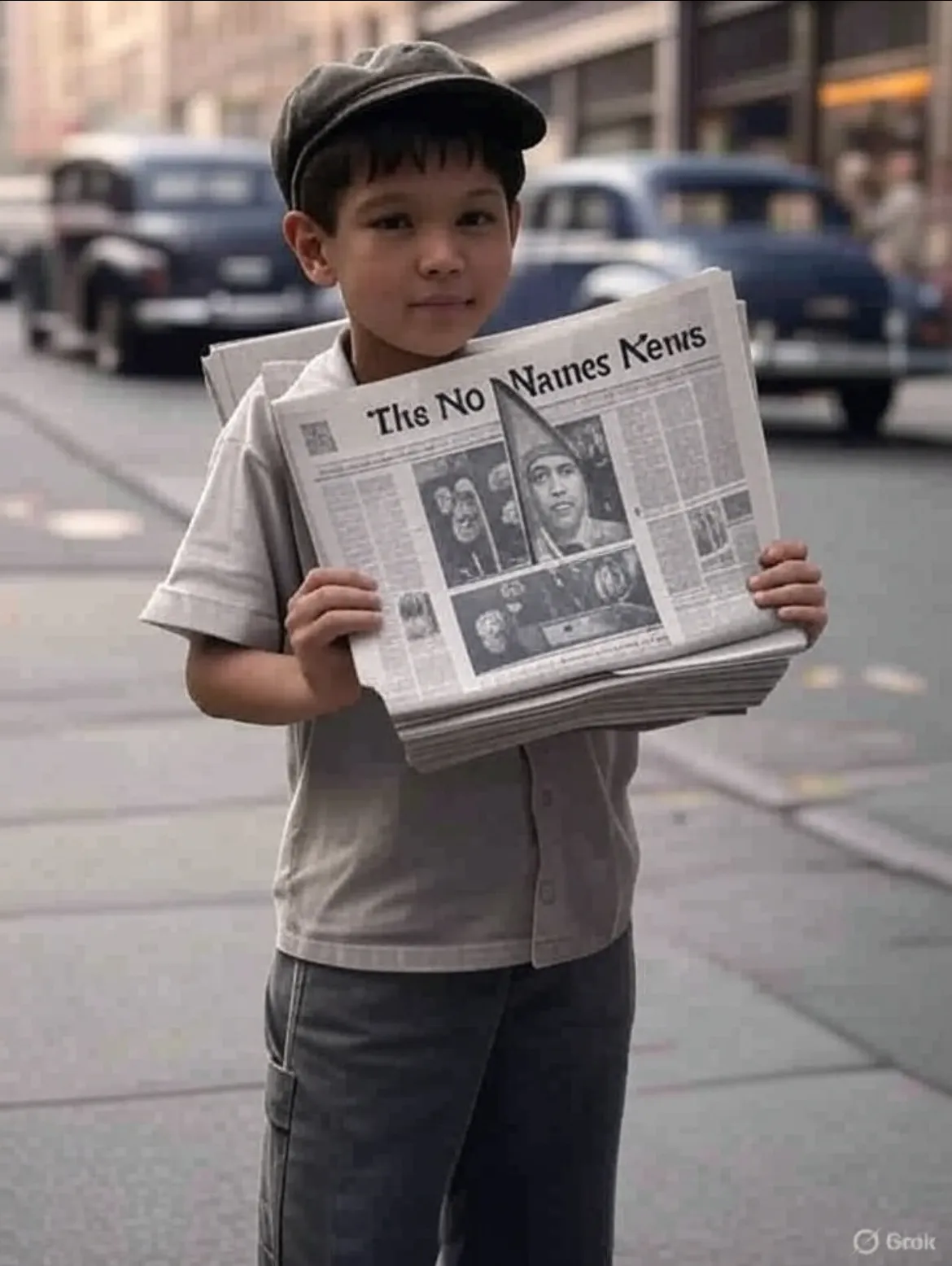
No name news image created by Grok, via The Rewrite
If I spun you a tale about my life as a mercenary in the 2012 Guinea-Bissau coup d’etat, I’d probably get your attention.
It would be a ripping good yarn, filled with evil masterminds, hints of Bond villains, precious relics, and blood diamonds. I might even sprinkle it with how I’d heard that the Ark of the Covenant is guarded quietly and stored in Nokolo-Koba National Park, not far from the Gambia River.
You might enjoy it. But I’m thinking you might ask for proof. Trust me, I would say, it’s not something I’m at liberty to discuss freely. Loose lips sink ships, these boys don’t like publicity, I’m not authorized, I wish to speak freely, etc. You’re going to have to put your faith in me.
Which, while I used hyperbole to make the point, is what the nation’s reporters are increasingly asking the public to do.
The once rare use of unnamed sources in the new “just trust me” world of Canadian journalism is getting out of control.
Exhibit A is a National Post story posted on May 23 in which readers learn of changes in the Prime Minister’s Office where staff are now expected to dress professionally and show up on time. In other words, a return to what most people would view as normal office decorum. Yes, you might wonder — as I did — why this constitutes news while the previous nine years’ shabbily-attired tardiness went unreported, but that would involve a significant digression. Another day, perhaps.
The sources were “half a dozen current and former PMO officials, senior bureaucrats and caucus members”, granted anonymity “to discuss internal workings of government openly”.
Two are “former” Liberal staffers, which makes one wonder if they might bear a grudge and what their motivations are. There is not a single named source in the story, nor is there any reference to the Post having asked the current management of the PMO for comment.
Exhibit B is the May 14 analysis on the pages of the Globe and Mail, which explains the thinking involved in selecting a finance minister. The thesis was based on “seven sources who have worked for Liberal and Conservative governments over the last two decades”, whose identities are being hidden “because they were not authorized by their parties to speak publicly about the federal finance minister”.
In Exhibit C, CBC/Radio Canada uses no fewer than 12 — count ’em — anonymous sources discussing whether party leader Pierre Poilievre should dismiss his chief of staff and recent campaign manager, Jenni Byrne. All were granted “confidentiality to discuss internal party matters”.
To his credit, the reporter selected sources offering a variety of perspectives on the issue. But still, other than reference to public statements by Poilievre, no one is on the record even for passive phrases such as “No one seems ready to make this their hill to die on”. Are there no political scientists left to comment on such topics?
Comments Off on Do journalists’ “unnamed sources” have to actually exist? Asking for an imaginary friend …
Schmeisser MK-36,II – The Mechanics of the MP40
Forgotten Weapons
Published 24 Mar 2025The German military began looking for a new submachine gun design in secret in the mid 1930s. There is basically no surviving documentation, but the main contenders appear to have featured: Hugo Schmeisser’s MK-36,II and Erma’s EMP-36. Today we are taking a look at the two known examples of the Schmeisser design at the British Royal Armouries. It is a simple blowback design with a full wooden stock, and chambered for 9x19mm (although the second example, made for Hungarian trials, is in 9x25mm). It does have a quite strange magazine safety, which prevents the bolt from opening if a magazine is not present — the purpose of this is a mystery to me.
The Schmeisser gun was simple and effective mechanically (expect for that weird safety), and it ultimately contributed its magazine, bolt, and fire control system to the MP38 and MP40 design. In exchange, the Haenel company that Schmeisser works for was one of the two initial MP38 manufacturers.
Many thanks to the Royal Armouries for allowing me to film and disassemble this unique prototype! The NFC collection there — perhaps the best military small arms collection in Western Europe — is available by appointment to researchers: https://royalarmouries.org/research/n…
You can browse the various Armouries collections online here:
https://royalarmouries.org/collection/
(more…)
Comments Off on Schmeisser MK-36,II – The Mechanics of the MP40
QotD: Modern English night life
There are few sounds more frightening than that of the English young enjoying themselves. The English, it was once said, take their pleasures sadly; but now they take them loudly, which is far, far worse. Their pleasures are brutish, and the sounds the men emit while experiencing them are indistinguishable from those of a mob indignantly beating someone to death. As for the women, they never speak but they scream, as if being chronically raped. Of course, they all have to raise the level of their vocalizations because there is the perpetual background throb and thump of background music, or para-music, turned up to maximum volume, so that the ground vibrates beneath you like a ripple bed in an intensive care unit.
Recently I stayed overnight in a charming small cathedral city in England, genteel by day and Gomorrah by night. It is a little like H.G. Wells’ story The Time Machine, set 3,000 years hence, when humanity has divided into two: the effete, gentle, vegetarian diurnal Eloi, and the ugly, vicious, carnivorous nocturnal Morlocks, who emerge from underground once the sun goes down and prey on the Eloi.
I had booked no place to stay until the last minute, and found only a room above a cavernous, darkened bar, for me an antechamber of Hell, where the Morlock youth of the cathedral city gathered to enjoy themselves — or at least to pretend to do so, for I have long thought that those who cannot enjoy themselves without shouting and screaming are really hysterics, trying to convince themselves that they are enjoying themselves when actually they do not really know how to do so.
Theodore Dalrymple, “Evening Above the Hell-Bar”, Taki’s Magazine, 2019-12-16.
Comments Off on QotD: Modern English night life
August 5, 2025
High tech and lust for power are a bad combination
Spaceman Spiff discusses the malign confluence of technocrats and amoral power-seekers (BIRM):

Today’s technocrats, assisted by billionaire tech bros, want to implement a digital surveillance grid that will eradicate any notion of anonymity or privacy forever.
Every major country, including the United States, is working on this with enthusiastic support from governments and their many agents.
The sales pitch is primarily platitudes about protecting people from harm, especially children.
What they seek is the end of the internet as it currently is, which means it will look a lot more like licensed corporate TV than the current free for all. From here their goal is to extend their surveillance operation into every aspect of our lives, from the energy we consume to the food we are permitted to eat.
This will probably cause a lot of damage, but it will ultimately fail.
Tech bro arrogance meets managerial control freakery
We are witnessing a partnership between the technocratic elite, with a limited understanding of technology, and silicone valley titans, who are blinded by the promise of technology.
Each group believes draconian surveillance systems combined with fancy data analysis will solve many societal problems and usher in a new era with them at the helm.
To the technocrats it promises full-spectrum control of all our choices. The food we eat, the material we consume, the ability to travel.
They are salivating at the thought of the ultimate control, the issuing of government-controlled digital currencies they can deactivate on a whim. No steak for the memelords, and no road trips for those without the right carbon profile.
They have been discussing these things for many years with a degree of enthusiasm bordering on mania.
The technologists see a chance to keep in with the powerful, to join the club. If they can be the trusted partner of the visionaries currently wrecking our world they will cash in and perhaps be spared from the concentration camps.
The technologists have powerful tools that promise amazing things. Machine learning, predictive programming, behavioural modelling.
Spotting patterns within trillions of data points is appealing to society’s tinkerers, all the better to predict problematic behaviours and to spot trends. Combined with nudge units and related horrors of social engineering this promises to be the holy grail for a technocratic managerialist regime absolutely convinced it can steer society in enlightened directions, just like they imagine they did during Covid.
It is all very futuristic, and it has clearly impressed our technology gurus as well as those who love control.
But along with the outsized data stores will come outsized cockups they cannot properly plan for.
Climate modelling has promised immense benefits and accuracy for decades and we have yet to see a single successful prediction. Indeed, some of the most famous climate predictions are almost comically wrong but nonetheless trigger endless rounds of funding, chatter, conferences and hubris. Such is the lure of anything that can be adapted to enforce top-down social control.
There have been many attempts to harness technology to predict the stock market, another obvious target. None of them worked either. It doesn’t seem to matter. No one is checking the track record. It is sold on its promise and that works because of who is buying. Or, rather, the type of person who embraces these schemes.
Digital surveillance, digital currencies, digital voting, digital IDs. Everything we do tracked and stored. Such absolute total control would make our superiors into gods as they exploit these powerful tools to direct us towards better versions of ourselves.
There is a delusion at play here. Those closest to this seem lost in their fantasies. They are blind.
Comments Off on High tech and lust for power are a bad combination
Inside the CIA Coup That Changed Iran Forever! – W2W 38
TimeGhost History
Published 3 Aug 2025In 1953, a battle for Iran’s soul erupts on the streets of Tehran. Prime Minister Mosaddegh defies British oil interests, outwits Soviet intrigue, and faces down the Shah — but a secret Anglo-American plot changes history forever. As coups, street mobs, and betrayal plunge Iran into chaos, the nation’s fragile democracy is crushed and a brutal new order rises. This is the untold story of oil, espionage, and the coup that reshaped the Middle East.
(more…)
Comments Off on Inside the CIA Coup That Changed Iran Forever! – W2W 38
Will the courts take away Tariff-master Trump’s favourite toy?
President Donald Trump’s second term in office has been dominated by his capricious and seemingly random deployment of tariffs as a bludgeon to intimidate and coerce America’s allies and enemies alike. In Reason, J.D. Tuccille considers the possibility of the courts taking away the one tool Trump has been using to get his own way in trade negotiations:
Everybody with a brain knows that tariffs are taxes. And they know that tariffs imposed on goods imported to the United States are largely paid by American businesses and consumers. The big question is whether tariffs unilaterally imposed by President Donald Trump under creative interpretations of emergency executive powers will withstand a federal court challenge. So far, the signs are promising for those hoping that a law intended to rein in the power of the presidency will not be read to permit the president to set trade policy of his own accord.
As CBS News reported this week, the U.S. Court of Appeals for the Federal Circuit in Washington, D.C. heard “oral arguments on Thursday in V.O.S. Selections v. Trump, a case brought by five small business owners and 12 states who allege they have been harmed by President Trump’s import taxes. V.O.S., the lead plaintiff in the case, is a New-York based wine importer.”
Representing the plaintiffs is the free-market Liberty Justice Center, along with co-counsel Ilya Somin, a law professor at George Mason University’s Scalia Law School. The plaintiffs are challenging the Trump administration’s invocation of the International Emergency Economic Powers Act (IEEPA) as the basis for the “Liberation Day” tariffs on much of the world as well as related tariffs on Mexico, Canada, and China.
A Law Intended To Trim Presidential Power, Not Expand It
The plaintiffs maintain that “under that law, the President may invoke emergency economic powers only after declaring a national emergency in response to an ‘unusual and extraordinary threat’ to national security, foreign policy, or the U.S. economy originating outside of the United States. The lawsuit argues that the Administration’s justification — a trade deficit in goods — is neither an emergency nor an unusual or extraordinary threat.”
What’s interesting is that Congress passed IEEPA not to expand presidential power, but to restrict it. According to a 2024 Congressional Research Service report, “following committee investigations that discovered that the United States had been in a state of emergency for more than 40 years, Congress passed the National Emergencies Act (NEA) in 1976 and IEEPA in 1977. The pair of statutes placed new limits on presidential emergency powers”. Under these laws, presidents are required to assess emergencies on an annual basis, extend them if necessary, and report on their status to Congress.
“Some experts argue that the renewal process has become pro forma“, the report acknowledges. “History shows that national emergencies invoking IEEPA often last nearly a decade, although some have lasted significantly longer — the first state of emergency declared under the NEA and IEEPA, which was declared in response to the taking of U.S. embassy staff as hostages by Iran in 1979, is in its fifth decade.”
Comments Off on Will the courts take away Tariff-master Trump’s favourite toy?
Origin of the China-Taiwan Conflict: Chinese Civil War 1945-1949
Real Time History
Published 21 Feb 2025With the Japanese surrender in September 1945, the Second World War comes to an end. But for China there won’t be peace right away because the nationalists under Chiang Kai-Shek and the communists under Mao Zedong still haven’t resolved their struggle and so the Chinese Civil War will flare up once again.
Chapters:
00:00 Japanese Surrender
03:44 Opposing Forces
07:33 KMT Offensives
12:18 CCP vs KMT Strategy
14.45 CCP Counterattack
19:19 Civilian Experience
23:23 CCP Huaihai Campaign
26:30 Final CCP Offensives
29:31 KMT Escape to Taiwan
31:59 Why did the Communists Win?
36:07 The United States and Taiwan
(more…)
Comments Off on Origin of the China-Taiwan Conflict: Chinese Civil War 1945-1949
QotD: Fighting a Middle Republic Legion
As you approach the velites, they scatter back to their lines and now the first real trial comes: when you are about twenty meters out from the enemy line, a storm of those heavy pila come in, thick and all at once. Each one masses around 1.3kg (just short of three pounds) so even if the tip doesn’t bite, one of these things clanging off of armor or a shield is going to hurt, the impacts stagger men near you as you struggle to keep formation (and for a Hellenistic army, get and keep those sarisa-points down). The impact of the massed volley, especially against close-order infantry with tight fighting-width, is going to be chaotic as some men are killed, others disabled, still more suddenly staggered. The volley is followed almost immediately by the on-rush of the hastati. These guys don’t have a long spear for keeping you at a distance, they’re all brandishing swords and aim to get in close, using their large body-shields to absorb any blows you might throw while they get right up in your face, where their swords can stab and slash viciously over or under your shield. These hastati are aggressive and they’re probably better armored than you are.
And of course an engagement in contact like this is unpredictable. Perhaps in some areas, your lines push forward, whereas in other places it bends back. For large maneuver units (like taxeis!) this can be a real problem, but Roman maniples are small, so one maniple can advance if it finds the opportunity while others hold position or are even forced back (we actually see a general give, essentially, an “advance at your own discretion” order at Pydna, Plut. Aem. 20.8).
After a short and terrifying experience – these moments of shock combat probably didn’t last all that long, perhaps as little as just a few minutes – the hastati fall back. The front of your line is already physically and mentally exhausted. Many men are wounded and certainly some have been killed or disabled. I don’t want to oversell the casualties aspect of this: armies don’t annihilate each other in stand-up engagements (instead more casualties happen in pursuit), but wounds and exhaustion matter. Latin has this phrase, of being confectus vulneribus, “exhausted by wounds” or perhaps “worn down by wounds” (Liv. 24.26.14, 31.17.11, Caes. BGall. 5.45) to describe how the accumulation of a lot of little wounds can sap soldiers of their ability to resist effectively, even if no one wound is lethal. And just as important, all of the emotional impetus of your initial attack is spent. And there’s a decent chance that, as you try to breath, you still have these light velites‘ javelins (the hasta velitaris) thudding into your line every few seconds, because – again – they carry seven of them. They’re not out.
And then, as you are getting your bearings, trying desperately to catch your breath, the principes come up. They’re not physically tired or emotionally exhausted, but eager (like you were a half an hour ago when you advanced), they’ve been waiting all this time. Worse yet, these are probably the most combat-effective soldiers the Romans have, in the prime of their life, with years of combat experience. Now the second volley of pila comes in, creating yet more chaos. And then more angry, heavily armored Romans, behind their big shields, stabbing and cutting with their deadly gladii.
Now the men at the back of your single line may be relatively fresh, but you have no real way to get them to the front, so the wrath of the principes falls on men who are already exhausted, already wounded, already tired and already out of fight. Your line isn’t advancing so stridently; the men in the back, if the formation is deep, don’t know why the advance is slowed, why the line seems to be wavering, only that it seems to be wavering. And meanwhile, everyone is hoping that, at any moment, the victorious cavalry on the flanks is going to show up and win the battle, but they can’t see it anywhere in the confusion. Maybe your cavalry has won and is moments away – or perhaps Antiochus III charged it off the field again and no help is coming. Or perhaps the enemy cavalry has tied it up or worse yet, the Romans’ highly skilled Numidian allies might have mastered the flanks. You have no idea, you only know that help isn’t here, you are tired and more Romans are upon you. And somewhere, the thin thread of human courage snaps, either from the exhausted men in front or the confused men behind and the formation begins to collapse.
As the collective defense of lapped shields or serried pikes gives way, the Romans are now truly in their element: their large shields function just fine in individual combat and their versatile swords do as well. Lead by their centurions, the principes, with practiced and experienced skill, are finding the gaps, cutting as they go. As the formation crumbles, the velites can pursue – lightly armored, but well enough armed, backed up by the equites if there are any left.
You can see thus how this is a formation designed to wear down an enemy’s main battle line. It isn’t that the Romans are set massively deeper than a Hellenistic army, either. Assuming a base-3 set of file-depths (which seems to me the most likely), the Roman ranks are probably six, six and three men deep (hastati, principes, triarii), for a total depth over each file of 15, one less than the normal Macedonian formation. And with the wider fighting intervals the Romans use, they won’t normally have much of a problem matching the fighting width of the enemy army, unless substantially outnumbered (as, for instance, at Magnesia).
It’s not the Roman formation is deeper, it’s that its successive battle lines avoid exposing the entire army to exhaustion, attrition and friction all at once. In effect, it uses the same principles as defense-in-depth, exploiting the effect of friction on the enemy line to wear it down, but does so on the offensive. I don’t think it is an accident that when the Romans do lose, it tends to be because this model battle was spoiled in some way, either because the army was ambushed, enveloped, something disrupted the triplex acies or because the enemy was able to carry the field with just the momentum of the first charge – the Roman lines essentially failing like a building undergoing controlled demolition, as each floor pancakes the next without slowing.
But an army that isn’t able to decisively win the battle either at the first onset or somewhere else on the line is going to find itself in quite a lot of trouble as the Romans almost inevitably sandpaper away the morale and stamina of the main line of resistance until it collapses.
Now many of you may already be realizing that this kind of force is going to present a Hellenistic army with a lot of problems, both because it is set up for a different kind of fight than they are, but also because it may end up matching much heavier troops against the lighter parts of a Hellenistic army. But before we jump into battles, we need to zoom up to the upper levels of military analysis – operations and strategy – and talk about the advantages the Romans have there.
Because if all the Romans had was an edge in their tactical system, we might expect them to win battles but sometimes lose wars. Instead, while the Romans sometimes lose battles, they seemingly always win the war.
Bret Devereaux, “Collections: Phalanx’s Twilight, Legion’s Triumph, Part IIa: How a Legion Fights”, A Collection of Unmitigated Pedantry, 2024-02-09.
Comments Off on QotD: Fighting a Middle Republic Legion
August 4, 2025
The EU still dominates in one key area – over-regulation
At the Foundation for Economic Education, Cláudia Ascensão Nunes identifies the one area that the EU has carved out a unique niche for itself … and it’s global in scope:

EU regulations delenda est
In a world where global power is measured by military strength, technological innovation, or cultural influence, it is striking that the European Union, without housing major tech giants or centers of disruptive innovation, has turned bureaucracy into a tool of global power. It shapes the behavior of global companies, including American big tech firms, which adapt their products to comply with European norms. This phenomenon is known as the “Brussels Effect” and has positioned the EU as the world’s regulatory superpower, fueling growing tensions, particularly with the United States following the re-election of Donald Trump.
The European market comprises 450 million consumers with significant purchasing power, making it an essential destination for global companies. However, access to this attractive market comes with detailed regulations based on the precautionary principle, ostensibly prioritizing consumer and environmental protection, and enforced by an efficient bureaucracy capable of implementing and enforcing rules with precision. This combination encourages companies to align their global operations with European standards, as maintaining different product versions for each region is costly and complex. In practice, this exports European standards worldwide.
American big tech companies such as Apple, Google, and Meta exemplify the impact of the “Brussels Effect,” as they face the requirements of legislations like the Digital Markets Act (DMA) and the Digital Services Act (DSA). These laws have forced companies to overhaul their business models, often at high cost and with significant implications. The DMA, for instance, forced Apple to allow alternative app stores and third-party payment systems on iOS, leading the company to announce, in 2024, global changes to its app policy affecting users even outside Europe, with cost estimates in the billions of dollars to restructure its infrastructure and address revenue losses from the App Store.
Google, under the same regulation, was required to offer alternatives to its search engine on Android and to unbundle services such as YouTube, impacting its global strategy and requiring significant investments in new operating systems and interfaces. The company faced potential fines of up to 10% of its global revenue for non-compliance.
Meanwhile, Meta, under the DSA, was required to invest billions in content moderation systems, a serious imposition that openly seeks to control freedom of expression on a global scale. Operational costs increased by around 20%, according to market analysts. These costly adjustments are ultimately coercive due to the weight of the European market, demonstrating how Brussels shapes corporate behavior on a global scale.
These successive impositions and forced adaptations illustrate precisely Friedrich Hayek’s warning about the dangers of central planning. By replacing spontaneous order with top-down, uniform rules imposed by a technocratic authority, the capacity for local adaptation and respect for market complexity is lost. In this scenario, the European Union increasingly takes on the features of a regulatory Leviathan, a body concentrating disproportionate power in the hands of bureaucrats far removed from citizens, reducing freedom of choice and stifling innovation.
Comments Off on The EU still dominates in one key area – over-regulation
Day Ten – German Victory in the Battle of France – Ten Days in Sedan
World War Two
Published 3 Aug 2025May 19, 1940. Ten days into Fall Gelb, Guderian’s panzers thunder toward the Channel, poised to slam a steel ring around nearly half a million Allied troops. In Paris, Paul Reynaud ousts Daladier and Gamelin, calling back Marshal Pétain and General Weygand as France’s last throw of the dice. The pocket is almost shut, yet the story is far from over. Is there time for one more twist? Keep watching as we follow the fight to its end and discuss the aftermath of this campaign.
(more…)
Comments Off on Day Ten – German Victory in the Battle of France – Ten Days in Sedan
TERF Island
At Spiked, Jo Bartosch reviews Fiona McAnena’s TERF Island: How the UK Resisted Trans Ideology:

The truth is, before they are revered, history-makers are almost always reviled. From universal suffrage to the abolition of the slave trade, the freedoms we take for granted today began as the unpopular obsessions of the awkward and bloody-minded. Fiona McAnena’s TERF Island: How the UK Resisted Trans Ideology charts how just such a small group of determined women – mocked, maligned and misrepresented – dragged sex-based rights back from the brink, often at huge personal cost. It’s the story of how they were hated before they became feted.
Part battle manual and part whodunnit, TERF Island is an insider’s chronicle of how a scrappy, unfunded grassroots movement of mostly middle-aged women outmanoeuvred a lobby bankrolled by billionaires and cheered on by multinational corporations and well-intentioned human-resources departments.
I have been involved in the TERF wars for a decade, and I know McAnena herself is no bystander. Formerly a volunteer at Fair Play for Women and now director of campaigns at Sex Matters, she has done her time in the trenches, too. Each chapter is a vivid, accurate and compelling profile of a key figure in the movement, including Transgender Trend’s Stephanie Davies-Arai, Fair Play for Women’s Nicola Williams, Let Women Speak founder Kellie-Jay Keen and Maya Forstater, whose case against her employer established gender-critical beliefs as protected in UK law – all women I’m proud to know.
It’s almost hard to remember how recently it was considered heresy to say, to use the words popularised by Keen, that “a woman is an adult human female”. In April, the Supreme Court confirmed this truth in law. The BBC may still choke on it, but the legal precedent stands. Yet only a few years ago, saying this out loud could land you in a police station, on the dole queue or even in hospital.
McAnena captures the febrile atmosphere of those early days, when stating a biological fact was enough to have you smeared as a fascist. She takes us inside the campaigns that exposed the lunacy of housing violent male offenders in women’s prisons, the cruelty of sterilising confused children and the institutional capture of sporting organisations. Now, a decade after Davies-Arai launched Transgender Trend, barely a week passes without a professional body or council quietly reversing a discriminatory “trans inclusive” policy. That didn’t happen by accident.
What makes TERF Island so readable is that it doesn’t just document the headline moments. McAnena records the unglamorous grind: women lobbying MPs, poring over policy documents and calmly dismantling pseudoscience from stalls in the high streets of British towns. As McAnena puts it, the campaign against gender self-identification, which galvanised the resistance, brought “hundreds of women on to the streets and thousands more online to defend their sex-based rights”. “It was the catalyst for greater awareness, resistance and campaigning for the rights of women and children in the face of the demands of transgender ideology.”
Comments Off on TERF Island
HBO’s Rome – Ep 8 “Caesarion” – History and Story
Adrian Goldsworthy. Historian and Novelist
Published 19 Feb 2025Continuing series looking at the HBO/BBC co production drama series ROME. We will look at how they chose to tell the story, at what they changed and where they stuck closer to the history.
Comments Off on HBO’s Rome – Ep 8 “Caesarion” – History and Story
QotD: The impeachment of Andrew Johnson
Almost.
I am greatly obliged to my old friend revisionist historian Jeffrey Rogers Hummel, who encouraged me to look into the Johnson impeachment. Johnson was the 17th President of the United States, rising to that office when his predecessor, Abraham Lincoln, was assassinated. Johnson had been a southern Democrat Senator, unjustly reviled by both sides, but remained in the Senate throughout the War Between the States and was chosen by Lincoln to help spread the appeal of a crypto-Republican “National Union” party dedicated to the peaceful and humane reintegration of those states that had seceded and been militarily crushed.
Lincoln’s Secretary of War, Edwin M. Stanton, however, held a somewhat different view. He thought he should be running the government. For various unsavory reasons — that would fill a book or two by themselves (hint: look up Grenville M. Dodge) — Stanton wanted to grind the South down even further under the Northern boot-heel, establishing, for example, extra-constitutional military zones to supervise the phony replacement “carpet-bag” state governments that the North had imposed on Southern states.
Once Johnson became President, he fired Stanton — whom more than one historian believes actually engineered Lincoln’s assassination — immediately running afoul of a little ditty called the 1867 Tenure of Office Act, which it appears was specifically cobbled together to keep Johnson from operating his own Presidency, leaving the nascent Stantonian Police State intact. Stanton and his cohorts impeached Johnson; his conviction failed by one vote in the U.S. Senate. Stanton resigned and skulked off to the garbage-heap of history.
L. Neil Smith, “Andrew and Donald”, Libertarian Enterprise, 2019-12-22.
Comments Off on QotD: The impeachment of Andrew Johnson
August 3, 2025
20th century advertising alchemy rediscovered
Much sound and fury has been devoted to the ritual denunciations of American Eagle and their new ad campaign featuring blatant Nazi ideology and imagery, er, I mean Sydney Sweeney:

Whenever I endure a sentence which trespasses into a jibe about whiteness or men or some other illusory bugbear, I stop reading and launch the laptop through the window. This week, I’ve cleaned out eBay. As one delivery driver lugs a fresh laptop to my front door, another scoops up the last to fall from the sky.
Those all-too-common laments about skin colour or genitalia are the scarlet letter imprinted on the chest of the thoughtless bore. It’s a mind virus without antidote. Screeching “whiteness!” upon snapping one’s shoelace betrays sound psychological health.
Take Sydney Sweeney, an American actress blessed with a merciless, unfair genetic inheritance. This week, Sydney broke the internet. Her crime? She’s rather attractive. Worse yet, Sydney flaunts her icy, Scandinavian beauty.
In an advert for American Eagle, the dewy, lissom blonde squeezes her gymnastic body into a pair of denim jeans. Smouldering before the camera, Sydney flutters her “great genes”.
Those great genes sashay around a classic Mustang — 400 horses of unapologetic masculine energy. Sydney pats her hypnotic behind. She fires up that climate-melting engine. The infernal marriage of masculine-feminine consummates as she roars off into the distance.
Advertisers know what they did. Diana, Roman goddess and huntress of men. Her chariot, the male appendage made steel and exploding gasoline. A combination to light our monkey brains on fire. The symbolism hijacks our amygdala: buy these jeans, and she’s yours. Or, for the other sex, buy these and manipulate them.
I’m sorry to be so blunt, reader. Those claims, as primitive as they may appear, are the animating spirit of advertising. Back in the 1920s, Freud’s nephew, Edward Bernays, transplanted Uncle Siggy’s theories into the advertising business. Out went staid adverts praising a product’s utility. In went adverts selling visions of your unconscious, insatiable self. Bernays transformed the public relations and advertising worlds. He sold products that stirred the galloping herds of the subconscious mind.
Take cigarettes. Before Bernays, smoking was a decidedly male pursuit. Tobacco giants, keen to double their potential customer pool, turned to him. Bernays transformed smoking from a vulgar, unladylike pastime into a symbol of freedom and female empowerment. Men buy Patek Phillipe watches for the same reason. As Dave Chappelle put it: “If a man could fuck a woman in a cardboard box, he wouldn’t buy a house”.
In just a few moments, Sweeney’s serpentine hips lulled advertising away from overt wokeness to its subliminal witchcraft. It worked. American Eagle’s stock surged fifteen percent.
For research, I studied the ad twenty-seven times. Your humble narrator bought thirty-seven pairs of jeans and then signed over his entire inheritance to Ms Sweeney.
The reaction on the identitarian left authored five additional chapters to the upcoming edition of the Diagnostic and Statistical Manual of Mental Disorders.
By teasing the words “genes” and “jeans”, Sweeney called for the annexation of Poland and the Sudetenland. MSNBC excelled itself, even birthing a new pidgin English indecipherable to 97 percent of native speakers:
“Sydney Sweeney’s ad shows an unbridled cultural shift towards whiteness”.
Well, that’s one way to think about it.
Comments Off on 20th century advertising alchemy rediscovered


