
Feral Historian
Published 1 Aug 2025Most of the satire in this film is so on the nose that commentary is redundant, but there are a few subtleties that are often missed in the bombastic spectacle of it all. More than that, many of the film’s best elements come from the ways it deviates from the book it’s based on.
(more…)
August 3, 2025
The Running Man: Prescient Subversive Shlock
Comments Off on The Running Man: Prescient Subversive Shlock
“Even when accused men win, they lose”
Janice Fiamengo on the recent court decision that acquitted five former junior hockey players of sexual assault charges in a London, Ontario court:

The acquittal, last week, by Justice Maria Carroccia of five former members of the Canadian World Junior Hockey Team charged with sexual assault has provoked the usual exaggerations and question-begging from feminist advocates.
A common theme has been the alleged negative impact of the verdict on “survivors”. Canada’s state broadcaster, the CBC, titled an article “Hockey Canada trial outcome a ‘crushing day’ for sexual assault survivors, says prof“. The Globe and Mail had the same focus: “After the Hockey Canada verdict, advocates fear survivors will fall silent“. For CTV News, also, “Advocates worry about message to survivors following Hockey Canada sex assault trial“. It seems that any not-guilty finding — no matter the accuser’s proven lies and venality — is said to constitute an assault on rape victims everywhere.
Our era’s motto: Better 100 innocent men go to prison than one potential accuser hesitate to come forward.
Many commentators also gushed about the courage of the woman, still identified only as E.M., who took the witness stand to proclaim her truth. E.M.’s lawyer, Karen Bellehumeur, called her “a remarkable person and truly a hero“. Professor Daphne Gilbert credited E.M. with provoking important public conversations at enormous personal cost. Supporters on the courthouse steps carried signs saying “We believe E.M.”
It’s hard to fathom that those declaring their anguish at the verdict and their admiration for E.M. have actually read Judge Carroccia’s 90-page judgement.
That judgement, far from revealing the judge’s failure to understand E.M.’s fear, as one feminist organization alleged, should cause any unbiased observer to question how the case was ever allowed to go to trial in the first place.
It had been found to be a loser when police first looked into it back in 2018. The story was that E.M. had met a hockey player, Michael McLeod, at Jake’s Bar in London, Ontario; McLeod was in town with his team to celebrate their World Junior Championship victory at a ring ceremony and gala dinner. E.M. agreed to go back to McLeod’s hotel room, but once there, he invited many other players to the room, where they took turns sexually assaulting her. She went home crying, and when her mother asked her what had happened, she told her. Her mother called the police.
The problem was that the complainant’s story was full of holes. Questioned by investigators in the days following, she couldn’t say she hadn’t consented, confessed that she may have enjoyed the sexual attention of the players, admitted she could have left the hotel room at any time, and never mentioned fear or intimidation as factors in her actions. London police closed the case in early 2019 without laying any charges. Over time, it seems, E.M. constructed a more compelling story to explain herself in a way that would be acceptable to her mother and to E.M.’s boyfriend.
In 2022, a police investigation was reopened after it was reported that Hockey Canada, the sport’s national governing body, had paid out millions in settlement money to women like E.M. who had alleged sexual misconduct on the part of players. E.M. herself received an undisclosed settlement amount in 2022 after suing for 3.5 million dollars.
Charges were ultimately laid, in early 2024, against five men, all of whom had by then launched careers in the National Hockey League: Dillon Dubé, Alex Formenton, Carter Hart, Callan Foote and Michael McLeod. Their NHL careers are now in tatters while their accuser has enriched herself with a false accusation.
Comments Off on “Even when accused men win, they lose”
ZB37: Czechoslovakia’s Super-Heavy Machine Gun
Forgotten Weapons
Published 12 Mar 2025The ZB37 began in 1930 as a design by none other than classic Czech arms designer Vaclav Holek. The Czechoslovakian military was still using the Schwarzlose heavy MG, and wanted something to replace it. To fill all the roles intended, there would eventually be three different models of the ZB37 — one for infantry, one for fortresses, and one for vehicle mounting.
Note that the factory designation for this gun at Brno began as the ZB50, and iterated to the final version being the ZB50. However, it was identified by the military as the ZB37 (for 1937, the year of adoption).
After a series of redesigns, an early version of the gun is finally adopted in 1935 as the ZB35. A series of improvements leads to the final ZB37 model. About 500 of the early ZB35s were produced, and most of these were used to fill export sale contracts. By the time World War Two begins, the Czechoslovak military has about 5,000 of the guns in its possession.
Interestingly, the gun uses a hybrid recoil and gas operating system, with a tilting bolt. It has two rates of fire that can be chosen, and uses the rear spade grips as the charging handle. It is belt fed, using continuous 100- and 200-round metallic belts and chambered for the 8x57mm Mauser cartridge.
During the war, both German and British forces made substantial use of the ZB37. The Germans purchased ongoing production from Brno, and the British had actually purchased a production license before the war began. For the British, the gun was called the BESA and used in several armored vehicles (still in 8mm Mauser) — with about 57,000 being made during the war. A number of export sales were also made, including Romania, Persia, China, and several others. In 1946 another 3,000 were ordered and manufactured for fortress use in the Czech Republic, serving until the end of Communist control of the country.
Thanks to Sellier & Bellot for giving me access to this example to film for you!
(more…)
Comments Off on ZB37: Czechoslovakia’s Super-Heavy Machine Gun
QotD: Undermining cultural taboos
One of the longest running debates on this side of the great divide is about how best to work through the thicket of taboos created and maintained by the ruling class. Because so much of observable reality is now off limits, it is nearly impossible to contradict the prevailing orthodoxy and maintain a position in the public square. For example, there can be nothing interesting said about crime, because no one is allowed to discuss the demographic reality of crime. The facts themselves are taboo.
One side of the debate argues that the only way to break a taboo is to break a taboo, so the only way forward to is to talk frankly about these things. In the case of crime, for example, the dissident must always interject the demographic facts about crime into the debate, even if it makes the beautiful people shriek. Since most people know the facts, the shrieking by the beautiful people actually advances the cause. This line of reasoning is extended to all taboo subjects universally.
The other side of the debate points out that the taboo breakers always end up in exile or condemned to some ghetto. In fact, their deliberate breaking of taboos ends up reinforcing the taboo, as no one wants to end up like the heretics. Instead, this camp argues the dissident must come up with clever language that subtly mocks the taboos, but narrowly adheres to the rules. The recent use of the word “jogger” is an example of complying with the taboo, while undermining it.
The taboo breakers counter that this just results in an endless search for approved language to hint at unapproved things. It is just a form of self-deception, where the clever think they are in revolt when in reality they are just asking permission. The optics guys counter this by pointing out the obvious. The taboo breakers are removed from the process, so in reality their tactic is just quitting the game. Rather than take on the system in a meaningful way, they mutter epithets in their ghetto.
The Z Man, “Strategy, Tactics & Discipline”, The Z Blog, 2020-05-19.
Comments Off on QotD: Undermining cultural taboos
August 2, 2025
“[T]he United States is an imperial power … it does not give foreign nations free rides and unearned favours”
On Substack, eugyppius discusses the European situation in a time of seemingly random and capricious tariffs from the Trump administration:
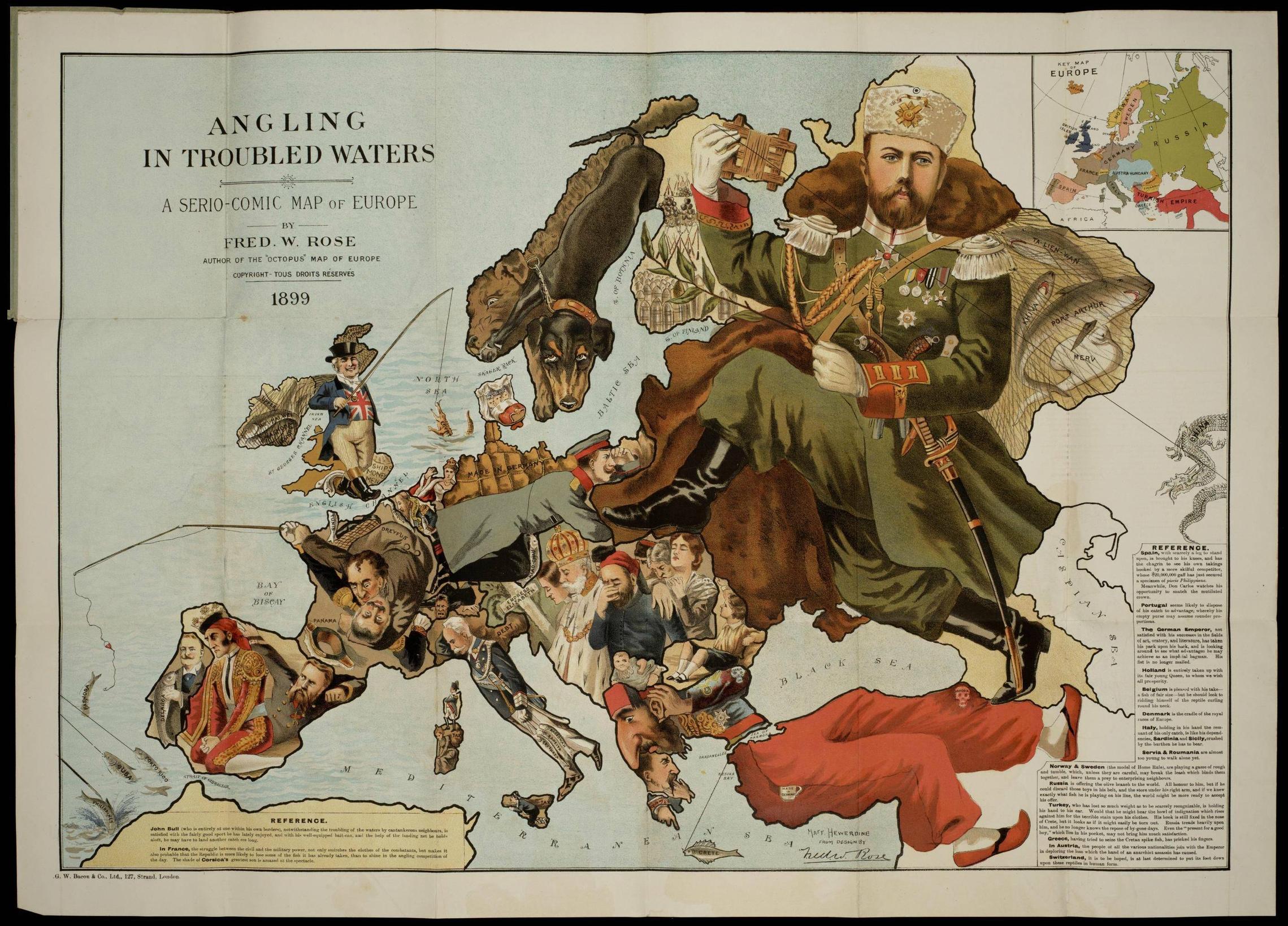
Europe in 1899, when the continent contained multiple world powers, before the rise of non-European power.
Whenever I talk about things like tariffs, Trump supporters appear in my comments to tell me that Europe has gotten a free ride for long enough and that it is time we learned to pay our way. I find it a little frustrating to read this, because in Europe it does not feel like we are getting a free ride at all. In fact it seems like the opposite: The most common complaint on the populist German right is that our political class refuses to represent our interests and will not stop carrying water for the Americans.
I recognise that I’ll never be able to put this right, but it’s worth trying, because it is important to understand the world as it is. The truth is that the United States is an imperial power. Generally speaking, it does not give foreign nations free rides and it does not hand out unearned favours. There is however a lot of confusion here, because hardly anybody bothers to describe honestly the geopolitical strategy pursued by the United States or the nature of the American empire. Western liberalism cannot conceptualise imperial politics, and while empire generally benefits political elites on both sides of the Atlantic, it is not necessarily or always in the interests of ordinary Americans or ordinary Europeans, which is yet another reason not to talk about it.
The Americans and the British before them expended enormous effort to preempt the emergence of a dominant power on the European Continent that might challenge their successive naval empires. They fought two world wars to stop Germany from becoming just such a power. This great struggle ended in 1945 with Western Europe as a fully subjugated imperial province. Since then, the Americans have coordinated the NATO alliance and guaranteed the security of European countries not out of charity, but because Europe is their provincial possession. As a rule, they have not wanted Europe to assume full responsibility for its own defence, because a world in which America no longer guarantees the security of Europe is a world in which Europe is no longer an American province. It’s that simple.
To fend off the Soviets, the Americans nevertheless rebuilt and rearmed the nations of Western Europe. Everyone involved in this project had to come up with a way to allow the Germans to become a dominant economic power again, without displacing the United States or provoking the hostilities of wary postwar neighbours like France. One solution here was the European Union, which promoted economic interdependency as a counterweight to nationalist concerns. Another solution came at the cultural level, where Germany sought to allay European anxieties over possible Teutonic aggression by developing a national cult of historical guilt for World War II, which steadily blossomed into a full-blown civic religion. This exercise in self-effacement has grown more and not less extreme over time, in part as a response to nervousness about the consequences of German reunification. Many voices on the right like to portray Germans as victims of an externally imposed guilt regime, but the truth is that we did most of this to ourselves. The German left in particular has profited from and encouraged this mindset from the beginning.
German political self-effacement had one unexpected feature, in that it proved to be contagious. Within a generation of 1945, many of the victorious allied powers were striving to develop their own historical guilt cults after the German example, in each case centred around a national original sin like slavery or colonialism. Just as the German political class found it expedient to foreground collective European concerns at the expense of a more narrowly construed German nationalism, so did the broader West develop an overarching obsession with global issues and the plight of the developing world. This has caused the proliferation of a lot of silly people in our political culture, a lot of profoundly stupid organisations, and at least two cancerous ideological systems in the form of climatism and migrationism. We have had a nearly incalculable gift in the form of 80 years of peace, which may yet be offset by the equally incalculable costs of the lunacies this peace has encouraged.
Comments Off on “[T]he United States is an imperial power … it does not give foreign nations free rides and unearned favours”
Canada’s PM “… has a job which, like that of most politicians, requires low intelligence and moral vacuousness”
At Essays in Idleness, David Warren explains why Canadian political leadership is so desperately uninspiring … except to our enemies and ill-wishers:
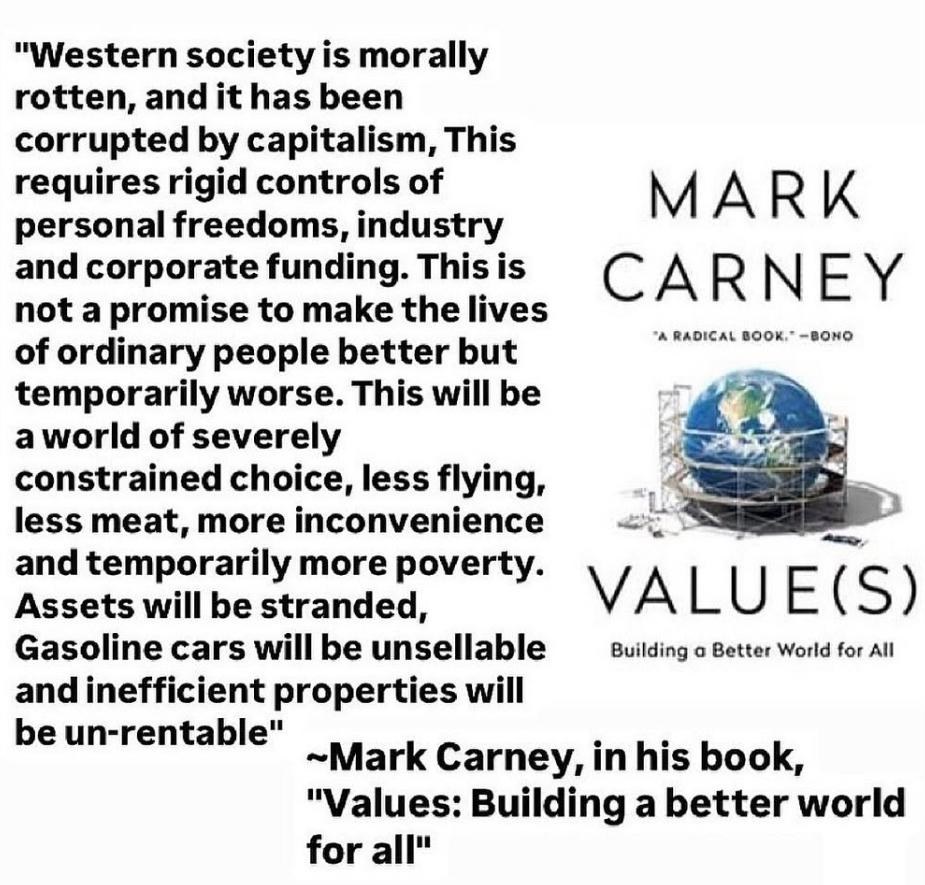
The Canadian prime minister — currently Mr Mark Carney — has a job which, like that of most politicians, requires low intelligence and moral vacuousness. At his cleverest he may exhibit a species of rat cunning. His views on Israel and the Middle East are quite uninteresting, for no rat cunning is required. He simply observes that an anti-Semitic policy is necessary, now that Muslim immigration exceeds the Jewish vote.
Not one good thing has come out of the Liberal Party since Louis St-Laurent was defeated in 1957. He, at least, achieved mediocrity. But what can we do? Canada’s population is one with the Liberals.
What happened on October 7th, 2023 — the slaughter of huge numbers of mostly unarmed Jews when Palestinians got outside the Gaza perimeter — can happen again and again. It will happen as long as Palestinians are, from childhood, taught or brainwashed to kill Jews throughout their education and social systems. I also protest against the disproportionate Israeli response. I think the Israelis have been much too restrained.
My model for “Palestine” would be Germany, or Japan. These formerly vicious nations became harmlessly bourgeois after they unconditionally surrendered to the United States and allies. It is ludicrous to think we should have offered them a peace deal, instead.

Damian Penny points out the sad truth that we get more obstinate even in support of a terrible idea when someone tries to bully us out of it:
… I find myself torn between being frustrated with my own government and simultaneously outraged by another government trying to bully us out of a policy decision with which I disagree.
I don’t expect most other Canadians to feel so conflicted, however. Trump may not realize it (nor care one bit even if he does understand it) but he just made it more likely that Canadian voters will rally around the flag.
This flag, specifically.
Nothing, and I mean nothing, has the motivational power of your opponent pushing back against you. That social media has given us a new and effective way to yell at and insult each other across partisan lines is part of the reason partisanship has become so much more entrenched in recent years.
And that includes me. During the last election campaign it was when I argued with Liberals on Facebook that I found myself feeling less like a Conservative voter and more like a Conservative militant, and my sparring partners likely felt the same way, only in the opposite direction.
Now, replace political partisanship with nationalism, and the effect becomes that much stronger.
Of course, hardcore supporters of either side won’t be moved. (That Carney is placing any conditions at all on Palestinian statehood, and saying a two-state solution remains the ultimate goal, makes him a filthy Zionist genocidaire as far as that crowd is concerned.) But sometimes it’s easy to forget that most people simply don’t pay as much attention to, and aren’t nearly as emotionally invested in, this conflict as much as we very online types are.

Comments Off on Canada’s PM “… has a job which, like that of most politicians, requires low intelligence and moral vacuousness”
The Bloody Battle of Cannae | Animated(ish) Episode
The Rest Is History
Published 5 Jun 2025This is the final episode of our series on Hannibal, which is the second season on Carthage, the whole series is here: Rome Vs Cathage
Part 1 of our series on Hannibal is here: Hannibal: The Rise of Rome’s Greatest Nemesis
How did the Battle of Cannae — one of the most important battles of all time for Ancient Rome, with a whole Empire at stake, and a reputation that had reverberated across the centuries — in 216 BC, unfold? What brilliant tactics did Hannibal adopt in order to overcome the Roman killing machine, with its vast numbers and relentless soldiers? Why did so many men die in such horrific circumstances? And, what would be the outcome of that bloody, totemic day, for the future of both Carthage and Rome?
Join Tom and Dominic for the climax of their epic journey through the rise of Hannibal, and his world-shaking war against Rome, in one of the deadliest rivalries of all time.
00:00 Context to the battle
08:30 Prelude to the battle and their plans of attack
37:28 The battle
(more…)
Comments Off on The Bloody Battle of Cannae | Animated(ish) Episode
QotD: The path to salvation
The following is not a theological argument, it’s an observation about human nature: Both faith and works are necessary, because by their fruits ye shall know them. If one has faith, then the works will follow — naturally, as it were. But works without faith are mere mumbo-jumbo, no different than the crudest magic spell. The kind of guy who does what David French does — performs the works solely to be seen performing the works — is what Jesus called a “whited sepulcher”, which indeed appear beautiful outward, but are within full of dead men’s bones, and of all uncleanness.
Again, you don’t have to be a Biblical scholar to observe that Jesus commanded what the parlance our times calls “tough love”. Just as you can’t save a sinner by taking away all his opportunities to sin — we are ALL guilty; we are ALL fallen; that alone is sufficient to damn us — so you can’t “save” a drunk, or an illegal alien, or a criminal, or whatever by enabling his lifestyle. The reason I’m not in church today is because the church is exactly like that gaggle of Karens in Starbucks — they talk a good game about renouncing the wiles of this world, but they bend over backwards to enable every possible social dysfunction.
No, Jesus did NOT command us to patch up the gutter addict every time he OD’s, so that he can go out and OD again. He did NOT command us to provide all kinds of food and shelter and medical care to every Squatemalan who broke the very first American law he had the opportunity to break by coming here. No, He did NOT command us to tolerate deviance — there are two clauses in “love the sinner, hate the sin”, and we must obey both.
The only route to salvation starts by admitting that everyone is fallen. You can take that in whatever sense you like, because it’s not theology, it’s just an obvious fact about human nature. Alas, it’s one you have to learn by age 12, or you’ll never learn it at all. That’s the greatest trick the Devil ever pulled.
Severian, “On Being Bad”, Founding Questions, 2021-12-12.
Comments Off on QotD: The path to salvation
August 1, 2025
Australia saw Britain’s awful Online Safety Act and said “hold my beer”
In The Freeman, Nicole James discusses how Australia’s attempt to protect young, innocent eyes from the terrors of the internet seems to be having all kinds of unforeseen impacts on adults:
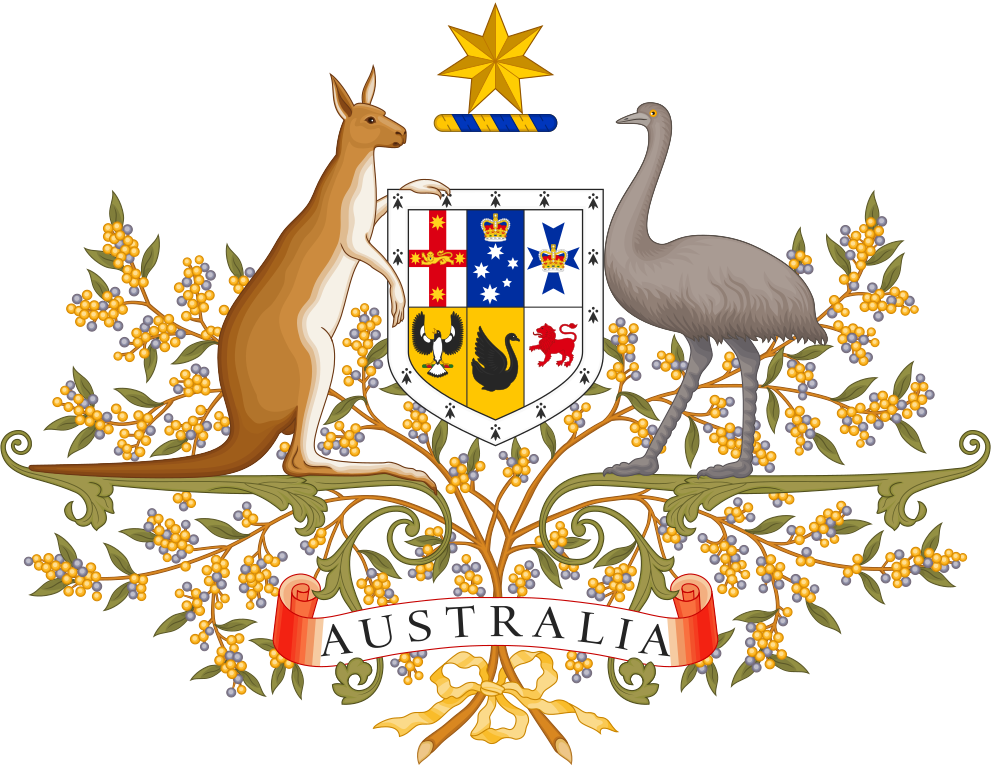
Commonwealth Coat of Arms of Australia (1912).
Quarterly of six, the first quarter Argent a Cross Gules charged with a Lion passant guardant between on each limb a Mullet of eight points Or; the second Azure five Mullets, one of eight, two of seven, one of six and one of five points of the first (representing the Constellation of the Southern Cross) ensigned with an Imperial Crown proper; the third of the first a Maltese Cross of the fourth, surmounted by a like Imperial Crown; the fourth of the third, on a Perch wreathed Vert and Gules an Australian Piping Shrike displayed also proper; the fifth also Or a Swan naiant to the sinister Sable; the last of the first, a Lion passant of the second, the whole within a Bordure Ermine; for the Crest on a Wreath Or and Azure A Seven-pointed Star Or, and for Supporters dexter a Kangaroo, sinister an Emu, both proper.
Once upon a time, not so long ago, children roamed freely through the pixelated wilderness of the Internet, posting dog memes, finding kindred spirits in weird little corners of Tumblr, and learning how to contour like Kylie Jenner. It was all chaotic, noisy, and entirely normal.
Now? Well, welcome to Australia in 2025, where the new Online Safety Amendment (Social Media Minimum Age) Bill has galloped through Parliament like a runaway Shetland pony, banning under-16s from social media. This is a full-blown digital eviction. And the ban isn’t limited just to TikTok and Snapchat. It also extends to YouTube (yes, YouTube), where apparently autoplay is now considered a gateway drug.
And how will they enforce this sweeping national grounding? Age verification, of course. Potentially through facial recognition. Not for the kids, mind you; they’ll simply be locked out. It’s everyone else who’ll need to prove they’re not children. Because nothing says “welcome to adulthood” like having to scan your actual face just to post a birthday shoutout or watch a slow-cooker recipe reel. All to reassure a tech platform that you’re not a rogue 14-year-old with strong opinions and a ring light.
The bill’s spiritual mother, eSafety Commissioner Julie Inman Grant, who, fun fact, once interviewed for a job at the CIA to analyze serial killers, gave a passionate speech at the National Press Club called “Swimming Between the Digital Flags”. It sounded very beachy and breezy until you realized she meant regulatory flags, and not the ones you’d use at Bondi. Her point was clear: the online world is full of rips and sharks and emotional jellyfish, and children must be protected from being dragged under.
Which is noble. Obviously. But somewhere between “protect the kids” and “build a biometric panopticon”, the line got a little smeared.
And where, you might ask, were parents in all this? Sitting quietly in the back, apparently, while Canberra (Australia’s Washington, DC) appointed itself Mum, Dad, the school principal, and possibly even the family dog. Because this isn’t just about safety; it’s about who decides what kids can see, say, share, and, in the case of a few bold young TikTokers, lip-sync while delivering motivational speeches to two mildly traumatized budgies.
The idea behind the project is that children are being harmed online, and honestly, yes, some are. The Internet is not all kittens and cake recipes. But rather than investing in education or digital literacy, the government has opted for a full blackout. It’s like banning scissors because one kid snipped their fringe into a reverse mullet.
And here’s the kicker. The bill had a consultation period of just 24 hours. That’s less time than it takes to read the terms and conditions you just agreed to without reading. (Don’t lie, we’ve all done it.)
In that tight little window, more than 15,000 submissions were made, and while some were supportive, the vast majority sounded the alarm. LGBTQIA+ organizations warned of disconnected teens losing safe spaces. Indigenous advocates pointed out the risks of further digital exclusion. Psychologists, educators, digital rights groups, and even a Community Soccer Club raised concerns.
Comments Off on Australia saw Britain’s awful Online Safety Act and said “hold my beer”
When Stalin and Hitler Teamed Up – Prussia 1931 – Rise of Hitler 20, August 1931
World War Two
Published 31 Jul 2025August 1931: Prussia becomes the battleground as a bizarre alliance of Nazis, Communists (under Stalin’s orders), right-wing elites, and President Hindenburg tries to topple Germany’s last major democracy. With foreign meddling, political violence, and backroom deals, the fate of the Weimar Republic hangs by a thread. Against all odds, the democratic coalition prevails — at least for now. But with chaos spreading and the world watching, can democracy survive the next assault?
(more…)
Comments Off on When Stalin and Hitler Teamed Up – Prussia 1931 – Rise of Hitler 20, August 1931
The sad saga of the CH-148 Cyclone helicopters in Canadian service
In the National Post, Tom Lawson and Gaëlle Rivard Piché argue for the Canadian government to learn from long and bitter past experiences while they “reconsider” the F-35 purchase for the RCAF … specifically the mind-numbing and depressing saga of obtaining helicopters for the Canadian Armed Forces. First, a quick recap of the helicopter story from a post back in 2012:

Pre-delivery Sikorsky CH-148 Cyclone helicopter, 4 April, 2012.
Photo by Gerry Metzler via Wikimedia Commons.
- In 1963, the CH-124 Sea King helicopter (a variant of the US Navy S-61 model) entered service with the Royal Canadian Navy.
- In 1983, the [Pierre] Trudeau government started a process to replace the Sea Kings. That process never got far enough for a replacement helicopter to be ordered.
- In 1985, the Mulroney government started a new process to find a replacement for the Sea Kings.
- In 1992, the Mulroney government placed an order for 50 EH-101 Cormorant helicopters (for both naval and search-and-rescue operations).
- In 1993, the Campbell government reduced the order from 50 to 43, theoretically saving $1.4B.
- In 1993, the new Chrétien government cancelled the “Cadillac” helicopters as being far too expensive and started a new process to identify the right helicopters to buy. The government had to pay nearly $500 million in cancellation penalties.
- In 1998, having split the plan into separate orders for naval and SAR helicopters, the government ended up buying 15 Cormorant SAR helicopters anyway — and the per-unit prices had risen in the intervening time.
- In 2004, the Martin government placed an order with Sikorsky for 28 CH-148 Cyclone helicopters to be delivered starting in 2008 (after very carefully arranging the specifications to exclude the Cormorant from the competition).
- Now, in 2012, we may still have another five years to wait for the delivery of the Cyclones.
A few data points in addition to that list:
- In 2009, the government granted Sikorsky two more years to begin deliveries … and waived the penalty fees for late delivery.
- In 2011, the government announced it would impose late delivery fines on Sikorsky.
- In 2012, Sikorsky announced the delay of the first batch of “interim” helicopters until 2013.
- In 2015, the first six helicopters were delivered so RCAF crews could begin training, with two more later in the year.
- In 2018, the first operational deployment of a Cyclone had the helicopter embarked on HMCS Ville de Quebec as part of Operation Reassurance.
- In 2021, 19 of the 23 helicopters delivered were taken out of service for cracks in the tail assemblies.
- In January 2025, the 27th helicopter was delivered to the RCAF.
Based on this lengthy and expensive process, Lawson and Piché write:
In 1992, the Progressive Conservative government signed a $4.8-billion contract with a European consortium to replace the aging Sea King helicopters deployed aboard Royal Canadian Navy (RCN) ships. For purely political reasons, when the Liberals came to power the following year, they cancelled the deal — incurring $500 million in termination penalties — and set out to find a more politically acceptable solution. That search dragged on for over a decade, culminating in a 2004 contract with Sikorsky to procure 28 CH-148 Cyclone helicopters.
What the government failed to realize — or chose to overlook — was that Sikorsky was not offering a ready-made military platform. Instead, it proposed to adapt its civilian S-92 model into a maritime helicopter fit for military use, with the hope of replicating the global success of its venerable Sea King.
But developmental issues plagued the project from the outset. The original delivery schedule of 2009 slipped repeatedly, prompting then-minister of national defence Peter MacKay to call the procurement “the worst in the history of Canada”. By 2014, the program was on the brink of cancellation. Only a tense meeting between senior ministers and Sikorsky’s president salvaged the deal, leading to a revised agreement that saw the Cyclone finally enter operational service in 2018.
Yet the challenges did not end there. The Cyclone has consistently posted poor serviceability rates. A crash that cost the lives of six Canadian Armed Forces members in early 2020 was linked to inadequate documentation and flawed software. More recently, the fleet has again been largely grounded — this time due to a shortage of spare parts. The Commander of the RCN has voiced public frustration over the shortage of deployable helicopters, even threatening to replace them with drones if necessary.
To be fair, Sikorsky is not solely to blame. It offered an attractive idea: a modern fly-by-wire maritime helicopter based on a successful civilian platform. The government accepted, underestimating the complexity of the transformation. The key lesson here — one that directly applies to the current fighter jet debate — is that there is enormous risk in buying aircraft, like the Cyclone, that exist in limited numbers worldwide.
The best path forward with the Cyclone may now be to phase out the fleet and absorb the sunk costs. A more reliable option could be the MH-60 Seahawk, also made by Sikorsky. Unlike the Cyclone, the Seahawk is a proven design, with nearly 1,000 units in active service with the U.S., Australian and some NATO navies. While it would be politically awkward to cancel a Sikorsky platform only to purchase another from the same manufacturer, pragmatism must prevail. Perhaps a deal could be struck to return the Cyclones for parts, recouping some value through the civilian S-92 supply chain.
Comments Off on The sad saga of the CH-148 Cyclone helicopters in Canadian service
How to make flat boards straight, smooth and square (stock preparation part 2) | Paul Sellers
Paul Sellers
Published 28 Jul 2013In this video Paul Sellers shows how to prepare a flat smooth board from rough stock. He does this with winding sticks and a no. 4 plane.
Part 1 is here: How to make square stock straight, sm…
Someone asked about the can Paul uses to lubricate the sole of the plane. You can find out how to make one here: http://paulsellers.com/2011/10/recycl…
To find out more about Paul Sellers and the projects he is involved with visit http://paulsellers.com
Comments Off on How to make flat boards straight, smooth and square (stock preparation part 2) | Paul Sellers
QotD: The self-serving mythology of Britain’s NHS
The interesting question of why the NHS should continue to hold the affection of the British people, when it is at best mediocre in its performance and frequently unpleasant to deal with, is one that should be of interest to all political scientists. The answer is not pleasing to those who believe in human rationality.
The affection represents the triumph of rhetoric over reality. This rhetoric contains an implicit historiography, in which the pre-NHS era is akin to that of jahiliyya, the era of ignorance before the advent of Muhammad, in Islamic historiography: in short, that there was no healthcare for most of the population before the NHS. This historiography has for decades been continuously and successfully insinuated into the minds of the population. It has been Britain’s pale imitation of totalitarian propaganda. Intentionally or not, Boris Johnson recently reinforced the mythological status of the NHS. And when, in the present crisis, retired doctors such as I were asked to return to work if they were able, it was to help the NHS. This was like asking a soldier to lay down his life for the sake of the Ministry of Defence. It says something about the credulity of the public that the response to slogans like “protect the NHS” was dull compliance, rather than outraged demands as to why it wasn’t protecting us.
I suspect also that the sheer unpleasantness of the NHS is reassuring to the British population. It evokes the Dunkirk spirit: we are all stranded on the beach of illness together. And if we cannot all live in luxury, we can at least all die in squalor. Justice is served.
Theodore Dalrymple, “Empire of conformists”, The Critic, 2020-04-29.
Comments Off on QotD: The self-serving mythology of Britain’s NHS


