Adrian Goldsworthy. Historian and Novelist
Published 4 Jun 2025Following on from the video about tank battles on screen, we look at the coverage of D-Day and the Battle of Normandy in movie and television dramas. This will be posted two days before the 81st anniversary of D-Day. As usual, this is a little about how good they are as drama and more about the historical background.
00.00 Introduction
02.50 Churchill
11.38 “Men on a mission” movies INTRO
16.45 Female Agents
20.20 The Dirty Dozen
32.06 The Big Red One
38.10 D Day: The Sixth of June
41.58 Patton
46.00 Night of the Generals
47.48 Breakthrough (1950)
49.36 Breakthrough (1971)
50.24 Pathfinders
57.48 Overlord
01.00.00 Storming Juno
01.04.48 My Way
01.12.12 They were not divided
01.17.24 Band of Brothers
01.51.00 Saving Private Ryan
02.33.45 The Longest Day
03.00.48 Conclusion and the “Ones that got away”For the discussion of the Pegasus Bridge project:
• Fighting On Film Podcast: Pegasus Bridge S…
June 5, 2025
D-Day and the Battle of Normandy on screen
The Liberals believe this time they’ll keep kids away from internet porn
Sometimes it’s hard to get a grip on what Liberals actually believe, as on the one hand they’re actively resisting pulling literal pornography out of school libraries (because it’s “LGBT friendly”) and on the other hand, they’re all gung-ho for yet another attempt to pass legislation that will try to prevent kids from seeing porn on the internet:

How does a website automatically, “responsibly” prove someone’s age down the end of an internet connection, without actually verifying their ID? Answer: It doesn’t. Obviously
There is another legislative effort afoot to keep Canadian children away from pornography. It’s well-intentioned effort, I suppose, but such efforts didn’t work very well when pornography was printed on glossy paper and distributed on VHS tapes and pay-per-view, so it seems particularly improbable in the internet age.
Bill S-209 is Independent (Liberal-appointed) Senator Julie Miville-Dechêne’s second attempt at a private member’s bill on the topic. It is predicated on the notion that it’s easier to verify age automatically than it used to be: “Online age-verification and age-estimation technology is increasingly sophisticated and can now effectively ascertain the age of users without breaching their privacy rights”, the bill’s preamble avers.
It is absolute rubbish, to the extent that even the Liberals under former prime minister Justin Trudeau seemed to realize it the first time it was tried. We can only hope Mark Carney’s Liberals are of similar mind. Early signs are not positive. The reappointment of Steven Guilbeault as heritage minister (now called Canadian identity and culture minister, for some reason) doesn’t bode well. He seems genuinely to dislike the online world on principle.
Or, maybe it does bode well. Guilbeault did a singularly terrible job trying to sell the Liberals’ anti-internet agenda in English Canada. I’m not sure he could give away ice cream in a Calgary heatwave. So if you think laws targeting “online harms” are doomed to fail at best — and could lead to dystopian outcomes — then maybe Guilbeault is exactly the fellow you want in charge.
When it came to online porn, the Trudeau Liberals seemed to have some sense of the Sisyphean proposition before them. Miville-Dechêne’s first attempt at a bill received support from MPs of all parties in the House of Commons last year, but the Liberal leadership cited privacy concerns in refusing to get behind it.
In large part that might just have been because Conservative Leader Pierre Poilievre supported the idea and, to Liberals, anything Poilievre supports must obviously be a serious threat to humanity’s survival. But still, Trudeau was pretty unequivocal in rejecting the idea.
Rate of Fire: What Determines it and How to Change It
Forgotten Weapons
Published 17 Jan 2025What determines the rate of fire of a machine gun, and how can that rate of fire be determined or changed from a design perspective? Let’s talk about pressure, mass, and distance …
(more…)
QotD: Political institutions of the late western Roman Empire
… last week we noted how the collapse of the Roman Empire in the West did not destroy the Roman cultural sphere so much as accelerate its transformation (albeit into a collection of fragmented fusion cultures which were part “Roman” mixed with other things), it did bring an end to the Roman state in the west (but not the east) and an end to Roman governance. But here too, we have to be careful in defining what that governance meant, because the Roman Empire of August, 378 AD was not the Roman Empire of August, 14 AD. This is a point that is going to come up again and again because how one views the decline of the fifth and sixth centuries depends in part on what the benchmark is: are we comparing it to the empire of Hadrian (r. 117-138) or the empire of Valentinian (r. 364-375)? Because most students are generally more familiar with the former (because it tends to be get focused on in teaching), there is a tendency to compare 476 directly with Rome under the Nervan-Antonines (96-192) without taking into account the events of the third and early fourth century.
Roman rule as effectively codified under the first emperor, Augustus (r. 31BC – 14AD) was relatively limited and indirect, not because the Romans believed in something called “limited government” but because the aims of the Roman state were very limited (secure territory, collect taxes) and the administrative apparatus for doing those things was also very limited. The whole of the central Roman bureaucracy in the first century probably consisted of just a few hundred senatorial and equestrian officials (supported, of course, by the army and also several thousand enslaved workers employed either by the state directly or in the households of those officials) – this for an empire of around 50 million people. Instead, day to day affairs in the provinces – public works, the administration of justice, the regulation of local markets, etc. – were handled by local governments, typically centered in cities (we’ll come back to them in a moment). Where there were no cities, the Romans tended to make new ones for this purpose. Roman officials could then interact with the city elites (they preferred oligarchic city governments because they were easier to control) and so avoid having to interact directly with the populace in a more granular way unless there was a crisis.
By contrast, the Roman governance system that emerges during the reigns of Diocletian (r. 284-305) and Constantine (r. 306-337) was centralized and direct. The process of centralizing governance had been going on for some time, really since the beginning of the empire, albeit slowly. The Constitutio Antoniniana (212), which extended Roman citizenship to all free persons in the empire, in turn had the effect of wiping out all of the local law codes and instead extending Roman law to cover everyone and so doubtless accelerated the process.
During the Crisis of the Third Century (235-284) this trend accelerates substantially; the sources for this period are relatively poor, making it hard to see this process clearly. Nevertheless, the chaotic security situation led Roman generals and usurpers to make much greater demands of whatever local communities were in their reach, while at the same time once in power, emperors sought to draw a clearer distinction between their power and that of their subordinates in an effort to “coup proof” their regimes. That new form of Roman rule was both completed and then codified by Diocletian (r. 284-305): the emperor was set visually apart, ruling from palaces in special regalia and wearing crowns, while at the same time the provinces were reorganized into smaller units that could be ruled much more directly.
Diocletian intervened in the daily life of the empire in a way that emperors before largely had not. When his plan to reform the Roman currency failed, sparking hyper-inflation (whoops!), Diocletian responded with his Edict on Maximum Prices, an effort to fix the prices of many goods empire wide. Now previous emperors were not averse to price fixing, mind you, but such efforts had almost always been restricted to staple goods (mostly wheat) in Rome itself or in Italy (typically in response to food shortages). Diocletian attempted to enforce religious unity by persecuting Christians; his successors by the end of the century would be attempting to enforce religious unity by persecuting non-Christians. Whereas before taxes had been assessed on communities, Diocletian planned a tax system based on assessments of individual landholders based on a regular census; when actually performing a regular census proved difficult, Constantine responded by mandating that coloni – the tenant farmers and sharecroppers of the empire – must stay on the land they had been farming so that their landlords would be able to pay the taxes, casually abrogating a traditional freedom of Roman citizens for millions of farmers out of administrative convenience. Of course all of this centralized direction demanded bureaucrats and the bureaucracy during this period swelled to probably around 35,000 officials (compared to the few hundred under Augustus!).
All of this matters here because it is this kind of government – centralized, bureaucratic, religiously framed and interventionist, which the new rulers of the fifth century break-away kingdoms will attempt to emulate. They will mostly fail, leading to a precipitous decline in state capacity. This process worked differently in different areas: in Britain, the Roman government largely withered away from neglect and was effectively gone before the arrival of the Saxons and Angles, a point made quite well by Robin Flemming in the first chapter of Britain after Rome (2010), while in Spain, Gaul, Italy and even to an extent North Africa, the new “barbarian” rulers attempted to maintain Roman systems of rule.
This is thus an odd point where the “change and continuity” and “decline and fall” camps can both be right at the same time. There is continuity here, as new kings mostly established regimes that used the visual language, court procedure and to a degree legal and bureaucratic frameworks of Late Roman imperial rule. On the other hand, those new kingdoms fairly clearly lacked the resources, even with respect to their smaller territories, to engage in the kind of state activity that the Late Roman state had, for instance, towards the end of the fourth century. Instead, central administration largely failed in the West, with the countryside gradually becoming subject to local rural magnates (who might then be attached to the king) rather than civic or central government.
The problem rulers faced was two-fold: first that the Late Roman system, in contrast to its earlier form, demanded a large, literate bureaucracy, but the economic decline of the fifth century (which we’ll get to next time) came with a marked decline in literacy, which in turn meant that the supply of literate elites to staff those positions was itself shrinking (while at the same time secular rulers found themselves competing with the institutional Church for those very same literate elites). Second – and we’ll deal with this in more depth in just a moment – Roman rule had worked through cities, but all over the Roman Empire (but most especially in the West), cities were in decline and the population was both shrinking and ruralizing.
That decline in state capacity is visible in a number of different contexts. Bryan Ward-Perkins (Rome and the End of Civilization (2005), 148ff) notes for instance a sharp decline in the size of Churches, which for Christian rulers (both the post-Constantine emperors and the new “barbarian” kings) were major state building projects meant to display either royal or local noble wealth and power; Church size really only reaches Late Roman equivalent in the west (an important caveat here, to be sure) in the ninth century. In this kind of context it is hard to say that Visigothic or Merovingian rulers are actually just doing a different form of rulership because they’re fairly clearly not – they just don’t have the resources to throw at expensive building projects, even when you adjust for their smaller realms.
Nor is it merely building projects. Under Constantine, the Romans had maintained a professional army of around 400,000 troops. Much of the success of the Roman Empire had been its ability to provide “public peace” within its borders (at least by the relatively low standards of the ancient world). While the third century had seen quite a lot of civil war and the in the fourth century the Roman frontiers were cracking, for much of the empire the legions continued to do their job: war remained something that happened far away. This was a substantial change from the pre-Roman norm where war was a regular occurrence basically everywhere.
The kingdoms that emerged from the collapse of Roman rule proved incapable of either maintaining a meaningful professional army or provisioning much of that public peace (though of course the Roman state in the west had also proved incapable of doing this during the fifth century). Instead those kingdoms increasingly relied on armies led by (frequently mounted) warrior-aristocrats, composed of a general levy of the landholding population. We’ve actually discussed some of the later forms of this system – the Anglo-Saxon fyrd and the Carolingian levy system – already; those systems are useful reference points because they’re quite a bit better attested in our evidence and reflect many of the general principles of how we suppose earlier armies to have been organized.
The shift to a militia army isn’t necessarily a step backwards – the army of the Middle Roman Republic had also been a landholder’s militia – except that in this case it also marked a substantial decrease in scale. Major Merovingian armies – like the one that fought at Tours in 732 – tended to be around 10,000-20,000 men (mostly amateurs), compared to Late Roman field armies frequently around 40,000 professional soldiers or the astounding mobilizations of the Roman Republic (putting around 225,000 – that is not a typo – citizen-soldiers in the field in 214BC, for instance). Compared to the armies of the Hellenistic Period (323-31BC) or the Roman Empire, the ability of the post-Roman kingdoms to mobilize force was surprisingly limited and the armies they fielded also declined noticeably in sophistication, especially when it came to siege warfare (which of course also required highly trained, often literate engineers and experts).
That said, it cannot be argued that the decline of “public peace” had merely begun in the fifth century. One useful barometer of the civilian sense of security is the construction of city walls well within the empire: for the first two centuries, many Roman cities were left unwalled. But fresh wall construction within the Empire in places like Northern Spain or Southern France begins in earnest in the third century (presumably in response to the Crisis) and then intensifies through the fifth century, suggesting that rather than a sudden collapse of security, there had been a steady but significant decline (though again this would thus place the nadir of security somewhere in the early Middle Ages), partially abated in the fourth century but then resumed with a vengeance in the fifth.
Consequently the political story in the West is one of an effort to maintain some of the institutions of Roman governance which largely fails, leading to the progressive fragmentation and localization of power. Precisely because the late Roman system was so top-heavy and centralized, the collapse of central Roman rule mortally wounded it and left the successor states of Rome with much more limited resources and administration to try to achieve their aims.
Bret Devereaux, “Collections: Rome: Decline and Fall? Part II: Institutions”, A Collection of Unmitigated Pedantry, 2022-01-28.
June 4, 2025
“Asshole Britain”
In The Line, Greg Quinn indulges in a bit of struggle sessioning about his earlier disagreements with the editors of The Line about Britain and Canada (protip: don’t search for images to go along with that particular headline, especially if you have “safe search” filters turned off):
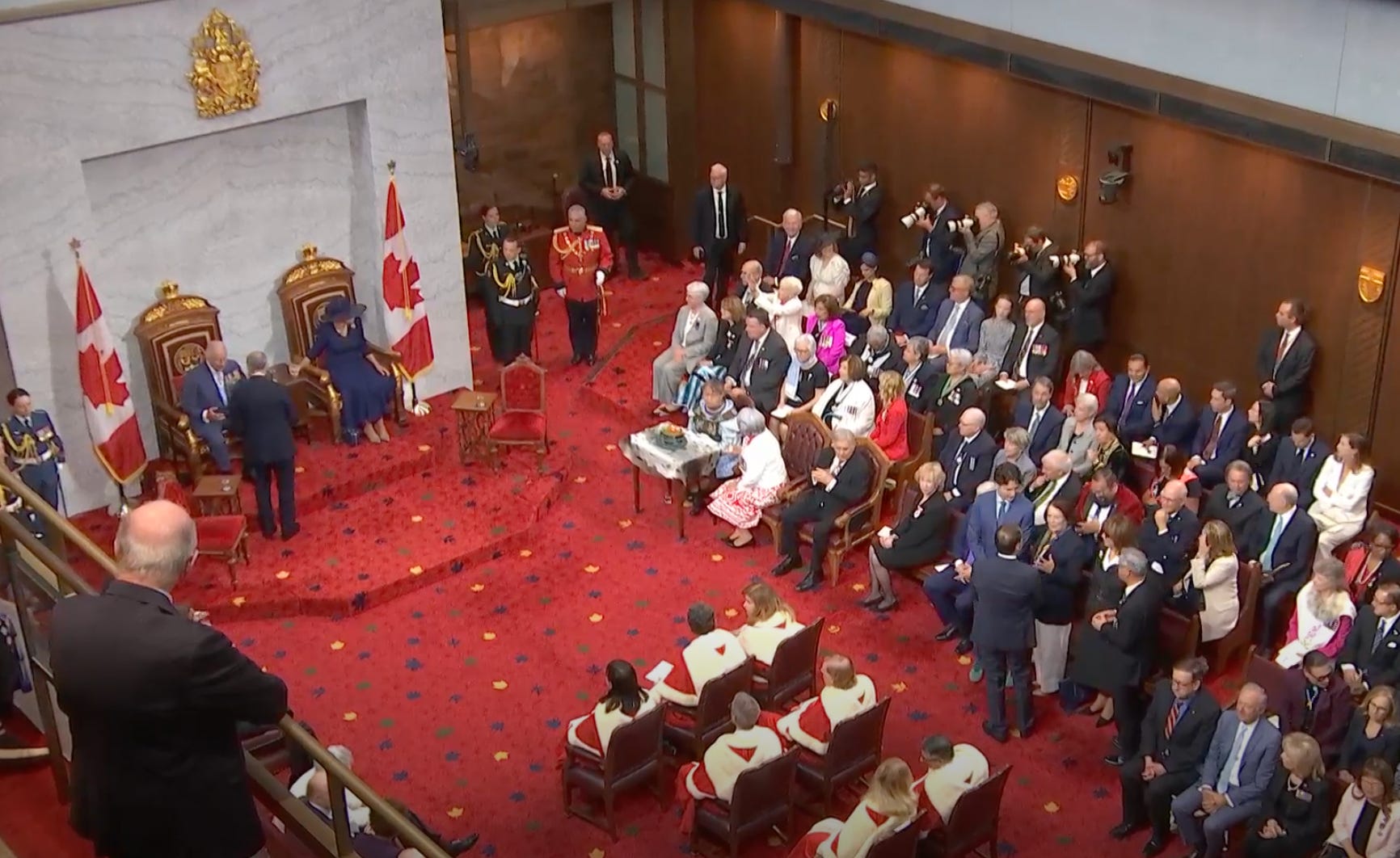
Yeah, let’s go with an inoffensive photo of His Royal Majesty and his Canadian First Minister chatting in the Senate chamber, rather than anything remotely to do with the headline of this post.
Photo by Paul Wells from his Substack
On February 12th of this year, I wrote in The Line about how my country, the United Kingdom, had “ghosted” Canada by refusing to come out strongly in reaction to U.S. President Donald Trump’s egregious attacks on the country and his calls for it to become the 51st state. In writing that piece, I didn’t beat around the bush — I called the U.K.’s actions what they were at the time: cowardice and sycophancy.
Since February, there have been a few (many?!) developments in Canada’s — and the world’s — relationship with President Trump.
Not least among these are Matt Gurney and Jen Gerson’s depiction (or technically, implication) of the U.K. as “Asshole Britain”. As other regular Line readers will know, “Asshole Canada” or “Maximum Canada” is an idea the editors floated here some months ago, where they asserted that Canada should abandon its typical desire to be seen as a global do-gooder and simply assert its national interests, vigorously and unapologetically, and if other countries, even allies, object, well, to hell with them. Editor Gurney, in a recent podcast, cited the just-concluded visit of His Majesty the King to Canada to deliver the Throne Speech — the first time a monarch has done so since 1977 — as an example of that. Prime Minister Mark Carney issued the invite to the King despite obvious discomfort with the idea among senior officials in my government.
Carney didn’t care. The King is the sovereign of Canada, too, and Carney didn’t let British discomfort deter him.
I have to say that HM the King’s speech was a blinder and (in its own royal diplomatic way) left no doubt as to where His Majesty’s sympathies lie and how he supports Canada’s sovereignty and independence. Whether you are a royalist or a republican, the fact that HM the King made the trip and read the speech should be welcomed. And I entirely agree with the editors here — Canadians should and must ignore the comments from the U.K. Who cares? HM the King was acting in his capacity as Canada‘s monarch — the views of anyone in the U.K. (government or otherwise) are irrelevant.
I wish I could condemn Jen and Matt for their (again, implied) characterization of the U.K. — Britain has needed no urging to unapologetically assert its own interests in this revived era of Trump. But I can’t. They are absolutely correct. And every day that passes, I’m sorry to say that the U.K. becomes more and more “Asshole Britain” when it comes to its relationship with Canada and the U.S.
The reasons remain much the same as I identified before: cowardice and sycophancy. To that, I’d now like to add venality. We think we have a special relationship with the U.S., as demonstrated by our recent trade agreement — except the impact of that agreement is open to some question. We seem to be afraid of saying anything that might upset President Trump, in case he reacts. Although we fail to understand that upsetting the President does not follow a rational process. He could (and does) get upset and react extremely easily at the simplest and most unexpected of things.
The President continues to make unacceptable claims against Canada, including reiterating his call for it to become the 51st state shortly after the King’s visit concluded. His latest iteration of this includes claims that Canada could save U.S.$61 billion it “should” be charged for the so-called Golden Dome (what is it with adjectives and this President?) if it joins the U.S. This, of course, fails to grasp the simple strategic fact that if you want a defence shield like this over North America, then you’re going to have to use sensors and other infrastructure on Canadian soil. Is he expecting to be provided that land for free?
By continuing to refuse to stand up to President Trump and clearly express our support for Canada, we are submitting to his attempts to divide and rule those of us who remain like-minded. At its worst, we are now venal — selling out to the president.
Instead, we should be standing true to our roots — as defenders of the free market and democracy. We should be leading the way, and we should be building an alliance of those who continue to share our values.
That is what we should be doing. That we aren’t is nothing short of a disgrace.
Update: Fixed broken link to Greg Quinn’s article. Doh!
The Korean War Week 50 – Trapped in the Triangle: Korea’s Killing Zone – June 3, 1951
The Korean War by Indy Neidell
Published 3 Jun 2025The MacArthur Senate Hearings continue this week, with US Secretary of State Dean Acheson now in the hot seat. He takes a rather confusing barrage of questions, and yet manages to signal to the world at large, i.e. the Chinese, that the US is open to negotiations to end the war. The war still continues in the field, of course, with the UN forces’ Operation Piledriver in action, driving into the “Iron Triangle” and trying to trap as much of the enemy as possible.
Chapters
00:00 Intro
01:07 Recap
01:35 Acheson Speaks
05:44 Operation Piledriver
09:10 Attacks Begin
10:53 A Unifying JCS Directive
16:54 Summary
(more…)
Arch-statist Mark Carney believes that Canadians “must earn their freedom everyday”
At The Intrepid Viking, Roxanne Halverson examines what Prime Minister Mark Carney means when he tosses off comments like “Freedom is something you earn everyday”:
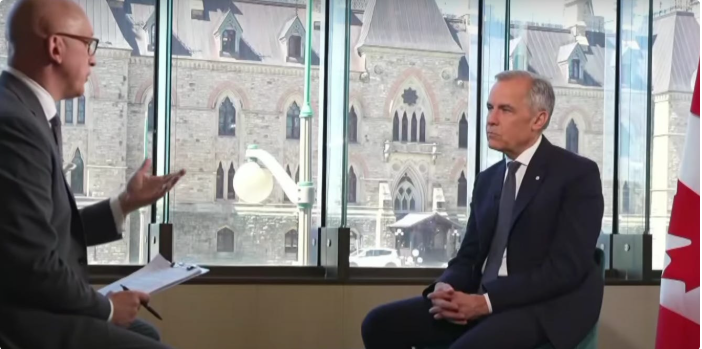
CBC’s David Cochrane interviewing Prime Minister Mark Carney in Ottawa.
It is surprising and disconcerting that so few pundits, commentators or even members of the Conservative Party, and for that matter are, not taking issue with a recent statement from our new Prime Minister in which he asserted, when talking about Canadians, that, “Freedom is something you earn everyday“.
Has anyone asked Mark Carney, this globalist World Economic Forum (WEF) acolyte, who is now Canada’s Prime Minister, what he meant when he made that statement? He made it during an interview with David Cochrane on CBC’s Power and Politics following on King Charles delivering the throne speech. He made the statement while talking about the great “crisis” Canada is and how his government has to get moving on major projects and our economy and solving the housing calamity. Of course he forget to mention that these problems are due to the policies of the previous Liberal government, for whom he was the financial advisor. He also does not explain that why, in the middle of such a crisis, his government has decided to take the summer off and not release of budget of any type, any time soon, but that’s another story.
Now, back to his claim that Canadians “must earn their freedom everyday”. Of course, Cochrane, being one of Carney’s main fanboys at CBC, didn’t probe any deeper to ask him what he meant by that statement. But it is a strange statement coming from the Prime Minister of a country where its constitution essentially says that individual freedom is a God given right. And given that Carney, with his recent visit to Rome to see the new pope, has made it clear that he is a devout practising Catholic, his belief in the Almighty is obviously not an issue. So again, what did he mean by that remark? Strange again, because just six weeks ago, before he was the Prime Minister, Carney posted the following statement on X.
The Charter of Rights and Freedoms is the embodiment of our principles and our aspirations as Canadians. It must be protected — not wielded for political gain. Forty-three years on, the Charter remains strong — and it’s on all of us to defend it.
This apparently was in response to Conservative Leader Pierre Poilievre’s assertion that he would use the notwithstanding clause to override a judicial ruling against imposing consecutive life sentences on murderers, rather than concurrent sentences.
So given that, it would seem that Mr. Carney believes our rights regarding freedom are enshrined in the Charter. Carney, in his interview with Cochrane also maintained that Canada was still “the true north strong and free”. So then which is it when it comes to freedom from his perspective? Is it enshrined in the Charter, are we the true north “strong and free”, or must freedom be earned, and in what way?
Remarkable Victory – The Bomber War Episode 5 – Jan to June 1944
HardThrasher
Published 28 Feb 2024In which the USAAF and RAF finally start to Get Good at their jobs and tie up their respective campaigns for literally the first time.
00:00 – 04:01 – Introduction
04:06 – 08:12 – Forward Operating Base
08:15 – 11:30 – Changes in Command
11:32 – 16:16 – Doolittle’s Plan
16:20 – 22:25 – Big Week
22:34 – 29:32 – Aftermath
29:35 – 32:06 – Berlin
32:09 – 33:59 – Overlord
34:02 – Survivor’s Club
(more…)
QotD: Conquest empires
Specifically, metal.
Soft metals are not for conquest empire. Gold, silver, copper, tin, etc, may be used for plates or posts or jewellery or skin scrapers, but they are not war fighting metals. Even the lightest leather armour or layers of feather padding makes them practically valueless for war fighting. Metal only becomes an imperial material when it can be made hard enough for combat purposes.
The first such metal is Bronze, which is made by combining different metals in compounds. Copper compounded with enough tin (usually 5-10 percent) makes Bronze. Bronze can make armour and weapons and even axles and bearings. But copper (mined in mountains) and tin (usually from swamps) and the charcoal needed to melt them (from forests) combined in sufficient quantities for mass production (cities supported by taxed farmers), require extensive trade routes, and probably a stable currency of some sort. But once these elements can be combined, empires can give up on mere Security, and enter Conquest.
All the early Sumerian, Egyptian, Hittite, Persian, Greek, Roman, Indian and Chinese empires that we now scrawl across maps with lines to show how they conquered the territories of other empires are based on this simple concept. The Hittites with their Bronze, Egyptians with their chariots, and Romans with their Steel: being only different developments from the same basic “metal technology” roots.
Yet this is where motive becomes uncertain. All these empires got into conquest, but in many cases they did it either to continue their security (by pushing the dangerous boundaries ever further), or to protect the trade that made their system work. Conquest for the sake of conquest was certainly an element — particularly with rulers like Alexander the Great — but the original reason why Phillip of Macedon and his predecessors had developed the world’s most efficient fighting machine had more to do with constant threats from Persians and Greeks and other “barbarians” than with any desire to get into the conquest game itself. Sometimes things done for security lead to expanded boundaries for security, which then lead to expanding further for conquest. (Often because the system developed for paying those fighting for security requires conquest to pay them off … see Julius and many later Caesars!)
Nigel Davies, “Types of Empires: Security, Conquest, and Trade”, rethinking history, 2020-05-02.
June 3, 2025
Ukraine’s strategic strikes against Russian airbases
CDR Salamander on the lessons to be learned from the latest dramatic turn in the Russo-Ukrainian war with Ukraine carefully avoiding letting their American supporters know about the attack before it went in:
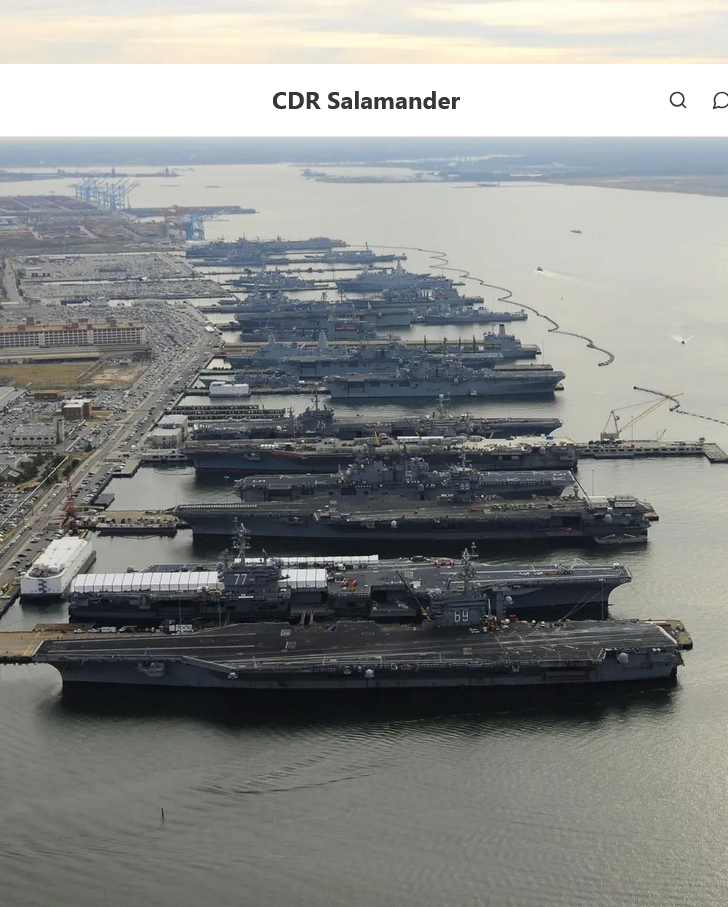
[This] picture from 2012 of Norfolk is what I want you to think about.
We talked about the superbly executed Ukrainian attack on Russian bomber bases for most of yesterday’s Midrats, and what keeps coming to mind for me is not the details of that attack, but the stark warning it is giving us.
The threat of drone strikes isn’t a new warning, but in my mind it intersect almost perfectly with the self-inflicted vulnerability of the US Navy’s fleet — its concentration.
The growing utility of attack drones isn’t an insight that is unique to the Russo-Ukrainian War. The topic has come up here and on Midrats for almost two decades. We’re not alone. Heck, broad thinking people like our friend Matt Hipple was pondering it over at CIMSEC thirteen years ago a few months before the picture at the top of the post was made.
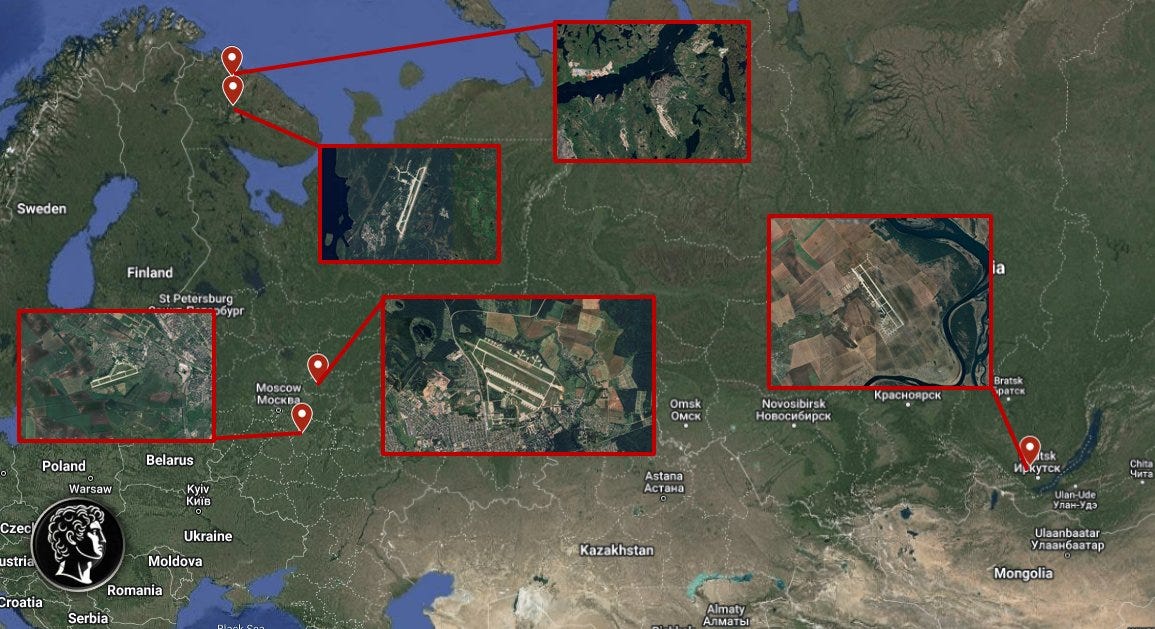
I’ll tie in the picture a bit, but let’s take a moment to give the Ukrainians credit where credit is due. They executed precision strikes against the RUS bomber fleet across the entire two-thirds of the Euro-Asian landmass.
We will find out more details, a dozen or 40+ high-demand/low-density strategic bombers were taken off the battle line. RUS is not building any more of them. As missile carriers, they have been a cornerstone of the city terrors for most of the last four years. You would be hard-pressed to find a more honorable, or legitimate target.
Streiff over at Red State has a good summary with what we think we know as of Sunday afternoon:
The airbases are the home to Russia’s fleet of Tu-22, Tu-95M, and Tu-160 nuclear-capable strategic bombers as well as AS-50 battle management aircraft. They were located from the Siberian Far East to the Arctic Circle. The furthest target, Belaya Airbase in Irkutsk, is over 2700 miles from Ukraine.
Reports indicate that at least 41 aircraft were hit. The unofficial tally indicates 24 Tu-22, 8 Tu-95MS, and 5 Tu-16 were hit. MiG-31 fighters and Il-76 transports were also hit. To put this in context, open-source data says Russia’s bomber inventory is about 58 Tu-22, 47 Tu-95MS, and 15 Tu-160. These planes are the ones used to launch most of the missiles fired at Ukrainian cities.
By any standard, this was a devastating attack. Nearly half of the Tu-22, a quarter of the Tu-95MS, and a third of the Tu-160 fleet, representing just over 30 percent of Russia’s strategic bomber force, were damaged or destroyed in one attack. When you consider the operational readiness rate, Russia probably has less than 50 aircraft capable of flying … on the bright side, they have plenty of aircraft to cannibalize for parts. The Tu-22 and Tu-95MS production lines are closed, and the Tu-160 production is one, yes, one per year. For all intents and purposes, this represents a permanent decrease in the size of the Russian strategic bomber fleet.
Before we discuss what the USA needs to take away, let’s look at the top-4 primary and second-order effects this will have on the Russian Federation.
First Order Effects
- Fewer raiding assets to use against UKR.
- The weakest leg of their nuclear triad (bombers are dual use) is even weaker.
- PSYOP defeat as RUS now know even their most valuable weapons, stationed deep into RUS rear, are vulnerable.
- Paranoia elevated into an already paranoid national psyche under duress of year four of a grinding war.
Second Order Effects
- Inefficiencies in both civilian logistics and manpower are the natural response to every tractor-trailer being a weapons delivery vehicle at range … and the need to defend important bases as a result, sinks into an already stressed nation.
- Loss of face. RUS launched a war of choice against nation 1/4th its size and much weaker than it from any measure, and four years on, still has only made marginal progress. Now that nation proved it can operate with impunity anywhere inside RUS. The “R” in BRICS is not impressing its friends.
- It shouldn’t, but this is going to get the nuclear autists the jitters. All theory, but yes, UKR took out one-third or more of the fully mission capable nuclear capable bombers that form one leg — but as mentioned above the weakest leg — of RUS’s nuclear deterrence. Those who work in the theory-dominated nuclear world will have all their gauges twitching, yes, but in the end analysis, it won’t matter.
- UKR morale just got a big boost. Wars of attrition usually last until one side or the other loses either the material ability or the will to fight. At least from the “will” line of operation, that decisive point just shifted to the right.
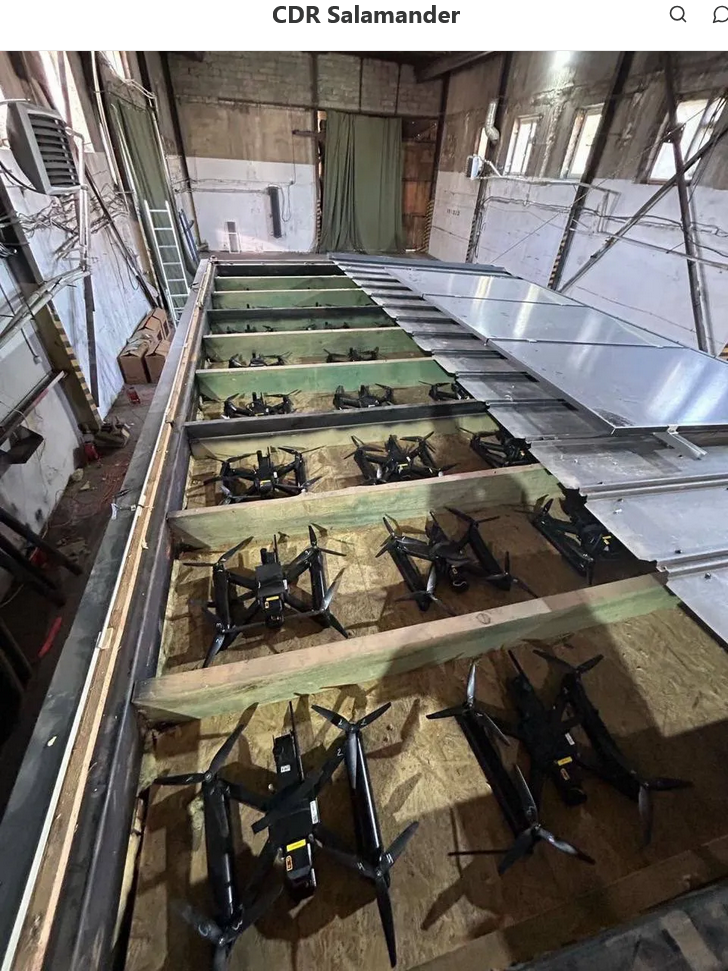
Simply a superb operation. How do you defend against weapons like this disguised in a trailer’s false roof?
Canadian immigration numbers go even higher in 2025
Although the new Liberal government in Ottawa made some slight noises about bringing immigration numbers back down to something closer to sustainable … there’s less than zero evidence that they actually meant it:
Despite all promises to the contrary, all the sudden and supposed interest in nation-building efforts that stretch from Victoria’s Inner Harbour to the Bay of Fundy, all the “Buy Canadian” horseshit lapped up by a portion of the electorate that votes like a long-tailed cat in a room full of rocking chairs, Canada’s once-in-a-generation betrayal of its labour market — and its very present and future — continued at pace to begin 2025.
The numbers are pants-shitting-ly grim.
The latest federal immigration data shows that Canada welcomed more than 817,000 newcomers in the first four months of 2025 when tallying up permanent and non-permanent streams.
Between January and April 2025, 132,100 people were granted permanent residency, while 194,000 study permits and 491,400 work permits (including extensions) were finalized by Immigration, Refugees and Citizenship Canada. (Juno News)

At a time when 89% of Canadians under 34 have been beaten into believing that “owning a home is only for the rich” (Ipsos poll), along comes the worst summer job market in two decades to match the continued Liberal failure to course-correct on the mass-immigration, replacement-caste grift.
The two are of course inextricably linked.
With even the Bank of Canada speaking uncomfortable truths, that the foreign “student” surge and “temporary” foreign worker bacchanal lead to wage suppression and job displacement for Canadian workers, for 2025’s numbers to continue to blow through any semblance of well-meaning, sustainable targets, is as “bonkers” as it is seditious towards any citizen with an investment in Canada’s future.
The grift, the very lie, that “shortages” drive corporate Canada’s need for a basement-apartment economy has been disproved time and time again.
“All we hear about are labour shortages, [but] we have to begin to recognize that this really is a self-serving narrative mostly coming from corporate Canada,” said Mikal Skuterud, labour economics professor at the University of Waterloo.


Exercise Tiger: The WW2 Cover-Up Before D Day
The History Chap
Published 23 May 2024Exercise Tiger 1944, was a large-scale dress rehearsal for the D-Day landings, off the Slapton Sands in England, that went horribly wrong. Over 700 US servicemen were killed, more than were killed on Utah beach on D-Day itself! With D-Day imminent, Allied Supreme Commander, General Dwight Eisenhower, ordered the disaster to be hushed up.
Following a friendly fire incident on Slapton Sands on the 27th April 1944, a convoy carrying US troops was attacked in the early hours of the 28th by German E-Boats. In what is called the Battle of Lyme Bay, two ships in the convoy were sunk resulting in the loss of over 700 US servicemen. Whilst rumours suggest that there were many casualties resulting from the friendly fire on Slapton Sands, the US Army has always remained tight-lipped. To this day, the mystery remains as to what extent the casualty figures were covered up.
In the 1980’s, a Sherman tank was raised from the seabed. It now stands at the end of Slapton Sands (near the village of Torcross) as a memorial to the young men who died 6 weeks before D-Day during Exercise Tiger.
Chapters
0:00 Intro
0:42 D-Day 1944
1:40 Slapton Sands
2:30 Civilian Evacuation
3:22 Military Build-up
4:58 Exercise Tiger
6:07 Live Fire Disaster
7:37 Convoy T-4
9:15 Spotted by Germans
10:03 E-boat attack
11:41 Battle of Lyme Bay
14:06 Casualty Figures
14:43 D-Day Compromised?
15:37 Cover-up?
17:00 D-Day Success
18:08 Exercise Tiger Remembered
(more…)
QotD: Heinlein’s opinions on the right to bear arms
Between 1942 and 1966 Heinlein’s politics evolved from New Deal left-liberalism towards what after 1971 would come to be called libertarianism. But that way of putting it is actually misleading, because Heinlein did not merely approach libertarianism, he played a significant part in defining it. His 1966 novel The Moon Is A Harsh Mistress was formative of the movement, with the “rational anarchist” Bernardo de la Paz becoming a role model for later libertarians. By 1978, we have direct evidence (from an interview in Samuel Edward Konkin’s New Libertarian magazine, among other sources) that Heinlein self-identified as a libertarian and regretted his earlier statism.
But if Heinlein’s overall politics changed considerably and wandered down some odd byways during his lifetime, his uncompromising support of civilian firearms rights was a constant on display throughout his life. Brin observes that was already true in 1942, but attempts to attribute this position to John W. Campbell. Multiple lines of evidence refute this claim.
[…]
Heinlein, on the other hand, was a vocal and consistent advocate of civilian weapons ownership both during and after his association with Campbell. This is perhaps clearest in his 1949 novel Red Planet, written after their parting of the ways. In that novel, the bearing of personal weapons is explicitly connected to the assumption of adult responsibilities.
Red Planet is also interesting because, although we might consider the views of Heinlein’s characters an unreliable guide to Heinlein’s own, Heinlein’s letters about the novel reveal much more. His editor at Scribner attempted to delete the section of argument in which weapons-bearing is connected to adult responsibility; Heinlein rejected this, objecting that it eviscerated the book’s ethical core and making very clear that the views of the pro-gun mentor figures in the novel were his own.
Heinlein was to reiterate similar views not only in his later fiction but in the posthumous nonfiction collection Grumbles From The Grave – by which time they were no surprise to any Heinlein fan. And it would be difficult to overstate the influence they had on firearms-rights activists during the dark years between the Gun Control Act of 1968 and our vindication in the 2008 District of Columbia v. Heller ruling.
Heinlein’s gift to firearms-rights activism during that bleak four decades was to be able to draw on the principled case for civilian firearms going back to the framers of the U.S. Constitution and English Republican sources and restate it in language appealing to the brightest children of post-WWII America. But he did more than that, because in Red Planet and elsewhere firearms rights were presented as an inextricable part of a philosophical whole, with the personal firearm both as instrument and defining symbol of personal liberty and responsibility.
Eric S. Raymond, “Brin on Heinlein on guns is dead wrong”, Armed and Dangerous, 2011-07-18.
June 2, 2025
The progressive case for unlimited immigration
Theophilus Chilton takes on the progressive arguments for bringing in as many “high quality” immigrants as humanly possible from his own professional background:
One of the constants that you can count on in any debate about the value of immigration (of every sort) is the inevitable assertion about the NECESSITY of immigration. Immigrants POWER AMERICA. Without them, NOTHING WOULD HAPPEN! They are ELITE HUMAN CAPITAL without which the White American chuds who did things like build the atom bomb and otherwise created modern technological civilisation would barely be able to keep the lights on in their single-wides. It’s not just that immigrants want a new life or might be useful — they are an absolutely necessity and the ones coming here are the cream of the world’s crop.
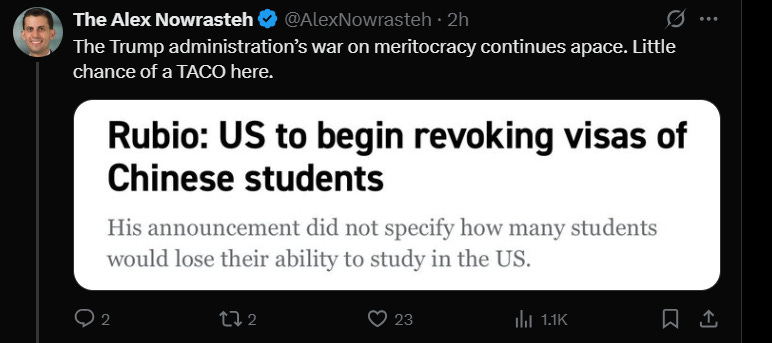
As a result, the recent move by Marco Rubio and the State Department to revoke visas from Chinese students in American universities (especially those associated with the CCP or who are in positions to commit especially damaging industrial espionage) will certainly not be well-received by this crowd. For example, witness Alex Nowrasteh, who’s whole schtick is to burble on about “meritocracy” and whine about “affirmative action for White Americans” while filling a useless sinecure at the Cato Institute that he got by being the token immigrant. He is appalled that we’d act in our own national interest rather than in the interests of a bunch of random foreigners.
Immigration man have big sad
Many people who know me on X already know this, but most readers here may not. Before I made a radical life-changing vocational choice a few years ago, I used to be a scientist in Big Pharma. For a little over two decades, I worked in the biotech/biopharma industry, covering a wide range of drug development stages and product types. I’ve developed vaccines (which is why I was skeptical about the Covid vaxx from the very beginning). I’ve developed small molecule drugs. I helped to bring to market several of the pharmaceuticals that millions take regularly and which you see advertised on television. I’ve done everything from bench scale analytical work to protein purification on 5000-liter batches used in support of human clinical trials. I’m proficient in literally dozens of different analytical techniques. Before that, in both undergraduate and graduate school, I specialised in synthetic organic small molecule development across a number of different subspecialties. And I’m good at all of this.
One other thing that I did throughout was work side-by-side with, and later manage, LOTS of visa holders and immigrants, especially from “tech heavy” countries like India and China, the stereotypical “H1-Bers”. As a result, I consider myself to be a pretty good judge of the value which visa holders bring to tech fields.
My judgment is, and has been for decades, that their value is minimal and it certainly does not live up to the hype. Indeed, one of the constants that I observed among most Indian, Chinese, and other visa holders was that they did not really, truly understand the science that was involved with the products being developed and the techniques being used to develop and test them. Most of these folks were the living embodiment of cramming to pass the test. When the test methods and the SOPs being employed were straightforward, these folks were great. They had a robot-like efficiency that comes with repetitively doing the same thing over and over and over again. Unfortunately, for anything requiring innovative or independent thinking, they’d be totally lost. If results from a test deviated from expectations and required some commonsense interpretation? That’s where the wheels came off. I mean, there was little to no capacity to deal with anything that wasn’t completely textbook.
Even basic scientific sense was often missing. At one job, there was an Indian guy who would takes dumps in the bathroom and then walk straight out back to his manufacturing suite in the cell line division without even washing his hands. I know this because I observed it for myself several times. I mean, even if you don’t care about getting fecal coliform bacteria all over door handles and whatnot, at least don’t carry them back into the suite where you’re helping to grow batches of genetically engineered E. coli. I assume he was properly gowned before going in, but still, there’s just that basic lack of sense there.
And then there are the ethics (or lack thereof) displayed by many visa holders (especially Chinese and Middle Eastern). Data manipulation, tweaked results, etc. etc. These tend to occur because both of those groups are under intense social pressure within their own cultures to “get the right results” rather than just dealing with the results you get. The “tiger mom” mentality carries over into the workplace. There is a reason for why these two groups are disproportionately overrepresented on the FDA’s debarment list. Indians can be subject to serious lapses in integrity as well, though theirs tend to revolve more around cutting corners and mistreating underlings, as I illustrated in a thread on X about three years ago where I recounted my time working for an Indian-owned company.
Over the years, my observations have been substantiated and reiterated by any number of people in various tech-heavy industry to whom I’ve related them. Whether it’s pharma or IT or medicine or metallurgy or whatever else, the familiar story is told. It’s really, really difficult to reconcile this mass of lived experience with the theoretical assertions made by people like Nowrasteh that immigrants are this valuable resource that we absolutely need to be or remain competitive in world markets.
In effect, the goal with this type of white-collar mass immigration is to “roboticise” tech fields which can’t be given over to AI or actual robotics just yet. The formula is to import masses of workers who can simply follow a script and save companies money on labour costs. If you think about it, this is really a low IQ, high time preference approach by corporations whereby they sacrifice real innovativeness and future competitiveness for short-term savings. I’d argue that the entry of H1-B and other visa holders in large numbers into American tech industries which accelerated around the late 2000s-early 2010s has actually led to a slowdown in real innovation. We may have tons of new apps for our phones, but fewer truly groundbreaking advances in tech across the board.
Fighting at Yenangyaung, 17-19 April 1942
Dr. Robert Lyman on the battle at Yenangyaung between 17-19 April 1942 early in the Burma campaign:
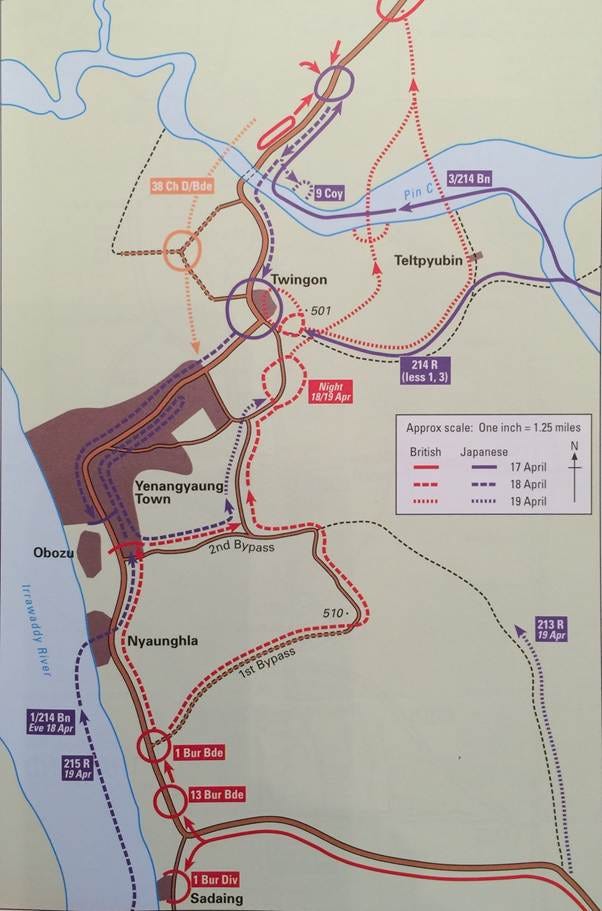
… the Yenangyaung battle is a fascinating one, with its own small degree of controversy, I decided to lay it out in this post. A mystery of the battle is the differing accounts of the Chinese attacks on the 19th April. In the British accounts (including Bill Slim’s in Defeat into Victory) the Chinese are blamed for failing to attack in the morning as they had promised, adding further jeopardy to the fate of the encircled 1st Burma Division. But was this true? The Japanese, Chinese and American accounts differ, so I thought I’d lay out the story to allow you, dear reader, to come to your own conclusion.
The fabulous map of Yenangyaung produced by the late Ian Lyall Grant.
The scrap at Yenangyaung was the final Corps-sized battle before the order to evacuate Burma Corps was given in early May. The Japanese had pushed out of Rangoon in mid-March, driving up the Irrawaddy on the left and against Toungoo on the right. Allied plans for the defence of Burma were inadequate, both Chinese (on the right) and Slim’s Burcorps (on the left) effectively fighting separate battles. Attempts by General Harold Alexander, the Army Commander, to control the battle and constrain the advancing Japanese ultimately came to naught. Alexander, Slim and Lieutenant General Joe Stilwell, nominally commanding the Chinese 5th Army, tried every trick in the tactical rule book to bring a halt to the relentless Japanese advance, and to destroy them in battle. After a month of fighting in which the Chinese were pushed out of Toungoo, the British lost control of Prome and an attempt to consolidate a defensive line across the country failed, the Japanese moved up the Irrawaddy in an attempt to turn the British flank, breaking in at the oilfield town of Yenangyaung on 17 April. At the time Slim’s Burma Corps was attempting to withdraw to the north from Allamyo. The Japanese infiltration into Yenangyaung cut the British in half. The 1st Burma Division was now cut off in Yenangyaung. The battle by the already weakened division (amounting to probably no more than 4,000 troops) into the Yenangyaung pocket over the period 17 and 19 April proved to be the severest trial yet faced by British troops in the short Burma campaign, the pressure applied by the Japanese exacerbated by the intense heat and the lack of water.
It was critical that Slim defeated this Japanese infiltration, rescue the 1st Burma Division from encirclement and retain the integrity of his Corps. If Yenangyaung were lost the Japanese would be free to sweep north to threaten Mandalay. It was crucial therefore that the divisional commander – Major General Bruce Scott – held on for as long as he could. But Slim had no reserve. The only hope of relief lay in assistance from the Chinese far to his right. He concluded that if he could engineer a attack into the pocket by the Chinese, across the Pin Chaung, combined with a breakout attack by 1st Burma Division, they might have a chance of escape. Nothing else looked likely to succeed.
When asked, Stilwell agreed to Alexander’s request for help to be provided to Slim, and gave him Lieutenant General Sun Lijen’s 38th Division – responsible for the defence of Mandalay – for the task. Chiang Kai-shek had given Sun responsibility for defending Mandalay. At midnight on 16 April Sun received an order from General Lo Cho-yin, “to dispatch his 113th Regiment to Kyaukpadaung, there to be commanded by the British General Slim …” Sun’s friend, Dr Ho Yungchi, recorded that by 3 a.m. he had arrived at Lo’s HQ at Pyawbe to discuss the order. Lo explained that the British were in serious trouble “in the oil town of Yenangyaung and had sent repeated requests for help”. By 6.30 a.m. it was agreed that Sun would personally take command of the 113th Regiment, while the two remaining regiments stayed to defend Mandalay. Sun and 1,121 men of 113th Regiment (commanded by Colonel Liu Fang-wu) arrived at Kyaukpadaung on the morning of 17 April.
Slim recalled: “The situation was not encouraging, and I was greatly relieved to hear that 113 Regiment of the Chinese 38th Division was just arriving at Kyaukpadaung. I dashed off in my jeep to meet their commander and give him his orders … this was the first time I had had Chinese troops under me … I got to like all, or almost all, my Chinese very much. They are a likeable people and as soldiers they have in a high degree the fighting man’s basic qualities – courage, endurance, cheerfulness, and an eye for country.”1
At Yenangyaung, Slim’s plan was for Sun’s 38th Division to attack from the north on the morning of 18th April while the 1st Burma Division, within the pocket, fought its way out. As Slim and Sun Lijen talked, discussing the details of the attack planned for the following morning Slim decided that he would place the Stuart tanks of the 7th Armoured Brigade directly under Sun’s command. It was only a move a man confident in the capabilities of his allies could make. Slim commented that “I was impressed by Sun and it was essential to gain his confidence. His division had no artillery or tanks of its own, and I was therefore arranging that all the artillery we had this side of the Pin Chaung and all available tanks should support his attack.” The commander of the British armoured brigade – Brigadier John Anstice – accepted this arrangement and according to Slim “he and Sun got on famously together”. What’s more, the soldiers worked well together too, Slim recording that the “gunners and tank crews, as is the way of British soldiers, soon got on good terms with their new comrades, and, in spite of language difficulties of an extreme kind, co-operation was, I was assured by both sides, not only close but mostly friendly.”2 Accordingly, at 6.15 a.m. on 18 April, Major Mark Rudkin of 2nd Royal Tank Regiment (2RTR) reported as instructed by Anstice to 38th Division HQ:
There was little activity except for the cooking of breakfast and it seemed most unlikely that the attack could start on time. I asked the British liaison officer with the Chinese what was happening and he informed me that as the Chinese realized that they would not be ready to attack at 0630 hours, they had put their watches back one hour, so that officially they were still attacking at 0630 though the time would in reality be 0730. They had, therefore, not lost “face” by being late.
The plan was that a troop of tanks would follow the leading troops of the leading Chinese battalion and give what support it could. Another troop was to follow the leading infantry battalion and assist the leading troop if required. The tanks would be almost entirely road bound owing to the going off the road.
At 0730 the assaulting Chinese moved forward off the ridge on a front of about four hundred yards, the leading troop keeping very close behind on the road. On foot near the tanks was a Chinese interpreter who carried out liaison between the tanks and infantry.
After advancing about half a mile the leading tank was hit by a Japanese 75-mm gun situated on the road just north of the Pin Chaung which was firing straight up 300 yards of road. The tank was disabled but there were no casualties.
The Chinese advance continued and by afternoon had almost reached the line of the ford on the Pin Chaung which was still held by the enemy. The Chinese had had heavy casualties, especially amongst officers, as it was the custom for Chinese officers to lead, whatever their rank. It was finally decided to hold positions about half a mile north of the crossing and continue the attack next day.3
With the first attack a failure, the Japanese retained their grip on both the ford and the village of Twingon. The situation for the surrounded remnants of the 1st Burma Division was desperate; the Japanese close to achieving a complete victory. Slim and Sun then worked through a plan for another attempt to be made the following morning, 19th April. This day also began badly, however. The Chinese attack was scheduled to begin at 7 a.m. British accounts subsequently recorded that a Chinese attack did not materialise at this time. Slim subsequently recorded in Defeat into Victory that the failure to attack must have been a function of the administrative difficulties faced by the Chinese. He wrote that with the Chinese “lack of signalling equipment, of means of evacuating wounded and of replenishing ammunition, and their paucity of trained junior leaders it was not surprising that to sort themselves out, reform, and start a fresh attack took time”.4 Slim was invariably impressed with what he saw of the Chinese soldier in action, but considered their support and command functions to be shockingly poor and a source of constant frustration to themselves, and to all who had occasion to operate with them.
Slim, and most other British published accounts, including the Indian and British Official Histories, record that the attack finally went in at 3 p.m., when Colonel Liu’s 113th Regiment successfully captured the ford and penetrated into Yenangyaung.5 “When the Chinese did attack they went in splendidly” wrote Slim in admiration. “They were thrilled at the tank and artillery support they were getting and showed real dash. They took Twingon, rescuing some two hundred of our prisoners and wounded. Next day, 20th April, the 38th Division attacked again and with tanks penetrated into Yenangyaung itself, repulsing a Japanese counter-attack. The fighting was severe and the Chinese acquitted themselves well, inflicting heavy losses, vouched for by our own officers.”
1. Slim, Defeat into Victory (1956), p. 63.
2. Ibid., p. 65.
3. Bryan Perrett, Tank Tracks to Rangoon: The Story of British Armour in Burma (London: Robert Hale, 1978)
4. Slim, op. cit., p. 70.
5. Bisheshwar Prasad (ed,) The Retreat from Burma 1941 – 42 (Calcutta, Combined Inter-Service Historical Section, 1954), p. 296.